

SIST EN 60684-3-228:2005
(Main)Flexible insulating sleeving -- Part 3: Specifications for individual types of sleeving -- Sheet 228: Heat-shrinkable, semi-rigid polyvinylidene fluoride sleeving, flame retarded, fluid resistant, shrink ratio 2:1
- Abstract
Gives the requirements for one type of heat-shrinkable, flame retarded, with a nominal shrink ratio 2:1, fluid resistant polyvinylidene fluoride sleeving for use at temperatures up to 175 C. This sleeving is normally supplied with an internal diameter up to 25,4 mm, and the standard colour is transparent. Sizes or colours other than those specifically listed in this standard may be available as custom items. These items are considered to comply with this standard if they comply with the property requirements listed in Tables 2, 3, 4 and 5, with the exception of dimensions and mass. Materials which conform to this specification meet established levels of performance. However, the selection of a material by a user for a specific application should be based on the actual requirements necessary for adequate performance in that application and not based on this specification alone. This edition includes the following significant technical change with regard to the previous edition: Replacement of the thermal endurance test method according to EN 60216 with a long term ageing test, i.e. 3 000 h at the recommended maximum temperature found suitable for use,in order to provide safe thermal test data within a workable time scale.
- Status
- Published
- Publication Date
- 31-Dec-2004
- Technical Committee
- IZO - Insulating materials
- Current Stage
- 6060 - National Implementation/Publication (Adopted Project)
- Start Date
- 01-Jan-2005
- Due Date
- 01-Jan-2005
- Completion Date
- 01-Jan-2005

SIST EN 60684-3-228:2005 is the Slovenian adoption of EN 60684-3-228:2004, based on IEC 60684-3-228:2004. It specifies one type of heat-shrinkable, semi-rigid polyvinylidene fluoride sleeving that is flame retarded, fluid resistant, and intended for use at temperatures up to 175 °C. The standard is used when sleeving must be selected, identified, tested, or approved for electrical insulation in demanding environments.
What does SIST EN 60684-3-228:2005 specify?
SIST EN 60684-3-228:2005 specifies the requirements for a single sleeving type within the IEC 60684 series. It covers the product’s size range, colour, designation, test conditioning, performance requirements, and conformance basis.
The scope states that the sleeving is normally supplied with an internal diameter up to 25,4 mm and that the standard colour is transparent. Custom sizes or colours may also be used if they meet the property requirements in Tables 2, 3, 4 and 5, except for dimensions and mass.
The document is organized into:
- Scope
- Normative references
- Designation
- Conditions of test
- Requirements
- Sleeving conformance
Its technical requirements are carried in Tables 1 to 5, and Annex ZA gives the normative references to other publications.
What are the key requirements of SIST EN 60684-3-228:2005?
The main practical requirement is that the sleeving must meet the property limits in Tables 1 to 5 in addition to the general requirements of IEC 60684-1. For buyers and engineers, that means the document is not just about material description - it also sets the testable properties that define acceptance.
Identification and test preparation
Clause 3 defines the designation format, including the IEC reference, sheet number, size, and colour. Colour abbreviations must follow IEC 60757, and where no abbreviation is given, the colour is written in full. Clause 4 requires pre-conditioning by shrinking the sleeving in a forced-air oven for 5 ± 1 min at 200 °C ± 5 K unless another method is specified.
Size, geometry, and conformance basis
Table 1 gives the dimensional and mass limits for the standard sizes, including expanded and recovered internal diameter, recovered wall thickness, and mass per unit length. Clause 6 says conformance is normally based on the 12,7/6,4 mm transparent size, while colour fastness to light must be determined for all colours. In practice, this tells a laboratory which specimen is the default compliance sample.
Mechanical, electrical, and environmental performance
Table 2 covers the key performance checks: tensile strength, elongation at break, longitudinal change, low-temperature bending, dimensional stability during storage, secant modulus, breakdown voltage, volume resistivity, flame propagation, transparency, copper corrosion, colour fastness to light, resistance to selected fluids, heat ageing, water absorption, and long-term ageing. These are the properties that matter when the sleeving has to survive installation, heat, fluids, handling, and service exposure.
Breakdown voltage and fluid resistance
Table 3 sets the breakdown voltage by recovered wall thickness, and the voltage must be applied at 500 V/s. Table 4 lists the selected fluids and immersion temperatures used for fluid-resistance testing, and it also allows additional fluids or temperatures by agreement between supplier and customer. That matters when the sleeving will be used near fuels, oils, hydraulic fluids, cleaning fluids, or de-icing fluids.
Long-term ageing and shelf life
Table 2 replaces the earlier thermal endurance approach with a long-term ageing test at 175 °C ± 3 K, using elongation at break as the failure criterion. Table 5 adds fungus resistance and shelf life, with shelf life checked over 60 months at ambient temperature and interim measurements every 12 months.
What terms does SIST EN 60684-3-228:2005 define?
TT means transparent sleeving, and it is the colour designation used in the product identification.
Heat-shrinkable means the sleeving is supplied in an expanded state and shrinks to fit when heated.
Semi-rigid means the sleeving is not fully rigid, but it has enough stiffness to hold shape and withstand handling.
Concentricity is the measure of how evenly the wall is distributed around the circumference of the sleeving.
Breakdown voltage is the electrical voltage at which the sleeving fails insulation testing.
Long-term ageing is the extended heat test used to judge whether elongation at break remains acceptable after prolonged exposure.
Who uses SIST EN 60684-3-228:2005?
This standard is used by sleeving manufacturers, electrical equipment assemblers, test laboratories, quality managers, and purchasing teams. They use it to specify product size and colour, run acceptance tests, compare suppliers, and check suitability for applications involving heat, fluids, flame retardance, and electrical insulation.
It is also relevant to approval authorities and customers who need documented evidence that a sleeving material meets a defined performance level.
What changed in SIST EN 60684-3-228:2005 from the previous edition?
This second edition supersedes the 1998 edition.
The significant technical change is the replacement of the thermal endurance test method according to EN 60216 with a long-term ageing test, using 3 000 h at the recommended maximum temperature found suitable for use. The reason stated is to provide safe thermal test data within a workable time scale.
Which standards are used with SIST EN 60684-3-228:2005?
- IEC 60684-1:2003 - gives the definitions and general requirements for flexible insulating sleeving.
- IEC 60684-2:1997, Amendment 1:2003 - provides the test methods used throughout this sheet.
- IEC 60757:1983 - provides the code for colour designation.
- ISO 846:1997 - provides the fungus resistance test method used in Table 5.
- ISO 1817:1999 - provides the liquid-exposure reference used for fluid-resistance testing.
What does the SIST EN 60684-3-228:2005 document contain?
The document contains the product designation rule, a test-conditioning clause, and five tables that define the size and performance limits. Table 1 gives the dimensional and mass requirements, Table 2 gives the main property requirements, Table 3 gives breakdown voltage, Table 4 lists the selected fluids and temperatures, and Table 5 adds fungus resistance and shelf-life requirements.
It also includes Annex ZA, which links the cited international publications to their European equivalents. For users, this means the standard is not only a product description - it is also a test and acceptance document for specification, quality control, and conformity assessment.
Relations
- Effective Date
- 29-Jan-2023
- Effective Date
- 09-Feb-2026
- Effective Date
- 03-Feb-2026
- Effective Date
- 03-Feb-2026
- Refers
SIST EN 60684-1:2004 - Flexible insulating sleeving -- Part 1: Definitions and general requirements - Effective Date
- 03-Feb-2026
- Effective Date
- 03-Feb-2026
- Referred By
SIST EN IEC 60684-2:2025 - Flexible insulating sleeving - Part 2: Methods of test (IEC 60684-2:2025) - Effective Date
- 03-Feb-2026
- Effective Date
- 03-Feb-2026
- Effective Date
- 13-May-2010
Get Certified
Connect with accredited certification bodies for this standard

IMQ S.p.A. (Certification)
Italian electrical product certification.

SLG Prüf- und Zertifizierungs GmbH
German testing and certification body.

UL Solutions
Global safety science company with testing, inspection and certification.
Sponsored listings
Frequently Asked Questions
SIST EN 60684-3-228:2005 is a standard published by the Slovenian Institute for Standardization (SIST). Its full title is "Flexible insulating sleeving -- Part 3: Specifications for individual types of sleeving -- Sheet 228: Heat-shrinkable, semi-rigid polyvinylidene fluoride sleeving, flame retarded, fluid resistant, shrink ratio 2:1". This standard covers: Gives the requirements for one type of heat-shrinkable, flame retarded, with a nominal shrink ratio 2:1, fluid resistant polyvinylidene fluoride sleeving for use at temperatures up to 175 C. This sleeving is normally supplied with an internal diameter up to 25,4 mm, and the standard colour is transparent. Sizes or colours other than those specifically listed in this standard may be available as custom items. These items are considered to comply with this standard if they comply with the property requirements listed in Tables 2, 3, 4 and 5, with the exception of dimensions and mass. Materials which conform to this specification meet established levels of performance. However, the selection of a material by a user for a specific application should be based on the actual requirements necessary for adequate performance in that application and not based on this specification alone. This edition includes the following significant technical change with regard to the previous edition: Replacement of the thermal endurance test method according to EN 60216 with a long term ageing test, i.e. 3 000 h at the recommended maximum temperature found suitable for use,in order to provide safe thermal test data within a workable time scale.
Gives the requirements for one type of heat-shrinkable, flame retarded, with a nominal shrink ratio 2:1, fluid resistant polyvinylidene fluoride sleeving for use at temperatures up to 175 C. This sleeving is normally supplied with an internal diameter up to 25,4 mm, and the standard colour is transparent. Sizes or colours other than those specifically listed in this standard may be available as custom items. These items are considered to comply with this standard if they comply with the property requirements listed in Tables 2, 3, 4 and 5, with the exception of dimensions and mass. Materials which conform to this specification meet established levels of performance. However, the selection of a material by a user for a specific application should be based on the actual requirements necessary for adequate performance in that application and not based on this specification alone. This edition includes the following significant technical change with regard to the previous edition: Replacement of the thermal endurance test method according to EN 60216 with a long term ageing test, i.e. 3 000 h at the recommended maximum temperature found suitable for use,in order to provide safe thermal test data within a workable time scale.
SIST EN 60684-3-228:2005 is classified under the following ICS (International Classification for Standards) categories: 29.035.20 - Plastics and rubber insulating materials. The ICS classification helps identify the subject area and facilitates finding related standards.
SIST EN 60684-3-228:2005 has the following relationships with other standards: It is inter standard links to SIST EN 60684-3-228:2001, SIST EN ISO 846:1999, SIST EN 60684-2:1998/A1:2004, SIST EN 60684-2:1998, SIST EN 60684-1:2004, SIST HD 457 S1:2003, SIST EN IEC 60684-2:2025, SIST EN 60684-2:2011, SIST EN 60684-3-228:2001. Understanding these relationships helps ensure you are using the most current and applicable version of the standard.
SIST EN 60684-3-228:2005 is available in PDF format for immediate download after purchase. The document can be added to your cart and obtained through the secure checkout process. Digital delivery ensures instant access to the complete standard document.
Standards Content (Sample)
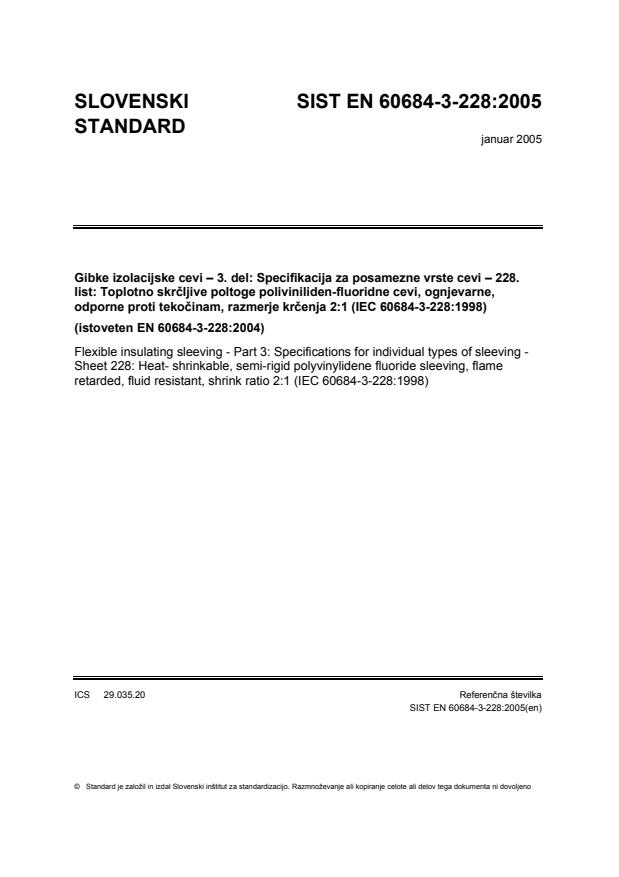
SLOVENSKI SIST EN 60684-3-228:2005
STANDARD
januar 2005
Gibke izolacijske cevi – 3. del: Specifikacija za posamezne vrste cevi – 228.
list: Toplotno skrčljive poltoge poliviniliden-fluoridne cevi, ognjevarne,
odporne proti tekočinam, razmerje krčenja 2:1 (IEC 60684-3-228:1998)
(istoveten EN 60684-3-228:2004)
Flexible insulating sleeving - Part 3: Specifications for individual types of sleeving -
Sheet 228: Heat- shrinkable, semi-rigid polyvinylidene fluoride sleeving, flame
retarded, fluid resistant, shrink ratio 2:1 (IEC 60684-3-228:1998)
ICS 29.035.20 Referenčna številka
© Standard je založil in izdal Slovenski inštitut za standardizacijo. Razmnoževanje ali kopiranje celote ali delov tega dokumenta ni dovoljeno
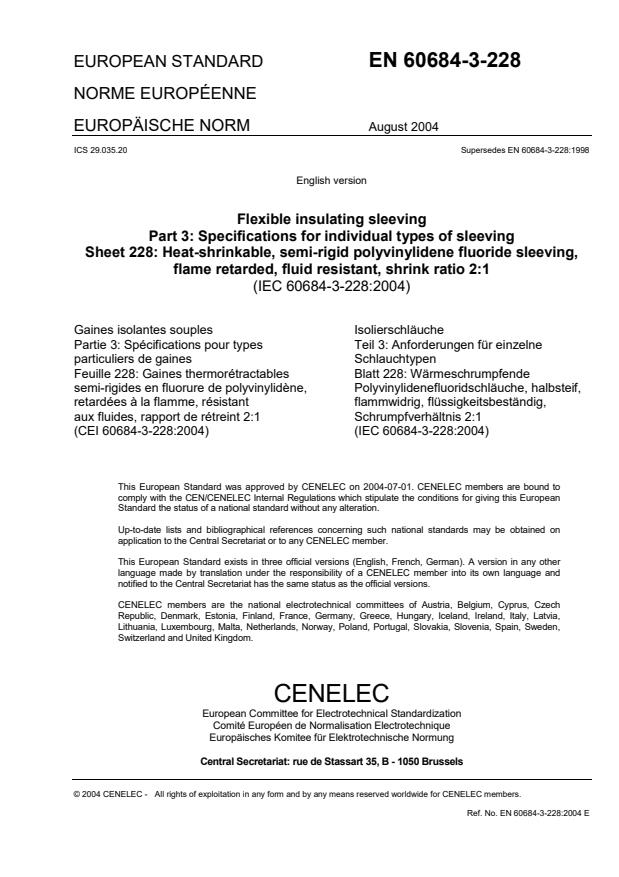
EUROPEAN STANDARD EN 60684-3-228
NORME EUROPÉENNE
EUROPÄISCHE NORM August 2004
ICS 29.035.20 Supersedes EN 60684-3-228:1998
English version
Flexible insulating sleeving
Part 3: Specifications for individual types of sleeving
Sheet 228: Heat-shrinkable, semi-rigid polyvinylidene fluoride sleeving,
flame retarded, fluid resistant, shrink ratio 2:1
(IEC 60684-3-228:2004)
Gaines isolantes souples Isolierschläuche
Partie 3: Spécifications pour types Teil 3: Anforderungen für einzelne
particuliers de gaines Schlauchtypen
Feuille 228: Gaines thermorétractables Blatt 228: Wärmeschrumpfende
semi-rigides en fluorure de polyvinylidène, Polyvinylidenefluoridschläuche, halbsteif,
retardées à la flamme, résistant flammwidrig, flüssigkeitsbeständig,
aux fluides, rapport de rétreint 2:1 Schrumpfverhältnis 2:1
(CEI 60684-3-228:2004) (IEC 60684-3-228:2004)
This European Standard was approved by CENELEC on 2004-07-01. CENELEC members are bound to
comply with the CEN/CENELEC Internal Regulations which stipulate the conditions for giving this European
Standard the status of a national standard without any alteration.
Up-to-date lists and bibliographical references concerning such national standards may be obtained on
application to the Central Secretariat or to any CENELEC member.
This European Standard exists in three official versions (English, French, German). A version in any other
language made by translation under the responsibility of a CENELEC member into its own language and
notified to the Central Secretariat has the same status as the official versions.
CENELEC members are the national electrotechnical committees of Austria, Belgium, Cyprus, Czech
Republic, Denmark, Estonia, Finland, France, Germany, Greece, Hungary, Iceland, Ireland, Italy, Latvia,
Lithuania, Luxembourg, Malta, Netherlands, Norway, Poland, Portugal, Slovakia, Slovenia, Spain, Sweden,
Switzerland and United Kingdom.
CENELEC
European Committee for Electrotechnical Standardization
Comité Européen de Normalisation Electrotechnique
Europäisches Komitee für Elektrotechnische Normung
Central Secretariat: rue de Stassart 35, B - 1050 Brussels
© 2004 CENELEC - All rights of exploitation in any form and by any means reserved worldwide for CENELEC members.
Ref. No. EN 60684-3-228:2004 E
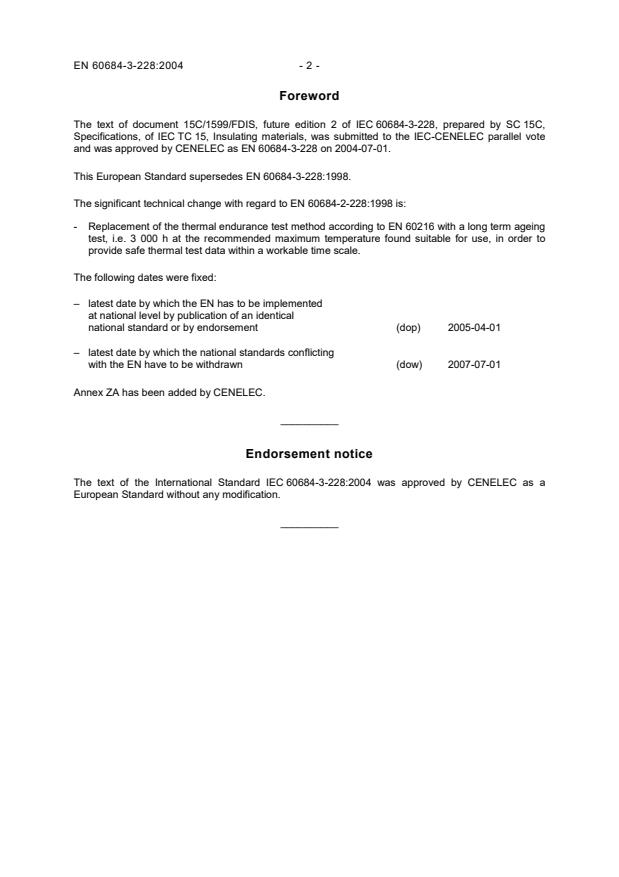
Foreword
The text of document 15C/1599/FDIS, future edition 2 of IEC 60684-3-228, prepared by SC 15C,
Specifications, of IEC TC 15, Insulating materials, was submitted to the IEC-CENELEC parallel vote
and was approved by CENELEC as EN 60684-3-228 on 2004-07-01.
This European Standard supersedes EN 60684-3-228:1998.
The significant technical change with regard to EN 60684-2-228:1998 is:
- Replacement of the thermal endurance test method according to EN 60216 with a long term ageing
test, i.e. 3 000 h at the recommended maximum temperature found suitable for use, in order to
provide safe thermal test data within a workable time scale.
The following dates were fixed:
– latest date by which the EN has to be implemented
at national level by publication of an identical
national standard or by endorsement (dop) 2005-04-01
– latest date by which the national standards conflicting
with the EN have to be withdrawn (dow) 2007-07-01
Annex ZA has been added by CENELEC.
__________
Endorsement notice
The text of the International Standard IEC 60684-3-228:2004 was approved by CENELEC as a
European Standard without any modification.
__________
- 3 - EN 60684-3-228:2004
Annex ZA
(normative)
Normative references to international publications
with their corresponding European publications
The following referenced documents are indispensable for the application of this document. For dated
references, only the edition cited applies. For undated references, the latest edition of the referenced
document (including any amendments) applies.
NOTE Where an international publication has been modified by common modifications, indicated by (mod), the relevant
EN/HD applies.
Publication Year Title EN/HD Year
IEC 60684-1 2003 Flexible insulating sleeving EN 60684-1 2003
Part 1: Definitions and general
requirements
IEC 60684-2 1997 Part 2: Methods of test EN 60684-2 1997
A1 2003 A1 2003
IEC 60757 1983 Code for designation of colours HD 457 S1 1985
ISO 846 1997 Plastics - Evaluation of the action of EN ISO 846 1997
micro-organisms
ISO 1817 1999 Rubber, vulcanized - Determination of the - -
effect of liquids
NORME CEI
INTERNATIONALE
IEC
60684-3-228
INTERNATIONAL
Deuxième édition
STANDARD
Second edition
2004-05
Gaines isolantes souples –
Partie 3:
Spécifications pour types particuliers de gaines –
Feuille 228: Gaines thermorétractables semi-
rigides en fluorure de polyvinylidène,
retardées à la flamme, résistant aux fluides,
rapport de rétreint 2:1
Flexible insulating sleeving –
Part 3:
Specifications for individual types of sleeving –
Sheet 228: Heat-shrinkable, semi-rigid
polyvinylidene fluoride sleeving,
flame retarded, fluid resistant, shrink ratio 2:1
IEC 2004 Droits de reproduction réservés Copyright - all rights reserved
Aucune partie de cette publication ne peut être reproduite ni No part of this publication may be reproduced or utilized in any
utilisée sous quelque forme que ce soit et par aucun procédé, form or by any means, electronic or mechanical, including
électronique ou mécanique, y compris la photocopie et les photocopying and microfilm, without permission in writing from
microfilms, sans l'accord écrit de l'éditeur. the publisher.
International Electrotechnical Commission, 3, rue de Varembé, PO Box 131, CH-1211 Geneva 20, Switzerland
Telephone: +41 22 919 02 11 Telefax: +41 22 919 03 00 E-mail: inmail@iec.ch Web: www.iec.ch
CODE PRIX
J
PRICE CODE
Commission Electrotechnique Internationale
International Electrotechnical Commission
МеждународнаяЭлектротехническаяКомиссия
Pour prix, voir catalogue en vigueur
For price, see current catalogue
60684-3-228 IEC:2004 – 3 –
INTERNATIONAL ELECTROTECHNICAL COMMISSION
___________
FLEXIBLE INSULATING SLEEVING –
Part 3: Specifications for individual types of sleeving –
Sheet 228: Heat-shrinkable, semi-rigid polyvinylidene fluoride sleeving,
flame retarded, fluid resistant, shrink ratio 2:1
FOREWORD
1) The International Electrotechnical Commission (IEC) is a worldwide organization for standardization comprising
all national electrotechnical committees (IEC National Committees). The object of IEC is to promote
international co-operation on all questions concerning standardization in the electrical and electronic fields. To
this end and in addition to other activities, IEC publishes International Standards, Technical Specifications,
Technical Reports, Publicly Available Specifications (PAS) and Guides (hereafter referred to as “IEC
Publication(s)”). Their preparation is entrusted to technical committees; any IEC National Committee interested
in the subject dealt with may participate in this preparatory work. International, governmental and non-
governmental organizations liaising with the IEC also participate in this preparation. IEC collaborates closely
with the International Organization for Standardization (ISO) in accordance with conditions determined by
agreement between the two organizations.
2) The formal decisions or agreements of IEC on technical matters express, as nearly as possible, an international
consensus of opinion on the relevant subjects since each technical committee has representation from all
interested IEC National Committees.
3) IEC Publications have the form of recommendations for international use and are accepted by IEC National
Committees in that sense. While all reasonable efforts are made to ensure that the technical content of IEC
Publications is accurate, IEC cannot be held responsible for the way in which they are used or for any
misinterpretation by any end user.
4) In order to promote international uniformity, IEC National Committees undertake to apply IEC Publications
transparently to the maximum extent possible in their national and regional publications. Any divergence
between any IEC Publication and the corresponding national or regional publication shall be clearly indicated in
the latter.
5) IEC provides no marking procedure to indicate its approval and cannot be rendered responsible for any
equipment declared to be in conformity with an IEC Publication.
6) All users should ensure that they have the latest edition of this publication.
7) No liability shall attach to IEC or its directors, employees, servants or agents including individual experts and
members of its technical committees and IEC National Committees for any personal injury, property damage or
other damage of any nature whatsoever, whether direct or indirect, or for costs (including legal fees) and
expenses arising out of the publication, use of, or reliance upon, this IEC Publication or any other IEC
Publications.
8) Attention is drawn to the Normative references cited in this publication. Use of the referenced publications is
indispensable for the correct application of this publication.
9) Attention is drawn to the possibility that some of the elements of this IEC Publication may be the subject of
patent rights. IEC shall not be held responsible for identifying any or all such patent rights.
International Standard IEC 60684-3-228 has been prepared by subcommittee 15C:
Specificatio
...