


oSIST prEN 12390-20:2025
(Main)Testing hardened concrete - Part 20: Determination of porosity
Testing hardened concrete - Part 20: Determination of porosity
This document describes the method for the determination of the open porosity (open pores) of hardened concrete on test specimens manufactured from moulded or cored specimens.
The test is suitable for specimens having a declared value of D of the coarsest fraction of aggregates used in concrete (Dmax) not greater than 40 mm.
The test method is not applicable for concrete containing lightweight aggregate.
Prüfung von Festbeton - Teil 20: Bestimmung der Porosität
Dieses Dokument beschreibt das Verfahren für die Bestimmung der Porosität (offene Poren) von Festbeton an Probekörpern aller Arten (in Formen hergestellt, gesägt, durch Kernbohren entnommen) oder Formen.
Die Prüfung ist geeignet für Probekörper mit einem Nennwert D des Größtkorns der tatsächlich im Beton verwendeten Gesteinskörnung (Dmax) von höchstens 40 mm.
Auf Beton, der leichte Gesteinskörnung enthält, ist dieses Prüfverfahren nicht anwendbar.
Essais pour béton durci - Partie 20 : Détermination de la porosité
Le présent document décrit la méthode de détermination de la porosité (pores ouverts) du béton durci sur des éprouvettes de tout type (moulées, sciées, carottées) ou de toute forme.
L’essai est adapté aux éprouvettes ayant une valeur déclarée D de la partie la plus grosse des granulats réellement utilisés dans le béton (Dmax) ne dépassant pas 40 mm.
La méthode d’essai ne s’applique pas au béton contenant du granulat léger.
Preskušanje strjenega betona - 20. del: - Določanje poroznosti
General Information
- Status
- Not Published
- Public Enquiry End Date
- 24-Apr-2025
- Technical Committee
- BBB - Concrete, reinforced concrete and prestressed concrete
- Current Stage
- 4020 - Public enquire (PE) (Adopted Project)
- Start Date
- 27-Feb-2025
- Due Date
- 17-Jul-2025
- Completion Date
- 04-Aug-2025
Overview
oSIST prEN 12390-20:2025:2025 is a European standard developed by CEN/TC 104 that specifies a test method for determining the porosity of hardened concrete. This method is applicable to test specimens of any type-moulded, sawn, or cored-and any shape. It focuses on measuring open pore porosity, which represents the volume of pores accessible to water. The standard is suitable for concrete specimens with a maximum aggregate size (Dmax) up to 40 mm and excludes concrete containing lightweight aggregates.
Porosity is a critical parameter influencing concrete durability, strength, and permeability, making this standard vital for quality control and structural integrity assessments within the construction industry.
Key Topics
Scope and Applicability
- Measurement of open pores in hardened concrete, excluding lightweight aggregate concretes
- Suitable for various specimen shapes and types (moulded, sawn, cored)
- Applicable to coarse aggregates with Dmax ≤ 40 mm
Test Principle
The method measures the mass of saturated concrete specimens in water (Mw), mass in air of saturated specimens (Mair), and dry mass (Mdry). Using these values, porosity is calculated as the ratio of pore volume to the apparent volume of the specimen.Required Apparatus
- Ventilated oven controlled at 105 ± 5 °C
- High-precision balance with 0.05% uncertainty
- Vacuum system capable of achieving pressure ≤ 25 mbar to saturate specimens
- Water tank maintaining constant water level and temperature at 20 ± 2 °C
- Calliper and rules permitting measurement precision to 0.5%
Specimen Preparation and Storage
- Specimens must be at least 28 days old and cured under standard conditions as per EN 12390-2
- Minimum three specimens per test ideally taken from different locations or parts of the sample
- Dimensions must conform to criteria for minimum size and volume relative to aggregate size
Testing Procedure
- Vacuum saturation for 4 hours followed by immersion under vacuum for 44 hours
- Weighing specimen in water and air immediately after saturation
- Oven drying specimens until mass stabilization to determine dry weight
Result Expression and Precision
- Porosity (%) is calculated for each specimen and averaged across the set
- Precision requirements specify that results with a range greater than 2 percentage points require further evaluation
- Test report must comprehensively document specimen details, curing, masses, calculated porosity, and any deviations from the standard
Applications
oSIST prEN 12390-20:2025 provides concrete testing laboratories, researchers, and construction professionals with a standardized method to assess the durability and quality of hardened concrete through porosity measurement. Key applications include:
Quality Control in Construction Projects
Assurance that concrete meets design specifications concerning permeability and durability.Research and Development
Evaluating new concrete mixes, additives, and curing processes to optimize pore structure and performance.Structural Health Monitoring
Monitoring porosity changes over time to predict degradation and guide maintenance planning.Regulatory Compliance
Supporting adherence to construction codes and standards regarding concrete performance and safety.
Related Standards
oSIST prEN 12390-20:2025 is part of the EN 12390 series, which covers testing methods for hardened concrete, including but not limited to:
- EN 12390-1: Shape, dimensions, and requirements for concrete test specimens
- EN 12390-2: Making and curing specimens for strength tests
- EN 12390-7: Density of hardened concrete
- EN 12390-8: Depth of water penetration under pressure
- EN 12504-1: Taking and testing cored concrete specimens
- Additional parts addressing compressive strength, tensile strength, carbonation resistance, chloride migration, and resistivity testing
By integrating results from these standards, professionals can gain a comprehensive understanding of concrete quality and durability for various construction applications.
Keywords: oSIST prEN 12390-20:2025, hardened concrete testing, porosity determination, concrete open pores, concrete quality control, vacuum saturation method, concrete porosity standard, concrete specimens testing, CEN concrete standards, concrete durability assessment

Get Certified
Connect with accredited certification bodies for this standard

ICC Evaluation Service
Building products evaluation and certification.

QAI Laboratories
Building and construction product testing and certification.

Aboma Certification B.V.
Specialized in construction, metal, and transport sectors.
Sponsored listings
Frequently Asked Questions
oSIST prEN 12390-20:2025 is a draft published by the Slovenian Institute for Standardization (SIST). Its full title is "Testing hardened concrete - Part 20: Determination of porosity". This standard covers: This document describes the method for the determination of the open porosity (open pores) of hardened concrete on test specimens manufactured from moulded or cored specimens. The test is suitable for specimens having a declared value of D of the coarsest fraction of aggregates used in concrete (Dmax) not greater than 40 mm. The test method is not applicable for concrete containing lightweight aggregate.
This document describes the method for the determination of the open porosity (open pores) of hardened concrete on test specimens manufactured from moulded or cored specimens. The test is suitable for specimens having a declared value of D of the coarsest fraction of aggregates used in concrete (Dmax) not greater than 40 mm. The test method is not applicable for concrete containing lightweight aggregate.
oSIST prEN 12390-20:2025 is classified under the following ICS (International Classification for Standards) categories: 91.100.30 - Concrete and concrete products. The ICS classification helps identify the subject area and facilitates finding related standards.
oSIST prEN 12390-20:2025 is available in PDF format for immediate download after purchase. The document can be added to your cart and obtained through the secure checkout process. Digital delivery ensures instant access to the complete standard document.
Standards Content (Sample)
SLOVENSKI STANDARD
01-april-2025
Preskušanje strjenega betona - 20. del: - Določanje poroznosti
Testing hardened concrete - Part 20: Determination of porosity
Prüfung von Festbeton - Teil 20: Bestimmung der Porosität
Essais pour béton durci - Partie 20 : Détermination de la porosité
Ta slovenski standard je istoveten z: prEN 12390-20
ICS:
91.100.30 Beton in betonski izdelki Concrete and concrete
products
2003-01.Slovenski inštitut za standardizacijo. Razmnoževanje celote ali delov tega standarda ni dovoljeno.
DRAFT
EUROPEAN STANDARD
prEN 12390-20
NORME EUROPÉENNE
EUROPÄISCHE NORM
February 2025
ICS 91.100.30
English Version
Testing hardened concrete - Part 20: Determination of
porosity
Essais pour béton durci - Partie 20 : Détermination de Prüfung von Festbeton - Teil 20: Bestimmung der
la porosité Porosität
This draft European Standard is submitted to CEN members for enquiry. It has been drawn up by the Technical Committee
CEN/TC 104.
If this draft becomes a European Standard, CEN members are bound to comply with the CEN/CENELEC Internal Regulations
which stipulate the conditions for giving this European Standard the status of a national standard without any alteration.
This draft European Standard was established by CEN in three official versions (English, French, German). A version in any other
language made by translation under the responsibility of a CEN member into its own language and notified to the CEN-CENELEC
Management Centre has the same status as the official versions.
CEN members are the national standards bodies of Austria, Belgium, Bulgaria, Croatia, Cyprus, Czech Republic, Denmark, Estonia,
Finland, France, Germany, Greece, Hungary, Iceland, Ireland, Italy, Latvia, Lithuania, Luxembourg, Malta, Netherlands, Norway,
Poland, Portugal, Republic of North Macedonia, Romania, Serbia, Slovakia, Slovenia, Spain, Sweden, Switzerland, Türkiye and
United Kingdom.
Recipients of this draft are invited to submit, with their comments, notification of any relevant patent rights of which they are
aware and to provide supporting documentation.
Warning : This document is not a European Standard. It is distributed for review and comments. It is subject to change without
notice and shall not be referred to as a European Standard.
EUROPEAN COMMITTEE FOR STANDARDIZATION
COMITÉ EUROPÉEN DE NORMALISATION
EUROPÄISCHES KOMITEE FÜR NORMUNG
CEN-CENELEC Management Centre: Rue de la Science 23, B-1040 Brussels
© 2025 CEN All rights of exploitation in any form and by any means reserved Ref. No. prEN 12390-20:2025 E
worldwide for CEN national Members.
prEN 12390-20:2025 (E)
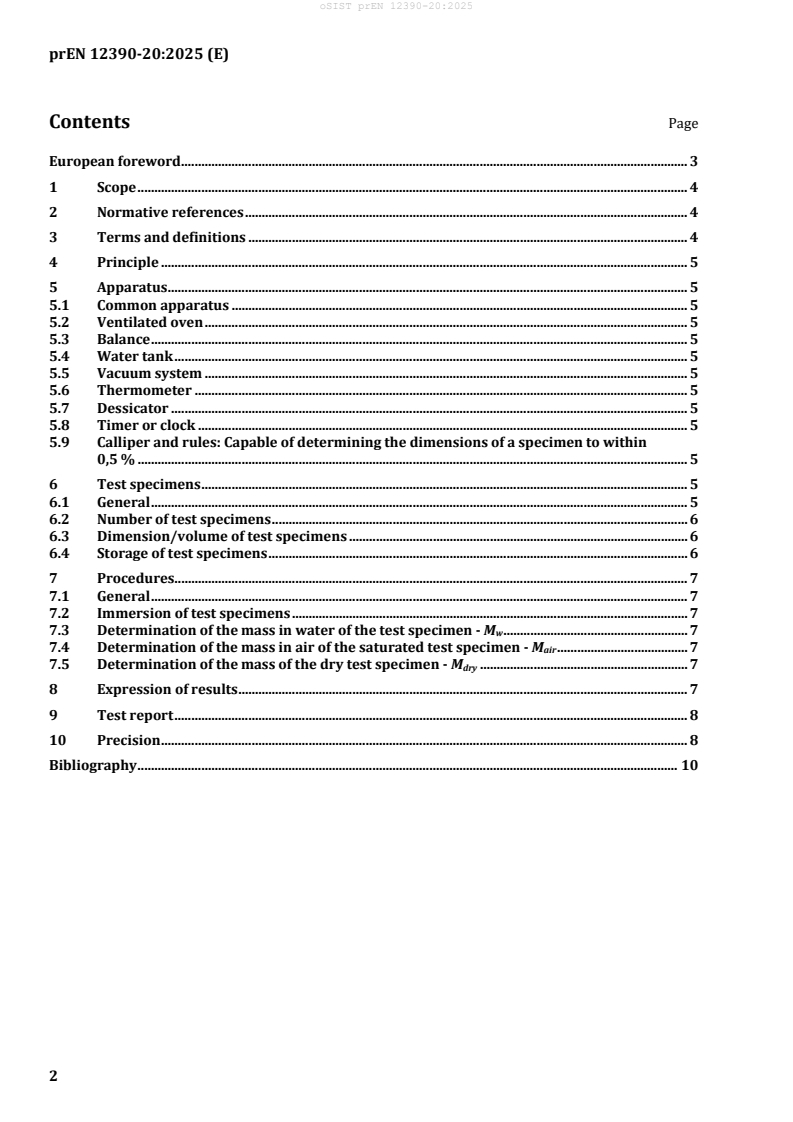
Contents Page
European foreword . 3
1 Scope . 4
2 Normative references . 4
3 Terms and definitions . 4
4 Principle . 5
5 Apparatus . 5
5.1 Common apparatus . 5
5.2 Ventilated oven . 5
5.3 Balance . 5
5.4 Water tank . 5
5.5 Vacuum system . 5
5.6 Thermometer . 5
5.7 Dessicator . 5
5.8 Timer or clock . 5
5.9 Calliper and rules: Capable of determining the dimensions of a specimen to within
0,5 % . 5
6 Test specimens . 5
6.1 General . 5
6.2 Number of test specimens . 6
6.3 Dimension/volume of test specimens . 6
6.4 Storage of test specimens . 6
7 Procedures. 7
7.1 General . 7
7.2 Immersion of test specimens . 7
7.3 Determination of the mass in water of the test specimen - M . 7
w
7.4 Determination of the mass in air of the saturated test specimen - M . 7
air
7.5 Determination of the mass of the dry test specimen - M . 7
dry
8 Expression of results . 7
9 Test report . 8
10 Precision . 8
Bibliography . 10
prEN 12390-20:2025 (E)
European foreword
This document (prEN 12390-20:2025) has been prepared by Technical Committee CEN/TC 104
“Concrete and related products”, the secretariat of which is held by SN.
This document is currently submitted to the CEN Enquiry.
It is based on the French Standard NF P 18-459 “Concrete — Testing hardened concrete — Testing
porosity and density”.
This document is one of a series on testing concrete.
EN 12390, Testing hardened concrete, consists of the following parts:
— Part 1: Shape, dimensions and other requirements for specimens and moulds
— Part 2: Making and curing specimens for strength tests
— Part 3: Compressive strength of test specimens
— Part 4: Compressive strength – Specification for testing machines
— Part 5: Flexural strength of test specimens
— Part 6: Tensile splitting strength of test specimens
— Part 7: Density of hardened concrete
— Part 8: Depth of penetration of water under pressure
— Part 10: Determination of the carbonation resistance of concrete at atmospheric levels of carbon dioxide
— Part 11: Determination of the chloride resistance of concrete, unidirectional diffusion
— Part 12: Determination of the potential carbonation resistance of concrete: Accelerated carbonation
method;
— Part 13: Determination of secant modulus of elasticity in compression;
— Part 14: Semi-adiabatic method for the determination of heat released by concrete during its hardening
process;
— Part 15: Adiabatic method for the determination of heat released by concrete during its hardening
process;
— Part 16: Determination of shrinkage of concrete;
— Part 17: Determination of creep of concrete in compression;
— Part 18: Determination of the chloride migration coefficient;
— Part19: Determination of resistivity;
prEN 12390-20:2025 (E)
1 Scope
This document describes the method for the determination of the porosity (open pores) of hardened
concrete on test specimens of any type (moulded, sawn, cored) or any shape.
The test is suitable for specimens having a declared value of D of the coarsest fraction of aggregates
actually used in the concrete (D ) not greater than 40
...
Questions, Comments and Discussion
Ask us and Technical Secretary will try to provide an answer. You can facilitate discussion about the standard in here.
Loading comments...