

SIST EN IEC 61400-1:2019/A1:2026
(Amendment)Wind energy generation systems - Part 1: Design requirements (IEC 61400-1:2019/AMD1:2025)
General Information
- Abstract
- Status
- Published
- Public Enquiry End Date
- 25-Jan-2024
- Publication Date
- 12-Mar-2026
- Technical Committee
- IEHT - Electrotechnics - Hydraulic turbins
- Current Stage
- 6060 - National Implementation/Publication (Adopted Project)
- Start Date
- 23-Feb-2026
- Due Date
- 30-Apr-2026
- Completion Date
- 13-Mar-2026
Overview
SIST EN IEC 61400-1:2019/A1:2026 is an essential amendment to the internationally recognized standard for wind energy generation systems, focusing particularly on design requirements. Developed by CENELEC (CLC) and aligned with IEC 61400-1:2019/AMD1:2025, this standard establishes a comprehensive set of requirements for the design and structural verification of onshore and offshore wind turbines. The objective is to ensure safety, efficiency, durability, and performance of wind energy systems under a variety of operational and environmental conditions.
Implemented across Europe, SIST EN IEC 61400-1:2019/A1:2026 forms the basis for national adoption and harmonization in the wind turbine industry. It is crucial for manufacturers, designers, operators, and regulatory bodies concerned with wind turbine safety and conformance.
Key Topics
- Design requirements for wind turbines: Covers key criteria to meet structural integrity and safety, including considerations for both onshore and offshore installations.
- Serviceability and limit states: The standard details how serviceability must be maintained under operational and environmental loads, defining various limit states such as S1, S2, and S3.
- Load assessment and comparisons: Provides methods for evaluating load cases via simulations and site-specific data, ensuring suitability and safety based on specific environmental conditions.
- Wind conditions and turbulence modeling: Explains how to assess wind regimes using normal and extreme wind models, and how turbulence affects turbine reliability and fatigue.
- Safety factors and component classification: Allocates partial safety factors based on component classes, with guidance on handling failures and protection measures.
- Electromagnetic compatibility (EMC): Sets requirements to ensure wind turbines and their components are immune to electromagnetic interference and limit emissions as per relevant EMC standards.
- Special considerations: Includes additional design load cases for scenarios such as ice formation, seismic activity, complex terrains, and other site-specific phenomena.
- Reference to national and international standards: Cross-references IEC 61400 series parts, including those on tower and foundation design and fixed offshore turbine requirements.
Applications
SIST EN IEC 61400-1:2019/A1:2026 is broadly applicable throughout the wind energy industry for:
- Wind turbine manufacturers: As a primary reference for designing safe, reliable, and compliant wind turbine systems.
- Project developers and site assessors: For evaluating wind resource, site suitability, and ensuring conformity of turbines to local conditions and regulations.
- Certification and conformity assessment bodies: Used as the basis for certifying wind turbine designs and installations against recognized international criteria.
- Engineering consultants: For technical analysis, validation of structural calculations, and risk assessment during project planning and operation.
- Regulatory agencies: To enforce safety and performance regulations for wind energy infrastructure.
Complying with this standard ensures that wind turbines are built to withstand site-specific and design-based loads, meet performance expectations, and maintain operational safety and serviceability over their planned lifetime.
Related Standards
SIST EN IEC 61400-1:2019/A1:2026 references and works in conjunction with several key standards, including:
- IEC 61400-3-1: Design requirements for fixed offshore wind turbines
- IEC 61400-6: Tower and foundation design requirements
- IEC 61000-6-2 and IEC 61000-6-4: EMC immunity and emission requirements
- CISPR 11:2024: Limits for radiated emission
- Additional guidance: DNV-RP-0585 for seismic design, and forthcoming parts such as IEC 61400-40 for advanced EMC requirements
By integrating the provisions of SIST EN IEC 61400-1:2019/A1:2026 with its referenced standards, stakeholders can ensure best practices in wind turbine design, operational safety, and regulatory compliance in the rapidly evolving renewable energy sector.
Keywords: wind turbine standard, wind turbine design requirements, wind energy generation system, EN IEC 61400-1, wind turbine safety, wind farm design compliance, turbine structural integrity, wind resource assessment, CENELEC standards, IEC 61400 series.
Relations
- Effective Date
- 03-Feb-2026
- Effective Date
- 03-Feb-2026
- Effective Date
- 03-Feb-2026
- Effective Date
- 01-Apr-2026
Get Certified
Connect with accredited certification bodies for this standard

DNV
DNV is an independent assurance and risk management provider.

Lloyd's Register
Lloyd's Register is a global professional services organisation specialising in engineering and technology.
DNV Energy Systems
Energy and renewable energy certification.
Sponsored listings
Frequently Asked Questions
SIST EN IEC 61400-1:2019/A1:2026 is a amendment published by the Slovenian Institute for Standardization (SIST). Its full title is "Wind energy generation systems - Part 1: Design requirements (IEC 61400-1:2019/AMD1:2025)". This standard covers: Wind energy generation systems - Part 1: Design requirements (IEC 61400-1:2019/AMD1:2025)
Wind energy generation systems - Part 1: Design requirements (IEC 61400-1:2019/AMD1:2025)
SIST EN IEC 61400-1:2019/A1:2026 is classified under the following ICS (International Classification for Standards) categories: 27.180 - Wind turbine energy systems. The ICS classification helps identify the subject area and facilitates finding related standards.
SIST EN IEC 61400-1:2019/A1:2026 has the following relationships with other standards: It is inter standard links to SIST EN IEC 61400-6:2020, SIST EN IEC 61400-3-1:2019, SIST EN IEC 61400-6:2020/A1:2025, SIST EN IEC 61400-1:2019. Understanding these relationships helps ensure you are using the most current and applicable version of the standard.
SIST EN IEC 61400-1:2019/A1:2026 is associated with the following European legislation: Standardization Mandates: M/617. When a standard is cited in the Official Journal of the European Union, products manufactured in conformity with it benefit from a presumption of conformity with the essential requirements of the corresponding EU directive or regulation.
SIST EN IEC 61400-1:2019/A1:2026 is available in PDF format for immediate download after purchase. The document can be added to your cart and obtained through the secure checkout process. Digital delivery ensures instant access to the complete standard document.
Standards Content (Sample)
SLOVENSKI STANDARD
01-april-2026
Sistemi za proizvodnjo energije na veter - 1. del: Zahteve za načrtovanje -
Dopolnilo A1 (IEC 61400-1:2019/AMD1:2025)
Wind energy generation systems - Part 1: Design requirements (IEC 61400-
1:2019/AMD1:2025)
Windenergieanlagen - Teil 1: Auslegungsanforderungen (IEC 61400-1:2019/AMD1:2025)
Systèmes de génération d'énergie éolienne - Partie 1: Exigences de conception (IEC
61400-1:2019/AMD1:2025)
Ta slovenski standard je istoveten z: EN IEC 61400-1:2019/A1:2026
ICS:
27.180 Vetrne elektrarne Wind turbine energy systems
2003-01.Slovenski inštitut za standardizacijo. Razmnoževanje celote ali delov tega standarda ni dovoljeno.
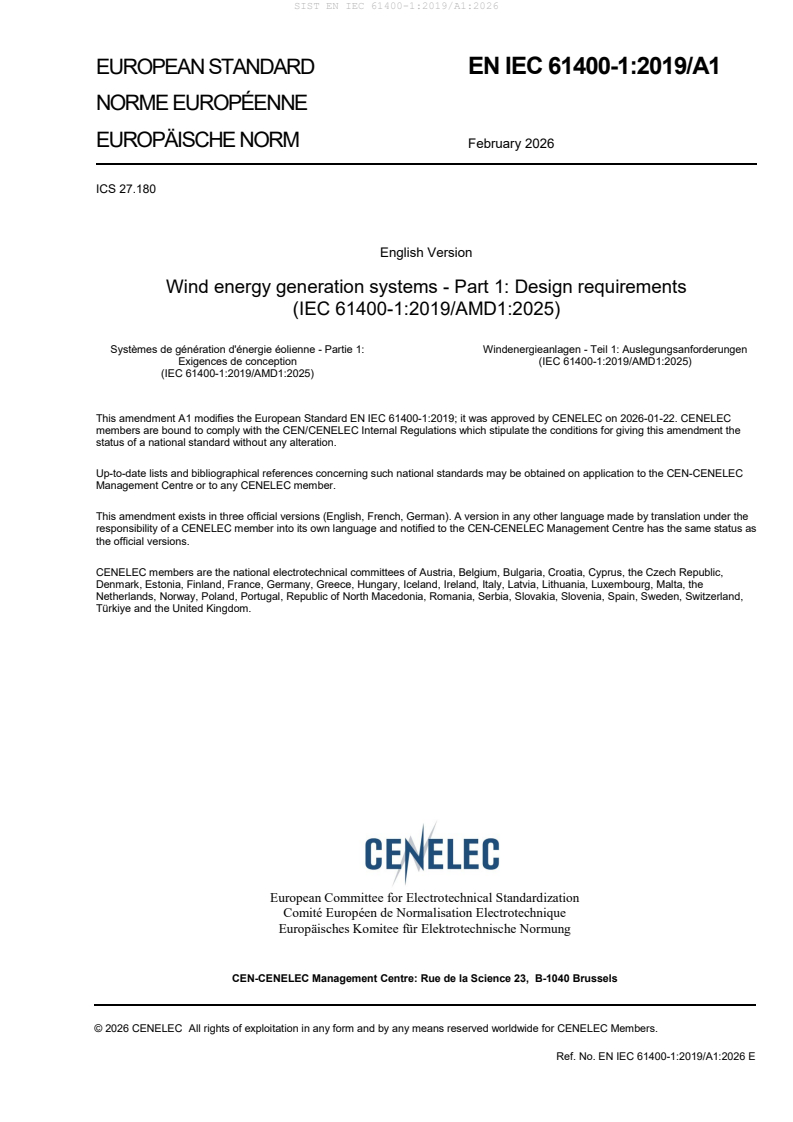
EUROPEAN STANDARD EN IEC 61400-1:2019/A1
NORME EUROPÉENNE
EUROPÄISCHE NORM February 2026
ICS 27.180
English Version
Wind energy generation systems - Part 1: Design requirements
(IEC 61400-1:2019/AMD1:2025)
Systèmes de génération d'énergie éolienne - Partie 1: Windenergieanlagen - Teil 1: Auslegungsanforderungen
Exigences de conception (IEC 61400-1:2019/AMD1:2025)
(IEC 61400-1:2019/AMD1:2025)
This amendment A1 modifies the European Standard EN IEC 61400-1:2019; it was approved by CENELEC on 2026-01-22. CENELEC
members are bound to comply with the CEN/CENELEC Internal Regulations which stipulate the conditions for giving this amendment the
status of a national standard without any alteration.
Up-to-date lists and bibliographical references concerning such national standards may be obtained on application to the CEN-CENELEC
Management Centre or to any CENELEC member.
This amendment exists in three official versions (English, French, German). A version in any other language made by translation under the
responsibility of a CENELEC member into its own language and notified to the CEN-CENELEC Management Centre has the same status as
the official versions.
CENELEC members are the national electrotechnical committees of Austria, Belgium, Bulgaria, Croatia, Cyprus, the Czech Republic,
Denmark, Estonia, Finland, France, Germany, Greece, Hungary, Iceland, Ireland, Italy, Latvia, Lithuania, Luxembourg, Malta, the
Netherlands, Norway, Poland, Portugal, Republic of North Macedonia, Romania, Serbia, Slovakia, Slovenia, Spain, Sweden, Switzerland,
Türkiye and the United Kingdom.
European Committee for Electrotechnical Standardization
Comité Européen de Normalisation Electrotechnique
Europäisches Komitee für Elektrotechnische Normung
CEN-CENELEC Management Centre: Rue de la Science 23, B-1040 Brussels
© 2026 CENELEC All rights of exploitation in any form and by any means reserved worldwide for CENELEC Members.
Ref. No. EN IEC 61400-1:2019/A1:2026 E
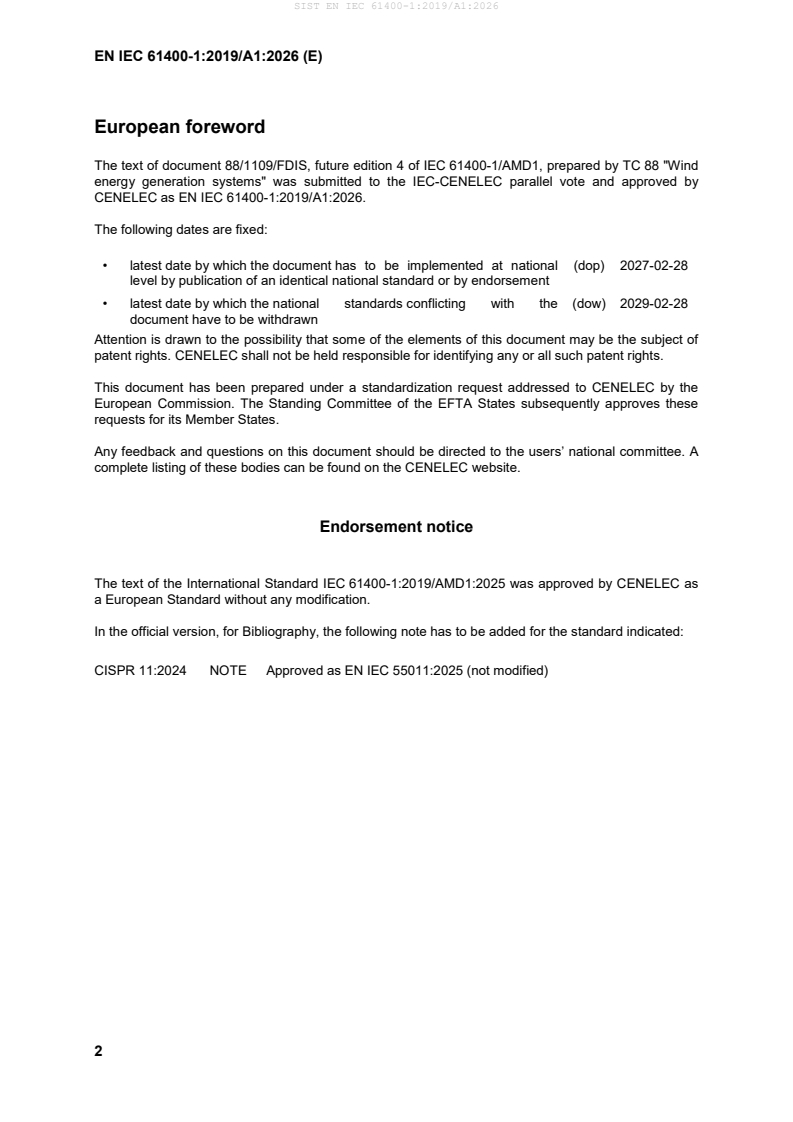
European foreword
The text of document 88/1109/FDIS, future edition 4 of IEC 61400-1/AMD1, prepared by TC 88 "Wind
energy generation systems" was submitted to the IEC-CENELEC parallel vote and approved by
CENELEC as EN IEC 61400-1:2019/A1:2026.
The following dates are fixed:
• latest date by which the document has to be implemented at national (dop) 2027-02-28
level by publication of an identical national standard or by endorsement
• latest date by which the national standards conflicting with the (dow) 2029-02-28
document have to be withdrawn
Attention is drawn to the possibility that some of the elements of this document may be the subject of
patent rights. CENELEC shall not be held responsible for identifying any or all such patent rights.
This document has been prepared under a standardization request addressed to CENELEC by the
European Commission. The Standing Committee of the EFTA States subsequently approves these
requests for its Member States.
Any feedback and questions on this document should be directed to the users’ national committee. A
complete listing of these bodies can be found on the CENELEC website.
Endorsement notice
The text of the International Standard IEC 61400-1:2019/AMD1:2025 was approved by CENELEC as
a European Standard without any modification.
In the official version, for Bibliography, the following note has to be added for the standard indicated:
CISPR 11:2024 NOTE Approved as EN IEC 55011:2025 (not modified)
Annex ZA
(normative)
Normative references to international publications
with their corresponding European publications
The following documents are referred to in the text in such a way that some or all of their content
constitutes requirements of this document. For dated references, only the edition cited applies. For
undated references, the latest edition of the referenced document (including any amendments)
applies.
NOTE 1 Where an International Publication has been modified by common modifications, indicated by (mod),
the relevant EN/HD applies.
NOTE 2 Up-to-date information on the latest versions of the European Standards listed in this annex is available
here: www.cencenelec.eu.
Delete:
Publication Year Title EN/HD Year
IEC 61400-3 - Wind turbines - Part 3: Design - -
requirements for offshore wind turbines
Add:
Publication Year Title EN/HD Year
IEC 61400-3-1 - Wind energy generation systems - Part 3- EN IEC 61400-3-1 -
1: Design requirements for fixed offshore
wind turbines
IEC 61400-6 - Wind energy generation systems - Part 6: EN IEC 61400-6 -
Tower and foundation design requirements
IEC 61400-1 ®
Edition 4.0 2025-12
INTERNATIONAL
STANDARD
AMENDMENT 1
Wind energy generation systems -
Part 1: Design requirements
ICS 27.180 ISBN 978-2-8327-0831-6
IEC 61400-1:2019-02/AMD1:2025-12(en)
IEC 61400-1:2019/AMD1:2025 © IEC 2025
INTERNATIONAL ELECTROTECHNICAL COMMISSION
____________
Wind energy generation systems -
Part 1: Design requirements
AMENDMENT 1
FOREWORD
1) The International Electrotechnical Commission (IEC) is a worldwide organization for standardization comprising
all national electrotechnical committees (IEC National Committees). The object of IEC is to promote international
co-operation on all questions concerning standardization in the electrical and electronic fields. To this end and
in addition to other activities, IEC publishes International Standards, Technical Specifications, Technical Reports,
Publicly Available Specifications (PAS) and Guides (hereafter referred to as "IEC Publication(s)"). Their
preparation is entrusted to technical committees; any IEC National Committee interested in the subject dealt with
may participate in this preparatory work. International, governmental and non-governmental organizations liaising
with the IEC also participate in this preparation. IEC collaborates closely with the International Organization for
Standardization (ISO) in accordance with conditions determined by agreement between the two organizations.
2) The formal decisions or agreements of IEC on technical matters express, as nearly as possible, an international
consensus of opinion on the relevant subjects since each technical committee has representation from all
interested IEC National Committees.
3) IEC Publications have the form of recommendations for international use and are accepted by IEC National
Committees in that sense. While all reasonable efforts are made to ensure that the technical content of IEC
Publications is accurate, IEC cannot be held responsible for the way in which they are used or for any
misinterpretation by any end user.
4) In order to promote international uniformity, IEC National Committees undertake to apply IEC Publications
transparently to the maximum extent possible in their national and regional publications. Any divergence between
any IEC Publication and the corresponding national or regional publication shall be clearly indicated in the latter.
5) IEC itself does not provide any attestation of conformity. Independent certification bodies provide conformity
assessment services and, in some areas, access to IEC marks of conformity. IEC is not responsible for any
services carried out by independent certification bodies.
6) All users should ensure that they have the latest edition of this publication.
7) No liability shall attach to IEC or its directors, employees, servants or agents including individual experts and
members of its technical committees and IEC National Committees for any personal injury, property damage or
other damage of any nature whatsoever, whether direct or indirect, or for costs (including legal fees) and
expenses arising out of the publication, use of, or reliance upon, this IEC Publication or any other IEC
Publications.
8) Attention is drawn to the Normative references cited in this publication. Use of the referenced publications is
indispensable for the correct application of this publication.
9) IEC draws attention to the possibility that the implementation of this document may involve the use of (a)
patent(s). IEC takes no position concerning the evidence, validity or applicability of any claimed patent rights in
respect thereof. As of the date of publication of this document, IEC had not received notice of (a) patent(s), which
may be required to implement this document. However, implementers are cautioned that this may not represent
the latest information, which may be obtained from the patent database available at https://patents.iec.ch. IEC
shall not be held responsible for identifying any or all such patent rights.
Amendment 1 to IEC 61400-1:2019 has been prepared by IEC technical committee 88: Wind
energy generation systems.
The text of this Amendment is based on the following documents:
Draft Report on voting
88/1109/FDIS 88/1133/RVD
Full information on the voting for its approval can be found in the report on voting indicated in
the above table.
The language used for the development of this Amendment is English.
IEC 61400-1:2019/AMD1:2025 © IEC 2025
This document was drafted in accordance with ISO/IEC Directives, Part 2, and developed in
accordance with ISO/IEC Directives, Part 1 and ISO/IEC Directives, IEC Supplement, available
at www.iec.ch/members_experts/refdocs. The main document types developed by IEC are
described in greater detail at www.iec.ch/publications/.
The committee has decided that the contents of this document will remain unchanged until the
stability date indicated on the IEC website under webstore.iec.ch in the data related to the
specific document. At this date, the document will be
– reconfirmed,
– withdrawn, or
– revised.
___________
2 Normative references
Delete:
IEC 61400-3, Wind energy generation systems - Part 3: Design requirements for offshore wind
turbines
Add the following new references:
IEC 61400-3-1, Wind energy generation systems - Part 3-1: Design requirements for offshore
wind turbines
IEC 61400-6, Wind energy generation systems - Part 6: Tower and foundation design
requirements
3 Terms and definitions
Add, after 3.77, the following new definitions:
3.78
damage equivalent load
constant amplitude cyclic load, S derived from the load spectrum and a given S-N curve
eq
exponent that results in an equivalent fatigue damage for a given reference number of load
cycles, N , as the real load spectrum under the assumption that the damage can be determined
ref
on basis of the load cycles from a linear S-N curve with a given negative inverse slope, m
Note 1 to entry: Let the discrete load spectrum be specified by the number of cycles n for the load S , i = 1,2, .,
i i
n . Then the equivalent load can be calculated from the equation
s
1/m
n
s m
nS
∑ ii
i=1
S = (40)
eq
N
ref
3.79
reference loads, pl.
loads that had been utilised for detailed structural verification of the wind turbine components
IEC 61400-1:2019/AMD1:2025 © IEC 2025
3.80
serviceability
ability of a structure or structural element to perform adequately for normal use under all
expected actions
3.81
serviceability limit state
state which corresponds to conditions beyond which specified service requirements for a
structure or structural element are no longer met
3.82
S1
serviceability limit state load level for design lifetime actions, which relate to continued correct
operation of the wind turbine
3.83
S2
-4
serviceability limit state load level for frequent actions, which are exceeded for 10 of the
lifetime
3.84
S3
serviceability limit state load level for the equivalent to frequent actions, which are exceeded
-2
for 10 of the lifetime
4 Symbols and abbreviated terms
4.1 Symbols
Add the following symbol to the list:
φ angle between a horizontal plane and the wind velocity vector at hub height. The flow
inclination angle is positive if the wind velocity vector is pointing upwards.
4.2 Abbreviated terms
Add the following abbreviated terms to the list:
EM electromagnetic
EMC electromagnetic compatibility
LDD load duration distribution
LRD load revolution distribution
NTM90 normal turbulence model, 90 % percentile value of distribution
6.2 Wind turbine class
Replace the second paragraph with the following new text:
Class T assumes all wind model parameters to be the same and allows the combination of V
ref,T
with all turbulence categories. It does not cover all the areas prone to tropical cyclones. The
evaluation of the 1-year return period extreme wind speed should be done independently of the
50-year return period extreme wind speed. A site assessment based on Clause 11 is needed,
as a minimum assessing that V is below V of class T ( V ), and that V is below the value
50 ref ref,T 1
of the chosen class I, II or III.
IEC 61400-1:2019/AMD1:2025 © IEC 2025
6.3 Wind conditions
6.3.1 General
Replace the third and fourth paragraphs with the following new text:
The wind regime for load and safety considerations is divided into the normal wind conditions,
which will occur frequently during normal operation of a wind turbine, and the extreme wind
conditions that are defined as having a 1-year or 50-year return period .
The wind conditions include a constant mean flow combined, in many cases, with either a
varying deterministic gust profile or with turbulence. In all cases, an upwards inclination of the
mean flow with respect to a horizontal plane of 8° shall be considered. This flow inclination
angle shall be assumed to be invariant with height.
6.3.2.3 Normal turbulence model (NTM)
Replace the first paragraph, including Equation (10), with the following new text and equations:
For the normal turbulence model, the turbulence standard deviation, σ , shall be defined for the
standard wind turbine classes based on the Weibull distribution in Equation (41) for the given
hub height wind speed.
The Weibull distribution for σ shall either be applied as a distribution with scale and shape
parameters as in Equation (43) or by the 90 % quantile value in Equation (44) :
k
σ
P (σσ<=) 1− exp−
(41)
W 10
C
where
kV0,27 s/m+1,4
( ) (42)
hub
CI 0,75V+ 3,3 m / s
( ) (43)
ref hub
σI 0,75V+b b 5,6 m / s
( ) (44)
1 ref hub
6.3.3.2 Extreme wind speed model (EWM)
Add, after the third paragraph, the following new text:
For site guidance 11.9.3 shall be used instead of Equation (13).
___________
The return period of the extreme event is independent of the design lifetime of the turbine as the largest value
for the normal failure probability is given for a single year (see Annex K, Clause K.2).
The choice of NTM model affects the level of reliability against fatigue failure. Using the Weibull distribution is
more robust for inclusion of non-linear effects, but the resulting fatigue loads have no bias and therefore result
in a lower reliability level in most cases compared to using the 90 % quantile value.
= =
=
=
IEC 61400-1:2019/AMD1:2025 © IEC 2025
Replace footnote 3 with the following:
The turbulence standard deviation for the turbulent extreme wind model is not related to the normal (NTM) or the
extreme turbulence model (ETM).
7.4.1 General
Add, after the fifth paragraph, the following new text:
Serviceability limit states (SLS) consider the function of the structure or one of its components
under normal service conditions or the appearance of the structure.
Serviceability limit states should be verified with serviceability load levels S1, S2 or S3 as
required in the relevant IEC 61400 standard or technical specification.
For serviceability limit state analyses, S1 is derived from load simulations from the ultimate limit
states classified as N (normal) and for S2 and S3 the same load simulations are used as those
used as basis for the fatigue limit state. The partial safety factor for loads shall be:
γ = 1,0
f (45)
Table 2 – Design load cases (DLC)
Add the following to the key to the table:
"F/U" Fatigue as well as ultimate loads including the relevant safety factors */N or */A.
7.4.7 Parked (standstill or idling) (DLC 6.1 to 6.4)
Delete the fifth paragraph starting with "The partial safety factors for loads".
7.6.1.3 Partial safety factor for consequence of failure and component classes
Delete in the first paragraph, item a), "structural" between "fail-safe" and "components" and
add, after "for example"," secondary components and".
Delete, in the first paragraph, item b), "structural" between "safe-life" and "components".
Replace, in the first paragraph, item c), the first sentence with the following new text:
c) component class 3: used for "safe-life" components whose failure can lead to human
injuries, e.g. mechanical components that link actuators and brakes to main structural
components for the purpose of implementing non-redundant wind turbine protection
functions.
IEC 61400-1:2019/AMD1:2025 © IEC 2025
Add, before the last paragraph, the following new text:
For component class 3, if the characteristic value of the load response F due to gravity
gravity
can be calculated for the design situation in question, and gravity is an unfavourable load, the
consequences of the failure factor for combined loading from gravity and other sources can
have the value
(46)
γζ1,1+ 0,1
n
F
gravity
1−≤for FF
gravity k
F
ζ= k
(47)
0 for FF>
gravity k
where
F is the characteristic load.
k
7.6.2.2 Partial safety factors for loads
Add, after the fourth paragraph starting with "For load cases", the following new text:
When the NTM is represented by a statistical distribution (Equations (41), (42) and (43)), the
characteristic value of the load shall correspond to the same return period of the load as
obtained using the 90 % quantile value NTM90 (Equation (44)) except for DLC 1.1.
7.6.2.4 Partial safety factors for resistances where recognized design codes are not
available
Replace the text of footnote 17 with "Void".
7.6.2.5 Partial safety factors for materials where recognized design codes are available
Replace the existing text with the following new text:
Partial safety factors for resistance, γ , shall be applied as given in the recognized design
M
codes, see 7.6.1.4. Alternatively, 7.6.2.4 can be used. The partial safety factors for the
consequences of failure, γ , shall be applied additionally as specified in 7.6.1.3.
n
7.6.3.4 Partial material factors where recognized design codes are available
Replace the existing text with the following new text:
Partial safety factors for resistance, γ , shall be applied as given in the recognized design
M
codes, see 7.6.1.4. The partial safety factors for the consequences of failure, γ , shall be applied
n
additionally as specified in 7.6.1.3. Alternatively, the provisions from 7.6.3.3 can be used.
Add, after 7.6.6, the following new subclause 7.6.7:
=
IEC 61400-1:2019/AMD1:2025 © IEC 2025
7.6.7 Evaluation of limit state through load comparison
7.6.7.1 General
As a simplified approach, ultimate limit state analysis can be evaluated through a load
comparison with a previously analysed design case. The reference loads shall always serve as
the reference for a load comparison.
This comparison can be used to assess the suitability of an existing structural design for
changed environmental conditions (as per 11.10) or for minor changes in turbine design (e.g.
controller updates or modification in some other turbine components, e.g. tower). In case of a
change of a major component, the rest of the structure can be assessed based on a load
comparison.
The following shall be considered as long as no component specific standards within the
IEC 61400 series specifies otherwise.
For extreme loading, a comparison of contemporaneous loads is not required. All mandatory
load cases shall be considered. The sign of the extreme load shall be considered when relevant.
For fatigue loading, the comparison can be based on DELs
...