


oSIST prEN 12350-13:2025
(Main)Testing fresh concrete - Part 13: Bleeding test - Static and pressure
Testing fresh concrete - Part 13: Bleeding test - Static and pressure
This document specifies the procedures for determining the static and pressure bleed of fresh concrete.
The tests are suitable for specimens having a declared value of the coarsest fraction of aggregates used in concrete (Dmax) not greater than 40 mm. It can be carried out in the laboratory or on site.
Prüfung von Frischbeton - Teil 13: Prüfung des Blutens - Statisch und Druck
Dieses Dokument legt die Vorgehensweisen für die Bestimmung des Blutens von Frischbeton im statischen Zustand und unter Druck fest.
Diese Prüfungen eignen sich für Probekörper mit einem Nennwert des Größtkorns der in Beton verwendeten Gesteinskörnung (Dmax) von höchstens 40 mm. Sie können entweder im Labor oder auf der Baustelle durchgeführt werden.
Essais pour béton frais - Partie 13 : Essai de ressuage - Statique et sous pression
Le présent document spécifie les modes opératoires pour la détermination du ressuage statique et du ressuage sous pression du béton frais.
Les essais sont adaptés aux éprouvettes ayant une valeur déclarée de la partie la plus grosse des granulats réellement utilisés dans le béton (Dmax) ne dépassant pas 40 mm. Ils peuvent être réalisés en laboratoire ou sur site.
Preizkušanje svežega betona - 13. del: Preskus naknadnega izločanja vode - Statika in dodatni tlak
General Information
- Status
- Not Published
- Public Enquiry End Date
- 24-Apr-2025
- Technical Committee
- BBB - Concrete, reinforced concrete and prestressed concrete
- Current Stage
- 4020 - Public enquire (PE) (Adopted Project)
- Start Date
- 27-Feb-2025
- Due Date
- 17-Jul-2025
- Completion Date
- 06-Aug-2025
Relations
- Effective Date
- 28-Jan-2026
Overview
The oSIST prEN 12350-13:2025:2025 standard, developed by CEN, specifies the procedures for conducting bleeding tests on fresh concrete. These tests include both static and pressure bleeding methods, designed to measure the upward flow of water from the concrete mixture after placement. Suitable for concrete with coarse aggregate sizes not exceeding 40 mm, the tests can be carried out either in the laboratory or directly on construction sites. This standard is part 13 of the EN 12350 series that covers various testing methods for fresh concrete quality and properties.
Key Topics
Static Bleeding Test
This test quantifies the release of water naturally rising to the surface of fresh concrete due to the settlement of solid particles.- Measurement involves collecting and recording the volume of bleed water at set intervals.
- Utilizes a watertight cylindrical container following defined dimensions for consistent results.
- Compaction methods vary with the concrete type, including vibration or self-compacting applications.
- Results include bleeding rate (ml/min) and total bleed expressed in mm/m or ml/l.
Pressure Bleeding Test
This test applies a pressure of 1 bar (0.1 MPa) on a concrete specimen placed in a special cell to extract bleed water.- Conducted over a 3-minute period to evaluate the pressure bleed volume.
- Assists in estimating maximum settlement potential in the concrete.
Test Setup and Apparatus
- Containers with smooth, non-absorbent internal surfaces (typically 255 mm diameter × 280 mm height).
- Covers and plastic film to prevent evaporation during testing.
- Equipment includes scales with high precision, pipettes, timers, and thermometers.
- Clear guidelines on sampling per EN 12350-1 to ensure repeatability.
Test Procedures
- Concrete is filled into containers and compacted according to relevant EN standards or left to self-compact.
- Bleed water is collected at intervals-every 10 minutes initially, and less frequently later-until bleeding ceases or final set is reached.
- Test temperature is controlled and reported as it affects bleeding behavior.
- Detailed recording of times, volumes, densities, and environmental conditions is mandatory.
Result Interpretation and Reporting
- Bleeding rate calculated using volume change over time for the initial phase.
- Total bleed calculated relative to specimen volume and density.
- Reports must capture all test conditions, methods, measurements, and any deviations for compliance and traceability.
Applications
- Quality Control of Fresh Concrete
Measuring bleeding ensures consistency in mix design and helps prevent issues such as segregation, excessive porosity, and weak surface layers. - On-Site and Laboratory Testing
The standard’s flexibility allows testing to be performed on-site for immediate feedback or in controlled laboratory conditions for detailed analysis. - Assessment of Concrete Workability and Stability
Determines concrete’s resistance to water separation during placement, which affects durability and surface finish quality. - Support for Structural Integrity
Helps in predicting settlement-related deformation and potential issues in hardened concrete, supporting structural design decisions.
Related Standards
- EN 12350-1: Sampling and Common Apparatus
Defines sampling methods essential to ensure representative concrete specimens for bleeding tests. - EN 12350-2: Slump Test
Measures concrete consistency relevant for interpreting bleeding results. - EN 12350-5: Flow Table Test
Provides flow characteristics of fresh concrete, influencing bleeding behavior. - EN 12350-6: Density of Fresh Concrete
Required for calculating total bleed related to specimen volume. - EN 12350-8: Self-Compacting Concrete - Slump-flow Test
Applicable for specific concrete types where traditional compaction is not performed. - EN 12390-2: Making and Curing Specimens for Strength Tests
Supports preparation consistency in concrete testing related to bleeding assessments.
Keywords: fresh concrete testing, bleeding test, static bleed, pressure bleed, concrete quality control, concrete bleeding rate, concrete settlement, concrete compaction, EN 12350-13, CEN concrete standards, fresh concrete properties.

Get Certified
Connect with accredited certification bodies for this standard

ICC Evaluation Service
Building products evaluation and certification.

QAI Laboratories
Building and construction product testing and certification.

Aboma Certification B.V.
Specialized in construction, metal, and transport sectors.
Sponsored listings
Frequently Asked Questions
oSIST prEN 12350-13:2025 is a draft published by the Slovenian Institute for Standardization (SIST). Its full title is "Testing fresh concrete - Part 13: Bleeding test - Static and pressure". This standard covers: This document specifies the procedures for determining the static and pressure bleed of fresh concrete. The tests are suitable for specimens having a declared value of the coarsest fraction of aggregates used in concrete (Dmax) not greater than 40 mm. It can be carried out in the laboratory or on site.
This document specifies the procedures for determining the static and pressure bleed of fresh concrete. The tests are suitable for specimens having a declared value of the coarsest fraction of aggregates used in concrete (Dmax) not greater than 40 mm. It can be carried out in the laboratory or on site.
oSIST prEN 12350-13:2025 is classified under the following ICS (International Classification for Standards) categories: 91.100.30 - Concrete and concrete products. The ICS classification helps identify the subject area and facilitates finding related standards.
oSIST prEN 12350-13:2025 has the following relationships with other standards: It is inter standard links to SIST EN ISO 12944-5:2020. Understanding these relationships helps ensure you are using the most current and applicable version of the standard.
oSIST prEN 12350-13:2025 is available in PDF format for immediate download after purchase. The document can be added to your cart and obtained through the secure checkout process. Digital delivery ensures instant access to the complete standard document.
Standards Content (Sample)
SLOVENSKI STANDARD
01-april-2025
Preizkušanje svežega betona - 13. del: Preizkus krvavitve - Statika in tlak
Testing fresh concrete - Part 13: Bleeding test - Static and pressure
Prüfung von Frischbeton - Teil 13: Prüfung des Blutens - Statisch und Druck
Essais pour béton frais - Partie 13 : Essai de ressuage - Statique et sous pression
Ta slovenski standard je istoveten z: prEN 12350-13
ICS:
91.100.30 Beton in betonski izdelki Concrete and concrete
products
2003-01.Slovenski inštitut za standardizacijo. Razmnoževanje celote ali delov tega standarda ni dovoljeno.
DRAFT
EUROPEAN STANDARD
prEN 12350-13
NORME EUROPÉENNE
EUROPÄISCHE NORM
February 2025
ICS 91.100.30
English Version
Testing fresh concrete - Part 13: Bleeding test - Static and
pressure
Essais pour béton frais - Partie 13 : Essai de ressuage - Prüfung von Frischbeton - Teil 13: Prüfung des Blutens
Statique et sous pression - Statisch und Druck
This draft European Standard is submitted to CEN members for enquiry. It has been drawn up by the Technical Committee
CEN/TC 104.
If this draft becomes a European Standard, CEN members are bound to comply with the CEN/CENELEC Internal Regulations
which stipulate the conditions for giving this European Standard the status of a national standard without any alteration.
This draft European Standard was established by CEN in three official versions (English, French, German). A version in any other
language made by translation under the responsibility of a CEN member into its own language and notified to the CEN-CENELEC
Management Centre has the same status as the official versions.
CEN members are the national standards bodies of Austria, Belgium, Bulgaria, Croatia, Cyprus, Czech Republic, Denmark, Estonia,
Finland, France, Germany, Greece, Hungary, Iceland, Ireland, Italy, Latvia, Lithuania, Luxembourg, Malta, Netherlands, Norway,
Poland, Portugal, Republic of North Macedonia, Romania, Serbia, Slovakia, Slovenia, Spain, Sweden, Switzerland, Türkiye and
United Kingdom.
Recipients of this draft are invited to submit, with their comments, notification of any relevant patent rights of which they are
aware and to provide supporting documentation.
Warning : This document is not a European Standard. It is distributed for review and comments. It is subject to change without
notice and shall not be referred to as a European Standard.
EUROPEAN COMMITTEE FOR STANDARDIZATION
COMITÉ EUROPÉEN DE NORMALISATION
EUROPÄISCHES KOMITEE FÜR NORMUNG
CEN-CENELEC Management Centre: Rue de la Science 23, B-1040 Brussels
© 2025 CEN All rights of exploitation in any form and by any means reserved Ref. No. prEN 12350-13:2025 E
worldwide for CEN national Members.
prEN 12350-13:2025 (E)
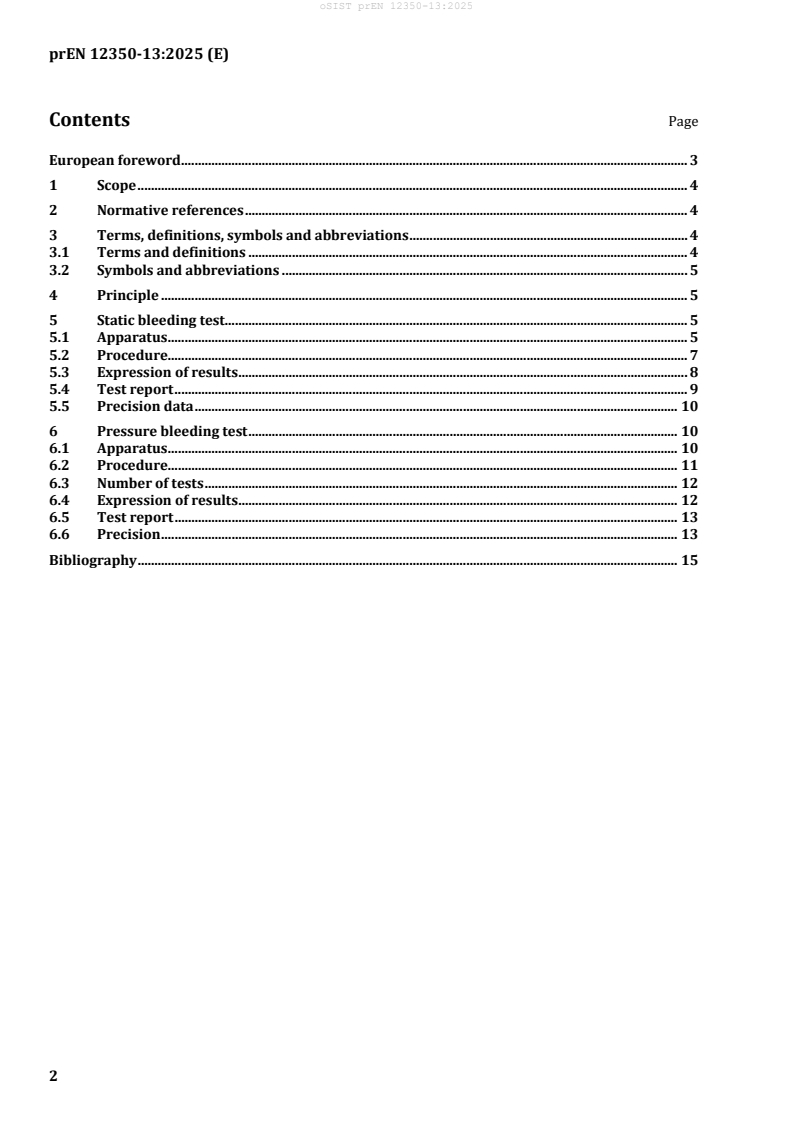
Contents Page
European foreword . 3
1 Scope . 4
2 Normative references . 4
3 Terms, definitions, symbols and abbreviations . 4
3.1 Terms and definitions . 4
3.2 Symbols and abbreviations . 5
4 Principle . 5
5 Static bleeding test . 5
5.1 Apparatus . 5
5.2 Procedure. 7
5.3 Expression of results . 8
5.4 Test report . 9
5.5 Precision data . 10
6 Pressure bleeding test . 10
6.1 Apparatus . 10
6.2 Procedure. 11
6.3 Number of tests . 12
6.4 Expression of results . 12
6.5 Test report . 13
6.6 Precision . 13
Bibliography . 15
prEN 12350-13:2025 (E)
European foreword
This document (prEN 12350-13:2025) has been prepared by Technical Committee CEN/TC 104
“Concrete and related products”, the secretariat of which is held by SN.
This document is currently submitted to the CEN Enquiry.
It is based on the French standard XP P 18-468 : Concrete — Testing fresh concrete — Bleed
This document is one of a series on testing concrete.
EN 12350, Testing fresh concrete, consists of the following parts:
— Part 1: Sampling and common apparatus
— Part 2: Slump test
— Part 3: Vebe test
— Part 4: Degree of compactability
— Part 5: Flow table test
— Part 6: Density
— Part 7: Air content – Pressure methods
— Part 8: Self-compacting concrete – Slump-flow test
— Part 9: Self-compacting concrete – V-funnel test
— Part 10: Self-compacting concrete – L-box test
— Part 11: Self-compacting concrete – Sieve segregation test
— Part 12: Self-compacting concrete – J-ring test
— Part 13: Bleeding test – Static and pressure.
prEN 12350-13:2025 (E)
1 Scope
This document specifies the procedures for determining the static and pressure bleed of fresh concrete.
The tests are suitable for specimens having a declared value of the coarsest fraction of aggregates actually
used in the concrete (D ) not greater than 40 mm. It can be carried out in the laboratory or on site.
max
2 Normative references
The following documents are referred to in the text in such a way that some or all of their content
constitutes requirements of this document. For dated references, only the edition cited applies. For
undated references, the latest edition of the referenced document (including any amendments) applies.
EN 12350-1, Testing fresh concrete — Part 1: Sampling and common apparatus
EN 12350-5, Testing fresh concrete — Part 5: Flow table test
EN 12350-6, Testing fresh concrete — Part 6: Density
EN 12350-8, Testing fresh concrete — Part 8: Self-compacting concrete — Slump-flow test
EN 12390-2, Testing hardened concrete — Part 2: Making and curing specimens for strength tests
EN ISO 10414-1, Petroleum and natural gas industries — Field testing of drilling fluids — Part 1:
Water-based fluids (ISO 10414-1)
3 Terms, definitions, symbols and abbreviations
For the purposes of this document, the following terms and definitions apply.
ISO and IEC maintain terminology databases for use in standardization at the following addresses:
— IEC Electropedia: available at https://www.electropedia.org/
— ISO Online browsing platform: available at https://www.iso.org/obp
3.1 Terms and definitions
3.1.1
static bleed
the upwards flow of water of fresh concrete after placing caused by the settlement of the solid materials
within the mass
3.1.2
bleeding rate
accumulated mass of bleed water during a defined period of time divided by the duration of this period
3.1.3
total bleed
accumulated mass of the bleed water during the duration of the test
3.1.4
pressure bleed
the release of water from fresh concrete after placing caused by the application of a pressure on the
concrete mass placed in a special cell
prEN 12350-13:2025 (E)
3.2 Symbols and abbreviations
For the purposes of this document, the following common symbols apply.
D density according to EN 12350-6 kg/m3
ρ
volume of the collected water (ml) at time ti
Vi
V volume of the collected water (ml) up to time ti
ci
V total collected water volume (ml)
ctotal
m mass of the container (g)
m mass of the sample and container (g) at the beginning of the test
m mass of the sample and container (g) at the end of the test
B total bleed
T
T starting time of concrete production (1st water-cement contact)
t test starting time
ti time at which a volume of water Vi is collected
V volume of the concrete test specimen (l)
conc
B bleeding rate (ml/min)
R
m mass of the filtration cell (g)
1p
m mass of the sample and filtration of cell (g) at the beginning of the test
2p
m mass of the graduated cylinder (g)
3p
m mass of the graduated cylinder and filtered water (g)
4p
PB pressure bleed of the test specimen (n) at the end of each pressure
n
bleeding test (mm/m)
4 Principle
In the static bleeding test, the water on the surface of the fresh concrete is collected at different time
intervals to determine the bleeding rate, and until the end of bleeding to determine the total bleed of
concrete.
In the pressure bleeding test, the water extracted from a concrete sample subject to a pressure of 1 bar
(0,1 MPa) for a period of 3 min is collected to determine the pressure bleed of the concrete.
This value may allow to estimate the maximum settlement of the concrete.
5 Static bleeding test
5.1 Apparatus
5.1.1 Common apparatus
The apparatus listed below for the execution of this test method shall be in accordance with the
specification given in EN 12350-1 and as specified below.
prEN 12350-13:2025 (E)
5.1.2 Cylindrical container
Watertight, of sufficient rigidity to retain its shape, made from a non-absorbent material not readily
attacked by cement paste, having a smooth internal face.
The reference container shall have an internal diameter of 255 ± 5 mm and internal height of 280 ± 5mm.
NOTE Where a container having different dimensions is used the test might not produce the same result as
that obtained when using the reference container.
5.1.3 Container cover
Made of the same material as the container or of glass, plexiglass or plastic.
5.1.4 Plastic film
Placed between the top part of the container and the cover to minimize water evaporation from the
concrete.
Any contact between the plastic film and the surface of the concrete shall be avoided.
5.1.5 Shim
Between 30 and 50 mm thick, strong enough not to deform under the weight of the concrete and
container.
5.1.6 Means of compacting the concrete, which may be one of the following
a) internal (poker) vibrator;
b) vibrating table;
c) compacting rod;
d) compacting bar.
5.1.7 Balance or scales
For the determination of the mass of the concrete sample having a maximum instrumental measurement
uncertainty of 0.1 % of the mass.
5.1.8 Balance or scales
For the determination of bleed water mass having a maximum instrumental measurement uncertainty of
0,5 g.
5.1.9 Pipette or similar instrument
Having a capacity of up to 10 ml, graduated to 0,5 ml.
5.1.10 Test tube
Having a capacity of 100 ml.
prEN 12350-13:2025 (E)
5.1.11 Scoop
5.1.12 Timer or clock
5.1.13 Steel trowel or float
5.1.14 Thermometer
5.2 Procedure
5.2.1 General
The test can be carried out in a laboratory or on site. If carried out on site, the container should be kept
in the shade and placed on a horizontal platform or floor free from vibration.
The sample shall be taken in accordance with EN 12350-1.
5.2.2 Container mass
Weigh the container and record the value (m ) to the nearest g.
5.2.3 Filling and compacting
If the purpose of the test is to give information on the behaviour of the concrete after placing, and if the
filling and compacting of the concrete are carried out in the laboratory, it shall be done at a time after
batching of the concrete reflecting the time of delivery and use on site, but no greater than 2 hours except
where specific consistence retention times had been specified.
Determine the consistence (slump, flow or slump-flow) of the concrete in accordance
...
Questions, Comments and Discussion
Ask us and Technical Secretary will try to provide an answer. You can facilitate discussion about the standard in here.
Loading comments...