

kSIST FprEN IEC 60794-1-205:2026
(Main)Optical fibre cables - Part 1-205: Generic specification - Basic optical cable test procedures - Environmental test methods - Water penetration, method F5
- Status
- Not Published
- Public Enquiry End Date
- 25-Dec-2025
- Technical Committee
- MOC - Mobile Communications
- Current Stage
- 5020 - Formal vote (FV) (Adopted Project)
- Start Date
- 22-Sep-2026
- Due Date
- 10-Nov-2026
- Completion Date
- 24-Sep-2026
Buy Documents


kSIST FprEN IEC 60794-1-205:2026 is a CLC/IEC draft standard for optical fibre cables, focused on environmental test method F5 for water penetration. It specifies how to check whether continuously water-blocked cables stop water from travelling along a defined cable length after sheath damage or entry at a cable end, for use in product specifications, test laboratories and cable qualification work.
What does kSIST FprEN IEC 60794-1-205:2026 specify?
kSIST FprEN IEC 60794-1-205:2026 defines the water penetration test procedures for optical fibre cables in the IEC 60794 series. The document is organized into scope, references, terms and abbreviations, the F5 test method, then clauses for the object, sample, apparatus, procedure, requirements, details to be specified, and details to be reported.
The method is aimed at continuously water-blocked cables. It covers three variants - F5A, F5B and F5C - so the test can match the cable design and the way water is expected to enter the cable in service.
What are the key requirements of kSIST FprEN IEC 60794-1-205:2026?
The standard’s core requirement is simple: after the chosen F5 test, no water shall be detected at the unsealed end of the sample. In practice, this tells the user whether the cable construction really blocks longitudinal water travel.
Method choice and what each variant checks
- F5A checks water penetration between the outer interstices of the optical core and the outer sheath after sheath damage.
- F5B checks longitudinal water penetration through the full cable cross-section designed to be water-blocked, from water applied at a cable end.
- F5C also checks longitudinal water penetration from a cable end, but is specifically for cables with swellable water blocking material.
This distinction matters because the method has to match the cable design. A lab or buyer should select the variant that reflects the expected field exposure and the product specification.
Sample preparation
For F5A, the method removes a 25 mm wide circumferential portion of sheath and wrapping at 3 m from one end, then uses a watertight sleeve and caps the opposite end. For F5B, the sample shall not exceed 3 m and one end is sealed for the water head. For F5C, the sample shall not exceed 3 m for the pre-soak or orifice procedure, or 40 m for the longer-sample option.
This is important because sample length and end preparation strongly affect the water path being tested. If armour is not designed to be water-blocked, it may be removed before sealing.
Test set-up and water conditions
The sample is normally supported horizontally unless the detail specification says otherwise. The test uses potable water, either tap water or deionized or distilled water, at the laboratory’s option. A fluorescent dye may be used to help detect seepage, but it must not react with cable components.
For F5C, an orifice may be used to limit water flow, and the document gives its size. That lets a laboratory control the severity of water admission when testing swellable water-blocking designs.
Test duration and pressure
F5A and F5B apply a 1 m water head for 24 h. F5C has three options: a pre-soak step followed by a 1 m head for 1 h, an orifice option with a 1 m head for 1 h, or a longer-sample option with a 1 m head for 24 h.
The practical effect is that the same method can represent different exposure conditions. The detail specification must say which option is used, because the duration and set-up change the severity of the test.
What the specification and report must identify
The detail specification shall state the method used, any alternative test length, water head, water type or test duration, and the chosen F5C option if applicable. The test report shall repeat that information and add atmospheric conditions, number of samples, water details, dye details, any orifice or pre-soak details, and any deviations from the apparatus or procedure.
What terms does kSIST FprEN IEC 60794-1-205:2026 define?
- OPAC means optical attached cable.
- OPGW means optical ground wire cable.
- Water head is the 1 m column of water applied to drive water into the cable sample.
- Pre-soak is the F5C alternative where one end of the sample is first immersed shallowly in water before the main water-head step.
- Orifice is a restricted opening used in F5C to limit water flow into the sample.
- Swellable water blocking material is a cable material intended to swell when wet and help block water paths.
- Test void is the condition where pressure forces fibre or filling compound out of filled tubes during the test.
Who uses kSIST FprEN IEC 60794-1-205:2026?
kSIST FprEN IEC 60794-1-205:2026 is used by cable manufacturers, test laboratories, and specifiers who need to verify water-blocking performance in optical fibre cables. It is also relevant to quality managers and procurement teams who write or check product specifications for continuously water-blocked cables, including designs that use swellable water blocking material.
What changed in kSIST FprEN IEC 60794-1-205:2026 from the previous edition?
kSIST FprEN IEC 60794-1-205:2026 partially replaces IEC 60794-1-22:2017 and is described as a technical revision. The document says the contents of 4.6 and 4.7 were revised compared with 5.6 and 5.7 in IEC 60794-1-22:2017, and the introduction says the environmental tests from IEC 60794-1-22:2017 are being renumbered into the IEC 60794-1-2xx series.
Which standards are used with kSIST FprEN IEC 60794-1-205:2026?
The bibliography names IEC 60794-1-1, which provides the general specification framework for optical fibre cables, and IEC 60794-1-2, which gives general guidance and full cross-reference details for the basic optical cable test procedures. The introduction points readers to IEC 60794-1-2 for the broader test-method cross-reference structure.
What does the kSIST FprEN IEC 60794-1-205:2026 document contain?
The document contains the F5 water penetration method, sample preparation rules, apparatus requirements, test procedures, acceptance requirement, and reporting items. It also includes six figures showing the test arrangements for F5A, F5B and the three F5C set-ups, including the pre-soak, orifice and longer-sample options.
For day-to-day use, the document gives enough detail to set up the test, choose the correct variant, and write a clear test report. It is therefore useful both for lab execution and for preparing product specifications that need a water-penetration check.
Relations
- Effective Date
- 08-Oct-2025
Buy Documents
Get Certified
Connect with accredited certification bodies for this standard

ANCE
Mexican certification and testing association.

Intertek Slovenia
Intertek testing, inspection, and certification services in Slovenia.

LNE (Laboratoire National de Métrologie et d'Essais)
French national laboratory for metrology and testing.
Sponsored listings
Frequently Asked Questions
kSIST FprEN IEC 60794-1-205:2026 is a draft published by the Slovenian Institute for Standardization (SIST). Its full title is "Optical fibre cables - Part 1-205: Generic specification - Basic optical cable test procedures - Environmental test methods - Water penetration, method F5". This standard covers: Optical fibre cables - Part 1-205: Generic specification - Basic optical cable test procedures - Environmental test methods - Water penetration, method F5
Optical fibre cables - Part 1-205: Generic specification - Basic optical cable test procedures - Environmental test methods - Water penetration, method F5
kSIST FprEN IEC 60794-1-205:2026 is classified under the following ICS (International Classification for Standards) categories: 33.180.10 - Fibres and cables. The ICS classification helps identify the subject area and facilitates finding related standards.
kSIST FprEN IEC 60794-1-205:2026 has the following relationships with other standards: It is inter standard links to SIST EN IEC 60794-1-22:2018. Understanding these relationships helps ensure you are using the most current and applicable version of the standard.
kSIST FprEN IEC 60794-1-205:2026 is available in PDF format for immediate download after purchase. The document can be added to your cart and obtained through the secure checkout process. Digital delivery ensures instant access to the complete standard document.
Standards Content (Sample)
SLOVENSKI STANDARD
oSIST prEN IEC 60794-1-205:2024
01-julij-2024
Optični kabli - 1-205. del: Splošna specifikacija - Osnovni preskusni postopki za
optične kable - Okoljske preskusne metode - Vdor vode, metoda F5
Optical fibre cables - Part 1-205: Generic specification - Basic optical cable test
procedures - Environmental test methods - Water penetration, method F5
Ta slovenski standard je istoveten z: prEN IEC 60794-1-205:2024
ICS:
33.180.10 (Optična) vlakna in kabli Fibres and cables
oSIST prEN IEC 60794-1-205:2024 en
2003-01.Slovenski inštitut za standardizacijo. Razmnoževanje celote ali delov tega standarda ni dovoljeno.
oSIST prEN IEC 60794-1-205:2024
oSIST prEN IEC 60794-1-205:2024
86A/2453/CDV
COMMITTEE DRAFT FOR VOTE (CDV)
PROJECT NUMBER:
IEC 60794-1-205 ED1
DATE OF CIRCULATION: CLOSING DATE FOR VOTING:
2024-05-31 2024-08-23
SUPERSEDES DOCUMENTS:
86A/2348/CD, 86A/2389A/CC
IEC SC 86A : FIBRES AND CABLES
SECRETARIAT: SECRETARY:
France Mr Laurent Gasca
OF INTEREST TO THE FOLLOWING COMMITTEES: PROPOSED HORIZONTAL STANDARD:
Other TC/SCs are requested to indicate their interest, if any, in
this CDV to the secretary.
FUNCTIONS CONCERNED:
EMC ENVIRONMENT QUALITY ASSURANCE SAFETY
SUBMITTED FOR CENELEC PARALLEL VOTING NOT SUBMITTED FOR CENELEC PARALLEL VOTING
Attention IEC-CENELEC parallel voting
The attention of IEC National Committees, members of CENELEC,
is drawn to the fact that this Committee Draft for Vote (CDV) is
submitted for parallel voting.
The CENELEC members are invited to vote through the CENELEC
online voting system.
This document is still under study and subject to change. It should not be used for reference purposes.
Recipients of this document are invited to submit, with their comments, notification of any relevant patent rights of which they are
aware and to provide supporting documentation.
Recipients of this document are invited to submit, with their comments, notification of any relevant “In Some Countries” clau ses to be
included should this proposal proceed. Recipients are reminded that the CDV stage is the final stage for submitting ISC c lauses.
(SEE AC/22/2007 OR NEW GUIDANCE DOC).
TITLE:
Optical fibre cables - Part 1-205: Generic specification - Basic optical cable test procedures - Environmental
test methods – Water penetration, Method F5
PROPOSED STABILITY DATE: 2028
NOTE FROM TC/SC OFFICERS:
file, to make a copy and to print out the content for the sole purpose of preparing National Committee positions. You may not copy
or "mirror" the file or printed version of the document, or any part of it, for any other purpose without permission in writi ng from IEC.
oSIST prEN IEC 60794-1-205:2024
86A/2453/CDV – 2 – IEC CDV 60794-1-205 © IEC 2024
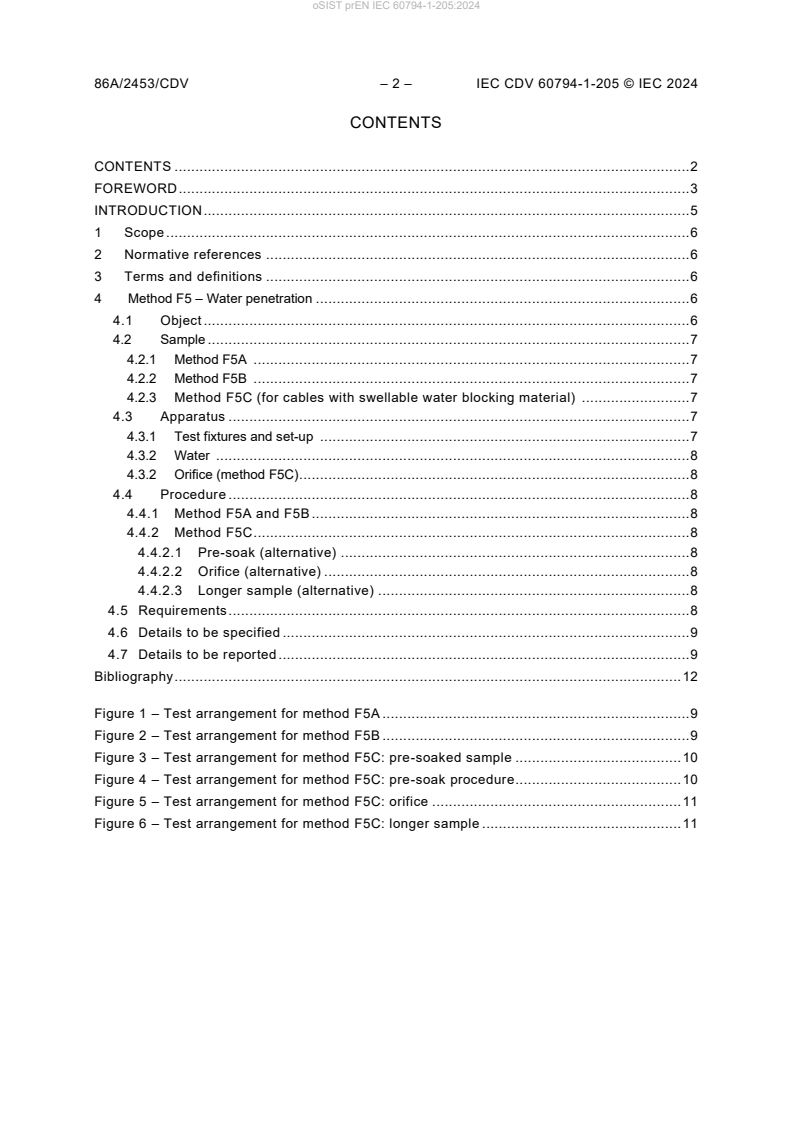
CONTENTS
CONTENTS . 2
FOREWORD . 3
INTRODUCTION . 5
1 Scope . 6
2 Normative references . 6
3 Terms and definitions . 6
4 Method F5 – Water penetration . 6
4.1 Object . 6
4.2 Sample . 7
4.2.1 Method F5A . 7
4.2.2 Method F5B . 7
4.2.3 Method F5C (for cables with swellable water blocking material) . 7
4.3 Apparatus . 7
4.3.1 Test fixtures and set-up . 7
4.3.2 Water . 8
4.3.2 Orifice (method F5C) . 8
4.4 Procedure . 8
4.4.1 Method F5A and F5B . 8
4.4.2 Method F5C . 8
4.4.2.1 Pre-soak (alternative) . 8
4.4.2.2 Orifice (alternative) . 8
4.4.2.3 Longer sample (alternative) . 8
4.5 Requirements . 8
4.6 Details to be specified . 9
4.7 Details to be reported . 9
Bibliography . 12
Figure 1 – Test arrangement for method F5A . 9
Figure 2 – Test arrangement for method F5B . 9
Figure 3 – Test arrangement for method F5C: pre-soaked sample . 10
Figure 4 – Test arrangement for method F5C: pre-soak procedure . 10
Figure 5 – Test arrangement for method F5C: orifice . 11
Figure 6 – Test arrangement for method F5C: longer sample . 11
oSIST prEN IEC 60794-1-205:2024
IEC CDV 60794-1-205 © IEC 2024 – 3 – 86A/2453/CDV
2 INTERNATIONAL ELECTROTECHNICAL COMMISSION
3 ____________
5 OPTICAL FIBRE CABLES –
7 Part 1-205: Generic specification –
8 Basic optical cable test procedures –
9 Environmental test methods – Water penetration, Method F5
11 FOREWORD
12 1) The International Electrotechnical Commission (IEC) is a worldwide organization for standardization comprising
13 all national electrotechnical committees (IEC National Committees). The object of IEC is to promote international
14 co-operation on all questions concerning standardization in the electrical and electronic fields. To this end and
15 in addition to other activities, IEC publishes International Standards, Technical Specifications, Technical Reports,
16 Publicly Available Specifications (PAS) and Guides (hereafter referred to as “IEC Publication(s)”). Their
17 preparation is entrusted to technical committees; any IEC National Committee interested in the subject dealt with
18 may participate in this preparatory work. International, governmental and non-governmental organizations liaising
19 with the IEC also participate in this preparation. IEC collaborates closely with the International Organization for
20 Standardization (ISO) in accordance with conditions determined by agreement between the two organizations.
21 2) The formal decisions or agreements of IEC on technical matters express, as nearly as possible, an international
22 consensus of opinion on the relevant subjects since each technical committee has representation from all
23 interested IEC National Committees.
24 3) IEC Publications have the form of recommendations for international use and are accepted by IEC National
25 Committees in that sense. While all reasonable efforts are made to ensure that the technical content of IEC
26 Publications is accurate, IEC cannot be held responsible for the way in which they are used or for any
27 misinterpretation by any end user.
28 4) In order to promote international uniformity, IEC National Committees undertake to apply IEC Publications
29 transparently to the maximum extent possible in their national and regional publications. Any divergence between
30 any IEC Publication and the corresponding national or regional publication shall be clearly indicated in the latter.
31 5) IEC itself does not provide any attestation of conformity. Independent certification bodies provide conformity
32 assessment services and, in some areas, access to IEC marks of conformity. IEC is not responsible for any
33 services carried out by independent certification bodies.
34 6) All users should ensure that they have the latest edition of this publication.
35 7) No liability shall attach to IEC or its directors, employees, servants or agents including individual experts and
36 members of its technical committees and IEC National Committees for any personal injury, property damage or
37 other damage of any nature whatsoever, whether direct or indirect, or for costs (including legal fees) and
38 expenses arising out of the publication, use of, or reliance upon, this IEC Publication or any other IEC Publications.
39 8) Attention is drawn to the Normative references cited in this publication. Use of the referenced publications is
40 indispensable for the correct application of this publication.
41 9) Attention is drawn to the possibility that some of the elements of this IEC Publication may be the subject of patent
42 rights. IEC shall not be held responsible for identifying any or all such patent rights.
43 International Standard IEC 60794-1-205 has been prepared by subcommittee 86A: Fibres and
44 cables, of IEC technical committee 86: Fibre optics.
45 This first edition of IEC 60794-1-205 cancels and replaces methods F5 of the second edition of
46 IEC 60794-1-22 published in 2017.
47 This edition includes the following significant technical changes with respect to the previous
48 edition:
49 a) the environmental test contained in IEC 60794-1-22: 2017 will now be individually numbered
50 in the IEC 60794-1-2xx series. Each test method is now considered to be an individual
51 document rather than part of a multi-test method compendium. Full cross-reference details
52 are given in IEC 60794-1-2.
oSIST prEN IEC 60794-1-205:2024
86A/2453/CDV – 4 – IEC CDV 60794-1-205 © IEC 2024
53 b) The clauses of “4.6 Details to be specified” and “4.7 Details to be reported” were revised.
54 The text of this International Standard is based on the following documents:
FDIS Report on voting
86A/xxxx/FDIS 86A/xxxx/RVD
56 Full information on the voting for the approval of this International Standard can be found in the
57 report on voting indicated in the above table.
58 The language used for the development of this International Standard is English.
59 This document has been drafted in accordance with the ISO/IEC Directives, Part 2 , and
60 developed in accordance with ISO/IEC Directives, Part 1 and ISO/IEC Directives, IEC Supplement,
61 avail
...
SLOVENSKI STANDARD
oSIST prEN IEC 60794-1-205:2025
01-december-2025
Optični kabli - 1-205. del: Splošna specifikacija - Osnovni preskusni postopki za
optične kable - Okoljske preskusne metode - Vdor vode, metoda F5
Optical fibre cables - Part 1-205: Generic specification - Basic optical cable test
procedures - Environmental test methods - Water penetration, method F5
Lichtwellenleiterkabel – Teil 1-205: Fachgrundspezifikation – Grundlegende
Prüfverfahren für Lichtwellenleiterkabel - Umweltprüfverfahren -Wasserdurchdringung,
Methode F5
Câbles à fibres optiques - Partie 1-205: Spécification générique - Procédures
fondamentales d’essais des câbles optiques - Méthodes d’essais d’environnement -
Pénétration d’eau, méthode f5
Ta slovenski standard je istoveten z: prEN IEC 60794-1-205:2025
ICS:
33.180.10 (Optična) vlakna in kabli Fibres and cables
oSIST prEN IEC 60794-1-205:2025 en
2003-01.Slovenski inštitut za standardizacijo. Razmnoževanje celote ali delov tega standarda ni dovoljeno.
oSIST prEN IEC 60794-1-205:2025
oSIST prEN IEC 60794-1-205:2025
86A/2623/CDV
COMMITTEE DRAFT FOR VOTE (CDV)
PROJECT NUMBER:
IEC 60794-1-205 ED1
DATE OF CIRCULATION: CLOSING DATE FOR VOTING:
2025-10-31 2025-12-26
SUPERSEDES DOCUMENTS:
86A/2453/CDV, 86A/2551/RVC
IEC SC 86A : FIBRES AND CABLES
SECRETARIAT: SECRETARY:
France Mr Laurent Gasca
OF INTEREST TO THE FOLLOWING COMMITTEES: HORIZONTAL FUNCTION(S):
ASPECTS CONCERNED:
SUBMITTED FOR CENELEC PARALLEL VOTING NOT SUBMITTED FOR CENELEC PARALLEL VOTING
Attention IEC-CENELEC parallel voting
The attention of IEC National Committees, members of
CENELEC, is drawn to the fact that this Committee Draft
for Vote (CDV) is submitted for parallel voting.
The CENELEC members are invited to vote through the
CENELEC online voting system.
This document is still under study and subject to change. It should not be used for reference purposes.
Recipients of this document are invited to submit, with their comments, notification of any relevant patent rights of
which they are aware and to provide supporting documentation.
Recipients of this document are invited to submit, with their comments, notification of any relevant “In Some
Countries” clauses to be included should this proposal proceed. Recipients are reminded that the CDV stage is the
final stage for submitting ISC clauses. (SEE AC/22/2007 OR NEW GUIDANCE DOC).
TITLE:
Optical fibre cables - Part 1-205: Generic specification - Basic optical cable test procedures -
Environmental test methods – Water penetration, Method F5
PROPOSED STABILITY DATE: 2029
NOTE FROM TC/SC OFFICERS:
electronic file, to make a copy and to print out the content for the sole purpose of preparing National Committee positions.
You may not copy or "mirror" the file or printed version of the document, or any part of it, for any other purpose without
permission in writing from IEC.
oSIST prEN IEC 60794-1-205:2025
IEC CDV 60794-1-205 © IEC 2025
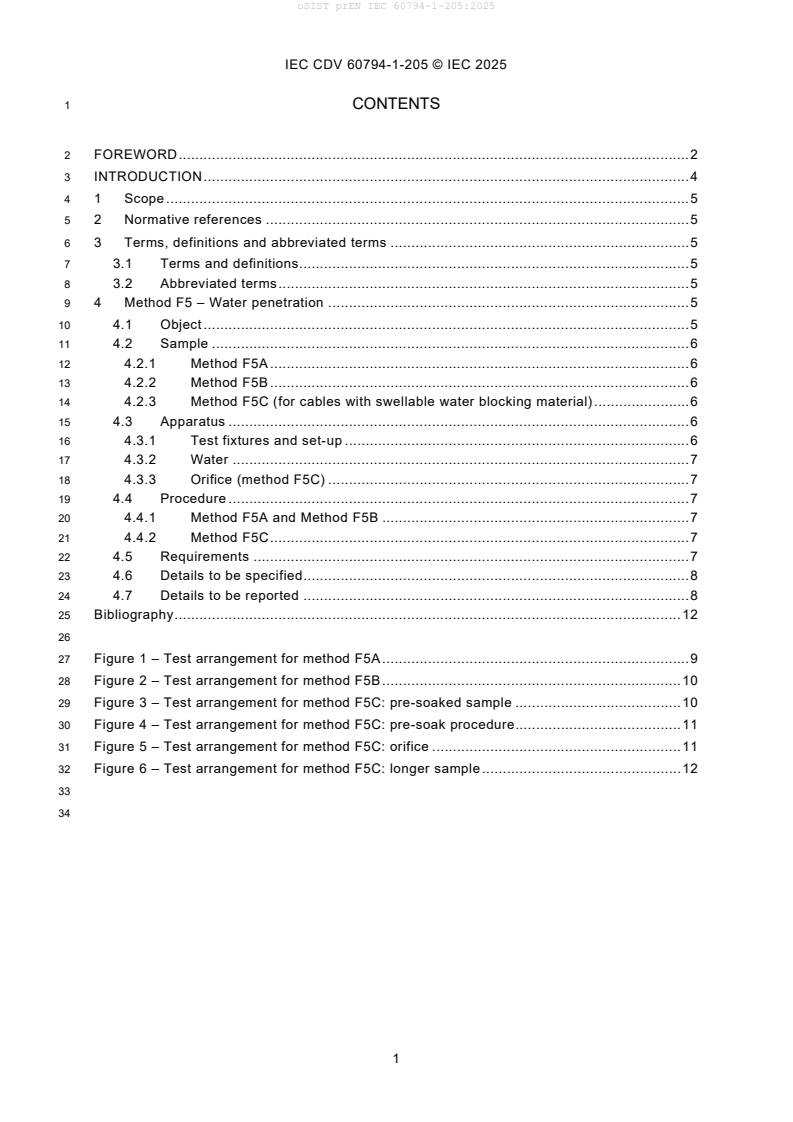
1 CONTENTS
2 FOREWORD . 2
3 INTRODUCTION . 4
4 1 Scope . 5
5 2 Normative references . 5
6 3 Terms, definitions and abbreviated terms . 5
7 3.1 Terms and definitions . 5
8 3.2 Abbreviated terms . 5
9 4 Method F5 – Water penetration . 5
10 4.1 Object . 5
11 4.2 Sample . 6
12 4.2.1 Method F5A . 6
13 4.2.2 Method F5B . 6
14 4.2.3 Method F5C (for cables with swellable water blocking material) . 6
15 4.3 Apparatus . 6
16 4.3.1 Test fixtures and set-up . 6
17 4.3.2 Water . 7
18 4.3.3 Orifice (method F5C) . 7
19 4.4 Procedure . 7
20 4.4.1 Method F5A and Method F5B . 7
21 4.4.2 Method F5C . 7
22 4.5 Requirements . 7
23 4.6 Details to be specified . 8
24 4.7 Details to be reported . 8
25 Bibliography . 12
27 Figure 1 – Test arrangement for method F5A . 9
28 Figure 2 – Test arrangement for method F5B . 10
29 Figure 3 – Test arrangement for method F5C: pre-soaked sample . 10
30 Figure 4 – Test arrangement for method F5C: pre-soak procedure . 11
31 Figure 5 – Test arrangement for method F5C: orifice . 11
32 Figure 6 – Test arrangement for method F5C: longer sample . 12
oSIST prEN IEC 60794-1-205:2025
IEC CDV 60794-1-205 © IEC 2025
35 INTERNATIONAL ELECTROTECHNICAL COMMISSION
36 ____________
38 OPTICAL FIBRE CABLES –
40 Part 1-205: Generic specification –
41 Basic optical cable test procedures –
42 Environmental test methods – Water penetration, Method F5
44 FOREWORD
45 1) The International Electrotechnical Commission (IEC) is a worldwide organization for standardization comprising
46 all national electrotechnical committees (IEC National Committees). The object of IEC is to promote international
47 co-operation on all questions concerning standardization in the electrical and electronic fields. To this end and
48 in addition to other activities, IEC publishes International Standards, Technical Specifications, Technical Reports,
49 Publicly Available Specifications (PAS) and Guides (hereafter referred to as “IEC Publication(s)”). Their
50 preparation is entrusted to technical committees; any IEC National Committee interested in the subject dealt with
51 may participate in this preparatory work. International, governmental and non-governmental organizations liaising
52 with the IEC also participate in this preparation. IEC collaborates closely with the International Organization for
53 Standardization (ISO) in accordance with conditions determined by agreement between the two organizations.
54 2) The formal decisions or agreements of IEC on technical matters express, as nearly as possible, an international
55 consensus of opinion on the relevant subjects since each technical committee has representation from all
56 interested IEC National Committees.
57 3) IEC Publications have the form of recommendations for international use and are accepted by IEC National
58 Committees in that sense. While all reasonable efforts are made to ensure that the technical content of IEC
59 Publications is accurate, IEC cannot be held responsible for the way in which they are used or for any
60 misinterpretation by any end user.
61 4) In order to promote international uniformity, IEC National Committees undertake to apply IEC Publications
62 transparently to the maximum extent possible in their national and regional publications. Any divergence between
63 any IEC Publication and the corresponding national or regional publication shall be clearly indicated in the latter.
64 5) IEC itself does not provide any attestation of conformity. Independent certification bodies provide conformity
65 assessment services and, in some areas, access to IEC marks of conformity. IEC is not responsible for any
66 services carried out by independent certification bodies.
67 6) All users should ensure that they have the latest edition of this publication.
68 7) No liability shall attach to IEC or its directors, employees, servants or agents including individual experts and
69 members of its technical committees and IEC National Committees for any personal injury, property damage or
70 other damage of any nature whatsoever, whether direct or indirect, or for costs (including legal fees) and
71 expenses arising out of the publication, use of, or reliance upon, this IEC Publication or any other IEC
72 Publications.
73 8) Attention is drawn to the Normative references cited in this publication. Use of the referenced publications is
74 indispensable for the correct application of this publication.
75 9) IEC draws attention to the possibility that the implementation of this document may involve the use of (a)
76 patent(s). IEC takes no position concerning the evidence, validity or applicability of any claimed patent rights in
77 respect thereof. As of the date of publication of this document, IEC had not received notice of (a) patent(s), which
78 may be required to implement this document. However, implementers are cautioned that this may not represent
79 the latest information, which may be obtained from the patent database available at https://patents.iec.ch. IEC
80 shall not be held responsible for identifying any or all such patent rights.
81 IEC 60794-1-205 has been prepared by subcommittee 86A: Fibres and cables, of IEC technical
82 committee 86: Fibre optics. It is an International Standard.
83 This document partially replaces IEC 60794-1-22:2017. This edition constitutes a technical
84 revision.
85 This edition includes the following significant technical changes with respect to IEC 60794-1-
86 22:2017:
87 a) Revision of the contents of 4.6 Details to be specified and 4.7 Details to be reported in
88 comparison to IEC 60794-1-22: 2017, 5.6 and 5.7.
oSIST prEN IEC 60794-1-205:2025
IEC CDV 60794-1-205 © IEC 2025
89 The text of this International Standard is based on the following documents:
Draft Report on voting
86A/XX/FDIS 86A/XX/RVD
91 Full information on the voting for its approval can be found in the report on voting indicated in
92 the above table.
93 The language used for the development of this International Standard is English.
94 This document was drafted in accordance with ISO/IEC Directives, Part 2, and developed in
95 accordance with ISO/IEC
...