

SIST EN 12607-2:2014
(Main)Bitumen and bituminous binders - Determination of the resistance to hardening under influence of heat and air - Part 2: TFOT method
General Information
- Abstract
This part of EN 12607 specifies a method for measuring the combined effects of heat and air on a film of bitumen or bituminous binder, simulating the hardening which most bituminous binders undergo during mixing in an asphalt mixing plant. The method is suitable for other bituminous binders than paving grade bitumen, but the reference temperature might give excessive hardening that does not resemble real conditions during mixing at the plant. The method may not represent the hardening that occurs during mixing of warm mix binders.
Additionally, this part of EN 12607 specifies a method for the determination of the change in mass of oxidized bitumens and hard industrial bitumens after heating. The method is used to detect volatile components.
The method is referred to as TFOT, i.e. Thin Film Oven Test.
WARNING: Use of this European Standard can involve hazardous materials, operations and equipment. This European Standard does not purport to address all of the safety problems associated with its use. It is the responsibility of the user of this European Standard to identify the hazards and assess the risks involved in performing this test method and to implement sufficient control measures to protect individual operators (and the environment). This includes appropriate safety and health practices and determination of the applicability of regulatory limitations prior to use.
If there is a likelihood of volatile components being present in a binder, this procedure should not be used. It should not be used for cut-back bitumen or bituminous emulsions before these products have been stabilized, e.g. in accordance with EN 13074 2.
- Status
- Published
- Public Enquiry End Date
- 19-May-2013
- Publication Date
- 23-Nov-2014
- Technical Committee
- VLA - Water proofing
- Current Stage
- 6060 - National Implementation/Publication (Adopted Project)
- Start Date
- 10-Nov-2014
- Due Date
- 15-Jan-2015
- Completion Date
- 24-Nov-2014

Overview
EN 12607-2:2014 - "Bitumen and bituminous binders - Determination of the resistance to hardening under influence of heat and air - Part 2: TFOT method" - specifies the Thin Film Oven Test (TFOT). The TFOT simulates the combined effects of heat and air on a thin film of bitumen or bituminous binder during asphalt mixing. The method reports the change in mass and changes in binder properties (for example, kinematic viscosity) after heating and is also used to detect volatile components in oxidized or hard industrial bitumens.
Keywords: EN 12607-2:2014, TFOT, Thin Film Oven Test, bitumen, bituminous binders, change in mass, hardening, kinematic viscosity, asphalt mixing.
Key topics and technical requirements
- Test principle: expose a thin film of binder to controlled heat and air flow in a rotating oven, then measure mass and property changes.
- Reference temperatures:
- Paving binders: (120 ± 1) °C (typical mixing temperature for soft paving grades).
- Industrial/oxidized binders: (163 ± 1) °C.
- Test duration: maintain sample at temperature for 5 h (total in oven not to exceed 5 h 15 min).
- Sample and apparatus:
- Pan: cylindrical, ≈140 mm diameter, ≈9.5 mm depth; ~50.0 g sample yields ~3.2 mm film thickness.
- Rotating shelf: (5.5 ± 1.0) r/min; oven ventilation and temperature control conform to performance limits (e.g., ≥10 air changes/h).
- Temperature measurement: device readable to 0.1 °C, accuracy ±0.5 °C; regular calibration required.
- Balance: readable to 1 mg, accuracy ±10 mg.
- Measurements: change in mass (expressed as %), and change in physical properties such as kinematic viscosity (EN 12595). Express mass loss as negative percentage (or positive for gain).
- Limitations: method may overestimate hardening for some non-paving binders, may not represent warm-mix binder behaviour, and must NOT be used where volatiles are likely (including unstabilized cut-back bitumen or emulsions).
Practical applications and users
- Quality control and specification testing of paving bitumens and certain industrial/oxidized bitumens.
- Detection of volatile components and evaluation of susceptibility to hardening during mixing.
- Typical users: asphalt laboratories, binder manufacturers, pavement engineers, certification bodies, and standardization specialists specifying binder behaviour in production and product standards.
Related standards
- EN 12595 (kinematic viscosity), EN 12594 (sample preparation), EN 58 (sampling), EN 1425 (perceptible properties), EN 13074-2 (stabilization of emulsions), EN 1426 / EN 1427 (penetration/softening point). TFOT results feed into product frameworks such as EN 13303, EN 13304 and EN 13305.
WARNING: TFOT involves hazardous materials and operations. Users must assess risks, follow safety rules and regulatory limits, and avoid TFOT when volatile components are suspected.
Relations
- Effective Date
- 01-Dec-2014
- Effective Date
- 28-Jan-2026
- Effective Date
- 28-Jan-2026
- Effective Date
- 28-Jan-2026
- Refers
SIST EN 1425:2012 - Bitumen and bituminous binders - Characterization of perceptible properties - Effective Date
- 28-Jan-2026
- Referred By
SIST EN 12591:2009 - Bitumen and bituminous binders - Specifications for paving grade bitumens - Effective Date
- 28-Jan-2026
- Effective Date
- 28-Jan-2026
- Effective Date
- 28-Jan-2026
- Effective Date
- 28-Jan-2026
- Effective Date
- 28-Jan-2026
- Referred By
SIST EN 12595:2014 - Bitumen and bituminous binders - Determination of kinematic viscosity - Effective Date
- 28-Jan-2026
Get Certified
Connect with accredited certification bodies for this standard

DIBt (Deutsches Institut für Bautechnik)
German Institute for Building Technology.
DIN CERTCO
DIN Group product certification.

Element Materials Technology
Materials testing and product certification.
Sponsored listings
Frequently Asked Questions
SIST EN 12607-2:2014 is a standard published by the Slovenian Institute for Standardization (SIST). Its full title is "Bitumen and bituminous binders - Determination of the resistance to hardening under influence of heat and air - Part 2: TFOT method". This standard covers: This part of EN 12607 specifies a method for measuring the combined effects of heat and air on a film of bitumen or bituminous binder, simulating the hardening which most bituminous binders undergo during mixing in an asphalt mixing plant. The method is suitable for other bituminous binders than paving grade bitumen, but the reference temperature might give excessive hardening that does not resemble real conditions during mixing at the plant. The method may not represent the hardening that occurs during mixing of warm mix binders. Additionally, this part of EN 12607 specifies a method for the determination of the change in mass of oxidized bitumens and hard industrial bitumens after heating. The method is used to detect volatile components. The method is referred to as TFOT, i.e. Thin Film Oven Test. WARNING: Use of this European Standard can involve hazardous materials, operations and equipment. This European Standard does not purport to address all of the safety problems associated with its use. It is the responsibility of the user of this European Standard to identify the hazards and assess the risks involved in performing this test method and to implement sufficient control measures to protect individual operators (and the environment). This includes appropriate safety and health practices and determination of the applicability of regulatory limitations prior to use. If there is a likelihood of volatile components being present in a binder, this procedure should not be used. It should not be used for cut-back bitumen or bituminous emulsions before these products have been stabilized, e.g. in accordance with EN 13074 2.
This part of EN 12607 specifies a method for measuring the combined effects of heat and air on a film of bitumen or bituminous binder, simulating the hardening which most bituminous binders undergo during mixing in an asphalt mixing plant. The method is suitable for other bituminous binders than paving grade bitumen, but the reference temperature might give excessive hardening that does not resemble real conditions during mixing at the plant. The method may not represent the hardening that occurs during mixing of warm mix binders. Additionally, this part of EN 12607 specifies a method for the determination of the change in mass of oxidized bitumens and hard industrial bitumens after heating. The method is used to detect volatile components. The method is referred to as TFOT, i.e. Thin Film Oven Test. WARNING: Use of this European Standard can involve hazardous materials, operations and equipment. This European Standard does not purport to address all of the safety problems associated with its use. It is the responsibility of the user of this European Standard to identify the hazards and assess the risks involved in performing this test method and to implement sufficient control measures to protect individual operators (and the environment). This includes appropriate safety and health practices and determination of the applicability of regulatory limitations prior to use. If there is a likelihood of volatile components being present in a binder, this procedure should not be used. It should not be used for cut-back bitumen or bituminous emulsions before these products have been stabilized, e.g. in accordance with EN 13074 2.
SIST EN 12607-2:2014 is classified under the following ICS (International Classification for Standards) categories: 75.140 - Waxes, bituminous materials and other petroleum products; 91.100.50 - Binders. Sealing materials. The ICS classification helps identify the subject area and facilitates finding related standards.
SIST EN 12607-2:2014 has the following relationships with other standards: It is inter standard links to SIST EN 12607-2:2007, SIST EN 12594:2025, SIST EN 12595:2023, SIST EN 58:2012, SIST EN 1425:2012, SIST EN 12591:2009, SIST EN 12594:2007, SIST EN 12594:2014, SIST EN 15323:2007, SIST EN 14769:2023, SIST EN 12595:2014. Understanding these relationships helps ensure you are using the most current and applicable version of the standard.
SIST EN 12607-2:2014 is associated with the following European legislation: EU Directives/Regulations: 305/2011, 89/106/EEC; Standardization Mandates: M/124. When a standard is cited in the Official Journal of the European Union, products manufactured in conformity with it benefit from a presumption of conformity with the essential requirements of the corresponding EU directive or regulation.
SIST EN 12607-2:2014 is available in PDF format for immediate download after purchase. The document can be added to your cart and obtained through the secure checkout process. Digital delivery ensures instant access to the complete standard document.
Standards Content (Sample)
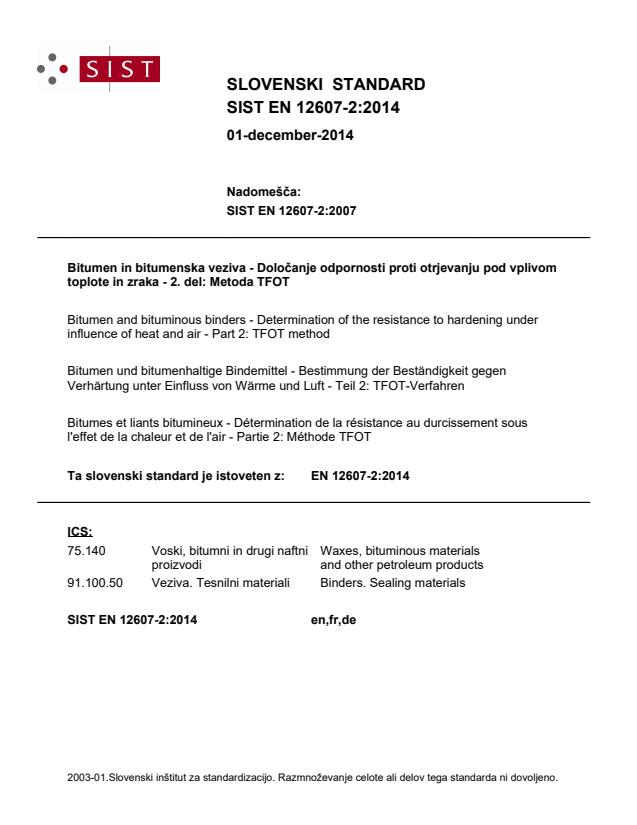
2003-01.Slovenski inštitut za standardizacijo. Razmnoževanje celote ali delov tega standarda ni dovoljeno.Bitumen und bitumenhaltige Bindemittel - Bestimmung der Beständigkeit gegen Verhärtung unter Einfluss von Wärme und Luft - Teil 2: TFOT-VerfahrenBitumes et liants bitumineux - Détermination de la résistance au durcissement sous l'effet de la chaleur et de l'air - Partie 2: Méthode TFOTBitumen and bituminous binders - Determination of the resistance to hardening under influence of heat and air - Part 2: TFOT method91.100.50Veziva. Tesnilni materialiBinders. Sealing materials75.140Voski, bitumni in drugi naftni proizvodiWaxes, bituminous materials and other petroleum productsICS:Ta slovenski standard je istoveten z:EN 12607-2:2014SIST EN 12607-2:2014en,fr,de01-december-2014SIST EN 12607-2:2014SLOVENSKI
STANDARDSIST EN 12607-2:20071DGRPHãþD
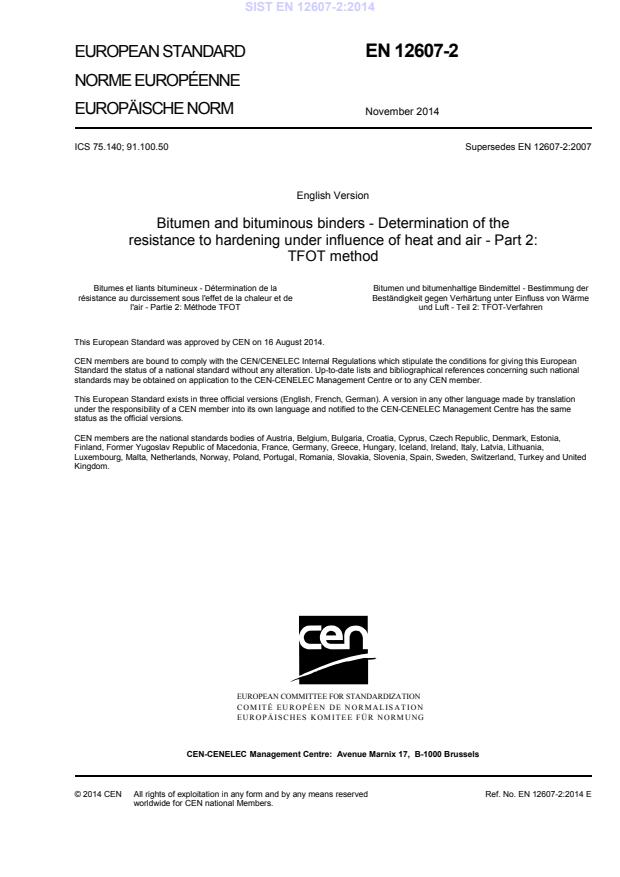
EUROPEAN STANDARD NORME EUROPÉENNE EUROPÄISCHE NORM
EN 12607-2
November 2014 ICS 75.140; 91.100.50 Supersedes EN 12607-2:2007English Version
Bitumen and bituminous binders - Determination of the resistance to hardening under influence of heat and air - Part 2: TFOT method
Bitumes et liants bitumineux - Détermination de la résistance au durcissement sous l'effet de la chaleur et de l'air - Partie 2: Méthode TFOT
Bitumen und bitumenhaltige Bindemittel - Bestimmung der Beständigkeit gegen Verhärtung unter Einfluss von Wärme und Luft - Teil 2: TFOT-Verfahren This European Standard was approved by CEN on 16 August 2014.
CEN members are bound to comply with the CEN/CENELEC Internal Regulations which stipulate the conditions for giving this European Standard the status of a national standard without any alteration. Up-to-date lists and bibliographical references concerning such national standards may be obtained on application to the CEN-CENELEC Management Centre or to any CEN member.
This European Standard exists in three official versions (English, French, German). A version in any other language made by translation under the responsibility of a CEN member into its own language and notified to the CEN-CENELEC Management Centre has the same status as the official versions.
CEN members are the national standards bodies of Austria, Belgium, Bulgaria, Croatia, Cyprus, Czech Republic, Denmark, Estonia, Finland, Former Yugoslav Republic of Macedonia, France, Germany, Greece, Hungary, Iceland, Ireland, Italy, Latvia, Lithuania, Luxembourg, Malta, Netherlands, Norway, Poland, Portugal, Romania, Slovakia, Slovenia, Spain, Sweden, Switzerland, Turkey and United Kingdom.
EUROPEAN COMMITTEE FOR STANDARDIZATION
COMITÉ EUROPÉEN DE NORMALISATION EUROPÄISCHES KOMITEE FÜR NORMUNG
CEN-CENELEC Management Centre:
Avenue Marnix 17,
B-1000 Brussels © 2014 CEN All rights of exploitation in any form and by any means reserved worldwide for CEN national Members. Ref. No. EN 12607-2:2014 ESIST EN 12607-2:2014
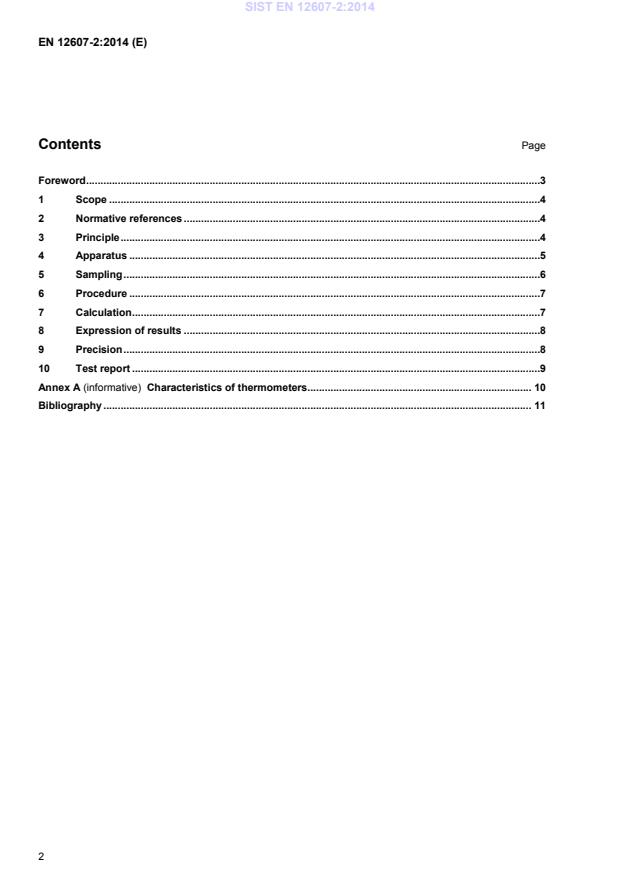
Characteristics of thermometers. 10 Bibliography . 11
— the reference to mercury thermometer has been deleted (see subclause 4.2) and Annex A is informative. EN 12607 consists of the following parts under the general title “Bitumen and bituminous binders – Determination of the resistance to hardening under the influence of heat and air”: — Part 1: RTFOT method; — Part 2: TFOT method; — Part 3: RFT method. The scope of this standard has been enlarged by adding oxidized bitumens and hard industrial bitumens that are not used for paving applications. The reason is to facilitate that EN 13303, Bitumen and bituminous binders – Determination of the loss of mass after heating of industrial bitumen can be replaced in product standards by EN 12607-2 at the next revision of EN 13303. It is to be noted that this – if so decided – will change the property from loss in mass into change in mass in EN 13304, Bitumen and bituminous binders – Framework for specification of oxidized bitumens and in EN 13305, Bitumen and bituminous binders – Framework for specification of hard industrial bitumens. According to the CEN-CENELEC Internal Regulations, the national standards organizations of the following countries are bound to implement this European Standard: Austria, Belgium, Bulgaria, Croatia, Cyprus, Czech Republic, Denmark, Estonia, Finland, Former Yugoslav Republic of Macedonia, France, Germany, Greece, Hungary, Iceland, Ireland, Italy, Latvia, Lithuania, Luxembourg, Malta, Netherlands, Norway, Poland, Portugal, Romania, Slovakia, Slovenia, Spain, Sweden, Switzerland, Turkey and the United Kingdom.
...