

SIST EN 4497:2006
(Main)Aerospace series - Screws, pan head, offset cruciform recess, close tolerance normal shank, short thread, in titanium alloy, anodized, with aluminium pigmented coating - Classification: 1 100 MPa (at ambient temperature) / 315 °C
General Information
- Abstract
This standard specifies the characteristics of screws, pan head, offset cruciform recess, close tolerance normal shank, short thread, in titanium alloy, anodized, with aluminium pigmented coating.
Classification: 1 100 MPa / 315 °C
- Status
- Published
- Publication Date
- 31-Aug-2006
- Technical Committee
- I13 - Imaginarni 13
- Current Stage
- 6060 - National Implementation/Publication (Adopted Project)
- Start Date
- 01-Sep-2006
- Due Date
- 01-Sep-2006
- Completion Date
- 01-Sep-2006

Overview
SIST EN 4497:2006 is a European standard developed by CEN for aerospace hardware, specifically outlining the characteristics of pan head screws with an offset cruciform recess. These screws feature a close tolerance normal shank and a short thread design, manufactured from titanium alloy, anodized, and finished with an aluminium pigmented coating. The standard sets out the requirements for strength (1 100 MPa at ambient temperature) and temperature resistance (up to 315 °C), ensuring high reliability and performance for aerospace applications.
This standard serves as a crucial specification for manufacturers, suppliers, and users of aerospace fasteners, promoting quality, safety, and interchangeability in demanding environments.
Key Topics
Product Characteristics
- Pan head with offset cruciform recess for enhanced driveability.
- Close tolerance normal shank for precise fit and reduced play.
- Short thread configuration.
- Manufactured from high-strength titanium alloy.
- Surface treatments: anodized with an aluminium pigmented coating for corrosion protection and elevated temperature stability.
- Identification and marking requirements for traceability.
Performance Classification
- Minimum tensile strength: 1 100 MPa at ambient temperature.
- Maximum operating temperature: 315 °C (as determined by the coating).
Dimensional and Tolerance Requirements
- Conformance to referenced ISO and EN standards governing dimensions, tolerances of form and position, and thread profiles.
- Specifications for mass, configuration, and optional features such as hole types and drive configurations.
Applications
SIST EN 4497:2006 is essential within the aerospace sector where high-performance fasteners are required. Practical applications of this standard include:
- Aircraft Structural Assemblies
Used in joining critical aircraft structures where strength, precision, and reliability are paramount. - Engine Components
Suitable for engine areas subjected to elevated temperatures and corrosive conditions. - Spacecraft and Satellites
Ideal for mechanisms exposed to extreme environments, offering lightweight and high strength. - Defense and Military Aircraft
Applied wherever close tolerance, durable fasteners are needed for mission-critical assemblies.
The specification supports consistent procurement, maintenance, and quality control across aerospace projects, minimizing the risk of fastener-related failures.
Related Standards
To ensure complete compliance and integration with wider aerospace quality and performance requirements, SIST EN 4497:2006 references several related standards, such as:
- ISO 3353-1: Aerospace - Lead and runout threads
- ISO 5855-2: MJ thread dimensions for bolts and nuts
- ISO 7913: Tolerances of form and position for bolts and screws
- ISO 7994: Internal drive, offset cruciform recess - Metric series
- ISO 9152: Bolts, with MJ threads, in titanium alloys, 1 100 MPa - Procurement specification
- EN 2424: Marking of aerospace products
- EN 4474: Aluminium pigmented coatings
- EN 9100: Aerospace quality management systems
- EN 9133: Qualification procedure for aerospace standard parts
- EN 4016: Oversized bolts
- MIL-L-87132B: Lubricant application to fasteners
- TR 3775: Materials for bolts and pins
Conclusion
SIST EN 4497:2006 is an authoritative reference for aerospace fastener manufacturing and procurement, ensuring pan head screws with specific features meet rigorous industry standards. Adoption of this standard enables consistent quality, enhances safety, and supports interoperability across national and international aerospace supply chains. For professionals seeking reliable, high-strength titanium alloy screws with advanced coatings for high-temperature aerospace applications, SIST EN 4497:2006 provides a comprehensive specification.
Relations
- Effective Date
- 28-Jan-2026
- Effective Date
- 28-Jan-2026
- Effective Date
- 28-Jan-2026
- Effective Date
- 28-Jan-2026
- Effective Date
- 28-Jan-2026
- Effective Date
- 28-Jan-2026
- Effective Date
- 28-Jan-2026
Get Certified
Connect with accredited certification bodies for this standard

BUREAU VERITAS Certification Germany
Bureau Veritas certification in Germany.

Element Materials Technology
Materials testing and product certification.

AQMS Ltd.
AQMS provides ISO certification to SMEs across the UK.
Sponsored listings
Frequently Asked Questions
SIST EN 4497:2006 is a standard published by the Slovenian Institute for Standardization (SIST). Its full title is "Aerospace series - Screws, pan head, offset cruciform recess, close tolerance normal shank, short thread, in titanium alloy, anodized, with aluminium pigmented coating - Classification: 1 100 MPa (at ambient temperature) / 315 °C". This standard covers: This standard specifies the characteristics of screws, pan head, offset cruciform recess, close tolerance normal shank, short thread, in titanium alloy, anodized, with aluminium pigmented coating. Classification: 1 100 MPa / 315 °C
This standard specifies the characteristics of screws, pan head, offset cruciform recess, close tolerance normal shank, short thread, in titanium alloy, anodized, with aluminium pigmented coating. Classification: 1 100 MPa / 315 °C
SIST EN 4497:2006 is classified under the following ICS (International Classification for Standards) categories: 49.025.20 - Aluminium; 49.025.30 - Titanium; 49.030.20 - Bolts, screws, studs. The ICS classification helps identify the subject area and facilitates finding related standards.
SIST EN 4497:2006 has the following relationships with other standards: It is inter standard links to SIST EN 9100:2018, SIST EN 9133:2018, SIST EN 2929:2001, SIST EN 4474:2025, SIST EN 840-6:2004+A1:2008, SIST EN 2424:2008, SIST EN 14460:2006. Understanding these relationships helps ensure you are using the most current and applicable version of the standard.
SIST EN 4497:2006 is available in PDF format for immediate download after purchase. The document can be added to your cart and obtained through the secure checkout process. Digital delivery ensures instant access to the complete standard document.
Standards Content (Sample)
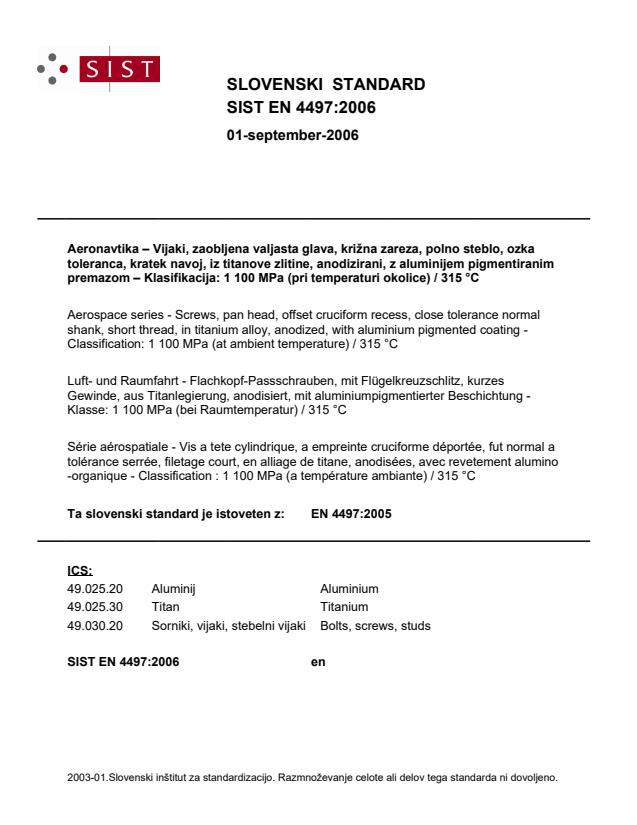
2003-01.Slovenski inštitut za standardizacijo. Razmnoževanje celote ali delov tega standarda ni dovoljeno.Aeronavtika – Vijaki, zaobljena valjasta glava, križna zareza, polno steblo, ozka toleranca, kratek navoj, iz titanove zlitine, anodizirani, z aluminijem pigmentiranim premazom – Klasifikacija: 1 100 MPa (pri temperaturi okolice) / 315 °CLuft- und Raumfahrt - Flachkopf-Passschrauben, mit Flügelkreuzschlitz, kurzes Gewinde, aus Titanlegierung, anodisiert, mit aluminiumpigmentierter Beschichtung - Klasse: 1 100 MPa (bei Raumtemperatur) / 315 °CSérie aérospatiale - Vis a tete cylindrique, a empreinte cruciforme déportée, fut normal a tolérance serrée, filetage court, en alliage de titane, anodisées, avec revetement alumino-organique - Classification : 1 100 MPa (a température ambiante) / 315 °CAerospace series - Screws, pan head, offset cruciform recess, close tolerance normal shank, short thread, in titanium alloy, anodized, with aluminium pigmented coating - Classification: 1 100 MPa (at ambient temperature) / 315 °C49.030.20Sorniki, vijaki, stebelni vijakiBolts, screws, studs49.025.30TitanTitanium49.025.20AluminijAluminiumICS:Ta slovenski standard je istoveten z:EN 4497:2005SIST EN 4497:2006en01-september-2006SIST EN 4497:2006SLOVENSKI
STANDARD
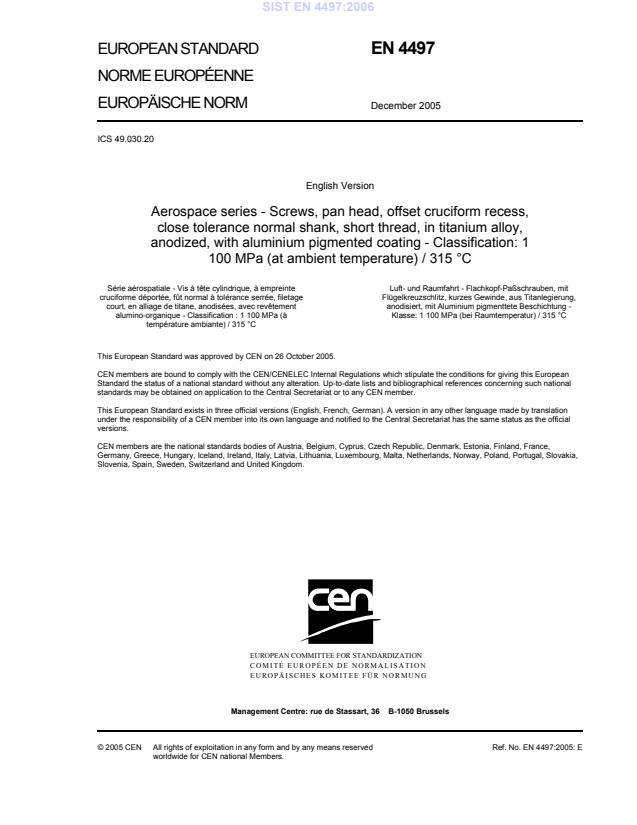
EUROPEAN STANDARD NORME EUROPÉENNE EUROPÄISCHE NORM
EN 4497
December 2005 ICS 49.030.20 English Version
Aerospace series - Screws, pan head, offset cruciform recess, close tolerance normal shank, short thread, in titanium alloy, anodized, with aluminium pigmented coating - Classification: 1 100 MPa (at ambient temperature) / 315 °C
Série aérospatiale - Vis à tête cylindrique, à empreinte cruciforme déportée, fût normal à tolérance serrée, filetage court, en alliage de titane, anodisées, avec revêtement alumino-organique - Classification : 1 100 MPa (à température ambiante) / 315 °C
Luft- und Raumfahrt - Flachkopf-Paßschrauben, mit Flügelkreuzschlitz, kurzes Gewinde, aus Titanlegierung, anodisiert, mit Aluminium pigmenttete Beschichtung - Klasse: 1 100 MPa (bei Raumtemperatur) / 315 °C This European Standard was approved by CEN on 26 October 2005.
CEN members are bound to comply with the CEN/CENELEC Internal Regulations which stipulate the conditions for giving this European Standard the status of a national standard without any alteration. Up-to-date lists and bibliographical references concerning such national standards may be obtained on application to the Central Secretariat or to any CEN member.
This European Standard exists in three official versions (English, French, German). A version in any other language made by translation under the responsibility of a CEN member into its own language and notified to the Central Secretariat has the same status as the official versions.
CEN members are the national standards bodies of Austria, Belgium, Cyprus, Czech Republic, Denmark, Estonia, Finland, France, Germany, Greece, Hungary, Iceland, Ireland, Italy, Latvia, Lithuania, Luxembourg, Malta, Netherlands, Norway, Poland, Portugal, Slovakia, Slovenia, Spain, Sweden, Switzerland and United Kingdom.
EUROPEAN COMMITTEE FOR STANDARDIZATION
COMITÉ EUROPÉEN DE NORMALISATION EUROPÄISCHES KOMITEE FÜR NORMUNG
Management Centre: rue de Stassart, 36
B-1050 Brussels © 2005 CEN All rights of exploitation in any form and by any means reserved worldwide for CEN national Members. Ref. No. EN 4497:2005: ESIST EN 4497:2006
...