

kSIST-TP FprCEN/TR 18384-1:2026
(Main)Children’s furniture - Compiled interpretations of CEN/TC 207/WG2 standards - Part 1: EN 1130:2019, Children's furniture - Cribs - Safety requirements and test methods
- Abstract
The purpose of this document is to provide replies to requests for interpretations and clarifications of EN 1130:2019, Children's furniture - Cribs - Safety requirements and test methods.
- Status
- Not Published
- Public Enquiry End Date
- 02-Aug-2026
- Technical Committee
- POH - Furniture
- Current Stage
- 5520 - Unique Acceptance Procedure (UAP) (Adopted Project)
- Start Date
- 04-Jun-2026
- Due Date
- 22-Oct-2026
- Completion Date
- 10-Aug-2026

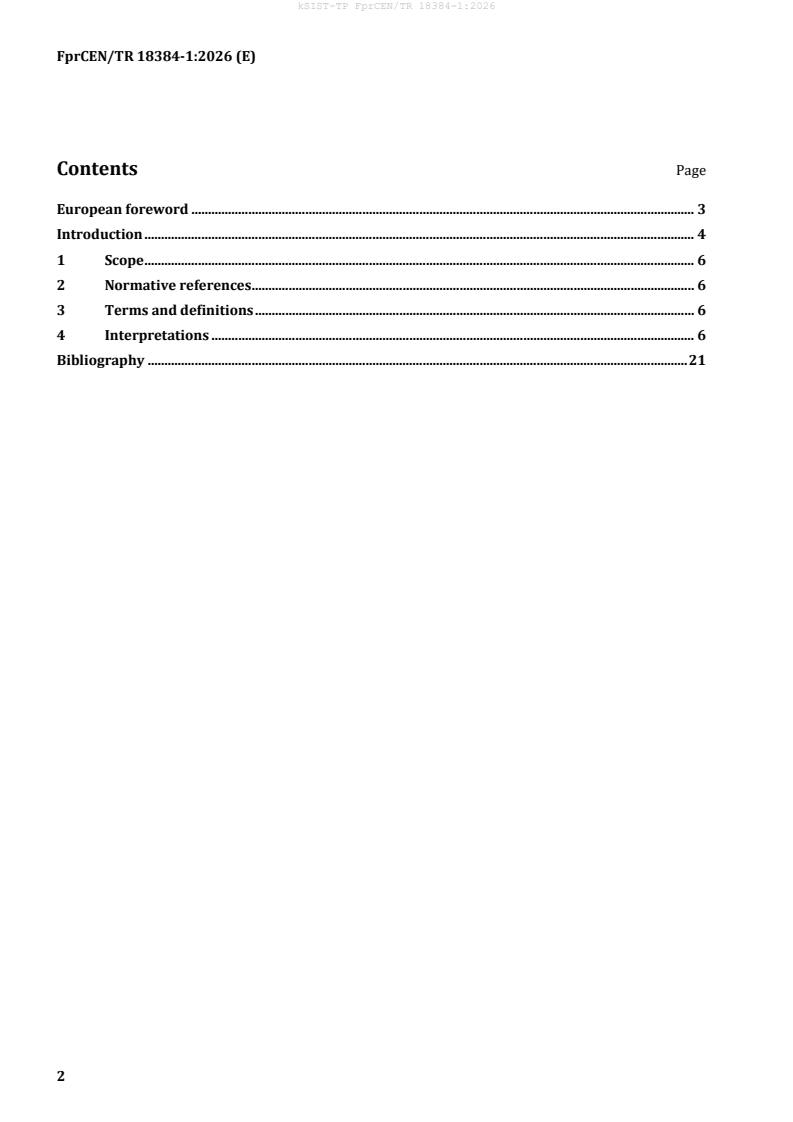
FprCEN/TR 18384-1:2026 is a CEN technical report prepared by CEN/TC 207 “Furniture” and published in the Slovenian system as kSIST-TP FprCEN/TR 18384-1:2026. It compiles interpretations and clarifications for EN 1130:2019, the European standard for children’s furniture cribs, including cradles, suspended cribs and bedside sleepers. It is aimed at people who design, test, manufacture or assess these products and need a clear reading of how specific EN 1130 clauses have been interpreted.
What does FprCEN/TR 18384-1:2026 specify?
FprCEN/TR 18384-1:2026 provides replies to requests for interpretation and clarification of EN 1130:2019. Its purpose is practical: it helps users of EN 1130 apply the clauses in a consistent way when questions arise about scope, testing, warnings and bedside-sleeper design.
The document is organised as a short technical report with a foreword, introduction, and four numbered clauses: Scope, Normative references, Terms and definitions, and Interpretations. The body is supported by a process figure, a summary table of requests, and a detailed table of each request and reply.
The report is built around EN 1130:2019 clauses and subclauses that raised interpretation questions. Table 1 summarises 14 requests, and Table 2 gives the wording of each request with the agreed reply or clarification.
What are the key requirements of FprCEN/TR 18384-1:2026?
FprCEN/TR 18384-1:2026 is not a product standard by itself. It explains how selected parts of EN 1130:2019 have been read by the expert group, and that matters because an interpretation can guide application but does not replace the wording of the standard.
Scope and intended products
The report confirms that EN 1130:2019 covers cribs for domestic and non-domestic use, including cradles, suspended cribs and bedside sleepers, when the crib base has a maximum internal length of 900 mm and the product is intended to provide sleeping accommodation for infants until they can sit unaided or pull or push themselves up on their hands and knees. In practice, that tells a buyer or tester which product families need to be checked against EN 1130.
Verification of compliance
For clause 6, the report states that the wording allows flexibility in how compliance is shown. A laboratory test report is one route, but other means can also be acceptable, such as a chemical safety assessment, while the manufacturer remains responsible for ensuring the product is safe. In practice, this means conformity work is not limited to one paperwork format, but the evidence still has to be credible and traceable.
Crib base inclination
For clause 8.1, the report explains that the angle of inclination of the crib base is measured head-to-feet and that a repeatable check can use the test plate described in subclause 5.9, followed by direct angle measurement. The interpretation also treats the horizontal sleeping position requirement as linked to that head-to-feet inclination. In practice, this gives testers a common way to measure the angle and reduces disagreement between laboratories.
Movement, locking systems and residual force
For clause 8.4 and especially 8.4.3, the report discusses locking systems for foldable or adjustable legs and feet. It accepts a spring force that automatically keeps the feet fully extended as meeting the automatic-engagement intent, and it treats the requirement as relevant to the full extension position when the product is used as a standalone crib. It also clarifies that the residual-force check of 50 N is measured with the feet lifted. In practice, manufacturers need to show that the locking action cannot be changed accidentally and that the mechanism remains secure under the test condition.
Bedside sleeping and drop-side height
For clause 8.10, the report confirms that bedside sleepers are within scope and that the minimum height requirement for the drop side above the mattress applies to these products, including designs with a completely removable side or with only three sides. The interpretation says the product cannot be treated as conforming by warning alone if the design itself falls outside the intended safety condition. For users, this is a key design check because the height of the barrier is used to limit rolling toward the adult bed and related entrapment risks.
Separation and information for use
For subclause 8.10.2, the report explains the disengagement test for bedside sleepers: under load and after removal of force, separation from the test platform must stay within the stated limit at any point. It also accepts flexible or mesh barriers if the initial gaps do not change under the test forces. For clause 10.3, the report says the word WARNING is not required before every purchase-information statement. For clause 10.4, it confirms that the minimum capital-letter size applies to the warning sentences throughout that clause. In practice, this affects both product design and the way safety information must be written and presented to buyers and users.
What terms does FprCEN/TR 18384-1:2026 define?
Interpretation - A reply that explains how a clause in EN 1130:2019 should be understood and applied.
Suspended crib - A crib suspended by cords, straps or similar means from one or more anchorage points.
Bedside sleeper - A crib with one drop side intended to be placed next to an adult’s bed.
Drop side - The side element referred to in the bedside-sleeper requirements, especially where its height and disengagement are assessed.
Purchase information - The product information shown at the point of sale, including the warnings required by clause 10.3.
Instructions for use - The user information that accompanies the product and carries the warnings and installation guidance in clause 10.4.
Verification - The way compliance with the safety requirements is demonstrated, using test reports or other suitable evidence.
Who uses FprCEN/TR 18384-1:2026?
FprCEN/TR 18384-1:2026 is used by crib and bedside-sleeper manufacturers, test laboratories, quality managers, conformity assessment staff, importers and technical teams working with children’s furniture. It is also useful for buyers and product engineers who need to know how EN 1130:2019 has been interpreted before they choose a design, prepare test evidence or write instructions and warnings.
Which standards are used with FprCEN/TR 18384-1:2026?
FprCEN/TR 18384-1:2026 is read together with EN 1130:2019, because the interpretations in the report are tied directly to clauses and subclauses of that standard. The bibliography also cites CEN/CENELEC Guide 11 and IEC/TR 62017-1 as referenced documents.
What does the FprCEN/TR 18384-1:2026 document contain?
The document contains a process figure showing how interpretation requests are handled, plus Table 1 and Table 2. Table 1 gives a clause-by-clause summary of 14 requests, and Table 2 sets out the full wording of each request and the reply. The entries focus on scope, chemical hazards, crib-base inclination, locking systems, bedside sleeping, purchase information and instructions for use. For someone applying EN 1130:2019, the value of the document is in the worked clarifications rather than in new product requirements.
Frequently Asked Questions
kSIST-TP FprCEN/TR 18384-1:2026 is a draft published by the Slovenian Institute for Standardization (SIST). Its full title is "Children’s furniture - Compiled interpretations of CEN/TC 207/WG2 standards - Part 1: EN 1130:2019, Children's furniture - Cribs - Safety requirements and test methods". This standard covers: The purpose of this document is to provide replies to requests for interpretations and clarifications of EN 1130:2019, Children's furniture - Cribs - Safety requirements and test methods.
The purpose of this document is to provide replies to requests for interpretations and clarifications of EN 1130:2019, Children's furniture - Cribs - Safety requirements and test methods.
kSIST-TP FprCEN/TR 18384-1:2026 is classified under the following ICS (International Classification for Standards) categories: 97.140 - Furniture; 97.190 - Equipment for children. The ICS classification helps identify the subject area and facilitates finding related standards.
kSIST-TP FprCEN/TR 18384-1:2026 is available in PDF format for immediate download after purchase. The document can be added to your cart and obtained through the secure checkout process. Digital delivery ensures instant access to the complete standard document.
Standards Content (Sample)
SLOVENSKI STANDARD
01-julij-2026
Pohištvo za otroke - Zbrane interpretacije standardov CEN/TC 207/WG2 - 1. del: EN
1130:2019, Pohištvo za otroke - Zibelke - Varnostne zahteve in preskusne metode
Children’s furniture - Compiled interpretations of CEN/TC 207/WG2 standards - Part 1:
EN 1130:2019, Children's furniture - Cribs - Safety requirements and test methods
Kindermöbel - Zusammengestellte Interpretationen zu Normen der CEN/TC 207/WG 2 -
Teil 1: EN 1130:2019, Kindermöbel - Krippen - Sicherheitstechnische Anforderungen und
Prüfverfahren
Meubles pour enfants - Compilation des interprétations des normes du CEN/TC
207/WG2 - Partie 1 : EN 1130:2019, Mobilier de puériculture - Berceaux - Exigences de
sécurité et méthodes d'essai
Ta slovenski standard je istoveten z: FprCEN/TR 18384-1
ICS:
97.140 Pohištvo Furniture
97.190 Otroška oprema Equipment for children
2003-01.Slovenski inštitut za standardizacijo. Razmnoževanje celote ali delov tega standarda ni dovoljeno.
CEN/TC 207
Date: 2026-05
FprCEN/TR 18384-1:2026
Secretariat: UNI
Children’s furniture — Compiled interpretations of CEN/TC 207/WG2 standards —
Part 1: EN 1130:2019, Children’s furniture — Cribs — Safety requirements and test
methods
Meubles pour enfants — Compilation des interprétations des normes du CEN/TC
207/WG2 — Partie 1 : EN 1130:2019, Mobilier de puériculture — Berceaux — Exigences
de sécurité et méthodes d'essai
Kindermöbel — Zusammengestellte Interpretationen zu Normen der CEN/TC 207/WG 2
— Teil 1: EN 1130:2019, Kindermöbel — Krippen — Sicherheitstechnische
Anforderungen und Prüfverfahren
CCMC will prepare and attach the official title page.
FprCEN/TR 18384-1:2026 (E)
Contents Page
European foreword . 3
Introduction . 4
1 Scope . 6
2 Normative references . 6
3 Terms and definitions . 6
4 Interpretations . 6
Bibliography . 21
FprCEN/TR 18384-1:2026 (E)
European foreword
This document (FprCEN/TR 18384-1:2026) has been prepared by Technical Committee CEN/TC 207
“Furniture”, the secretariat of which is held by UNI.
This document is currently submitted to the Vote on TR.
FprCEN/TR 18384-1:2026 (E)
Introduction
This document contains replies to requests for interpretation and clarifications with regard to the
understanding of clauses in the standards elaborated within the CEN/TC 207/WG2. The replies concern
those requests which have resulted in an interpretation or the decision that no action is necessary.
An interpretation does not have the same status as the text of the standard, nor can it overrule the text
of the standard. However, following an interpretation can give assurance that the relevant clause of the
standard has been correctly applied. An interpretation will only be regarded as a clarification of the
meaning of the standard.
a) Disclaimer:
The interpretations and clarifications have been derived by expert groups of CEN/TC 207/WG2.
The information contained herein is for guidance only and does not reflect the formal approval by
CEN or CEN member bodies. The interpretations are neither part of any standard nor have been
referenced in the Official Journal of the European Union.
b) Requests for interpretation/clarification:
Requests for interpretations and clarifications can be submitted by a CEN member body through its
national committee directly to the CEN/TC207/WG2 or by a CEN/TC 207/WG2 liaison (but not
directly by an individual or a company) – in accordance with the interpretation protocols agreed by
CEN/TC 207/WG2. A flowchart of the process is given in Figure 1.
A request for an interpretation can lead to:
1) an interpretation of the standard:
the intention is to reflect a reasonable interpretation of how the standard should be used,
whilst taking into account:
i) the wording of the standard;
ii) the rationale of the standard;
iii) the history of the standard.
2) a no-action decision:
this is applicable when it is agreed that the standard appropriately specifies how a childcare
article should be assessed.
3) a proposal for an amendment of the standard:
this is applicable when it is agreed that the standard is deficient in some way.
NOTE Interpretations are published in CEN/TR 18384-1, which will be updated on a regular basis.
Proposals for amendments will be progressed as new work item proposals in accordance with CEN
rules.
FprCEN/TR 18384-1:2026 (E)
c) Answers to requests for interpretations:
Since requests for interpretations are submitted through a CEN member body, it is assumed that
the member body will keep itself informed about decisions concerning the request and its progress
and will itself inform the originator of the request as appropriate.
Figure 1 — Process
FprCEN/TR 18384-1:2026 (E)
1 Scope
The purpose of this document is to provide replies to requests for interpretations and clarifications of
EN 1130:2019, Children's furniture — Cribs — Safety requirements and test methods.
2 Normative references
There are no normative references in this document.
3 Terms and definitions
No terms and definitions are listed in this document.
ISO and IEC maintain terminology databases for use in standardization at the following addresses:
— ISO Online browsing platform: available at https://www.iso.org/obp/
— IEC Electropedia: available at https://www.electropedia.org/
4 Interpretations
For a summary of requests for interpretation and clarification of EN 1130:2019, see Table 1. For further
details of each request and the reply, see Table 2.
Table 1 — Summary table of the request for interpretations classified in the order of the
clauses/subclauses of EN 1130:2019
a
Interpretation Standard Title Document N
Clause / / (date)
Subclause
1 3.3 Suspended crib N1461 (2025)
2 6 Chemical hazards N1279 (2022)
3 8.1 Crib base inclination N1324 (2022)
4 8.1 & 8.4 Crib base inclination N1188 (2020)
Hazards due to the movement of the product
5 8.4.1.3 Test method to measure the angle N1462 (2025)
6 8.4.3 Locking system for foldable or adjustable legs and feet N1270 (2021)
7 8.4.3.1 Locking system for foldable or adjustable legs and feet N1280 (2022)
8 8.10 Hazards due to bedside sleeping N1281 (2022)
9 8.10 Hazards due to bedside sleeping N1464 (2025)
10 8.10.1 Hazards due to the drop side N1244 (2021)
11 8.10.1 Hazards due to the drop side N1417 (2024)
12 8.10.2 Hazards due to bedside sleepers’ disengagement N1303 (2022)
13 10.3 Purchase information N1242 (2021)
14 10.4 Instructions for use N1243 (2021)
a
N documents are CEN/TC 207/WG2 internal documents.
FprCEN/TR 18384-1:2026 (E)
Table 2 — Table of the request for interpretation/clarification for EN 1130:2019
Clause/ Paragraph/
N° Subclause/ Figure/ Question / Proposed answer Reply
Annex Table/Note
The scope of the standard and the
definition of suspended cribs are
setting the requirements on which
products are within the standard.
[extract from EN 1130]
“Scope: This document specifies
safety requirements and test
methods for cribs (including
Yes, we agree this product falls in the scope of
cradles, suspended cribs and
1 3.3 EN 1130 and all requirements of the standard
bedside sleepers) for domestic and
apply.
non-domestic use. The requirements
apply to cribs with a maximum
internal length of crib base of
900 mm which are intended to
provide sleeping accommodation
for infants, until they are able to sit
unaided or pull or push themselves
up on their hands and knees. (…)”
FprCEN/TR 18384-1:2026 (E)
Clause/ Paragraph/
N° Subclause/ Figure/ Question / Proposed answer Reply
Annex Table/Note
“3.3
suspended crib
Crib suspended with cords, straps or the like from one or more
anchorage points”
It is foreseeable, that an infant will sleep in a product like the
one pictured. This type of product does not provide a flat
sleeping surface at all. Furthermore, an inclination of more
than 10 degrees is considered as hazardous for infants when
sleeping with risk for positional asphyxiation.
Having all this in mind, our interpretation is, that the product
is a a sleeping accommodation for infants and EN 1130 applies.
Is our interpretation correct?
I am writing with regard to the requirement of “Verification" in
the European standard EN 1130: November 2019. This This is a clarification.
requirement is stated in several sections such as 6.1 Migration
The wording of the standard allows flexibility
of certain elements, 6.2 Formaldehyde.
in the way it is possible to prove compliance
Since we are about to adopt the above standard, I would like to with the safety requirements.
know what needs to be done to meet the verification
The manufacturer is always responsible for the
requirement. Is it necessary to provide:
2 6 means to ensure its product is safe.
1. A laboratory test that proves compliance with the
A laboratory test report is an easy solution, but
requirements?
other means are acceptable, such as, for
2. A statement from the manufacturer that the product meets example, a chemical safety assessment.
the requirements?
Laboratories will follow the requirements of
3. A statement from a body such as a supplier / importer EN ISO 17025 to issue full test reports.
regarding compliance with the requirements?
FprCEN/TR 18384-1:2026 (E)
Clause/ Paragraph/
N° Subclause/ Figure/ Question / Proposed answer Reply
Annex Table/Note
[Subclause 8.1] of EN 1130 standard says:
8.1
crib base inclination
When adjusted in accordance with the manufacturer
instructions, the angle of inclination of the crib base end to end
(head to feet) shall not be greater than 10° to the horizontal and
This is a clarification.
it shall be capable of providing a horizontal sleeping position (0°
For the time being, the standard does not
± 2°).
provide any other test equipment that may
The standard gives a measured requirement, but no test
help to measure than the test plate which is
method.
described in 5.9.
3 8.1
Depending on the product, there might be important
Therefore, the WG considers using this test
differences in the measurement, thus leading to contradictory
plate to obtain repeatable results is acceptable.
test results.
A test method and maybe the tolerance on the
This is the case for example, if a product is fitted with a
0° will be studied and proposed in the future.
mattress base.
Proposed answer:
To obtain consistent and repeatable results we suggest using
the test plate described in the standard subclause 5.9: place it
on the sample to be tested, then measure directly the angle
using any angle measuring device.
FprCEN/TR 18384-1:2026 (E)
Clause/ Paragraph/
N° Subclause/ Figure/ Question / Proposed answer Reply
Annex Table/Note
[Subclause 8.1] gives the following requirement for crib base
inclination:
When adjusted in accordance with the manufacturer
instructions, the angle of inclination of the crib base end to end
(head to feet) shall not be greater than 10° to the horizontal and
This is a clarification.
it shall be capable of providing a horizontal sleeping position (0°
± 2°).
Subclause 8.1 is applicable to the inclination
“head to feet” only. The aim is to provide a safe
Literally reading the sentence, the horizontal sleeping position
position for sleeping.
of (0° ± 2°) seems referred to the inclination head to feet.
This clause is not correlated with the
Subclause 8.4.1.1 gives a maximum angle for rocking cribs of
Subclause 8.4, applicable to the movement of
10°; however, according to this clause a stop to block the
cradles and suspended cribs, which is assessed
rocking mechanism is not mandatory (if a stop is provided.),
8.1
separately.
which means that the sleeping position, when the child
8.4 naturally moves towards one side, will not be horizontal
The question of introducing a requirement for
within 2°.
a mechanism to block the rocking movement
has been considered during the drafting of the
If a stop is provided to prevent the cradle from moving, the
standard, but as there was no evidence of
stop shall not become disengaged when tested in accordance
safety issue the requirement has not been
with 8.4.1.2. The maximum sideways angle of cradles or
included.
suspended cribs is 10° when tested in accordance with 8.4.1.3.
Any change would necessitate an amendment
It is therefore not clear if the standard gives a requirement for
or revision of the standard.
a horizontal sleeping surface in the side-to-side direction; if the
(0° ± 2°) is assumed as the relevant angle, then a stop for the
rocking mechanism is always needed to avoid that the
movement of the child during sleep can bring him/her towards
the side causing the inclination of a non-blocked rocking
mechanism.
FprCEN/TR 18384-1:2026 (E)
Clause/ Paragraph/
N° Subclause/ Figure/ Question / Proposed answer Reply
Annex Table/Note
We have received indications that manufacturers and test labs
interpretate the test method for maximum sideways angle in
different ways. One of them was that the angle is tested with a
We agree with t
...