


SIST EN 10025-5:2019
(Main)Hot rolled products of structural steels - Part 5: Technical delivery conditions for structural steels with improved atmospheric corrosion resistance
Hot rolled products of structural steels - Part 5: Technical delivery conditions for structural steels with improved atmospheric corrosion resistance
This document specifies technical delivery conditions for flat and long products of hot rolled steels with improved atmospheric corrosion resistance in the grades and qualities given in Tables 2 and 3 (chemical composition) and Tables 4 and 5 (mechanical properties) in the usual delivery conditions as given in 6.3.
The thicknesses in which products of the steel grades and qualities specified in this document can be supplied are given in Table 1.
Table 1 - Product forms for the different steel grades with improved atmospheric corrosion resistance depending on their thickness
[table not reproduced]
The steels specified in this document are not intended to be heat treated except products delivered in the delivery condition +N. Stress relieving is accepted. Products delivered in +N condition can be hot formed and/or normalized after delivery (see Clause 3).
Warmgewalzte Erzeugnisse aus Baustählen - Teil 5: Technische Lieferbedingungen für wetterfeste Baustähle
Dieses Dokumentes legt die technischen Lieferbedingungen für Flach- und Langerzeugnisse aus warmgewalzten wetterfesten Baustählen in den Sorten und Gütegruppen nach den Tabellen 2 und 3 (chemische Zusammensetzung) und den Tabellen 4 und 5 (mechanische Eigenschaften) im üblichen Lieferzustand nach 6.3 fest.
Die Dicken der Erzeugnisse aus den in diesem Dokument erfassten Sorten und Gütegruppen dürfen wie in Tabelle 1 angegeben geliefert werden.
Tabelle 1 - Erzeugnisformen der wetterfesten Baustähle in Abhängigkeit von der Dicke
(...)
Die in diesem Dokument festgelegten Stähle sind, mit Ausnahme der Erzeugnisse im Lieferzustand +N, nicht für eine Wärmebehandlung vorgesehen. Spannungsarmglühen ist zulässig. Im Zustand +N gelieferte Erzeugnisse dürfen nach der Lieferung warm umgeformt und/oder normalgeglüht werden (siehe Abschnitt 3).
Produits laminés à chaud en aciers de construction - Partie 5 : Conditions techniques de livraison pour les aciers de construction à résistance améliorée à la corrosion atmosphérique
Le présent document spécifie les conditions techniques de livraison des produits plats et longs en aciers laminés à chaud à résistance améliorée à la corrosion atmosphérique, dans les nuances et qualités données dans les Tableaux 2 et 3 (composition chimique) et 4 et 5 (caractéristiques mécaniques), dans les états de livraison courants indiqués en 6.3.
Les épaisseurs dans lesquelles les produits en aciers des nuances et qualités spécifiées dans le présent document peuvent être livrés sont données dans le Tableau 1.
Tableau 1 - Formes de produits pour les différentes nuances d'acier à résistance améliorée à la corrosion atmosphérique en fonction de leur épaisseur
(...)
Les aciers spécifiés dans le présent document ne sont pas destinés à subir un traitement thermique, à l’exception des produits livrés à l'état +N. Le traitement de relaxation des contraintes est admis. Les produits livrés à l'état +N peuvent être formés à chaud et/ou normalisés après livraison (voir Article 3).
Vroče valjani izdelki iz konstrukcijskih jekel - 5. del: Tehnični dobavni pogoji za konstrukcijska jekla z izboljšano odpornostjo proti atmosferski koroziji
5. del tega dokumenta poleg 1. dela določa zahteve za ploske in dolge izdelke iz vroče valjanega jekla z izboljšano atmosfersko korozijsko odpornostjo v razredih ter z lastnostmi iz preglednic 2 in 3 (kemična sestava) ter preglednic 4 in 5 (mehanske lastnosti) v običajnih dobavnih pogojih, podanih v točki 6.3.
Debeline, v katerih so lahko dobavljeni izdelki iz jekla razredov in z lastnostmi, ki so navedeni v tem dokumentu, so podane v preglednici 1.
Poleg namena uporabe iz standarda EN 10025-1:2004 so jekla v tem dokumentu namenjena posebej za uporabo v varjenih, vijačnih in kovičenih sestavnih delih, ki imajo povečano odpornost proti atmosferski koroziji in se uporabljajo pri temperaturah okolice (ob upoštevanju omejitev iz točke 7.4.1).
Jekla iz tega 5. dela niso predvidena za toplotno obdelavo, razen izdelkov, dobavljenih v stanju dobave +N. Kaljenje za zmanjšanje napetosti je dovoljeno (glej tudi OPOMBO v točki 7.3.1.1 standarda EN 10025-1:2004). Izdelke, dobavljene v stanju +N, je mogoče po dostavi vroče oblikovati in/ali normalizirati (glej točko 3).
General Information
- Status
- Published
- Public Enquiry End Date
- 05-Sep-2018
- Publication Date
- 02-Sep-2019
- Technical Committee
- IFEK - Ferrous metals
- Current Stage
- 6060 - National Implementation/Publication (Adopted Project)
- Start Date
- 21-Aug-2019
- Due Date
- 26-Oct-2019
- Completion Date
- 03-Sep-2019
Relations
- Effective Date
- 21-Aug-2019
- Effective Date
- 01-Jul-2014
Overview
EN 10025-5:2019 - published by CEN - defines technical delivery conditions for hot rolled structural steels with improved atmospheric corrosion resistance (commonly called weathering steels). The standard covers flat and long hot-rolled products, specifying the grades and qualities (chemical composition and mechanical properties) in the included tables and the allowable product forms and thickness ranges (see Table 1). It replaces the 2004 edition and is intended for use alongside other EN 10025 parts when specifying structural steels for atmospheric exposure.
Key topics and requirements
- Scope and classification: flat and long products of hot-rolled weathering steels; classification and designation systems for the grades covered.
- Chemical composition: grades and element limits are given in Tables 2–3 (see standard for exact values).
- Mechanical properties: tensile, yield and impact requirements are listed in Tables 4–5; impact and deformation properties perpendicular to the surface are addressed.
- Delivery conditions: usual delivery conditions are detailed (Clause 6.3). Products are generally not intended for heat treatment except when supplied in the +N condition; stress relief is permitted and +N products may be hot-formed or normalized after delivery.
- Manufacturing and technological properties: requirements on steelmaking, deoxidation, weldability, formability and flame straightening.
- Surface, dimensional and internal soundness: surface quality for strips, plates, sections, bars/rods; tolerances and shape requirements.
- Inspection & testing: sampling, frequency of tests, test methods (chemical analysis, tensile and impact tests, ultrasonic testing), inspection documents and re-test rules.
- Marking, labelling and packaging: requirements for traceability and delivery documentation.
- Annexes: informative guidance on fabrication, options list and sample locations.
Applications and practical use
EN 10025-5:2019 is used to specify and procure weathering steels for structures exposed to the atmosphere where enhanced corrosion resistance reduces maintenance and coating needs. Typical applications:
- Bridges, rail infrastructure and civil engineering structures
- Building façades, architectural panels and cladding
- Structural sections, beams, plates, bars and rods used in outdoor installations
- Fabrication and welding processes where weathering performance is required
Practical benefits include assured material performance, consistent mechanical and chemical properties, and traceable inspection/testing for long-term atmospheric exposure.
Who should use this standard
- Structural engineers and specifiers drafting material requirements
- Steel producers and mills supplying hot-rolled weathering steels
- Fabricators, welders and inspectors responsible for compliance
- Procurement teams and quality managers in construction and infrastructure projects
Related standards
- EN 10025-1: General technical delivery conditions
- EN 10025-2 to EN 10025-6: Other specific delivery condition parts (non-alloy, normalized, thermomechanically rolled, quenched & tempered)
- EN 10017, EN 10029 and other referenced EN standards for tolerances, test methods and designation systems
Keywords: EN 10025-5:2019, hot rolled products, structural steels, improved atmospheric corrosion resistance, weathering steel, technical delivery conditions, mechanical properties, chemical composition, inspection and testing.


Frequently Asked Questions
SIST EN 10025-5:2019 is a standard published by the Slovenian Institute for Standardization (SIST). Its full title is "Hot rolled products of structural steels - Part 5: Technical delivery conditions for structural steels with improved atmospheric corrosion resistance". This standard covers: This document specifies technical delivery conditions for flat and long products of hot rolled steels with improved atmospheric corrosion resistance in the grades and qualities given in Tables 2 and 3 (chemical composition) and Tables 4 and 5 (mechanical properties) in the usual delivery conditions as given in 6.3. The thicknesses in which products of the steel grades and qualities specified in this document can be supplied are given in Table 1. Table 1 - Product forms for the different steel grades with improved atmospheric corrosion resistance depending on their thickness [table not reproduced] The steels specified in this document are not intended to be heat treated except products delivered in the delivery condition +N. Stress relieving is accepted. Products delivered in +N condition can be hot formed and/or normalized after delivery (see Clause 3).
This document specifies technical delivery conditions for flat and long products of hot rolled steels with improved atmospheric corrosion resistance in the grades and qualities given in Tables 2 and 3 (chemical composition) and Tables 4 and 5 (mechanical properties) in the usual delivery conditions as given in 6.3. The thicknesses in which products of the steel grades and qualities specified in this document can be supplied are given in Table 1. Table 1 - Product forms for the different steel grades with improved atmospheric corrosion resistance depending on their thickness [table not reproduced] The steels specified in this document are not intended to be heat treated except products delivered in the delivery condition +N. Stress relieving is accepted. Products delivered in +N condition can be hot formed and/or normalized after delivery (see Clause 3).
SIST EN 10025-5:2019 is classified under the following ICS (International Classification for Standards) categories: 77.140.10 - Heat-treatable steels; 77.140.50 - Flat steel products and semi-products. The ICS classification helps identify the subject area and facilitates finding related standards.
SIST EN 10025-5:2019 has the following relationships with other standards: It is inter standard links to SIST EN 10025-5:2005, SIST EN 10025-5:2005. Understanding these relationships helps ensure you are using the most current and applicable version of the standard.
SIST EN 10025-5:2019 is available in PDF format for immediate download after purchase. The document can be added to your cart and obtained through the secure checkout process. Digital delivery ensures instant access to the complete standard document.
Standards Content (Sample)
SLOVENSKI STANDARD
01-oktober-2019
Nadomešča:
SIST EN 10025-5:2005
Vroče valjani izdelki iz konstrukcijskih jekel - 5. del: Tehnični dobavni pogoji za
konstrukcijska jekla z izboljšano odpornostjo proti atmosferski koroziji
Hot rolled products of structural steels - Part 5: Technical delivery conditions for structural
steels with improved atmospheric corrosion resistance
Warmgewalzte Erzeugnisse aus Baustählen - Teil 5: Technische Lieferbedingungen für
wetterfeste Baustähle
Produits laminés à chaud en aciers de construction - Partie 5 : Conditions techniques de
livraison pour les aciers de construction à résistance améliorée à la corrosion
atmosphérique
Ta slovenski standard je istoveten z: EN 10025-5:2019
ICS:
77.140.10 Jekla za toplotno obdelavo Heat-treatable steels
77.140.50 Ploščati jekleni izdelki in Flat steel products and semi-
polizdelki products
2003-01.Slovenski inštitut za standardizacijo. Razmnoževanje celote ali delov tega standarda ni dovoljeno.
EN 10025-5
EUROPEAN STANDARD
NORME EUROPÉENNE
August 2019
EUROPÄISCHE NORM
ICS 77.140.10; 77.140.50 Supersedes EN 10025-5:2004
English Version
Hot rolled products of structural steels - Part 5: Technical
delivery conditions for structural steels with improved
atmospheric corrosion resistance
Produits laminés à chaud en aciers de construction - Warmgewalzte Erzeugnisse aus Baustählen - Teil 5:
Partie 5 : Conditions techniques de livraison pour les Technische Lieferbedingungen für wetterfeste
aciers de construction à résistance améliorée à la Baustähle
corrosion atmosphérique
This European Standard was approved by CEN on 16 June 2019.
CEN members are bound to comply with the CEN/CENELEC Internal Regulations which stipulate the conditions for giving this
European Standard the status of a national standard without any alteration. Up-to-date lists and bibliographical references
concerning such national standards may be obtained on application to the CEN-CENELEC Management Centre or to any CEN
member.
This European Standard exists in three official versions (English, French, German). A version in any other language made by
translation under the responsibility of a CEN member into its own language and notified to the CEN-CENELEC Management
Centre has the same status as the official versions.
CEN members are the national standards bodies of Austria, Belgium, Bulgaria, Croatia, Cyprus, Czech Republic, Denmark, Estonia,
Finland, France, Germany, Greece, Hungary, Iceland, Ireland, Italy, Latvia, Lithuania, Luxembourg, Malta, Netherlands, Norway,
Poland, Portugal, Republic of North Macedonia, Romania, Serbia, Slovakia, Slovenia, Spain, Sweden, Switzerland, Turkey and
United Kingdom.
EUROPEAN COMMITTEE FOR STANDARDIZATION
COMITÉ EUROPÉEN DE NORMALISATION
EUROPÄISCHES KOMITEE FÜR NORMUNG
CEN-CENELEC Management Centre: Rue de la Science 23, B-1040 Brussels
© 2019 CEN All rights of exploitation in any form and by any means reserved Ref. No. EN 10025-5:2019 E
worldwide for CEN national Members.
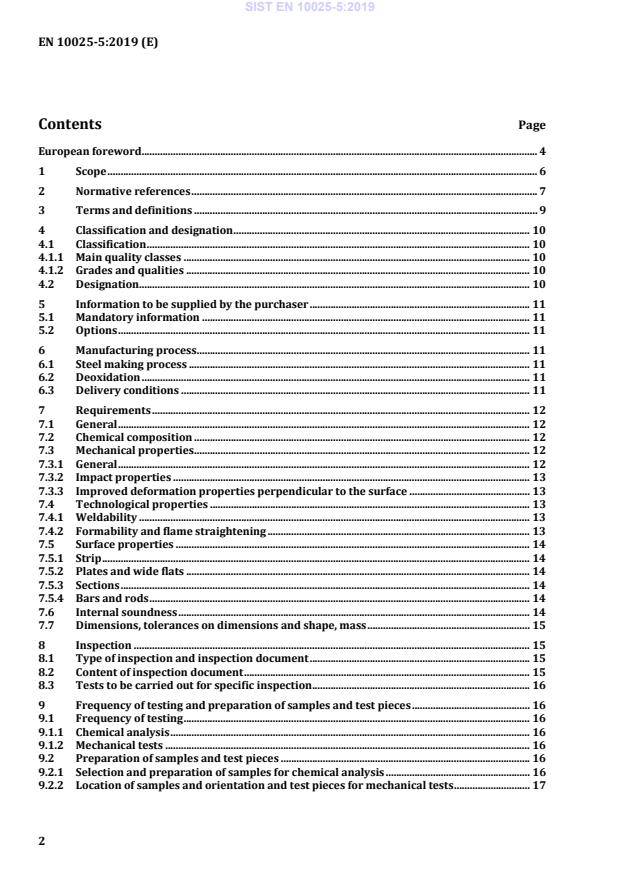
Contents Page
European foreword . 4
1 Scope . 6
2 Normative references . 7
3 Terms and definitions . 9
4 Classification and designation . 10
4.1 Classification . 10
4.1.1 Main quality classes . 10
4.1.2 Grades and qualities . 10
4.2 Designation. 10
5 Information to be supplied by the purchaser . 11
5.1 Mandatory information . 11
5.2 Options . 11
6 Manufacturing process . 11
6.1 Steel making process . 11
6.2 Deoxidation . 11
6.3 Delivery conditions . 11
7 Requirements . 12
7.1 General . 12
7.2 Chemical composition . 12
7.3 Mechanical properties . 12
7.3.1 General . 12
7.3.2 Impact properties . 13
7.3.3 Improved deformation properties perpendicular to the surface . 13
7.4 Technological properties . 13
7.4.1 Weldability . 13
7.4.2 Formability and flame straightening . 13
7.5 Surface properties . 14
7.5.1 Strip . 14
7.5.2 Plates and wide flats . 14
7.5.3 Sections . 14
7.5.4 Bars and rods . 14
7.6 Internal soundness . 14
7.7 Dimensions, tolerances on dimensions and shape, mass . 15
8 Inspection . 15
8.1 Type of inspection and inspection document . 15
8.2 Content of inspection document . 15
8.3 Tests to be carried out for specific inspection . 16
9 Frequency of testing and preparation of samples and test pieces . 16
9.1 Frequency of testing . 16
9.1.1 Chemical analysis . 16
9.1.2 Mechanical tests . 16
9.2 Preparation of samples and test pieces . 16
9.2.1 Selection and preparation of samples for chemical analysis . 16
9.2.2 Location of samples and orientation and test pieces for mechanical tests . 17
9.2.3 Preparation of test pieces for mechanical tests. 17
9.3 Identification of samples and test pieces . 18
10 Test methods . 18
10.1 Chemical analysis . 18
10.2 Mechanical tests . 18
10.2.1 Tensile test . 18
10.2.2 Impact test . 18
10.3 Ultrasonic testing . 19
10.4 Retests . 19
11 Marking, labelling, packaging . 19
12 Complaints . 19
13 Options . 20
Annex A (normative) Location of samples and test pieces . 29
Annex B (informative) Additional information for the use of steel with improved
atmospheric corrosion resistance . 32
Annex C (informative) Notes on fabrication . 33
C.1 Weldability . 33
C.2 Riveting and bolting . 33
Annex D (informative) List of Options of EN 10025-2 to −6 . 34
Bibliography . 36
European foreword
This document (EN 10025-5:2019) has been prepared by Technical Committee CEN/TC 459/SC 3
“Structural steels other than reinforcements”, the secretariat of which is held by DIN.
This European Standard shall be given the status of a national standard, either by publication of an
identical text or by endorsement, at the latest by February 2020 and conflicting national standards shall
be withdrawn at the latest by February 2020.
Attention is drawn to the possibility that some of the elements of this document may be the subject of
patent rights. CEN shall not be held responsible for identifying any or all such patent rights.
This document supersedes EN 10025-5:2004.
This document consists of the following parts, under the general title Hot rolled products of structural
steels:
— Part 1: General technical delivery conditions
— Part 2: Technical delivery conditions for non-alloy structural steels
— Part 3: Technical delivery conditions for normalized/normalized rolled weldable fine grain structural
steels
— Part 4: Technical delivery conditions for thermomechanical rolled weldable fine grain structural steels
— Part 5: Technical delivery conditions for structural steels with improved atmospheric corrosion
resistance
— Part 6: Technical delivery conditions for flat products of high yield strength structural steels in the
quenched and tempered condition
For a short transition period there will be a coexistence of EN 10025-1:2004 with EN 10025-2:2019 to -
EN 10025-6:2019, since the new EN 10025-1 has to fulfil the requirements of the CPR and will
therefore be published later. For this short transition period up-to-the publication of the next edition of
part 1 the following is to be taken into account for EN 10025-1:2004:
a) all dated and undated references to EN 10025-1:2004 to EN 10025-6:2004 are unchanged to this
version with following exception: In 9.2.2.1 the references are 8.3.1 and 8.3.2 instead of 8.4.1 and
8.4.2;
b) Clauses 5, 12 and 13 of EN 10025-1:2004 are no longer relevant.
The main changes with respect to the previous edition are listed below:
a) part 5 is now a stand-alone standard for technical delivery conditions including the preparation of
samples and test pieces, the test methods, the marking, labelling and packaging and the drawings;
b) for applications under the CPR this document and part 1 are to be used together;
c) requirements for elements not definded were added to 7.2.1 and 7.2.2;
d) Option 33 were added, Options 9 and 21 were deleted;
e) key to Figure A.1 was updated;
f) steel grades S355J4, S420J0W, S420J2W, S420J4W, S460J0W, S460J2W and S460J4W were added to
Tables 1 to 5;
g) Annex B concerning the corresponding EURONORMS deleted;
h) references were updated and document editorial revised.
According to the CEN-CENELEC Internal Regulations, the national standards organisations of the
following countries are bound to implement this European Standard: Austria, Belgium, Bulgaria,
Croatia, Cyprus, Czech Republic, Denmark, Estonia, Finland, Republic of North Macedonia, France,
Germany, Greece, Hungary, Iceland, Ireland, Italy, Latvia, Lithuania, Luxembourg, Malta, Netherlands,
Norway, Poland, Portugal, Romania, Serbia, Slovakia, Slovenia, Spain, Sweden, Switzerland, Turkey and
the United Kingdom.
1 Scope
This document specifies technical delivery conditions for flat and long products of hot rolled steels with
improved atmospheric corrosion resistance in the grades and qualities given in Tables 2 and 3
(chemical composition) and Tables 4 and 5 (mechanical properties) in the usual delivery conditions as
given in 6.3.
The thicknesses in which products of the steel grades and qualities specified in this document can be
supplied are given in Table 1.
Table 1 — Product forms for the different steel grades with improved atmospheric corrosion
resistance depending on their thickness
Designation Flat products Long products
Nominal thickness Sections Bars Rods
mm Nominal thickness or diameter
Steel name Steel number mm
≤ 12 ≤ 150 ≤ 63 ≤ 150 ≤ 60
S235J0W 1.8958 x x x x
S235J2W 1.8961 x x x x
S355J0WP 1.8945 x
S355J2WP 1.8946 x
S355J0W 1.8959 x x x x
S355J2W 1.8965 x x x x
S355K2W 1.8967 x x x x
S355J4W 1.8787 x x x x
S355J5W 1.8991 x
S420J0W 1.8943 x x
S420J2W 1.8949 x x
S420K2W 1.8997 x x
S420J4W 1.8954 x
S420J5W 1.8992 x
S460J0W 1.8966 x x
S460J2W 1.8980 x x
S460K2W 1.8990 x x
S460J4W 1.8981 x
S460J5W 1.8993 x
The steels specified in this document are not intended to be heat treated except products delivered in
the delivery condition +N. Stress relieving is accepted. Products delivered in +N condition can be hot
formed and/or normalized after delivery (see Clause 3).
2 Normative references
The following documents are referred to in the text in such a way that some or all of their content
constitutes requirements of this document. For dated references, only the edition cited applies. For
undated references, the latest edition of the referenced document (including any amendments) applies.
EN 10017, Steel rod for drawing and/or cold rolling — Dimensions and tolerances
EN 10020:2000, Definition and classification of grades of steel
EN 10021, General technical delivery conditions for steel products
EN 10024, Hot rolled taper flange I sections — Tolerances on shape and dimensions
EN 10025-1, Hot rolled products of structural steels — Part 1: General technical delivery conditions
EN 10027-1, Designation systems for steels — Part 1: Steel names
EN 10027-2, Designation systems for steels — Part 2: Numerical system
EN 10029, Hot-rolled steel plates 3 mm thick or above — Tolerances on dimensions and shape
EN 10034, Structural steel I and H sections — Tolerances on shape and dimensions
EN 10048, Hot rolled narrow steel strip — Tolerances on dimensions and shape
EN 10051, Continuously hot-rolled strip and plate/sheet cut from wide strip of non-alloy and alloy steels
— Tolerances on dimensions and shape
EN 10055, Hot rolled steel equal flange tees with radiused root and toes — Dimensions and tolerances on
shape and dimensions
EN 10056-1, Structural steel equal and unequal leg angles —Part 1: Dimensions
EN 10056-2, Structural steel equal and unequal leg angles — Part 2: Tolerances on shape and dimensions
EN 10058, Hot rolled flat steel bars and steel wide flats for general purposes — Dimensions and tolerances
on shape and dimensions
EN 10059, Hot rolled square steel bars for general purposes — Dimensions and tolerances on shape and
dimensions
EN 10060, Hot rolled round steel bars for general purposes — Dimensions and tolerances on shape and
dimensions
EN 10061, Hot rolled hexagon steel bars for general purposes — Dimensions and tolerances on shape and
dimensions
EN 10067, Hot rolled bulb flats — Dimensions and tolerances on shape, dimensions and mass
EN 10079, Definition of steel products
EN 10160, Ultrasonic testing of steel flat product of thickness equal or greater than 6 mm (reflection
method)
EN 10163-1, Delivery requirements for surface condition of hot-rolled steel plates, wide flats and sections
— Part 1: General requirements
EN 10163-2, Delivery requirements for surface condition of hot-rolled steel plates, wide flats and sections
— Part 2: Plate and wide flats
EN 10163-3, Delivery requirements for surface condition of hot-rolled steel plates, wide flats and sections
— Part 3: Sections
EN 10164, Steel products with improved deformation properties perpendicular to the surface of the
product — Technical delivery conditions
EN 10168, Steel products — Inspection documents — List of information and description
EN 10204, Metallic products — Types of inspection documents
EN 10279, Hot rolled steel channels — Tolerances on shape, dimensions and mass
EN 10306, Iron and steel — Ultrasonic testing of H beams with parallel flanges and IPE beams
EN 10308, Non destructive testing — Ultrasonic testing of steel bars
EN 10315, Routine method for analysis of high alloy steel by X-ray Fluorescence Spectrometry (XRF) by
using a near by technique
CR 10320, Optical emission analysis of low alloy steels (routine method) — Method for determination of C,
Si, S, P, Mn, Cr, Ni and Cu
CEN/TR 10347, Guidance for forming of structural steels in processing
EN 10363, Continuously hot-rolled patterned steel strip and plate/sheet cut from wide strip — Tolerances
on dimensions and shape
EN 10365, Hot rolled steel channels, I and H sections — Dimensions and masses
EN ISO 148-1, Metallic materials — Charpy pendulum impact test — Part 1: Test method (ISO 148-1)
EN ISO 377, Steel and steel products — Location and preparation of samples and test pieces for
mechanical testing (ISO 377)
EN ISO 2566-1, Steel — Conversion of elongation values — Part 1: Carbon and low alloy steels
(ISO 2566-1)
EN ISO 6892-1:2016, Metallic materials — Tensile testing — Part 1: Method of test at room temperature
(ISO 6892-1:2016)
EN ISO 9443, Surface quality classes for hot-rolled bars and wire rod (ISO 9443)
EN ISO 14284, Steel and iron — Sampling and preparation of samples for the determination of chemical
composition (ISO 14284)
EN ISO 15350, Steel and iron — Determination of total carbon and sulfur content — Infrared absorption
method after combustion in an induction furnace (routine method) (ISO 15350)
3 Terms and definitions
For the purposes of this document, the terms and definitions given in EN 10079 and the following apply.
ISO and IEC maintain terminological databases for use in standardization at the following addresses:
— IEC Electropedia: available at http://www.electropedia.org/
— ISO Online browsing platform: available at http://www.iso.org/obp
3.1
normalized rolled
+N
rolling process in which the final deformation is carried out in a certain temperature range leading to a
material condition equivalent to that obtained after normalizing so that the specified values of the
mechanical properties are retained even after normalizing
Note 1 to entry: In international publications for both the normalizing rolling, as well as the thermomechanical
rolling, the expression “controlled rolling” may be found. However in view of the different applicability of the
products a distinction of the terms is necessary.
3.2
as-rolled
+AR
conventional hot rolling without any normalized rolling or thermomechanical rolling and/or heat
treatment condition like normalizing or quenching
3.3
thermomechanical rolling
+M
rolling process in which the final deformation is carried out in a certain temperature range leading to a
material condition with certain properties which cannot be achieved or repeated by heat treatment
alone
Note 1 to entry: Thermomechanical rolling leading to the delivery condition +M can include processes with an
increasing cooling rate with or without tempering including self-tempering but excluding direct quenching and
quenching and tempering.
Note 2 to entry: In some publications the word TMCP (Thermomechanical Control Process) is also used.
3.4
normalizing
+N
heat treatment consisting of austenitizing followed by air cooling
3.5
steel with improved atmospheric corrosion resistance
steel in which a certain number of alloying elements, such as P, Cu, Cr, Ni, Mo, has been added in order
to increase its resistance to atmospheric corrosion, by forming an auto-protective oxide layer on the
base metal under the influence of weather conditions
Note 1 to entry: Steel with improved atmospheric corrosion resistance is often called weathering steel.
Note 2 to entry: Additional information for the use of steel with improved atmospheric corrosion resistance is
given in Annex B.
4 Classification and designation
4.1 Classification
4.1.1 Main quality classes
The steel grades specified in this document shall be classified as alloy special steels according to
EN 10020.
4.1.2 Grades and qualities
This document specifies four steel grades S235, S355, S420 and S460.
The steel grades may be supplied in different qualities. The qualities differ in specified impact energy
requirements (see Table 5).
Grade S355 is subdivided into the classes W and WP, which differ mainly in their carbon and
phosphorus contents (see Tables 2 and 3) and availability (see Table 1).
4.2 Designation
4.2.1 For the steel grades covered by this document the steel names shall be allocated in accordance
with EN 10027-1; the steel numbers shall be allocated in accordance with EN 10027-2.
4.2.2 The designation shall consist of:
— the number of this document (EN 10025-5);
— the steel name or the steel number; the steel name consisting of:
— symbol S (for structural steel);
— indication of the minimum specified yield strength for thickness ≤ 16 mm expressed in MPa;
— quality designation (see 4.1.2) in respect of specified impact energy values;
— letter W indicating that the steel has an improved atmospheric corrosion resistance;
— if applicable, the letter P for the class with a greater phosphorus content (only in the case of
grade S355);
— the indication “+N”, “+AR” or “+M”, when the products are ordered and delivered in the condition
+N, +AR or +M (see 3.1, 3.2, 3.3, 3.4 and 6.3). The indication “+N”, “+AR” or “+M” shall be added to
the steel name or steel number.
EXAMPLE Structural steel (S) with improved atmospheric corrosion resistance (W), with a specified
minimum yield strength at room temperature of 355 MPa with a minimum impact energy of 27 J at 0 °C (J0),
delivery condition +N:
EN 10025-5 - S355J0W+N
Or
EN 10025-5 - 1.8959+N
5 Information to be supplied by the purchaser
5.1 Mandatory information
The following information shall be supplied by the purchaser at the time of the order:
a) quantity to be delivered;
b) product form and the number of the standard for dimensions and tolerances(see 2.2);
c) nominal dimensions and tolerances on dimensions and shape (see 7.7.1);
d) steel designation (see 4.2.2);
e) additional requirements of inspection and testing and all required options (see 5.2 and Clause 13);
f) type of inspection document according to EN 10204 (see 8.1);
5.2 Options
A number of options are specified in Clause 13. In the event that the purchaser does not indicate his
wish to implement any of these options, the supplier shall supply in accordance with the basic
specification, see 5.1 a) to d) and f).
6 Manufacturing process
6.1 Steel making process
The steel making process is at the discretion of the manufacturer with the exclusion of the open hearth
(Siemens-Martin) process.
See Option 1, Clause 13 (details of manufacturing process).
6.2 Deoxidation
The deoxidation methods are designated as follows:
a) FN Rimming steel not permitted;
b) FF Fully killed steel containing nitrogen binding elements in amounts sufficient to bind
the available nitrogen (for example min. 0,020 % total aluminium). The usual
guideline is a minimum aluminium to nitrogen ratio of 2:1, when no other
nitrogen binding elements are present. Such other elements and their content (%
mass) shall be reported in the inspection document.
The method of deoxidation shall be as given in Table 2.
6.3 Delivery conditions
Unless otherwise agreed upon the delivery condition of products can be +AR, +N or +M at the
manufacturer's discretion.
See Option 19, Clause 13 (delivery condition +AR, +N or +M).
If an inspection document is required (see 8.1) the delivery condition shall be indicated in it with its
specific symbol (+AR, +N or +M). In case the products are ordered in the delivery condition +AR, +N or
+M the specific symbol (+AR, +N or +M) shall be added to the designation (see 4.2.2).
NOTE The requirements on the mechanical properties of the steel grades according to this document are not
depending on the delivery condition.
7 Requirements
7.1 General
The requirements in 7.2 and 7.3 apply for sampling, preparation of test pieces and testing specified in
Clauses 9 and 10.
7.2 Chemical composition
7.2.1 The chemical composition determined by heat analysis shall comply with the specified values of
Table 2.
For elements not defined in the table for the chemical composition for heat analysis, limit values of
Table 1 of EN 10020:2000 shall apply as maximum values.
7.2.2 The limits applicable for the product analysis are given in Table 3.
The product analysis shall be carried out when specified at the time of the order.
See Option 2, Clause 13 (product analysis).
For elements not defined in table for the chemical composition for product analysis, limit values of
Table 1 of EN 10020:2000 shall apply as maximum values.
7.2.3 The maximum carbon equivalent values based on the heat analysis given in Table 2 shall apply.
For determining the carbon equivalent value the following IIW (International Institute of Welding)
formula shall be used:
Cr++Mo V Ni+ Cu
Mn
CEV=C++ +
6 5 15
7.3 Mechanical properties
7.3.1 General
7.3.1.1 Under the inspection and testing conditions as specified in Clauses 8, 9 and 10 and in the
delivery condition as specified in 6.3 the mechanical properties shall comply with the values given in
Tables 4 and 5.
Stress relieving at more than 580 °C or for over 1 h can lead to a deterioration of the mechanical
properties of the steel grade. For normalized and normalized rolled flat products the maximum stress
relief temperature should be 560 °C. If the purchaser intends to stress relief the products at higher
temperatures or for longer times than mentioned above the minimum values of the mechanical
properties after such a treatment should be agreed upon at the time of the order.
7.3.1.2 For flat and bar products ordered and supplied in the normalized or normalized rolled
condition (delivery condition +N) the mechanical properties shall comply with the relevant tables for
mechanical properties in the normalized or normalized rolled condition or after normalizing by heat
treatment after delivery or after hot forming if the provisions of CEN/TR 10347 are satisfied.
Products can be susceptible to a deterioration in mechanical strength if they are subjected to incorrect
heat treatment processes at higher temperature such as flame straightening, rerolling, etc. Products in
the +N delivery condition are less sensitive than other delivery conditions, but it is recommended that
guidance is sought from the manufacturer if any higher temperature processing is required.
7.3.1.3 For flat products the nominal thickness applies. For long products of irregular section the
nominal thickness of that part from which the samples are taken applies (see Annex A).
7.3.2 Impact properties
7.3.2.1 The impact properties, except for steel grade S355 class WP, shall be verified by test at the
temperature given in Table 5, unless otherwise agreed upon at the time of the order.
The impact properties of steel grade S355 class WP are verified only when specified at the time of the
order.
See Option 3, Clause 13 (Verification of impact properties for qualities S355 class WP).
7.3.2.2 If specified at the time of the order for flat products of quality J2, J4, J5 and K2 out of each
parent plate or coil the impact properties only or the impact properties and the tensile properties shall
be verified.
See Option 13, Clause 13 (For flat products on each parent plate or coil impact properties only to be
verified).
See Option 14, Clause 13 (For flat products on each parent plate or coil impact and tensile properties to
be verified).
7.3.3 Improved deformation properties perpendicular to the surface
If agreed upon at the time of the order products shall comply with one of the requirements of EN 10164.
See Option 4, Clause 13 (Deformation properties perpendicular to the surface).
7.4 Technological properties
7.4.1 Weldability
The steels specified in this document do not have unlimited suitability for the various welding
processes, since the behaviour of a steel during and after welding depends not only on the material but
also on the dimensions and shape and on the manufacturing and service conditions of the components.
In Annex C, more information on weldability may be found.
7.4.2 Formability and flame straightening
7.4.2.1 General
Recommendations regarding hot forming, cold forming and flame straightening are laid out in
CEN/TR 10347.
7.4.2.2 Hot forming
Only products ordered and supplied in the normalized or normalized rolled condition shall comply with
the requirements of Tables 4 and 5 if hot forming is carried out after delivery (see 7.3.1.2).
NOTE The products ordered and supplied in the thermomechanical rolled and as-rolled condition are not
suitable for hot forming.
7.4.2.3 Cold formability
7.4.2.3.1 General
NOTE Cold forming leads to reduction in the ductility.
7.4.2.3.2 Flangeability
If specified at the time of the order, plate, sheet, strip, wide flats and flats (width < 150 mm) with a
nominal thickness ≤ 20 mm shall be suitable for flanging without cracking with the minimum
recommended bend radii given in Table 6. The grades and qualities to which this applies are given in
Table 6.
See Option 11, Clause 13 (Flangeability without cracking).
7.5 Surface properties
7.5.1 Strip
The surface condition should not impair an application appropriate to the steel grade if adequate
processing of the strip is applied.
7.5.2 Plates and wide flats
EN 10163-1 and EN 10163-2 shall apply for the permissible surface discontinuities and for the repair of
surface defects by grinding and/or welding. Class A, subclass 1 of EN 10163-2 shall apply, unless
otherwise agreed upon at the time of the order.
See Option 15, Clause 13 (Other surface class for plates and wide flats).
7.5.3 Sections
EN 10163-1 and EN 10163-3 shall apply for the permissible surface discontinuities and for the repair of
surface defects by grinding and/or welding. Class C, subclass 1 of EN 10163-3 shall apply, unless
otherwise agreed upon at the time of the order.
See Option 16, Clause 13 (Other surface class for sections).
7.5.4 Bars and rods
EN ISO 9443 applies for the permissible surface discontinuities and for the repair of surface defects by
grinding and/or welding. Class A of EN ISO 9443 shall apply, unless otherwise agreed upon at the time
of the order.
See Option 17, Clause 13 (Other surface class for bars and rods).
7.6 Internal soundness
Ultrasonic testing may be agreed upon at the time of the order and shall comply with 10.3.
See Option 6, Clause 13 (Ultrasonic testing for flat products).
See Option 7, Clause 13 (Ultrasonic testing for H beams with parallel flanges and IPE beams).
See Option 8, Clause 13 (Ultrasonic testing for bars).
7.7 Dimensions, tolerances on dimensions and shape, mass
7.7.1 Dimensions, tolerances on dimensions and shape shall be in accordance with the requirements
given in the order by reference to following standards: EN 10017, EN 10024, EN 10029, EN 10034,
EN 10048, EN 10051, EN 10055, EN 10056-1, EN 10056-2, EN 10058, EN 10059, EN 10060, EN 10061,
EN 10067, EN 10279, EN 10363 and EN 10365.
For hot rolled plate tolerances the basic requirements shall be in accordance with EN 10029, including
thickness tolerances to class A, unless otherwise agreed upon at the time of the order.
See Option 18, Clause 13 (For plates other thickness tolerance than class A).
For plates cut from continuously hot rolled strip, the thickness tolerances shall be in accordance with
EN 10051, unless otherwise agreed upon at the time of order.
See Option 34, Clause 13 (For plates cut from strip thickness tolerances according to EN 10029).
7.7.2 The nominal mass shall be determined from the nominal dimensions using a volumetric mass of
7 850 kg/m .
8 Inspection
8.1 Type of inspection and inspection document
The products shall be delivered either with specific or non-specific inspection and testing to indicate
compliance with the order and this document. The manufacturer shall obtain from the purchaser which
of the inspection documents specified in EN 10204 is required.
NOTE Some application standards, e.g. EN 1090-2, require particular inspection documents according to
EN 10204.
Unless otherwise agreed upon steel grades of this document are delivered with CE marking and they
shall not only fulfil these technical delivery conditions but also the requirements of EN 10025-1.
It can be agreed upon at the time of enquiry and order to abstain from CE-marking, see Option 33, in
this case EN 10025-1 does not apply.
See Option 33, Clause 13 (no application of CE-marking).
In case of specific inspection, testing shall be carried out according to the requirement of 8.3, Clause 9
and Clause 10.
8.2 Content of inspection document
The inspection document shall include, in accordance with EN 10168, the following codes and/or
information, where applicable:
A commercial transactions and parties involved;
B description of products to which the inspection document applies;
C00-C03 identification of the sample, location of the sample, direction of the test pieces, test
temperature;
C10-C13 shape of the test piece, yield or proof strength, tensile strength, elongation after
fracture;
C40-C43 type of test piece, width of test piece, individual values, mean value;
C70-C92 steelmaking process, chemical composition;
D other tests;
Z validation.
8.3 Tests to be carried out for specific inspection
8.3.1 The following tests shall be carried out:
— the heat analysis;
— the tensile test;
— for products of quality J0, J2 of the steel grade S235 and for all products of quality J0, J2, J4, J5 and
K2 of the steel grades S355, S420 and S460, class W, the impact test with thickness limitations as
specified in 9.2.3.3.
8.3.2 At the time of the order the following additional tests can be agreed upon (see also Clause 13):
a) the product analysis, see 7.2.2 and Option 2, Clause 13;
b) for all products of steel grade S355, class WP, the impact test, see 7.3.2.1 and Option 3, Clause 13.
9 Frequency of testing and preparation of samples and test pieces
9.1 Frequency of testing
9.1.1 Chemical analysis
The heat analysis shall be determined once per cast. If a product analysis has been agreed upon at the
time of enquiry and order, the purchaser shall specify the frequency if not once per cast.
9.1.2 Mechanical tests
The verification of the mechanical properties (tensile strength, yield strength, impact energy and
elongation) shall be by test unit(s) from within each cast.
For verifying the mechanical properties the following test unit shall apply:
— 60 tonnes or part thereof;
— 80 tonnes or part thereof for heavy sections with a mass > 200 kg/m;
— 80 tonnes or part thereof for all sections if the mass of the cast exceeds 200 tonnes.
The test unit shall contain products of the same form, grade and quality, delivery condition and of the
same thickness range as specified in Table 4 for the yield strength.
The following samples shall be taken from one sample product of each test unit:
— one sample for tensile testing;
— one sample sufficient for one set of six impact test pieces.
9.2 Preparation of samples and test pieces
9.2.1 Selection and preparation of samples for chemical analysis
The selection and preparation of samples for product analysis shall be in accordance with
EN ISO 14284.
9.2.2 Location of samples and orientation and test pieces for mechanical tests
The location of samples shall be as shown in Annex A.
In addition the samples shall be taken:
— from the thickest product in the test unit;
— from any product of the test unit for products in delivery condition +N (see 3.1, 3.4).
Additionally for plates, sheet, wide strip and wide flats the samples shall be taken so that the axes of the
test pieces are approximately midway between the edge and centre line of the products.
For wide strip and rod the sample shall be taken at an adequate distance from the end of the product.
For narrow strip (< 600 mm wide) the sample shall be taken at an adequate distance from the end of
the coil and at one third of the width.
9.2.3 Preparation of test pieces for mechanical tests
9.2.3.1 General
The requirements of EN ISO 377 shall apply.
9.2.3.2 Preparation of tensile test pieces
The requirements of EN ISO 6892-1 shall apply.
For flat products of nominal thickness > 30 mm a round test piece may be used with the longitudinal
axis at 1/4 thickness, if a testing machine with an adequate capacity is not available. In case of doubt or
dispute, results on full thickness of the product will prevail.
NOTE For bars round test pieces are commonly used but other forms are not prohibited (see EN ISO 6892-1).
9.2.3.3 Preparation of impact test pieces
V-notch test pieces shall be machined and prepared in accordance with EN ISO 148-1. In addition the
following requirements apply:
a) flat products and sections:
— for nominal thicknesses > 12 mm, standard 10 mm × 10 mm test pieces shall be machined in
such a way that one side is not further away than 2 mm from a rolled surface;
— for nominal thicknesses ≤ 12 mm, when test pieces with reduced widths are used, the largest
width possible has to be chosen;
— for nominal thickness < 6 mm no impact tests are required;
b) bars and rod:
— for nominal diameter ≥ 16 mm (round cross section) or nominal thickness ≥ 12 mm
(rectangular cross section), standard 10 mm × 10 mm test pieces shall be machined;
— for nominal diameter < 16 mm (round cross section) or nominal thickness < 12 mm
(rectangular cross section) no impact tests are required.
9.3 Identification of samples and test pieces
Samples and test pieces shall be marked so that the original products and their location and orientation
in the product are known.
10 Test methods
10.1 Chemical analysis
T
...
Questions, Comments and Discussion
Ask us and Technical Secretary will try to provide an answer. You can facilitate discussion about the standard in here.
Loading comments...