

oSIST prEN IEC 60695-1-12:2026
(Main)Fire hazard testing - Part 1-12: Guidance for assessing the fire hazard of electrotechnical products - Fire safety engineering
General Information
- Abstract
- Status
- Not Published
- Public Enquiry End Date
- 28-Feb-2026
- Technical Committee
- I09 - Imaginarni 09
- Current Stage
- 4020 - Public enquire (PE) (Adopted Project)
- Start Date
- 16-Dec-2025
- Due Date
- 05-May-2026
- Completion Date
- 25-Feb-2026

Overview
oSIST prEN IEC 60695-1-12:2026 - Fire hazard testing – Part 1-12: Guidance for assessing the fire hazard of electrotechnical products – Fire safety engineering is an international standard developed by the International Electrotechnical Commission (IEC) and CENELEC (CLC). This standard provides essential guidance for evaluating fire hazards related to electrotechnical products using fire safety engineering (FSE) methodologies. It emphasizes the role of scientific principles and engineering approaches in developing effective fire safety strategies, with the aim to protect life, property, and the environment.
As fire safety regulations become more rigorous worldwide, oSIST prEN IEC 60695-1-12:2026 supports manufacturers, engineers, and authorities in the systematic assessment of fire risks in electrical and electronic products. This guidance document forms part of the widely recognized IEC 60695 series on fire hazard testing.
Key Topics
Fire Safety Engineering (FSE) Process:
The standard outlines a systematic process for implementing fire safety engineering, including:- Identification and analysis of potential fire scenarios
- Application of engineering calculations and scientific data to predict fire behavior
- Validation of methods used in fire hazard assessments
Objectives of Fire Safety Engineering:
Guidance is provided to help organizations address the following core objectives:- Safety of life
- Conservation of property
- Continuity of operation
- Environmental protection
- Preservation of heritage
Performance Criteria and Functional Requirements:
The document distinguishes between explicit and implicit performance criteria to assess product safety thoroughly and ensure regulatory compliance.Design Fire Scenarios:
Practical approaches for developing design fire scenarios and design fires are discussed, given their importance in the accurate evaluation of fire risks associated with electrotechnical products.Data and Testing:
Recommendations for selecting and developing appropriate fire tests, including conditions for evaluation, are presented. The standard also addresses how to use data relevant to fire safety engineering and how to evaluate products both as potential ignition sources and as items at risk in fire scenarios.
Applications
The guidance in oSIST prEN IEC 60695-1-12:2026 is vital for various stakeholders involved in the design, manufacturing, testing, and certification of electrotechnical products, including:
Product Designers and Engineers:
Apply this standard to perform robust fire risk assessments, develop safer products, and implement compliant design strategies.Testing Laboratories:
Use the guidance to select suitable fire hazard tests and interpret results within the context of FSE principles.Manufacturers:
Leverage FSE to demonstrate compliance with local, national, and international fire safety requirements, thus facilitating market access and reducing liability risks.Regulatory Authorities and Inspectors:
Reference the standard to evaluate technical documentation and to ensure that essential fire protection objectives are met in the approval process.Environmental and Facility Managers:
Consider the broader impacts, such as environmental protection and operational continuity, when assessing fire hazards in installed electrical and electronic systems.
Related Standards
oSIST prEN IEC 60695-1-12:2026 is part of the IEC 60695 series addressing fire hazard testing for electrotechnical products. Related key standards include:
- IEC 60695-1-10: Guidance for assessing the fire hazard of electrotechnical products – General guidelines
- IEC 60695-1-11: Guidance for assessing the fire hazard of electrotechnical products – Fire hazard assessment
- IEC 60695-1-30: Guidance for preselection testing
- IEC 60695-1-40: Insulating liquids – Guidance for fire hazard assessment
Organizations are encouraged to use oSIST prEN IEC 60695-1-12:2026 in conjunction with related parts of the IEC 60695 series to ensure a comprehensive approach to fire safety assessment.
Keywords: fire hazard testing, electrotechnical products, fire safety engineering, IEC 60695-1-12, product safety, fire hazard assessment, standards compliance, FSE, regulatory approval, electrical safety
Relations
- Effective Date
- 19-Mar-2024
Get Certified
Connect with accredited certification bodies for this standard

IMQ S.p.A. (Certification)
Italian electrical product certification.

SLG Prüf- und Zertifizierungs GmbH
German testing and certification body.

UL Solutions
Global safety science company with testing, inspection and certification.
Sponsored listings
Frequently Asked Questions
oSIST prEN IEC 60695-1-12:2026 is a draft published by the Slovenian Institute for Standardization (SIST). Its full title is "Fire hazard testing - Part 1-12: Guidance for assessing the fire hazard of electrotechnical products - Fire safety engineering". This standard covers: Fire hazard testing - Part 1-12: Guidance for assessing the fire hazard of electrotechnical products - Fire safety engineering
Fire hazard testing - Part 1-12: Guidance for assessing the fire hazard of electrotechnical products - Fire safety engineering
oSIST prEN IEC 60695-1-12:2026 is classified under the following ICS (International Classification for Standards) categories: 13.220.40 - Ignitability and burning behaviour of materials and products; 29.020 - Electrical engineering in general. The ICS classification helps identify the subject area and facilitates finding related standards.
oSIST prEN IEC 60695-1-12:2026 has the following relationships with other standards: It is inter standard links to SIST EN IEC 60695-1-12:2020. Understanding these relationships helps ensure you are using the most current and applicable version of the standard.
oSIST prEN IEC 60695-1-12:2026 is available in PDF format for immediate download after purchase. The document can be added to your cart and obtained through the secure checkout process. Digital delivery ensures instant access to the complete standard document.
Standards Content (Sample)
SLOVENSKI STANDARD
01-februar-2026
Preskušanje požarne ogroženosti - 1-12. del: Navodilo za ocenjevanje požarne
varnosti elektrotehniških izdelkov - Požarno inženirstvo
Fire hazard testing - Part 1-12: Guidance for assessing the fire hazard of electrotechnical
products - Fire safety engineering
Prüfungen zur Beurteilung der Brandgefahr - Teil 1-12: Anleitung zur Beurteilung der
Brandgefahr von elektrotechnischen Erzeugnissen - Brandschutzingenieurwesen
Essais relatifs aux risques du feu - Partie 1-12: Lignes directrices pour l'évaluation des
risques du feu des produits électrotechniques - Ingénierie de la sécurité incendie
Ta slovenski standard je istoveten z: prEN IEC 60695-1-12:2025
ICS:
13.220.40 Sposobnost vžiga in Ignitability and burning
obnašanje materialov in behaviour of materials and
proizvodov pri gorenju products
29.020 Elektrotehnika na splošno Electrical engineering in
general
2003-01.Slovenski inštitut za standardizacijo. Razmnoževanje celote ali delov tega standarda ni dovoljeno.
89/1631/CDV
COMMITTEE DRAFT FOR VOTE (CDV)
PROJECT NUMBER:
IEC 60695-1-12 ED2
DATE OF CIRCULATION: CLOSING DATE FOR VOTING:
2025-12-12 2026-03-06
SUPERSEDES DOCUMENTS:
89/1595/CD, 89/1612/CC
IEC TC 89 : FIRE HAZARD TESTING
SECRETARIAT: SECRETARY:
Germany Mr Bernd Komanschek
OF INTEREST TO THE FOLLOWING COMMITTEES: HORIZONTAL FUNCTION(S):
TC 10,TC 23,SC 23A,TC 34,TC 46,TC 61,TC 99,TC
TC 89 Horizontal Basic Safety
104,TC 108,TC 112,SC 121A
ASPECTS CONCERNED:
Safety
SUBMITTED FOR CENELEC PARALLEL VOTING NOT SUBMITTED FOR CENELEC PARALLEL VOTING
Attention IEC-CENELEC parallel voting
The attention of IEC National Committees, members of
CENELEC, is drawn to the fact that this Committee Draft
for Vote (CDV) is submitted for parallel voting.
The CENELEC members are invited to vote through the
CENELEC online voting system.
This document is still under study and subject to change. It should not be used for reference purposes.
Recipients of this document are invited to submit, with their comments, notification of any relevant patent rights of
which they are aware and to provide supporting documentation.
Recipients of this document are invited to submit, with their comments, notification of any relevant “In Some
Countries” clauses to be included should this proposal proceed. Recipients are reminded that the CDV stage is the
final stage for submitting ISC clauses. (SEE AC/22/2007 OR NEW GUIDANCE DOC).
TITLE:
Fire hazard testing - Part 1-12: Guidance for assessing the fire hazard of electrotechnical
products - Fire safety engineering
PROPOSED STABILITY DATE: 2026
NOTE FROM TC/SC OFFICERS:
download this electronic file, to make a copy and to print out the content for the sole purpose of preparing National
Committee positions. You may not copy or "mirror" the file or printed version of the document, o r any part of it, for
any other purpose without permission in writing from IEC.
IEC CDV 60695-1-12 © IEC 2025
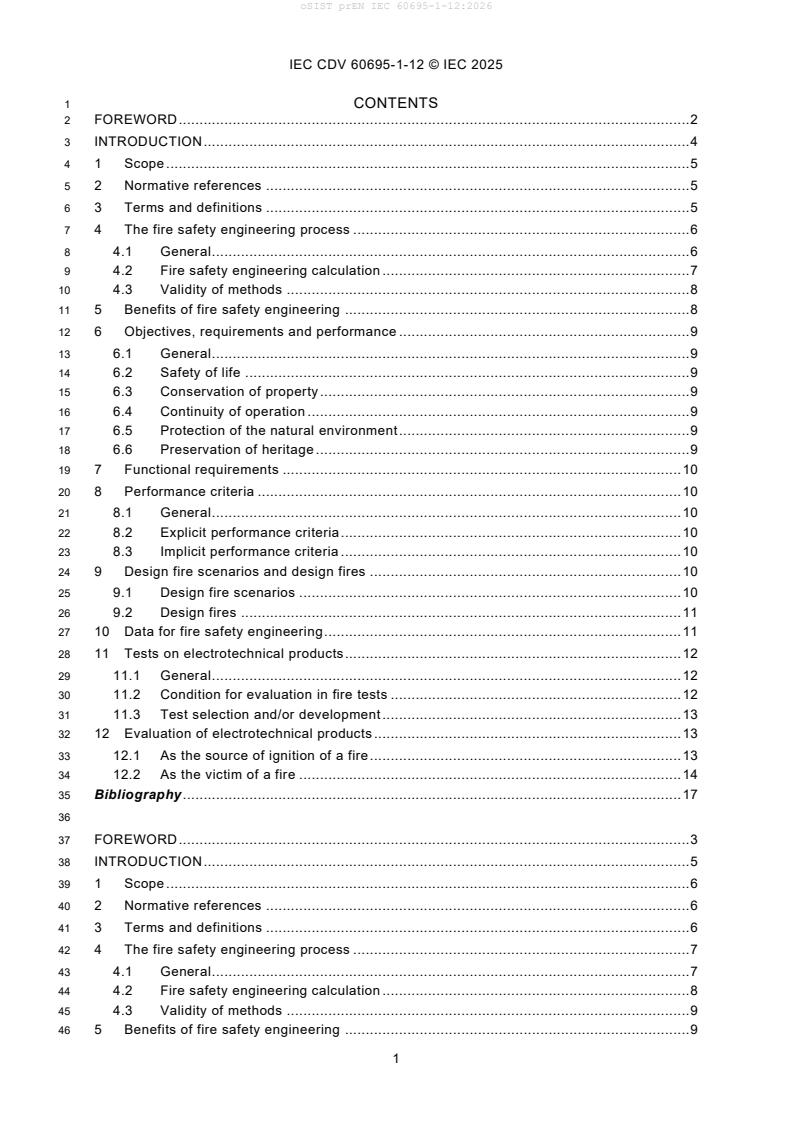
1 CONTENTS
2 FOREWORD . 2
3 INTRODUCTION . 4
4 1 Scope . 5
5 2 Normative references . 5
6 3 Terms and definitions . 5
7 4 The fire safety engineering process . 6
8 4.1 General . 6
9 4.2 Fire safety engineering calculation . 7
10 4.3 Validity of methods . 8
11 5 Benefits of fire safety engineering . 8
12 6 Objectives, requirements and performance . 9
13 6.1 General . 9
14 6.2 Safety of life . 9
15 6.3 Conservation of property . 9
16 6.4 Continuity of operation . 9
17 6.5 Protection of the natural environment . 9
18 6.6 Preservation of heritage . 9
19 7 Functional requirements . 10
20 8 Performance criteria . 10
21 8.1 General . 10
22 8.2 Explicit performance criteria . 10
23 8.3 Implicit performance criteria . 10
24 9 Design fire scenarios and design fires . 10
25 9.1 Design fire scenarios . 10
26 9.2 Design fires . 11
27 10 Data for fire safety engineering . 11
28 11 Tests on electrotechnical products . 12
29 11.1 General . 12
30 11.2 Condition for evaluation in fire tests . 12
31 11.3 Test selection and/or development . 13
32 12 Evaluation of electrotechnical products . 13
33 12.1 As the source of ignition of a fire . 13
34 12.2 As the victim of a fire . 14
35 Bibliography . 17
37 FOREWORD . 3
38 INTRODUCTION . 5
39 1 Scope . 6
40 2 Normative references . 6
41 3 Terms and definitions . 6
42 4 The fire safety engineering process . 7
43 4.1 General . 7
44 4.2 Fire safety engineering calculation . 8
45 4.3 Validity of methods . 9
46 5 Benefits of fire safety engineering . 9
IEC CDV 60695-1-12 © IEC 2025
47 6 Objectives, requirements and performance . 10
48 6.1 General . 10
49 6.2 Safety of life . 10
50 6.3 Conservation of property . 10
51 6.4 Continuity of operation . 10
52 6.5 Protection of the natural environment . 10
53 6.6 Preservation of heritage . 10
54 7 Functional requirements . 11
55 8 Performance criteria . 11
56 8.1 General . 11
57 8.2 Explicit performance criteria . 11
58 8.3 Implicit performance criteria . 11
59 9 Design fire scenarios and design fires . 11
60 9.1 Design fire scenarios . 11
61 9.2 Design fires . 12
62 10 Data for fire safety engineering . 12
63 11 Tests on electrotechnical products . 13
64 11.1 General . 13
65 11.2 Condition for evaluation in fire tests . 13
66 11.3 Test selection and/or development . 14
67 12 Evaluation of electrotechnical products . 14
68 12.1 As the source of ignition of a fire . 14
69 12.2 As the victim of a fire . 15
70 Bibliography . 18
71 Figure 1 - FSE process – Design, implementation and management………………………….8
IEC CDV 60695-1-12 © IEC 2025
74 INTERNATIONAL ELECTROTECHNICAL COMMISSION
75 ____________
77 FIRE HAZARD TESTING –
79 Part 1-12: Guidance for assessing the fire hazard of
80 electrotechnical products – Fire safety engineering
83 FOREWORD
84 1) The International Electrotechnical Commission (IEC) is a worldwide organization for standardization comprising
85 all national electrotechnical committees (IEC National Committees). The object of IEC is to promote international
86 co-operation on all questions concerning standardization in the electrical and electronic fields. To this end and
87 in addition to other activities, IEC publishes International Standards, Technical Specifications, Technical Reports,
88 Publicly Available Specifications (PAS) and Guides (hereafter referred to as “IEC Publication(s)”). Their
89 preparation is entrusted to technical committees; any IEC National Committee interested in the subject dealt with
90 may participate in this preparatory work. International, governmental and non-governmental organizations liaising
91 with the IEC also participate in this preparation. IEC collaborates closely with the International Organization for
92 Standardization (ISO) in accordance with conditions determined by agreement between the two organizations.
93 2) The formal decisions or agreements of IEC on technical matters express, as nearly as possible, an international
94 consensus of opinion on the relevant subjects since each technical committee has representation from all
95 interested IEC National Committees.
96 3) IEC Publications have the form of recommendations for international use and are accepted by IEC National
97 Committees in that sense. While all reasonable efforts are made to ensure that the technical content of IEC
98 Publications is accurate, IEC cannot be held responsible for the way in which they are used or for any
99 misinterpretation by any end user.
100 4) In order to promote international uniformity, IEC National Committees undertake to apply IEC Publications
101 transparently to the maximum extent possible in their national and regional publications. Any divergence between
102 any IEC Publication and the corresponding national or regional publication shall be clearly indicated in the latter.
103 5) IEC itself does not provide any attestation of conformity. Independent certification bodies provide conformity
104 assessment services and, in some areas, access to IEC marks of conformity. IEC is not responsible for any
105 services carried out by independent certification bodies.
106 6) All users should ensure that they have the latest edition of this publication.
107 7) No liability shall attach to IEC or its directors, employees, servants or agents including individual experts and
108 members of its technical committees and IEC National Committees for any personal injury, property damage or
109 other damage of any nature whatsoever, whether direct or indirect, or for costs (including legal fees) and
110 expenses arising out of the publication, use of, or reliance upon, this IEC Publication or any other IEC Publications.
111 8) Attention is drawn to the Normative references cited in this publication. Use of the referenced publications is
112 indispensable for the correct application of this publication.
113 9) IEC draws attention to the possibility that the implementation of this document may involve the use of (a) patent(s).
114 IEC takes no position concerning the evidence, validity or applicability of any claimed patent rights in respect
115 thereof. As of the date of publication of this document, IEC had not received notice of (a) patent(s), which may
116 be required to implement this document. However, implementers are cautioned that this may not represent the
117 latest information, which may be obtained from the patent database available at https://patents.iec.ch. IEC shall
118 not be held responsible for identifying any or all such patent rights.
119 International Standard IEC 60695-1-12 has been prepared by IEC technical committee 89: Fire
120 hazard testing. It is an International Standard.
121 It has the status of a basic safety publication in accordance with IEC Guide 104 and 106 ISO/IEC
122 Guide 51.
123 This second edition cancels and replaces the first edition published in 201 5. This edition
124 constitutes a technical revision.
125 This edition includes the following significant technical changes with respect to the previous
126 edition:
127 a) .; (TBD)
128 The text of this International Standard is based on the following documents:
IEC CDV 60695-1-12 © IEC 2025
FDIS Report on voting
XX/XX/FDIS XX/XX/RVD
130 Full information on the voting for its approval can be found in the report on voting indicated in
131 the above table.
132 The language used for the development of this International Standard is English.
133 This document has been drafted in accordance with the ISO/IEC Directives, Part 2 , and
134 developed in accordance with ISO/IEC Directives, Part 1 and ISO/IEC Directives, IEC
135 Supplement, available at www.iec.ch/members_experts/reference. The main document types
136 developed by IEC are described in greater detail at www.iec.ch/publications.
137 A list of all the parts in the 60695 series, under the general title Fire hazard testing, can be found on
138 the IEC web site.
139 IEC 60695-1 consists of the following parts:
140 Part 1-10: Guidance for assessing the fire hazard of electrotechnical products – General guidelines
141 Part 1-11: Guidance for assessing the fire hazard of electrotechnical products - Fire hazard
142 assessment
143 Part 1-12: Guidance for assessing the fire hazard of electrotechnical products - Fire safety engineering
144 Part 1-30: Guidance for assessing the fire hazard of electrotechnical products – Preselection testing
145 process – General guidelines
146 Part 1-40: Guidance for assessing the fire hazard of electrotechnical products – Insulating liquids.
147 This standard is to be used in conjunction with IEC 60695-1-10 and IEC 60695-1-11.
148 The committee has decided that the contents of this document will remain unchanged until the
149 stability date indicated on the IEC website under "http://webstore.iec.ch" in the data related to
150 the specific document. At this date, the document will be
151 • reconfirmed,
152 • withdrawn,
153 • replaced by a revised edition, or
154 • amended.
156 The National Committees are requested to note that for this document the stability date
157 is 2025.
158 THIS TEXT IS INCLUDED FOR THE INFORMATION OF THE NATIONAL COMMITTEES AND WILL BE DELETED
159 AT THE PUBLICATION STAGE.
IEC CDV 60695-1-12 © IEC 2025
161 INTRODUCTION
162 Fire safety engineering
163 Fire safety engineering (FSE) is the application of engineering methods based on scientific
164 principles to the development or assessment of designs in the built environment through the
165 analysis of specific fire scenarios or through the quantification of risk for a group of fire
166 scenarios.
167 Typical objectives of FSE are:
168 a) to protect life safety,
169 b) to protect property,
170 c) to maintain the continuity of operations,
171 d) to protect the natural environment, and
172 e) to preserve heritage.
173 The analysis of FSE is usually based on calculations that use input data obtained principally
174 from quantitative fire tests as described in IEC 60695-1-11.
175 Fire safety engineering (FSE) is a discipline increasingly being used in support of performance-
176 based national fire safety regulations in many states and regional jurisdictions throughout the
177 world. ISO 23932-1 [25], developed by ISO TC 92/SC 4, outlines the fundamental
178 methodologies and uses of FSE. Further detailed aspects of FSE are covered in ISO 16730 -1
179 [16], ISO 16732-1 [17], ISO 16733-1 [18], ISO 24678-2 [19], ISO 26678-3 [20], ISO 24678-4
180 [21] and ISO/TR 16738 [22].
181 In addition to performance-based regulations, many nations are also using FSE to supplement
182 prescriptive regulations by applying FSE principles to specific design aspects, where reduced
183 costs, alternative practices, improved performance and improved safety are the objectives.
184 The International Maritime Organization (IMO) is using FSE and the ISO standards mentioned
185 above to develop fire safety designs for ships as described in IMO MSC/Circ.1002 Guidelines
186 on alternative design and arrangement for fire safety [27]. These are considered to bring an
187 improvement on designs of electrotechnical products.
188 Qualitative and quantitative fire tests
189 Many standardized qualitative fire test methods give information on the performance of a
190 material or end product as measured in the test. Such information usually may not be related
191 to a real fire scenario or real installation practices. These qualitative fire test methods result in
192 a “pass” or “fail” and/or a product or material ranking. They play an important role in prescriptive
193 regulations, and the results of a qualitative test can be used indirectly in fire hazard assessment
194 of electrotechnical products, but they are not suitable for directly supporting performance -based
195 design.
196 Most standardized test methods developed by IEC TC 89 for electrotechnical products are of
197 the qualitative type. It is agreed within ISO TC 92 and IEC TC 89 that this type of fire test will
198 continue to be maintained and, where necessary, developed. It is recognized that, even if the
199 use of these standards is in prescriptive codes, product data from many of these standards may
200 be potentially adaptable for fire safety engineering purposes.
201 In contrast, quantitative fire tests are increasingly being developed and used, and these provide
202 data that can be inputs to fire safety engineering calculations.
203 Various quantitative fire tests have been developed by ISO TC 92 SC 1 Fire safety – Initiation
204 and growth of fire, some of which can be used to assess the performance of electrotechnical
205 products (see 9.4), and referred to in the series of IEC 60695, e.g. IEC /TS 60695-5-2 [1], IEC
206 60695-6-2 [2], IEC 60695-7-2 [3], IEC 60695-8-2 [4] and IEC 60695-9-2 [5].
IEC CDV 60695-1-12 © IEC 2025
208 FIRE HAZARD TESTNG
210 Part 1-12: Guidance for assessing the fire hazard of
211 electrotechnical products – Fire safety engineering
213 1 Scope
214 This part of IEC 60695 specifies methodologies of fire safety engineering for electrotechnical
215 products by providing:
216 – an explanation of the principles and uses of fire safety engineering;
217 – guidance on the use of fire safety engineering in the design of electrotechnical products;
218 – fire safety engineering terminology, and concepts;
219 – an indication of properties, data and tests needed for input into fire safety engineering
220 assessment; and
221 – informative references.
222 This document is intended to provide guidance for product committees on fire safety engineering
223 methods and performance-based tests for use in performance-based designs and fire hazard
224 assessments of electrotechnical materials, assemblies, products and systems. More detailed
225 information on fire safety engineering is contained in ISO 23932-1 [25].
226 NOTE Further detailed aspects of FSE are covered in ISO 16730-1 [16], ISO 16732-1 [17], ISO 16733-1 [18], ISO
227 24678-2 [19], ISO 26678-3 [20], ISO 24678-4 [21] and ISO/TR 16738 [22].
228 This basic safety publication is intended for use by technical committees in the preparation of standards
229 in accordance with the principles laid down in IEC Guide 104 and ISO/IEC Guide 51.
230 One of the responsibilities of a technical committee is, wherever applicable, to make use of basic safety
231 publications in the preparation of its publications. The requirements, test methods or test conditions of
232 this basic safety publication will not apply unless specifically referred to or included in the relevant
233 publications.
234 2 Normative references
235 The following documents are referred to in the text in such a way that some or all of
236 their content constitutes requirements of this document. For dated references, only the
237 edition cited applies. For undated references, the latest edition of the referenced
238 document (including any amendments) applies.
239 IEC 60695-1-10, Fire hazard testing – Part 1-10: Guidance for assessing the fire hazard of
240 electrotechnical products – General guidelines
241 IEC 60695-1-11, Fire hazard testing – Part 1-11: Guidance for assessing the fire hazard of
242 electrotechnical products – Fire hazard assessment
243 IEC 60695-4:2021, Fire hazard testing – Part 4: Terminology concerning fire tests for
244 electrotechnical products
245 ISO 13943:2017, Fire safety – Vocabulary
246 3 Terms and definitions
247 For the purposes of this document, the terms and definitions given in IEC 60695-4:2021
248 and ISO 13943:2017 apply.
249 ISO and IEC maintain terminological databases for use in standardization at the
250 following addresses:
251 • IEC Electropedia: available at http://www.electropedia.org/
IEC CDV 60695-1-12 © IEC 2025
252 • ISO Online browsing platform: available at http://www.iso.org/obp
253 4 The fire safety engineering process
254 4.1 General
255 Fire safety engineering has been developed and is continuing to be developed to enable the
256 design, implementation and maintenance of objects and structures in the built environment,
257 using scientific principles, so that defined fire safety engineering objectives can be met. In order
258 to do this, quantitative fire tests are used to provide input data for the necessary calculations.
259 When applied to a major project in the built environment, the fire engineering process is both
260 complex and comprehensive. A flow chart in Figure 1 illustrates an example of the fire safety
261 engineering process.
262 The process will encompass many different issues, for example; architectural design, structural
263 design, ventilation, plumbing and electrical infrastructure. The fire safety of electrotechnical
264 products is therefore only one aspect of a much larger process.
265 Fire safety engineering should be used when safety objectives cannot adequately be met by
266 prescriptive requirements, and can also be used in parallel with prescriptive requirements e.g.
267 to support, from a scientific point of view, that such requirements are valid, or to further improve
268 the fire safety of the product.
IEC CDV 60695-1-12 © IEC 2025
Set SE pro ect scope
Identify fire safety ob ectives
Identify functional re uirements
Select risk analysis approach
Identify performance criteria
Does
yes
no
life cycle
Create fire safety design plan
analysis show
changes
Determine design scenarios
E ecute fire safety management
Select engineering methods
Implement fire safety design plan
Evaluate design
Document in final report
no
no yes
yes Are other
Are performance
S s affected
criteria satisfied
270 Figure 1 – FSE process – Design, implementation and management
271 (Figure 1 in ISO 23932-1)
272 4.2 Fire safety engineering calculation
273 These calculations can range from the solution of simple equations to very complex computer
274 models. For example, they could be used to calculate pipe sizes for sprinkler systems, or they
275 could be used to calculate the structural response of a load bearing building element, such as
276 a beam or a column, from a knowledge of the material properties at elevated temperatures, the
277 predicted temperatures reached in the fire and the applied loads.
278 At another level, requiring the use of integrated computer programs, these can be applied to
279 the evaluation of the life safety consequences of a specified fire, which would involve definition
oundaries of analysis
IEC CDV 60695-1-12 © IEC 2025
280 of the context, the product designs, the structures, the scenarios, and then calculation of the
281 resulting hazards.
282 An electrotechnical example would be to assess the risks associated with cable fires in the built
283 environment using quantified data of fire growth, flame spread, smoke and toxic gas generation
284 of electric cables as well as the prediction of people movement.
285 NOTE A study at Lund University [28] simulated the escape phase in an occupied furnished building considering two
286 different cable installations but with various fire scenarios and means of evacuation. Cables with widely differing
287 material properties were chosen, not necessarily representing installed cables. The study aimed at illustrating the
288 power of modelling tools (simulation and FSE approach) rather than a practical selection study.
289 At a more strategic level, fire safety engineering can be applied by using a package of tests
290 and measures to a variety of different fire scenarios. Computer fire models have been
291 developed with four-dimensional animations (time and space) simulating multiple fire dynamics
292 over a range of fire scenarios, and structure responses (See an example in [29]).
293 4.3 Validity of methods
294 The fire safety engineering process should be based on sound fire science and engineering
295 practice incorporating widely accepted methods, empirical data, calculations, correlation, and
296 computer models as contained in engineering textbooks and technical literature. There are
297 numerous technical resources that may be of use in a particular fire safety design. Therefore,
298 it is very important that fire safety engineers and other members of the design team determine
299 the acceptability of the sources and methodologies used for the applications in which they are
300 used.
301 When determining the validity of a resource, it is helpful to know the process through which the
302 resource was developed, reviewed, and validated. For example, many fire safety codes and
303 standards for fire safety are developed under an open consensus process conducted by
304 recognized professional societies, code-making organizations, or governmental bodies. Other
305 technical references are subject to a peer review process, such as many of the technical and
306 engineering journals available. Also, engineering handbooks and textbooks provide widely
307 recognized and t
...