

SIST EN 300 433-2 V1.3.1:2011
(Main)Electromagnetic compatibility and Radio spectrum Matters (ERM) - Citizens' Band (CB) radio equipment - Part 2: Harmonized EN covering the essential requirements of article 3.2 of the R&TTE Directive
- Abstract
Update/revision making to bring in line with latest guidance on creation of HENs. Amend test approaches. New revised standard should support also FM modulation for more simple conformity assessment procedure of combined AM/FM equipment.
- Status
- Published
- Public Enquiry End Date
- 31-Oct-2010
- Publication Date
- 04-Aug-2011
- Technical Committee
- MOC - Mobile Communications
- Current Stage
- 6060 - National Implementation/Publication (Adopted Project)
- Start Date
- 21-Jul-2011
- Due Date
- 25-Sep-2011
- Completion Date
- 05-Aug-2011
- Mandate
- M/284
Buy Documents
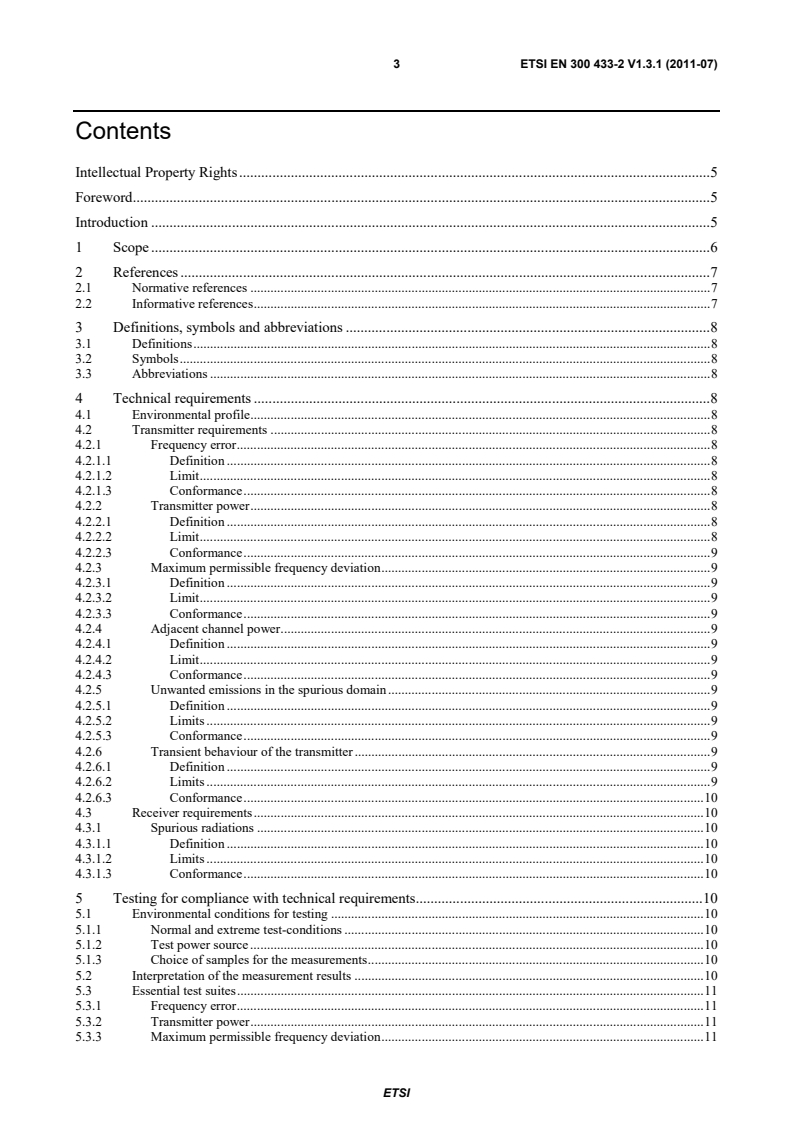
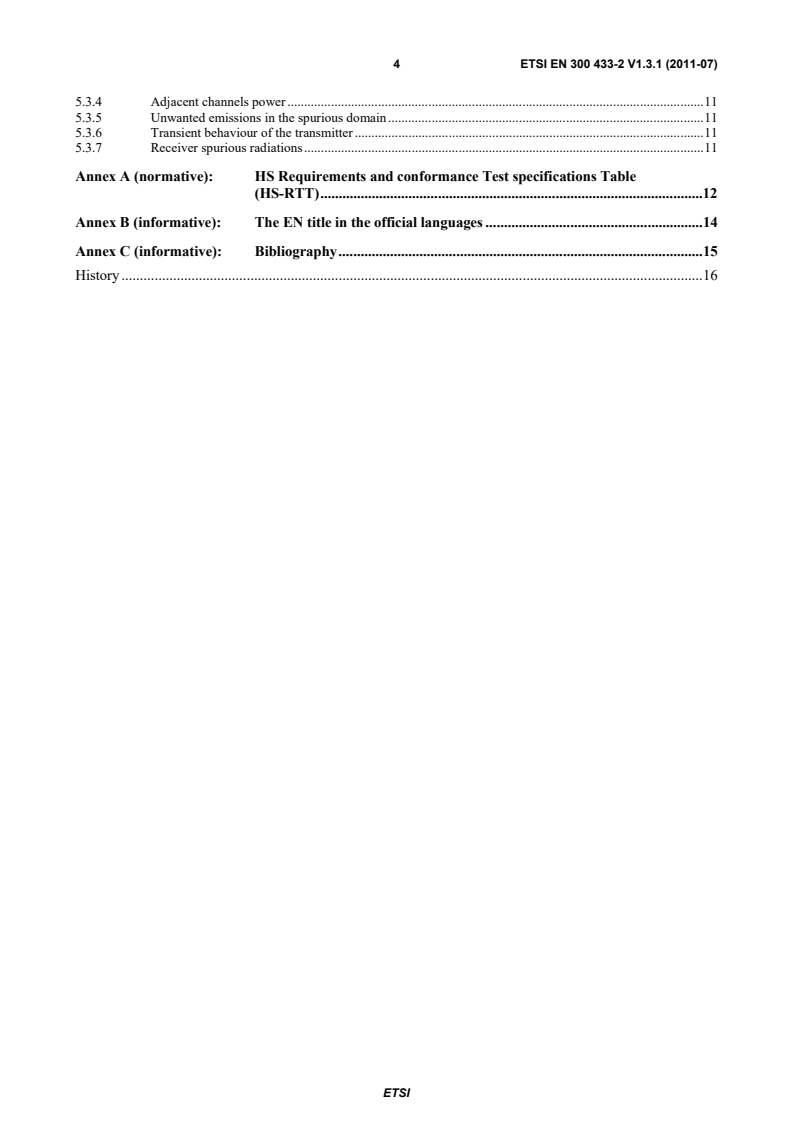
en_30043302v010301p - Electromagnetic compatibility and Radio spectrum Matters (ERM); Citizens' Band (CB) radio equipment; Part 2: Harmonized EN covering the essential requirements of article 3.2 of the R&TTE Directive
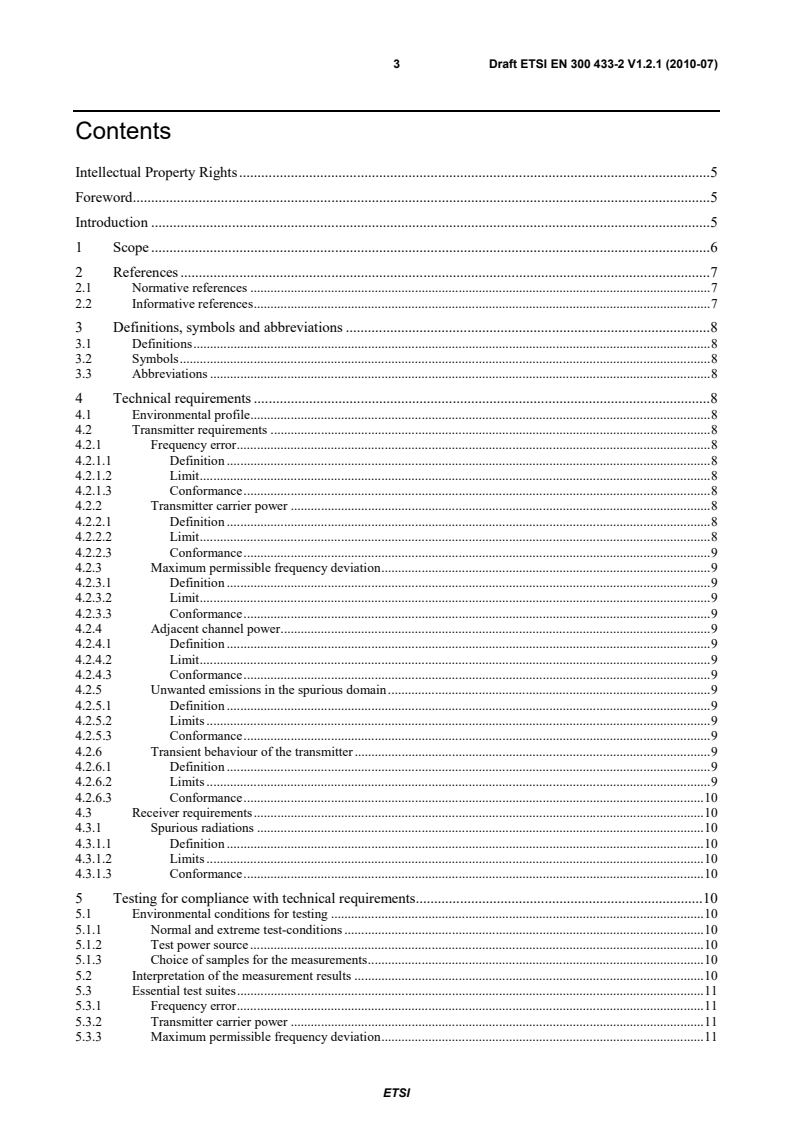
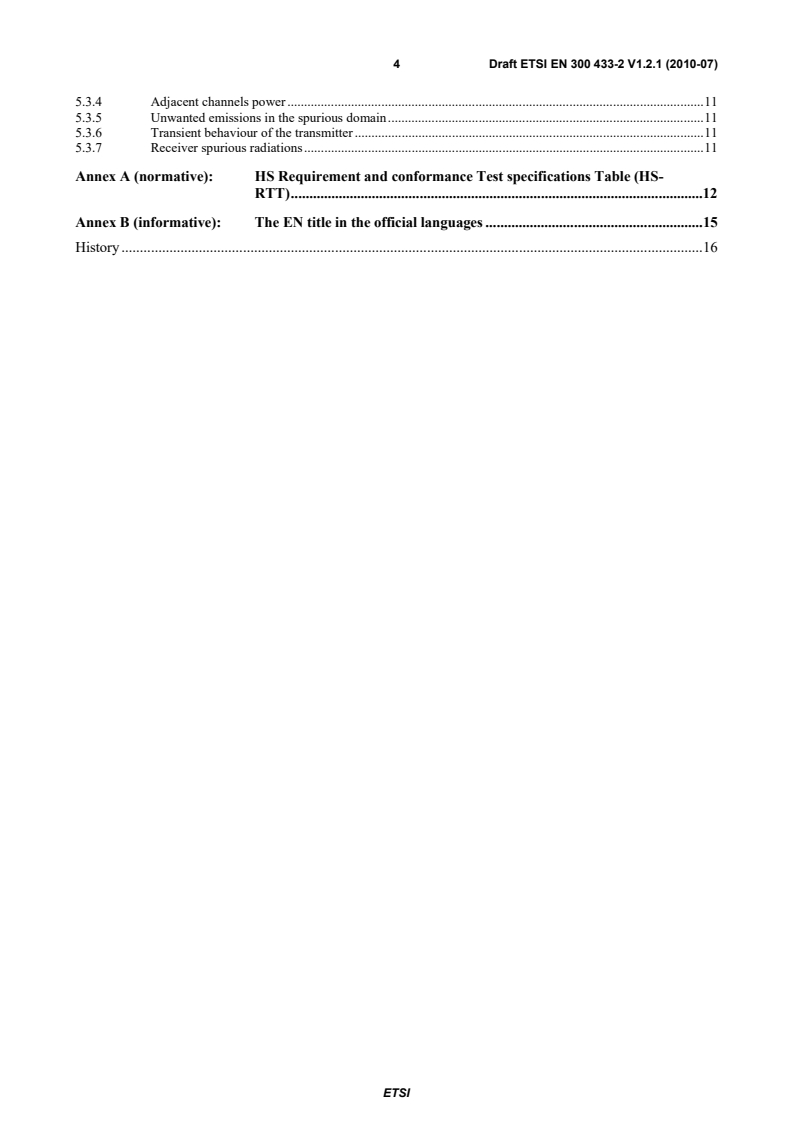
ETSI EN 300 433-2 V1.2.1 (2010-07) - Electromagnetic compatibility and Radio spectrum Matters (ERM); Land Mobile Service; Citizens' Band (CB) radio equipment; Part 2: Harmonized EN covering the essential requirements of article 3.2 of the R&TTE Directive
en_30043302v010301v - Electromagnetic compatibility and Radio spectrum Matters (ERM); Citizens' Band (CB) radio equipment; Part 2: Harmonized EN covering the essential requirements of article 3.2 of the R&TTE Directive

SIST EN 300 433-2 V1.3.1:2011 is the Slovenian adoption of ETSI EN 300 433-2 V1.3.1, published by SIST. It is a Harmonized European Standard for Citizens' Band (CB) radio equipment and addresses the essential requirements of article 3.2 of the R&TTE Directive for spectrum use. Manufacturers, test laboratories, and conformity assessors use it to check whether CB transmitters and receivers meet the radio spectrum requirements that support presumption of conformity.
What does SIST EN 300 433-2 V1.3.1:2011 specify?
SIST EN 300 433-2 V1.3.1:2011 specifies the technical requirements and compliance tests for CB radio equipment operating in the 26,960 MHz to 27,410 MHz band with 10 kHz channel spacing. It applies to angle modulated, Double Side Band (DSB) modulated, and/or Single Side Band (SSB) modulated equipment intended for analogue speech and/or data transmission.
The scope covers base stations, mobile stations, and hand portable stations when they have an antenna connector or a permanent or temporary internal 50 ohm RF connector that gives access to transmitter output and receiver input. Hand portable equipment without an external or accessible internal RF connector is outside the scope.
The document is organized into clauses for scope, references, definitions, technical requirements, and testing, followed by three annexes.
| Annex | What it covers |
|---|---|
| Annex A | HS Requirements and conformance Test specifications Table (HS-RTT) for article 3.2 conformity |
| Annex B | EN title in the official languages |
| Annex C | Bibliography |
What are the key requirements of SIST EN 300 433-2 V1.3.1:2011?
SIST EN 300 433-2 V1.3.1:2011 sets transmitter and receiver requirements by pointing back to the detailed definitions and limit values in EN 300 433-1. In practice, this means the supplier must show that the equipment stays within the referenced limits under the declared operating conditions and that the test report records the uncertainty of measurement.
- Environmental profile, clause 4.1 - The equipment has to meet the technical requirements throughout its declared operational environmental profile. For a reader, this means test conditions must match the intended use environment, not only ideal laboratory conditions.
- Frequency error, clause 4.2.1 - The transmitter frequency must stay within the referenced limit. If adjacent channel power was not measured under extreme conditions, the standard calls for the frequency error conformance test in clause 5.3.1.
- Transmitter power, clause 4.2.2 - The transmitter power must not exceed the referenced limit, and clause 5.3.2 gives the conformance test. This matters because output power affects both coverage and interference risk.
- Maximum permissible frequency deviation, clause 4.2.3 - The deviation must stay within the referenced limit and is checked by the test in clause 5.3.3. This is important for modulation quality and spectrum occupation.
- Adjacent channel power and unwanted emissions, clauses 4.2.4 and 4.2.5 - These limits control how much energy spills into neighboring channels and the spurious domain. Clause 5.3.4 and 5.3.5 define the corresponding tests, which is what laboratories use to judge interference potential.
- Transient behaviour of the transmitter, clause 4.2.6 - This applies to equipment with cyclic keying during data transmission and an external antenna connector, as identified in Annex A. The test in clause 5.3.6 checks switching behavior that can create short interference bursts.
- Receiver spurious radiations, clause 4.3.1 - Clause 5.3.7 covers the receiver emissions that can escape from the equipment. This matters when the receiver itself could disturb nearby services.
- Measurement uncertainty, clause 5.2 - The test report must include uncertainty for each measured parameter, and the uncertainty must meet the stated limits. This helps buyers and auditors judge whether a pass result is technically credible.
What terms does SIST EN 300 433-2 V1.3.1:2011 define?
SIST EN 300 433-2 V1.3.1:2011 uses the definitions, symbols, and abbreviations from EN 300 433-1. The following terms are especially useful when reading the scope and test table:
- CB - Citizens' Band radio equipment, the class of radio equipment covered by the standard.
- DSB - Double Side Band modulation, one of the modulation types in scope.
- SSB - Single Side Band modulation, another modulation type in scope.
- R&TTE Directive - The EU directive whose article 3.2 spectrum requirement this standard supports.
- ERM - Electromagnetic compatibility and Radio spectrum Matters, the ETSI technical area named in the title.
- HS-RTT - Harmonized Standard Requirements and conformance Test specifications Table, the Annex A matrix that links requirements to tests.
- EN 300 433-1 - The companion Part 1 standard that supplies technical characteristics, methods of measurement, limits, and common definitions.
Who uses SIST EN 300 433-2 V1.3.1:2011?
SIST EN 300 433-2 V1.3.1:2011 is used by manufacturers of CB radio equipment, test houses, and conformity assessment teams that need to show article 3.2 compliance. It is also useful for quality managers and technical buyers who need to understand what evidence is expected for type approval or technical file preparation.
The standard is most relevant when the equipment is a base, mobile, or hand portable station with accessible RF connections, because those are the device types the scope addresses. It gives these users a common test basis for transmitter and receiver performance, especially where mixed-mode or combined AM/FM equipment is being assessed.
What changed in SIST EN 300 433-2 V1.3.1:2011 from the previous edition?
The foreword says the significant changes from the previous version are the inclusion of angle modulated CB equipment and the adaptation of maximum transmitter power levels. The scope statement also says the revision was updated to follow the latest guidance for creating harmonized ENs, to amend test approaches, and to support FM modulation for simpler conformity assessment of combined AM/FM equipment.
Which standards are used with SIST EN 300 433-2 V1.3.1:2011?
| Reference | What it contributes |
|---|---|
| ETSI EN 300 433-1 (V1.3.1) | Technical characteristics, methods of measurement, definitions, symbols, abbreviations, and the detailed limits used throughout this part |
| ETSI TR 100 028 (V1.4.1) | Principles for calculating measurement uncertainty |
| ETSI EN 300 135-1 (V1.2.1) | Related CB radio equipment standard for angle-modulated land mobile service equipment |
| ETSI EG 201 399 (V2.1.1) | Guidance on producing candidate Harmonized Standards |
| Directive 1999/5/EC | The R&TTE Directive whose article 3.2 requirement this EN addresses |
What does the SIST EN 300 433-2 V1.3.1:2011 document contain?
SIST EN 300 433-2 V1.3.1:2011 contains the scope, references, definitions, technical requirements, and compliance testing framework for CB radio equipment. Clause 1 includes the carrier-frequency table for the channel plan, and clause 5 sets the environmental conditions, measurement uncertainty rules, and the essential test suites.
Annex A provides the HS-RTT table that maps each requirement to its test specification and marks requirements as unconditional or conditional. Annex B gives the official-language titles, and Annex C lists the bibliography used for background and context.
Buy Documents
en_30043302v010301p - Electromagnetic compatibility and Radio spectrum Matters (ERM); Citizens' Band (CB) radio equipment; Part 2: Harmonized EN covering the essential requirements of article 3.2 of the R&TTE Directive
ETSI EN 300 433-2 V1.2.1 (2010-07) - Electromagnetic compatibility and Radio spectrum Matters (ERM); Land Mobile Service; Citizens' Band (CB) radio equipment; Part 2: Harmonized EN covering the essential requirements of article 3.2 of the R&TTE Directive
en_30043302v010301v - Electromagnetic compatibility and Radio spectrum Matters (ERM); Citizens' Band (CB) radio equipment; Part 2: Harmonized EN covering the essential requirements of article 3.2 of the R&TTE Directive
Get Certified
Connect with accredited certification bodies for this standard

ANCE
Mexican certification and testing association.

Intertek Slovenia
Intertek testing, inspection, and certification services in Slovenia.

LNE (Laboratoire National de Métrologie et d'Essais)
French national laboratory for metrology and testing.
Sponsored listings
Frequently Asked Questions
SIST EN 300 433-2 V1.3.1:2011 is a standard published by the Slovenian Institute for Standardization (SIST). Its full title is "Electromagnetic compatibility and Radio spectrum Matters (ERM) - Citizens' Band (CB) radio equipment - Part 2: Harmonized EN covering the essential requirements of article 3.2 of the R&TTE Directive". This standard covers: Update/revision making to bring in line with latest guidance on creation of HENs. Amend test approaches. New revised standard should support also FM modulation for more simple conformity assessment procedure of combined AM/FM equipment.
Update/revision making to bring in line with latest guidance on creation of HENs. Amend test approaches. New revised standard should support also FM modulation for more simple conformity assessment procedure of combined AM/FM equipment.
SIST EN 300 433-2 V1.3.1:2011 is classified under the following ICS (International Classification for Standards) categories: 33.060.99 - Other equipment for radiocommunications; 33.100.01 - Electromagnetic compatibility in general. The ICS classification helps identify the subject area and facilitates finding related standards.
SIST EN 300 433-2 V1.3.1:2011 is associated with the following European legislation: EU Directives/Regulations: 1999/5/EC, TRRTP124; Standardization Mandates: M/284. When a standard is cited in the Official Journal of the European Union, products manufactured in conformity with it benefit from a presumption of conformity with the essential requirements of the corresponding EU directive or regulation.
SIST EN 300 433-2 V1.3.1:2011 is available in PDF format for immediate download after purchase. The document can be added to your cart and obtained through the secure checkout process. Digital delivery ensures instant access to the complete standard document.
Standards Content (Sample)
Contents
- Introduction
- 6 ETSI EN 300 433-2 V1.3.1 (2011-07)
- 1 Scope
- 7 ETSI EN 300 433-2 V1.3.1 (2011-07)
- 2 References
- 2.1 Normative references
- 2.2 Informative references
- 8 ETSI EN 300 433-2 V1.3.1 (2011-07)
- 3 Definitions, symbols and abbreviations
- 3.1 Definitions
- 3.2 Symbols
- 3.3 Abbreviations
- 4 Technical requirements
- 4.1 Environmental profile
- 4.2 Transmitter requirements
- 9 ETSI EN 300 433-2 V1.3.1 (2011-07)
- 10 ETSI EN 300 433-2 V1.3.1 (2011-07)
- 4.3 Receiver requirements
- 5 Testing for compliance with technical requirements
- 5.1 Environmental conditions for testing
- 5.2 Interpretation of the measurement results
- 11 ETSI EN 300 433-2 V1.3.1 (2011-07)
- 5.3 Essential test suites
- 12 ETSI EN 300 433-2 V1.3.1 (2011-07)
- 13 ETSI EN 300 433-2 V1.3.1 (2011-07)
- 14 ETSI EN 300 433-2 V1.3.1 (2011-07)
- 15 ETSI EN 300 433-2 V1.3.1 (2011-07)
- Bibliography
- 16 ETSI EN 300 433-2 V1.3.1 (2011-07)
Introduction
The present document is part of a set of standards developed by ETSI and is designed to fit in a modular structure to cover all radio and telecommunications terminal equipment within the scope of the R&TTE Directive [i.2]. The modular structure is shown in EG 201 399 [i.3].
ETSI
6 ETSI EN 300 433-2 V1.3.1 (2011-07)
1 Scope
The present document covers the technical requirements for transmitters and receivers used in stations of angle modulated, Double Side Band (DSB) modulated and/or Single Side Band (SSB) modulated Citizens' Band (CB) radio equipment operating in all or part of the frequency band 26,960 MHz to 27,410 MHz with a channel spacing of 10 kHz, and intended for analogue speech and/or data transmission.
Citizens' Band radio equipment operation is in accordance with Draft ECC Decision on the harmonised use of frequencies for Citizens' Band (CB) radio equipment [i.5].
The equipment operates on one or more channels of the carrier frequencies as shown in table 1. Table 1: Carrier frequencies Carrier Channel Carrier frequencies Channel frequencies Number Number 26,965 MHz 1 27,215 MHz 21 26,975 MHz 2 27,225 MHz 22 26,985 MHz 3 27,235 MHz 24 27,005 MHz 4 27,245 MHz 25 27,015 MHz 5 27,255 MHz 23 27,025 MHz 6 27,265 MHz 26 27,035 MHz 7 27,275 MHz 27 27,055 MHz 8 27,285 MHz 28 27,065 MHz 9 27,295 MHz 29 27,075 MHz 10 27,305 MHz 30 27,085 MHz 11 27,315 MHz 31 27,105 MHz 12 27,325 MHz 32 27,115 MHz 13 27,335 MHz 33 27,125 MHz 14 27,345 MHz 34 27,433 MHz 15 27,355 MHz 35 27,155 MHz 16 27,365 MHz 36 27,165 MHz 17 27,375 MHz 37 27,175 MHz 18 27,385 MHz 38 27,185 MHz 19 27,395 MHz 39 27,205 MHz 20 27,405 MHz 40
Transmission and reception takes place on the same channel (single frequency simplex mode). Any equipment using national regulations on Citizens' Band (CB) permitting the use of channels outside of the carrier frequencies shown in table 1 within the frequency range from 26 MHz to 28 MHz can use the present document. The types of equipment covered by the present document are as follows:
- Base station: equipment fitted with antenna connector;
- Mobile station: equipment fitted with antenna connector.
- Hand portable stations:
a) Either fitted with an antenna connector; or b) Without an external antenna connector but fitted with a permanent internal or a temporary internal 50 ohm RF connector which allows access to the transmitter output and the receiver input. Hand portable station equipment without an external or internal Radio Frequency (RF) connector and without the possibility of having a temporary internal 50 ohm RF connector is not covered by the present document. The present document is intended to cover the provisions of Article 3.2, of Directive 1999/5/EC [i.2] (R&TTE Directive), which states that "… radio equipment shall be so constructed that it effectively uses the spectrum allocated to terrestrial/space radio communications and orbital resources so as to avoid harmful interference." ETSI
7 ETSI EN 300 433-2 V1.3.1 (2011-07)
In addition to the present document, other ENs that specify technical requirements in respect of essential requirements under other parts of Article 3 of the R&TTE Directive [i.2] may apply to equipment within the scope of the present document.
NOTE: A list of such ENs is included on the web site http://www.newapproach.org.
2 References
References are either specific (identified by date of publication and/or edition number or version number) or non-specific. For specific references, only the cited version applies. For non-specific references, the latest version of the reference document (including any amendments) applies.
Referenced documents which are not found to be publicly available in the expected location might be found at http://docbox.etsi.org/Reference.
NOTE: While any hyperlinks included in this clause were valid at the time of publication ETSI cannot guarantee their long term validity.
2.1 Normative references
The following referenced documents are necessary for the application of the present document. [1] ETSI EN 300 433-1 (V1.3.1): "Electromagnetic compatibility and Radio spectrum Matters (ERM); Citizens' Band (CB) radio equipment; Part 1: Technical characteristics and methods of measurement".
[2] ETSI TR 100 028 (V1.4.1) (all parts): "Electromagnetic compatibility and Radio spectrum Matters (ERM); Uncertainties in the measurement of mobile radio equipment characteristics".
2.2 Informative references
The following referenced documents are not necessary for the application of the present document but they assist the user with regard to a particular subject area.
[i.1] Directive 98/34/EC of the European Parliament and of the Council of 22 June 1998 laying down a procedure for the provision of information in the field of technical standards and regulations. [i.2] Directive 1999/5/EC of the European Parliament and of the Council of 9 March 1999 on radio equipment and telecommunications terminal equipment and the mutual recognition of their conformity (R&TTE Directive).
[i.3] ETSI EG 201 399 (V2.1.1): "Electromagnetic compatibility and Radio spectrum Matters (ERM); A guide to the production of candidate Harmonized Standards for application under the R&TTE Directive".
[i.4] ETSI EN 300 135-1 (V1.2.1): "Electromagnetic compatibility and Radio spectrum Matters (ERM); Land Mobile Service; Citizens' Band (CB) radio equipment; Angle-modulated Citizens' Band radio equipment (PR 27 Radio Equipment); Part 1: Technical characteristics and methods of measurement".
[i.5] FM38(10)37rev2: "Draft ECC/DEC/(11)XX on the harmonised use of frequencies for Citizens' Band (CB) radio equipment".
ETSI
8 ETSI EN 300 433-2 V1.3.1 (2011-07)
3 Definitions, symbols and abbreviations
3.1 Definitions
For the purposes of the present document, the terms and definitions given in EN 300 433-1 [1] apply.
3.2 Symbols
For the purposes of the present document, the symbols given in EN 300 433-1 [1] apply.
3.3 Abbreviations
For the purposes of the present document, the abbreviations given in EN 300 433-1 [1] apply.
...
Contents
- Introduction
- 6 Draft ETSI EN 300 433-2 V1.2.1 (2010-07)
- 1 Scope
- 7 Draft ETSI EN 300 433-2 V1.2.1 (2010-07)
- 2 References
- 2.1 Normative references
- 2.2 Informative references
- 8 Draft ETSI EN 300 433-2 V1.2.1 (2010-07)
- 3 Definitions, symbols and abbreviations
- 3.1 Definitions
- 3.2 Symbols
- 3.3 Abbreviations
- 4 Technical requirements
- 4.1 Environmental profile
- 4.2 Transmitter requirements
- 9 Draft ETSI EN 300 433-2 V1.2.1 (2010-07)
- 10 Draft ETSI EN 300 433-2 V1.2.1 (2010-07)
- 4.3 Receiver requirements
- 5 Testing for compliance with technical requirements
- 5.1 Environmental conditions for testing
- 5.2 Interpretation of the measurement results
- 11 Draft ETSI EN 300 433-2 V1.2.1 (2010-07)
- 5.3 Essential test suites
- 12 Draft ETSI EN 300 433-2 V1.2.1 (2010-07)
- 13 Draft ETSI EN 300 433-2 V1.2.1 (2010-07)
- 14 Draft ETSI EN 300 433-2 V1.2.1 (2010-07)
- 15 Draft ETSI EN 300 433-2 V1.2.1 (2010-07)
- 16 Draft ETSI EN 300 433-2 V1.2.1 (2010-07)
Introduction
The present document is part of a set of standards developed by ETSI and is designed to fit in a modular structure to cover all radio and telecommunications terminal equipment within the scope of the R&TTE Directive. The modular structure is shown in EG 201 399 [i.3].
ETSI
6 Draft ETSI EN 300 433-2 V1.2.1 (2010-07)
1 Scope
The present document covers the technical requirements for transmitters and receivers used in stations of angle modulated, Double Side Band (DSB) modulated and/or Single Side Band (SSB) modulated Citizens' Band (CB) radio equipment operating in all or part of the frequency band 26,960 MHz to 27,410 MHz with a channel spacing of 10 kHz, and intended for analogue speech and/or data transmission.
Angle modulated Citizens' Band radio equipment (PR 27) operation is in accordance with ERC Decision (98)11 [i.5]. The equipment operates on one or more channels of the carrier frequencies as shown in table 1. Table 1: Carrier frequencies Carrier Channel Carrier frequencies Channel frequencies Number Number 26,965 MHz 1 27,215 MHz 21 26,975 MHz 2 27,225 MHz 22 26,985 MHz 3 27,235 MHz 24 27,005 MHz 4 27,245 MHz 25 27,015 MHz 5 27,255 MHz 23 27,025 MHz 6 27,265 MHz 26 27,035 MHz 7 27,275 MHz 27 27,055 MHz 8 27,285 MHz 28 27,065 MHz 9 27,295 MHz 29 27,075 MHz 10 27,305 MHz 30 27,085 MHz 11 27,315 MHz 31 27,105 MHz 12 27,325 MHz 32 27,115 MHz 13 27,335 MHz 33 27,125 MHz 14 27,345 MHz 34 27,433 MHz 15 27,355 MHz 35 27,155 MHz 16 27,365 MHz 36 27,165 MHz 17 27,375 MHz 37 27,175 MHz 18 27,385 MHz 38 27,185 MHz 19 27,395 MHz 39 27,205 MHz 20 27,405 MHz 40
Transmission and reception takes place on the same channel (single frequency simplex mode). Any equipment using national regulations on Citizens' Band (CB) permitting the use of channels outside of the carrier frequencies shown in table 1 within the frequency range from 26 MHz to 28 MHz can use the present document. The types of equipment covered by the present document are as follows:
- Base station: equipment fitted with antenna connector;
- Mobile station: equipment fitted with antenna connector.
- Hand portable stations:
a) Either fitted with an antenna connector; or b) Without an external antenna connector but fitted with a permanent internal or a temporary internal 50 ohm RF connector which allows access to the transmitter output and the receiver input. Hand portable station equipment without an external or internal Radio Frequency (RF) connector and without the possibility of having a temporary internal 50 ohm RF connector is not covered by the present document. The present document is intended to cover the provisions of Article 3.2, of Directive 1999/5/EC [i.2] (R&TTE Directive), which states that "… radio equipment shall be so constructed that it effectively uses the spectrum allocated to terrestrial/space radio communications and orbital resources so as to avoid harmful interference." ETSI
7 Draft ETSI EN 300 433-2 V1.2.1 (2010-07)
In addition to the present document, other ENs that specify technical requirements in respect of essential requirements under other parts of Article 3 of the R&TTE Directive [i.2] may apply to equipment within the scope of the present document.
NOTE: A list of such ENs is included on the web site http://www.newapproach.org.
2 References
References are either specific (identified by date of publication and/or edition number or version number) or non-specific. For specific references, only the cited version applies. For non-specific references, the latest version of the reference document (including any amendments) applies.
Referenced documents which are not found to be publicly available in the expected location might be found at http://docbox.etsi.org/Reference.
NOTE: While any hyperlinks included in this clause were valid at the time of publication ETSI cannot guarantee their long term validity.
2.1 Normative references
The following referenced documents are necessary for the application of the present document. [1] ETSI EN 300 433-1 (V1.2.1): "Electromagnetic compatibility and Radio spectrum Matters (ERM); Land Mobile Service; Citizens' Band (CB) radio equipment; Part 1: Technical characteristics and methods of measurement".
[2] ETSI TR 100 028 (all parts): "Electromagnetic compatibility and Radio spectrum Matters (ERM); Uncertainties in the measurement of mobile radio equipment characteristics".
2.2 Informative references
The following referenced documents are not necessary for the application of the present document but they assist the user with regard to a particular subject area.
[i.1] Directive 98/34/EC of the European Parliament and of the Council of 22 June 1998 laying down a procedure for the provision of information in the field of technical standards and regulations. [i.2] Directive 1999/5/EC of the European Parliament and of the Council of 9 March 1999 on radio equipment and telecommunications terminal equipment and the mutual recognition of their conformity (R&TTE Directive).
[i.3] ETSI EG 201 399 (V2.1.1): "Electromagnetic compatibility and Radio spectrum Matters (ERM); A guide to the production of candidate Harmonized Standards for application under the R&TTE Directive".
[i.4] ETSI EN 300 135-1(V1.2.1): "Electromagnetic compatibility and Radio spectrum Matters (ERM); Land Mobile Service; Citizens' Band (CB) radio equipment; Angle-modulated Citizens' Band radio equipment (PR 27 Radio Equipment); Part 1: Technical characteristics and methods of measurement".
[i.5] ERC/DEC/(98)11: "ERC Decision of 23 November 1998 on the harmonised frequency band to be designated for CEPT PR 27 radio equipment and on the implementation of the technical standard for this equipment".
ETSI
8 Draft ETSI EN 300 433-2 V1.2.1 (2010-07)
3 Definitions, symbols and abbreviations
3.1 Definitions
For the purposes of the present document, the terms and definitions given in EN 300 433-1 [1] apply.
3.2 Symbols
For the purposes of the present document, the symbols given in EN 300 433-1 [1] apply.
3.3 Abbreviations
For the purposes of the present document, the abbreviations given in EN 300 433-1 [1] apply.
...
Contents
- Introduction
- 6 Final draft ETSI EN 300 433-2 V1.3.1 (2011-05)
- 1 Scope
- 7 Final draft ETSI EN 300 433-2 V1.3.1 (2011-05)
- 2 References
- 2.1 Normative references
- 2.2 Informative references
- 8 Final draft ETSI EN 300 433-2 V1.3.1 (2011-05)
- 3 Definitions, symbols and abbreviations
- 3.1 Definitions
- 3.2 Symbols
- 3.3 Abbreviations
- 4 Technical requirements
- 4.1 Environmental profile
- 4.2 Transmitter requirements
- 9 Final draft ETSI EN 300 433-2 V1.3.1 (2011-05)
- 10 Final draft ETSI EN 300 433-2 V1.3.1 (2011-05)
- 4.3 Receiver requirements
- 5 Testing for compliance with technical requirements
- 5.1 Environmental conditions for testing
- 5.2 Interpretation of the measurement results
- 11 Final draft ETSI EN 300 433-2 V1.3.1 (2011-05)
- 5.3 Essential test suites
- 12 Final draft ETSI EN 300 433-2 V1.3.1 (2011-05)
- 13 Final draft ETSI EN 300 433-2 V1.3.1 (2011-05)
- 14 Final draft ETSI EN 300 433-2 V1.3.1 (2011-05)
- 15 Final draft ETSI EN 300 433-2 V1.3.1 (2011-05)
- 16 Final draft ETSI EN 300 433-2 V1.3.1 (2011-05)
- Bibliography
- 17 Final draft ETSI EN 300 433-2 V1.3.1 (2011-05)
Introduction
The present document is part of a set of standards developed by ETSI and is designed to fit in a modular structure to cover all radio and telecommunications terminal equipment within the scope of the R&TTE Directive [i.2]. The modular structure is shown in EG 201 399 [i.3].
ETSI
6 Final draft ETSI EN 300 433-2 V1.3.1 (2011-05)
1 Scope
The present document covers the technical requirements for transmitters and receivers used in stations of angle modulated, Double Side Band (DSB) modulated and/or Single Side Band (SSB) modulated Citizens' Band (CB) radio equipment operating in all or part of the frequency band 26,960 MHz to 27,410 MHz with a channel spacing of 10 kHz, and intended for analogue speech and/or data transmission.
Citizens' Band radio equipment operation is in accordance with Draft ECC Decision on the harmonised use of frequencies for Citizens' Band (CB) radio equipment [i.5].
The equipment operates on one or more channels of the carrier frequencies as shown in table 1. Table 1: Carrier frequencies Carrier Channel Carrier frequencies Channel frequencies Number Number 26,965 MHz 1 27,215 MHz 21 26,975 MHz 2 27,225 MHz 22 26,985 MHz 3 27,235 MHz 24 27,005 MHz 4 27,245 MHz 25 27,015 MHz 5 27,255 MHz 23 27,025 MHz 6 27,265 MHz 26 27,035 MHz 7 27,275 MHz 27 27,055 MHz 8 27,285 MHz 28 27,065 MHz 9 27,295 MHz 29 27,075 MHz 10 27,305 MHz 30 27,085 MHz 11 27,315 MHz 31 27,105 MHz 12 27,325 MHz 32 27,115 MHz 13 27,335 MHz 33 27,125 MHz 14 27,345 MHz 34 27,433 MHz 15 27,355 MHz 35 27,155 MHz 16 27,365 MHz 36 27,165 MHz 17 27,375 MHz 37 27,175 MHz 18 27,385 MHz 38 27,185 MHz 19 27,395 MHz 39 27,205 MHz 20 27,405 MHz 40
Transmission and reception takes place on the same channel (single frequency simplex mode). Any equipment using national regulations on Citizens' Band (CB) permitting the use of channels outside of the carrier frequencies shown in table 1 within the frequency range from 26 MHz to 28 MHz can use the present document. The types of equipment covered by the present document are as follows:
- Base station: equipment fitted with antenna connector;
- Mobile station: equipment fitted with antenna connector.
- Hand portable stations:
a) Either fitted with an antenna connector; or b) Without an external antenna connector but fitted with a permanent internal or a temporary internal 50 ohm RF connector which allows access to the transmitter output and the receiver input. Hand portable station equipment without an external or internal Radio Frequency (RF) connector and without the possibility of having a temporary internal 50 ohm RF connector is not covered by the present document. The present document is intended to cover the provisions of Article 3.2, of Directive 1999/5/EC [i.2] (R&TTE Directive), which states that "… radio equipment shall be so constructed that it effectively uses the spectrum allocated to terrestrial/space radio communications and orbital resources so as to avoid harmful interference." ETSI
7 Final draft ETSI EN 300 433-2 V1.3.1 (2011-05)
In addition to the present document, other ENs that specify technical requirements in respect of essential requirements under other parts of Article 3 of the R&TTE Directive [i.2] may apply to equipment within the scope of the present document.
NOTE: A list of such ENs is included on the web site http://www.newapproach.org.
2 References
References are either specific (identified by date of publication and/or edition number or version number) or non-specific. For specific references, only the cited version applies. For non-specific references, the latest version of the reference document (including any amendments) applies.
Referenced documents which are not found to be publicly available in the expected location might be found at http://docbox.etsi.org/Reference.
NOTE: While any hyperlinks included in this clause were valid at the time of publication ETSI cannot guarantee their long term validity.
2.1 Normative references
The following referenced documents are necessary for the application of the present document. [1] ETSI EN 300 433-1 (V1.3.1): "Electromagnetic compatibility and Radio spectrum Matters (ERM); Citizens' Band (CB) radio equipment; Part 1: Technical characteristics and methods of measurement".
[2] ETSI TR 100 028 (V1.4.1) (all parts): "Electromagnetic compatibility and Radio spectrum Matters (ERM); Uncertainties in the measurement of mobile radio equipment characteristics".
2.2 Informative references
The following referenced documents are not necessary for the application of the present document but they assist the user with regard to a particular subject area.
[i.1] Directive 98/34/EC of the European Parliament and of the Council of 22 June 1998 laying down a procedure for the provision of information in the field of technical standards and regulations. [i.2] Directive 1999/5/EC of the European Parliament and of the Council of 9 March 1999 on radio equipment and telecommunications terminal equipment and the mutual recognition of their conformity (R&TTE Directive).
[i.3] ETSI EG 201 399 (V2.1.1): "Electromagnetic compatibility and Radio spectrum Matters (ERM); A guide to the production of candidate Harmonized Standards for application under the R&TTE Directive".
[i.4] ETSI EN 300 135-1 (V1.2.1): "Electromagnetic compatibility and Radio spectrum Matters (ERM); Land Mobile Service; Citizens' Band (CB) radio equipment; Angle-modulated Citizens' Band radio equipment (PR 27 Radio Equipment); Part 1: Technical characteristics and methods of measurement".
[i.5] FM38(10)37rev2: "Draft ECC/DEC/(11)XX on the harmonised use of frequencies for Citizens' Band (CB) radio equipment".
ETSI
8 Final draft ETSI EN 300 433-2 V1.3.1 (2011-05)
3 Definitions, symbols and abbreviations
3.1 Definitions
For the purposes of the present document, the terms and definitions given in EN 300 433-1 [1] apply.
3.2 Symbols
For the purposes of the present document, the symbols given in EN 300 433-1 [1] apply.
3.3 Abbreviations
For the purposes of the present document, the abbreviations given in EN 300 433-1 [1] apply.
4 Technical requirements
4.1 Environmental profile
The technical requirements of the present document apply under the environmental profile for operation of the equipment, which shall be determined by the environmental class of the equipment. The equipment shall comply with all the technical requirements of the present document at all times when operating within the boundary limits of the required operational environmental profile.
...
2003-01.Slovenski inštitut za standardizacijo. Razmnoževanje celote ali delov tega standarda ni dovoljeno.Electromagnetic compatibility and Radio spectrum Matters (ERM) - Citizens' Band (CB) radio equipment - Part 2: Harmonized EN covering the essential requirements of article 3.2 of the R&TTE Directive33.100.01Elektromagnetna združljivost na splošnoElectromagnetic compatibility in general33.060.99Druga oprema za radijske komunikacijeOther equipment for radiocommunicationsICS:Ta slovenski standard je istoveten z:EN 300 433-2 Version 1.3.1SIST EN 300 433-2 V1.3.1:2011en01-september-2011SIST EN 300 433-2 V1.3.1:2011SLOVENSKI
STANDARD
ETSI ETSI EN 300 433-2 V1.3.1 (2011-07) 2
Reference REN/ERM-TGDMR-266-2 Keywords CB, radio, regulation, testing ETSI 650 Route des Lucioles F-06921 Sophia Antipolis Cedex - FRANCE
Tel.: +33 4 92 94 42 00
Fax: +33 4 93 65 47 16
Siret N° 348 623 562 00017 - NAF 742 C Association à but non lucratif enregistrée à la Sous-Préfecture de Grasse (06) N° 7803/88
Important notice Individual copies of the present document can be downloaded from: http://www.etsi.org The present document may be made available in more than one electronic version or in print. In any case of existing or perceived difference in contents between such versions, the reference version is the Portable Document Format (PDF). In case of dispute, the reference shall be the printing on ETSI printers of the PDF version kept on a specific network drive within ETSI Secretariat. Users of the present document should be aware that the document may be subject to revision or change of status. Information on the current status of this and other ETSI documents is available at http://portal.etsi.org/tb/status/status.asp If you find errors in the present document, please send your comment to one of the following services: http://portal.etsi.org/chaircor/ETSI_support.asp Copyright Notification No part may be reproduced except as authorized by written permission. The copyright and the foregoing restriction extend to reproduction in all media.
© European Telecommunications Standards Institute 2011. All rights reserved.
DECTTM, PLUGTESTSTM, UMTSTM and the ETSI logo are Trade Marks of ETSI registered for the benefit of its Members. 3GPPTM and LTE™ are Trade Marks of ETSI registered for the benefit of its Members and of the 3GPP Organizational Partners. GSM® and the GSM logo are Trade Marks registered and owned by the GSM Association. SIST EN 300 433-2 V1.3.1:2011
ETSI ETSI EN 300 433-2 V1.3.1 (2011-07) 3 Contents Intellectual Property Rights . 5 Foreword . 5 Introduction . 5 1 Scope . 6 2 References . 7 2.1 Normative references . 7 2.2 Informative references . 7 3 Definitions, symbols and abbreviations . 8 3.1 Definitions . 8 3.2 Symbols . 8 3.3 Abbreviations . 8 4 Technical requirements . 8 4.1 Environmental profile . 8 4.2 Transmitter requirements . 8 4.2.1 Frequency error . 8 4.2.1.1 Definition . 8 4.2.1.2 Limit . 8 4.2.1.3 Conformance . 8 4.2.2 Transmitter power . 8 4.2.2.1 Definition . 8 4.2.2.2 Limit . 8 4.2.2.3 Conformance . 9 4.2.3 Maximum permissible frequency deviation . 9 4.2.3.1 Definition . 9 4.2.3.2 Limit . 9 4.2.3.3 Conformance . 9 4.2.4 Adjacent channel power . 9 4.2.4.1 Definition . 9 4.2.4.2 Limit . 9 4.2.4.3 Conformance . 9 4.2.5 Unwanted emissions in the spurious domain . 9 4.2.5.1 Definition . 9 4.2.5.2 Limits . 9 4.2.5.3 Conformance . 9 4.2.6 Transient behaviour of the transmitter . 9 4.2.6.1 Definition . 9 4.2.6.2 Limits . 9 4.2.6.3 Conformance . 10 4.3 Receiver requirements . 10 4.3.1 Spurious radiations . 10 4.3.1.1 Definition . 10 4.3.1.2 Limits . 10 4.3.1.3 Conformance . 10 5 Testing for compliance with technical requirements . 10 5.1 Environmental conditions for testing . 10 5.1.1 Normal and extreme test-conditions . 10 5.1.2 Test power source . 10 5.1.3 Choice of samples for the measurements . 10 5.2 Interpretation of the measurement results . 10 5.3 Essential test suites . 11 5.3.1 Frequency error . 11 5.3.2 Transmitter power . 11 5.3.3 Maximum permissible frequency deviation . 11 SIST EN 300 433-2 V1.3.1:2011
ETSI ETSI EN 300 433-2 V1.3.1 (2011-07) 4 5.3.4 Adjacent channels power . 11 5.3.5 Unwanted emissions in the spurious domain . 11 5.3.6 Transient behaviour of the transmitter . 11 5.3.7 Receiver spurious radiations . 11 Annex A (normative): HS Requirements and conformance Test specifications Table (HS-RTT) . 12 Annex B (informative): The EN title in the official languages . 14 Annex C (informative): Bibliography . 15 History . 16
ETSI ETSI EN 300 433-2 V1.3.1 (2011-07) 5 Intellectual Property Rights IPRs essential or potentially essential to the present document may have been declared to ETSI. The information pertaining to these essential IPRs, if any, is publicly available for ETSI members and non-members, and can be found in ETSI SR 000 314: "Intellectual Property Rights (IPRs); Essential, or potentially Essential, IPRs notified to ETSI in respect of ETSI standards", which is available from the ETSI Secretariat. Latest updates are available on the ETSI Web server (http://ipr.etsi.org). Pursuant to the ETSI IPR Policy, no investigation, including IPR searches, has been carried out by ETSI. No guarantee can be given as to the existence of other IPRs not referenced in ETSI SR 000 314 (or the updates on the ETSI Web server) which are, or may be, or may become, essential to the present document. Foreword This Harmonized European Standard (EN) has been produced by ETSI Technical Committee Electromagnetic compatibility and Radio spectrum Matters (ERM). The present document has been produced by ETSI in response to a mandate from the European Commission issued under Council Directive 98/34/EC [i.1] (as amended) laying down a procedure for the provision of information in the field of technical standards and regulations. The title and reference to the present document are intended to be included in the publication in the Official Journal of the European Union of titles and references of Harmonized Standard under the Directive 1999/5/EC [i.2]. See article 5.1 of Directive 1999/5/EC [i.2] for information on presumption of conformity and Harmonised Standards or parts thereof the references of which have been published in the Official Journal of the European Union. The requirements relevant to Directive 1999/5/EC [i.2] are summarised in annex A. The present document is part 2 of a multi-part deliverable covering Citizens' Band (CB) radio equipment, as identified below: Part 1: "Technical characteristics and methods of measurement"; Part 2:
"Harmonized EN covering the essential requirements of article 3.2 of the R&TTE Directive". Significant changes from the previous version of the harmonised standard are: the standard includes angle modulated CB equipment and the adaption of maximum transmitter power levels.
National transposition dates Date of adoption of this EN: 5 July 2011 Date of latest announcement of this EN (doa): 31 October 2011 Date of latest publication of new National Standard or endorsement of this EN (dop/e):
30 April 2012 Date of withdrawal of any conflicting National Standard (dow): 30 April 2013
Introduction The present document is part of a set of standards developed by ETSI and is designed to fit in a modular structure to cover all radio and telecommunications terminal equipment within the scope of the R&TTE Directive [i.2]. The modular structure is shown in EG 201 399 [i.3]. SIST EN 300 433-2 V1.3.1:2011
ETSI ETSI EN 300 433-2 V1.3.1 (2011-07) 6 1 Scope The present document covers the technical requirements for transmitters and receivers used in stations of angle modulated, Double Side Band (DSB) modulated and/or Single Side Band (SSB) modulated Citizens' Band (CB) radio equipment operating in all or part of the frequency band 26,960 MHz to 27,410 MHz with a channel spacing of 10 kHz, and intended for analogue speech and/or data transmission. Citizens' Band radio equipment operation is in accordance with Draft ECC Decision on the harmonised use of frequencies for Citizens' Band (CB) radio equipment [i.5]. The equipment operates on one or more channels of the carrier frequencies as shown in table 1. Table 1: Carrier frequencies Carrier frequencies Channel Number Carrier frequencies Channel Number 26,965 MHz 1 27,215 MHz 21 26,975 MHz 2 27,225 MHz 22 26,985 MHz 3 27,235 MHz 24 27,005 MHz 4 27,245 MHz 25 27,015 MHz 5 27,255 MHz 23 27,025 MHz 6 27,265 MHz 26 27,035 MHz 7 27,275 MHz 27 27,055 MHz 8 27,285 MHz 28 27,065 MHz 9 27,295 MHz 29 27,075 MHz 10 27,305 MHz 30 27,085 MHz 11 27,315 MHz 31 27,105 MHz 12 27,325 MHz 32 27,115 MHz 13 27,335 MHz 33 27,125 MHz 14 27,345 MHz 34 27,433 MHz 15 27,355 MHz 35 27,155 MHz 16 27,365 MHz 36 27,165 MHz 17 27,375 MHz 37 2
...