

SIST EN 2591-308:2001
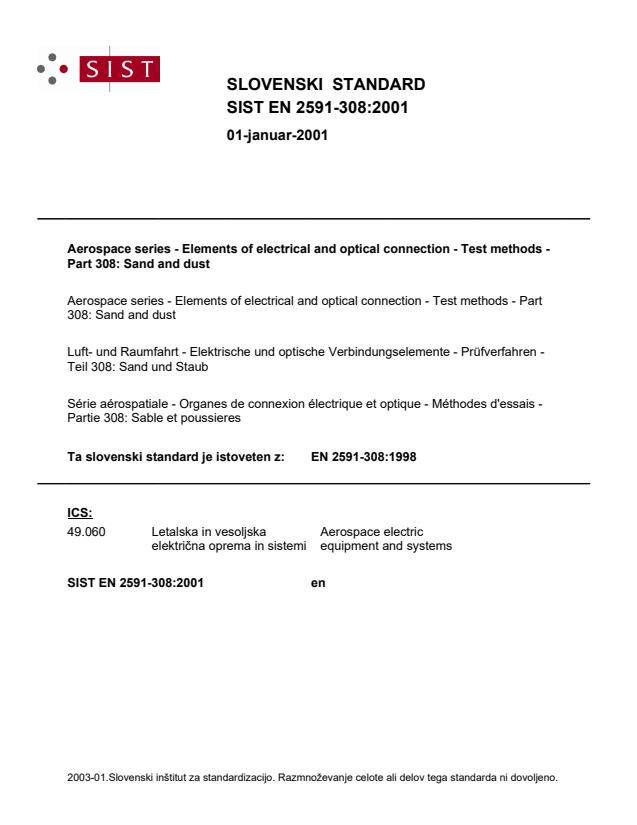
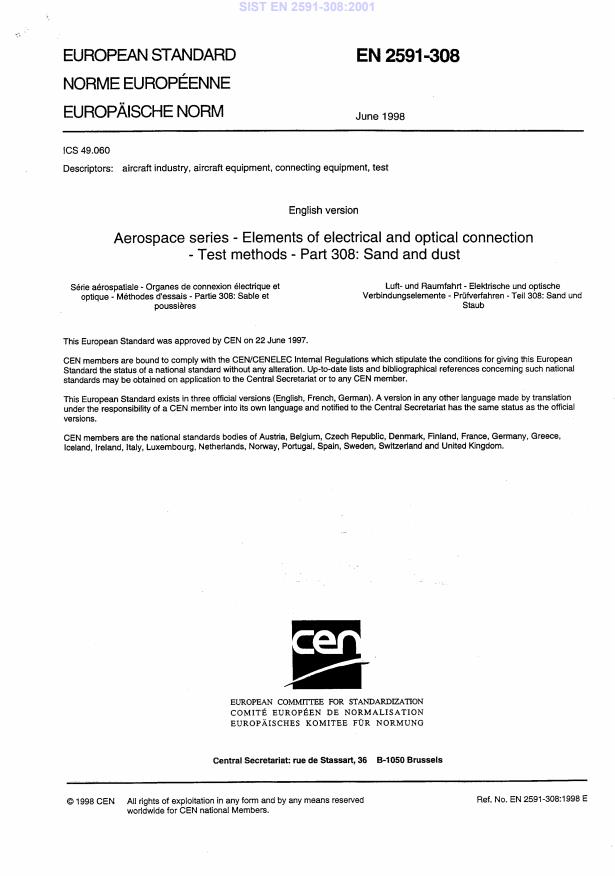
(Main)Aerospace series - Elements of electrical and optical connection - Test methods - Part 308: Sand and dust
General Information
- Abstract
This standard specifies a method of assessing the ability of elements of connection to withstand the effects of driving fine sand and dust. It shall be used together with EN 2591.
- Status
- Published
- Publication Date
- 31-Dec-2000
- Technical Committee
- SS SPL - Technical Board for the general field
- Current Stage
- 6060 - National Implementation/Publication (Adopted Project)
- Start Date
- 01-Jan-2001
- Due Date
- 01-Jan-2001
- Completion Date
- 01-Jan-2001

Overview
EN 2591-308:1998 (CEN) is an aerospace-series test method that specifies how to assess the ability of elements of electrical and optical connection to withstand the effects of driven fine sand and dust. Intended for use together with the general EN 2591 series, this standard defines a reproducible environmental test to evaluate contamination, abrasion and ingress risks that sand and dust present to connector performance in aerospace applications.
Key topics and requirements
- Scope and applicability: Applies to electrical and optical connectors and associated connection elements used in aircraft and spacecraft systems. It is a component-level environmental qualification for sand and dust exposure.
- Test objective: Assess functional degradation, mechanical wear and contamination-related failure modes caused by fine particulate ingress and driven sand/dust.
- Specimen preparation: Requires standardized handling and mounting of connector samples so results are repeatable and comparable across test laboratories.
- Test procedure basics: Defines the controlled exposure of connectors to driven sand/dust under specified conditions (airflow, particle feed, duration and orientation) as an environmental stressor. (Specific numerical parameters are given in the full standard and are to be used with EN 2591.)
- Inspection and acceptance criteria: Covers post-test functional checks, visual inspection for abrasion/contamination, and electrical/optical performance verification to determine pass/fail.
- Documentation and reporting: Stipulates test record content to support traceability and qualification decisions (sample ID, test conditions, pre/post-test measurements).
Applications
- Connector qualification and type-approval for aerospace OEMs and suppliers.
- Environmental testing during product development to validate design robustness against sand/dust contamination.
- Maintenance and depot-level assessment to determine serviceability after exposure to sandy environments.
- Independent test laboratories performing component-level environmental tests for aircraft systems.
- Risk assessment for avionics, sensors and optical fiber connections used in desert, coastal or dust-prone operating environments.
Who should use this standard
- Aerospace electrical and optical connector designers and manufacturers
- Systems engineers responsible for environmental qualification
- Test houses and certification bodies performing connector validation
- Maintenance, repair and overhaul (MRO) organizations assessing in-service damage
Related standards
- EN 2591 (general series) - to be used together with Part 308
- Other aerospace environmental and ingress-protection standards used in connector qualification
EN 2591-308 is essential for ensuring reliable connector performance in dusty operational conditions-keywords: EN 2591-308, sand and dust test, aerospace connectors, electrical and optical connection elements, environmental testing, connector qualification.
Relations
- Effective Date
- 28-Jan-2026
- Effective Date
- 28-Jan-2026
- Effective Date
- 28-Jan-2026
- Effective Date
- 28-Jan-2026
- Effective Date
- 28-Jan-2026
- Effective Date
- 28-Jan-2026
- Effective Date
- 28-Jan-2026
- Effective Date
- 28-Jan-2026
- Effective Date
- 28-Jan-2026
- Effective Date
- 28-Jan-2026
- Effective Date
- 28-Jan-2026
- Effective Date
- 28-Jan-2026
- Effective Date
- 28-Jan-2026
- Effective Date
- 28-Jan-2026
- Effective Date
- 28-Jan-2026
Get Certified
Connect with accredited certification bodies for this standard

BUREAU VERITAS Certification Germany
Bureau Veritas certification in Germany.

Element Materials Technology
Materials testing and product certification.

AQMS Ltd.
AQMS provides ISO certification to SMEs across the UK.
Sponsored listings
Frequently Asked Questions
SIST EN 2591-308:2001 is a standard published by the Slovenian Institute for Standardization (SIST). Its full title is "Aerospace series - Elements of electrical and optical connection - Test methods - Part 308: Sand and dust". This standard covers: This standard specifies a method of assessing the ability of elements of connection to withstand the effects of driving fine sand and dust. It shall be used together with EN 2591.
This standard specifies a method of assessing the ability of elements of connection to withstand the effects of driving fine sand and dust. It shall be used together with EN 2591.
SIST EN 2591-308:2001 is classified under the following ICS (International Classification for Standards) categories: 49.060 - Aerospace electric equipment and systems. The ICS classification helps identify the subject area and facilitates finding related standards.
SIST EN 2591-308:2001 has the following relationships with other standards: It is inter standard links to SIST EN 2591:2001, SIST EN 2591-408:2001, SIST EN 3660-063:2022, SIST EN 3155-071:2019, SIST EN 3660-062:2022, SIST EN 3155-081:2019, SIST EN 3155-017:2009, SIST EN 3155-071:2008, SIST EN 4652-111:2015, SIST EN 3155-079:2019, SIST EN 3660-024:2008, SIST EN 3660-026:2009, SIST EN 3660-033:2020, SIST EN 3660-025:2009, SIST EN 3660-004:2023. Understanding these relationships helps ensure you are using the most current and applicable version of the standard.
SIST EN 2591-308:2001 is available in PDF format for immediate download after purchase. The document can be added to your cart and obtained through the secure checkout process. Digital delivery ensures instant access to the complete standard document.
Standards Content (Sample)
2003-01.Slovenski inštitut za standardizacijo. Razmnoževanje celote ali delov tega standarda ni dovoljeno.Aerospace series - Elements of electrical and optical connection - Test methods - Part 308: Sand and dustLuft- und Raumfahrt - Elektrische und optische Verbindungselemente - Prüfverfahren - Teil 308: Sand und StaubSérie aérospatiale - Organes de connexion électrique et optique - Méthodes d'essais - Partie 308: Sabl
...