

SIST EN 14786:2006
(Main)Protective clothing - Determination of resistance to penetration by sprayed liquid chemicals, emulsions and dispersions - Atomizer test
General Information
- Abstract
This European Standard specifies a test method to determine the resistance of textile materials against penetration by atomized liquid chemicals, emulsions and dispersions. These materials are intended to be used in both limited-use and reusable protective clothing.
The penetration is expressed in percent, as ratio of the amounts of chemical applied and retained by the textile. The methods of quantitative physico-chemical analysis used for mass detection will depend on the chemical under test.
- Status
- Published
- Publication Date
- 30-Jun-2006
- Technical Committee
- OVP - Personal protecting equipment
- Current Stage
- 6060 - National Implementation/Publication (Adopted Project)
- Start Date
- 01-Jul-2006
- Due Date
- 01-Jul-2006
- Completion Date
- 01-Jul-2006
89/686/EEC - Personal protective equipment (PPE)OJ Ref: C 205 OJ Date: 09-Jul-2011

Overview
SIST EN 14786:2006 defines a standardized test method for evaluating the resistance of textile materials in protective clothing to penetration by atomized sprayed liquid chemicals, emulsions, and dispersions. Developed by the European Committee for Standardization (CEN) and adopted by the Slovenski inštitut za standardizacijo (SIST), this standard supports the assessment and certification of protective clothing materials for use in environments where exposure to liquid chemicals may occur. The standard covers both limited-use and reusable garments and specifies how to measure the penetration percentage as an indicator of the material's protective performance.
Key Topics
- Penetration Measurement: The standard describes how to calculate chemical penetration as a percentage, based on the mass of the chemical applied versus the amount retained by the textile and what passes through to an absorbent layer.
- Atomizer Test Method: Textile samples are exposed to an atomized spray of a test chemical using standardized apparatus and conditions, simulating real-world exposure scenarios.
- Test Procedures: Requirements for sample preparation, conditioning, controlled spraying, extraction, and quantitative analysis are detailed to ensure procedural repeatability and reliability.
- Analysis Techniques: Guidance is given for the use of appropriate physico-chemical analysis techniques, such as high pressure liquid chromatography (HPLC) or gas chromatography (GC), depending on the test chemical.
- Scope and Limitations: While suitable for screening materials for protection against sprayed and atomized liquids, this method is not intended for circumstances requiring barriers at the molecular level (where EN ISO 6529 should be used).
Applications
SIST EN 14786:2006 is instrumental in several practical contexts:
- Protective Clothing Selection: Enables manufacturers and procurers to assess and compare the penetration resistance of textile materials, supporting informed decisions for garment specification in industries such as agriculture, chemical handling, and industrial cleaning.
- Conformity Assessment: Assists PPE certification bodies in evaluating compliance with essential health and safety requirements under the European PPE Directive 89/686/EEC.
- Quality Control: Provides textile and garment manufacturers with a reliable test procedure for ongoing quality assurance in protective clothing production.
- Product Development: Supports research, development, and improvement of protective clothing by furnishing a standardized benchmark for evaluating new materials against chemical spray hazards.
Related Standards
For comprehensive chemical protective clothing assessment, consider the following related standards:
- EN ISO 6529: Protective clothing - Determination of resistance to permeation by liquids and gases. Focuses on molecular-level protection and complete barriers to chemical penetration.
- EN ISO 6530: Test method for resistance of materials to penetration by liquids. Addresses direct liquid contact rather than atomized sprays.
- EN 22768-1: Provides general tolerances for the apparatus used in testing.
SIST EN 14786:2006 works effectively in conjunction with these standards to ensure thorough evaluation and compliance of chemical protective clothing in varied occupational environments.
Keywords: SIST EN 14786:2006, protective clothing, chemical penetration resistance, atomizer test, sprayed liquid chemicals, textile materials, PPE standards, penetration test method, protective clothing certification, personal protective equipment (PPE), safety standards.
Relations
- Effective Date
- 28-Jan-2026
- Effective Date
- 28-Jan-2026
- Effective Date
- 28-Jan-2026
- Effective Date
- 28-Jan-2026
- Effective Date
- 28-Jan-2026
- Effective Date
- 28-Jan-2026
- Effective Date
- 28-Jan-2026
- Effective Date
- 28-Jan-2026
- Effective Date
- 28-Jan-2026
- Effective Date
- 28-Jan-2026
- Effective Date
- 28-Jan-2026
- Effective Date
- 28-Jan-2026
Get Certified
Connect with accredited certification bodies for this standard

CIS Institut d.o.o.
Personal Protective Equipment (PPE) certification body. Notified Body NB-2890 for EU Regulation 2016/425 PPE.

Kiwa BDA Testing
Building and construction product certification.
Kmetijski inštitut Slovenije
Agricultural Institute of Slovenia. Soil testing, plant health, agricultural product analysis.
Sponsored listings
Frequently Asked Questions
SIST EN 14786:2006 is a standard published by the Slovenian Institute for Standardization (SIST). Its full title is "Protective clothing - Determination of resistance to penetration by sprayed liquid chemicals, emulsions and dispersions - Atomizer test". This standard covers: This European Standard specifies a test method to determine the resistance of textile materials against penetration by atomized liquid chemicals, emulsions and dispersions. These materials are intended to be used in both limited-use and reusable protective clothing. The penetration is expressed in percent, as ratio of the amounts of chemical applied and retained by the textile. The methods of quantitative physico-chemical analysis used for mass detection will depend on the chemical under test.
This European Standard specifies a test method to determine the resistance of textile materials against penetration by atomized liquid chemicals, emulsions and dispersions. These materials are intended to be used in both limited-use and reusable protective clothing. The penetration is expressed in percent, as ratio of the amounts of chemical applied and retained by the textile. The methods of quantitative physico-chemical analysis used for mass detection will depend on the chemical under test.
SIST EN 14786:2006 is classified under the following ICS (International Classification for Standards) categories: 13.340.10 - Protective clothing. The ICS classification helps identify the subject area and facilitates finding related standards.
SIST EN 14786:2006 has the following relationships with other standards: It is inter standard links to SIST EN 22768-1:2000, SIST EN 845-1:2004+A1:2008, SIST EN ISO 7823-2:2003, SIST EN ISO 23936-1:2022, SIST EN ISO 8257-2:2006, SIST EN ISO 7823-1:2003, SIST EN ISO 19712-3:2022, SIST EN ISO 7823-3:2007, SIST EN ISO 21309-2:2019, SIST EN ISO 7823-3:2021, SIST EN ISO 14663-2:2006, SIST EN ISO 24026-2:2020. Understanding these relationships helps ensure you are using the most current and applicable version of the standard.
SIST EN 14786:2006 is associated with the following European legislation: EU Directives/Regulations: 2016/425, 89/686/EEC, 93/68/EEC, 93/95/EEC, 96/58/EC; Standardization Mandates: M/031. When a standard is cited in the Official Journal of the European Union, products manufactured in conformity with it benefit from a presumption of conformity with the essential requirements of the corresponding EU directive or regulation.
SIST EN 14786:2006 is available in PDF format for immediate download after purchase. The document can be added to your cart and obtained through the secure checkout process. Digital delivery ensures instant access to the complete standard document.
Standards Content (Sample)
2003-01.Slovenski inštitut za standardizacijo. Razmnoževanje celote ali delov tega standarda ni dovoljeno.Protective clothing - Determination of resistance to penetration by sprayed liquid chemicals, emulsions and dispersions - Atomizer testVetements de protection - Détermination de la résistance a la pénétration par les produits chimiques liquides pulvérisés, les émulsions et les dispersions - Essai de pulvérisationSchutzkleidung - Bestimmung des Widerstandes gegen Durchdringung von flüssigen gespritzten Chemikalien, Emulsionen und Dispersionen - SpritzverfahrenTa slovenski standard je istoveten z:EN 14786:2006SIST EN 14786:2006en13.340.10ICS:SLOVENSKI
STANDARDSIST EN 14786:200601-julij-2006
EUROPEAN STANDARDNORME EUROPÉENNEEUROPÄISCHE NORMEN 14786April 2006ICS 13.340.10 English VersionProtective clothing - Determination of resistance to penetrationby sprayed liquid chemicals, emulsions and dispersions -Atomizer testVêtements de protection - Détermination de la résistance àla pénétration par les produits chimiques liquidespulvérisés, les émulsions et les dispersions - Essai depulvérisationSchutzkleidung - Bestimmung des Widerstandes gegenDurchdringung von flüssigen gespritzten Chemikalien,Emulsionen und Dispersionen - SpritzverfahrenThis European Standard was approved by CEN on 16 March 2006.CEN members are bound to comply with the CEN/CENELEC Internal Regulations which stipulate the conditions for giving this EuropeanStandard the status of a national standard without any alteration. Up-to-date lists and bibliographical references concerning such nationalstandards may be obtained on application to the Central Secretariat or to any CEN member.This European Standard exists in three official versions (English, French, German). A version in any other language made by translationunder the responsibility of a CEN member into its own language and notified to the Central Secretariat has the same status as the officialversions.CEN members are the national standards bodies of Austria, Belgium, Cyprus, Czech Republic, Denmark, Estonia, Finland, France,Germany, Greece, Hungary, Iceland, Ireland, Italy, Latvia, Lithuania, Luxembourg, Malta, Netherlands, Norway, Poland, Portugal, Romania,Slovakia, Slovenia, Spain, Sweden, Switzerland and United Kingdom.EUROPEAN COMMITTEE FOR STANDARDIZATIONCOMITÉ EUROPÉEN DE NORMALISATIONEUROPÄISCHES KOMITEE FÜR NORMUNGManagement Centre: rue de Stassart, 36
B-1050 Brussels© 2006 CENAll rights of exploitation in any form and by any means reservedworldwide for CEN national Members.Ref. No. EN 14786:2006: E
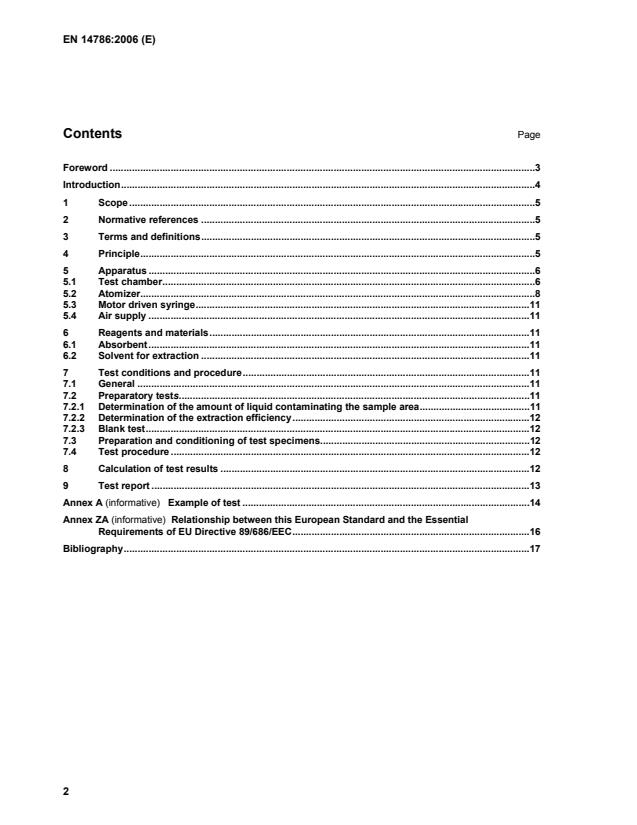
Example of test.14 Annex ZA (informative)
Relationship between this European Standard and the Essential Requirements of EU Directive 89/686/EEC.16 Bibliography.17
This European standard specifies a test method to measure a penetration index for protective clothing materials against atomized emulsions and dispersions of liquid chemicals, e.g. pesticides used in agricultural crop spraying. The data may be used as a guide for screening protective clothing materials but the results of the test are affected by the physical properties of the test chemical, e.g. low volatility chemicals. Clothing, which has been developed from materials selected by means of this method of test, should be used only in well-defined circumstances, i.e. when an evaluation of the finished item has indicated an acceptable level of performance (e.g. in laboratory and field testing of a garment, consideration of exposure levels to specified chemicals etc.).
Clothing made of these materials is not for use as the sole means of protection where resistance to permeation by chemicals at the molecular level (to be determined by EN ISO 6529) is essential and where a complete barrier to liquid (or gaseous chemicals) is required (e.g. risk of exposure to massive and forceful discharges of concentrated liquid chemicals). The potential performance levels of materials as assessed by the test method described in this standard are intended to be used in product specifications for protective apparel against atomized liquids, emulsified and dispersed chemicals.
1 Scope This European Standard specifies a test method to determine the resistance of textile materials against penetration by atomized liquid chemicals, emulsions and dispersions. These materials are intended to be used in both limited-use and reusable protective clothing.
The penetration is expressed in percent, as ratio of the amounts of chemical applied and retained by the textile. The methods of quantitative physico-chemical analysis used for mass detection will depend on the chemical under test. 2 Normative references The following referenced documents are indispensable for the application of this European Standard. For dated references, only the edition cited applies. For undated references, the latest edition of the referenced document (including any amendments) applies. EN 22768-1, General tolerances - Part 1: Tolerances for linear and angular dimensions without individual tolerance indications (ISO 2768-1:1998) 3 Terms and definitions For the purposes of this European Standard, the following terms and definitions apply.
3.1 penetration
process by which a chemical flows through holes or essential openings in the material.
NOTE The holes may be the result of mechanical damage
3.2 permeation
the process by which a chemical moves through a protective clothing material on a molecular level.
NOTE Permeation involves:
sorption of the molecules of the chemical into the contacted (outside) surface of the material;
diffusion of the sorbed molecules in the material, and desorption of the molecules from the opposite (inner) surface of the material. 4 Principle
A test specimen is contaminated by a small quantity of atomized liquid chemical, emulsion or dispersion, injected by a two-phase nozzle operated by a microprocessor controlled step motor. Part of the chemicals will penetrate and wet the test specimen. The flow of chemical passing through the material will be taken up by an absorbent under the test specimen (see Figure 1 for a schematic representation of the test equipment). After 30 min. exposure time the textile and the adsorbent are extracted and analysed in order to determine the amounts of chemical retained and passed through .The extraction efficiency shall be proven and should be larger than 95 %. Depending on the type of chemical different techniques such as e. g. high pressure liquid chromatography (HPLC) or gas chromatography (GC) are used for the quantitative analysis.
The penetration of a protective clothing material is defined as the ratio of the mass of chemical penetrated to the mass of chemical applied.
Key a Detail X: see Figure 6 1 Fastenings 2 Controlled step motor 3 Syringe with test chemical 4 Two-phase nozzle 5 Nozzle holder 6 Covering cylinder 7 Mask 8 Textile specimen 9 Sorbent 10 Ground plate of specimen holder
Figure 1 - Schem
...