

SIST EN 3960:2002
(Main)Aerospace series - Gold base alloy AU-B40001 (AuNi18) - Filler metal for brazing - Powder or paste
General Information
- Abstract
This standard specifies the requirements relating to:
Gold base alloy AU-B40001 (AuNi18)
Filler metal for brazing
Powder or paste
for aerospace applications.
- Status
- Published
- Publication Date
- 31-Dec-2001
- Technical Committee
- SS SPL - Technical Board for the general field
- Current Stage
- 6060 - National Implementation/Publication (Adopted Project)
- Start Date
- 01-Jan-2002
- Due Date
- 01-Jan-2002
- Completion Date
- 01-Jan-2002

Overview
SIST EN 3960:2002 is a European standard developed by CEN that specifies the requirements for the aerospace series gold base alloy AU-B40001 (AuNi18). This standard focuses on filler metals used for brazing in powder or paste form, primarily intended for aerospace applications. The gold base filler metal is highly specialized to meet strict aerospace manufacturing needs, ensuring high-quality and reliable joining of critical components.
This standard is part of a broader series of EN metallic material standards tailored for aerospace applications and aligns with established practices as outlined in EN 4258 and EN 4500-6. EN 3960 ensures consistent production, quality control, and performance characteristics of the AuNi18 brazing filler alloy across European aerospace industries.
Key Topics
- Material Composition & Designation: Defines the chemical composition of gold base alloy AU-B40001 (AuNi18) with Nickel (Ni) content ranging from 17.5% to 18.5%, along with other key elements and impurities.
- Forms & Production Methods: Filler metals are available in powder or paste format. Powders are produced through water or inert gas atomization and sieving. Pastes are water or inert gas atomized powders mixed with a binder.
- Melting Methods: The alloy can be melted using air, inert gas, or vacuum environments to maintain quality and purity.
- Technical and Delivery Specifications: Details on delivery condition (as manufactured or mixed with binder), heat treatments, and product form dimensions.
- Mechanical Properties & Testing: Addresses performance parameters such as proof stress, strength, elongation, hardness, shear strength, and bending. Thermal analysis (eutectic temperature of 950°C) and fusion tests ensure material consistency.
- Quality Assurance: Incorporates external defect inspection, batch uniformity checks, marking, dimensional inspection, and sieve analysis for particle size.
- Product Qualification: Qualification programs following EN 2043 require agreement between manufacturers and purchasers to guarantee material suitability for aerospace brazing applications.
- Application Focus: Specifically designed for joining nickel base heat resistant alloys critical in aerospace structures and components.
Applications
EN 3960-compliant gold base alloy AU-B40001 filler metals are engineered for high-performance brazing in the aerospace industry where:
- Reliable joining of materials such as nickel base heat resistant alloys is critical for engine components, turbine blades, and structural aerospace assemblies.
- High-temperature resistance and corrosion resistance are essential due to extreme operational environments.
- Precise, defect-free joints are mandatory to ensure aircraft safety, durability, and performance.
- Powder and paste forms provide versatile options for different brazing methods including controlled atmosphere brazing and vacuum brazing processes.
Manufacturers and aerospace engineers use this standard to source filler metals that guarantee consistent chemical and physical characteristics important for aerospace-grade reliability and material integrity.
Related Standards
SIST EN 3960:2002 operates in conjunction with several related aerospace and metallic materials standards to provide a comprehensive framework:
- EN 2043: Covers general requirements for semi-finished metallic products excluding forgings and castings.
- EN 3875: Defines technical specifications for filler metals used in brazing, including quality and performance tests.
- EN 4258: Describes the organization and linkage of various metallic material standards for aerospace materials.
- EN 4500-6: Provides general rules for drafting and presenting filler metal standards, offering consistency in aerospace material documentation.
Together, these standards enable the aerospace industry to maintain uniformity, quality, and compliance across materials and joining processes used in aircraft manufacturing and maintenance.
Keywords: SIST EN 3960:2002, gold base alloy AU-B40001, AuNi18, aerospace filler metal, brazing alloy, powder filler metal, paste filler metal, nickel base heat resistant alloys, aerospace brazing standards, CEN aerospace standards, aerospace materials certification, high-temperature brazing alloy.
Relations
- Effective Date
- 28-Jan-2026
- Effective Date
- 01-May-2004
Get Certified
Connect with accredited certification bodies for this standard

BUREAU VERITAS Certification Germany
Bureau Veritas certification in Germany.

Element Materials Technology
Materials testing and product certification.

AQMS Ltd.
AQMS provides ISO certification to SMEs across the UK.
Sponsored listings
Frequently Asked Questions
SIST EN 3960:2002 is a standard published by the Slovenian Institute for Standardization (SIST). Its full title is "Aerospace series - Gold base alloy AU-B40001 (AuNi18) - Filler metal for brazing - Powder or paste". This standard covers: This standard specifies the requirements relating to: Gold base alloy AU-B40001 (AuNi18) Filler metal for brazing Powder or paste for aerospace applications.
This standard specifies the requirements relating to: Gold base alloy AU-B40001 (AuNi18) Filler metal for brazing Powder or paste for aerospace applications.
SIST EN 3960:2002 is classified under the following ICS (International Classification for Standards) categories: 49.025.15 - Non-ferrous alloys in general. The ICS classification helps identify the subject area and facilitates finding related standards.
SIST EN 3960:2002 has the following relationships with other standards: It is inter standard links to SIST EN 4258:2024, SIST EN 3960:2002/AC:2004. Understanding these relationships helps ensure you are using the most current and applicable version of the standard.
SIST EN 3960:2002 is available in PDF format for immediate download after purchase. The document can be added to your cart and obtained through the secure checkout process. Digital delivery ensures instant access to the complete standard document.
Standards Content (Sample)
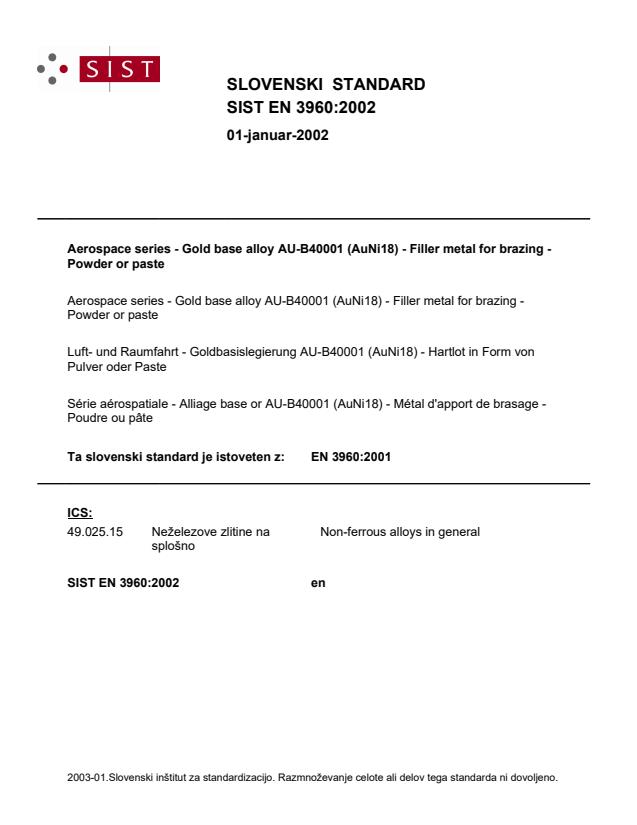
2003-01.Slovenski inštitut za standardizacijo. Razmnoževanje celote ali delov tega standarda ni dovoljeno.Aerospace series - Gold base alloy AU-B40001 (AuNi18) - Filler metal for brazing - Powder or pasteLuft- und Raumfahrt - Goldbasislegierung AU-B40001 (AuNi18) - Hartlot in Form von Pulver oder PasteSérie aérospatiale - Alliage base or AU-B40001 (AuNi18) - Métal d'apport de brasage - Poudre ou pâteAerospace series - Gold base alloy AU-B40001 (AuNi18) - Filler metal for brazing - Powder or paste49.025.15Neželezove zlitine na splošnoNon-ferrous alloys in generalICS:Ta slovenski standard je istoveten z:EN 3960:2001SIST EN 3960:2002en01-januar-2002SIST EN 3960:2002SLOVENSKI
STANDARD
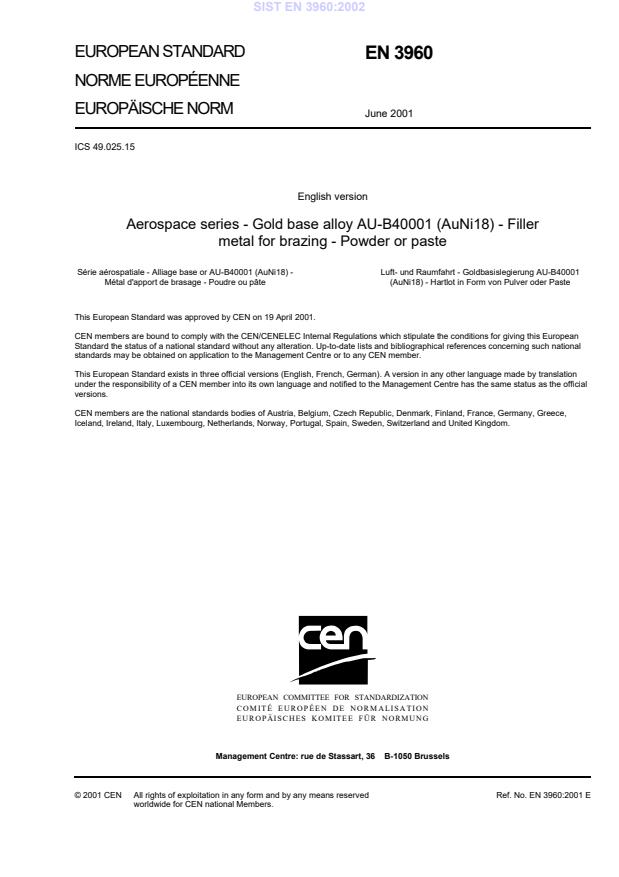
EUROPEAN STANDARDNORME EUROPÉENNEEUROPÄISCHE NORMEN 3960June 2001ICS 49.025.15English versionAerospace series - Gold base alloy AU-B40001 (AuNi18) - Fillermetal for brazing - Powder or pasteSérie aérospatiale - Alliage base or AU-B40001 (AuNi18) -Métal d'apport de brasage - Poudre ou pâteLuft- und Raumfahrt - Goldbasislegierung AU-B40001(AuNi18) - Hartlot in Form von Pulver oder PasteThis European Standard was approved by CEN on 19 April 2001.CEN members are bound to comply with the CEN/CENELEC Internal Regulations which stipulate the conditions for giving this EuropeanStandard the status of a national standard without any alteration. Up-to-date lists and bibliographical references concerning such nationalstandards may be obtained on application to the Management Centre or to any CEN member.This European Standard exists in three official versions (English, French, German). A version in any other language made by translationunder the responsibility of a CEN member into its own language and notified to the Management Centre has the same status as the officialversions.CEN members are the national standards bodies of Austria, Belgium, Czech Republic, Denmark, Finland, France, Germany, Greece,Iceland, Ireland, Italy, Luxembourg, Netherlands, Norway, Portugal, Spain, Sweden, Switzerland and United Kingdom.EUROPEAN COMMITTEE FOR STANDARDIZATIONCOMITÉ EUROPÉEN DE NORMALISATIONEUROPÄISCHES KOMITEE FÜR NORMUNGManagement Centre: rue de Stassart, 36
B-1050 Brussels© 2001 CENAll rights of exploitation in any form and by any means reservedworldwide for CEN national Members.Ref. No. EN 3960:2001 ESIST EN 3960:2002
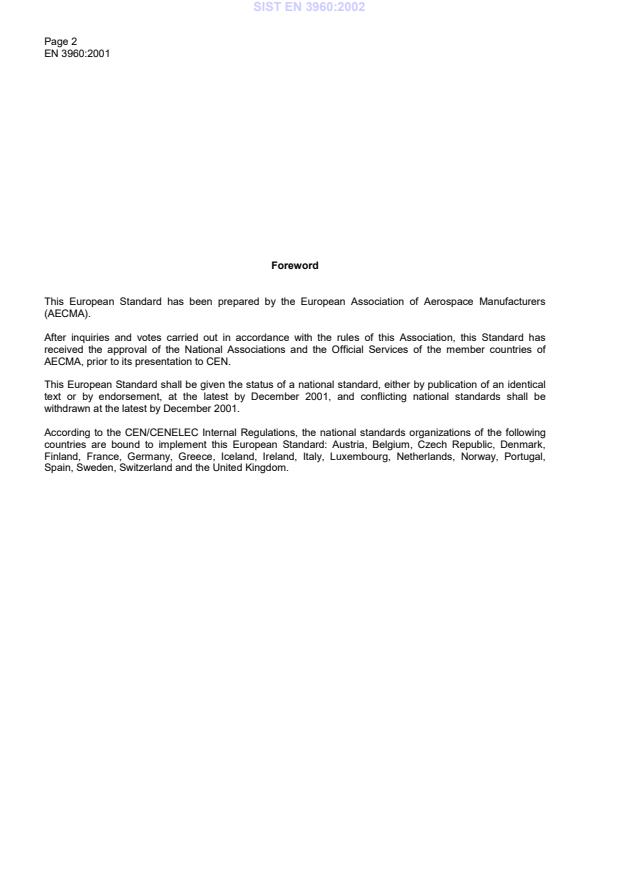
Page 2EN 3960:2001ForewordThis European Standard has been prepared by the European Association of Aerospace Manufacturers(AECMA).After inquiries and votes carried out in accordance with the rules of this Association, this Standard hasreceived the approval of the National Associations and the Official Services of the member countries ofAECMA, prior to its presentation to CEN.This European Standard shall be given the status of a national standard, either by publication of an identicaltext or by endorsement, at the latest by December 2001, and conflicting national standards shall bewithdrawn at the latest by December 2001.According to the CEN/CENELEC Internal Regulations, the national standards organizations of the followingcountries are bound to implement this European Standard: Austria, Belgium, Czech Republic, Denmark,Finland, France, Germany, Greece, Iceland, Ireland, Italy, Luxembourg, Netherlands, Norway, Portugal,Spain, Sweden, Switzerland and the United Kin
...