

SIST EN 12685:1999
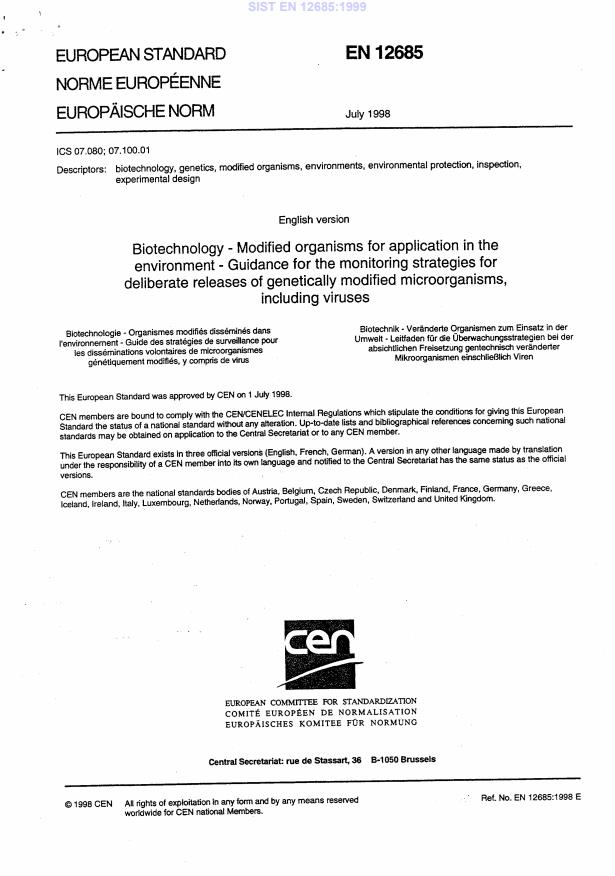
(Main)Biotechnology - Modified organisms for application in the environment - Guidance for the monitoring strategies for deliberate releases of genetically modified microorganisms, including viruses
- Abstract
This European Standard provides guidance on factors and criteria considered for the determination of the suitability and validity of the design, development and execution of a monitoring strategy for GMM. Monitoring encompasses detection of genotypic and phenotypic properties, as well as detection of viral material and/or symptoms specific for the infected host, for the identification of GMMs in an experimental release.
- Status
- Published
- Publication Date
- 30-Nov-1999
- Technical Committee
- BTH - Biotechnology
- Current Stage
- 6060 - National Implementation/Publication (Adopted Project)
- Start Date
- 01-Dec-1999
- Due Date
- 01-Dec-1999
- Completion Date
- 01-Dec-1999


SIST EN 12685:1999 is a standard published by SIST that gives guidance for monitoring strategies used in deliberate releases of genetically modified microorganisms (GMM), including viruses. It helps people judge whether a monitoring plan is suitable and valid, especially for experimental releases where the aim is to identify the GMM by the evidence it leaves behind.
What does SIST EN 12685:1999 specify?
SIST EN 12685:1999 specifies guidance for selecting and assessing monitoring strategies for deliberate releases of GMMs, including viruses. The focus is on the factors and criteria that matter when deciding whether a monitoring approach will work in practice and whether its design, development and execution are appropriate for the release being monitored.
The scope ties monitoring to identification of GMMs in an experimental release by looking for:
- genotypic properties
- phenotypic properties
- viral material
- symptoms specific to the infected host
In practice, this means the standard helps users decide what evidence to look for, how to collect it, and how to judge whether the monitoring strategy is fit for the release.
What are the key requirements of SIST EN 12685:1999?
SIST EN 12685:1999 centres on how to build and judge a monitoring strategy for a deliberate release of GMMs. The main technical point is not a product specification but a set of considerations that should support reliable identification of the released organism.
- Define the monitoring purpose clearly. The strategy has to be matched to a deliberate release and to the experimental context. In practice, the team must know what it is trying to detect before choosing methods.
- Check genotypic properties. Genetic features are part of the monitoring approach. This matters because DNA or other genetic evidence may be the most direct way to confirm the presence of the GMM.
- Check phenotypic properties. Observable characteristics are also part of monitoring. In practice, this means watching for traits that can be measured or seen in the field or laboratory.
- Include virus-related evidence when viruses are involved. The scope explicitly covers detection of viral material and symptoms in the infected host. That tells the reader to plan for both direct and indirect signs of infection.
- Link monitoring to identification of the GMM. The monitoring strategy is used to identify the organism in an experimental release. This means the methods chosen need to produce evidence that can support a clear identification decision.
- Assess suitability and validity. The standard is aimed at determining whether the strategy is suitable and valid. In practice, that means asking whether the plan is technically appropriate, logically arranged, and able to support the monitoring objective.
- Cover design, development and execution. The guidance applies across the whole monitoring strategy, not only the final field work. Readers should use it when planning the strategy, setting it up, and carrying it out.
What terms does SIST EN 12685:1999 define?
- Genetically modified microorganisms (GMM): microorganisms that have been genetically modified and are the subject of the monitoring strategy.
- Deliberate release: a planned release into the environment, rather than an accidental escape.
- Experimental release: a release carried out to study or assess the GMM under controlled conditions.
- Monitoring strategy: the planned approach for detecting and assessing the released material.
- Genotypic properties: genetic characteristics used to identify the GMM.
- Phenotypic properties: observable characteristics used to identify the GMM.
- Viral material: material from a virus that may be detected as part of monitoring.
- Infected host: the host organism showing symptoms linked to infection.
Who uses SIST EN 12685:1999?
SIST EN 12685:1999 is used by biotechnology and microbiology teams that plan or review deliberate releases of GMMs and viruses. It is relevant to researchers, biosafety staff, and assessors who need to design monitoring plans, choose detection approaches, and decide whether the strategy is suitable for an experimental release.
What changed in SIST EN 12685:1999 from the previous edition?
SIST EN 12685:1999 is identical to EN 12685:1998.
What does the SIST EN 12685:1999 document contain?
SIST EN 12685:1999 contains guidance text focused on factors and criteria for monitoring strategy design and assessment. Its content is aimed at helping users decide how to monitor an experimental release of GMMs, including viruses, by looking for genetic, observable, and virus-related evidence.
The document supports planning and evaluation work rather than giving a product test method. For readers, the practical value is in the decision framework: what to consider, what to observe, and how to judge whether the monitoring approach is suitable and valid for the release being monitored.
Relations
- Effective Date
- 28-Jan-2026
Frequently Asked Questions
SIST EN 12685:1999 is a standard published by the Slovenian Institute for Standardization (SIST). Its full title is "Biotechnology - Modified organisms for application in the environment - Guidance for the monitoring strategies for deliberate releases of genetically modified microorganisms, including viruses". This standard covers: This European Standard provides guidance on factors and criteria considered for the determination of the suitability and validity of the design, development and execution of a monitoring strategy for GMM. Monitoring encompasses detection of genotypic and phenotypic properties, as well as detection of viral material and/or symptoms specific for the infected host, for the identification of GMMs in an experimental release.
This European Standard provides guidance on factors and criteria considered for the determination of the suitability and validity of the design, development and execution of a monitoring strategy for GMM. Monitoring encompasses detection of genotypic and phenotypic properties, as well as detection of viral material and/or symptoms specific for the infected host, for the identification of GMMs in an experimental release.
SIST EN 12685:1999 is classified under the following ICS (International Classification for Standards) categories: 07.080 - Biology. Botany. Zoology; 07.100.01 - Microbiology in general. The ICS classification helps identify the subject area and facilitates finding related standards.
SIST EN 12685:1999 has the following relationships with other standards: It is inter standard links to SIST EN 12686:1999. Understanding these relationships helps ensure you are using the most current and applicable version of the standard.
SIST EN 12685:1999 is associated with the following European legislation: EU Directives/Regulations: 90/219/EEC, 90/220/EEC, 90/679/EEC; Standardization Mandates: M/BC/CEN/91/19. When a standard is cited in the Official Journal of the European Union, products manufactured in conformity with it benefit from a presumption of conformity with the essential requirements of the corresponding EU directive or regulation.
SIST EN 12685:1999 is available in PDF format for immediate download after purchase. The document can be added to your cart and obtained through the secure checkout process. Digital delivery ensures instant access to the complete standard document.
Standards Content (Sample)
2003-01.Slovenski inštitut za standardizacijo. Razmnoževanje celote ali delov tega standarda ni dovoljeno.HPHQMHQLKBiotechnik - Veränderte Organismen zum Einsatz in der Umwelt - Leitfaden für die Überwachungsstrategien bei der absichtlichen Freisetzung gentechnisch veränderter Mikroorganismen einschließlich VirenBiotechnologie - Organismes modifiés disséminés dans l'environnement - Guide des stratégies de surveillance pour les disséminations volontaires de microorganismes génétiquement modifiés, y compris de virusBiotechnology - Modified organisms for application in the environment - Guidance for the monitoring strategies for deliberate releases of genetically modif
...