

oSIST prEN 566:2026
(Main)Mountaineering equipment - Slings - Safety requirements and test methods
General Information
- Abstract
This document specifies safety requirements and test methods for slings used for mountaineering including climbing and related activities.
- Status
- Not Published
- Public Enquiry End Date
- 26-Mar-2026
- Technical Committee
- SPO - Sports
- Current Stage
- 4020 - Public enquire (PE) (Adopted Project)
- Start Date
- 27-Jan-2026
- Due Date
- 16-Jun-2026

Overview
oSIST prEN 566:2026:2026 – Mountaineering equipment – Slings – Safety requirements and test methods is a draft European Standard developed by the European Committee for Standardization (CEN/TC 136). The document specifies essential safety requirements and testing procedures for slings used in mountaineering, climbing, and associated recreational activities. This standard aims to ensure that slings, including those manufactured with textile or metallic components, meet rigorous safety and performance criteria to protect users in challenging outdoor environments.
Slings are vital pieces of personal protective equipment (PPE) in mountaineering systems, commonly used for connecting components, anchoring, and protection against falls. oSIST prEN 566:2026:2026 provides uniform criteria to assess durability, design, and performance, promoting user safety and compliance with relevant EU regulations.
Key Topics
Scope and Definitions
- Applies to all slings used in mountaineering, climbing, and related activities.
- Defines slings as tapes, cords, ropes, or metallic elements joined by acceptable means (e.g., stitching, splicing).
Design Requirements
- Stitching for joints must be visible and in contrasting color for easy inspection.
- Woven tapes should not unravel under specified test conditions.
- Metal slings must have smooth finishes without burrs or sharp edges.
- Eye terminations in wire slings require thimbles and secure splices or ferrules.
Performance Requirements
- Minimum tensile strength of 22 kN for all slings.
- Adjustable slings must exhibit slippage not exceeding 20 mm under specified loading.
- Metal components must resist corrosion, as tested according to EN ISO 9227:2022.
Testing Procedures
- Detailed methods for evaluating stability, tensile strength, slippage, and corrosion resistance.
Marking and Instructions
- Clear manufacturer identification, production date, and strength rating required.
- Compliance symbol (from ISO 7000:2019) indicating the need to read instructions.
- Comprehensive user instructions including maintenance, selection, and warning guidance.
Applications
Slings standardized under oSIST prEN 566:2026:2026 are essential for:
- Recreational Climbing and Mountaineering: Used as anchor slings, quickdraws, personal attachment points, and in belay systems.
- Industrial Rope Access and Rescue: As components in complex safety systems requiring proven strength and durability.
- Alpine Expeditions and Via Ferrata: Suited for harsh environments where reliability of connectors is critical.
By adhering to the requirements set out in oSIST prEN 566:2026:2026, manufacturers and users can ensure slings offer appropriate levels of safety and performance, reducing risk during outdoor and vertical activities.
Related Standards
oSIST prEN 566:2026:2026 is part of a comprehensive suite of European standards for mountaineering equipment, which includes:
- EN 564: Accessory cords – Safety requirements and test methods
- EN 565: Tape for mountaineering – Safety requirements and test methods
- EN 567: Rope clamps – Safety requirements and test methods
- EN 892: Dynamic mountaineering ropes – Safety requirements and test methods
- EN 958: Energy-absorbing systems for via ferrata
- EN 12275: Connectors (carabiners) – Safety requirements and test methods
- EN 12492: Helmets for mountaineers – Safety requirements and test methods
For comprehensive safety, oSIST prEN 566:2026:2026 slings must be used alongside compatible, standardized mountaineering equipment.
Keywords: oSIST prEN 566:2026:2026, mountaineering equipment, climbing slings, safety requirements, test methods, personal protective equipment, European Standard, CEN, tensile strength, corrosion resistance, outdoor equipment, climbing safety, PPE compliance, slings testing.
Relations
- Effective Date
- 19-Jan-2023
- Effective Date
- 18-Jan-2023
- Effective Date
- 09-Nov-2022
Frequently Asked Questions
oSIST prEN 566:2026 is a draft published by the Slovenian Institute for Standardization (SIST). Its full title is "Mountaineering equipment - Slings - Safety requirements and test methods". This standard covers: This document specifies safety requirements and test methods for slings used for mountaineering including climbing and related activities.
This document specifies safety requirements and test methods for slings used for mountaineering including climbing and related activities.
oSIST prEN 566:2026 is classified under the following ICS (International Classification for Standards) categories: 97.220.40 - Outdoor and water sports equipment. The ICS classification helps identify the subject area and facilitates finding related standards.
oSIST prEN 566:2026 has the following relationships with other standards: It is inter standard links to SIST EN 566:2017, SIST EN 566:2017, SIST EN 566:2017. Understanding these relationships helps ensure you are using the most current and applicable version of the standard.
oSIST prEN 566:2026 is associated with the following European legislation: EU Directives/Regulations: 2016/425; Standardization Mandates: M/031, M/571, M/571 Amd 1. When a standard is cited in the Official Journal of the European Union, products manufactured in conformity with it benefit from a presumption of conformity with the essential requirements of the corresponding EU directive or regulation.
oSIST prEN 566:2026 is available in PDF format for immediate download after purchase. The document can be added to your cart and obtained through the secure checkout process. Digital delivery ensures instant access to the complete standard document.
Standards Content (Sample)
SLOVENSKI STANDARD
01-marec-2026
Gorniška oprema - Zanke - Varnostne zahteve in preskusne metode
Mountaineering equipment - Slings - Safety requirements and test methods
Bergsteigerausrüstung - Schlingen - Sicherheitstechnische Anforderungen und
Prüfverfahren
Équipement d'alpinisme et d'escalade - Anneaux - Exigences de sécurité et méthodes
d'essai
Ta slovenski standard je istoveten z: prEN 566
ICS:
97.220.40 Oprema za športe na Outdoor and water sports
prostem in vodne športe equipment
2003-01.Slovenski inštitut za standardizacijo. Razmnoževanje celote ali delov tega standarda ni dovoljeno.
DRAFT
EUROPEAN STANDARD
NORME EUROPÉENNE
EUROPÄISCHE NORM
January 2026
ICS 97.220.40 Will supersede EN 566:2017
English Version
Mountaineering equipment - Slings - Safety requirements
and test methods
Équipement d'alpinisme et d'escalade - Anneaux - Bergsteigerausrüstung - Schlingen -
Exigences de sécurité et méthodes d'essai Sicherheitstechnische Anforderungen und
Prüfverfahren
This draft European Standard is submitted to CEN members for enquiry. It has been drawn up by the Technical Committee
CEN/TC 136.
If this draft becomes a European Standard, CEN members are bound to comply with the CEN/CENELEC Internal Regulations
which stipulate the conditions for giving this European Standard the status of a national standard without any alteration.
This draft European Standard was established by CEN in three official versions (English, French, German). A version in any other
language made by translation under the responsibility of a CEN member into its own language and notified to the CEN-CENELEC
Management Centre has the same status as the official versions.
CEN members are the national standards bodies of Austria, Belgium, Bulgaria, Croatia, Cyprus, Czech Republic, Denmark, Estonia,
Finland, France, Germany, Greece, Hungary, Iceland, Ireland, Italy, Latvia, Lithuania, Luxembourg, Malta, Netherlands, Norway,
Poland, Portugal, Republic of North Macedonia, Romania, Serbia, Slovakia, Slovenia, Spain, Sweden, Switzerland, Türkiye and
United Kingdom.
Recipients of this draft are invited to submit, with their comments, notification of any relevant patent rights of which they are
aware and to provide supporting documentation.
Warning : This document is not a European Standard. It is distributed for review and comments. It is subject to change without
notice and shall not be referred to as a European Standard.
EUROPEAN COMMITTEE FOR STANDARDIZATION
COMITÉ EUROPÉEN DE NORMALISATION
EUROPÄISCHES KOMITEE FÜR NORMUNG
CEN-CENELEC Management Centre: Rue de la Science 23, B-1040 Brussels
© 2026 CEN All rights of exploitation in any form and by any means reserved Ref. No. prEN 566:2026 E
worldwide for CEN national Members.
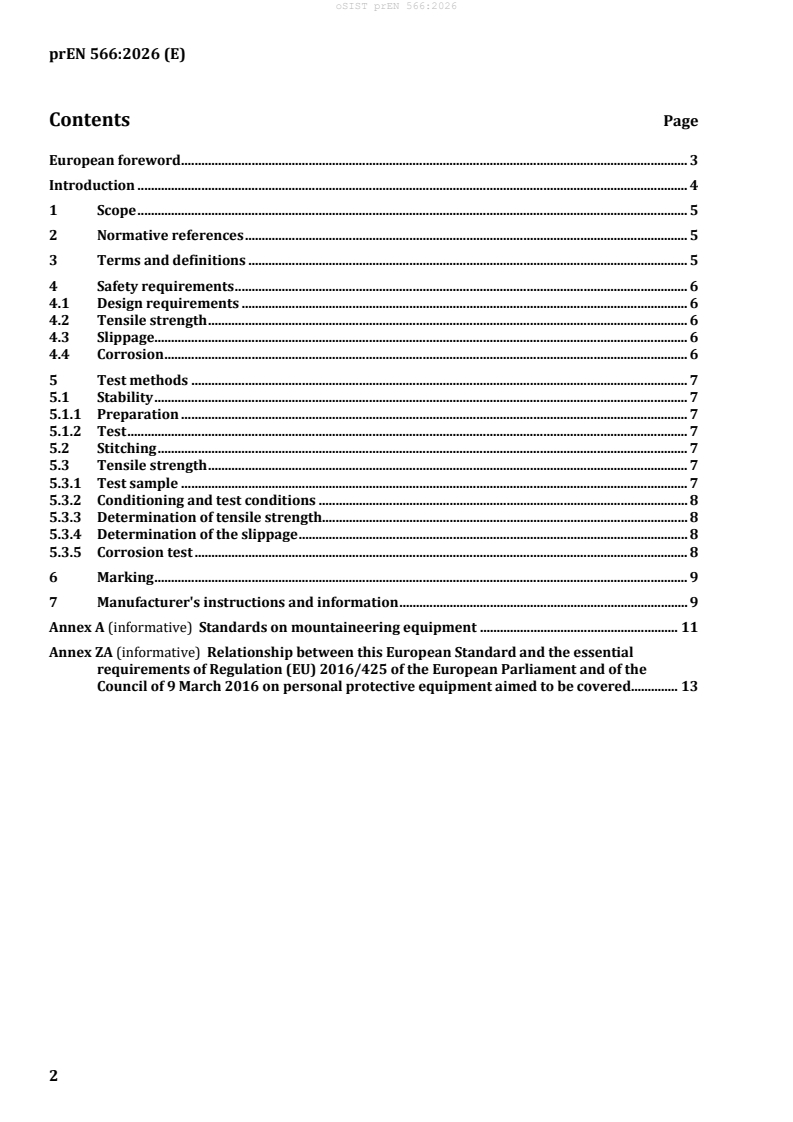
Contents Page
European foreword . 3
Introduction . 4
1 Scope . 5
2 Normative references . 5
3 Terms and definitions . 5
4 Safety requirements . 6
4.1 Design requirements . 6
4.2 Tensile strength . 6
4.3 Slippage. 6
4.4 Corrosion . 6
5 Test methods . 7
5.1 Stability . 7
5.1.1 Preparation . 7
5.1.2 Test . 7
5.2 Stitching . 7
5.3 Tensile strength . 7
5.3.1 Test sample . 7
5.3.2 Conditioning and test conditions . 8
5.3.3 Determination of tensile strength . 8
5.3.4 Determination of the slippage . 8
5.3.5 Corrosion test . 8
6 Marking . 9
7 Manufacturer's instructions and information . 9
Annex A (informative) Standards on mountaineering equipment . 11
Annex ZA (informative) Relationship between this European Standard and the essential
requirements of Regulation (EU) 2016/425 of the European Parliament and of the
Council of 9 March 2016 on personal protective equipment aimed to be covered. 13
European foreword
This document (prEN 566:2026) has been prepared by Technical Committee CEN/TC 136 “Sports,
playground and other recreational facilities and equipment”, the secretariat of which is held by DIN.
This document is currently submitted to the CEN Enquiry.
This document will supersede EN 566:2017.
a) Clause 2 “Normative references” has been added;
b) Figure 1 has been updated;
c) definition of metallic sling has been added;
d) metal components has been included;
e) 4.1 has been changed from "Stability" to "Design requirements" taken into account metallic slings;
f) 4.2 "Stitching" has been deleted;
g) 4.3 "Slippage" has been added with the relevant test method in 5.3.4;
h) new 4.4 "Corrosion" has been added with the relevant test method in 5.3.5;
i) Clause 7 "Manufacturer's instruction and information" has been updated. Metallic slings and high
strength material has been added;
j) the document has been editorially revised.
This document has been prepared under a standardization request addressed to CEN by the European
Commission. The Standing Committee of the EFTA States subsequently approves these requests for its
Member States.
For the relationship with EU Legislation, see informative Annex ZA, which is an integral part of this
document.
Introduction
The text of this document is based on the former UIAA-Standard J (Union Internationale des Associations
d'Alpinisme), which has been developed with international participation.
This document is one of a package of standards for mountaineering equipment, see Annex A, Table A.1.
1 Scope
This document specifies safety requirements and test methods for slings used for mountaineering
including climbing and related activities.
2 Normative references
The following documents are referred to in the text in such a way that some or all of their content
constitutes requirements of this document. For dated references, only the edition cited applies. For
undated references, the latest edition of the referenced document (including any amendments) applies.
ISO 7000:2019, Graphical symbols for use on equipment — Registered symbols
EN ISO 9227:2022, Corrosion tests in artificial atmospheres — Salt spray tests (ISO 9227:2022)
3 Terms and definitions
For the purposes of this document, the following terms and definitions applies.
3.1
sling
tape, accessory cord, rope or metal component(s) joined together by stitching, or other means of
fastening, whose shape and length are not specified to link other items in safety systems
Note 1 to entry: Examples of construction of slings are illustrated in Figure 1.
3.2
metallic sling
sling mainly made of a flexible metal component
Note 1 to entry: Example of metallic sling is illustrated in Figure 1.
a)
b)
c)
d)
e)
f)
g)
Key
a, b, c, d slings for quickdraw 1 cable
e daisy chain 2 pressed ferrules
f metallic sling 3 thimble
g belay sling IIII stiching
Figure 1 — Examples of construction
4 Safety requirements
4.1 Design requirements
Where stitching is used to provide safety and strength (e.g. in joints) it shall be visible for control and
contrast with the webbing/rope in colour or surface appearance.
When a woven tape is used, the weft yarn of the tape shall not unravel when tested in accordance with
5.1.
All parts of metallic slings that can come into contact with the user's hands and/or combinable
components such as ropes shall be free from burrs and sharp edges.
Eye terminations of wire cable shall be made with thimbles and splices or with thimbles and pressed
ferrules.
NOTE Recycled materials with guaranteed characteristic can be used in place of virgin materials for textile
slings.
4.2 Tensile st
...