

SIST EN 60870-5-103:2000
(Main)Telecontrol equipment and systems - Part 5-103: Transmission protocols - Companion standard for the informative interface of protection equipment (IEC 60870-5-103:1997)
General Information
- Abstract
Applies to protection equipment with coded bit serial data transmission for exchanging information with control systems. Defines a companion standard that enables interoperability between protection equipment and devices of a control system in a substation.
- Status
- Published
- Publication Date
- 31-Jan-2000
- Technical Committee
- PSE - Power systems management
- Current Stage
- 6060 - National Implementation/Publication (Adopted Project)
- Start Date
- 01-Feb-2000
- Due Date
- 01-Feb-2000
- Completion Date
- 01-Feb-2000

Overview - EN 60870-5-103 (IEC 60870-5-103)
EN 60870-5-103:1998 / IEC 60870-5-103 is a companion standard for the informative interface of protection equipment used in electrical substations. It applies to protection devices that use coded bit serial data transmission to exchange information with control systems. The document defines protocol selections, message models and interoperability rules so protection relays and substation control equipment can communicate reliably without affecting protection functions.
Key topics and technical requirements
- Scope and objective: Defines an informative interface for protection equipment to exchange data with control systems; does not necessarily apply when protection and control functions share a single port.
- Protocol model: Uses the Enhanced Performance Architecture (EPA) - a three‑layer model (physical, link, application) optimized for fast response of critical information.
- Physical layer options: Support for fibre optic and EIA RS‑485 based transmission (binary, symmetric, memoryless channels).
- Link layer: Selects frame formats and link transmission procedures from IEC 60870‑5‑1 and IEC 60870‑5‑2, including explicit Link Protocol Control Information (LPCI).
- Application layer: Two methods for information exchange:
- Standardized ASDUs (Application Service Data Units) with defined application procedures for common messages.
- Generic services for transmission of broader or vendor‑specific information when standardized messages do not apply.
- Mandatory/optional use: Predefined standardized messages and procedures are mandatory when applicable; otherwise generic services are used. Private ranges exist for legacy compatibility but their future use is discouraged.
- Interoperability: Clause 8 requires selecting compatible subsets of messages and parameters to ensure cross‑vendor interoperability. Annexes A and B provide examples of directory construction and ASDUs.
Practical applications and users
EN 60870-5-103 is intended for:
- Protection equipment manufacturers implementing communication interfaces in relays.
- Substation automation engineers designing IEC 60870‑5 based communication architectures.
- Control system integrators ensuring interoperability between protection devices and SCADA/IEDs.
- Utilities and testing labs validating conformance and interoperability in substations.
Typical applications:
- Exchanging event/ disturbance records and status signals from protection relays to the control center.
- Integrating protection devices with substation control and monitoring systems using standardized ASDUs or generic services.
Related standards
- IEC 60870‑5‑1, ‑2, ‑3, ‑4, ‑5 (sections on frame formats, link procedures, application data, information elements, application functions)
- IEC 60794, IEC 60874 (fibre cables/connectors)
- EIA RS‑485 (balanced multipoint interface)
- ISO/IEC 7498‑1 (OSI Basic Reference Model)
EN 60870‑5‑103 is a practical companion standard for secure, interoperable telecontrol communications between protection relays and control systems in substations.
Relations
- Effective Date
- 09-Feb-2026
- Effective Date
- 09-Feb-2026
- Effective Date
- 03-Feb-2026
- Effective Date
- 03-Feb-2026
- Effective Date
- 03-Feb-2026
- Effective Date
- 03-Feb-2026
- Effective Date
- 03-Feb-2026
- Referred By
SIST EN 13757-2:2018 - Communication systems for meters - Part 2: Wired M-Bus communication - Effective Date
- 09-Feb-2026
- Effective Date
- 03-Feb-2026
- Effective Date
- 03-Feb-2026
- Effective Date
- 03-Feb-2026
- Effective Date
- 03-Feb-2026
- Effective Date
- 03-Feb-2026
- Effective Date
- 03-Feb-2026
- Effective Date
- 13-May-2025
Get Certified
Connect with accredited certification bodies for this standard

ANCE
Mexican certification and testing association.

Intertek Slovenia
Intertek testing, inspection, and certification services in Slovenia.

LNE (Laboratoire National de Métrologie et d'Essais)
French national laboratory for metrology and testing.
Sponsored listings
Frequently Asked Questions
SIST EN 60870-5-103:2000 is a standard published by the Slovenian Institute for Standardization (SIST). Its full title is "Telecontrol equipment and systems - Part 5-103: Transmission protocols - Companion standard for the informative interface of protection equipment (IEC 60870-5-103:1997)". This standard covers: Applies to protection equipment with coded bit serial data transmission for exchanging information with control systems. Defines a companion standard that enables interoperability between protection equipment and devices of a control system in a substation.
Applies to protection equipment with coded bit serial data transmission for exchanging information with control systems. Defines a companion standard that enables interoperability between protection equipment and devices of a control system in a substation.
SIST EN 60870-5-103:2000 is classified under the following ICS (International Classification for Standards) categories: 33.200 - Telecontrol. Telemetering. The ICS classification helps identify the subject area and facilitates finding related standards.
SIST EN 60870-5-103:2000 has the following relationships with other standards: It is inter standard links to SIST EN 589:1999, SIST EN 727:1997, SIST EN 60870-5-4:1997, SIST EN 60870-5-5:1997, SIST EN 60870-5-1:1997, SIST EN 60870-5-2:1997, SIST EN 60870-5-3:1997, SIST EN 13757-2:2018, SIST EN IEC 62351-5:2023, SIST EN 62559-2:2015, SIST EN 60870-5-101:1997/A2:2002, SIST EN 62361-2:2014, SIST EN 61850-5:2013/A1:2022, SIST EN 60870-5-101:2004, SIST EN 60870-5-103:2000/oprA1:2026. Understanding these relationships helps ensure you are using the most current and applicable version of the standard.
SIST EN 60870-5-103:2000 is associated with the following European legislation: Standardization Mandates: M/490. When a standard is cited in the Official Journal of the European Union, products manufactured in conformity with it benefit from a presumption of conformity with the essential requirements of the corresponding EU directive or regulation.
SIST EN 60870-5-103:2000 is available in PDF format for immediate download after purchase. The document can be added to your cart and obtained through the secure checkout process. Digital delivery ensures instant access to the complete standard document.
Standards Content (Sample)
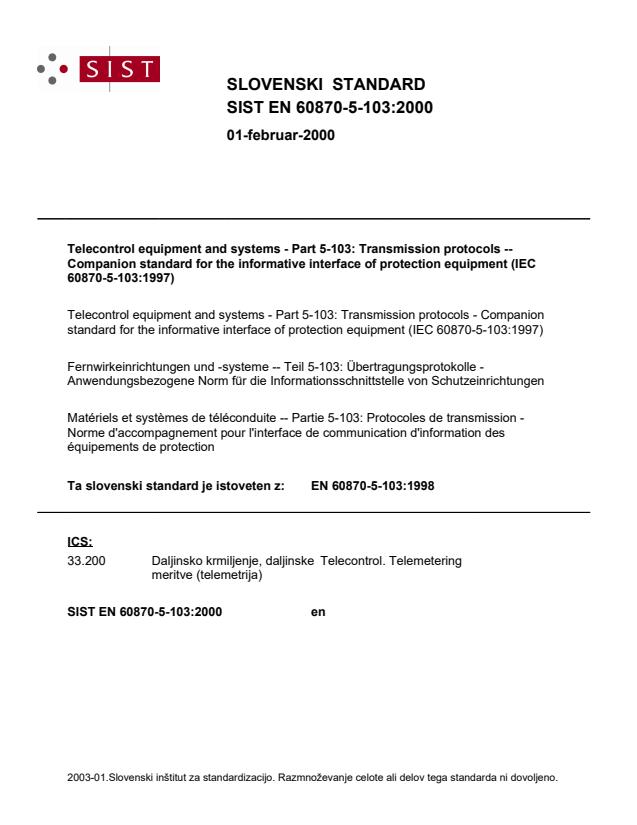
SLOVENSKI STANDARD
01-februar-2000
Telecontrol equipment and systems - Part 5-103: Transmission protocols --
Companion standard for the informative interface of protection equipment (IEC
60870-5-103:1997)
Telecontrol equipment and systems - Part 5-103: Transmission protocols - Companion
standard for the informative interface of protection equipment (IEC 60870-5-103:1997)
Fernwirkeinrichtungen und -systeme -- Teil 5-103: Übertragungsprotokolle -
Anwendungsbezogene Norm für die Informationsschnittstelle von Schutzeinrichtungen
Matériels et systèmes de téléconduite -- Partie 5-103: Protocoles de transmission -
Norme d'accompagnement pour l'interface de communication d'information des
équipements de protection
Ta slovenski standard je istoveten z: EN 60870-5-103:1998
ICS:
33.200 Daljinsko krmiljenje, daljinske Telecontrol. Telemetering
meritve (telemetrija)
2003-01.Slovenski inštitut za standardizacijo. Razmnoževanje celote ali delov tega standarda ni dovoljeno.
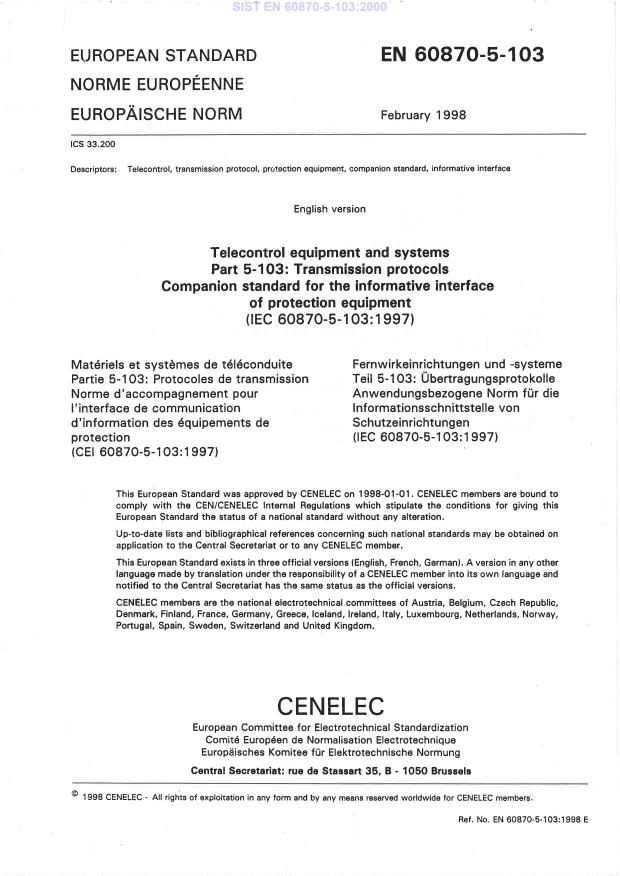
NORME
CEI
INTERNATIONALE
IEC
60870-5-103
INTERNATIONAL
Première édition
STANDARD
First edition
1997-12
Matériels et systèmes de téléconduite –
Partie 5-103:
Protocoles de transmission –
Norme d’accompagnement pour l’interface
de communication d’information
des équipements de protection
Telecontrol equipment and systems –
Part 5-103:
Transmission protocols –
Companion standard for the informative
interface of protection equipment
IEC 1997 Droits de reproduction réservés Copyright - all rights reserved
Aucune partie de cette publication ne peut être reproduite ni No part of this publication may be reproduced or utilized in
utilisée sous quelque forme que ce soit et par aucun any form or by any means, electronic or mechanical,
procédé, électronique ou mécanique, y compris la photo- including photocopying and microfilm, without permission in
copie et les microfilms, sans l'accord écrit de l'éditeur. writing from the publisher.
International Electrotechnical Commission 3, rue de Varembé Geneva, Switzerland
Telefax: +41 22 919 0300 e-mail: inmail@iec.ch IEC web site http: //www.iec.ch
CODE PRIX
Commission Electrotechnique Internationale
PRICE CODE XD
International Electrotechnical Commission
Pour prix, voir catalogue en vigueur
For price, see current catalogue
60870-5-103 IEC:1997 – 3 –
CONTENTS
Page
FOREWORD.5
Clause
1 Scope and object . 7
2 Normative references . 7
3 Definitions. 9
4 General rules . 15
4.1 Protocol structure.15
4.2 Physical layer. 17
4.3 Link layer. 19
4.4 Application layer. 19
4.5 User process. 19
4.6 Compatibility with companion standards of the IEC 60870-5 series. 19
5 Physical layer.19
5.1 Fibre optic transmission. 21
5.2 EIA RS-485 interface. 21
6 Link layer . 23
6.1 Selections from IEC 60870-5-1 (transmission frame formats) . 23
6.2 Selections from IEC 60870-5-2 (link transmission procedures) . 23
6.3 Additional specifications to IEC 60870-5-2. 25
7 Application layer . 25
7.1 Selections from IEC 60870-5-3 (general structure of application data). 25
7.2 Selections from IEC 60870-5-4 (definition and coding of
application information elements). 29
7.3 Definition and presentation of ASDUs . 65
7.4 Application functions. 87
8 Interoperability . 159
8.1 Physical layer. 159
8.2 Link layer. 159
8.3 Application layer. 159
Annex A (informative) – Generic functions – Examples of constructing a directory. 173
Annex B (informative) – Generic functions – Examples of ASDUs . 183
60870-5-103 IEC:1997 – 5 –
INTERNATIONAL ELECTROTECHNICAL COMMISSION
___________
TELECONTROL EQUIPMENT AND SYSTEMS –
Part 5-103: Transmission protocols –
Companion standard for the informative interface
of protection equipment
FOREWORD
1) The IEC (International Electrotechnical Commission) is a worldwide organization for standardization comprising
all national electrotechnical committees (IEC National Committees). The object of the IEC is to promote
international co-operation on all questions concerning standardization in the electrical and electronic fields. To
this end and in addition to other activities, the IEC publishes International Standards. Their preparation is
entrusted to technical committees; any IEC National Committee interested in the subject dealt with may
participate in this preparatory work. International, governmental and non-governmental organizations liaising
with the IEC also participate in this preparation. The IEC collaborates closely with the International Organization
for Standardization (ISO) in accordance with conditions determined by agreement between the two
organizations.
2) The formal decisions or agreements of the IEC on technical matters express, as nearly as possible, an
international consensus of opinion on the relevant subjects since each technical committee has representation
from all interested National Committees.
3) The documents produced have the form of recommendations for international use and are published in the form
of standards, technical reports or guides and they are accepted by the National Committees in that sense.
4) In order to promote international unification, IEC National Committees undertake to apply IEC International
Standards transparently to the maximum extent possible in their national and regional standards. Any
divergence between the IEC Standard and the corresponding national or regional standard shall be clearly
indicated in the latter.
5) The IEC provides no marking procedure to indicate its approval and cannot be rendered responsible for any
equipment declared to be in conformity with one of its standards.
6) Attention is drawn to the possibility that some of the elements of this International Standard may be the subject
of patent rights. The IEC shall not be held responsible for identifying any or all such patent rights.
International Standard IEC 60870-5-103 has been prepared by IEC technical committee 57:
Power system control and associated communications.
The text of this standard is based on the following documents:
FDIS Report on voting
57/327/FDIS 57/333/RVD
Full information on the voting for the approval of this standard can be found in the report on
voting indicated in the above table.
Annexes A and B are for information only.
60870-5-103 IEC:1997 – 7 –
TELECONTROL EQUIPMENT AND SYSTEMS –
Part 5-103: Transmission protocols –
Companion standard for the informative interface
of protection equipment
1 Scope and object
This section of IEC 60870-5 applies to protection equipment with coded bit serial data transmission for
exchanging information with control systems. It defines a companion standard that enables
interoperability between protection equipment and devices of a control system in a substation. The
defined companion standard utilizes standards of the IEC 60870-5 series.
This section of IEC 60870-5 presents specifications for the informative interface of protection
equipment. This standard does not necessarily apply to equipment that combines protection and
control functions in the same device sharing a single communication port.
This section of IEC 60870-5 describes two methods of information exchange: the first is based on
PPLICATION ERVICE ATA NITS
explicitly specified A S D U (ASDUs) and application procedures for
transmission of ‘standardized’ messages, and the second uses generic services for transmission of
nearly all possible information. The ‘standardized’ messages do not cover all possible protection
functions, and furthermore a protection device may support only a subset of the messages specified in
this standard. For interoperability purposes, in specific applications, this subset has to be specified in
clause 8.
The use of predefined messages and application procedures is mandatory, if applicable. In other cases
generic services shall be used. The ‘private ranges’ defined in this standard are maintained for
compatibility reasons; however, their use is not recommended for future applications.
2 Normative references
The following normative documents contain provisions which, through reference in this text, constitute
provisions of this section of IEC 60870-5. At the time of publication, the editions indicated were valid.
All normative documents are subject to revision, and parties to agreements based on this section of
IEC 60870-5 are encouraged to investigate the possibility of applying the most recent editions of the
normative documents indicated below. Members of IEC and ISO maintain registers of currently valid
International Standards.
IEC 60050(371): 1984, International Electrotechnical Vocabulary – Chapter 371: Telecontrol
IEC 60794-1: 1996, Optical fibre cables – Part 1: Generic specification
IEC 60794-2: 1989, Optical fibre cables – Part 2: Product specifications
IEC 60870-5-1: 1990, Telecontrol equipment and systems – Part 5: Transmission protocols –
Section 1: Transmission frame formats
IEC 60870-5-2: 1992, Telecontrol equipment and systems – Part 5: Transmission protocols –
Section 2: Link transmission procedures
60870-5-103 IEC:1997 – 9 –
IEC 60870-5-3: 1992, Telecontrol equipment and systems – Part 5: Transmission protocols –
Section 3: General structure of application data
IEC 60870-5-4: 1993, Telecontrol equipment and systems – Part 5: Transmission protocols –
Section 4: Definition and coding of application information elements
IEC 60870-5-5: 1995, Telecontrol equipment and systems – Part 5: Transmission protocols –
Section 5: Basic application functions
IEC 60874-2: 1993, Connectors for optical fibres and cables – Part 2: Sectional specification for fibre
optic connector – Type F-SMA
IEC 60874-10: 1992, Connectors for optical fibres and cables – Part 10: Sectional specification – Fibre
optic connector type BFOC/2,5
ISO/IEC 7498-1: 1994, Information technology – Open System Interconnection – Basic Reference
Model: The Basic Model
EIA RS-485: Standard for electrical characteristics of generators and receivers for use in balanced
digital multipoint systems
R 32 – IEEE Standard 754
R 64 - IEEE Standard 754
3 Definitions
For the purpose of this section of IEC 60870-5, the following definitions apply.
3.1
companion standard
a companion standard adds semantics to the definitions of the basic standard or a functional profile.
This may be expressed by defining particular uses for information objects or by defining additional
information objects, service procedures and parameters of the basic standard
NOTE – Companion standards do not alter the standards to which they refer, but make explicit the relationship between those
used together for a specific domain of activity.
3.2
enhanced performance architecture (EPA)
a protocol reference model that provides, compared with the full seven layer architecture according to
the basic reference model of ISO/IEC 7498-1, a three layer architecture for obtaining faster response
times for the critical information but with service limitations
3.3
control direction
direction of transmission from the control system to the protection equipment
3.4
monitor direction
direction of transmission from the protection equipment to the control system
3.5
control system
used for the master of the communication link, i.e. the primary station according to IEC 60870-5-2
60870-5-103 IEC:1997 – 11 –
3.6
informative interface
interface of a protection equipment used to exchange data with control systems without having an
impact on the protection function
3.7
tag
binary signal which is recorded and transmitted within the transmission of disturbance data
3.8
compatible range
standard range to be used by all manufacturers
3.9
private range
range that may be used by manufacturers for their own private use
3.10 Abbreviations
ΔI Line differential protection
L
ΔI Transformer differential protection
T
ACC Actual channel
AR Auto-recloser
ASC ASCII character
ASDU APPLICATION SERVICE DATA UNIT
APCI APPLICATION PROTOCOL CONTROL INFORMATION
BFOC/2,5 Bayonet fibre optic connector
BS Bitstring
CB Circuit breaker
COL Compatibility level
COM Command
CONT Continued
COT CAUSE OF TRANSMISSION
COUNT One bit counter of ASDUs
CP Compound
CU Communication unit
CP32Time2a FOUR OCTET BINARY TIME
CP56Time2a SEVEN OCTET BINARY TIME
dB Decibel
DCE Data circuit-terminating equipment
DCO Double command
DFC Data flow control
DPI Double-point information
DTE Data terminal equipment
EIA Electronic Industries Association
EPA Enhanced Performance Architecture
ER Error
f Frequency
F Fixed point number
FAN Fault number
F-Code Function code
FCB Frame count bit
FCV Frame count bit valid
F-SMA Type of an optical fibre connector
60870-5-103 IEC:1997 – 13 –
FT Frame transmission format
FUN FUNCTION TYPE
GDD Generic data description
GEN Generic function type
GGI General interrogation of generic data
GI General interrogation
GID Generic identification data
GIN Generic identification number
GLB Global function type
GRC GENERIC REPLY CODE
I Integer
I>> Overcurrent protection
IEC International Electrotechnical Commission
IEV International Electrotechnical Vocabulary
INF INFORMATION NUMBER
INT Interval between information elements
ISO International Organization for Standardization
IV Invalid
KOD Kind of description
L Line
LED Light emitting diode
LPCI LINK PROTOCOL CONTROL INFORMATION
LPDU LINK PROTOCOL DATA UNIT
MEA Measurand with quality descriptor
MVAL Value of measurand
NDE Number of descriptive elements
NDV Number of relevant disturbance values per ASDU
NFE Number of the ASDU first information element
NGD Number of generic data sets
NO Number
NOC Number of channels
NOE Number of information elements of a channel
NOF Number of grid faults
NOG Number of generic identification
NOT Number of tags
OTEV Other event (disturbance data recording initiated by)
OV Overflow
P Active power
PRM Primary message
Q Reactive power
RES Reserved
RET Relative time
RFA Reference factor
RII RETURN INFORMATION IDENTIFIER
RPV Rated primary value
RSV Rated secondary value
S Sign
SCL Short-circuit location
SCN SCAN NUMBER
SDV Single disturbance value
SIN SUPPLEMENTARY INFORMATION
SOF Status of fault
60870-5-103 IEC:1997 – 15 –
SU Summer bit
SQ Sequence of equal information elements
t(z) Distance protection
TAP Tag position
TM Transmit (disturbance data)
TOO Type of order
TOV Type of disturbance values
TP Trip (recorded fault)
T Loop delay
LD
t Cycle repeat time
wz
TYP TYPE IDENTIFICATION
UF Unsigned fixed point number
UI Unsigned integer
V Voltage
V Neutral voltage
EN
VT Voltage transformer
4 General rules
This clause provides general rules for constructing companion standards for the transmission protocol
of specific control systems and protection equipment, using the IEC 60870-5 protocol.
These general rules are applied in the following subclauses.
4.1 Protocol structure
The IEC 60870-5 protocol is based on the three layer reference model ‘Enhanced Performance
Architecture’ (EPA), as specified in clause 4 of IEC 60870-5-3.
The physical layer uses a fibre optic or a copper-wire based system that provides binary symmetric and
memoryless transmission.
The link layer consists of a number of link transmission procedures, using explicit LINK PROTOCOL
CONTROL INFORMATION (LPCI), that are capable of carrying APPLICATION SERVICE DATA UNITS (ASDUs)
as link user data. The link layer uses a selection of frame formats to provide the required integrity,
efficiency, and convenience of transmission.
The application layer contains a number of application functions that involve the transmission of
APPLICATION SERVICE DATA UNITS (ASDUs) between source and destination.
The application layer of this companion standard does not use explicit APPLICATION PROTOCOL
CONTROL INFORMATION (APCI). This is implicit in the contents of the ASDU DATA UNIT IDENTIFIER and in
the type of link service used.
Table 1 shows the Enhanced Performance Architecture (EPA) model and the selected standard defi-
nitions of this companion standard.
60870-5-103 IEC:1997 – 17 –
Table 1 – Selected standard provisions of this companion standard
Selected application functions
of User process
IEC 60870-5-5
Selected APPLICATION SERVICE DATA UNITS
of Application layer
IEC 60870-5-3
Selected application information elements
of (Layer 7)
IEC 60870-5-4
Selected link transmission procedures
of
IEC 60870-5-2 Link layer
Selected transmission frame formats (Layer 2)
of
IEC 60870-5-1
Fibre optic system based on IEC 60874-2
or IEC 60874-10 and IEC 60794-1 and IEC 60794-2 Physical layer
or copper-wire based system (Layer 1)
according to EIA RS-485
4.2 Physical layer
Either a fibre optic system or a copper-wire based transmission system is used in this companion
standard between the protection equipment and the control system. The interface between the data
circuit-terminating equipment (DCE) and data terminal equipment (DTE) of the protection equipment,
according to figure 1, is not defined within this companion standard.
NOTE – Data transmission methods which increase the exploitation of the bandwidth of a given transmission channel should
be avoided, unless it can be proven that the method, that usually violates the required memoryless channel encoding principle,
does not reduce the Hamming distance of the data block encoding method of the selected frame format in the link layer.
Serial communication system
Data terminal Data terminal
Data circuit Data circuit
equipment equipment
terminating terminating
DTE DTE
equipment equipment
of the of the
Transmission media
protection DCE DCE control
a) Fibre optic
equipment system
b) Copper wire
Protection equipment Control system
Figure 1 – Interfaces and connections of a protection equipment and a control system
60870-5-103 IEC:1997 – 19 –
4.3 Link layer
IEC 60870-5-2 offers a selection of link transmission procedures using a control field and an optional
address field. Links between stations may be operated in either an unbalanced or a balanced
transmission mode. Appropriate function codes for the control field are specified for both modes of
operation.
If the links from a control system to several protection equipments share a common physical channel,
then these links shall be operated in an unbalanced mode to avoid the possibility that more than one
protection equipment attempts to transmit on the channel at the same time. The sequence in which the
various protection equipments are granted access to transmit on the channel is then determined by an
application layer procedure in the control system, see 6.2 of IEC 60870-5-5.
The companion standard specifies whether an unbalanced or a balanced transmission mode is used,
together with which link procedures (and corresponding link function codes) are to be used.
The companion standard specifies an unambiguous address (number) for each link. Each address
may be unique within a specific system, or it may be unique within a group of links sharing a common
channel. The latter needs a smaller address field but requires the control system to map addresses by
channel number.
A companion standard shall specify one frame format chosen from those offered in IEC 60870-5-1.
The format chosen shall provide the required data integrity together with the maximum efficiency
available for an acceptable level of convenience of implementation.
4.4 Application layer
A companion standard shall define appropriate ASDUs from a given general structure in
IEC 60870-5-3. These ASDUs are constructed using the definition and coding specifications for
application information elements given in IEC 60870-5-4.
A companion standard shall specify one chosen order of transport for application data fields according
to 4.10 of IEC 60870-5-4. The order, i.e. mode 1 or mode 2, may be chosen to provide the maximum
overall convenience of programming for the various computers in the specific system.
4.5 User process
IEC 60870-5-5 offers a selection of basic application functions. A companion standard contains one or
more instances of these functions chosen to provide the required set of input and of output application
procedures to suit the specific system.
4.6 Compatibility with companion standards of the IEC 60870-5 series
Certain parts of this standard are not fully compatible with other companion standards of the
IEC 60870-5 series. This is due to the need to maintain compatibility with existing equipment already in
use.
5 Physical layer
The data circuit terminating equipment (DCE) of the protection equipment may either be realized as a
fibre optic transmission system or as a copper-wire-based transmission system. In the following sub-
clauses, descriptions are given for both alternatives.
60870-5-103 IEC:1997 – 21 –
5.1 Fibre optic transmission
If a fibre optic transmission system is used, the compatible interface is a fibre optic connector at the
protection equipment. Separate optical fibres are used in the monitor direction and in the control
direction. The DCE may be mechanically and/or electrically integrated into the data terminal equipment
(DTE).
For connecting the fibre optic cables to the DCE, a fibre optic connector of the BFOC/2,5 type as
specified in IEC 60874-10 shall be used. The fibre optic connector of F-SMA type, as specified in
IEC 60874-2, is included for compatibility with existing equipment. All the other mechanical
specifications, for example mounting position and cable layout, are manufacturer specific.
The connectors are suitable for use with glass and plastic fibres, as indicated in table 2.
The line-idle state is defined as ‘light on’.
Table 2 – The compatible fibre optic transmission system
Characteristics Plastic fibre Glass fibre
Connector BFOC/2,5 (or F-SMA) BFOC/2,5 (or F-SMA)
Cable type Step-index 980/1 000 μm Graded-index 62,5/125 μm*
Typical distance Up to 40 m Up to 1 000 m
Optical wavelength 660 nm 820 nm - 860 nm
Temperature range –5 °C. +55 °C –5 °C. +55 °C
Transmission power Min. –7 dBm Min. –16 dBm
Minimum receiving power Min. –20 dBm Min. –24 dBm
System reserve Min. +3 dB Min. +3 dB
* Both connectors may also be used with 50/125 μm optical fibres. If this type of fibre is used, the transmitting power
that can be input is reduced and therefore the distance, the receiving power, and the system reserve shall be specified
separately.
5.2 EIA RS-485 interface
As an alternative to the fibre optic transmission described above a copper-wire based transmission
system may be used between the protection equipment and the control system. This transmission
system shall comply with the EIA RS-485 standard.
Due to the characteristic of the EIA RS-485 standard a maximum number of 32 units of load can be
connected to one physical line. The location and the values of the termination resistances used are not
specified, neither in the base standard nor in this companion standard. For compatibility purposes, the
manufacturer shall state the units of load for each specific device (refer to clause 8).
The type of the cable used is not defined in the EIA RS-485 standard. However, guidance on the
choice of the cable is given in annex A.2.2 of the EIA RS-485 standard.
All other mechanical specifications are manufacturer specific.
NOTE – Copper-wire based transmission systems are more susceptible to electromagnetic interference than fibre optic based
systems. The inclusion of a copper-wire based system shall not degrade the performance of the protection equipment with
respect to the relevant EMC standards.
60870-5-103 IEC:1997 – 23 –
6 Link layer
The following International Standards are applicable:
IEC 60870-5-1;
IEC 60870-5-2.
6.1 Selections from IEC 60870-5-1 (transmission frame formats)
This companion standard admits exclusively frame format FT1.2 that is defined in 6.2.4.2 of
IEC 60870-5-1. Formats with fixed and with variable block lengths are admitted. Also the single control
character E5H transmission is admitted.
NOTE 1 – The rules defined in clause 6.2.4.2 of IEC 60870-5-1 have to be observed completely.
NOTE 2 – The maximum number of user data is limited to 255 octets. However, as the frame length has an impact on the
polling cycle time, especially when transmission errors occur, it may be considered to limit further the number of user data
octets.
6.2 Selections from IEC 60870-5-2 (link transmission procedures)
The statements in the ‘introduction’ and ‘scope’ of IEC 60870-5-2 regarding utilization in geographically
widespread telecontrol networks are not relevant.
The following selections from IEC 60870-5-2 shall be applied:
6.2.1 Format FT 1.2 (see 3.2 of IEC 60870-5-2)
The frame with fixed length has no link user data. It is referred to below as a short message. The
single character A2H is not used .
6.2.2 Service primitives and elements of transmission procedures
(see clause 4 of IEC 60870-5-2)
All three transmission procedures (S1 to S3) are used. The interface between the link control level and
the user service is not specified.
6.2.3 Unbalanced transmission (see clause 5 of IEC 60870-5-2)
The control system constitutes the master, the protection equipment the slave; i.e. the control system
is always primary station, the protection equipment always secondary station. The RES bit is not used.
The following function codes are used:
PRM = 1 0, 3, 4, 9, 10, 11
PRM = 0 0, 1, 8, 9, 11
Address field A always consists of one octet only. For broadcast (send/no reply) the address is defined
as 255.
6.2.4 Time out interval for repeated frame transmission (see annex A.1 of IEC 60870-5-2)
The loop delay T shall be 50 ms.
LD
The standard transmission speeds are 9,6 kbit/s or 19,2 kbit/s (adjustable).
60870-5-103 IEC:1997 – 25 –
6.3 Additional specifications to IEC 60870-5-2
The following additional function code is defined in the reserved range:
PRM = 1 F-Code 7 := reset FCB FCB and FCV = 0
This SEND function code is used to set the internal FCB bit to the value 0, i.e. the next successive
primary message with FCV = 1 is expected with the setting FCB = 1 by the protection equipment. No
other reset function such as those associated with function code 0 (reset communication unit) are
triggered.
The following function codes are already specified in the standard. They are used here as follows:
PRM = 0 F-Code 14 := link service not functioning
Primary messages that cannot be passed on due to a malfunction are answered with an F-Code 14.
The FCB bit is processed alternately.
PRM = 0 F-Code 15 := link service not implemented
Primary messages containing not implemented function codes are acknowledged with short messages
and will not be processed. Non-plausible primary messages involving function codes 0-15 will be
answered by means of function code 15 in a short message. The FCB bit will be processed alternately.
As long as the protection equipment is not able to process a further command, the DFC bit is set to ‘1’
to prevent loss of information in the control direction. This state may only be maintained for a maximum
of 15 s. During this time, no further command shall be transmitted by the control system. Such
messages are answered by the protection equipment by means of a short message with function code
1 and are not processed. This leads to a loss of information. The exception to this is the broadcast
command.
7 Application layer
The following International Standards are applicable:
IEC 60870-5-3;
IEC 60870-5-4;
IEC 60870-5-5.
7.1 Selections from IEC 60870-5-3 (general structure of application data)
IEC 60870-5-3 describes the basic application data units in transmission frames. This subclause
selects specific field elements out of this basic standard and defines APPLICATION SERVICE DATA UNITS
used in this companion standard.
A LINK PROTOCOL DATA UNIT (LPDU) of this companion standard contains not more than one
APPLICATION SERVICE DATA UNIT (ASDU).
The ASDU according to figure 2 is composed of a DATA UNIT IDENTIFIER and only one INFORMATION
OBJECT.
60870-5-103 IEC:1997 – 27 –
The DATA UNIT IDENTIFIER has always the same structure for all ASDUs and consists of four octets. Its
structure is as follows:
• TYPE IDENTIFICATION
• VARIABLE STRUCTURE QUALIFIER
• CAUSE OF TRANSMISSION
• COMMON ADDRESS OF ASDU
The COMMON ADDRESS OF ASDU shall normally be identical to the address used in the link layer.
The INFORMATION OBJECT consists of an INFORMATION OBJECT IDENTIFIER, a SET OF INFORMATION
ELEMENTS and, if present, a TIME TAG.
The INFORMATION OBJECT IDENTIFIER consists of two octets. Its structure is as follows:
• FUNCTION TYPE
• INFORMATION NUMBER
The SET OF INFORMATION ELEMENTS consists of a SINGLE INFORMATION ELEMENT, a COMBINATION OF
INFORMATION ELEMENTS, or a SEQUENCE OF INFORMATION ELEMENTS.
TYPE IDENTIFICATION
DATA UNIT
TYPE
DATA VARIABLE STRUCTURE QUALIFIER
UNIT
IDENTIFIER CAUSE OF TRANSMISSION
COMMON ADDRESS OF ASDU
FUNCTION TYPE INFORMATION
OBJECT
INFORMATION NUMBER IDENTIFIER
APPLICATION
SERVICE
SET OF INFORMATION ELEMENTS
DATA UNIT
TIME TAG ms
TIME TAG OF
INFORMATION INFORMATION
OBJECT OBJECT
IV Res TIME TAG min
(optional)
SU TIME TAG h
Figure 2 – Structure of an APPLICATION SERVICE DATA UNIT
60870-5-103 IEC:1997 – 29 –
APPLICATION SERVICE DATA UNIT := CP48+8i+8j {DATA UNIT IDENTIFIER, INFORMATION
OBJECT}
DATA UNIT IDENTIFIER := CP32{TYPE IDENTIFICATION, VARIABLE STRUCTURE
QUALIFIER, CAUSE OF TRANSMISSION, COMMON ADDRESS
OF ASDU}
INFORMATION OBJECT := CP16+8i+8j{FUNCTION TYPE, INFORMATION NUMBER,
SET OF INFORMATION ELEMENTS, TIME TAG}
with parameter i := number of octets of SET OF INFORMATION ELEMENTS
parameter j := 0 : TIME TAG not present, 4 : TIME TAG present
7.2 Selections from IEC 60870-5-4 (definition and coding of application information
elements)
The sizes and the contents of individual information fields of the ASDUs are specified according to the
declaration rules for information elements defined in IEC 60870-5-4.
NOTE – The definitions concerning the TYPE IDENTIFICATION, the CAUSE OF TRANSMISSION and the FUNCTION TYPE are used for
the compatible range. Combinations going beyond these may be used for the private range.
Example: TYPE IDENTIFICATION 7 (general interrogation) in combination with a CAUSE OF TRANSMISSION >63 may be used for a
private initiation of a general interrogation, which is specific to a given manufacturer.
7.2.1 Type identification
The first octet of the DATA UNIT IDENTIFIER of the ASDU defines the TYPE IDENTIFICATION. For compatible
data exchange, 31 TYPE IDENTIFICATIONs are used. Their definition is as follows:
TYPE IDENTIFICATION := UI8[1.8] <1.255>
<1.31> := definitions of this companion standard (compatible range)
<32.255> := for special use (private range)
Table 3 – Semantics of TYPE IDENTIFICATION; Information in monitor direction
<1> := time-tagged message
<2> := time-tagged message with relative time
<3> := measurands I
<4> := time-tagged measurands with relative time
<5> := identification
<6> := time synchronization
<8> := general interrogation termination
<9> := measurands II
<10> := generic data
<11> := generic identification
<23> := list of recorded disturbances
<26> := ready for transmission of disturbance data
<27> := ready for transmission of a channel
<28> := ready for transmission of tags
<29> := transmission of tags
<30> := transmission of disturbance values
<31> := end of transmission
60870-5-103 IEC:1997 – 31 –
Table 4 – Semantics of TYPE IDENTIFICATION; Information in control direction
<6> := time synchronization
<7> := general interrogation
<10> := generic data
<20> := general command
<21> := generic command
<24> := order for disturbance data transmission
<25> := acknowledgement for disturbance data transmission
All values in the range <0.31> not listed above are reserved for future compatible use.
7.2.2 Variable structure qualifier
The second octet of the DATA UNIT IDENTIFIER of the ASDU defines the VARIABLE STRUCTURE QUALIFIER,
which is specified as follows:
VARIABLE STRUCTURE QUALIFIER := CP8 {number, SQ}
with number := UI7 [1.7] <0.127>
<0.9> := number of information elements
<10.127> := not used
SQ := BS1 [8] <0.1>
<0> := addressing of a sequence of information elements in one object
<1> := addressing of single information element or a combination of elements
The SQ bit specifies the method of addressing the following INFORMATION OBJECT or information
elements.
SQ = 0: A sequence of equal information elements is addressed (see 5.1.5 of IEC 60870-5-3) by the
INFORMATION OBJECT address. The INFORMATION OBJECT address specifies the associated address of
the first information element of the sequence. The following information elements are identified by
numbers increasing by 1 from this address. This mode is used for measurands and for the list of
recorded disturbances.
SQ = 1: Each single element or combination of elements is addressed by the INFORMATION OBJECT
address.
7.2.3 Cause of transmission
In the third octet of the DATA UNIT IDENTIFIER of the ASDU the CAUSE OF TRANSMISSION is identified. This
octet is specified as follows:
CAUSE OF TRANSMISSION := UI8 [1.8] <0.255>
with <0> := not used
<1.63> := compatible range
<64.255> := private range
60870-5-103 IEC:1997 – 33 –
Table 5 – Semantics of CAUSE OF TRANSMISSION; Information in monitor direction
<1> := spontaneous
<2> := cyclic
<3> := reset frame count bit (FCB)
<4> := reset communication unit (CU)
<5> := start / restart
<6> := power on
<7> := test mode
<8> := time synchronization
<9> := general interrogation
<10> := termination of general interrogation
<11> := local operation
<12> := remote operation
<20> := positive acknowledgement of command
<21> := negative acknowledgement of command
<31> := transmission of disturbance data
<40> := positive acknowledgement of generic write command
<41> := negative acknowledgement of generic write command
<42> := valid data response to generic read command
<43> := invalid data response to generic read command
<44> := generic write confirmation
NOTE – For further explanation, see 7.4.
Table 6 – Semantics of CAUSE oF TRANSMISSION; Information in control direction
<8> := time synchronization
<9> := initiation of general interrogation
<20> := general command
<31> := transmission of disturbance data
<40> := generic write command
<42> := generic read command
All values in the range <0.63> not listed in tables 5 and 6 are reserved for future compatible use.
7.2.4 Common address of ASDU
The fourth octet of the DATA UNIT IDENTIFIER of the ASDU defines the COMMON ADDRESS OF ASDU. This
octet shall normally be identical to the station address used at the link level. Exceptions are only
permitted where additional COMMON ADDRESSES OF ASDUs are required on the same physical link
because of duplicated functions, for example two overcurrent protection functions within a transformer
differential protection.
COMMON ADDRESS OF ASDU := UI8 [1.8] <0.255>
with <0.254> := station address
<255> := global address
System co-ordination functions (see tables 8 and 16) need only use the COMMON ADDRESS OF ASDU
which is identical to the link layer address.
60870-5-103 IEC:1997 – 35 –
7.2.5 Information object identifier
7.2.5.1 Function type
The first octet of the INFORMATION OBJECT IDENTIFIER defines the FUNCTION TYPE of the protection
equipment used. It is defined as follows:
FUNCTION TYPE := UI8 [1.8] <0.255>
with <0.127> := private range
<128.129> := compatible range
<130.143> := private range
<144.145> := compatible range
<146.159> := private range
<160.161> := compatible range
<162.175> := private range
<176.177> := compatible range
<178.191> := private range
<192.193> := compatible range
<194.207> := private range
<208.209> := compatible range
<210.223> := private range
<224.225> := compatible range
<226.239> := private range
<240.241> := compatible range
<242.253> := private range
<254.255> := compatible range
Table 7 – Semantics of FUNCTION TYPE
<128> := distance protection t(z)
<129> := not used
<144> := not used
<145> := not used
<160> := overcurrent protection I>>
<161> := not used
<176> := transformer differential protection ΔI
T
<177> := not used
<192> := line differential protection ΔI
L
<193> := not used
<208> := not used
<209> := not used
<224> := not used
<225> := not used
<240> := not used
<241> := not used
<254> := generic function type GEN
<255> := global function type GLB
60870-5-103 IEC:1997 – 37 –
7.2.5.2 Information number
The second octet of the INFORMATION OBJECT IDENTIFIER defines the INFORMATION NUMBER within a
given FUNCTION TYPE. The full range <0.255> is used independently in the control direction as well as
in the monitor direction. The second octet is defined as follows:
INFORMATION NUMBER := UI8 [1.8] <0.255>
with monitor direction := <0.255>
<0.15> := system functions
<16.31> := status
<32.47> := supervision
<48.63> := earth fault
<64.127> := short circuit
<128.143> := auto-reclosure
<144.159> := measurands
<160.239> := not used
<240.255> := generic functions
control direction := <0.255>
<0.15> := system functions
<16.31> := general commands
<32.239> := not used
<240.255> := generic functions
The semantics of the octet INFORMATION NUMBER (INF) is given in the following tables. INFORMATION
NUMBERs not listed are not used according to the above list.
A distinction is not only made between monitor direction and control direction but also for the different
modes mentioned above. Additionally, the TYPE IDENTIFICATIONS (TYP) and possible CAUSES OF
TRANSMISSION (COT) are listed.
For each INFORMATION NUMBER typical FUNCTION TYPEs (FUN) are given. GLB and GEN are mandatory,
where specified.
The field GI indicates whether the information is included in the general interrogation. For these
INFORMATION NUMBERs both status changes (‘OFF’ to ‘ON’ and ‘ON’ to ‘OFF’) are also transmitted
spontaneously. For the other INFORMATION NUMBERs only the status changes ‘OFF’ to ‘ON’ are
transmitted.
Table 8 – Semantics of INFORMATION NUMBER; System functions in monitor direction
INF Description GI TYP COT FUN
<0> := end of general interrogation – 8 10 GLB
<0> := time synchronization – 6 8 GLB
<1> := not used –
<2> := reset FCB – 5 3 according to main FUN
<3> := reset CU – 5 4 according to main FUN
<4> := start/restart – 5 5 according to main FUN
<5> := power on – 5 6 according to main FUN
NOTE 1 – INFORMATION NUMBER 0 refers to the GLOBAL FUNCTION TYPE and is identical for all system services.
NOTE 2 – INFORMATION NUMBERs 2 to 5 are used with a FUN according to the main function of the protection device.
60870-5-103 IEC:1997 – 39 –
Table 9 – Semantics of INFORMATION NUMBER; Status indications in monitor direction
INF Description GI TYP COT FUN (typical)
<16> := auto-recloser active x 1 1,7,9,11,12,20,21 t(z), I>>, I
Δ
L
<17> := teleprotection active x 1 1,7,9,11,12,20,21 t(z), I>>
<18> := protection active x 1 1,7,9,11,12,20,21 t(z), I>>, ΔI , ΔI
T L
<19> := LED reset – 1 1,7,11,12,20,21 t(z), I>>, ΔI , ΔI
T L
<20> := monitor direction blocked x 1 9,11
t(z), I>>, ΔI , ΔI
T L
<21> := test mode x 1 9,11
t(z), I>>, ΔI , ΔI
T L
<22> := local parameter setting x 1 9,11 t(z), I>>, ΔI , ΔI
T L
<23> := characteristic 1 x 1 1,7,9,11,12,20,21 t(z)
<24> := characteristic 2 x 1 1,7,9,11,12,20,21 t(z)
<25> := characteristic 3 x 1 1,7,9,11,12,20,21 t(z)
<26> := characteristic 4 x 1 1,7,9,11,12,20,21 t(z)
<27> := auxiliary input 1 x 1 1,7,9,11
t(z), I>>, ΔI , ΔI
T L
<28> := auxiliary input 2 x 1 1,7,9,11
t(z), I>>, ΔI , ΔI
T L
<29> := auxiliary input 3 x 1 1,7,9,11 t(z), I>>, ΔI , ΔI
T L
<30> := auxiliary input 4 x 1 1,7,9,11 t(z), I>>, ΔI , ΔI
T L
Table 10 – Semantics of INFORMATION NUMBER; Supervision indications in monitor direction
INF Description GI TYP COT FUN (typical)
<32> := measurand supervision I x 1 1,7,9 t(z), I>>
<33> := measurand supervision V x 1 1,7,9 t(z), I>>
<35> := phase sequence supervision x 1 1,7,9 t(z), I>>
<36> := trip circuit supervision x 1 1,7,9 t(z), I>>, ΔI , ΔI
T L
<37> := I>> back-up operation x 1 1,7,9 t(z)
<38> := VT fuse failure* x 1 1,7,9 t(z), I>>
<39> := teleprotection disturbed x 1 1,7,9 t(z), I>>, ΔI
L
<46> := group warning x 1 1,7,9
t(z), I>>, ΔI , ΔI
T L
<47> := group alarm x 1 1,7,9
t(z), I>>, ΔI , ΔI
T L
*
VT := voltage transformer
Table 11 – Semantics of INFORMATION NUMBER; Earth fault indications in monitor direction
INF Description GI TYP COT FUN (typical)
<48> := earth fault L x 1 1,7,9 t(z), I>>
<49> := e
...