

SIST EN 16422:2025
(Main)Clothing - Physiological effects - Classification of thermoregulatory properties
General Information
- Abstract
This document specifies test methods available for the measurement of thermoregulatory properties of textile materials for use in garments and gives guidance on the most suitable methods for selection where choices are available to the user.
This document also establishes classification of the thermoregulatory properties in three performance levels.
This document does not apply to garments or clothing intended to be worn by babies, infants and children whose thermoregulation within the body has not yet been fully developed.
This document does not apply to the thermoregulatory properties of personal protective equipment (PPE) and clothing items or textile products for which a standard already specifies a particular requirement.
This document does not apply also to heated textiles, phase change materials (PCM) and similar smart materials for thermoregulation, for which CEN ISO/TR 23383 can give better guidance.
- Status
- Published
- Public Enquiry End Date
- 28-Dec-2023
- Publication Date
- 08-Apr-2025
- Technical Committee
- ITEK - Textile and textile products
- Current Stage
- 6060 - National Implementation/Publication (Adopted Project)
- Start Date
- 08-Apr-2025
- Due Date
- 13-Jun-2025
- Completion Date
- 09-Apr-2025
Buy Documents


Overview
EN 16422:2025 - Clothing - Physiological effects - Classification of thermoregulatory properties (CEN) provides guidance and a classification system for measuring and grading the thermoregulatory performance of textile materials used in garments. The standard specifies available test methods, recommends suitable methods for particular needs, and establishes three performance levels for material properties that influence human thermoregulation. It excludes garments for babies/infants, PPE governed by other standards, and smart/heated textiles (see CEN ISO/TR 23383).
Key topics and technical requirements
- Scope and exclusions: Defines applicability to textile materials for garments but excludes babies/infants, PPE with specific standards, and phase change/heated textiles.
- Test method guidance: Summarises standard test methods and where to use them:
- Thermal insulation: ISO 5085‑1 (low thermal resistance) and EN ISO 11092 (sweating guarded‑hotplate).
- Water vapour transmission (breathability): EN ISO 11092.
- Air permeability: standard air permeability test practices and principles.
- Water penetration resistance/repellence: EN ISO 811 (hydrostatic pressure), Bundesmann rain‑shower (EN 29865 / ISO 9865), EN ISO 4920 (spray test).
- Liquid sweat management: EN 17534 and AATCC Test Method 195.
- References to thermal manikin methods (EN ISO 15831, EN 17528) for whole‑garment level assessment.
- Classification system: Materials are graded into three performance levels for properties such as thermal insulation, breathability (water vapour resistance/permeability and permeability index), air permeability, water penetration resistance/repellence, and liquid sweat management. The standard includes guidance on selecting appropriate levels depending on product use (warm vs cold climate).
- Marking and product profiles: Includes provisions for marking and a normative Annex A with examples illustrating how to combine property levels to create a product profile for specific use situations.
Applications - who uses EN 16422:2025
- Textile and apparel manufacturers selecting materials for underwear, mid‑layers, outerwear, sportswear and performance garments.
- Product developers and designers creating clothing systems optimized for climate, activity level and wearer comfort.
- Test laboratories and certification bodies using standardised methods to measure thermal resistance, breathability, air permeability and water resistance.
- Retailers and specifiers assessing material claims and labelling garments for consumer guidance.
- R&D teams evaluating fabric treatments or constructions for thermoregulatory performance.
Related standards
- EN ISO 11092, ISO 5085‑1, EN ISO 811, EN ISO 4920, EN 17534, AATCC 195, EN ISO 15831, EN 17528, and CEN ISO/TR 23383 (guidance on heated/PCM textiles).
Keywords: EN 16422:2025, thermoregulatory properties, textile testing, thermal insulation, breathability, water vapour resistance, air permeability, water repellence, liquid sweat management, CEN.
Relations
- Effective Date
- 12-Nov-2025
- Effective Date
- 19-Jan-2023
Buy Documents
Get Certified
Connect with accredited certification bodies for this standard

Control Union Certifications
Global certification for agriculture and sustainability.

Hohenstein Institut
Textile testing and certification.

Bureau Veritas Bangladesh
Bureau Veritas certification services in Bangladesh.
Sponsored listings
Frequently Asked Questions
SIST EN 16422:2025 is a standard published by the Slovenian Institute for Standardization (SIST). Its full title is "Clothing - Physiological effects - Classification of thermoregulatory properties". This standard covers: This document specifies test methods available for the measurement of thermoregulatory properties of textile materials for use in garments and gives guidance on the most suitable methods for selection where choices are available to the user. This document also establishes classification of the thermoregulatory properties in three performance levels. This document does not apply to garments or clothing intended to be worn by babies, infants and children whose thermoregulation within the body has not yet been fully developed. This document does not apply to the thermoregulatory properties of personal protective equipment (PPE) and clothing items or textile products for which a standard already specifies a particular requirement. This document does not apply also to heated textiles, phase change materials (PCM) and similar smart materials for thermoregulation, for which CEN ISO/TR 23383 can give better guidance.
This document specifies test methods available for the measurement of thermoregulatory properties of textile materials for use in garments and gives guidance on the most suitable methods for selection where choices are available to the user. This document also establishes classification of the thermoregulatory properties in three performance levels. This document does not apply to garments or clothing intended to be worn by babies, infants and children whose thermoregulation within the body has not yet been fully developed. This document does not apply to the thermoregulatory properties of personal protective equipment (PPE) and clothing items or textile products for which a standard already specifies a particular requirement. This document does not apply also to heated textiles, phase change materials (PCM) and similar smart materials for thermoregulation, for which CEN ISO/TR 23383 can give better guidance.
SIST EN 16422:2025 is classified under the following ICS (International Classification for Standards) categories: 59.080.30 - Textile fabrics. The ICS classification helps identify the subject area and facilitates finding related standards.
SIST EN 16422:2025 has the following relationships with other standards: It is inter standard links to SIST EN 16422:2025/AC:2026, SIST-TP CEN/TR 16422:2013. Understanding these relationships helps ensure you are using the most current and applicable version of the standard.
SIST EN 16422:2025 is available in PDF format for immediate download after purchase. The document can be added to your cart and obtained through the secure checkout process. Digital delivery ensures instant access to the complete standard document.
Standards Content (Sample)
SLOVENSKI STANDARD
01-junij-2025
Oblačila - Fiziološki učinki - Klasifikacija termoregulacijskih lastnosti
Clothing - Physiological effects - Classification of thermoregulatory properties
Bekleidung - Klassifizierung von thermoregulierenden Eigenschaften
Habillement - Effets physiologiques - Classification des propriétés thermorégulantes
Ta slovenski standard je istoveten z: EN 16422:2025
ICS:
59.080.30 Tkanine Textile fabrics
2003-01.Slovenski inštitut za standardizacijo. Razmnoževanje celote ali delov tega standarda ni dovoljeno.
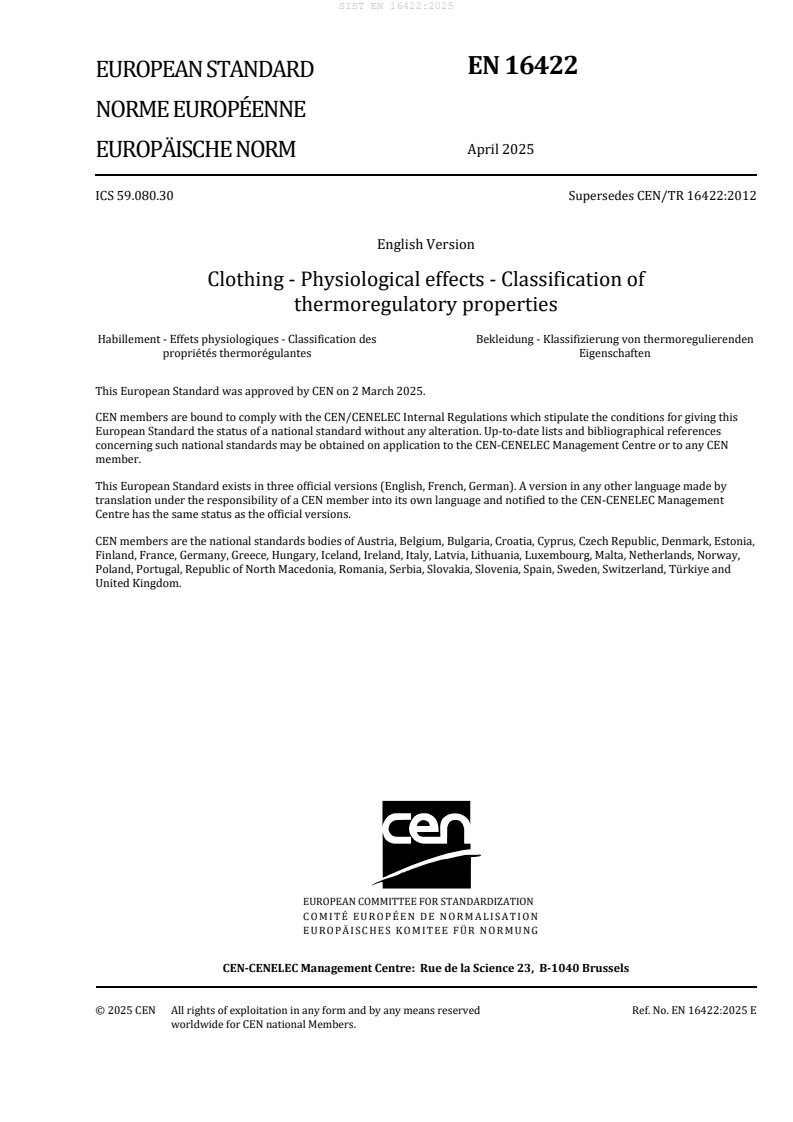
EN 16422
EUROPEAN STANDARD
NORME EUROPÉENNE
April 2025
EUROPÄISCHE NORM
ICS 59.080.30 Supersedes CEN/TR 16422:2012
English Version
Clothing - Physiological effects - Classification of
thermoregulatory properties
Habillement - Effets physiologiques - Classification des Bekleidung - Klassifizierung von thermoregulierenden
propriétés thermorégulantes Eigenschaften
This European Standard was approved by CEN on 2 March 2025.
CEN members are bound to comply with the CEN/CENELEC Internal Regulations which stipulate the conditions for giving this
European Standard the status of a national standard without any alteration. Up-to-date lists and bibliographical references
concerning such national standards may be obtained on application to the CEN-CENELEC Management Centre or to any CEN
member.
This European Standard exists in three official versions (English, French, German). A version in any other language made by
translation under the responsibility of a CEN member into its own language and notified to the CEN-CENELEC Management
Centre has the same status as the official versions.
CEN members are the national standards bodies of Austria, Belgium, Bulgaria, Croatia, Cyprus, Czech Republic, Denmark, Estonia,
Finland, France, Germany, Greece, Hungary, Iceland, Ireland, Italy, Latvia, Lithuania, Luxembourg, Malta, Netherlands, Norway,
Poland, Portugal, Republic of North Macedonia, Romania, Serbia, Slovakia, Slovenia, Spain, Sweden, Switzerland, Türkiye and
United Kingdom.
EUROPEAN COMMITTEE FOR STANDARDIZATION
COMITÉ EUROPÉEN DE NORMALISATION
EUROPÄISCHES KOMITEE FÜR NORMUNG
CEN-CENELEC Management Centre: Rue de la Science 23, B-1040 Brussels
© 2025 CEN All rights of exploitation in any form and by any means reserved Ref. No. EN 16422:2025 E
worldwide for CEN national Members.
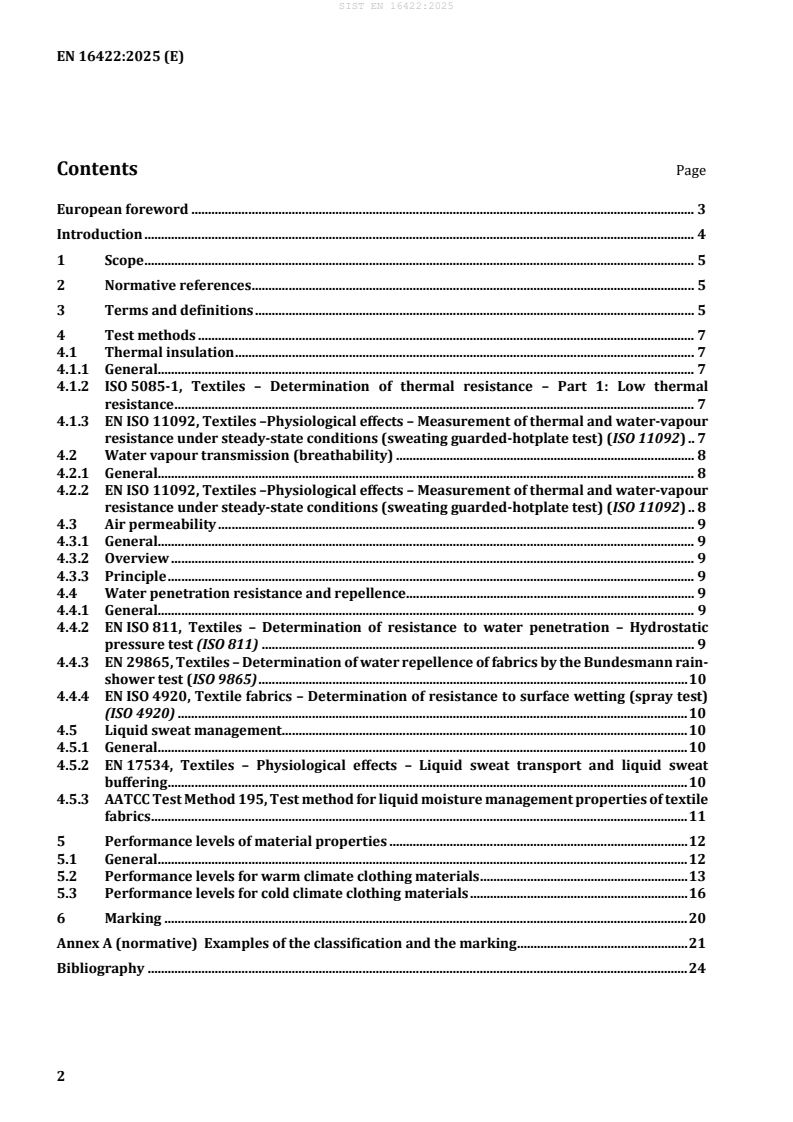
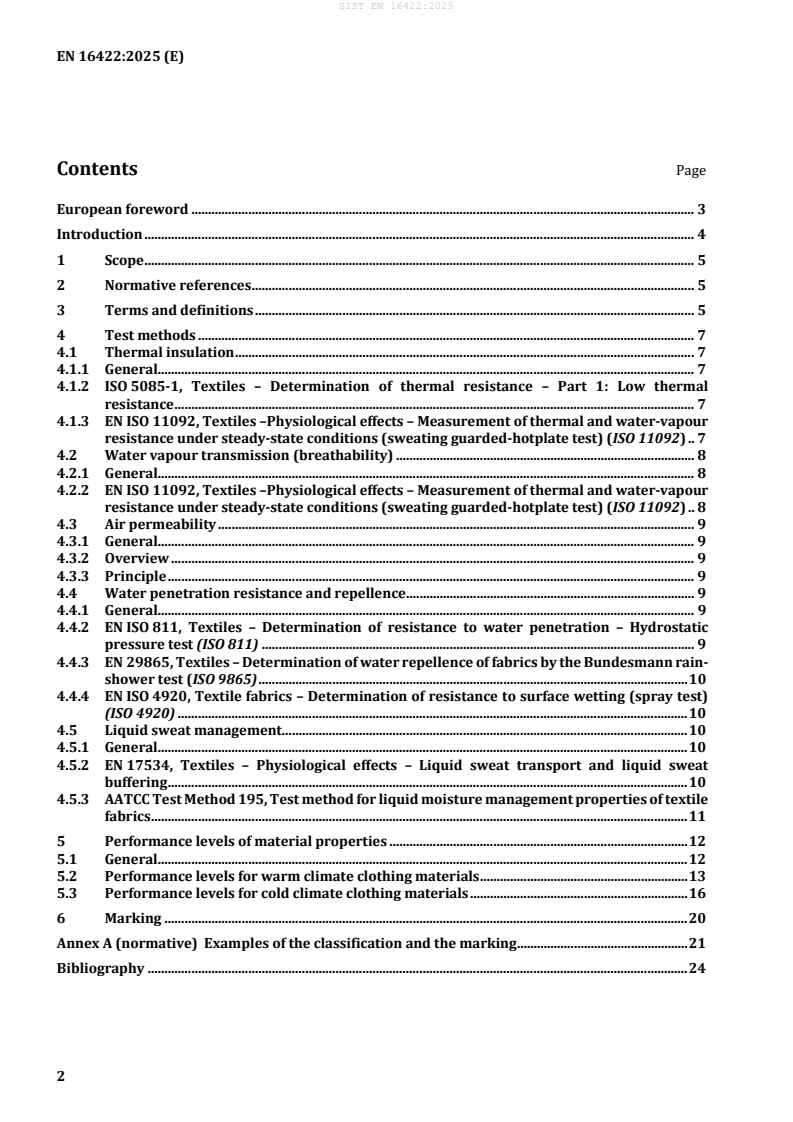
Contents Page
European foreword . 3
Introduction . 4
1 Scope . 5
2 Normative references . 5
3 Terms and definitions . 5
4 Test methods . 7
4.1 Thermal insulation . 7
4.1.1 General. 7
4.1.2 ISO 5085-1, Textiles – Determination of thermal resistance – Part 1: Low thermal
resistance . 7
4.1.3 EN ISO 11092, Textiles –Physiological effects – Measurement of thermal and water-vapour
resistance under steady-state conditions (sweating guarded-hotplate test) (ISO 11092) . 7
4.2 Water vapour transmission (breathability) . 8
4.2.1 General. 8
4.2.2 EN ISO 11092, Textiles –Physiological effects – Measurement of thermal and water-vapour
resistance under steady-state conditions (sweating guarded-hotplate test) (ISO 11092) . 8
4.3 Air permeability . 9
4.3.1 General. 9
4.3.2 Overview . 9
4.3.3 Principle . 9
4.4 Water penetration resistance and repellence . 9
4.4.1 General. 9
4.4.2 EN ISO 811, Textiles – Determination of resistance to water penetration – Hydrostatic
pressure test (ISO 811) . 9
4.4.3 EN 29865, Textiles – Determination of water repellence of fabrics by the Bundesmann rain-
shower test (ISO 9865) . 10
4.4.4 EN ISO 4920, Textile fabrics – Determination of resistance to surface wetting (spray test)
(ISO 4920) . 10
4.5 Liquid sweat management. 10
4.5.1 General. 10
4.5.2 EN 17534, Textiles – Physiological effects – Liquid sweat transport and liquid sweat
buffering . 10
4.5.3 AATCC Test Method 195, Test method for liquid moisture management properties of textile
fabrics . 11
5 Performance levels of material properties . 12
5.1 General. 12
5.2 Performance levels for warm climate clothing materials . 13
5.3 Performance levels for cold climate clothing materials . 16
6 Marking . 20
Annex A (normative) Examples of the classification and the marking . 21
Bibliography . 24
European foreword
This document (EN 16422:2025) has been prepared by Technical Committee CEN/TC 248 “Textiles and
textile products”, the secretariat of which is held by BSI.
This European Standard shall be given the status of a national standard, either by publication of an
identical text or by endorsement, at the latest by October 2025, and conflicting national standards shall
be withdrawn at the latest by October 2025.
Attention is drawn to the possibility that some of the elements of this document may be the subject of
patent rights. CEN shall not be held responsible for identifying any or all such patent rights.
This document supersedes CEN/TR 16422:2012.
— updated normative references and move of all normative references into the Bibliography;
— informative Annex A becomes normative;
— informative Annex B has been replaced by an informative reference to EN 17534;
— informative references to manikin standards EN ISO 15831 and EN 17528 added;
— editorial changes were made throughout the document to bring it up-to-date.
Any feedback and questions on this document should be directed to the users’ national standards body.
A complete listing of these bodies can be found on the CEN website.
According to the CEN-CENELEC Internal Regulations, the national standards organisations of the
following countries are bound to implement this European Standard: Austria, Belgium, Bulgaria, Croatia,
Cyprus, Czech Republic, Denmark, Estonia, Finland, France, Germany, Greece, Hungary, Iceland, Ireland,
Italy, Latvia, Lithuania, Luxembourg, Malta, Netherlands, Norway, Poland, Portugal, Republic of North
Macedonia, Romania, Serbia, Slovakia, Slovenia, Spain, Sweden, Switzerland, Türkiye and the United
Kingdom.
Introduction
This document has been developed to help retailers, manufacturers, and consumers with the evaluation
of thermoregulatory properties of textiles, and selection of the most appropriate methods to define their
individual material performance requirements.
In order to encourage the use of the widest possible selection of materials and technologies, this
document takes the form of advice and guidance on the tests or groups of tests which would verify the
defined performance characteristics of a material or a product composite. It summarizes the scope and
application of the test described and provides an indication of suggested range of results for the referred
test methods to allow the user to grade performance of the material under evaluation. Where a choice of
test methods is available for measuring the same parameter on a material, each is described to allow the
user of this document to select the most appropriate method for their requirements.
This document also introduces a system of three performance levels for the different thermoregulatory
properties:
— thermal insulation;
— water vapour transmission (breathability);
— air permeability;
— water penetration resistance and repellence;
— liquid sweat management.
The large differences in the conditions of use necessitate a flexible use of the properties and performance
levels. This allows a choice of the appropriate level for each property and so to compose a 'product
profile', adapted to each specific type of use. There is for example, a significant difference between
thermoregulatory properties required for outerwear clothing for cool, windy, and rainy weather during
low activity, and socks for warm indoor use during intense physical or sport activity. In addition, the work
garments for a shop assistant requires different properties of thermoregulation than the underwear
intended for skiing, or home wear for the elderly. The ambient temperature, ambient moisture, wind and
level of activity, the contact to skin or other layers of garment(s) influence the requirements.
At the point of issue, it is recognized that the industry is in a constant state of development with regard
to new technology for innovative fibres and performance applications, and that methods required to
evaluate these new technologies can in the future be different to those in this document. Subsequent
revisions will consider the addition of any new test methods required to keep advice current to the
industry and its changing needs.
This document includes an Annex A. In this Annex A, there is consideration for product design and use
situations, as material performance is not the sole contributory factor to the thermoregulatory
performance of the final product or ensemble in use. This Annex A also has examples of marking products.
1 Scope
This document specifies test methods available for the measurement of thermoregulatory properties of
textile materials for use in garments and gives guidance on the most suitable methods for selection where
choices are available to the user.
This document also establishes classification of the thermoregulatory properties in three performance
levels.
This document does not apply to garments or clothing intended to be worn by babies, infants and children
whose thermoregulation within the body has not yet been fully developed.
This document does not apply to the thermoregulatory properties of personal protective equipment
(PPE) and clothing items or textile products for which a standard already specifies a particular
requirement.
This document does not apply also to heated textiles, phase change materials (PCM) and similar smart
materials for thermoregulation, for which CEN ISO/TR 23383 can give better guidance.
2 Normative references
There are no normative references in this document.
3 Terms and definitions
For the purposes of this document, the following terms and definitions apply.
ISO and IEC maintain terminology databases for use in standardization at the following addresses:
— ISO Online browsing platform: available at https://www.iso.org/obp/
— IEC Electropedia: available at https://www.electropedia.org/
3.1
thermoregulatory property
property of textiles which influence the thermoregulation of the human body to maintain the core body
temperature at a stable and comfortable state
Note 1 to entry: The properties are thermal insulation, water vapour transmission (breathability), air
permeability, water penetration resistance and repellence and liquid sweat management.
3.2
thermal insulation
thermal resistance
R
ct
quantity specific to textile materials or composites which determines the dry heat flux between the two
faces of a material related to area and temperature gradient, expressed in square metres Kelvin per watt
(m K/W)
Note 1 to entry: The dry heat flux consists of one or more conductive, convective, and radiant components.
3.3
water vapour transmission
breathability
WVT
ability of textile materials or composites to transport water vapour expressed either as an absolute value
by the water vapour resistance R , by the water vapour permeability WVP, or by the relative value
et
related to thermal insulation by the water vapour permeability index i
mt
3.4
water vapour resistance
R
et
quantity specific to textile materials and composites, which determines the 'latent' evaporative heat flux
between the two faces of a material related to area and water vapour pressure gradient, expressed in
square metres pascal per watt (m Pa/W)
Note 1 to entry: The evaporative heat flux consists of both diffusive and convective components.
3.5
water vapour permeability index
i
mt
transport properties related to thermal insulation expressed by an index between 0 and 1
3.6
water vapour permeability
WVP
rate of water vapour transmission expressed in grams per square metre hour pascal (g/(m Pa h))
3.7
air permeability
AP
volume of air passing perpendicularly through a test specimen under specified conditions of test area,
pressure difference and time (mm/s)
3.8
water penetration resistance
WPR
resistance to the penetration of water through the material under a specific hydrostatic pressure
3.9
water repellence
ability of fabric to resist surface wetting by water
3.10
liquid sweat management
combining of uptake or buffering of the sweat from the skin, on one hand, and of the transport of the
sweat from the skin to the ambience, on the other hand
[SOURCE: EN 17534:2022, 3.3]
3.11
skin contact product
fabric or garment intended primarily to be worn next to the skin
Note 1 to entry: Typical examples are underwear, t-shirts, shirts, blouses, trousers, nightwear.
3.12
second layer or intermediate layer product
fabric or garment intended to be worn above the skin contact products and beneath the outer layer
products
Note 1 to entry: Typical examples are sweaters, shirts, vests, blouses.
3.13
outer layer product
fabric or garment intended to be worn outermost of the layer of clothing, primarily outdoors
Note 1 to entry: Typical examples are overcoats, jackets, trousers, overalls, rainwear.
4 Test methods
4.1 Thermal insulation
4.1.1 General
For the purposes of this document, two EN or ISO test methods have been identified for the measurement
of thermal insulation. Both test methods give the thermal insulation value in m K/W, and the results
from the two tests are comparable.
4.1.2 ISO 5085-1, Textiles – Determination of thermal resistance – Part 1: Low thermal
resistance
4.1.2.1 Overview
The standard specifies a method for the determination of the resistance of fabrics, fabric assemblies, or
fibre aggregates in sheet form to the transmission of heat through them in the 'steady-state' condition. It
applies to materials whose thermal resistance is up to approximately 0,2 m K/W.
The method is only suitable for materials of up to 20 mm thickness (if the material is thicker, lateral edge
losses are more substantial).
4.1.2.2 Principle
The temperature drop across a material of known thermal resistance and across a test specimen of the
material under test in series with it are measured, and from the values obtained, the thermal resistance
of the test specimen is determined.
4.1.2.3 Application
Two methods are specified in the standard (single and double plate methods). In the context of this
document, the single plate method is used.
4.1.3 EN ISO 11092, Textiles –Physiological effects – Measurement of thermal and water-
vapour resistance under steady-state conditions (sweating guarded-hotplate test) (ISO 11092)
4.1.3.1 Overview
The standard specifies test methods for the measurement of the thermal resistance and water vapour-
resistance of fabrics, under steady-state conditions.
The application of this measurement technique is restricted to a maximum thermal resistance which
depends on the dimensions and construction of the apparatus used, for the minimum specifications of
the equipment referred to in this international standard. This value is 2 m K/W.
The test conditions used in EN ISO 11092 are not intended to represent specific comfort situations, and
performance specifications in relation to physiological comfort are not stated.
4.1.3.2 Principle
The test specimen is placed on an electrically heated plate with conditioned air ducted to flow across and
parallel to its upper surface as specified in said International Standard (ISO 11092).
For the determination of thermal resistance, the heat flux through the test specimen is measured after
steady-state conditions have been reached.
The thermal resistance R of a material is determined by subtracting the thermal resistance of the
ct
boundary air layer above the surface of the test apparatus from that of a test specimen plus boundary air
layer, both measured under the same conditions.
NOTE A more affordable alternative to EN ISO 11092 and ISO 5085-1 is described in EN 17667.
4.2 Water vapour transmission (breathability)
4.2.1 General
Several methods for testing of the water vapour transmission through textile materials are in use. In the
context of this document EN ISO 11092 should be used, which specifies the measurement of water vapour
resistance and water vapour permeability index.
4.2.2 EN ISO 11092, Textiles –Physiological effects – Measurement of thermal and water-
vapour resistance under steady-state conditions (sweating guarded-hotplate test) (ISO 11092)
4.2.2.1 Overview
The application of this measurement technique is restricted to a maximum water-vapour resistance
which depends on the dimensions and construction of the apparatus used, for the minimum
specifications of the equipment referred to in this International Standard. This value is 700 m Pa/W.
4.2.2.2 Principle
The test specimen is placed on an electrically heated plate with conditioned air ducted to flow across and
parallel to its upper surface as specified in said International Standard (ISO 11092).
For the determination of water-vapour resistance, an electrically heated porous plate is covered by a
water-vapour permeable but liquid-water impermeable membrane. Water fed to the heated plate
evaporates and passes through the membrane as vapour, so that no liquid water contacts the test
specimen. With the test specimen placed on the membrane, the heat flux required to maintain a constant
temperature at the plate is a measure of the rate of water evaporation, and from this the water-vapour
resistance of the test specimen is determined.
The water-vapour resistance R of a material is determined by subtracting the water-vapour resistance
et
of the boundary air layer above the surface of the test apparatus from that of the test specimen plus
boundary air layer, both measured under the same conditions.
Particularly for knitted fabrics and thick cold protective garments, which due to the thickness would get
high water vapour resistance values, a more relevant value is the water vapour permeability index i
mt
which expresses the relation between thermal insulation R and water vapour resistance R .
ct et
4.3 Air permeability
4.3.1 General
Testing should be in accordance with EN ISO 9237, Textiles – Determination of permeability of fabrics to
air.
4.3.2 Overview
The standard describes a method for measuring the permeability of fabrics to air and is applicable to
most types of fabrics, including industrial fabrics for technical purposes, nonwovens and made-up textile
articles that are permeable to air.
4.3.3 Principle
The rate of flow of air passing perpendicularly through a given area of fabric is measured at a given
pressure difference across the fabric test area over a given time period.
In the context of this document, the measurement should be carried out at a pressure drop across the test
specimen of 100 Pa and the area of the test specimen holder 20 cm .
4.4 Water penetration resistance and repellence
4.4.1 General
Protection against liquid water can be expressed with different fabric properties, for example, resistance
to hydrostatic head pressure or water repellence. Several EN or ISO standards are available for testing
and for this document the following can be applied as appropriate, but the results of the different methods
cannot be compared.
4.4.2 EN ISO 811, Textiles – Determination of resistance to water penetration – Hydrostatic
pressure test (ISO 811)
4.4.2.1 Overview
The standard specifies a hydrostatic pressure method for determining the resistance of fabrics to
penetration by water.
4.4.2.2 Principle
The hydrostatic head supported by a fabric is a measure of the resistance to the penetration of water
through the fabric. A test specimen is subjected to a steadily increasing pressure of water on one face,
under standard conditio
...
SLOVENSKI STANDARD
01-junij-2025
Klasifikacija termoregulacijskih lastnosti
Classification of thermoregulatory properties
Klassifizierung von thermoregulierenden Eigenschaften
Classification des propriétés thermorégulantes
Ta slovenski standard je istoveten z: EN 16422:2025
ICS:
59.080.30 Tkanine Textile fabrics
2003-01.Slovenski inštitut za standardizacijo. Razmnoževanje celote ali delov tega standarda ni dovoljeno.
EN 16422
EUROPEAN STANDARD
NORME EUROPÉENNE
April 2025
EUROPÄISCHE NORM
ICS 59.080.30 Supersedes CEN/TR 16422:2012
English Version
Clothing - Physiological effects - Classification of
thermoregulatory properties
Habillement - Effets physiologiques - Classification des Bekleidung - Klassifizierung von thermoregulierenden
propriétés thermorégulantes Eigenschaften
This European Standard was approved by CEN on 2 March 2025.
CEN members are bound to comply with the CEN/CENELEC Internal Regulations which stipulate the conditions for giving this
European Standard the status of a national standard without any alteration. Up-to-date lists and bibliographical references
concerning such national standards may be obtained on application to the CEN-CENELEC Management Centre or to any CEN
member.
This European Standard exists in three official versions (English, French, German). A version in any other language made by
translation under the responsibility of a CEN member into its own language and notified to the CEN-CENELEC Management
Centre has the same status as the official versions.
CEN members are the national standards bodies of Austria, Belgium, Bulgaria, Croatia, Cyprus, Czech Republic, Denmark, Estonia,
Finland, France, Germany, Greece, Hungary, Iceland, Ireland, Italy, Latvia, Lithuania, Luxembourg, Malta, Netherlands, Norway,
Poland, Portugal, Republic of North Macedonia, Romania, Serbia, Slovakia, Slovenia, Spain, Sweden, Switzerland, Türkiye and
United Kingdom.
EUROPEAN COMMITTEE FOR STANDARDIZATION
COMITÉ EUROPÉEN DE NORMALISATION
EUROPÄISCHES KOMITEE FÜR NORMUNG
CEN-CENELEC Management Centre: Rue de la Science 23, B-1040 Brussels
© 2025 CEN All rights of exploitation in any form and by any means reserved Ref. No. EN 16422:2025 E
worldwide for CEN national Members.
Contents Page
European foreword . 3
Introduction . 4
1 Scope . 5
2 Normative references . 5
3 Terms and definitions . 5
4 Test methods . 7
4.1 Thermal insulation . 7
4.1.1 General. 7
4.1.2 ISO 5085-1, Textiles – Determination of thermal resistance – Part 1: Low thermal
resistance . 7
4.1.3 EN ISO 11092, Textiles –Physiological effects – Measurement of thermal and water-vapour
resistance under steady-state conditions (sweating guarded-hotplate test) (ISO 11092) . 7
4.2 Water vapour transmission (breathability) . 8
4.2.1 General. 8
4.2.2 EN ISO 11092, Textiles –Physiological effects – Measurement of thermal and water-vapour
resistance under steady-state conditions (sweating guarded-hotplate test) (ISO 11092) . 8
4.3 Air permeability . 9
4.3.1 General. 9
4.3.2 Overview . 9
4.3.3 Principle . 9
4.4 Water penetration resistance and repellence . 9
4.4.1 General. 9
4.4.2 EN ISO 811, Textiles – Determination of resistance to water penetration – Hydrostatic
pressure test (ISO 811) . 9
4.4.3 EN 29865, Textiles – Determination of water repellence of fabrics by the Bundesmann rain-
shower test (ISO 9865) . 10
4.4.4 EN ISO 4920, Textile fabrics – Determination of resistance to surface wetting (spray test)
(ISO 4920) . 10
4.5 Liquid sweat management. 10
4.5.1 General. 10
4.5.2 EN 17534, Textiles – Physiological effects – Liquid sweat transport and liquid sweat
buffering . 10
4.5.3 AATCC Test Method 195, Test method for liquid moisture management properties of textile
fabrics . 11
5 Performance levels of material properties . 12
5.1 General. 12
5.2 Performance levels for warm climate clothing materials . 13
5.3 Performance levels for cold climate clothing materials . 16
6 Marking . 20
Annex A (normative) Examples of the classification and the marking . 21
Bibliography . 24
European foreword
This document (EN 16422:2025) has been prepared by Technical Committee CEN/TC 248 “Textiles and
textile products”, the secretariat of which is held by BSI.
This European Standard shall be given the status of a national standard, either by publication of an
identical text or by endorsement, at the latest by October 2025, and conflicting national standards shall
be withdrawn at the latest by October 2025.
Attention is drawn to the possibility that some of the elements of this document may be the subject of
patent rights. CEN shall not be held responsible for identifying any or all such patent rights.
This document supersedes CEN/TR 16422:2012.
— updated normative references and move of all normative references into the Bibliography;
— informative Annex A becomes normative;
— informative Annex B has been replaced by an informative reference to EN 17534;
— informative references to manikin standards EN ISO 15831 and EN 17528 added;
— editorial changes were made throughout the document to bring it up-to-date.
Any feedback and questions on this document should be directed to the users’ national standards body.
A complete listing of these bodies can be found on the CEN website.
According to the CEN-CENELEC Internal Regulations, the national standards organisations of the
following countries are bound to implement this European Standard: Austria, Belgium, Bulgaria, Croatia,
Cyprus, Czech Republic, Denmark, Estonia, Finland, France, Germany, Greece, Hungary, Iceland, Ireland,
Italy, Latvia, Lithuania, Luxembourg, Malta, Netherlands, Norway, Poland, Portugal, Republic of North
Macedonia, Romania, Serbia, Slovakia, Slovenia, Spain, Sweden, Switzerland, Türkiye and the United
Kingdom.
Introduction
This document has been developed to help retailers, manufacturers, and consumers with the evaluation
of thermoregulatory properties of textiles, and selection of the most appropriate methods to define their
individual material performance requirements.
In order to encourage the use of the widest possible selection of materials and technologies, this
document takes the form of advice and guidance on the tests or groups of tests which would verify the
defined performance characteristics of a material or a product composite. It summarizes the scope and
application of the test described and provides an indication of suggested range of results for the referred
test methods to allow the user to grade performance of the material under evaluation. Where a choice of
test methods is available for measuring the same parameter on a material, each is described to allow the
user of this document to select the most appropriate method for their requirements.
This document also introduces a system of three performance levels for the different thermoregulatory
properties:
— thermal insulation;
— water vapour transmission (breathability);
— air permeability;
— water penetration resistance and repellence;
— liquid sweat management.
The large differences in the conditions of use necessitate a flexible use of the properties and performance
levels. This allows a choice of the appropriate level for each property and so to compose a 'product
profile', adapted to each specific type of use. There is for example, a significant difference between
thermoregulatory properties required for outerwear clothing for cool, windy, and rainy weather during
low activity, and socks for warm indoor use during intense physical or sport activity. In addition, the work
garments for a shop assistant requires different properties of thermoregulation than the underwear
intended for skiing, or home wear for the elderly. The ambient temperature, ambient moisture, wind and
level of activity, the contact to skin or other layers of garment(s) influence the requirements.
At the point of issue, it is recognized that the industry is in a constant state of development with regard
to new technology for innovative fibres and performance applications, and that methods required to
evaluate these new technologies can in the future be different to those in this document. Subsequent
revisions will consider the addition of any new test methods required to keep advice current to the
industry and its changing needs.
This document includes an Annex A. In this Annex A, there is consideration for product design and use
situations, as material performance is not the sole contributory factor to the thermoregulatory
performance of the final product or ensemble in use. This Annex A also has examples of marking products.
1 Scope
This document specifies test methods available for the measurement of thermoregulatory properties of
textile materials for use in garments and gives guidance on the most suitable methods for selection where
choices are available to the user.
This document also establishes classification of the thermoregulatory properties in three performance
levels.
This document does not apply to garments or clothing intended to be worn by babies, infants and children
whose thermoregulation within the body has not yet been fully developed.
This document does not apply to the thermoregulatory properties of personal protective equipment
(PPE) and clothing items or textile products for which a standard already specifies a particular
requirement.
This document does not apply also to heated textiles, phase change materials (PCM) and similar smart
materials for thermoregulation, for which CEN ISO/TR 23383 can give better guidance.
2 Normative references
There are no normative references in this document.
3 Terms and definitions
For the purposes of this document, the following terms and definitions apply.
ISO and IEC maintain terminology databases for use in standardization at the following addresses:
— ISO Online browsing platform: available at https://www.iso.org/obp/
— IEC Electropedia: available at https://www.electropedia.org/
3.1
thermoregulatory property
property of textiles which influence the thermoregulation of the human body to maintain the core body
temperature at a stable and comfortable state
Note 1 to entry: The properties are thermal insulation, water vapour transmission (breathability), air
permeability, water penetration resistance and repellence and liquid sweat management.
3.2
thermal insulation
thermal resistance
R
ct
quantity specific to textile materials or composites which determines the dry heat flux between the two
faces of a material related to area and temperature gradient, expressed in square metres Kelvin per watt
(m K/W)
Note 1 to entry: The dry heat flux consists of one or more conductive, convective, and radiant components.
3.3
water vapour transmission
breathability
WVT
ability of textile materials or composites to transport water vapour expressed either as an absolute value
by the water vapour resistance R , by the water vapour permeability WVP, or by the relative value
et
related to thermal insulation by the water vapour permeability index i
mt
3.4
water vapour resistance
R
et
quantity specific to textile materials and composites, which determines the 'latent' evaporative heat flux
between the two faces of a material related to area and water vapour pressure gradient, expressed in
square metres pascal per watt (m Pa/W)
Note 1 to entry: The evaporative heat flux consists of both diffusive and convective components.
3.5
water vapour permeability index
i
mt
transport properties related to thermal insulation expressed by an index between 0 and 1
3.6
water vapour permeability
WVP
rate of water vapour transmission expressed in grams per square metre hour pascal (g/(m Pa h))
3.7
air permeability
AP
volume of air passing perpendicularly through a test specimen under specified conditions of test area,
pressure difference and time (mm/s)
3.8
water penetration resistance
WPR
resistance to the penetration of water through the material under a specific hydrostatic pressure
3.9
water repellence
ability of fabric to resist surface wetting by water
3.10
liquid sweat management
combining of uptake or buffering of the sweat from the skin, on one hand, and of the transport of the
sweat from the skin to the ambience, on the other hand
[SOURCE: EN 17534:2022, 3.3]
3.11
skin contact product
fabric or garment intended primarily to be worn next to the skin
Note 1 to entry: Typical examples are underwear, t-shirts, shirts, blouses, trousers, nightwear.
3.12
second layer or intermediate layer product
fabric or garment intended to be worn above the skin contact products and beneath the outer layer
products
Note 1 to entry: Typical examples are sweaters, shirts, vests, blouses.
3.13
outer layer product
fabric or garment intended to be worn outermost of the layer of clothing, primarily outdoors
Note 1 to entry: Typical examples are overcoats, jackets, trousers, overalls, rainwear.
4 Test methods
4.1 Thermal insulation
4.1.1 General
For the purposes of this document, two EN or ISO test methods have been identified for the measurement
of thermal insulation. Both test methods give the thermal insulation value in m K/W, and the results
from the two tests are comparable.
4.1.2 ISO 5085-1, Textiles – Determination of thermal resistance – Part 1: Low thermal
resistance
4.1.2.1 Overview
The standard specifies a method for the determination of the resistance of fabrics, fabric assemblies, or
fibre aggregates in sheet form to the transmission of heat through them in the 'steady-state' condition. It
applies to materials whose thermal resistance is up to approximately 0,2 m K/W.
The method is only suitable for materials of up to 20 mm thickness (if the material is thicker, lateral edge
losses are more substantial).
4.1.2.2 Principle
The temperature drop across a material of known thermal resistance and across a test specimen of the
material under test in series with it are measured, and from the values obtained, the thermal resistance
of the test specimen is determined.
4.1.2.3 Application
Two methods are specified in the standard (single and double plate methods). In the context of this
document, the single plate method is used.
4.1.3 EN ISO 11092, Textiles –Physiological effects – Measurement of thermal and water-
vapour resistance under steady-state conditions (sweating guarded-hotplate test) (ISO 11092)
4.1.3.1 Overview
The standard specifies test methods for the measurement of the thermal resistance and water vapour-
resistance of fabrics, under steady-state conditions.
The application of this measurement technique is restricted to a maximum thermal resistance which
depends on the dimensions and construction of the apparatus used, for the minimum specifications of
the equipment referred to in this international standard. This value is 2 m K/W.
The test conditions used in EN ISO 11092 are not intended to represent specific comfort situations, and
performance specifications in relation to physiological comfort are not stated.
4.1.3.2 Principle
The test specimen is placed on an electrically heated plate with conditioned air ducted to flow across and
parallel to its upper surface as specified in said International Standard (ISO 11092).
For the determination of thermal resistance, the heat flux through the test specimen is measured after
steady-state conditions have been reached.
The thermal resistance R of a material is determined by subtracting the thermal resistance of the
ct
boundary air layer above the surface of the test apparatus from that of a test specimen plus boundary air
layer, both measured under the same conditions.
NOTE A more affordable alternative to EN ISO 11092 and ISO 5085-1 is described in EN 17667.
4.2 Water vapour transmission (breathability)
4.2.1 General
Several methods for testing of the water vapour transmission through textile materials are in use. In the
context of this document EN ISO 11092 should be used, which specifies the measurement of water vapour
resistance and water vapour permeability index.
4.2.2 EN ISO 11092, Textiles –Physiological effects – Measurement of thermal and water-
vapour resistance under steady-state conditions (sweating guarded-hotplate test) (ISO 11092)
4.2.2.1 Overview
The application of this measurement technique is restricted to a maximum water-vapour resistance
which depends on the dimensions and construction of the apparatus used, for the minimum
specifications of the equipment referred to in this International Standard. This value is 700 m Pa/W.
4.2.2.2 Principle
The test specimen is placed on an electrically heated plate with conditioned air ducted to flow across and
parallel to its upper surface as specified in said International Standard (ISO 11092).
For the determination of water-vapour resistance, an electrically heated porous plate is covered by a
water-vapour permeable but liquid-water impermeable membrane. Water fed to the heated plate
evaporates and passes through the membrane as vapour, so that no liquid water contacts the test
specimen. With the test specimen placed on the membrane, the heat flux required to maintain a constant
temperature at the plate is a measure of the rate of water evaporation, and from this the water-vapour
resistance of the test specimen is determined.
The water-vapour resistance R of a material is determined by subtracting the water-vapour resistance
et
of the boundary air layer above the surface of the test apparatus from that of the test specimen plus
boundary air layer, both measured under the same conditions.
Particularly for knitted fabrics and thick cold protective garments, which due to the thickness would get
high water vapour resistance values, a more relevant value is the water vapour permeability index i
mt
which expresses the relation between thermal insulation R and water vapour resistance R .
ct et
4.3 Air permeability
4.3.1 General
Testing should be in accordance with EN ISO 9237, Textiles – Determination of permeability of fabrics to
air.
4.3.2 Overview
The standard describes a method for measuring the permeability of fabrics to air and is applicable to
most types of fabrics, including industrial fabrics for technical purposes, nonwovens and made-up textile
articles that are permeable to air.
4.3.3 Principle
The rate of flow of air passing perpendicularly through a given area of fabric is measured at a given
pressure difference across the fabric test area over a given time period.
In the context of this document, the measurement should be carried out at a pressure drop across the test
specimen of 100 Pa and the area of the test specimen holder 20 cm .
4.4 Water penetration resistance and repellence
4.4.1 General
Protection against liquid water can be expressed with different fabric properties, for example, resistance
to hydrostatic head pressure or water repellence. Several EN or ISO standards are available for testing
and for this document the following can be applied as appropriate, but the results of the different methods
cannot be compared.
4.4.2 EN ISO 811, Textiles – Determination of resistance to water penetration – Hydrostatic
pressure test (ISO 811)
4.4.2.1 Overview
The standard specifies a hydrostatic pressure method for determining the resistance of fabrics to
penetration by water.
4.4.2.2 Principle
The hydrostatic head supported by a fabric is a measure of the resistance to the penetration of water
through the fabric. A test specimen is subjected to a steadily increasing pressure of water on one face,
under standard conditions, until penetration occurs in three places. The pressure
...