

SIST EN 16899:2017
(Main)Sports and recreational equipment - Parkour equipment - Safety requirements and test methods
General Information
- Abstract
This European Standard specifies requirements for parkour equipment for use mainly by users starting from 8 years of age. This European Standard recognizes that parkour movement is personally determined by users, using controlled physical exertion from, to and through equipment elements and structures; both permanently installed and portable.
The requirements are intended to protect users from hazards that they might be unable to foresee when using the equipment as intended, or in a manner that can be reasonably anticipated.
This European Standard also specifies requirements for the installation and maintenance of parkour equipment, including area, height, flow, location and separation from other facilities, including children’s playgrounds and multi-use games areas (free access multi-sports equipment).
NOTE As listed above, this European Standard is only applicable to parkour equipment, installation and maintenance, but not for example to parkour activities.
- Status
- Published
- Public Enquiry End Date
- 29-Oct-2015
- Publication Date
- 19-Feb-2017
- Technical Committee
- SPO - Sports
- Current Stage
- 6060 - National Implementation/Publication (Adopted Project)
- Start Date
- 03-Jan-2017
- Due Date
- 10-Mar-2017
- Completion Date
- 20-Feb-2017

Overview
EN 16899:2016 - "Sports and recreational equipment - Parkour equipment - Safety requirements and test methods" is a CEN European Standard that sets safety, installation and testing requirements for parkour equipment intended mainly for users aged 8 years and above. The standard covers both permanently installed and portable parkour elements, recognizing that parkour movement is user‑driven and varied. It aims to protect users from reasonably foreseeable hazards when equipment is used as intended or in a reasonably anticipated way. Note: EN 16899:2016 applies to equipment, installation and maintenance - not to parkour activities or coaching.
Key topics and technical requirements
EN 16899:2016 addresses technical areas critical to parkour equipment safety and testing, including:
- Materials and structural integrity - requirements for concrete, wood, metals and synthetics and methods to verify strength and stability.
- Safety requirements - access restrictions, surface profiles, edge chamfers, bars/rails, enclosed passages and injury protection during movement and falls.
- Entrapment and clearances - head, neck, body and finger clearances and test procedures to reduce entrapment risk.
- Dimensions and surfacing - specifications for landings, impact attenuating surface (IAS), critical fall height (CFH), maximum element heights and falling space extents.
- Installation, inspection and maintenance - guidance on site layout (area, height, flow), separation from other facilities (children’s playgrounds, multi‑use areas), routine inspections, maintenance schedules and documentation.
- Labelling and manufacturer information - product data, pre‑information, installation instructions and signage requirements.
- Normative test methods (Annexes) - structural integrity assessment, user capacity, impact testing, landing area assessment and entrapment tests.
Practical applications and who uses it
EN 16899:2016 is used to design, build, test and manage safe parkour facilities. Typical users include:
- Manufacturers and suppliers of parkour elements and portable equipment
- Park designers, landscape architects and installers planning parkour parks or mixed‑use recreational areas
- Facility operators, municipal authorities and park managers responsible for installation, inspection and maintenance
- Safety assessors and testing laboratories performing structural and impact tests
- Coaches and supervising personnel who require product data and safety signage for supervised settings
Compliance helps reduce injury risk, informs risk‑benefit assessments for new designs and supports consistent inspection and maintenance regimes. Remember: conformity with EN 16899:2016 does not remove legal obligations; a competent person should perform risk assessments for novel designs.
Related standards
For comprehensive safety and surfacing solutions, EN 16899:2016 is typically used alongside other CEN standards covering playground equipment safety, surfacing impact testing and material specifications (refer to national standards bodies for exact cross‑references).
Relations
- Effective Date
- 11-Mar-2026
- Effective Date
- 28-Jan-2026
- Effective Date
- 28-Jan-2026
- Effective Date
- 28-Jan-2026
- Effective Date
- 28-Jan-2026
- Effective Date
- 28-Jan-2026
- Effective Date
- 28-Jan-2026
- Effective Date
- 28-Jan-2026
- Effective Date
- 28-Jan-2026
Frequently Asked Questions
SIST EN 16899:2017 is a standard published by the Slovenian Institute for Standardization (SIST). Its full title is "Sports and recreational equipment - Parkour equipment - Safety requirements and test methods". This standard covers: This European Standard specifies requirements for parkour equipment for use mainly by users starting from 8 years of age. This European Standard recognizes that parkour movement is personally determined by users, using controlled physical exertion from, to and through equipment elements and structures; both permanently installed and portable. The requirements are intended to protect users from hazards that they might be unable to foresee when using the equipment as intended, or in a manner that can be reasonably anticipated. This European Standard also specifies requirements for the installation and maintenance of parkour equipment, including area, height, flow, location and separation from other facilities, including children’s playgrounds and multi-use games areas (free access multi-sports equipment). NOTE As listed above, this European Standard is only applicable to parkour equipment, installation and maintenance, but not for example to parkour activities.
This European Standard specifies requirements for parkour equipment for use mainly by users starting from 8 years of age. This European Standard recognizes that parkour movement is personally determined by users, using controlled physical exertion from, to and through equipment elements and structures; both permanently installed and portable. The requirements are intended to protect users from hazards that they might be unable to foresee when using the equipment as intended, or in a manner that can be reasonably anticipated. This European Standard also specifies requirements for the installation and maintenance of parkour equipment, including area, height, flow, location and separation from other facilities, including children’s playgrounds and multi-use games areas (free access multi-sports equipment). NOTE As listed above, this European Standard is only applicable to parkour equipment, installation and maintenance, but not for example to parkour activities.
SIST EN 16899:2017 is classified under the following ICS (International Classification for Standards) categories: 97.220.10 - Sports facilities. The ICS classification helps identify the subject area and facilitates finding related standards.
SIST EN 16899:2017 has the following relationships with other standards: It is inter standard links to SIST EN 206-2:2026, SIST EN 636:2013+A1:2015, SIST EN 1177:2018+A1:2024, SIST EN 335:2013, SIST EN 206:2013+A2:2021, SIST EN 351-1:2007, SIST EN 350-2:1995, SIST EN ISO 21253-1:2020, SIST EN ISO 5667-13:2012. Understanding these relationships helps ensure you are using the most current and applicable version of the standard.
SIST EN 16899:2017 is available in PDF format for immediate download after purchase. The document can be added to your cart and obtained through the secure checkout process. Digital delivery ensures instant access to the complete standard document.
Standards Content (Sample)
2003-01.Slovenski inštitut za standardizacijo. Razmnoževanje celote ali delov tega standarda ni dovoljeno.Oprema za šport in rekreacijo - Oprema za parkour - Varnostne zahteve in preskusne metodeSport- und Freizeitanlagen - Parkoureinrichtungen - Sicherheitstechnische Anforderungen und PrüfverfahrenEquipements de sports et de loisirs - Equipements de parkour - Exigences de sécurité et méthodes d'essaiSports and recreational equipment - Parkour equipment - Safety requirements and test methods97.220.10Športni objektiSports facilitiesICS:Ta slovenski standard je istoveten z:EN 16899:2016SIST EN 16899:2017en,fr,de01-marec-2017SIST EN 16899:2017SLOVENSKI
STANDARD
EUROPEAN STANDARD NORME EUROPÉENNE EUROPÄISCHE NORM
EN 16899
November
t r s x ICS
{ yä t t rä s r English Version
Sports and recreational equipment æ Parkour equipment æ Safety requirements and test methods Equipements de sports et de loisirs æ Equipements de parkour æ Exigences de sécurité et méthodes d 5essai
Sportæ und Freizeitanlagen æ Parkoureinrichtungen æ Sicherheitstechnische Anforderungen und Prüfverfahren This European Standard was approved by CEN on
s y September
t r s xä
egulations which stipulate the conditions for giving this European Standard the status of a national standard without any alterationä Upætoædate lists and bibliographical references concerning such national standards may be obtained on application to the CENæCENELEC Management Centre or to any CEN memberä
translation under the responsibility of a CEN member into its own language and notified to the CENæCENELEC Management Centre has the same status as the official versionsä
CEN members are the national standards bodies of Austriaá Belgiumá Bulgariaá Croatiaá Cyprusá Czech Republicá Denmarká Estoniaá Finlandá Former Yugoslav Republic of Macedoniaá Franceá Germanyá Greeceá Hungaryá Icelandá Irelandá Italyá Latviaá Lithuaniaá Luxembourgá Maltaá Netherlandsá Norwayá Polandá Portugalá Romaniaá Slovakiaá Sloveniaá Spainá Swedená Switzerlandá Turkey andUnited Kingdomä
EUROPEAN COMMITTEE FOR STANDARDIZATION COMITÉ EUROPÉEN DE NORMALISATION EUROPÄISCHES KOMITEE FÜR NORMUNG
CEN-CENELEC Management Centre:
Avenue Marnix 17,
B-1000 Brussels
t r s x CEN All rights of exploitation in any form and by any means reserved worldwide for CEN national Membersä Refä Noä EN
s x z { {ã t r s x ESIST EN 16899:2017
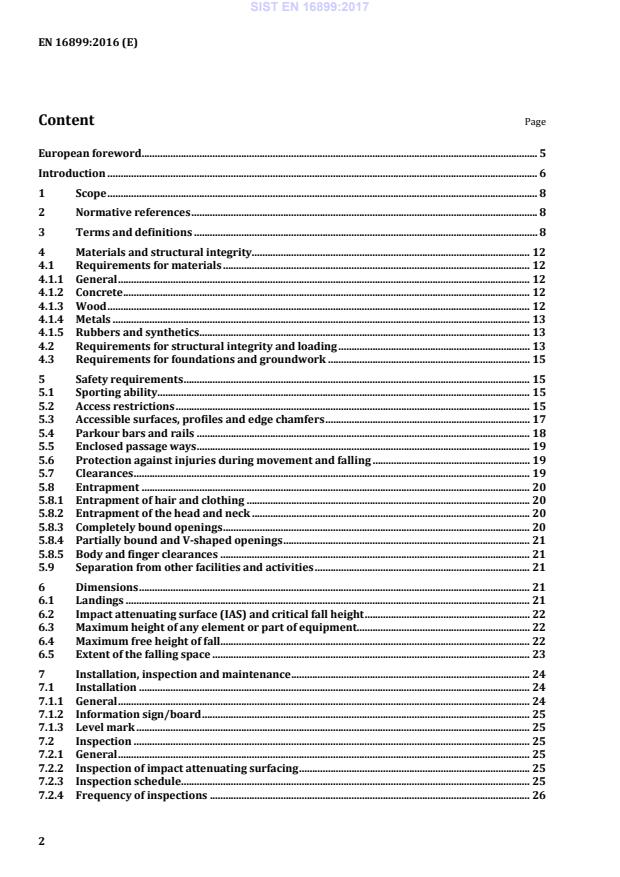
Method of determining structural integrity . 32 A.1 General principle . 32 A.2 User load . 33 A.3 Safety factors . 33 A.4 Self-weight . 33 A.5 Physical testing . 33 A.6 Horizontal stability . 33 Annex B (normative)
Number of users on the equipment . 34 B.1 General . 34 B.2 Number of users on a point . 34 B.3 Number of users on line type elements . 34 B.4 Number of users on an area . 34 Annex C (normative)
Impact test method . 35 C.1 Principle . 35 C.2 Apparatus . 35 C.3 Procedure . 36 Annex D (normative)
Assessment of surface area of a landing . 37 D.1 Principle . 37 D.2 Apparatus . 37 D.3 Procedure . 38 Annex E (normative)
Test method for entrapment . 40 E.1 General . 40 E.2 Head and neck entrapment . 40 SIST EN 16899:2017
Figure 1 —Example groove 3.10 impact area area that can be hit by a user after falling through the falling space 3.11 impact attenuating surface IAS material on the ground that has a property to attenuate some of the impact energy of a falling user 3.12 landing regular and inflexible surface in any plane 3.13 mechanical movement movement to which a user is committed by the equipment 3.14 movement method of travelling from and to equipment Note 1 to entry: See 3.7. 3.15 opening gap that passes through the material Note 1 to entry: See Figure 2 for an example opening. SIST EN 16899:2017
Figure 2 —Example opening 3.16 parkour non-competitive sport of training to move freely over and through any terrain using only the abilities of the body, principally through running, jumping, climbing and quadrupedal movement Note 1 to entry: See also Introduction. Note 2 to entry: Movements such as somersaults, flips or tricks are gymnastic/acrobatic movements. Gymnastics/acrobatics is an entirely separate sport in its own right and has been practised much longer than the sport of parkour. However, traceurs/freerunners (practitioners) sometimes include acrobatics as part of their movement for fun and as a method of improving coordination, flight, balance and spatial awareness. 3.17 parkour equipment product or a combination of products intended to be used to practice a sport of parkour 3.18 portable property of an item that can be moved when needed and is not fixed to one place, position or posture 3.19 rails and bars rails are typically of a square or rectangular section; bars are typically of a circular or oval section 3.20 supervision condition where a competent person personally attends and oversees the setting and takes care of the user's safety Note 1 to entry: In some countries, national sports associations and/or governing bodies may have rules and/or advice for proper supervision and the level of supervisor's competence. SIST EN 16899:2017
· 0,1 m wide, and which has less than a 30° angle from the horizontal, shall be able to carry the load caused by at least one user. NOTE 1 This also applies to rungs or steps for supporting a user’s feet. Additional measures shall be taken for equipment in which the stability depends on only one cross section. When parkour equipment relies on one post for its stability, the construction shall be carried out such as to: a) minimize rotting or corrosion in parts contributing to stability; b) allow for controlling degradation and the need for decommissioning; and c) be used without collapse within the foreseen inspection period when maintained correctly. NOTE 2 No allowance for accidental loads, i.e. loads produced by fire, collision by vehicles or earthquake, needs to be made. NOTE 3 The loads associated with fatigue are generally much smaller than the loads in combination with the appropriate load factors when calculated in accordance with A.2. Therefore, equipment in general doesn't need to be verified for fatigue. Structural parts shall resist the worst-case loading condition, as demonstrated by, for example, that part of the user load causing favourable effects, as shown in Figure 3. SIST EN 16899:2017
Key 1 part of load to be removed Figure 3 — Example of removal of that part of the user load which causes a favourable effect Landings shall be designed to withstand repeated shock from users, including occasional heavy impacts, from more than one user landing at the same time. The manufacturer can choose either a physical test done according to Annex C or provide static calculations performed by appropriate methods. For combined structures, when tested in accordance with Annex C, surround, panel and fixing points shall show no signs of cracks or deformation, loosening of connecting parts, or any other failure of structural integrity (see Figure 4).
Key 1 panel 2 surround 3 fixing points Figure 4 — Example of a combined structure SIST EN 16899:2017
Key a vertical dimension b horizontal dimension NOTE Step = a + b. Figure 5 — Measuring the step Rails and bars: Access to rails and bars in higher position than 1 000 mm from the impact area shall require at least one step that is minimum of 700 mm. See Figures 5 and 6. SIST EN 16899:2017
a)
b) Key 1 Step
· 700 mm 2 Step
· 1 000 mm NOTE See Figures 5 and 6. Figure 6 — Easiest allowed access to landings and bars SIST EN 16899:2017
a)
b) Key a) Pass b) Fail Figure 7 — Protrusion of fixings 5.4 Parkour bars and rails Parkour bars shall conform to 5.3. The minimum opening between any two bars shall conform to 5.7. The minimum and maximum heights for bars on an elevated landing shall be in accordance with Figure 8. Bars shall have a diameter greater than 16 mm. If the bar or rail has a diameter of 100 mm or bigger, it is considered a landing. When a bar or a rail is installed on the landing wider than 200 mm and inclined less than 30°, the foot shall be prevented from going through the gap between the bar (or rail) and landing by filling it, unless the gap is greater than body clearance. See Figure 8. SIST EN 16899:2017
a) b) c) Key b body clearance 350 mm × 550 mm Figure 8 — Acceptable heights of bar or rail on landing 5.5 Enclosed passage ways Enclosed passage ways shall not accumulate water. Minimum internal clearance: — for length up to 1 000 mm, the clearance shall be at least 350 mm x 550 mm; — for lengths greater than 1 000 mm, the clearance shall be at least Ø 750 mm. When only one side is open, the maximum declination shall be 5°. 5.6 Protection against injuries during movement and falling Objects in the falling space shall be restricted to landings, bars and rails. All elements of the parkour area are inspected as one cluster. They shall fulfil requirements given in 5.7 regarding clearances and requirements given in 6.5 regarding falling space. 5.7 Clearances Grooves shall be
· 45 mm in width and depth. Openings shall be: a) in minimum or greater than oval shape sized 350 mm x 550 mm; or b) in minimum or greater than 45 mm in diameter, but not permitting test probes E and C (see Annex E) to enter; or c) smaller than 8 mm in diameter. See Figure 9. NOTE Drainage lids in the ground are excluded from finger entrapment requirements. SIST EN 16899:2017
Key 1 pass 2 fail Figure 9 — Dimensions of grooves, openings, gaps and holes 5.8 Entrapment 5.8.1 Entrapment of hair and clothing Equipment shall be constructed such that hair or cloth entrapment does not occur. V-shaped openings converging downwards and which may result in cloth entrapment shall be wider than 60°. 5.8.2 Entrapment of the head and neck Equipment shall be constructed so that any openings do not create head and neck entrapment hazards, either by head first or feet first passage. 5.8.3 Completely bound openings When accessible completely bound openings with a lower edge of more than 600 mm above the impact area are tested in accordance with E.2.1, Probe C or E shall not pass through any opening unless it also allows sufficient clearance for the body (oval shape 350 mm × 550 mm). SIST EN 16899:2017
...