

SIST EN 167:2002
(Main)Personal eye-protection - Optical test methods
- Abstract
This European standard specifies optical test methods for eye-protectors, the requirements for which are contained in other EN's. Alternative methods may be used if shown to be equivalent. Non-optical test methods are given in EN 168. A definition of terms is given in EN 165.
- Status
- Published
- Publication Date
- 31-May-2002
- Technical Committee
- OVP - Personal protecting equipment
- Current Stage
- 6060 - National Implementation/Publication (Adopted Project)
- Start Date
- 01-Jun-2002
- Due Date
- 01-Jun-2002
- Completion Date
- 01-Jun-2002
89/686/EEC - Personal protective equipment (PPE)OJ Ref: C 190 OJ Date: 10-Aug-2002 Conflicting Date: 10-Aug-2002



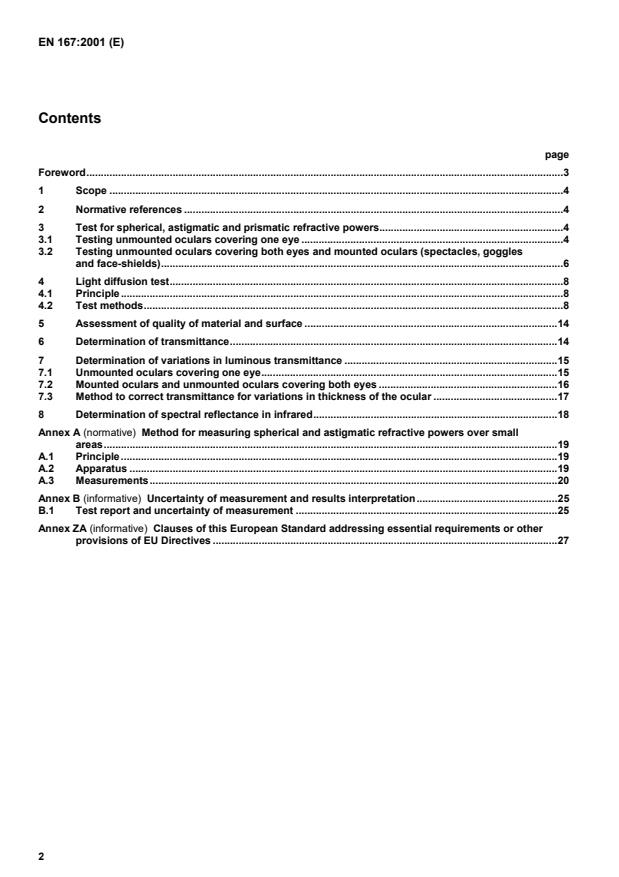
SIST EN 167:2002 is the Slovenian identical adoption of EN 167:2001 from SIST. It specifies optical test methods for personal eye-protectors, and the requirements being checked are defined in other EN standards.
This document is for manufacturers, test laboratories, and quality or compliance teams that need to measure optical performance of eye-protectors such as spectacles, goggles, and face-shields. It gives the methods used to verify refractive power, light diffusion, transmittance, and related optical properties.
What does SIST EN 167:2002 specify?
SIST EN 167:2002 specifies the optical test methods used for eye-protectors whose product requirements are given in other EN standards. It also points readers to EN 168 for non-optical test methods and to EN 165 for terms.
The document is organized as follows:
| Part | What it covers |
|---|---|
| Clause 1 | Scope |
| Clause 2 | Normative references |
| Clause 3 | Spherical, astigmatic and prismatic refractive powers |
| Clause 4 | Light diffusion test |
| Clause 5 | Assessment of quality of material and surface |
| Clause 6 | Determination of transmittance |
| Clause 7 | Variations in luminous transmittance |
| Clause 8 | Spectral reflectance in infrared |
| Annex A | Method for measuring spherical and astigmatic refractive powers over small areas |
| Annex B | Uncertainty of measurement and results interpretation |
| Annex ZA | Clauses addressing EU Directive essential requirements |
Alternative methods may be used if they are shown to be equivalent. In practice, that gives laboratories some flexibility, but the results still need to match the intent of the standard.
What are the key requirements of SIST EN 167:2002?
SIST EN 167:2002 focuses on a small set of optical checks that show whether an eye-protector will affect vision in use. The main requirement is not a single pass/fail number, but a set of defined measurement methods and reporting rules.
Refractive power testing
Clause 3 covers spherical, astigmatic, and prismatic refractive powers. For unmounted oculars and mounted products, the sample is tested in the as-worn position when that position is known; otherwise the geometric centre is used.
This matters because the optical result has to represent how the user actually sees through the product, not just how a flat sample behaves on the bench. If the telescope image shows doubling or another aberration, the ocular may be treated as defective or checked further using Annex A.
Light diffusion
Clause 4 gives two ways to measure reduced luminance factor: a basic method and a simplified method. The basic method is for oculars without corrective effect and for all shade numbers; the simplified method is for oculars with corrective effect.
The document also limits the relative measurement uncertainty for reduced luminance factor to 25%. In practice, the test method chosen has to match the product type, and the laboratory has to control uncertainty well enough to make the result meaningful.
Material and surface quality
Clause 5 uses visual inspection with a light box or illuminated grid. If the appearance is doubtful, the standard directs the user to objective checks using a 5 mm light beam and the methods for transmittance, diffusion, and refractive power.
This means appearance alone is not enough when quality is in question. The tester should confirm whether visible marks or defects affect optical performance.
Transmittance and transmittance variation
Clause 6 measures transmittance with radiation falling normally on the ocular and on the frame areas through which light can reach the eye. Clause 7 then checks how luminous transmittance varies across the lens area.
This is important for tinted lenses, gradients, and multi-zone products. The standard defines the test area around the centre, excludes a 5 mm marginal zone, and allows corrections when thickness variation is part of the design.
Infrared reflectance
Clause 8 measures spectral reflectance in the infrared over 780 nm to 2 000 nm at a nominal 8° angle of incidence. This is the check used when infrared performance is relevant to the eye-protector design.
Localized refractive power
Annex A gives a small-area method for spherical and astigmatic refractive power. It scans a 5 mm beam across the sample and is intended for assessing local optical effects that the telescope method averages out.
What terms does SIST EN 167:2002 define?
SIST EN 167:2002 uses several optical terms that are central to the test methods.
- Visual centre - the point on the ocular used as the reference position for measurement when the wearer’s line of sight is being represented.
- Geometric centre - the physical centre of the ocular, used when the visual centre is not known.
- Prismatic refractive power - the prism effect of the ocular, expressed in cm/m, which shifts the image position.
- Spherical refractive power - the overall lens power measured in the telescope method.
- Astigmatic refractive power - the difference in power between two principal meridians.
- Luminous transmittance - the amount of visible light that passes through the ocular.
- Reduced luminance factor - the diffusion measure corrected for transmittance so products can be compared more fairly.
Who uses SIST EN 167:2002?
SIST EN 167:2002 is used by eye-protector manufacturers, optical test laboratories, and quality assurance teams. It is also useful for purchasers and certification staff who need to verify that a product’s optical performance is checked by the same method each time.
It is especially relevant for products such as spectacles, goggles, and face-shields. These users rely on the standard when selecting test equipment, setting up measurements, and reporting results.
What changed in SIST EN 167:2002 from the previous edition?
SIST EN 167:2002 replaces EN 167:1995.
Which standards are used with SIST EN 167:2002?
SIST EN 167:2002 relies on three companion standards:
- EN 165 - provides the vocabulary used for terms such as visual centre.
- EN 166 - gives the specifications for personal eye-protection that the tests are meant to support.
- EN 168 - gives the non-optical test methods that complement this standard.
What does the SIST EN 167:2002 document contain?
SIST EN 167:2002 contains detailed test set-ups, apparatus descriptions, and measurement procedures. It includes figures for the telescope target, prism test arrangement, diffusion test arrangements, and the small-area refractive power method in Annex A.
It also includes calculation methods and formulas for transmittance, reduced luminance factor, thickness correction, and infrared reflectance. Annex B explains how to treat uncertainty of measurement in reporting, and Annex ZA links the clauses to EU Directive essential requirements.
Relations
- Effective Date
- 01-Jun-2002
- Effective Date
- 04-Sep-2024
- Effective Date
- 04-Sep-2024
- Effective Date
- 04-Sep-2024
- Effective Date
- 04-Sep-2024
- Effective Date
- 04-Sep-2024
- Effective Date
- 28-Jan-2026
- Effective Date
- 28-Jan-2026
- Effective Date
- 28-Jan-2026
- Effective Date
- 28-Jan-2026
- Effective Date
- 28-Jan-2026
- Effective Date
- 28-Jan-2026
- Effective Date
- 28-Jan-2026
- Effective Date
- 28-Jan-2026
- Effective Date
- 28-Jan-2026
Get Certified
Connect with accredited certification bodies for this standard

CIS Institut d.o.o.
Personal Protective Equipment (PPE) certification body. Notified Body NB-2890 for EU Regulation 2016/425 PPE.

Kiwa BDA Testing
Building and construction product certification.
Kmetijski inštitut Slovenije
Agricultural Institute of Slovenia. Soil testing, plant health, agricultural product analysis.
Sponsored listings
Frequently Asked Questions
SIST EN 167:2002 is a standard published by the Slovenian Institute for Standardization (SIST). Its full title is "Personal eye-protection - Optical test methods". This standard covers: This European standard specifies optical test methods for eye-protectors, the requirements for which are contained in other EN's. Alternative methods may be used if shown to be equivalent. Non-optical test methods are given in EN 168. A definition of terms is given in EN 165.
This European standard specifies optical test methods for eye-protectors, the requirements for which are contained in other EN's. Alternative methods may be used if shown to be equivalent. Non-optical test methods are given in EN 168. A definition of terms is given in EN 165.
SIST EN 167:2002 is classified under the following ICS (International Classification for Standards) categories: 13.340.20 - Head protective equipment. The ICS classification helps identify the subject area and facilitates finding related standards.
SIST EN 167:2002 has the following relationships with other standards: It is inter standard links to SIST EN 167:1996, SIST EN ISO 18526-2:2020, SIST EN ISO 16321-2:2021, SIST EN ISO 18526-1:2020, SIST EN ISO 18526-4:2020, SIST EN ISO 18526-3:2020, SIST EN ISO 4007:2019, SIST EN ISO 16321-1:2022, SIST EN ISO 16321-3:2022, SIST EN 1938:2010, SIST EN 14458:2004, SIST EN 174:2001, SIST EN 207:2010, SIST EN 1836:2005+A1:2007, SIST EN 169:2003. Understanding these relationships helps ensure you are using the most current and applicable version of the standard.
SIST EN 167:2002 is associated with the following European legislation: EU Directives/Regulations: 2016/425, 89/686/EEC; Standardization Mandates: M/031. When a standard is cited in the Official Journal of the European Union, products manufactured in conformity with it benefit from a presumption of conformity with the essential requirements of the corresponding EU directive or regulation.
SIST EN 167:2002 is available in PDF format for immediate download after purchase. The document can be added to your cart and obtained through the secure checkout process. Digital delivery ensures instant access to the complete standard document.
Standards Content (Sample)
2003-01.Slovenski inštitut za standardizacijo. Razmnoževanje celote ali delov tega standarda ni dovoljeno.Personal eye-protection - Optical test methodsProtection individuelle de l'oeil - Méthodes d'essais optiquesPersönlicher Augenschutz - Optische Prüfverfahren13.340.20Varovalna oprema za glavoHead protective equipmentICS:SIST EN 167:2002enTa slovenski standard je istoveten z:EN 167:200101-junij-2002SIST EN 167:2002SLOVENSKI
STANDARDSIST EN 167:19961DGRPHãþD
EUROPEAN STANDARDNORME EUROPÉENNEEUROPÄISCHE NORMEN 167November 2001ICS 13.340.20Supersedes EN 167:1995English versionPersonal eye-protection - Optical test methodsProtection individuelle de l'oeil - Méthodes d'essaisoptiquesPersönlicher Augenschutz - Optische PrüfverfahrenThis European Standard was approved by CEN on 3 September 2001.CEN members are bound to comply with the CEN/CENELEC Internal Regulations which stipulate the conditions for giving this EuropeanStandard the status of a national standard without any alteration. Up-to-date lists and bibliographical references concerning such nationalstandards may be obtained on application to the Management Centre or to any CEN member.This European Standard exists in three official versions (English, French, German). A version in any other language made by translationunder the responsibility of a CEN member into its own language and notified to the Management Centre has the same status as the officialversions.CEN members are the national standards bodies of Austria, Belgium, Czech Republic, Denmark, Finland, France, Germany, Greece,Iceland, Ireland, Italy, Luxembourg, Netherlands, Norway, Portugal, Spain, Sweden, Switzerland and United Kingdom.EUROPEAN COMMITTEE FOR STANDARDIZATIONCOMITÉ EUROPÉEN DE NORMALISATIONEUROPÄISCHES KOMITEE FÜR NORMUNGManagement Centre: rue de Stassart, 36
B-1050 Brussels© 2001 CENAll rights of exploitation in any form and by any means reservedworldwide for CEN national Members.Ref. No. EN 167:2001 E
Method for measuring spherical and astigmatic refractive powers over smallareas.19A.1Principle.19A.2Apparatus.19A.3Measurements.20Annex B (informative)
Uncertainty of measurement and results interpretation.25B.1Test report and uncertainty of measurement.25Annex ZA (informative)
Clauses of this European Standard addressing essential requirements or otherprovisions of EU Directives.27
in the as-worn position so that the axis of the eye-protector is parallel to the optical axis of the test assembly. Adjustable tilteye-protectors are positioned with their oculars normal to the optical axis of the test equipment.Measure the vertical and horizontal distances between the two displaced images arising from the two ocularregions of the eye-protector.These distances in centimetres are divided by two to give the horizontal and vertical prismatic differencesin centimetres per metre.If the light paths which correspond to the two eye regions cross, the prismatic refractive power is `base in' and if thelight paths do not cross, it is `base out'.
70) nm, etc.JInterference filter with peak transmittance in the green part of the spectrum (required only if a filament lamp is used as the light source)L1Achromatic lens, focal length between 20 mm and 50 mmLB1Diaphragm, diameter of aperture 1 mm nominalPEye-protectorLB2Diaphragm as shown in detail AL2Achromatic lens, 1 000 mm nominal focal length and 75 mm nominal diameterBImage planeaAs close as possible.bX = (32,0
0,2) mm or (27,0
0,2) mm depending on the size of the head-form specified in EN 168.Figure 2 — Arrangement of apparatus for measurement of prismatic difference
and .Key1Incident light on optical axis2Diffused light3OcularFigure 3 — Diffusion angles4.2 Test methodsTwo test methods are specified which use the same measurement principle. The `basic method' detailed in 4.2.1may be used for oculars without corrective effect and for all shade numbers. The `simplified method' detailedin 4.2.2 has to be used for oculars with corrective effect.The results obtained with the two methods may be considered to be equivalent; whichever method is used therelative measurement uncertainty for the reduced luminance factor shall not be greater than 25 %.Measurements of light diffusion shall be taken at the visual centre of the ocular. If the visual centre is not knownthen the geometric centre shall be used.NOTEVisual centre is as defined in EN 166.
= 1,5 and
+
= 2 in relationto the optical axis.4.2.1.2 ProcedureThe ocular is placed in the parallel beam at position P, then diaphragm BL is put in place. The flux 1L falling ontothe photodetector corresponds to the undiffused light transmitted by the sample. Diaphragm BL is then replaced byannular diaphragm BR; flux 1R falling onto the photodetector corresponds to the total diffused light originating fromthe filter and from the apparatus. The test sample is then placed at position P. The flux 2R which then falls ontothe photodetector corresponds to the diffused light coming from the apparatus only.The difference 1R - 2R corresponds to the light diffused by the filter. The mean reduced luminance factor l* forthe solid angle
is calculated from the preceding fluxes by means of the formula:1L2R1R*llwhere1R, 2Rare the luminance fluxes with the annular diaphragm;1Lis the luminous flux with the circular diaphragm;is the solid angle defined by the annular diaphragm.
may be determined accurately; any deviation from the nominal diameters shall be taken into account bycalculation.
...