

oSIST prEN 13590:2026
(Main)Packaging - Flexible carrier bags for the transport of various retail goods - General characteristics and test methods for the determination of volume and carrying capacity
- Abstract
This document specifies general characteristics and test methods for determination of volume and carrying capacity of flexible carrier bags with handles for transport of various unspecified retail goods.
This document is applicable to:
- carrier bags made of paper, thermoplastic material and/or any other flexible material;
- carrier bags with any shape and dimension;
- carrier bags with or without gussets.
- Status
- Not Published
- Public Enquiry End Date
- 19-Jan-2026
- Technical Committee
- EPO - Packaging - sales and grouped
- Current Stage
- 4020 - Public enquire (PE) (Adopted Project)
- Start Date
- 08-Dec-2025
- Due Date
- 27-Apr-2026
- Completion Date
- 12-Feb-2026

oSIST prEN 13590:2026 is the Slovenian publication of the draft European Standard prEN 13590 from CEN, issued through SIST. It specifies how to determine the volume and carrying capacity of flexible carrier bags with handles for unspecified retail goods, so manufacturers, suppliers, buyers, and test laboratories can describe bag size and load performance in the same way.
What does oSIST prEN 13590:2026 specify?
oSIST prEN 13590:2026 specifies general characteristics and test methods for measuring the volume and carrying capacity of flexible carrier bags with handles. It applies to paper bags, thermoplastic bags, and bags made from other flexible materials, in any shape or size, with or without gussets.
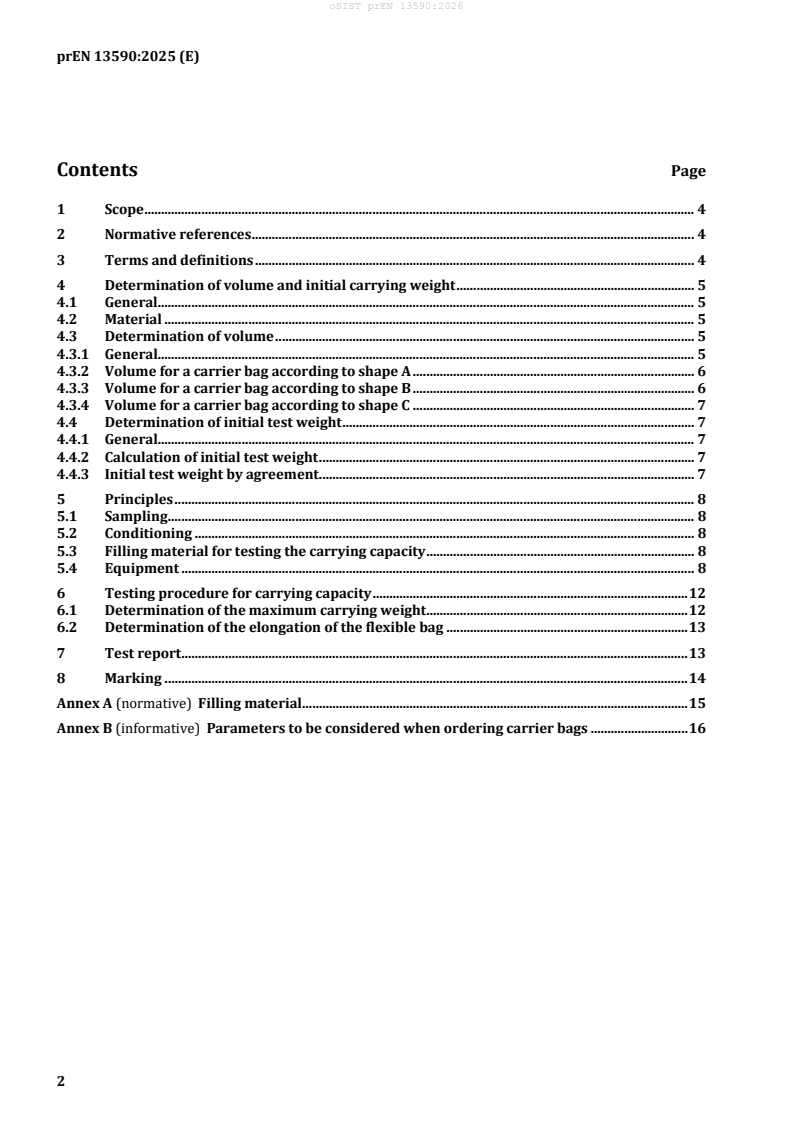
The document is organized into eight clauses and two annexes.
| Part | What it covers |
|---|---|
| Clause 1 | Scope |
| Clause 2 | Normative references |
| Clause 3 | Terms and definitions |
| Clause 4 | Determination of volume and initial carrying weight |
| Clause 5 | Principles |
| Clause 6 | Testing procedure for carrying capacity |
| Clause 7 | Test report |
| Clause 8 | Marking |
| Annex A | Filling material |
| Annex B | Parameters to be considered when ordering carrier bags |
What are the key requirements of oSIST prEN 13590:2026?
Volume and initial test weight
oSIST prEN 13590:2026 first requires the bag volume to be determined from the bag dimensions before carrying-capacity testing starts. The bag is measured empty and unloaded, and the tolerances for dimensions follow EN ISO 8367-1 or EN ISO 8367-2, depending on bag material.
For the three illustrated bag shapes in Figure 1, Clause 4 gives separate volume calculation methods. In practice, this means the tester must identify the bag shape, measure the specified dimensions, and then calculate volume in litres before moving to load testing.
Clause 4 also sets how the initial test weight is chosen. For maximum-capacity testing, the initial weight is calculated from the measured volume using a constant, while an agreed weight may be used when the test is verifying a stated carrying capacity. This saves time during testing because the procedure starts near the expected load instead of at a very low weight.
Sampling, conditioning, and filling material
Clause 5 requires a type test once for each bag type, using at least 100 bags selected at random from normal production. This matters because the result is meant to represent the bag type as produced, not just one specimen.
Samples are conditioned and tested according to EN ISO 2233, condition G. For humidity-sensitive bags, that means controlled temperature and relative humidity before testing.
The filling material for carrying-capacity testing is defined in Annex A as HDPE cylinders. This keeps the load material consistent from test to test, so results are comparable across laboratories and suppliers.
Carrying-capacity test procedure
Clause 6.1 defines a repeated lifting test for maximum carrying weight. The bag is loaded, mounted on the test machine, and lifted and lowered until failure or until the set number of lifts is completed. The pass/fail rules allow small holes up to 30 mm while the bag is hanging, but larger holes or handle ruptures count as failure.
The acceptance logic is stepped in groups of bags. If too many bags fail, the load is reduced by 1 kg; if most bags pass, the load is increased by 1 kg. In practice, this gives a tested carrying weight rather than a single subjective estimate.
Clause 6.2 adds a deformation check for bags that elongate under load. One bag from the sampling batch is loaded for 5 minutes, then the total length is measured again and the elongation is expressed in percent. The permitted elongated length after unloading is 12%, so this clause is relevant where bag stretch under load matters to use or appearance.
Reporting and marking
Clause 7 requires the test report to identify the document, the laboratory, the test date, the supplier, the bag type, the number of bags tested, the volume in litres, the carrying capacity in kilograms, and elongation of the handle in percent when applicable. This gives buyers and quality teams a traceable test record.
Clause 8 lists marking items that may be added after testing: the document reference, supplier identification, year of testing, laboratory name, carrying capacity, and volume. If the bag changes significantly in composition, thickness, or key dimensions, the bag has to be tested again.
What terms does oSIST prEN 13590:2026 define?
- gusset - a fold inserted in the longitudinal edge of a tube or bag.
- base gusset - a fold inserted in the bottom of the bag.
- tube - one or more plies in the form of a flattened cylinder cut into prescribed lengths.
- ply - a film or sheet of flexible material, or a combination of such materials, that forms the bag walls.
- handle - the part that lets a person insert the hand and carry the load.
- total length of bag - the overall length from bottom to top, including the handle.
- high-density polyethylene (HDPE) - the polymer material used for the standardized filling cylinders in Annex A.
Who uses oSIST prEN 13590:2026?
oSIST prEN 13590:2026 is used by bag manufacturers, packaging converters, and suppliers who need to specify volume and carrying capacity for retail carrier bags. It is also used by buyers, private-label owners, and quality managers when ordering bags and checking that production matches the agreed bag type.
Testing laboratories use it to run type tests, carry out load and elongation measurements, and prepare reports. Procurement and technical teams use Annex B when agreeing material, shape, dimensions, volume, and carrying capacity.
What changed in oSIST prEN 13590:2026 from the previous edition?
oSIST prEN 13590:2026 supersedes EN 13590:2003. The foreword states these main changes:
- the document was revised to align with the latest Internal Regulations Part 3;
- Clause 4 and Clause 5 were restructured;
- EN ISO 6590-1 was added as a normative reference;
- the term for total length of bag was added;
- Figure 1 was expanded with an additional carrier bag example;
- elongation of the flexible bag was added to the carrying-capacity test;
- the responsible supplier was removed from the test report list;
- elongation of the handle in percent was added to the test report;
- year and month or week of manufacture were removed from marking;
- year of testing was added to marking;
- Annex B on ordering parameters was added.
Which standards are used with oSIST prEN 13590:2026?
- EN ISO 2233 - gives the conditioning method used before testing, including the controlled atmosphere for humidity-sensitive bags.
- EN ISO 8367-1 - provides dimensional tolerances for general-purpose paper sacks used when measuring bag dimensions.
- EN ISO 8367-2 - provides dimensional tolerances for sacks made from thermoplastic flexible film.
- ISO 6590-1 - provides vocabulary used in the terms and definitions clause.
What does the oSIST prEN 13590:2026 document contain?
oSIST prEN 13590:2026 contains measurement methods, loading procedures, and reporting rules rather than product design rules. Figure 1 shows three bag shapes and the dimensions used to calculate volume. Figures 2 to 5 show the test equipment, grip, handle stop, and assembly used for carrying-capacity testing.
Clause 4 gives the volume calculations and the method for selecting an initial test weight. Clause 6 gives the lifting sequence, failure criteria, and the elongation check. Annex A defines the HDPE cylinder filling material, and Annex B lists the parameters to agree when ordering carrier bags.
Relations
- Effective Date
- 01-Jan-2026
Get Certified
Connect with accredited certification bodies for this standard

BRCGS (Brand Reputation Compliance Global Standards)
Global food safety and quality standards owner.
Sponsored listings
Frequently Asked Questions
oSIST prEN 13590:2026 is a draft published by the Slovenian Institute for Standardization (SIST). Its full title is "Packaging - Flexible carrier bags for the transport of various retail goods - General characteristics and test methods for the determination of volume and carrying capacity". This standard covers: This document specifies general characteristics and test methods for determination of volume and carrying capacity of flexible carrier bags with handles for transport of various unspecified retail goods. This document is applicable to: - carrier bags made of paper, thermoplastic material and/or any other flexible material; - carrier bags with any shape and dimension; - carrier bags with or without gussets.
This document specifies general characteristics and test methods for determination of volume and carrying capacity of flexible carrier bags with handles for transport of various unspecified retail goods. This document is applicable to: - carrier bags made of paper, thermoplastic material and/or any other flexible material; - carrier bags with any shape and dimension; - carrier bags with or without gussets.
oSIST prEN 13590:2026 is classified under the following ICS (International Classification for Standards) categories: 55.080 - Sacks. Bags. The ICS classification helps identify the subject area and facilitates finding related standards.
oSIST prEN 13590:2026 has the following relationships with other standards: It is inter standard links to SIST EN 13590:2003. Understanding these relationships helps ensure you are using the most current and applicable version of the standard.
oSIST prEN 13590:2026 is available in PDF format for immediate download after purchase. The document can be added to your cart and obtained through the secure checkout process. Digital delivery ensures instant access to the complete standard document.
Standards Content (Sample)
SLOVENSKI STANDARD
01-januar-2026
Embalaža - Prožne vreče za nošenje različnega drobnega blaga - Splošne
značilnosti in preskusne metode za ugotavljanje prostornine in nosilnosti
Packaging - Flexible carrier bags for the transport of various retail goods - General
characteristics and test methods for the determination of volume and carrying capacity
Verpackung - Tragetaschen für den Transport verschiedener Einzelhandelsgüter -
Allgemeine Eigenschaften und Prüfverfahren für die Bestimmung des Volumens und der
Tragekapazität
Emballage - Sacs en matériau souple pour le transport de marchandises de détail
variées - Caractéristiques générales et méthodes d'essai pour la détermination du
volume et de la capacité de transport
Ta slovenski standard je istoveten z: prEN 13590
ICS:
55.080 Vreče. Vrečke Sacks. Bags
2003-01.Slovenski inštitut za standardizacijo. Razmnoževanje celote ali delov tega standarda ni dovoljeno.
DRAFT
EUROPEAN STANDARD
prEN 13590
NORME EUROPÉENNE
EUROPÄISCHE NORM
November 2025
ICS 55.080 Will supersede EN 13590:2003
English Version
Packaging - Flexible carrier bags for the transport of
various retail goods - General characteristics and test
methods for the determination of volume and carrying
capacity
Emballage - Sacs en matériau souple pour le transport Verpackung - Tragetaschen für den Transport
de marchandises de détail variées - Caractéristiques verschiedener Einzelhandelsgüter - Allgemeine
générales et méthodes d'essai pour la détermination Eigenschaften und Prüfverfahren für die Bestimmung
du volume et de la capacité de transport des Volumens und der Tragekapazität
This draft European Standard is submitted to CEN members for enquiry. It has been drawn up by the Technical Committee
CEN/TC 261.
If this draft becomes a European Standard, CEN members are bound to comply with the CEN/CENELEC Internal Regulations
which stipulate the conditions for giving this European Standard the status of a national standard without any alteration.
This draft European Standard was established by CEN in three official versions (English, French, German). A version in any other
language made by translation under the responsibility of a CEN member into its own language and notified to the CEN-CENELEC
Management Centre has the same status as the official versions.
CEN members are the national standards bodies of Austria, Belgium, Bulgaria, Croatia, Cyprus, Czech Republic, Denmark, Estonia,
Finland, France, Germany, Greece, Hungary, Iceland, Ireland, Italy, Latvia, Lithuania, Luxembourg, Malta, Netherlands, Norway,
Poland, Portugal, Republic of North Macedonia, Romania, Serbia, Slovakia, Slovenia, Spain, Sweden, Switzerland, Türkiye and
United Kingdom.
Recipients of this draft are invited to submit, with their comments, notification of any relevant patent rights of which they are
aware and to provide supporting documentation.
Warning : This document is not a European Standard. It is distributed for review and comments. It is subject to change without
notice and shall not be referred to as a European Standard.
EUROPEAN COMMITTEE FOR STANDARDIZATION
COMITÉ EUROPÉEN DE NORMALISATION
EUROPÄISCHES KOMITEE FÜR NORMUNG
CEN-CENELEC Management Centre: Rue de la Science 23, B-1040 Brussels
© 2025 CEN All rights of exploitation in any form and by any means reserved Ref. No. prEN 13590:2025 E
worldwide for CEN national Members.
prEN 13590:2025 (E)
Contents Page
1 Scope . 4
2 Normative references . 4
3 Terms and definitions . 4
4 Determination of volume and initial carrying weight . 5
4.1 General. 5
4.2 Material . 5
4.3 Determination of volume . 5
4.3.1 General. 5
4.3.2 Volume for a carrier bag according to shape A . 6
4.3.3 Volume for a carrier bag according to shape B . 6
4.3.4 Volume for a carrier bag according to shape C . 7
4.4 Determination of initial test weight . 7
4.4.1 General. 7
4.4.2 Calculation of initial test weight . 7
4.4.3 Initial test weight by agreement . 7
5 Principles . 8
5.1 Sampling . 8
5.2 Conditioning . 8
5.3 Filling material for testing the carrying capacity . 8
5.4 Equipment . 8
6 Testing procedure for carrying capacity . 12
6.1 Determination of the maximum carrying weight . 12
6.2 Determination of the elongation of the flexible bag . 13
7 Test report . 13
8 Marking . 14
Annex A (normative) Filling material . 15
Annex B (informative) Parameters to be considered when ordering carrier bags . 16
prEN 13590:2025 (E)
European foreword
This document (prEN 13590:2025) has been prepared by Technical Committee CEN/TC 261 “Packaging”,
the secretariat of which is held by AFNOR.
This document is currently submitted to the CEN Enquiry.
This document will supersede EN 13590:2003.
prEN 13590:2025 includes the following significant technical changes with respect to EN 13590:2003:
— the document has been revised according to the latest updated version of the principles and rules of
the Internal Regulations Part 3;
— the document has been restructured to shape two new clauses on the determination of volume and
initial carrying weight and principles, respectively;
— EN ISO 6590-1, has been listed as a normative reference in Clause 2;
— the term and definition for the total length of bag has been added to Clause 3;
— Figure 1 has been expanded to include an additional example of a carrier bag in Clause 4;
— the determination of the elongation of the flexible bag has been added to the testing procedure for
carrying capacity;
— the name and address of responsible supplier is deleted from the list of information included in the
test report;
— the elongation of the handle in percent is added to the list of information included in the test report;
— the year and month or week of manufacture has been deleted from the information included in the
marking;
— the year of testing has been added to the list of the information included in the marking;
— Annex B on Parameters to be considered when ordering carrier bag has been added to the document.
prEN 13590:2025 (E)
1 Scope
This document specifies general characteristics and test methods for determination of volume and
carrying capacity of flexible carrier bags with handles for transport of various unspecified retail goods.
This document is applicable to:
— carrier bags made of paper, thermoplastic material and/or any other flexible material;
— carrier bags with any shape and dimension;
— carrier bags with or without gussets.
2 Normative references
The following documents are referred to in the text in such a way that some or all of their content
constitutes requirements of this document. For dated references, only the edition cited applies. For
undated references, the latest edition of the referenced document (including any amendments) applies.
EN ISO 2233, Packaging — Complete, filled transport packages and unit loads — Conditioning for testing
(ISO 2233)
EN ISO 8367-1, Packaging — Dimensional tolerances for general purpose sacks — Part 1: Paper sacks
(ISO 8367-1)
EN ISO 8367-2, Packaging — Dimensional tolerances for general purpose sacks — Part 2: Sacks made from
thermoplastic flexible film (ISO 8367-2)
ISO 6590-1, Packaging — Vocabulary — Part 1: Paper sacks
3 Terms and definitions
For the purposes of this document, the terms and definitions given in EN ISO 6590-1 and the following
apply.
ISO and IEC maintain terminology databases for use in standardization at the following addresses:
— ISO Online browsing platform: available at https://www.iso.org/obp
— IEC Electropedia: available at https://www.electropedia.org/
3.1
gusset
fold inserted in the longitudinal edge of a tube or bag
3.2
base gusset
fold inserted in the bottom of the bag
3.3
tube
one or more plies in the form of a flattened cylinder cut into prescribed lengths
3.4
ply
film or sheet of flexible material, or combination of such materials, forming the walls of a bag
prEN 13590:2025 (E)
3.5
handle
device forming part of the bag allowing the insertion of hands for the easy carrying of a load
3.6
length of bag up to handle
overall length from bottom to the start of the handle, perpendicular to the bottom
3.7
width of bag
distance between the longitudinal edges of the flat bag, gusset not included, parallel to the bottom
3.8
width of bottom
distance between the two bottom edge folds or the external creases of the base gusset, measured at the
centre, parallel to the bag's length
3.9
length of handle
overall length from the top to the maximum possible filling height of the bag
3.10
width of gusset
distance between the external creases of the unfolded gusset
3.11
width of handle
minimal width of a handle measured on the flat bag
3.12
total length of bag
overall length from bottom to the top, including the handle, perpendicular to the bottom
4 Determination of volume and initial carrying weight
4.1 General
The testing procedure always starts by determining the volum
...