

SIST EN 13130-6:2004
(Main)Materials and articles in contact with foodstuffs - Plastics substances subject to limitation - Part 6: Determination of vinylidene chloride in plastics
General Information
- Abstract
This part of this European Standard specifies a method for the determination of vinylidene chloride (VdC) in plastics materials and articles.
The method is applicable to poly(vinylidene chloride) (PVdC) films, PVdC coated films, and laminates and coextruded materials containing PVdC. The level of vinylidene chloride determined is expressed as milligrams of vinylidene chloride per kilogram of polymer. The method is appropriate for the quantitative determination of vinylidene chloride at a level of 5 mg/kg in plastics materials and articles.
- Status
- Published
- Publication Date
- 31-Aug-2004
- Technical Committee
- EPO - Packaging - sales and grouped
- Current Stage
- 6060 - National Implementation/Publication (Adopted Project)
- Start Date
- 01-Sep-2004
- Due Date
- 01-Sep-2004
- Completion Date
- 01-Sep-2004


Overview
EN 13130-6:2004 is a CEN European Standard for the analysis of residual vinylidene chloride (VdC) in plastics intended to contact foodstuffs. It specifies an analytical method for determining VdC levels in poly(vinylidene chloride) (PVdC) films, PVdC‑coated films, laminates and co‑extruded materials. Results are reported as milligrams of vinylidene chloride per kilogram of polymer, and the method is suitable for quantitative determinations down to 5 mg/kg.
Key topics and technical requirements
- Analytical principle: Automated headspace gas chromatography (HS‑GC) using either electron capture detection (ECD) or flame ionization detection (FID). Manual injection is covered in an annex where automated sampling is unavailable.
- Sample preparation: Polymer dissolution in N,N‑dimethylacetamide (DMA) where soluble; for insoluble laminates/co‑extrusions the 'hot jar' technique is used to thermally release VdC.
- Quantification approach: The standard addition method is mandated because fully VdC‑free matrix material is not available. 1‑chloropropane (1‑CP) is specified as the internal standard; external calibration is permitted if interferences prevent use of the internal standard.
- Standards and reagents: High‑purity vinylidene chloride and defined standard solutions in DMA are required. Storage guidance for standards (e.g., low‑temperature protected from light) is given.
- Confirmation: Positive identification of VdC is confirmed either by GC–MS or by re‑analysis on a second GC column of different polarity.
- Performance claims: The method is appropriate for reliable quantification at ≈5 mg/kg; the standard also addresses calibration, interferences, repeatability/reproducibility and detection limit considerations.
Practical applications and users
This standard is essential for:
- Food‑contact material manufacturers (PVdC films, coated/laminated packaging) to verify residual monomer levels.
- Analytical and conformity testing laboratories performing regulatory compliance testing and quality control.
- Regulatory bodies and inspection authorities assessing compliance with EU food‑contact legislation.
- R&D and QC teams who need validated methods for monitoring monomer residues and migration risk.
Typical use cases include pre‑market testing, routine lot release testing, failure investigation, and supporting documentation for compliance with EU directives related to plastics in contact with food.
Related standards
- EN 13130‑1:2004 - Guide to test methods for specific migration and determination of substances in plastics (normative companion).
- EN 13130 series (other parts) - includes methods for VdC in food simulants (Part 5) and numerous other monomers/migrants; EN 13130‑6 should be read in the context of the series and relevant EU directives (e.g., directive 2002/72/EC).
Keywords: EN 13130-6:2004, vinylidene chloride, VdC, PVdC, headspace GC, ECD, DMA, food-contact plastics, standard addition, 1-chloropropane, hot jar method, CEN.
Relations
- Effective Date
- 01-Sep-2004
- Effective Date
- 28-Jan-2026
Get Certified
Connect with accredited certification bodies for this standard

BSI Group
BSI (British Standards Institution) is the business standards company that helps organizations make excellence a habit.

Bureau Veritas
Bureau Veritas is a world leader in laboratory testing, inspection and certification services.

DNV
DNV is an independent assurance and risk management provider.
Sponsored listings
Frequently Asked Questions
SIST EN 13130-6:2004 is a standard published by the Slovenian Institute for Standardization (SIST). Its full title is "Materials and articles in contact with foodstuffs - Plastics substances subject to limitation - Part 6: Determination of vinylidene chloride in plastics". This standard covers: This part of this European Standard specifies a method for the determination of vinylidene chloride (VdC) in plastics materials and articles. The method is applicable to poly(vinylidene chloride) (PVdC) films, PVdC coated films, and laminates and coextruded materials containing PVdC. The level of vinylidene chloride determined is expressed as milligrams of vinylidene chloride per kilogram of polymer. The method is appropriate for the quantitative determination of vinylidene chloride at a level of 5 mg/kg in plastics materials and articles.
This part of this European Standard specifies a method for the determination of vinylidene chloride (VdC) in plastics materials and articles. The method is applicable to poly(vinylidene chloride) (PVdC) films, PVdC coated films, and laminates and coextruded materials containing PVdC. The level of vinylidene chloride determined is expressed as milligrams of vinylidene chloride per kilogram of polymer. The method is appropriate for the quantitative determination of vinylidene chloride at a level of 5 mg/kg in plastics materials and articles.
SIST EN 13130-6:2004 is classified under the following ICS (International Classification for Standards) categories: 67.250 - Materials and articles in contact with foodstuffs. The ICS classification helps identify the subject area and facilitates finding related standards.
SIST EN 13130-6:2004 has the following relationships with other standards: It is inter standard links to SIST ENV 13130-6:2000, SIST EN 13130-1:2004. Understanding these relationships helps ensure you are using the most current and applicable version of the standard.
SIST EN 13130-6:2004 is associated with the following European legislation: EU Directives/Regulations: 89/109/EEC; Standardization Mandates: M/052. When a standard is cited in the Official Journal of the European Union, products manufactured in conformity with it benefit from a presumption of conformity with the essential requirements of the corresponding EU directive or regulation.
SIST EN 13130-6:2004 is available in PDF format for immediate download after purchase. The document can be added to your cart and obtained through the secure checkout process. Digital delivery ensures instant access to the complete standard document.
Standards Content (Sample)
2003-01.Slovenski inštitut za standardizacijo. Razmnoževanje celote ali delov tega standarda ni dovoljeno.PDWHULDOLKWerkstoffe und Gegenstände in Kontakt mit Lebensmitteln - Substanzen in Kunststoffen, die Beschränkungen unterliegen - Teil 6: Bestimmung von Vinylidenchlorid in KunststoffenMatériaux et objets en contact avec les denrées alimentaires - Substances dans les matieres plastiques soumises a des limitations - Partie 6 : Détermination du chlorure de vinylidene dans les matieres plastiquesMaterials and articles in contact with foodstuffs - Plastics substances subject to limitation - Part 6: Determination of vinylidene chloride in plastics67.250Materiali in predmeti v stiku z živiliMaterials and articles in contact with foodstuffsICS:Ta slovenski standard je istoveten z:EN 13130-6:2004SIST EN 13130-6:2004en,fr,de01-september-2004SIST EN 13130-6:2004SLOVENSKI
STANDARDSIST ENV 13130-6:20001DGRPHãþD
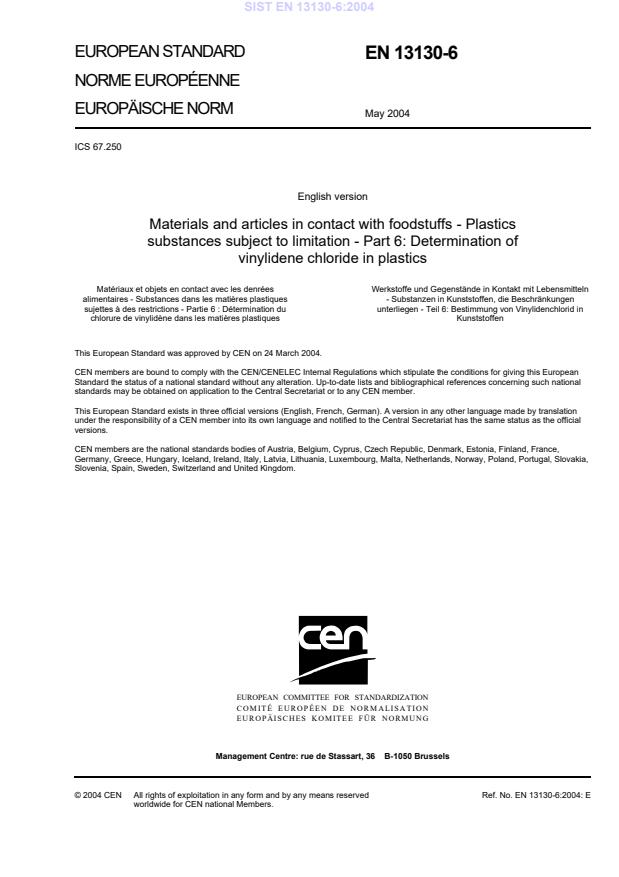
EUROPEAN STANDARDNORME EUROPÉENNEEUROPÄISCHE NORMEN 13130-6May 2004ICS 67.250English versionMaterials and articles in contact with foodstuffs - Plasticssubstances subject to limitation - Part 6: Determination ofvinylidene chloride in plasticsMatériaux et objets en contact avec les denréesalimentaires - Substances dans les matières plastiquessujettes à des restrictions - Partie 6 : Détermination duchlorure de vinylidène dans les matières plastiquesWerkstoffe und Gegenstände in Kontakt mit Lebensmitteln- Substanzen in Kunststoffen, die Beschränkungenunterliegen - Teil 6: Bestimmung von Vinylidenchlorid inKunststoffenThis European Standard was approved by CEN on 24 March 2004.CEN members are bound to comply with the CEN/CENELEC Internal Regulations which stipulate the conditions for giving this EuropeanStandard the status of a national standard without any alteration. Up-to-date lists and bibliographical references concerning such nationalstandards may be obtained on application to the Central Secretariat or to any CEN member.This European Standard exists in three official versions (English, French, German). A version in any other language made by translationunder the responsibility of a CEN member into its own language and notified to the Central Secretariat has the same status as the officialversions.CEN members are the national standards bodies of Austria, Belgium, Cyprus, Czech Republic, Denmark, Estonia, Finland, France,Germany, Greece, Hungary, Iceland, Ireland, Italy, Latvia, Lithuania, Luxembourg, Malta, Netherlands, Norway, Poland, Portugal, Slovakia,Slovenia, Spain, Sweden, Switzerland and United Kingdom.EUROPEAN COMMITTEE FOR STANDARDIZATIONCOMITÉ EUROPÉEN DE NORMALISATIONEUROPÄISCHES KOMITEE FÜR NORMUNGManagement Centre: rue de Stassart, 36
B-1050 Brussels© 2004 CENAll rights of exploitation in any form and by any means reservedworldwide for CEN national Members.Ref. No. EN 13130-6:2004: ESIST EN 13130-6:2004
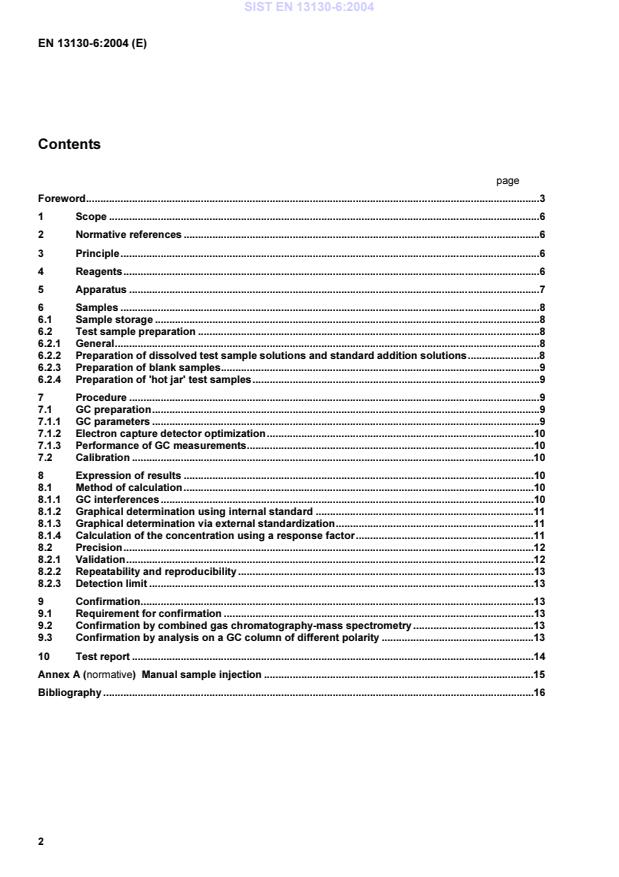
page Foreword.3 1 Scope.6 2 Normative references.6 3 Principle.6 4 Reagents.6 5 Apparatus.7 6 Samples.8 6.1 Sample storage.8 6.2 Test sample preparation.8 6.2.1 General.8 6.2.2 Preparation of dissolved test sample solutions and standard addition solutions.8 6.2.3 Preparation of blank samples.9 6.2.4 Preparation of 'hot jar' test samples.9 7 Procedure.9 7.1 GC preparation.9 7.1.1 GC parameters.9 7.1.2 Electron capture detector optimization.10 7.1.3 Performance of GC measurements.10 7.2 Calibration.10 8 Expression of results.10 8.1 Method of calculation.10 8.1.1 GC interferences.10 8.1.2 Graphical determination using internal standard.11 8.1.3 Graphical determination via external standardization.11 8.1.4 Calculation of the concentration using a response factor.11 8.2 Precision.12 8.2.1 Validation.12 8.2.2 Repeatability and reproducibility.13 8.2.3 Detection limit.13 9 Confirmation.13 9.1 Requirement for confirmation.13 9.2 Confirmation by combined gas chromatography-mass spectrometry.13 9.3 Confirmation by analysis on a GC column of different polarity.13 10 Test report.14 Annex A (normative)
Manual sample injection.15 Bibliography.16
Further parts of EN 13130, under the general title Materials and articles in contact with foodstuffs - Plastics substances subject to limitation, have been prepared, and others are in preparation, concerned with the determination of specific migration from plastics materials into foodstuffs and food simulants and the determination of specific monomers and additives in plastics. The other parts of
EN 13130 are as follows.
Part 1: Guide to test methods for the specific migration of substances from plastics to foods and food simulants and the determination of substances in plastics and the selection of conditions of exposure to food simulants Part 2: Determination of terephthalic acid in food simulants Part 3: Determination of acrylonitrile in food and food simulants Part 4: Determination of 1,3-butadiene in plastics Part 5: Determination of vinylidene chloride in food simulants Part 7: Determination of monoethylene glycol and diethylene glycol in food simulants Part 8: Determination of isocyanates in plastics
Part 9:
Determination of acetic acid, vinyl ester in food simulants Part 10: Determination of acrylamide in food simulants
Part 11: Determination of 11-aminoundecanoic acid in food simulants
Part 12: Determination of 1,3-benzenedimethanamine in food simulants Part 13: Determination of 2,2-bis(4-hydroxyphenyl)propane (Bisphenol A) in food simulants SIST EN 13130-6:2004
Part 16: Determination of caprolactam and caprolactam salt in food simulants Part 17: Determination of carbonyl chloride in plastics
Part 18: Determination of 1,2-dihydroxybenzene, 1,3- dihydroxybenzene, 1,4- dihydroxybenzene, 4,4’-dihydroxybenzophenone and 4,4’dihydroxybiphenyl in food simulants Part 19: Determination of dimethylaminoethanol in food simulants Part 20: Determination of epichlorohydrin in plastics Part 21: Determination of ethylenediamine and hexamethylenediamine in food simulants Part 22: Determination of ethylene oxide and propylene oxide in plastics Part 23: Determination of formaldehyde and hexamethylenetetramine in food simulants Part 24: Determination of maleic acid and maleic anhydride in food simulants Part 25: Determination of 4-methyl-pentene in food simulants Part 26: Determination of 1-octene and tetrahydrofuran in food simulants Part 27: Determination of 2,4,6-triamino-1,3,5-triazine in food simulants Part 28: Determination of 1,1,1-trimethylopropane in food simulants
Parts 1 to 8 are European Standards.
Parts 9 to 28 are Technical Specifications, prepared within the Standards, Measurement and Testing project, MAT1-CT92-0006, “Development of Methods of Analysis for Monomers”. According to the CEN/CENELEC Internal Regulations, the national standards organizations of the following countries are bound to implement this European Standard: Austria, Belgium, Cyprus, Czech Republic, Denmark, Estonia, Finland, France, Germany, Greece, Hungary, Iceland, Ireland, Italy, Latvia, Lithuania, Luxembourg, Malta, Netherlands, Norway, Poland, Portugal, Slovakia, Slovenia, Spain, Sweden, Switzerland and United Kingdom. SIST EN 13130-6:2004
During the manufacture of vinylidene chloride polymers and copolymers, residual vinylidene chloride monomer can remain in the polymer and can migrate into food coming into contact with the polymer. The method described in this European Standard should be used in conjunction with part 1 of this standard, which describes the procedures required prior to the determination of vinylidene chloride. SIST EN 13130-6:2004
1 Scope This part of this European Standard specifies a method for the determination of vinylidene chloride (VdC) in plastics materials and articles. The method is applicable to poly(vinylidene chloride) (PVdC) films, PVdC coated films, and laminates and coextruded materials containing PVdC.
The level of vinylidene chloride determined is expressed as milligrams of vinylidene chloride per kilogram of polymer.
The method is appropriate for the quantitative determination of vinylidene chloride at a level of 5 mg/kg in plastics materials and articles. 2 Normative references This European Standard incorporates by dated or undated reference, provisions from other publications.
These normative references are cited at the appropriate places in the text, and the publications are listed hereafter. For dated references, subsequent amendments to or revisions of any of these publications apply to this European Standard only when incorporated in it by amendment or revision.
For undated references the latest edition of the publication referred to applies (including amendments).
EN 13130-1:2004, Materials and articles in contact with foodstuffs - Plastics substances subject to limitation - Part 1: Guide to test methods for the specific migration of substances from plastics to foods and food simulants and the determination of substances in plastics and the selection of conditions of exposure to food simulants. 3 Principle The level of vinylidene chloride in a polymer is determined by headspace gas chromatography with automated sample injection, using either electron capture detection (ECD) or flame ionization detection (FID).
As it is not possible to obtain test material free of vinylidene chloride, the method of standard addition is employed.
Quantification is achieved using 1-chloropropane (1-CP) as an internal standard. Plastics samples are dissolved in N,N-dimethylacetamide (DMA) prior to headspace analysis.
For samples not soluble in this solvent, e.g. laminates and co-extrusions, determination can be carried out by the 'hot jar' method in which the polymer alone is heated to release the vinylidene chloride. If interferences are experienced with the internal standard then calibration is carried out by external standardization. If automated headspace sampling cannot be performed then manual injection as described in annex A shall be applied. Confirmation of vinylidene chloride levels is carried out either by combined gas chromatography/mass spectrometry (GC/MS) or by re-analysis on a second GC column of different polarity. 4 Reagents WARNING:
All chemicals are hazardous to health to a greater or lesser extent.
It is beyond the scope of this standard to give instructions for the safe handling of all chemicals, that meet, in full, the legal obligations in all countries in which this standard may be followed.
Therefore, specific warnings are not given and users of this standard shall ensure that they meet all the necessary safety requirements in their own country. 4.1 Vinylidene chloride, H2C=CCl2, of purity greater than 99 % (w/w). SIST EN 13130-6:2004
Add to the N,N-dimethylacetamide a quantity of approximately 0,1 ml (0,125 g) vinylidene chloride (4.1) and shake the closed flask.
Determine the exact mass of vinylidene chloride added, in grams per kilogram, by re-weighing to an accuracy of 0,1 mg.
b) Repeat item a) using 0,05 ml (0,06 g) vinylidene chloride. c) Repeat items a) and b) to provide a second set of concentrated standard solutions. 4.4.2 Prepare dilute standard vinylidene chloride solutions as follows; a) To two 20 ml flasks or vials tared with cap, add 18 ml and 16 ml N,N-dimethylacetamide and weigh to an accuracy of 0,1 mg.
Add 2 ml of the 2,5 g/kg concentrated standard solution to the first flask or vial and 4 ml to the second.
Cap, re-weigh to an accuracy of 0,1 mg and shake thoroughly.
b) Repeat item a) using 19,6 ml and 18 ml dimethylacetamide and 0,4 ml and 2 ml of the 1,25 g/kg standard.
The dilute standard solutions shall be stored in suitable glass septum-capped vials with minimal headspace volume.
c) Repeat items a) and b) using the second solutions prepared in 4.4.1 to provide a second set of four dilute standard vinylidene chloride solutions.
NOTE The standard solutions with known vinylidene chloride concentrations of approximately 25 mg/kg, 125 mg/kg, 250 mg/kg and 500 mg/kg, respectively can be stored at - 20 °C for up to four weeks, protected from light. 4.5 Solution of 1-chloropropane (4.2) in N,N-dimethylacetamide at approximately 0,4 g/kg 4.5.1 Prepare a concentrated standard 1-chloropropane solution at approximately 2,0 g/kg as follows: To a 50 ml flask or vial tared with cap, add 50 ml of dimethylacetamide.
Close and weigh to an accuracy of 0,1 mg.
Add to the dimethylacetamide, approximately 0,1 ml (0,090 g) of 1-chloropropane and shake the closed flask or vial.
Determine the exact mass of 1-chloropropane added by re-weighing to an accuracy of 0,1 mg. 4.5.2 Prepare a dilu
...