

SIST EN 2591-405:2001
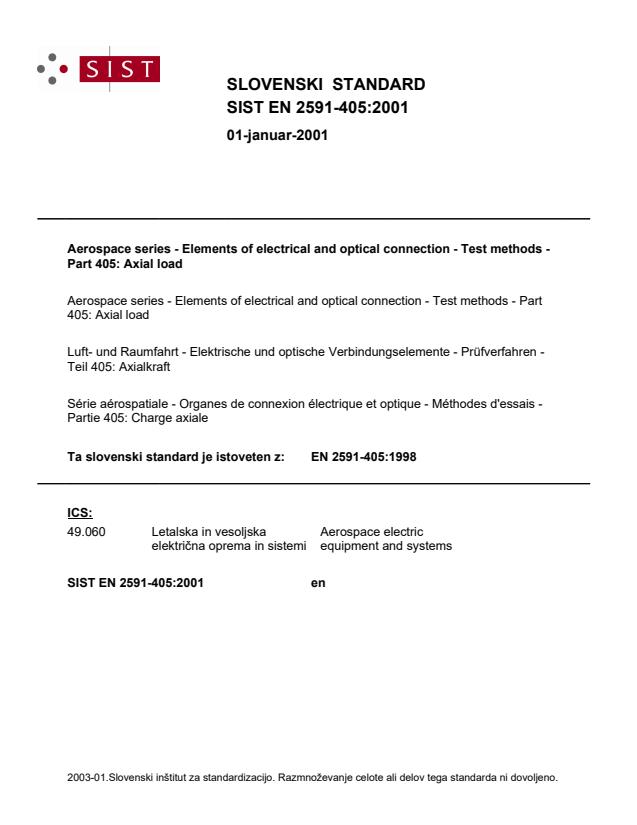
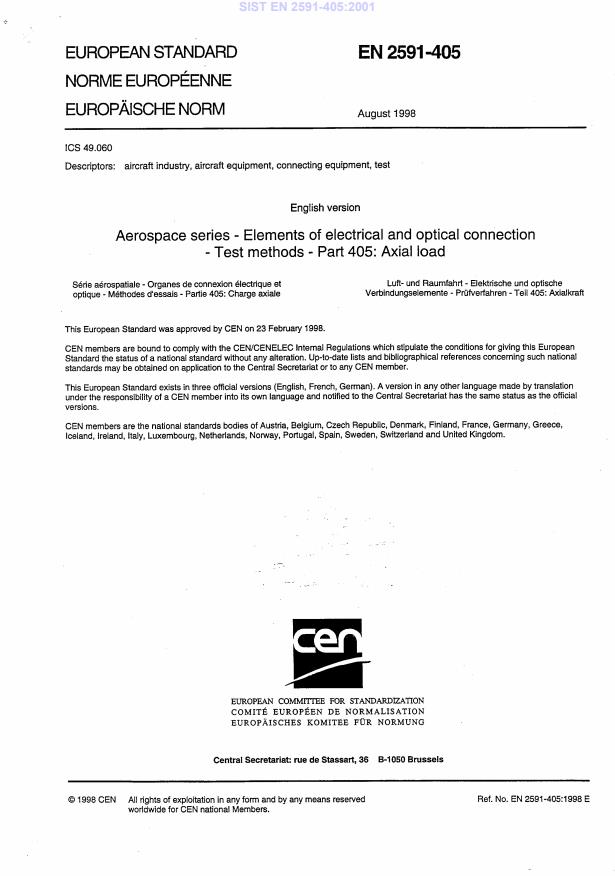
(Main)Aerospace series - Elements of electrical and optical connection - Test methods - Part 405: Axial load
General Information
- Abstract
This standard specifies a method of assessing the ability of elements of connection to withstand axial loads without mechanical or electrical damage. It shall be used together with EN 2591.
- Status
- Published
- Publication Date
- 31-Dec-2000
- Technical Committee
- SS SPL - Technical Board for the general field
- Current Stage
- 6060 - National Implementation/Publication (Adopted Project)
- Start Date
- 01-Jan-2001
- Due Date
- 01-Jan-2001
- Completion Date
- 01-Jan-2001

Overview
EN 2591-405:1998 - Aerospace series - Elements of electrical and optical connection - Test methods - Part 405: Axial load is a European test-method standard published by CEN. It defines a procedure for assessing the ability of electrical and optical connection elements (for example connectors, contacts and cable terminations) to withstand axial (pull) forces without mechanical or electrical damage. This part is intended to be used together with the general requirements in EN 2591 and applies to aerospace applications where connector integrity under axial stress is critical.
Key Topics and Requirements
- Purpose: Establishes a reproducible method to evaluate axial-load resistance of connection elements used in aerospace systems.
- Scope: Applies to both electrical and optical connection elements subject to axial pulling forces during installation, handling, service or failure scenarios.
- Performance criterion: Focus on avoiding mechanical breakage, loss of contact, or measurable electrical degradation after axial loading (the standard specifies assessment criteria rather than design values).
- Test methodology: Defines the general approach for applying axial force and observing resultant mechanical and electrical conditions - to be read in conjunction with EN 2591 for complementary procedures, test conditions and specimen preparation.
- Applicability: Intended for qualification, verification and acceptance testing of connector designs and assemblies used in aerospace environments.
- Reference classification: Falls under ICS 49.060 (Aerospace electric equipment and systems).
Applications
EN 2591-405:1998 is practical for:
- Aerospace manufacturers validating connector designs for aircraft, spacecraft and related systems.
- Component suppliers establishing product data for axial-load resistance and reliability.
- Test laboratories performing standardized mechanical and electrical verification of connectors and optical termini.
- Quality, reliability and certification engineers who need a documented test method for supplier acceptance, maintenance qualification, and design assurance.
- Maintenance and repair organizations assessing connector integrity after field incidents involving tensile loads.
Related Standards
- EN 2591 (general parts) - EN 2591-405 must be used together with the general EN 2591 series that covers broader test procedures and common requirements for electrical and optical connection elements.
- Other aerospace connector standards and industry test methods (refer to national adoptions and sector-specific guidance) may complement axial load testing for complete qualification.
This content helps engineers, test houses and procurement specialists find and apply EN 2591-405:1998 when assessing connector axial-load performance in aerospace systems. Keywords: EN 2591-405:1998, axial load test, aerospace connectors, electrical and optical connection, CEN test methods, connector qualification.
Relations
- Effective Date
- 28-Jan-2026
- Effective Date
- 28-Jan-2026
- Effective Date
- 28-Jan-2026
- Effective Date
- 28-Jan-2026
- Effective Date
- 28-Jan-2026
- Effective Date
- 28-Jan-2026
- Effective Date
- 28-Jan-2026
- Effective Date
- 28-Jan-2026
- Effective Date
- 28-Jan-2026
- Effective Date
- 28-Jan-2026
- Effective Date
- 28-Jan-2026
- Effective Date
- 28-Jan-2026
- Effective Date
- 28-Jan-2026
- Effective Date
- 28-Jan-2026
- Effective Date
- 28-Jan-2026
Get Certified
Connect with accredited certification bodies for this standard

BUREAU VERITAS Certification Germany
Bureau Veritas certification in Germany.

Element Materials Technology
Materials testing and product certification.

AQMS Ltd.
AQMS provides ISO certification to SMEs across the UK.
Sponsored listings
Frequently Asked Questions
SIST EN 2591-405:2001 is a standard published by the Slovenian Institute for Standardization (SIST). Its full title is "Aerospace series - Elements of electrical and optical connection - Test methods - Part 405: Axial load". This standard covers: This standard specifies a method of assessing the ability of elements of connection to withstand axial loads without mechanical or electrical damage. It shall be used together with EN 2591.
This standard specifies a method of assessing the ability of elements of connection to withstand axial loads without mechanical or electrical damage. It shall be used together with EN 2591.
SIST EN 2591-405:2001 is classified under the following ICS (International Classification for Standards) categories: 49.060 - Aerospace electric equipment and systems. The ICS classification helps identify the subject area and facilitates finding related standards.
SIST EN 2591-405:2001 has the following relationships with other standards: It is inter standard links to SIST EN 2591-101:2001, SIST EN 2591:2001, SIST EN 2591-205:2001, SIST EN 2591-204:2001, SIST EN 2591-408:2001, SIST EN 3155-071:2019, SIST EN 4639-102:2008, SIST EN 3155-076:2020, SIST EN 3155-076:2012, SIST EN 3155-077:2020, SIST EN 3155-024:2009, SIST EN 3155-081:2019, SIST EN 3646-001:2009, SIST EN 3155-071:2008, SIST EN 3660-012:2008. Understanding these relationships helps ensure you are using the most current and applicable version of the standard.
SIST EN 2591-405:2001 is available in PDF format for immediate download after purchase. The document can be added to your cart and obtained through the secure checkout process. Digital delivery ensures instant access to the complete standard document.
Standards Content (Sample)
2003-01.Slovenski inštitut za standardizacijo. Razmnoževanje celote ali delov tega standarda ni dovoljeno.Aerospace series - Elements of electrical and optical connection - Test methods - Part 405: Axial loadLuft- und Raumfahrt - Elektrische und optische Verbindungselemente - Prüfverfahren - Teil 405: AxialkraftSérie aérospatiale - Organes de connexion électrique et optique - Méthodes d'essais - Partie 405: Cha
...