

SIST EN 71-11:2006
(Main)Safety of toys - Part 11: Organic chemical compounds - Methods of analysis
General Information
- Abstract
This Part 11 of the European Standard EN 71 for safety of toys specifies methods for the analysis of toy and toy material extracts prepared according to the sampling procedures in EN 71-10, to enable assessment of compliance with the chemical requirements specified in EN 71-9.
This European Standard specifies analytical methods for the identification and determination of the following groups of organic chemicals:
Flame retardants
Colourants
Primary aromatic amines
Monomers and solvents
Wood preservatives
Preservatives
Plasticisers
NOTE 1 Methods for formaldehyde in accessible textile components of toys; accessible paper components of toys; and accessible resin-bonded wood components of toys are specified in EN 71-9.
NOTE 2 The method for free formaldehyde as a preservative is specified in EN 71-10.
- Status
- Published
- Publication Date
- 31-Jan-2006
- Technical Committee
- OTR - Child use and care article
- Current Stage
- 6060 - National Implementation/Publication (Adopted Project)
- Start Date
- 01-Feb-2006
- Due Date
- 01-Feb-2006
- Completion Date
- 01-Feb-2006
- Directive
- 88/378/EEC - Safety of toys



Overview
EN 71-11:2005 - Safety of toys: Part 11 - Organic chemical compounds - Methods of analysis is a CEN European Standard that specifies analytical methods to identify and quantify organic chemicals in toy and toy material extracts. It is intended to be used together with EN 71-10 (sample preparation and extraction) and EN 71-9 (chemical requirements) to assess compliance with EU toy safety requirements. The standard targets groups of organic compounds of concern in toys and defines laboratory procedures, detection techniques and reporting requirements.
Key topics
- Scope and purpose
- Methods apply to extracts prepared according to EN 71-10 to enable compliance assessment with EN 71-9.
- Covers flame retardants, colourants, primary aromatic amines, monomers and solvents, wood preservatives, preservatives and plasticisers.
- Notes on formaldehyde methods: formaldehyde in accessible textile/paper/wood components is addressed in EN 71-9; free formaldehyde as a preservative is in EN 71-10.
- Analytical techniques
- Liquid chromatography with diode-array and mass spectrometry detection (LC‑DAD‑MS) for flame retardants.
- LC‑DAD for colourants with LC‑MS confirmation where required.
- Procedures for calibration, identification criteria (e.g., peak purity), quantification and calculation of concentrations referenced to sample mass.
- Performance criteria and limits
- Action limits, precision (RSD) and recovery figures are given for specific analytes (example: pentabromodiphenyl ether, octabromodiphenyl ether, tri‑o‑cresyl phosphate).
- Correlation and validation requirements for alternative methods: alternatives acceptable only if equivalent in accuracy, precision and sensitivity.
- Laboratory practice and safety
- Requirements for reagent quality, volumetric precision, use of fume cupboards, disposal of solvents and personnel protective equipment.
- Annexes
- Annex A: volatile solvent methods
- Annex B: validation of test methods
- Annex C: colourants - conformational analysis
- Annex ZA: relationship to EU Directives
Applications and users
- Who uses EN 71-11
- Toy manufacturers and material suppliers verifying chemical safety of components.
- Independent testing laboratories conducting conformity testing to EN 71 series.
- Regulatory authorities and conformity assessors checking compliance with EU toy safety rules.
- Importers and retailers ensuring products meet EN 71 chemical limits before market placement.
- Practical uses
- Routine testing workflows: extract preparation (EN 71-10) → targeted analysis (EN 71-11) → comparison with limits in EN 71-9.
- Development and validation of in‑house methods equivalent to the standard.
- Supporting technical documentation for CE marking and regulatory submissions.
Related standards
- EN 71-9:2005 - Organic chemical compounds - Requirements
- EN 71-10:2005 - Sample preparation and extraction
- EN ISO 3696 - Water for analytical laboratory use
Keywords: EN 71-11, safety of toys, organic chemical compounds, methods of analysis, CEN, LC‑DAD‑MS, toy testing, EN 71-9, EN 71-10.
Relations
- Effective Date
- 28-Jan-2026
- Effective Date
- 28-Jan-2026
- Effective Date
- 28-Jan-2026
- Effective Date
- 10-Feb-2026
- Referred By
SIST EN 71-9:2005+A1:2007 - Safety of toys - Part 9: Organic chemical compounds - Requirements - Effective Date
- 28-Jan-2026
- Effective Date
- 28-Jan-2026
- Effective Date
- 28-Jan-2026
- Effective Date
- 28-Jan-2026
- Referred By
SIST EN 1273:2021 - Child care articles - Baby walking frames - Safety requirements and test methods - Effective Date
- 28-Jan-2026
- Effective Date
- 28-Jan-2026
- Effective Date
- 28-Jan-2026
- Effective Date
- 28-Jan-2026
- Effective Date
- 28-Jan-2026
- Effective Date
- 28-Jan-2026
- Effective Date
- 28-Jan-2026
Frequently Asked Questions
SIST EN 71-11:2006 is a standard published by the Slovenian Institute for Standardization (SIST). Its full title is "Safety of toys - Part 11: Organic chemical compounds - Methods of analysis". This standard covers: This Part 11 of the European Standard EN 71 for safety of toys specifies methods for the analysis of toy and toy material extracts prepared according to the sampling procedures in EN 71-10, to enable assessment of compliance with the chemical requirements specified in EN 71-9. This European Standard specifies analytical methods for the identification and determination of the following groups of organic chemicals: Flame retardants Colourants Primary aromatic amines Monomers and solvents Wood preservatives Preservatives Plasticisers NOTE 1 Methods for formaldehyde in accessible textile components of toys; accessible paper components of toys; and accessible resin-bonded wood components of toys are specified in EN 71-9. NOTE 2 The method for free formaldehyde as a preservative is specified in EN 71-10.
This Part 11 of the European Standard EN 71 for safety of toys specifies methods for the analysis of toy and toy material extracts prepared according to the sampling procedures in EN 71-10, to enable assessment of compliance with the chemical requirements specified in EN 71-9. This European Standard specifies analytical methods for the identification and determination of the following groups of organic chemicals: Flame retardants Colourants Primary aromatic amines Monomers and solvents Wood preservatives Preservatives Plasticisers NOTE 1 Methods for formaldehyde in accessible textile components of toys; accessible paper components of toys; and accessible resin-bonded wood components of toys are specified in EN 71-9. NOTE 2 The method for free formaldehyde as a preservative is specified in EN 71-10.
SIST EN 71-11:2006 is classified under the following ICS (International Classification for Standards) categories: 97.200.50 - Toys. The ICS classification helps identify the subject area and facilitates finding related standards.
SIST EN 71-11:2006 has the following relationships with other standards: It is inter standard links to SIST EN 71-10:2006, SIST EN 71-9:2005, SIST EN ISO 3696:1998, SIST-V CEN/CLC Guide 14:2009, SIST EN 71-9:2005+A1:2007, SIST EN 1400:2013+A1:2014, SIST EN 1466:2024, SIST EN 1272:2017, SIST EN 1273:2021, SIST EN 12790-1:2024, SIST EN 12586:2008+A1:2011, SIST EN 1400:2013+A2:2018, SIST EN 1400:2013, SIST EN 16232:2013+A2:2024, SIST EN 16232:2013+A1:2018. Understanding these relationships helps ensure you are using the most current and applicable version of the standard.
SIST EN 71-11:2006 is associated with the following European legislation: EU Directives/Regulations: 88/378/EEC, TRRTP215; Standardization Mandates: M/229. When a standard is cited in the Official Journal of the European Union, products manufactured in conformity with it benefit from a presumption of conformity with the essential requirements of the corresponding EU directive or regulation.
SIST EN 71-11:2006 is available in PDF format for immediate download after purchase. The document can be added to your cart and obtained through the secure checkout process. Digital delivery ensures instant access to the complete standard document.
Standards Content (Sample)
SLOVENSKI STANDARD
01-februar-2006
Varnost igrač – 11. del: Organske kemijske spojine – Analizne metode
Safety of toys - Part 11: Organic chemical compounds - Methods of analysis
Sicherheit von Spielzeug - Teil 11: Organisch-chemische Verbindungen,
Analysenverfahren
Sécurité des jouets - Partie 11 : Composés organiques chimiques - Méthodes d'analyse
Ta slovenski standard je istoveten z: EN 71-11:2005
ICS:
97.200.50 Igrače Toys
2003-01.Slovenski inštitut za standardizacijo. Razmnoževanje celote ali delov tega standarda ni dovoljeno.
EUROPEAN STANDARD
EN 71-11
NORME EUROPÉENNE
EUROPÄISCHE NORM
November 2005
ICS 97.200.50
English Version
Safety of toys - Part 11: Organic chemical compounds - Methods
of analysis
Sécurité des jouets - Partie 11 : Composés chimiques Sicherheit von Spielzeug - Teil 11: Organisch-chemische
organiques dans les jouets - Méthodes d'analyse Verbindungen - Analysenverfahren
This European Standard was approved by CEN on 27 June 2005.
CEN members are bound to comply with the CEN/CENELEC Internal Regulations which stipulate the conditions for giving this European
Standard the status of a national standard without any alteration. Up-to-date lists and bibliographical references concerning such national
standards may be obtained on application to the Central Secretariat or to any CEN member.
This European Standard exists in three official versions (English, French, German). A version in any other language made by translation
under the responsibility of a CEN member into its own language and notified to the Central Secretariat has the same status as the official
versions.
CEN members are the national standards bodies of Austria, Belgium, Cyprus, Czech Republic, Denmark, Estonia, Finland, France,
Germany, Greece, Hungary, Iceland, Ireland, Italy, Latvia, Lithuania, Luxembourg, Malta, Netherlands, Norway, Poland, Portugal, Slovakia,
Slovenia, Spain, Sweden, Switzerland and United Kingdom.
EUROPEAN COMMITTEE FOR STANDARDIZATION
COMITÉ EUROPÉEN DE NORMALISATION
EUROPÄISCHES KOMITEE FÜR NORMUNG
Management Centre: rue de Stassart, 36 B-1050 Brussels
© 2005 CEN All rights of exploitation in any form and by any means reserved Ref. No. EN 71-11:2005: E
worldwide for CEN national Members.
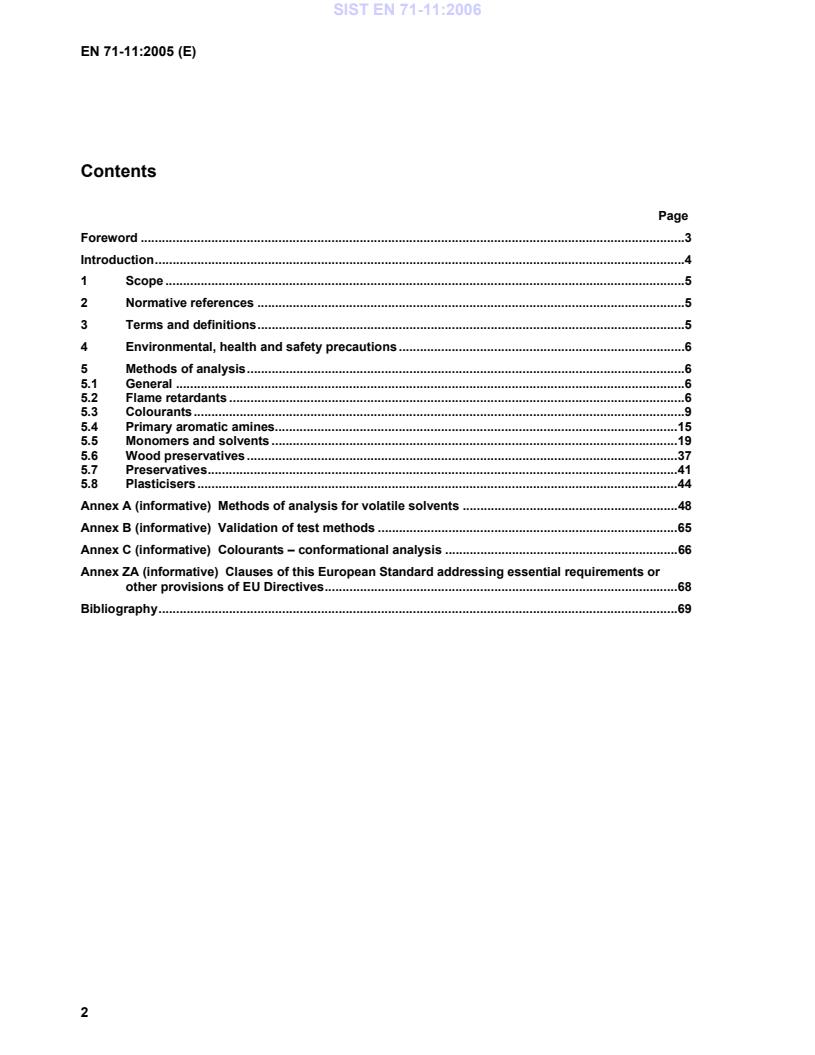
Contents
Page
Foreword .3
Introduction.4
1 Scope .5
2 Normative references .5
3 Terms and definitions.5
4 Environmental, health and safety precautions .6
5 Methods of analysis.6
5.1 General .6
5.2 Flame retardants .6
5.3 Colourants.9
5.4 Primary aromatic amines.15
5.5 Monomers and solvents .19
5.6 Wood preservatives.37
5.7 Preservatives.41
5.8 Plasticisers.44
Annex A (informative) Methods of analysis for volatile solvents .48
Annex B (informative) Validation of test methods .65
Annex C (informative) Colourants – conformational analysis .66
Annex ZA (informative) Clauses of this European Standard addressing essential requirements or
other provisions of EU Directives.68
Bibliography.69
Foreword
This European Standard (EN 71-11:2005) has been prepared by Technical Committee CEN/TC 52 “Safety of
Toys”, the secretariat of which is held by DS.
This European Standard shall be given the status of a national standard, either by publication of an identical
text or by endorsement, at the latest by May 2006, and conflicting national standards shall be withdrawn at the
latest by May 2006.
This European Standard has been prepared under a mandate given to CEN by the European Commission
and the European Free Trade Association, and supports essential requirements of EU Directive(s).
For relationship with EU Directive(s), see informative Annex ZA, which is an integral part of this European
Standard.
This European Standard constitutes part 11 of the European Standard on Safety of Toys.
This part should be read in conjunction with parts 9 and 10.
According to the CEN/CENELEC Internal Regulations, the national standards organizations of the following
countries are bound to implement this European Standard: Austria, Belgium, Cyprus, Czech Republic,
Denmark, Estonia, Finland, France, Germany, Greece, Hungary, Iceland, Ireland, Italy, Latvia, Lithuania,
Luxembourg, Malta, Netherlands, Norway, Poland, Portugal, Slovakia, Slovenia, Spain, Sweden, Switzerland
and United Kingdom.
Introduction
The European Standard EN 71 for “safety of toys” consists of the following parts:
Part 1: Mechanical and physical properties
Part 2: Flammability
Part 3: Migration of certain elements
Part 4: Experimental sets for chemistry and related activities
Part 5: Chemical toys (sets) other than experimental sets
Part 6: Graphical symbols for age warning labelling
Part 7: Finger paints – Requirements and test methods
Part 8: Swings, slides and similar activity toys for indoor and outdoor family domestic use
Part 9: Organic chemical compounds – Requirements
Part 10: Organic chemical compounds – Sample preparation and extraction
Part 11: Organic chemical compounds – Methods of analysis
The European Standards EN 71-9, EN 71-10 and EN 71-11 were mandated by the European Commission
(M/229) to address the risks presented by organic chemical compounds in toys by taking into account the
potential exposure and toxicological effects of those substances considered to present the greatest risk to
health.
This European Standard specifies methods of analysis to enable assessment of compliance with the chemical
requirements specified in EN 71-9 when toy and toy material extracts have been prepared according to the
sampling procedures in EN 71-10.
This part on methods of analysis should be read in conjunction with EN 71-9, which contains requirements for
certain organic chemical compounds in toys, and EN 71-10, which describes sample preparation and
extraction procedures.
This European Standard takes into account the opinion of the Toxicology Section of the Scientific Advisory
Committee published in 1992 (EUR 13976), which recommended that certain groups of chemical compounds
used in toys and toy materials need to be given special attention. In drafting this European Standard CEN/TC
52 has considered organic chemicals that can be classified within the following groups:
Solvents
Preservatives
Plasticisers (excluding phthalate plasticisers)
Flame retardants
Monomers
Biocides (wood preservatives)
Processing aids
Colouring agents
Phthalate plasticisers were specifically excluded from the scope of mandate M/229.
1 Scope
This Part 11 of the European Standard EN 71 for safety of toys specifies methods for the analysis of toy and
toy material extracts prepared according to the sampling procedures in EN 71-10, to enable assessment of
compliance with the chemical requirements specified in EN 71-9.
This European Standard specifies analytical methods for the identification and determination of the following
groups of organic chemicals:
Flame retardants
Colourants
Primary aromatic amines
Monomers and solvents
Wood preservatives
Preservatives
Plasticisers
NOTE 1 Methods for formaldehyde in accessible textile components of toys; accessible paper components of toys; and
accessible resin-bonded wood components of toys are specified in EN 71-9.
NOTE 2 The method for free formaldehyde as a preservative is specified in EN 71-10.
2 Normative references
The following referenced documents are indispensable for the application of this European Standard. For
dated references, only the edition cited applies. For undated references, the latest edition of the referenced
document (including any amendments) applies.
EN 71-9:2005, Safety of toys – Part 9: Organic chemical compounds – Requirements
EN 71-10:2005, Safety of toys – Part 10: Organic chemical compounds – Sample preparation and extraction
EN ISO 3696, Water for analytical laboratory use – Specification and test methods (ISO 3696:1987)
3 Terms and definitions
For the purposes of this European Standard, the following terms and definitions apply.
3.1
action limit
routinely-achievable limit of quantification for a particular substance using the specified method of analysis
3.2
aqueous migrate
liquid obtained after extracting a toy material according to the procedure specified in Clause 6 of EN 71-
10:2005
3.3
test portion
portion of the laboratory sample prepared for analysis
3.4
toy material
material from which toys and toy components are made
NOTE This definition differs from that given in EN 71-3
4 Environmental, health and safety precautions
When preparing this European Standard, consideration was given to the minimisation of environmental
impacts caused by the use of the methods of analysis.
It is the users’ responsibility to use safe and proper techniques in handling materials in the methods of
analysis specified in this European Standard.
Consult manufacturers for specific details such as material safety data sheets and other
recommendations.
Wear protective goggles and coats in all laboratory areas.
Be careful about substances, which are toxic and/or human carcinogens.
A fume cupboard shall be used during preparation of organic solvent solutions.
Solvents shall be disposed of in accordance with environmental requirements.
5 Methods of analysis
5.1 General
All chemicals used for analysis shall be of analytical grade (pro analysis) or, if unavailable, the best technical
grade. Water shall be of grade 3 according to EN ISO 3696 or of a comparable quality, and demonstrably free
from analytes of interest.
The precision of volumetric glassware should be grade A.
The analysis of toys and toy materials for chemical compounds for which limits are given in Tables 2 A to 2 I
of EN 71-9:2005 shall be performed in accordance with the sampling procedures specified in EN 71-10 and
the methods of analysis described in this European Standard. Alternative methods of analysis are acceptable
only if they are capable of achieving at least the accuracy and precision of the methods described in this
European Standard; an adequate sensitivity; and have been validated to show that the results are equivalent
to those of these standard methods.
5.2 Flame retardants
NOTE Methods are given for pentabromodiphenyl ether and octabromodiphenyl ether in order to enable compliance
with Directive 2003/11/EC of the European Parliament and of the Council to be demonstrated for textile toy materials.
5.2.1 Principle
Flame retardants are determined in acetonitrile extracts of toy materials by liquid chromatography with diode-
array and mass spectrometry detection (LC-DAD-MS) using the external standard method of calibration.
5.2.2 Standards, reagents and solvents
5.2.2.1 Standards
2*
5.2.2.1.1 Pentabromodiphenyl ether , CAS No. 32534-81-9
5.2.2.1.2 Octabromodiphenyl ether * , CAS No. 32536-52-0
5.2.2.1.3 Tri-o-cresyl phosphate, CAS No. 78-30-8
5.2.2.1.4 Tris(2-chloroethyl) phosphate, CAS No. 115-96-8
5.2.2.2 Reagents and solvents
5.2.2.2.1 Acetonitrile
5.2.2.2.2 Dichloromethane
5.2.2.2.3 Ammonium acetate, anhydrous
5.2.2.2.4 Acetic acid, glacial
5.2.2.2.5 Ammonium acetate, 10 mmol/l aqueous solution, pH 3,6
Transfer (0,77 0,01) g ammonium acetate (5.2.2.2.3) into a 1 000-ml volumetric flask, add 980 ml of water,
±
adjust the pH to 3,6 ± 0,1 with glacial acetic acid and make up to the mark with water.
5.2.2.3 Stock standard solution (100 mg/l)
Weigh, to the nearest 0,1 mg, (10 ± 1) mg of each flame retardant (5.2.2.1) into a 100-ml volumetric flask.
Add 25 ml of acetonitrile (5.2.2.2.1) and mix carefully to dissolve. Place in an ultrasonic bath for 10 min to
ensure complete dissolution. Make up to the mark with acetonitrile.
The stability of the mixed stock standard solution should be checked regularly. It should be stable for up to 6
months when stored in the dark at (4 ± 2) °C.
5.2.3 Apparatus
Liquid chromatograph with diode-array and mass spectrometer detectors
The following LC-DAD-MS conditions for flame retardant determination have been found to be suitable:
Column: C18, 80 Å, 3,5 µm, double endcapped, (Zorbax Eclipse XDB , or equivalent)
2,1 mm x 150 mm
Guard column: C18, 80 Å, 4 mm x 2,0 mm,
Mobile phase A: Ammonium acetate solution, 10 mmol/l, pH 3,6 (5.2.2.2.5)
Mobile phase B: Acetonitrile
Gradient: see Table 1
This substance is also known as pentabromodiphenyl oxide.
*
There are no requirements in EN 71-9 for this substance.
This substance is also known as octabromodiphenyl oxide.
Zorbax Eclipse XDB is an example of a suitable product available commercially. This information is given for the
convenience of users of this European Standard and does not constitute an endorsement by CEN of this product.
Injection volume: 5 µl
Run time: 45 min
Flow: 0,3 ml/min
DAD mode: 240 nm ± 20 nm
DAD range: 200 nm to 800 nm
Nebulizer: 200 Kpa
Dry gas: 10 l/min
MS range: 110 m/z to 500 m/z
MS mode: Scan positive
Ionisation: ESI+
Fragmentor: 80 V
Table 1 – Gradient program
Time Mobile phase A Mobile phase B
min % %
0 60 40
7 40 60
17 2 98
35 2 98
45 60 40
5.2.4 Procedure
5.2.4.1 Calibration solutions
Prepare a series of mixed flame retardant calibration solutions from the stock standard solution (5.2.2.3) at
1,0 mg/l, 2,0 mg/l, 4,0 mg/l and 8,0 mg/l concentrations in acetonitrile.
5.2.4.2 Determination
Proceed to liquid chromatographic determination using the conditions described in 5.2.3. Inject the calibration
solutions (5.2.4.1) and the extract obtained at 8.1.1 of EN 71-10:2005.
5.2.4.3 Identification
For a positive identification, the peak purity factor should achieve a match of at least 85 %.
5.2.5 Calculation of analyte concentration
Determine the concentration of a flame retardant in the acetonitrile extract from a calibration graph produced
from the calibration solutions.
Calculate the concentration of a flame retardant in the sample using the following equation:
C [mg /l ]
comp, solvent
Conc [mg / kg ] = x 10 (1)
A
where
C is the concentration of a flame retardant in acetonitrile extract
comp, solvent
A is the mass in grams of the test portion taken for analysis (see 8.1.1 of EN 71-10:2005).
5.2.6 Limits and precision
Table 2 – Limits and precision
Component Action limit RSD Recovery
mg/kg % at 5 mg/l % at 100 mg/kg
(equivalent to from fabric
50 mg/kg in sample)
a
Pentabromodiphenyl ether 2,0 103
(total of 3 isomers)
a
Octabromodiphenyl ether 1,2 99
(total of 4 isomers)
Tri-o-cresyl phosphate 50 2,4 69
Tris(2-chloroethyl) 50 2,6 102
phosphate
a
The limit in Directive 2003/11/EC is 0,1 % by mass (1 000 mg/kg)
Correlation coefficient (r): > 0,995
5.2.7 Test report
The test report shall contain the following information:
a) description and identification of the product and material tested;
b) reference to this European Standard;
c) identification of flame retardants in the extract of the test portion;
d) amount of each flame retardant identified expressed as a concentration (mg/kg) in the toy material;
e) any deviations from the test procedure specified;
f) date of test.
5.3 Colourants
5.3.1 Principle
Colourants are identified and semi-quantified in extracts of toy materials by liquid chromatography with diode-
array detection (LC-DAD). If a positive identification is obtained, confirmation can be achieved using liquid
chromatography with mass spectrometry detection (LC-MS).
5.3.2 Standards, reagents and solvents
NOTE Pure materials for these colourants are not readily available and their composition can vary. A supplier of a
suitable colourant is indicated for each analyte.
5.3.2.1 Standards
5.3.2.1.1 Disperse Blue 1, C.I. 64500
e.g. Sigma Aldrich 21 564-3
5.3.2.1.2 Disperse Blue 3, C.I. 61505
e.g. Sigma Aldrich 21 565-1
5.3.2.1.3 Disperse Blue 106
e.g. Fluka 28241
5.3.2.1.4 Disperse Blue 124
e.g. Fluka 21620
5.3.2.1.5 Disperse Yellow 3, C.I. 11855
e.g. Sigma Aldrich 21 568-6
5.3.2.1.6 Disperse Orange 3, C.I. 11005
e.g. Sigma Aldrich 36 479-7
5.3.2.1.7 Disperse Orange 37
e.g. Fluka 21603
5.3.2.1.8 Disperse Red 1, C.I. 11110
e.g. Sigma Aldrich 34 420-6
5.3.2.1.9 Solvent Yellow 1, C.I. 11000
e.g. Sigma Aldrich 18 636-8
5.3.2.1.10 Solvent Yellow 2, C.I. 11020
e.g. Sigma Aldrich 11 449-9
5.3.2.1.11 Solvent Yellow 3, C.I. 11160
e.g. Sigma Aldrich 12 156-8
5.3.2.1.12 Basic Red 9, C.I. 42500
e.g. Sigma Aldrich 21 559-7
The suppliers of the colourants mentioned in this subclause are examples of suppliers of suitable products available
commercially. This information is given for the convenience of users of this European Standard and does not constitute an
endorsement by CEN.
5.3.2.1.13 Basic Violet 1, C.I. 42535
e.g. Sigma Aldrich 19 809-9
5.3.2.1.14 Basic Violet 3, C.I.42555
e.g. Sigma Aldrich 86 099-9
5.3.2.1.15 Acid Red 26, C.I.16150
e.g. Sigma Aldrich 19 976-1
5.3.2.1.16 Acid Violet 49, C.I. 42640
e.g. Sigma Aldrich S334294
5.3.2.2 Reagents and solvents
5.3.2.2.1 Tetrabutylammonium hydroxide solution, 40 % in water
5.3.2.2.2 Citric acid
5.3.2.2.3 Ammonium acetate, anhydrous
5.3.2.2.4 Acetonitrile
5.3.2.2.5 Tetrahydrofuran
5.3.2.2.6 Ethanol, absolute
5.3.2.2.7 Ammonium hydroxide, approx. 35 % (V/V)
5.3.2.2.8 Acetic acid, glacial
5.3.2.2.9 Ammonium acetate, 10 mmol/l aqueous solution, pH 3,6
Transfer (0,77 ± 0,01) g ammonium acetate (5.3.2.2.3) into a 1 000-ml volumetric flask, add 980 ml of water,
adjust the pH to 3,6 ± 0,1 with glacial acetic acid and make up to the mark with water.
5.3.2.2.10 Citrate-buffered tetrabutylammonium hydroxide solution
Transfer (13,6 ± 0,1) g tetrabutylammonium hydroxide solution (5.3.2.2.1) and (2,8 ± 0,1) g citric acid into a
1 000-ml volumetric flask, add 980 ml of water, adjust the pH to 9,0 ± 0,1 with ammonium hydroxide
(5.3.2.2.7) and make up to the mark with water.
5.3.3 Standard solutions
5.3.3.1 General
When preparing stock solutions of each colourant, purity values shall be taken into account. Store the stock
standard solutions in a refrigerator at (4 ± 2) °C.
5.3.3.2 Stock standard solution (50 µg/ml), mix 1
Weigh, to the nearest 0,1 mg, (5 ± 1) mg of each colourant listed below into a 100-ml volumetric flask. Add
50 ml of ethanol (5.3.2.2.6) and mix carefully to dissolve. Place in an ultrasonic bath for 15 min to ensure
complete dissolution. Make up to the mark with ethanol.
Disperse Blue 1
Disperse Blue 106
Disperse Blue 124
Disperse Orange 3
Disperse Orange 37
Solvent Yellow 1
Solvent Yellow 2
Solvent Yellow 3
Basic Red 9
Basic Violet 1
Basic Violet 3
5.3.3.3 Stock standard solution (50 µg/ml), mix 2
Weigh, to the nearest 0,1 mg, (5 ± 1) mg of each colourant listed below into a 100-ml volumetric flask. Add
50 ml of ethanol and mix carefully to dissolve. Place in an ultrasonic bath for 15 min to ensure complete
dissolution. Make up to the mark with ethanol.
Disperse Blue 3
Disperse Yellow 3
Disperse Red 1
Acid Red 26
Acid Red 49
5.3.4 Apparatus
5.3.4.1 PTFE membrane filter, 0,45 µm
5.3.4.2 Ultrasonic bath
5.3.4.3 Liquid chromatograph with diode-array detector
The following LC-DAD conditions for colourant analysis have been found to be suitable:
Column: C18, 100 Å, 5 µm, endcapped, (Luna C18(2) , or equivalent), 250 mm x 4,6 mm
Guard column: 2 x C18, 100 Å, 5 µm, endcapped, (Luna C18(2) , or equivalent)
Column temperature: 25 °C
Mobile phase A: Citrate-buffered tetrabutylammonium hydroxide solution (5.3.2.2.10)
Mobile phase B: Tetrahydrofuran
Mobile phase C: Acetonitrile
Gradient: see Table 3
Run time: 45 min
Flow rate 0,8 ml/min
Injection volume: 5 µl to 50 µl
Analysis time: 35 min
Wavelength range: 275 nm to 760 nm
Resolution factor: 4,8 nm
Acquisition rate: 1 spectrum/second
Table 3 – Gradient program
Time Mobile phase A Mobile phase B Mobile phase C
min % % %
0 80,0 10,0 10,0
2,50 80,0 10,0 10,0
30,0 5,0 48,0 47,0
35,0 5,0 48,0 47,0
45,0 80,0 10,0 10,0
5.3.5 Procedure
5.3.5.1 Calibration solutions
Prepare two series of colourant calibration solutions from the stock standard solutions of mix 1 (5.3.3.2) and
mix 2 (5.3.3.3) at 1 mg/l, 2 mg/l, 3 mg/l, 4 mg/l and 5 mg/l concentrations in ethanol.
5.3.5.2 Determination
Proceed to liquid chromatographic determination using the conditions described in 5.3.4.3. Inject the
calibration solutions of both mix 1 and mix 2 (5.3.5.1) and the ethanol phase obtained at 8.1.3, 8.2.1, 8.3.1,
8.4.1, 8.5.1, 8.6.1, 8.7.1, 8.8.1 or 8.9.1 of EN 71-10:2005, as appropriate.
5.3.5.3 Identification
For a positive identification, the peak purity factor should achieve a match of at least 85 %.
Luna C18(2) is an example of a suitable product available commercially. This information is given for the convenience of
users of this European Standard and does not constitute an endorsement by CEN of this product.
5.3.6 Calculation of analyte concentration
Determine the concentration of a colourant in the ethanolic extract from a calibration graph produced from the
calibration solutions.
Calculate the concentration of a colourant in the sample using the following equation:
C [mg /l ]
comp, solvent
Conc [mg / kg ] = xD (2)
A
where
C is the concentration of a colourant in ethanolic extract
comp, solvent
A is the mass in grams of the test portion taken for analysis (see 8.1.3, 8.2.1, 8.3.1, 8.4.1,
8.5.1, 8.6.1, 8.7.1, 8.8.1 or 8.9.1 of EN 71-10:2005, as appropriate)
D is the dilution factor; generally 10, but see 8.5 of EN 71-10:2005 for aqueous liquid toy
material samples.
5.3.7 Limits and precision
Table 4 – Limits and precision
Substance Action limit RSD
mg/kg % at 5 mg/l
(equivalent to 10 mg/kg
in a sample)
Disperse Blue 1 10 1,8
Disperse Blue 3 10 4,9
Disperse Blue 106 10 4,4
Disperse Blue 124 10 2,2
Disperse Yellow 3 10 0,3
Disperse Orange 3 10 1,6
Disperse Orange 37 10 2,8
Disperse Red 1 10 1,6
Solvent Yellow 1 10 1,1
Solvent Yellow 2 10 1,1
Solvent Yellow 3 10 1,6
Basic Red 9 10 1,1
Basic Violet 1 10 1,5
Basic Violet 3 10 1,0
Acid Red 26 10 2,1
Acid Violet 49 10 1,4
Correlation coefficient (r): > 0,995
5.3.8 Additional information
5.3.8.1 LC-DAD spectral library
It is advisable to compile a spectral library of all colours listed in 5.3.2.1 using the processing software that is
used to operate the liquid chromatograph. Details of retention times and Lambda max of each colourant
should be recorded together with peak purity data, if available.
It has been observed that several of the colourants separated into two or more chromatographic peaks. The
colourants concerned were C.I. Acid Red 26, C.I. Disperse Blue 3, C.I. Acid Violet 49 and C.I. Basic Violet 1.
In an attempt to characterise these peaks, an LC-MS method was developed in tandem with the LC-DAD
method. The conditions used for the LC-MS analysis are detailed in Annex C.
5.3.9 Test report
The test report shall contain the following information:
a) description and identification of the product and material tested;
b) reference to this European Standard;
c) identification of colourants in the ethanolic extract of the test portion;
d) amount of each colourant identified expressed as a concentration (mg/kg) in the toy material;
e) whether a confirmation test has been carried out and, if so, the technique used and its result;
f) any deviations from the test procedure specified;
g) date of test.
5.4 Primary aromatic amines
5.4.1 Principle
Aromatic amines are determined in extracts of toy materials by gas chromatography with mass spectrometry
detection (GC-MS) using the external standard method of calibration combined with appropriate internal
standards.
5.4.2 Standards, reagents and solvents
5.4.2.1 Standards
5.4.2.1.1 Benzidine
5.4.2.1.2 Aniline
5.4.2.1.3 2-Naphthylamine
5.4.2.1.4 3,3’-Dichlorobenzidine
5.4.2.1.5 3,3’-Dimethoxybenzidine
5.4.2.1.6 3,3’-Dimethylbenzidine
5.4.2.1.7 2-Methoxyaniline
5.4.2.1.8 o-Toluidine
5.4.2.1.9 4-Chloroaniline
5.4.2.2 Reagents and solvents
Acetonitrile
5.4.2.2.1
tert-Butyl methyl ether
5.4.2.2.2
5.4.2.2.3 n-Hexane
5.4.2.2.4 Chromabond XTR (Porous granulated kieselguhr)
5.4.2.3 Stock standard solution (100 mg/l)
Weigh, to the nearest 0,1 mg, (10 ± 1) mg of each aromatic amine (5.4.2.1) into a 100-ml volumetric flask.
Add 25 ml of acetonitrile (5.4.2.2.1) and mix carefully to dissolve. Place in an ultrasonic bath for 10 min to
ensure complete dissolution. Make up to the mark with acetonitrile.
The stability of the mixed stock standard solution should be checked regularly. It should be stable for up to 6
months when stored in the dark at (4 ± 2) °C.
Chromabond XTR is an example of a suitable product available commercially. This information is given for the
convenience of users of this European Standard and does not constitute an endorsement by CEN of this product.
5.4.3 Apparatus
5.4.3.1 Ultrasonic bath
5.4.3.2 Vortex® shaker
5.4.3.3 Centrifuge
5.4.3.4 Gas chromatograph with mass spectrometer detector
Ensure that the gas chromatograph has been fully cleaned before analysis, as the determination of aromatic
amines by this technique is affected by other contaminants. It is recommended that the inlet sleeve is
deactivated and an amine-specific column used.
The following GC-MS conditions for primary aromatic amine determination have been found to be suitable:
Injector:
Mode: Splitless 0,5 min
Carrier gas: Helium 0,8 ml/min
Injector temperature: 250 °C
Injection volume: 2 µl
Column: 5 % diphenylpolysiloxane / 95 % dimethylpolysiloxane, (RTX-5 Amine , or
equivalent), 30 m x 0,25 mm (ID) x 0,25 µm (film thickness)
Oven program: 60 °C (3 min) – 7 °C/min – 280 °C (4 min) – 10 °C/min – 300 °C (2 min)
Detector: MSD
Transfer line temperature: 280 °C
Detector scan range: 70 m/z to 400 m/z
Quantification ions
Choose the molecular ion as the target ion for each of the aromatic amines followed by two qualifier ions for
confirmation.
Table 5 – Target and qualifier ions
Substance Target ion Qualifier 1 Qualifier 2
m/z m/z m/z
o-Toluidine 106 107 77
2-Methoxyaniline 108 123 80
4-Chloroaniline 127 129 92
2-Naphthylamine 143 115 116
Benzidine 184 183 185
Aniline 93 92 94
3,3’-Dimethylbenzidine 212 213 106
3,3’-Dichlorobenzidine 252 254 126
3,3’-Dimethoxybenzidine 244 201 229
RTX-5 Amine is an example of a suitable product available commercially. This information is given for the convenience
of users of this European Standard and does not constitute an endorsement by CEN of this product.
5.4.4 Procedure
5.4.4.1 Calibration solutions
Prepare a series of mixed aromatic amine calibration solutions from the stock standard solution (5.4.2.3) at
1 mg/l, 2,5 mg/l, 5 mg/l, 10 mg/l and 20 mg/l concentrations in tert-butyl methyl ether.
The calibration solutions should be freshly prepared on a daily basis.
5.4.4.2 Determination
Proceed to gas chromatographic determination using the conditions described in 5.4.3.4. Inject the calibration
solutions (5.4.4.1) and the tert-butyl methyl ether phase obtained at 8.1.4, 8.2.2, 8.3.2, 8.4.2, 8.5.2, 8.6.2,
8.7.2, 8.8.2 or 8.9.2 of EN 71-10:2005, as appropriate.
5.4.5 Calculation of analyte concentration
Determine the concentration of a primary aromatic amine in the tert-butyl methyl ether extract from a
calibration graph produced from the calibration solutions.
Calculate the concentration of a primary aromatic amine in the sample using the following equation:
C [mg /l]×V[ml]
comp, solvent
Conc [mg /kg] =
A
(3)
where:
C is the concentration of a primary aromatic amine in tert-butyl methyl ether extract;
comp, solvent
V is the volume in ml of tert-butyl methyl ether extract;
A is the mass in grams of the test portion taken for analysis (see 8.1.4, 8.2.2, 8.3.2, 8.4.2, 8.5.2,
8.6.2, 8.7.2, 8.8.2 or 8.9.2 of EN 71-10:2005, as appropriate).
5.4.6 Limits and precision
Table 6 – Limits and precision
Substance Action limit RSD Recovery
mg/kg % at 5 mg/l % at 2,5 mg/l
(equivalent to
5 mg/kg in sample)
o-Toluidine 5 3,7 93
2-Methoxyaniline 5 3,2 95
4-Chloroaniline 5 3,8 87
2-Naphthylamine 5 2,3 84
Benzidine 5 3,2 85
Aniline 5 5,0 102
3,3’-Dimethylbenzidine 5 1,9 82
3,3’Dichlorobenzidine 5 2,6 81
3,3’Dimethoxybenzidine 5 3,0 77
Correlation coefficient (r): > 0,995
5.4.7 Additional information
Due to the polar nature of some amines, clean chromatographic conditions are essential. Derivitization of the
toy material extract using trifluoroacetic anhydride (TFAA) or N-methyl-bis(trifluoroacetamide) (MBTFA) may
help overcome this problem.
During sample preparation and extraction of a toy material for primary aromatic amines, the possibility exists
of azo-dyes also being extracted. Such dyes can decompose to aromatic amines during GC analysis. If a
result above the action limit for a primary aromatic amine specified in Table 6 is obtained from a toy material
extract that is coloured, it is necessary to ascertain whether the amine has arisen from the decomposition of
an azo-dye. Except for aniline, this could indicate the presence of an azo-dye prohibited from textile and
leather toys under European legislation.
NOTE 1 Directive 2002/61/EC of the European Parliament and of the Council refers.
NOTE 2 Primary aromatic amines can also be determined using a suitably validated LC-DAD or LC-MS method.
5.4.8 Test report
The test report shall contain the following information:
a) description and identification of the product and material tested;
b) reference to this European Standard;
c) identification of primary aromatic amines in the tert-butyl methyl ether extract of the test portion;
d) amount of each primary aromatic amine identified expressed as a concentration (mg/kg) in the toy
material;
e) any deviations from the test procedure specified;
f) date of test.
5.5 Monomers and solvents
NOTE Monomers and solvents are covered by six methods in this European Standard (5.5.1 to 5.5.6).
5.5.1 Method for acrylamide
5.5.1.1 Principle
Acrylamide is determined in aqueous extracts of toy materials, without sample preparation and derivatization,
by liquid chromatography with diode-array detection (LC-DAD).
5.5.1.2 Standards
5.5.1.2.1 Acrylamide
5.5.1.2.2 Acrylamide stock standard solution, 1 000 mg/l, in water
5.5.1.3 Apparatus
Liquid chromatograph with diode-array detector
The following LC-DAD conditions for acrylamide analysis have been found to be suitable:
Column: C18, 100 Å; 5 µm, (Nucleosil 100-5 C , or equivalent), 250 mm x 3 mm
Column temperature: 25 °C
Eluent: Deionized water
Flow: 0,85 ml/min
Injection volume: 100 µl
Run time: 10 min
DAD wavelength: 198 nm
5.5.1.4 Procedure
5.5.1.4.1 Calibration solutions
Prepare a series of acrylamide calibration solutions from the acrylamide stock standard solution (5.5.1.2.2) at
0,02 mg/l, 0,04 mg/l, 0,08 mg/l, 0,2 mg/l and 0,4 mg/l concentrations in water.
5.5.1.4.2 Determination
Transfer a portion of the aqueous migrate obtained at 6.4 of EN 71-10:2005 into a 2-ml vial and close with a
crimping cap.
Proceed to liquid chromatographic determination using the conditions described in 5.5.1.3. Inject the
calibration solutions (5.5.1.4.1) and the aqueous migrate.
5.5.1.5 Calculation of analyte concentration
Determine the concentration of acrylamide in the aqueous migrate (mg/l) directly from a calibration graph
produced from the calibration solutions.
5.5.1.6 Limit and precision
Table 7 – Limit and precision
Substance Action limit RSD
in the aqueous migrate % at 0,02 mg/l
mg/l
Acrylamide 0,02 0,6
Correlation coefficient (r): > 0,995
Nucleosil 100-5 C is an example of a suitable product available commercially. This information is given for the
convenience of users of this European Standard and does not constitute an endorsement by CEN of this product.
5.5.1.7 Test report
The test report shall contain the following information:
a) description and identification of the product and material tested;
b) reference to this European Standard;
c) result of the analysis for acrylamide expressed as a concentration (mg/l) in the aqueous migrate of
the toy material;
d) any deviations from the test procedure specified;
e) date of test.
5.5.2 Method for phenol and bisphenol A
5.5.2.1 Principle
Phenol and bisphenol A are determined in aqueous extracts of toy materials by liquid chromatography with
diode-array and fluorescence detection (LC-DAD-FLD).
5.5.2.2 Standards, reagents and solvents
5.5.2.2.1 Standards
5.5.2.2.1.1 Phenol
NOTE Phenol should be colourless or bright yellow. If the colour is pink, the substance should not be used.
5.5.2.2.1.2 Bisphenol A
5.5.2.2.2 Solvents
Methanol
5.5.2.2.3 Standard solutions
5.5.2.2.3.1 Phenol stock standard solution (1 000 mg/l)
Weigh to the nearest mg, (100 ± 10) mg of phenol into a 100-ml volumetric flask. Dissolve and make up to the
mark with methanol.
5.5.2.2.3.2 Bisphenol A stock standard solution (1 000 mg/l)
Weigh to the nearest mg, (100 ± 10) mg of bisphenol A into a 100-ml volumetric flask. Dissolve and make up
to the mark with methanol.
5.5.2.3 Apparatus
Liquid chromatograph with diode-array and fluorescence detector (FLD)
The following LC-DAD-FLD conditions for phenol and bisphenol A analysis have been found to be suitable:
Column: C18, 100 Å; 5 µm, (Nucleosil 100-5 C , or equivalent), 250 mm x 4 mm
Column temperature: 20 °C
Mobile phase: Methanol : water = 65 : 35; isocratic
Flow: 0,8 ml/min
Injection volume: 40 µl
Detectors:
For phenol: DAD: 274 nm
For bisphenol A: FLD: Excitation wavelength, Ex = 275 nm
Emission wavelength, Em = 313 nm
NOTE Both detectors are connected in series, the DAD first.
5.5.2.4 Procedure
5.5.2.4.1 Calibration solutions
NOTE Aqueous solutions of phenol and bisphenol A should be stable for a period of up to 3 weeks when stored in
the dark at (4 ± 2) °C.
5.5.2.4.1.1 Phenol
Prepare a series of phenol calibration solutions from the phenol stock standard solution (5.5.2.2.3.1) at 1 mg/l,
3 mg/l, 7,5 mg/l, 15 mg/l and 45 mg/l concentrations in water.
5.5.2.4.1.2 Bisphenol A
Prepare a series of bisphenol A calibration solutions from the bisphenol A stock standard solution (5.5.2.2.3.2)
at 0,01 mg/l, 0,05 mg/l, 0,1 mg/l, 0,2 mg/l and 0,5 mg/l concentrations in water.
5.5.2.4.2 Determination
Transfer a portion of the aqueous migrate obtained at 6.4 of EN 71-10:2005 or the extract obtained at 8.2.3,
8.5.3, 8.7.3 or 8.9.3 of EN 71-10:2005, as appropriate, to a 2-ml vial and close with a crimping cap.
Proceed to liquid chromatographic determination using the conditions described in 5.5.2.3. Inject the
calibration solutions (5.5.2.4.1) and the aqueous migrate.
5.5.2.5 Calculation of analyte concentration
Determine the concentration of phenol and bisphenol A in the aqueous migrate (mg/l), or the concentration of
phenol (as a preservative) in the extract (mg/l), directly from a calibration graph produced from the calibration
solutions.
The mass concentration of phenol (as a preservative) in a sample can be calculated using the following
equation:
Nucleosil 100-5 C is an example of a suitable product available commercially. This information is given for the
convenience of users of this European Standard and does not constitute an endorsement by CEN of this product.
C [mg /l ]
comp, solvent
Conc [mg / kg ] = x15 (4)
A
where
C is the concentration of phenol in extract
comp, solvent
A is the mass in grams of the test portion taken for analysis (see 8.2.3, 8.5.3, 8.7.3, or
8.9.3 of EN 71-10:2005, as appropriate).
5.5.2.6 Limits and precision
Table 8 – Limits and precision
Substance Limit in aqueous RSD
migrate %
mg/l
Phenol (as a monomer) 15 0,3 at 15 mg/l
Phenol (as a preservative) 10 mg/kg
(Action limit in
toy material)
Bisphenol A 0,1 1,5 at 0,03 mg/l
Correlation coefficient (r): > 0,995
5.5.2.7 Test report
The test report shall contain the following information:
a) description and identification of the product and material tested;
b) reference to this European Standard;
c) result of the analysis for phenol and bisphenol A expressed as a concentration (mg/l) in the aqueous
migrate of the toy material; or
result of the analysis for phenol (as a preservative) expressed as a concentration (mg/kg) in the toy
material;
d) any deviations from the test procedure specified;
e) date of test.
5.5.3 Method for formaldehyde
5.5.3.1 Principle
Formaldehyde reacts with pentane-2,4-dione (acetylacetone) in the presence of ammonium acetate to form
3,5-diacetyl-1,4-dihydrolutidine. The absorbance is measured at a wavelength of 410 nm. Ultraviolet (UV)
spectroscopy is used for confirmation where the level of formaldehyde exceeds the limit specified in EN 71-9.
NOTE This method is based on the procedure specified in EN 1541.
5.5.3.2 Standards, reagents and solvents
5.5.3.2.1 Ammonium acetate, anhydrous
5.5.3.2.2 Acetic acid, glacial (d = 1,05)
5.5.3.2.3 Pentane-2,4-dione
5.5.3.2.4 Hydrochloric acid, 1 mol/l
5.5.3.2.5 Sodium hydroxide solution, 1 mol/l
5.5.3.2.6 Starch solution freshly prepared, 2 g/l
5.5.3.2.7 Formaldehyde solution, 370 g/l to 400 g/l
5.5.3.2.8 Standard iodine solution, 0,05 mol/l
5.5.3.2.9 Standard sodium thiosulphate solution, 0,1 mol/l
5.5.3.2.10 Pentane-2,4-dione reagent
In a 100-ml volumetric flask dissolve in 25 ml of water:
− 15,0 g anhydrous ammonium acetate;
− 0,3 ml glacial acetic acid;
− 0,2 ml pentane-2,4-dionex;.
Make up to 100,0 ml with water. This reagent shall be freshly prepared.
5.5.3.2.11 Reagent without pentane-2,4-dione
In a 100-ml volumetric flask dissolve in 25 ml of water:
− 15,0 g anhydrous ammonium acetate;
− 0,3 ml glacial acetic acid.
Make up to 100,0 ml with water.
5.5.3.3 Standard solutions
5.5.3.3.1 Standardised formaldehyde stock solution
Transfer 5,0 ml formaldehyde solution (5.5.3.2.7) into a 1 000-ml volumetric flask and make up to the mark
with water.
Just before use determine the concentration of this solution as follows:
To standardise this stock solution transfer 10,0 ml into a conical flask, add 25,0 ml of a standard iodine
solution (5.5.3.2.8) and 10,0 ml of sodium hydroxide solution (5.5.3.2.5). Allow to stand for 5 min.
Acidify with 11,0 ml of hydrochloric acid (5.5.3.2.4) and determine the excess iodine by titration with a
standard sodium thiosulphate solution (5.5.3.2.9), using 0,1 ml of the starch solution (5.5.3.2.6) as indicator.
NOTE Add the starch solution when the solution being titrated has become a pale straw colour. Theoretically, 1,0 ml
of 0,05 mol/l iodine consumed is equivalent to 1,5 mg formaldehyde.
5.5.3.3.2 Formaldehyde dilute standard solution
Using pipettes and volumetric flasks, dilute an aliquot of the standardised formaldehyde stock solution
(5.5.3.3.1) to 20 times its volume with water, and then further dilute an aliquot of this second solution to 100
times its volume so that 1,0 ml of the final solution contains about 0,001 mg of formaldehyde.
Calculate the actual formaldehyde concentration (mg/l).
This solution shall be freshly prepared.
5.5.3.4 Apparatus
5.5.3.4.1 Spectrometer, capable of measuring absorbance at a wavelength of 410 nm with cells of an
optical path length of 10 mm
5.5.3.4.2 Scanning ultraviolet (UV) spectrometer, capable of measuring in the range of 300 nm to
500 nm (R
...