


ISO/IEC DIS 23090-9
(Main)Information technology -- Coded representation of immersive media
Information technology -- Coded representation of immersive media
Technologies de l'information -- Représentation codée de média immersifs
General Information
- Status
- Published
- Publication Date
- 30-Mar-2023
- Technical Committee
- ISO/IEC JTC 1/SC 29 - Coding of audio, picture, multimedia and hypermedia information
- Drafting Committee
- ISO/IEC JTC 1/SC 29/WG 7 - MPEG 3D Graphics coding
- Current Stage
- 4099 - Full report circulated: DIS approved for registration as FDIS
- Start Date
- 05-Mar-2021
Relations
- Effective Date
- 25-Nov-2023
Overview
ISO/IEC 23090-9:2023 - first edition (2023-03) - is Part 9 of the ISO/IEC 23090 series, titled Information technology - Coded representation of immersive media - Part 9: Geometry-based point cloud compression. This international standard specifies the coded representation, syntax and semantics, and decoding processes for geometry-based point cloud compression (G‑PCC) used in immersive media. The document covers point cloud formats, attribute handling, codec-derived metadata, coordinate systems, and detailed decoding procedures for reliable transmission and storage of 3D point cloud data.
Key Topics and Technical Requirements
The standard organizes technical content across detailed sections and defines requirements for:
Point cloud format and attributes
- Standardized attribute types: colour, opacity, reflectance, normal vectors, material identifiers, frame numbers, and user-defined attributes.
- Codec-derived attributes such as slice identifier, slice tag, canonical point order, and point Morton order.
Coordinate systems and coded representations
- Sequence coordinate system and coding coordinate system definitions and their role in coded point cloud sequences, frames, slices, tiles, and parameter sets.
Syntax, semantics and data units
- Formal specification of geometry data units and attribute data units, parameter sets, ancillary data, byte alignment, and default attribute handling using tabular syntax and named expressions.
Mathematical and bit-level primitives
- Precise definitions for numeric representations, arithmetic, logical and bit-wise operators, and integer math functions (e.g., IntAtan2, IntSin/IntCos, IntSqrt, Morton/FromMorton) important for encoding/decoding geometry.
Decoding processes
- End-to-end decoding workflow including frame decoding, slice decoding, state variables, default attribute values, and finalization steps for slices and frames.
High-level syntax and entropy coding
- Terms and requirements related to high-level syntax, entropy coding, and tree structures used in compression.
Practical Applications and Users
ISO/IEC 23090-9 is essential for anyone implementing or using geometry-based point cloud compression for immersive media applications, such as:
- VR/AR and mixed reality streaming platforms
- 3D video conferencing and telepresence systems
- Autonomous systems and 3D sensing (LIDAR, mapping)
- Digital twins, cultural heritage digitization, and gaming
- Codec developers, multimedia middleware vendors, device manufacturers, and research labs developing point cloud encoders/decoders
Adopting this standard ensures interoperable 3D point cloud encoding, efficient bandwidth use, and consistent attribute handling across devices and ecosystems.
Related Standards
- Other parts of the ISO/IEC 23090 series (coded representation of immersive media) and related point cloud compression specifications provide complementary guidance for full immersive-media systems, signaling and containerization.
Keywords: ISO/IEC 23090-9, geometry-based point cloud compression, G-PCC, point cloud encoding, 3D point cloud, immersive media, Morton order, attribute coding, coordinate system, decoder.


Frequently Asked Questions
ISO/IEC DIS 23090-9 is a standard published by the International Organization for Standardization (ISO). Its full title is "Information technology -- Coded representation of immersive media". This standard covers: Information technology -- Coded representation of immersive media
Information technology -- Coded representation of immersive media
ISO/IEC DIS 23090-9 is classified under the following ICS (International Classification for Standards) categories: 35.040.40 - Coding of audio, video, multimedia and hypermedia information. The ICS classification helps identify the subject area and facilitates finding related standards.
ISO/IEC DIS 23090-9 has the following relationships with other standards: It is inter standard links to ISO/FDIS 13935-2. Understanding these relationships helps ensure you are using the most current and applicable version of the standard.
ISO/IEC DIS 23090-9 is available in PDF format for immediate download after purchase. The document can be added to your cart and obtained through the secure checkout process. Digital delivery ensures instant access to the complete standard document.
Standards Content (Sample)
INTERNATIONAL ISO/IEC
STANDARD 23090-9
First edition
2023-03
Information technology — Coded
representation of immersive media —
Part 9:
Geometry-based point cloud
compression
Technologies de l'information — Représentation codée de média
immersifs —
Partie 9: Compression des nuages de points basée sur la géométrie
Reference number
ISO/IEC 23090-9:2023(E)
© ISO/IEC 2023
ISO/IEC 23090-9:2023(E)
© ISO/IEC 2023
All rights reserved. Unless otherwise specified, or required in the context of its implementation, no part of this publication may
be reproduced or utilized otherwise in any form or by any means, electronic or mechanical, including photocopying, or posting on
the internet or an intranet, without prior written permission. Permission can be requested from either ISO at the address below
or ISO’s member body in the country of the requester.
ISO copyright office
CP 401 • Ch. de Blandonnet 8
CH-1214 Vernier, Geneva
Phone: +41 22 749 01 11
Email: copyright@iso.org
Website: www.iso.org
Published in Switzerland
ii
© ISO/IEC 2023 – All rights reserved
ISO/IEC 23090-9:2023(E)
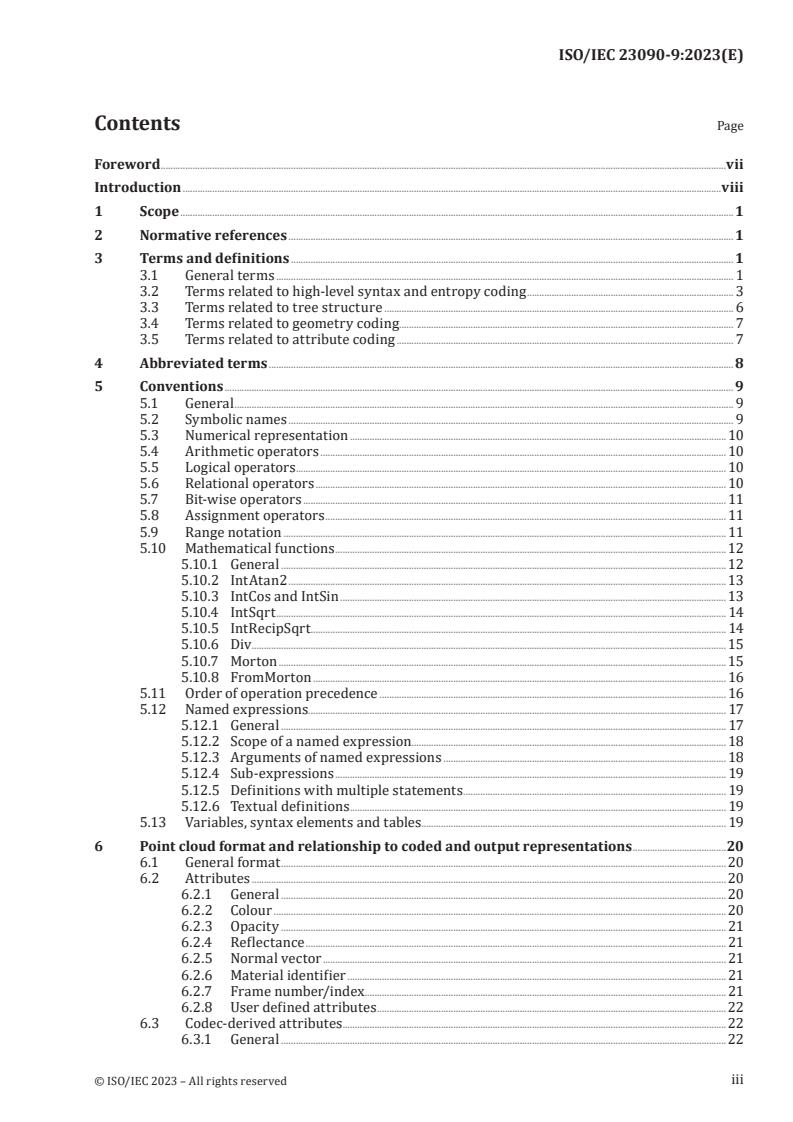
Contents Page
Foreword .vii
Introduction .viii
1 Scope . 1
2 Normative references . 1
3 Terms and definitions . 1
3.1 General terms . 1
3.2 Terms related to high-level syntax and entropy coding . 3
3.3 Terms related to tree structure . 6
3.4 Terms related to geometry coding. 7
3.5 Terms related to attribute coding . 7
4 Abbreviated terms . 8
5 Conventions . 9
5.1 General . 9
5.2 Symbolic names . 9
5.3 Numerical representation . 10
5.4 Arithmetic operators . 10
5.5 Logical operators . 10
5.6 Relational operators . 10
5.7 Bit-wise operators . 11
5.8 Assignment operators . 11
5.9 Range notation . 11
5.10 Mathematical functions .12
5.10.1 General .12
5.10.2 IntAtan2 .13
5.10.3 IntCos and IntSin . 13
5.10.4 IntSqrt . 14
5.10.5 IntRecipSqrt. 14
5.10.6 Div . 15
5.10.7 Morton .15
5.10.8 FromMorton . 16
5.11 Order of operation precedence . 16
5.12 Named expressions. 17
5.12.1 General . 17
5.12.2 Scope of a named expression . . 18
5.12.3 Arguments of named expressions . 18
5.12.4 Sub-expressions . 19
5.12.5 Definitions with multiple statements . 19
5.12.6 Textual definitions . 19
5.13 Variables, syntax elements and tables. 19
6 Point cloud format and relationship to coded and output representations .20
6.1 General format . 20
6.2 Attributes . 20
6.2.1 General .20
6.2.2 Colour . 20
6.2.3 Opacity . 21
6.2.4 Reflectance . 21
6.2.5 Normal vector . 21
6.2.6 Material identifier . 21
6.2.7 Frame number/index . 21
6.2.8 User defined attributes . 22
6.3 Codec-derived attributes . .22
6.3.1 General .22
iii
© ISO/IEC 2023 – All rights reserved
ISO/IEC 23090-9:2023(E)
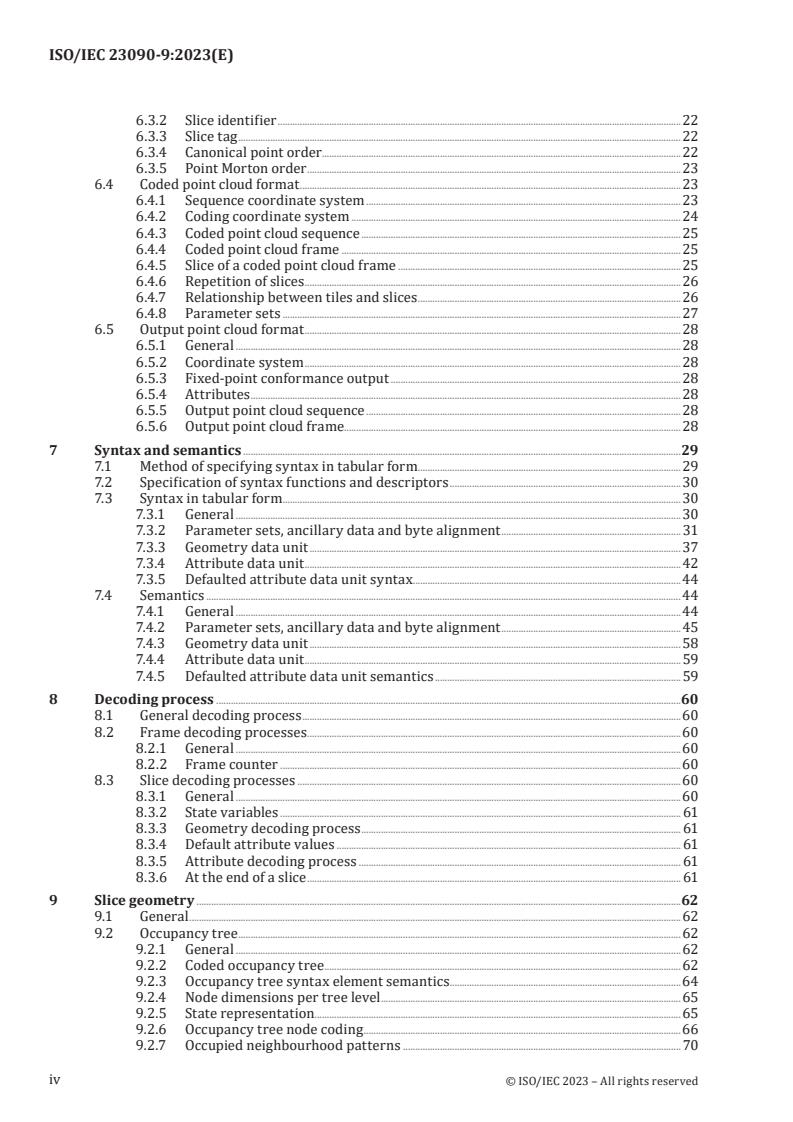
6.3.2 Slice identifier .22
6.3.3 Slice tag . 22
6.3.4 Canonical point order . .22
6.3.5 Point Morton order .23
6.4 Coded point cloud format .23
6.4.1 Sequence coordinate system . 23
6.4.2 Coding coordinate system . 24
6.4.3 Coded point cloud sequence . 25
6.4.4 Coded point cloud frame . 25
6.4.5 Slice of a coded point cloud frame . 25
6.4.6 Repetition of slices .26
6.4.7 Relationship between tiles and slices . 26
6.4.8 Parameter sets . 27
6.5 Output point cloud format .28
6.5.1 General .28
6.5.2 Coordinate system .28
6.5.3 Fixed-point conformance output .28
6.5.4 Attributes .28
6.5.5 Output point cloud sequence .28
6.5.6 Output point cloud frame.28
7 Syntax and semantics .29
7.1 Method of specifying syntax in tabular form . .29
7.2 Specification of syntax functions and descriptors .30
7.3 Syntax in tabular form . 30
7.3.1 General .30
7.3.2 Parameter sets, ancillary data and byte alignment . 31
7.3.3 Geometry data unit . 37
7.3.4 Attribute data unit . 42
7.3.5 Defaulted attribute data unit syntax.44
7.4 Semantics .44
7.4.1 General .44
7.4.2 Parameter sets, ancillary data and byte alignment . 45
7.4.3 Geometry data unit .58
7.4.4 Attribute data unit . 59
7.4.5 Defaulted attribute data unit semantics . 59
8 Decoding process .60
8.1 General decoding process .60
8.2 Frame decoding processes . .60
8.2.1 General .60
8.2.2 Frame counter .60
8.3 Slice decoding processes .60
8.3.1 General .60
8.3.2 State variables . 61
8.3.3 Geometry decoding process . 61
8.3.4 Default attribute values . 61
8.3.5 Attribute decoding process . 61
8.3.6 At the end of a slice . 61
9 Slice geometry .62
9.1 General . 62
9.2 Occupancy tree . 62
9.2.1 General . 62
9.2.2 Coded occupancy tree . 62
9.2.3 Occupancy tree syntax element semantics.64
9.2.4 Node dimensions per tree level .65
9.2.5 State representation . .65
9.2.6 Occupancy tree node coding .66
9.2.7 Occupied neighbourhood patterns . 70
iv
© ISO/IEC 2023 – All rights reserved
ISO/IEC 23090-9:2023(E)
9.2.8 Neighbourhood-permuted node occupancy bitmap .72
9.2.9 Dictionary coding of occupancy_byte .73
9.2.10 Bitwise occupancy coding . 78
9.2.11 Planar occupancy coding .84
9.2.12 Direct nodes .90
9.2.13 Angular coding .95
9.2.14 Subtree scaling .104
9.3 Predictive tree .109
9.3.1 General .109
9.3.2 Syntax element semantics .109
9.3.3 Tree traversal for reconstruction of point positions . 110
9.3.4 Reconstruction of point coordinates . 111
10 Slice attributes . 113
10.1 General .113
10.2 Point coordinates .113
10.2.1 General .113
10.2.2 Conversion to scaled angular coordinates . 114
10.3 Syntax element semantics . 114
10.3.1 Attribute data unit coefficients . 114
10.3.2 Attribute coefficient tuples . 114
10.3.3 Raw attribute values .115
10.4 Raw attribute decoding .115
10.5 Attribute decoding using the region-adaptive hierarchical transform .115
10.5.1 General .115
10.5.2 Transform tree .115
10.5.3 Coefficient order .118
10.5.4 Coefficient scaling . 119
10.5.5 Transform domain prediction .121
10.5.6 Inverse transform .125
10.5.7 Reconstructed attribute values .127
10.6 Attribute decoding using levels of detail .127
10.6.1 General .127
10.6.2 Syntax element semantics .128
10.6.3 Reconstruction process .128
10.6.4 State variables .128
10.6.5 Levels of detail.129
10.6.6 Predictor search .135
10.6.7 Reconstruction of attribute values . 141
10.6.8 Prediction mode coding . 142
10.6.9 Scaling .144
10.6.10 Coefficient prediction .144
10.6.11 Transform coefficient weights . 145
10.6.12 Transform .146
10.7 Attribute quantization parameters . 147
10.7.1 Syntax element semantics . 147
10.7.2 Per-point regional QP offset .148
10.7.3 Attribute coefficient QP.148
10.7.4 Definition of AttrQstep .148
11 Parsing process . 149
11.1 General . 149
11.2 Data unit buffer . 151
11.2.1 General .151
11.2.2 State . 151
11.2.3 Initialization at the start of parsing a data unit .151
11.2.4 Initialization at the start of parsing a geometry data unit footer .151
11.2.5 Definition of DuNextBit .152
11.3 Chunked bytestream parsing .152
v
© ISO/IEC 2023 – All rights reserved
ISO/IEC 23090-9:2023(E)
11.3.1 General .152
11.3.2 Chunk syntax .152
11.3.3 Chunk semantics .153
11.3.4 State .153
11.3.5 Span of chunked bytestream data within a data unit .153
11.3.6 The chunk buffer .153
11.3.7 State update at the start of every CBS .154
11.3.8 Unpacking a single chunk .154
11.3.9 Definition of ChunkNextAeBit .154
11.3.10 Definition of ChunkNextBpBit .154
11.3.11 Boundary between spliced chunked bytestreams .155
11.3.12 Location of chunked bytestream boundaries .156
11.4 General inverse binarization processes .156
11.4.1 Parsing unsigned fixed-length codes (FL) .156
11.4.2 Parsing signed fixed-length codes (FL+S) .156
11.4.3 Parsing k-th order exp-Golomb codes (EGk) .156
11.4.4 Parsing concatenated truncated unary and k-th order exp-Golomb codes
(TU+EGk) .157
11.4.5 Parsing truncated unary codes (TU) .157
11.4.6 Mapping process for signed codes .157
11.4.7 Parsing ASN.1 object identifiers .158
11.5 CABAC parsing processes .158
11.5.1 Initialization .158
11.5.2 Definition of AeReadBin .158
11.5.3 Contextual probability models .159
11.5.4 Arithmetic decoding engine .162
11.6 Parsing state memorization and restoration .164
11.6.1 General .164
11.6.2 Geometry data units .164
11.6.3 Attribute data units .165
11.6.4 Defaulted attribute data units.165
Annex A (normative) Profiles and levels . 166
Annex B (normative) Type-length-value encapsulated bytestream format . 172
Annex C (informative) Arithmetic encoding engine .174
Annex D (normative) Partial decoding and spatial scalability .177
Annex E (informative) Index of named expressions and variables .179
Bibliography . 185
vi
© ISO/IEC 2023 – All rights reserved
ISO/IEC 23090-9:2023(E)
Foreword
ISO (the International Organization for Standardization) and IEC (the International Electrotechnical
Commission) form the specialized system for worldwide standardization. National bodies that are
members of ISO or IEC participate in the development of International Standards through technical
committees established by the respective organization to deal with particular fields of technical
activity. ISO and IEC technical committees collaborate in fields of mutual interest. Other international
organizations, governmental and non-governmental, in liaison with ISO and IEC, also take part in the
work.
The procedures used to develop this document and those intended for its further maintenance
are described in the ISO/IEC Directives, Part 1. In particular, the different approval criteria
needed for the different types of document should be noted. This document was drafted in
accordance with the editorial rules of the ISO/IEC Directives, Part 2 (see www.iso.org/directives or
www.iec.ch/members_experts/refdocs).
Attention is drawn to the possibility that some of the elements of this document may be the subject
of patent rights. ISO and IEC shall not be held responsible for identifying any or all such patent
rights. Details of any patent rights identified during the development of the document will be in the
Introduction and/or on the ISO list of patent declarations received (see www.iso.org/patents) or the IEC
list of patent declarations received (see https://patents.iec.ch).
Any trade name used in this document is information given for the convenience of users and does not
constitute an endorsement.
For an explanation of the voluntary nature of standards, the meaning of ISO specific terms and
expressions related to conformity assessment, as well as information about ISO's adherence to
the World Trade Organization (WTO) principles in the Technical Barriers to Trade (TBT) see
www.iso.org/iso/foreword.html. In the IEC, see www.iec.ch/understanding-standards.
This document was prepared by Joint Technical Committee ISO/IEC JTC 1, Information technology,
Subcommittee SC 29, Coding of audio, picture, multimedia and hypermedia information.
A list of all parts in the ISO/IEC 23090 series can be found on the ISO and IEC websites.
Any feedback or questions on this document should be directed to the user’s national standards
body. A complete listing of these bodies can be found at www.iso.org/members.html and
www.iec.ch/national-committees.
vii
© ISO/IEC 2023 – All rights reserved
ISO/IEC 23090-9:2023(E)
Introduction
Advancements in 3D capturing and rendering technologies are enabling new applications and services
in the fields of assisted and autonomous driving, cartography, cultural heritage, industrial processes,
immersive real-time communication, and virtual/augmented/mixed reality (VR/AR/MR) content
creation, transmission and communication. Point clouds have arisen as one of the main representations
for such applications. A point cloud frame consists of a set of 3D points. Every point, in addition to having
a 3D position, may also be associated with numerous other attributes such as colour, transparency,
reflectance, timestamp, surface normal and classification. Such representations require a large amount
of data, which can be costly in terms of storage and transmission. This document provides the method
for efficiently compressing point cloud representations.
The International Organization for Standardization (ISO) and the International Electrotechnical
Commission (IEC) draw attention to the fact that it is claimed that compliance with this document may
involve the use of a patent.
ISO and IEC take no position concerning the evidence, validity and scope of this patent right.
The holder of this patent right has assured ISO and IEC that he/she is willing to negotiate licences under
reasonable and non-discriminatory terms and conditions with applicants throughout the world. In this
respect, the statement of the holder of this patent right is registered with ISO and IEC. Information may
be obtained from the patent database available at www.iso.org/patents or https://patents.iec.ch.
Attention is drawn to the possibility that some of the elements of this document may be the subject
of patent rights other than those in the patent database. ISO and IEC shall not be held responsible for
identifying any or all such patent rights.
viii
© ISO/IEC 2023 – All rights reserved
INTERNATIONAL STANDARD ISO/IEC 23090-9:2023(E)
Information technology — Coded representation of
immersive media —
Part 9:
Geometry-based point cloud compression
1 Scope
This document specifies geometry-based point cloud compression.
2 Normative references
The following documents are referred to in the text in such a way that some or all of their content
constitutes requirements of this document. For dated references, only the edition cited applies. For
undated references, the latest edition of the referenced document (including any amendments) applies.
Rec. ITU-T X.690 | ISO/IEC 8825-1, Information technology — ASN.1 encoding rules — Part 1: Specification
of Basic Encoding Rules (BER), Canonical Encoding Rules (CER) and Distinguished Encoding Rules (DER)
Rec. ITU-T X.660 | ISO/IEC 9834-1, Information technology — Procedures for the operation of object
identifier registration authorities: General procedures and top arcs of the international object identifier
tree — Part 1:
Rec. ITU-T X.667 | ISO/IEC 9834-8, Information technology — Procedures for the operation of object
identifier registration authorities — Part 8: Generation of universally unique identifiers (UUIDs) and their
use in object identifiers
ISO/IEC 23091-2, Information technology — Coding-independent code points — Part 2: Video
Rec. ITU-T T.35, Procedure for the allocation of ITU T defined codes for non-standard facilities
3 Terms and definitions
For the purposes of this document, the following terms and definitions apply.
ISO and IEC maintain terminology databases for use in standardization at the following addresses:
— ISO Online browsing platform: available at https:// www .iso .org/ obp
— IEC Electropedia: available at https:// www .electropedia .org/
3.1 General terms
3.1.1
point
fundamental element of a point cloud (3.1.2) comprising a position specified as Cartesian coordinates
(3.1.8) and zero or more attributes (3.1.19)
3.1.2
point cloud
unordered list of points (3.1.1)
© ISO/IEC 2023 – All rights reserved
ISO/IEC 23090-9:2023(E)
3.1.3
point cloud sequence
sequence of one or more point clouds (3.1.2)
3.1.4
point cloud frame
point cloud (3.1.2) in a point cloud sequence (3.1.3
...
Questions, Comments and Discussion
Ask us and Technical Secretary will try to provide an answer. You can facilitate discussion about the standard in here.
Loading comments...