

ISO 21111-3:2020
(Main)Road vehicles — In-vehicle Ethernet — Part 3: Optical 1-Gbit/s physical entity requirements and conformance test plan
General Information
- Abstract
This document provides supplemental specifications to a physical layer capable of transmitting 1 Gbit/s over plastic optical fibre compliant with ISO/IEC/IEEE 8802-3:2017/Amd 9:2018, with specific application to communications inside road vehicles. Additionally, there is a test plan specified for conformance testing. The test plan includes test cases to assure compliance of an IUT with the functionality specified in this document. ISO/IEC/IEEE 8802-3:2017/Amd 9:2018 is considered indispensable for the application of this document. The supplemental specifications include wake-up and synchronised link sleep functionality. The specification includes the sublayers, service interfaces, and state diagrams that support the functionality. The supplemental specifications are collected in protocol implementation conformance statement (PICS). The requirements specified in ISO/IEC/IEEE 8802-3:2017/Amd 9:2018 and in this document constitute the complete PICS that specifies the GEPOF physical entity functionality. The optical component requirements and test methods for optical 1-Gbit/s transmission of in-vehicle Ethernet are not within the scope of this document.
- Status
- Published
- Publication Date
- 28-Jun-2020
- Technical Committee
- ISO/TC 22/SC 31 - Data communication
- Drafting Committee
- ISO/TC 22/SC 31/WG 3 - In-vehicle networks
- Current Stage
- 9092 - International Standard to be revised
- Start Date
- 27-Sep-2025
- Completion Date
- 29-Aug-2026
Buy Documents

ISO 21111-3:2020 - Road vehicles -- In-vehicle Ethernet

ISO 21111-3:2020 - Road vehicles — In-vehicle Ethernet — Part 3: Optical 1-Gbit/s physical entity requirements and conformance test plan/29/2020
Overview
ISO 21111-3:2020 specifies supplemental physical-layer requirements and a conformance test plan for optical 1‑Gbit/s in-vehicle Ethernet over plastic optical fibre (GEPOF). It is intended specifically for communications inside road vehicles and supplements ISO/IEC/IEEE 8802-3:2017/Amd 9:2018 (considered indispensable). The document defines wake-up and synchronised link sleep functionality, sublayers, service interfaces, state diagrams and a Protocol Implementation Conformance Statement (PICS) proforma. Note: optical component requirements and optical test methods for 1‑Gbit/s transmission are outside the scope.
Key Topics and Requirements
- Physical entity (PHY) supplemental specifications for 1 Gbit/s transmission over plastic optical fibre (GEPOF).
- Power management features: wake-up and synchronised link sleep behaviors to support vehicle low-power operation.
- Sublayers and service interfaces: PHY service, neighbour PHY, conciliation, FFME and WUSME interfaces are defined with signals and events.
- State diagrams and variables to specify state transitions (power states, link monitor, TX/RX control).
- Protocol Implementation Conformance Statement (PICS): complete PICS combining ISO/IEC/IEEE 8802-3:2017/Amd 9:2018 and this part to describe GEPOF physical entity functionality.
- Conformance test plan: structured test architecture including:
- Block 1: test modes and loopback tests (e.g., loopback control, GMII, PMD).
- Block 2: PCS, PMA, PMD and MDI mandatory functionality tests (alignment, payload, power scaling, state-diagram validation).
- Block 3: EEE, OAM and wake-up/synchronised link sleep tests.
- Test setups and cases: multiple test setups (TS_BASE, TS_EXTEND, TS_SIGPOW, etc.) and detailed test cases to validate compliance.
Practical Applications and Users
Who uses ISO 21111-3:
- Automotive OEMs and system architects designing in-vehicle Ethernet topologies over plastic optical fibre.
- PHY and transceiver designers implementing GEPOF physical entities.
- Tier‑1 suppliers integrating optical cabling and network devices.
- Test houses and certification labs performing conformance testing and PICS validation.
- Software/firmware engineers implementing power-management features (wake-up/sync sleep) and link-state handling.
Why it matters:
- Ensures interoperability and predictable behavior of in-vehicle optical Ethernet components.
- Provides a testable conformance path to validate PHY functionality, link management and power-saving features critical for vehicle networks.
- Supports safety- and power-sensitive automotive applications that require robust, low-latency 1‑Gbit/s links.
Related Standards
- ISO/IEC/IEEE 8802-3:2017/Amd 9:2018 (indispensable normative reference)
- ISO 21111 series (other parts of the in-vehicle Ethernet family)
- IEEE 802.3 (Ethernet physical-layer framework)
Keywords: in-vehicle Ethernet, GEPOF, optical 1-Gbit/s, plastic optical fibre, conformance test plan, wake-up, synchronised link sleep, PHY, PICS.
Buy Documents
ISO 21111-3:2020 - Road vehicles -- In-vehicle Ethernet
ISO 21111-3:2020 - Road vehicles — In-vehicle Ethernet — Part 3: Optical 1-Gbit/s physical entity requirements and conformance test plan/29/2020
Get Certified
Connect with accredited certification bodies for this standard

TÜV Rheinland
TÜV Rheinland is a leading international provider of technical services.

TÜV SÜD
TÜV SÜD is a trusted partner of choice for safety, security and sustainability solutions.

DEKRA Certification Inc.
DEKRA US certification services.
Sponsored listings
Frequently Asked Questions
ISO 21111-3:2020 is a standard published by the International Organization for Standardization (ISO). Its full title is "Road vehicles — In-vehicle Ethernet — Part 3: Optical 1-Gbit/s physical entity requirements and conformance test plan". This standard covers: This document provides supplemental specifications to a physical layer capable of transmitting 1 Gbit/s over plastic optical fibre compliant with ISO/IEC/IEEE 8802-3:2017/Amd 9:2018, with specific application to communications inside road vehicles. Additionally, there is a test plan specified for conformance testing. The test plan includes test cases to assure compliance of an IUT with the functionality specified in this document. ISO/IEC/IEEE 8802-3:2017/Amd 9:2018 is considered indispensable for the application of this document. The supplemental specifications include wake-up and synchronised link sleep functionality. The specification includes the sublayers, service interfaces, and state diagrams that support the functionality. The supplemental specifications are collected in protocol implementation conformance statement (PICS). The requirements specified in ISO/IEC/IEEE 8802-3:2017/Amd 9:2018 and in this document constitute the complete PICS that specifies the GEPOF physical entity functionality. The optical component requirements and test methods for optical 1-Gbit/s transmission of in-vehicle Ethernet are not within the scope of this document.
This document provides supplemental specifications to a physical layer capable of transmitting 1 Gbit/s over plastic optical fibre compliant with ISO/IEC/IEEE 8802-3:2017/Amd 9:2018, with specific application to communications inside road vehicles. Additionally, there is a test plan specified for conformance testing. The test plan includes test cases to assure compliance of an IUT with the functionality specified in this document. ISO/IEC/IEEE 8802-3:2017/Amd 9:2018 is considered indispensable for the application of this document. The supplemental specifications include wake-up and synchronised link sleep functionality. The specification includes the sublayers, service interfaces, and state diagrams that support the functionality. The supplemental specifications are collected in protocol implementation conformance statement (PICS). The requirements specified in ISO/IEC/IEEE 8802-3:2017/Amd 9:2018 and in this document constitute the complete PICS that specifies the GEPOF physical entity functionality. The optical component requirements and test methods for optical 1-Gbit/s transmission of in-vehicle Ethernet are not within the scope of this document.
ISO 21111-3:2020 is classified under the following ICS (International Classification for Standards) categories: 43.040.10 - Electrical and electronic equipment. The ICS classification helps identify the subject area and facilitates finding related standards.
ISO 21111-3:2020 is available in PDF format for immediate download after purchase. The document can be added to your cart and obtained through the secure checkout process. Digital delivery ensures instant access to the complete standard document.
Standards Content (Sample)
INTERNATIONAL ISO
STANDARD 21111-3
First edition
2020-06
Road vehicles — In-vehicle Ethernet —
Part 3:
Optical 1-Gbit/s physical entity
requirements and conformance test
plan
Véhicules routiers — Ethernet embarqué —
Partie 3: Exigences et plan d’essais de conformité de la couche
physique optique à 1-Gbit/s
Reference number
©
ISO 2020
© ISO 2020
All rights reserved. Unless otherwise specified, or required in the context of its implementation, no part of this publication may
be reproduced or utilized otherwise in any form or by any means, electronic or mechanical, including photocopying, or posting
on the internet or an intranet, without prior written permission. Permission can be requested from either ISO at the address
below or ISO’s member body in the country of the requester.
ISO copyright office
CP 401 • Ch. de Blandonnet 8
CH-1214 Vernier, Geneva
Phone: +41 22 749 01 11
Email: copyright@iso.org
Website: www.iso.org
Published in Switzerland
ii © ISO 2020 – All rights reserved
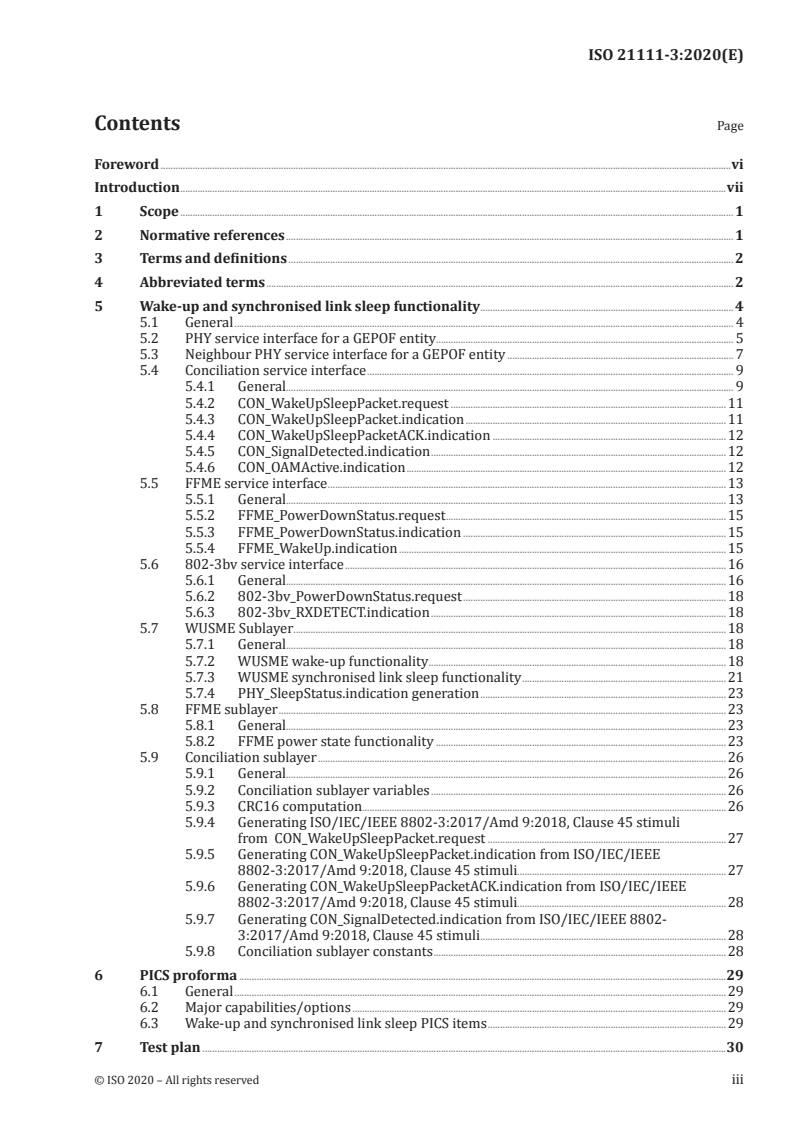
Contents Page
Foreword .vi
Introduction .vii
1 Scope . 1
2 Normative references . 1
3 Terms and definitions . 2
4 Abbreviated terms . 2
5 Wake-up and synchronised link sleep functionality . 4
5.1 General . 4
5.2 PHY service interface for a GEPOF entity . 5
5.3 Neighbour PHY service interface for a GEPOF entity . 7
5.4 Conciliation service interface . 9
5.4.1 General. 9
5.4.2 CON_WakeUpSleepPacket.request .11
5.4.3 CON_WakeUpSleepPacket.indication .11
5.4.4 CON_WakeUpSleepPacketACK.indication .12
5.4.5 CON_SignalDetected.indication .12
5.4.6 CON_OAMActive.indication .12
5.5 FFME service interface .13
5.5.1 General.13
5.5.2 FFME_PowerDownStatus.request .15
5.5.3 FFME_PowerDownStatus.indication .15
5.5.4 FFME_WakeUp.indication .15
5.6 802-3bv service interface .16
5.6.1 General.16
5.6.2 802-3bv_PowerDownStatus.request .18
5.6.3 802-3bv_RXDETECT.indication .18
5.7 WUSME Sublayer .18
5.7.1 General.18
5.7.2 WUSME wake-up functionality .18
5.7.3 WUSME synchronised link sleep functionality .21
5.7.4 PHY_SleepStatus.indication generation .23
5.8 FFME sublayer .23
5.8.1 General.23
5.8.2 FFME power state functionality .23
5.9 Conciliation sublayer .26
5.9.1 General.26
5.9.2 Conciliation sublayer variables .26
5.9.3 CRC16 computation.26
5.9.4 Generating ISO/IEC/IEEE 8802-3:2017/Amd 9:2018, Clause 45 stimuli
from CON_WakeUpSleepPacket.request .27
5.9.5 Generating CON_WakeUpSleepPacket.indication from ISO/IEC/IEEE
8802-3:2017/Amd 9:2018, Clause 45 stimuli.27
5.9.6 Generating CON_WakeUpSleepPacketACK.indication from ISO/IEC/IEEE
8802-3:2017/Amd 9:2018, Clause 45 stimuli.28
5.9.7 Generating CON_SignalDetected.indication from ISO/IEC/IEEE 8802-
3:2017/Amd 9:2018, Clause 45 stimuli .28
5.9.8 Conciliation sublayer constants .28
6 PICS proforma .29
6.1 General .29
6.2 Major capabilities/options .29
6.3 Wake-up and synchronised link sleep PICS items .29
7 Test plan .30
7.1 Test plan scope .30
7.2 Test plan architecture .30
7.3 Test plan organization .32
7.4 Test case sections .32
7.5 Test case reference tables .33
7.5.1 Block 1: test mode and loopback test cases .33
7.5.2 Block 2: PCS, PMA, PMD and MDI test cases .34
7.5.3 Block 3. EEE, OAM and wake-up and synchronised link sleep test cases .37
7.6 Test setups .38
7.6.1 General.38
7.6.2 Test setup 1: TS_BASE .42
7.6.3 Test setup 2: TS_EXTEND .43
7.6.4 Test setup 3: TS_SIGPOW .44
7.6.5 Test setup 4: TS_AOPTX .44
7.6.6 Test setup 5: TS_ER .44
7.6.7 Test setup 6: TS_CW .44
7.6.8 Test setup 7: TS_SW . .44
7.6.9 Test setup 8: TS_RT_FT .44
7.6.10 Test setup 9: TS_OS .44
7.6.11 Test setup 10: TS_NOD_POD .44
7.6.12 Test setup 11: TS_DIST .45
7.6.13 Test setup 12: TS_RIN .45
7.6.14 Test setup 13: TS_MPD . .45
7.6.15 Test setup 14: TS_TJ .45
7.6.16 Test setup 15: TS_2LP .45
7.6.17 Test setup 16: TS_AOPRX .45
7.6.18 Test setup 17: TS_LOOP .46
7.7 Block 1 test cases: test modes and loopbacks .47
7.7.1 General.47
7.7.2 LBT_1: Loopback control .47
7.7.3 LBT_2: GMII loopback . .48
7.7.4 LBT_3: PMD loopback .50
7.7.5 TMT_1: Test mode configuration general .52
7.7.6 TMT_2: Test mode 1 transmission .53
7.7.7 TMT_4: Test mode 2 transmission .55
7.7.8 TMT_5: Test mode 3 transmission .56
7.7.9 TMT_6: Test mode 4 transmission .57
7.7.10 TMT_7: Test mode 5 transmission .58
7.7.11 TMT_8: Test mode 6 transmission .59
7.7.12 TMT_3: Test mode 1 reception .60
7.7.13 LBT_4: Line loopback .62
7.8 Block 2 test cases: Mandatory functionality .64
7.8.1 General.64
7.8.2 PCST_1: PCS transmission signalling .64
7.8.3 PCST_2: PCS transmission PHD .65
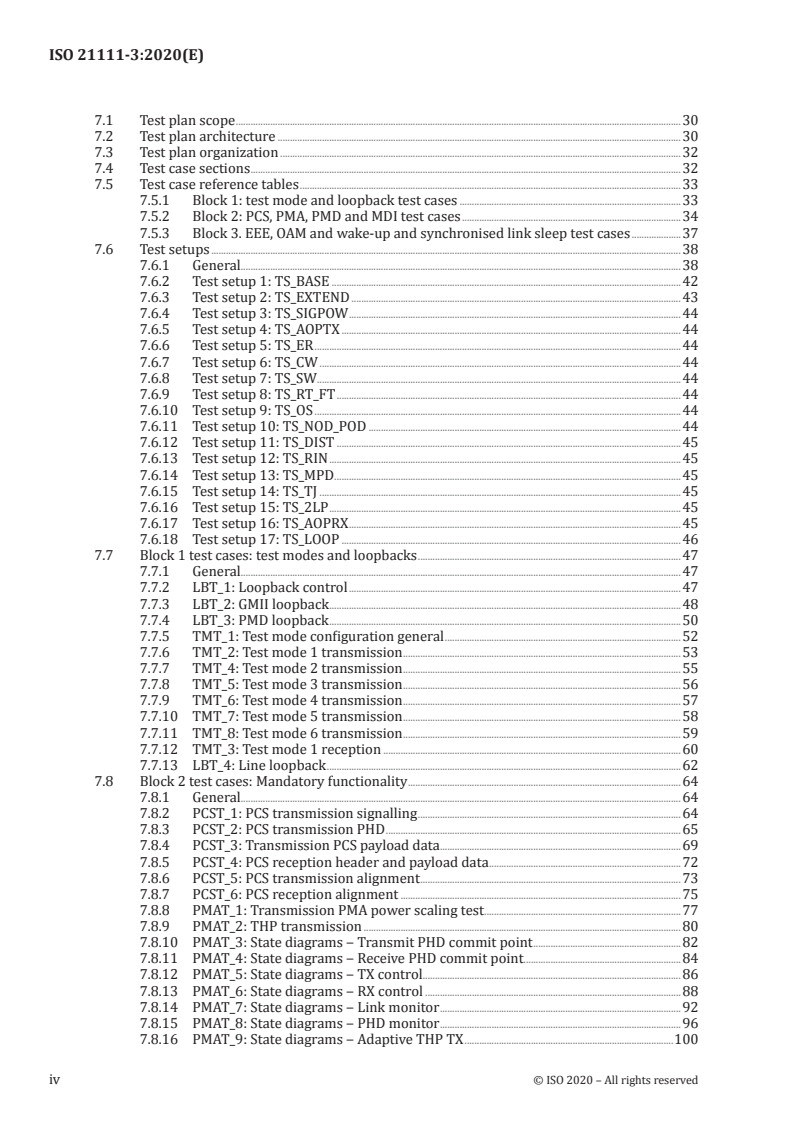
7.8.4 PCST_3: Transmission PCS payload data.69
7.8.5 PCST_4: PCS reception header and payload data .72
7.8.6 PCST_5: PCS transmission alignment .73
7.8.7 PCST_6: PCS reception alignment .75
7.8.8 PMAT_1: Transmission PMA power scaling test .77
7.8.9 PMAT_2: THP transmission .80
7.8.10 PMAT_3: State diagrams ‒ Transmit PHD commit point .82
7.8.11 PMAT_4: State diagrams ‒ Receive PHD commit point.84
7.8.12 PMAT_5: State diagrams ‒ TX control .86
7.8.13 PMAT_6: State diagrams ‒ RX control .88
7.8.14 PMAT_7: State diagrams ‒ Link monitor .92
7.8.15 PMAT_8: State diagrams ‒ PHD monitor .96
7.8.16 PMAT_9: State diagrams ‒ Adaptive THP TX .100
iv © ISO 2020 – All rights reserved
7.8.17 PMAT_10: State diagrams ‒ Adaptive THP request .103
7.8.18 PMAT_11: State diagrams ‒ Quality monitor state diagram .106
7.8.19 PMAT_12: Synchronisation .110
7.8.20 PMAT_13: Equalization and BER measurement .112
7.8.21 PMDT_1: PMD transmit function ‒ Electrical to optical.114
7.8.22 PMDT_2: PMD transmit function ‒ Power control.116
7.8.23 PMDT_3: PMD receive function ‒ Optical to electrical .117
7.8.24 PMDT_4: PMD signal detect function .119
7.8.25 PMD_MDIT_1: Transmitter optical specifications ‒ AOP .120
7.8.26 PMD_MDIT_2: Transmitter optical specifications ‒ ER .121
7.8.27 PMD_MDIT_3: Transmitter optical specifications ‒ Centre wavelength .122
7.8.28 PMD_MDIT_4: Transmitter optical specifications ‒ Spectral width .123
7.8.29 PMD_MDIT_5: Transmitter optical specifications ‒ Rise time .123
7.8.30 PMD_MDIT_6: Transmitter optical specifications ‒ Fall time .124
7.8.31 PMD_MDIT_7: Transmitter optical specifications ‒ Signal overshoot .125
7.8.32 PMD_MDIT_8: Transmitter optical specifications ‒ Positive output droop .126
7.8.33 PMD_MDIT_9: Transmitter optical specifications ‒ Negative output droop .127
7.8.34 PMD_MDIT_10: Transmitter optical specifications ‒ Signal distortion .127
7.8.35 PMD_MDIT_11: Transmitter optical specifications ‒ Relative intensity noise .128
7.8.36 PMD_MDIT_12: Transmitter optical specifications ‒ Transmitter off
transition time .129
7.8.37 PMD_MDIT_13: Transmitter optical specifications ‒ Transmitter on
transition time .132
7.8.38 PMD_MDIT_14: Transmitter optical specifications ‒ Modal power
distribution .134
7.8.39 PMD_MDIT_15: Transmitter optical specifications ‒ Timing jitter .135
7.8.40 PMD_MDIT_16: Receiver optical specifications ‒ AOP for a minimum BER .136
7.8.41 PMD_MDIT_17: Receiver optical specifications ‒ Damage threshold power .137
7.8.42 DLYT_1: Transmission plus reception delay .138
7.9 Block 3 test cases: Optional functionality .139
7.9.1 General.139
7.9.2 EEET_1: Enter to LPI mode transmit operation .140
7.9.3 EEET_2: EEE capability exchange.143
7.9.4 EEET_3: Loop test for LPI mode .145
7.9.5 EEET_4: Resume from LPI mode transmit operation .148
7.9.6 OAMT_1: State diagrams ‒ OAM transmit control .150
7.9.7 OAMT_2: State diagrams ‒ OAM receive control .155
7.9.8 OAMT_3: Loop test for OAMPDU transmission and reception .159
7.9.9 WUST_1: WUSME synchronised link sleep state diagram ‒ Synchronised
link sleep ACK .165
7.9.10 WUST_2: WUSME synchronised link sleep state diagram ‒ SLEEP_ACK
packet reception .169
7.9.11 WUST_3: WUSME synchronised link sleep state diagram ‒ SLEEP packet
reception .173
7.9.12 WUST_4: WUSME synchronised link sleep state diagram ‒ Sleep rejection .176
7.9.13 WUST_5: WUSME wake-up state diagram .182
Bibliography .186
Foreword
ISO (the International Organization for Standardization) is a worldwide federation of national standards
bodies (ISO member bodies). The work of preparing International Standards is normally carried out
through ISO technical committees. Each member body interested in a subject for which a technical
committee has been established has the right to be represented on that committee. International
organizations, governmental and non-governmental, in liaison with ISO, also take part in the work.
ISO collaborates closely with the International Electrotechnical Commission (IEC) on all matters of
electrotechnical standardization.
The procedures used to develop this document and those intended for its further maintenance are
described in the ISO/IEC Directives, Part 1. In particular, the different approval criteria needed for the
different types of ISO documents should be noted. This document was drafted in accordance with the
editorial rules of the ISO/IEC Directives, Part 2 (see www .iso .org/ directives).
Attention is drawn to the possibility that some of the elements of this document may be the subject of
patent rights. ISO shall not be held responsible for identifying any or all such patent rights. Details of
any patent rights identified during the development of the document will be in the Introduction and/or
on the ISO list of patent declarations received (see www .iso .org/ patents).
Any trade name used in this document is information given for the convenience of users and does not
constitute an endorsement.
For an explanation of the voluntary nature of standards, the meaning of ISO specific terms and
expressions related to conformity assessment, as well as information about ISO's adherence to the
World Trade Organization (WTO) principles in the Technical Barriers to Trade (TBT), see www .iso .org/
iso/ foreword .html.
This document was prepared by Technical Committee ISO/TC 22, Road vehicles, Subcommittee SC 31,
Data communication.
A list of all parts in the ISO 21111 series can be found on the ISO website.
Any feedback or questions on this document should be directed to the user’s national standards body. A
complete listing of these bodies can be found at www .iso .org/ members .html.
vi © ISO 2020 – All rights reserved
Introduction
The ISO 21111 series includes in-vehicle Ethernet requirements and test plans that are disseminated in
other International Standards and complements them with additional test methods and requirements.
The resulting requirement and test plans are structured in different documents following the Open
Systems Interconnection (OSI) reference model and grouping the documents that depend on the
physical media and bit rate used.
In general, the Ethernet requirements are specified in ISO/IEC/IEEE 8802-3. The ISO 21111 series
provides supplemental specifications (e.g. wake-up, I/O functionality), which are required for in-vehicle
Ethernet applications. In road vehicles, Ethernet networks are used for different purposes requiring
different bit-rates. Currently, the ISO 21111 series specifies the 1-Gbit/s optical and 100-Mbit/s
electrical physical layer.
The ISO 21111 series contains requirement specifications and test methods related to the in-vehicle
Ethernet. This includes requirement specifications for physical layer entity (e.g. connectors, physical
layer implementations) providers, device (e.g. electronic control units, gateway units) suppliers, and
system (e.g. network systems) designers. Additionally, there are test methods specified for conformance
testing and for interoperability testing.
Safety (electrical safety, protection, fire, etc.) and electromagnetic compatibility (EMC) requirements
are out of the scope of the ISO 21111 series.
The structure of the specifications given in the ISO 21111 series complies with the Open Systems
[1] [5]
Interconnection (OSI) reference model specified in ISO/IEC 7498-1 and ISO/IEC 10731 .
ISO 21111-1 defines the terms which are used in this series of standards and provides an overview of
the standards for in-vehicle Ethernet including the complementary relations to ISO/IEC/IEEE 8802-3,
the document structure, type of physical entities, in-vehicle Ethernet specific functionalities and so on.
ISO 21111-2 specifies the interface between reconciliation sublayer and physical entity including
reduced gigabit media independent interface (RGMII), and the common physical entity wake-up and
synchronized link sleep functionalities, independent from physical media and bit rate.
This document specifies supplemental requirements to a physical layer capable of transmitting
1-Gbit/s over plastic optical fibre compliant with ISO/IEC/IEEE 8802-3, with specific application to
communications inside road vehicles, and a test plan for physical entity conformance testing.
ISO 21111-4 specifies the optical components requirements and test methods for 1-Gbit/s optical in-
vehicle Ethernet.
ISO 21111-5 specifies, for 1-Gbit/s optical in-vehicle Ethernet, requirements on the physical layer at
system level, requirements on the interoperability test set-ups, the interoperability test plan that checks
the requirements for the physical layer at system level, requirements on the device-level physical layer
conformance test set-ups, and device-level physical layer conformance test plan that checks a set of
requirements for the OSI physical layer that are relevant for device vendors.
ISO 21111-6 specifies advanced features of an ISO/IEC/IEEE 8802-3 in-vehicle Ethernet physical layer
(often also called transceiver), e.g. for diagnostic purposes for in-vehicle Ethernet physical layers. It
specifies advanced physical layer features, wake-up and sleep features, physical layer test suite,
physical layer control requirements and conformance test plan, physical sublayers test suite and
physical sublayers requirements and conformance test plan.
ISO 21111-7 specifies the implementation for ISO/IEC/IEEE 8802-3:2017/Amd 1:2017, which defines
the interface implementation for automotive applications together with requirements on components
used to realize this Bus Interface Network (BIN). ISO 21111-7 also defines further testing and system
requirements for systems implemented according to the system specification. In addition, ISO 21111-7
defines the channels for tests of transceivers with a test wiring harness that simulates various electrical
communication channels.
ISO 21111-8 specifies the transmission media, the channel performance and the tests for
ISO/IEC/IEEE 8802-3 in-vehicle Ethernet.
ISO 21111-9 specifies the data link layer requirements and conformance test plan. It specifies the
requirements and test plan for devices and systems with bridge functionality.
ISO 21111-10 specifies the application to network layer requirements and test plan. It specifies the
requirements and test plan for devices and systems that include functionality related with OSI layers
from 3 to 7.
Figure 1 shows the parts of the ISO 21111 series and the document structure.
Figure 1 — In-vehicle Ethernet document reference according to the OSI model
viii © ISO 2020 – All rights reserved
INTERNATIONAL STANDARD ISO 21111-3:2020(E)
Road vehicles — In-vehicle Ethernet —
Part 3:
Optical 1-Gbit/s physical entity requirements and
conformance test plan
1 Scope
This document provides supplemental specifications to a physical layer capable of transmitting
1 Gbit/s over plastic optical fibre compliant with ISO/IEC/IEEE 8802-3:2017/Amd 9:2018, with specific
application to communications inside road vehicles.
Additionally, there is a test plan specified for conformance testing. The test plan includes test cases to
assure compliance of an IUT with the functionality specified in this document.
ISO/IEC/IEEE 8802-3:2017/Amd 9:2018 is considered indispensable for the application of this
document.
The supplemental specifications include wake-up and synchronised link sleep functionality.
The specification includes the sublayers, service interfaces, and state diagrams that support the
functionality. The supplemental specifications are collected in protocol implementation conformance
statement (PICS).
The requirements specified in ISO/IEC/IEEE 8802-3:2017/Amd 9:2018 and in this document constitute
the complete PICS that specifies the GEPOF physical entity functionality.
The optical component requirements and test methods for optical 1-Gbit/s transmission of in-vehicle
Ethernet are not within the scope of this document.
2 Normative references
The following documents are referred to in the text in such a way that some or all of their content
constitutes requirements of this document. For dated references, only the edition cited applies. For
undated references, the latest edition of the referenced document (including any amendments) applies.
1)
ISO 21111-1 , Road vehicle — In-vehicle Ethernet — Part 1: General information and definitions
2)
ISO 21111-2:— , Road vehicles — In-vehicle Ethernet — Part 2: Common medium-independent interface
specifications
ISO/IEC/IEEE 8802-3:2017, Information technology — Telecommunications and information exchange
between systems — Local and metropolitan area networks — Specific requirements — Part 3: Standard
for Ethernet
ISO/IEC/IEEE 8802-3:2017/Amd 9:2018, Physical layer specifications and management parameters for
1000 Mb/s operation over plastic optical fiber
1) Under preparation. Stage at the time of publication: ISO/DIS 21111-1:2020.
2) Under preparation. Stage at the time of publication: ISO/DIS 21111-2:2020.
3 Terms and definitions
For the purposes of this document, the terms and definitions in ISO/IEC/IEEE 8802-3, ISO 21111-1 and
the following apply.
ISO and IEC maintain terminological databases for use in standardization at the following addresses:
— ISO Online browsing platform: available at https:// www .iso .org/ obp
— IEC Electropedia: available at http:// www .electropedia .org/
3.1
neighbour GEPOF entities
two or more GEPOF entities embedded in the same device
3.2
GEPOF link partners
two GEPOF entities connected bi-directionally through POF
3.3
IEEE 802.3bv physical layer
physical layer compliant with 1000BASE-RHC
Note 1 to entry: 1000BASE-RHC is specified in ISO/IEC/IEEE 8802-3:2017/Amd 9:2018, 1.4.26c.
3.4
symbol
smallest unit of data transmission on the medium
Note 1 to entry: Symbols are specified in ISO/IEC/IEEE 8802-3:2017, 1.4.393 and in ISO/IEC/IEEE 8802-3:2017/
Amd 9:2018, 115.2.
3.5
transmit block
sequence of a fixed number of symbols (3.4) that encodes data from MAC layer and control information
Note 1 to entry: The transmit block is specified in ISO/IEC/IEEE 8802-3:2017/Amd 9:2018, 115.2.1.
3.6
transmit block generator
instrument that transmits and generates a transmit block (3.5) with controlled content
3.7
transmit block analyser
instrument that receives a transmit block (3.5) and processes the information contained in it
3.8
payload data sub-block
part of a transmit block (3.5) that encodes data from MAC layer
Note 1 to entry: The payload data sub-block is specified in ISO/IEC/IEEE 8802-3:2017/Amd 9:2018, 115.2.1.
4 Abbreviated terms
ACK acknowledgement
AOP average optical power
BCH Bose, Ray-Chaudhuri, Hocquenghem
BER bit error rate
2 © ISO 2020 – All rights reserved
CID company identifier
CRC cyclic check redundancy
EEE energy-efficient Ethernet
ER extinction ratio
FFME fast forward management entity
GEPOF gigabit Ethernet over plastic optical fibre
GMII gigabit media independent interface
IUT implementation under test
LPI low power idle
LSB least significant bit
LT lower tester
MAC medium access control
MDI medium dependent interface
MDIO management data input/output
MSB most significant bit
OAM operations, administration, and maintenance
OAMPDU OAM protocol data unit
PCS physical coding sublayer
PHD physical header data
PHS physical header sub-frame
PICS protocol implementation conformance statement
PMA physical medium attachment
PMD physical medium dependent
POF plastic optical fibre
RIN reference input noise
RX receiver
TX transmitter
UT upper tester
WUSME wake-up and synchronised link sleep management entity
5 Wake-up and synchronised link sleep functionality
5.1 General
Figure 2 shows the functional block diagram of the GEPOF entity.
Figure 2 — GEPOF entity functional block diagram
WUSME sublayer shall communicate with the MAC layer over the PHY service interface specified in 5.2
and in ISO 21111-2:—, 6.8.
4 © ISO 2020 – All rights reserved
WUSME sublayer shall contain wake-up and synchronised link sleep algorithms as specified in
ISO 21111-2:—, 6.4 and 6.5. This specification includes exchange of events that shall be encoded by
using message exchange over the 1000BASE-H OAM channel specified in ISO/IEC/IEEE 8802-3:2017/
Amd 9:2018, 115.9 and the state diagrams specified in 5.7.
WUSME sublayer shall communicate with the conciliation sublayer over the conciliation service
interface specified in 5.2.
WUSME sublayer shall communicate with FFME sublayer over the FFME service interface specified in 5.5.
FFME sublayer shall behave as the state diagram that controls the power state of the GEPOF entity
specified in 5.8 and ISO 21111-2:—, 6.2.
FFME shall communicate with another FFME located inside neighbour GEPOF entity over the neighbour
PHY service interface specified in 5.3 and in ISO 21111-2:—, 6.9.
FFME shall communicate with the IEEE 802.3bv physical layer over the 802-3bv service interface
specified in 5.6.
The conciliation sublayer shall include the functions described in 5.9 that translate each of the
conciliation service primitives into transactions over MDIO registers.
Bit naming and MDIO register numbering are specified in ISO/IEC/IEEE 8802-3:2017/Amd 9:2018,
Clause 45. CID is specified in ISO/IEC/IEEE 8802-A:2015, 1.4.162.
The high logic level and low logic level for the MDIO registers are specified in
ISO/IEC/IEEE 8802-3:2017, 22.4.
The value of the service primitive parameters follows a positive logic. TRUE corresponds to a high logic
level and FALSE corresponds to a low logic level.
State diagrams in this document follow the notation specified in ISO/IEC/IEEE 8802-3:2017, 1.2.
5.2 PHY service interface for a GEPOF entity
The following specifies the mandatory service primitives of the PHY service interface as given in
ISO 21111-2 that are required by a GEPOF entity.
Figure 3 shows the service primitives of the PHY service interface and the relationship with the GEPOF
entity sublayers.
Key
PHY service interface
PHY_1: PHY_LinkSleep.request
PHY_2: PHY_LinkSleep.indication
PHY_3: PHY_WakeUp.request
PHY_4: PHY_WakeUp.indication
PHY_5: PHY_ConfigSleepReject.request
PHY_6: PHY_SleepStatus.indication
Figure 3 — PHY service interface
6 © ISO 2020 – All rights reserved
The PHY service interface comprises the following service primitives:
— PHY_LinkSleep.request (see ISO 21111-2:—, 6.8.1);
— PHY_LinkSleep.indication (see ISO 21111-2:—, 6.8.2);
— PHY_WakeUp.request (see ISO 21111-2:—, 6.8.3);
— PHY_WakeUp.indication (see ISO 21111-2:—, 6.8.4);
— PHY_ConfigSleepReject.request (see ISO 21111-2:—, 6.8.5);
— PHY_SleepStatus.indication (see ISO 21111-2:—, 6.8.6).
5.3 Neighbour PHY service interface for a GEPOF entity
The following specifies the mandatory service primitives of the neighbour PHY service interface as
given in ISO 21111-2 that are required by a GEPOF entity.
Figure 4 shows the service primitives of the neighbour PHY service interface and the relationship with
the GEPOF entity sublayers.
Key
Neigbour PHY service interface
NPHY_1: PHY_WakeUpForward.request
NPHY_2: PHY_WakeUpForward.indication
Figure 4 — Neighbour PHY service interface
The neighbour PHY service interface comprises the following service primitives:
— NPHY_WakeUpForward.request (see ISO 21111-2:— , 6.9.1);
— NPHY_WakeUpForward.indication (see ISO 21111-2:— , 6.9.2).
8 © ISO 2020 – All rights reserved
5.4 Conciliation service interface
5.4.1 General
The following specifies the service primitives provided by the conciliation sublayer to the WUSME
sublayer. Figure 5 shows the service primitives of the conciliation service interface and the relationship
with the GEPOF entity sublayers.
Key
Conciliation service interface
CON_1: CON_WakeUpSleepPacket.request
CON_2: CON_WakeUpSleepPacket.indication
CON_3: CON_WakeUpSleepPacketACK.indication
CON_4: CON_SignalDetected.indication
CON_5: CON_OAMActive.indication
Figure 5 — Conciliation service interface
10 © ISO 2020 – All rights reserved
The conciliation service interface comprises the following service primitives:
— CON_WakeUpSleepPacket.request (see 5.4.2);
— CON_WakeUpSleepPacket.indication (see 5.4.3);
— CON_WakeUpSleepPacketACK.indication (see 5.4.4);
— CON_SignalDetected.indication (see 5.4.5);
— CON_OAMActive.indication (see 5.4.6).
5.4.2 CON_WakeUpSleepPacket.request
This service primitive is used to request to send a synchronised link sleep or wake-up event as specified
in ISO 21111-2.
Table 1 specifies CON_WakeUpSleepPacket.request.
Table 1 — Specification of CON_WakeUpSleepPacket.request
Item Description
Semantic CON_WakeUpSleepPacket.request(c45_wu_sleep_pkt)
Parameters The c45_wu_sleep_pkt parameter shall have one of the following values:
— SLEEP;
— SLEEP_ACK;
— NO_SLEEP;
— WAKE_UP.
Generation CON_WakeUpSleepPacket.request shall be generated when the wu_sleep_pkt (see Table 10)
variable is assigned to a value in the state diagram of Figure 8 or Figure 9. The value of the
wu_sleep_pkt variable shall be copied to the c45_wu_sleep_pkt parameter.
Effect of receipt A sequence of transactions over the IEEE 802.3bv physical layer registers depending on the
c45_wu_sleep_pkt value shall be performed as described in 5.9.4.
5.4.3 CON_WakeUpSleepPacket.indication
This service primitive is used to indicate the reception of a synchronised link sleep or wake-up event as
specified in ISO 21111-2.
Table 2 specifies CON_WakeUpSleepPacket.indication
...
INTERNATIONAL ISO
STANDARD 21111-3
First edition
2020-06
Road vehicles — In-vehicle Ethernet —
Part 3:
Optical 1-Gbit/s physical entity
requirements and conformance test
plan
Véhicules routiers — Ethernet embarqué —
Partie 3: Exigences et plan d’essais de conformité de la couche
physique optique à 1-Gbit/s
Reference number
©
ISO 2020
© ISO 2020
All rights reserved. Unless otherwise specified, or required in the context of its implementation, no part of this publication may
be reproduced or utilized otherwise in any form or by any means, electronic or mechanical, including photocopying, or posting
on the internet or an intranet, without prior written permission. Permission can be requested from either ISO at the address
below or ISO’s member body in the country of the requester.
ISO copyright office
CP 401 • Ch. de Blandonnet 8
CH-1214 Vernier, Geneva
Phone: +41 22 749 01 11
Email: copyright@iso.org
Website: www.iso.org
Published in Switzerland
ii © ISO 2020 – All rights reserved
Contents Page
Foreword .vi
Introduction .vii
1 Scope . 1
2 Normative references . 1
3 Terms and definitions . 2
4 Abbreviated terms . 2
5 Wake-up and synchronised link sleep functionality . 4
5.1 General . 4
5.2 PHY service interface for a GEPOF entity . 5
5.3 Neighbour PHY service interface for a GEPOF entity . 7
5.4 Conciliation service interface . 9
5.4.1 General. 9
5.4.2 CON_WakeUpSleepPacket.request .11
5.4.3 CON_WakeUpSleepPacket.indication .11
5.4.4 CON_WakeUpSleepPacketACK.indication .12
5.4.5 CON_SignalDetected.indication .12
5.4.6 CON_OAMActive.indication .12
5.5 FFME service interface .13
5.5.1 General.13
5.5.2 FFME_PowerDownStatus.request .15
5.5.3 FFME_PowerDownStatus.indication .15
5.5.4 FFME_WakeUp.indication .15
5.6 802-3bv service interface .16
5.6.1 General.16
5.6.2 802-3bv_PowerDownStatus.request .18
5.6.3 802-3bv_RXDETECT.indication .18
5.7 WUSME Sublayer .18
5.7.1 General.18
5.7.2 WUSME wake-up functionality .18
5.7.3 WUSME synchronised link sleep functionality .21
5.7.4 PHY_SleepStatus.indication generation .23
5.8 FFME sublayer .23
5.8.1 General.23
5.8.2 FFME power state functionality .23
5.9 Conciliation sublayer .26
5.9.1 General.26
5.9.2 Conciliation sublayer variables .26
5.9.3 CRC16 computation.26
5.9.4 Generating ISO/IEC/IEEE 8802-3:2017/Amd 9:2018, Clause 45 stimuli
from CON_WakeUpSleepPacket.request .27
5.9.5 Generating CON_WakeUpSleepPacket.indication from ISO/IEC/IEEE
8802-3:2017/Amd 9:2018, Clause 45 stimuli.27
5.9.6 Generating CON_WakeUpSleepPacketACK.indication from ISO/IEC/IEEE
8802-3:2017/Amd 9:2018, Clause 45 stimuli.28
5.9.7 Generating CON_SignalDetected.indication from ISO/IEC/IEEE 8802-
3:2017/Amd 9:2018, Clause 45 stimuli .28
5.9.8 Conciliation sublayer constants .28
6 PICS proforma .29
6.1 General .29
6.2 Major capabilities/options .29
6.3 Wake-up and synchronised link sleep PICS items .29
7 Test plan .30
7.1 Test plan scope .30
7.2 Test plan architecture .30
7.3 Test plan organization .32
7.4 Test case sections .32
7.5 Test case reference tables .33
7.5.1 Block 1: test mode and loopback test cases .33
7.5.2 Block 2: PCS, PMA, PMD and MDI test cases .34
7.5.3 Block 3. EEE, OAM and wake-up and synchronised link sleep test cases .37
7.6 Test setups .38
7.6.1 General.38
7.6.2 Test setup 1: TS_BASE .42
7.6.3 Test setup 2: TS_EXTEND .43
7.6.4 Test setup 3: TS_SIGPOW .44
7.6.5 Test setup 4: TS_AOPTX .44
7.6.6 Test setup 5: TS_ER .44
7.6.7 Test setup 6: TS_CW .44
7.6.8 Test setup 7: TS_SW . .44
7.6.9 Test setup 8: TS_RT_FT .44
7.6.10 Test setup 9: TS_OS .44
7.6.11 Test setup 10: TS_NOD_POD .44
7.6.12 Test setup 11: TS_DIST .45
7.6.13 Test setup 12: TS_RIN .45
7.6.14 Test setup 13: TS_MPD . .45
7.6.15 Test setup 14: TS_TJ .45
7.6.16 Test setup 15: TS_2LP .45
7.6.17 Test setup 16: TS_AOPRX .45
7.6.18 Test setup 17: TS_LOOP .46
7.7 Block 1 test cases: test modes and loopbacks .47
7.7.1 General.47
7.7.2 LBT_1: Loopback control .47
7.7.3 LBT_2: GMII loopback . .48
7.7.4 LBT_3: PMD loopback .50
7.7.5 TMT_1: Test mode configuration general .52
7.7.6 TMT_2: Test mode 1 transmission .53
7.7.7 TMT_4: Test mode 2 transmission .55
7.7.8 TMT_5: Test mode 3 transmission .56
7.7.9 TMT_6: Test mode 4 transmission .57
7.7.10 TMT_7: Test mode 5 transmission .58
7.7.11 TMT_8: Test mode 6 transmission .59
7.7.12 TMT_3: Test mode 1 reception .60
7.7.13 LBT_4: Line loopback .62
7.8 Block 2 test cases: Mandatory functionality .64
7.8.1 General.64
7.8.2 PCST_1: PCS transmission signalling .64
7.8.3 PCST_2: PCS transmission PHD .65
7.8.4 PCST_3: Transmission PCS payload data.69
7.8.5 PCST_4: PCS reception header and payload data .72
7.8.6 PCST_5: PCS transmission alignment .73
7.8.7 PCST_6: PCS reception alignment .75
7.8.8 PMAT_1: Transmission PMA power scaling test .77
7.8.9 PMAT_2: THP transmission .80
7.8.10 PMAT_3: State diagrams ‒ Transmit PHD commit point .82
7.8.11 PMAT_4: State diagrams ‒ Receive PHD commit point.84
7.8.12 PMAT_5: State diagrams ‒ TX control .86
7.8.13 PMAT_6: State diagrams ‒ RX control .88
7.8.14 PMAT_7: State diagrams ‒ Link monitor .92
7.8.15 PMAT_8: State diagrams ‒ PHD monitor .96
7.8.16 PMAT_9: State diagrams ‒ Adaptive THP TX .100
iv © ISO 2020 – All rights reserved
7.8.17 PMAT_10: State diagrams ‒ Adaptive THP request .103
7.8.18 PMAT_11: State diagrams ‒ Quality monitor state diagram .106
7.8.19 PMAT_12: Synchronisation .110
7.8.20 PMAT_13: Equalization and BER measurement .112
7.8.21 PMDT_1: PMD transmit function ‒ Electrical to optical.114
7.8.22 PMDT_2: PMD transmit function ‒ Power control.116
7.8.23 PMDT_3: PMD receive function ‒ Optical to electrical .117
7.8.24 PMDT_4: PMD signal detect function .119
7.8.25 PMD_MDIT_1: Transmitter optical specifications ‒ AOP .120
7.8.26 PMD_MDIT_2: Transmitter optical specifications ‒ ER .121
7.8.27 PMD_MDIT_3: Transmitter optical specifications ‒ Centre wavelength .122
7.8.28 PMD_MDIT_4: Transmitter optical specifications ‒ Spectral width .123
7.8.29 PMD_MDIT_5: Transmitter optical specifications ‒ Rise time .123
7.8.30 PMD_MDIT_6: Transmitter optical specifications ‒ Fall time .124
7.8.31 PMD_MDIT_7: Transmitter optical specifications ‒ Signal overshoot .125
7.8.32 PMD_MDIT_8: Transmitter optical specifications ‒ Positive output droop .126
7.8.33 PMD_MDIT_9: Transmitter optical specifications ‒ Negative output droop .127
7.8.34 PMD_MDIT_10: Transmitter optical specifications ‒ Signal distortion .127
7.8.35 PMD_MDIT_11: Transmitter optical specifications ‒ Relative intensity noise .128
7.8.36 PMD_MDIT_12: Transmitter optical specifications ‒ Transmitter off
transition time .129
7.8.37 PMD_MDIT_13: Transmitter optical specifications ‒ Transmitter on
transition time .132
7.8.38 PMD_MDIT_14: Transmitter optical specifications ‒ Modal power
distribution .134
7.8.39 PMD_MDIT_15: Transmitter optical specifications ‒ Timing jitter .135
7.8.40 PMD_MDIT_16: Receiver optical specifications ‒ AOP for a minimum BER .136
7.8.41 PMD_MDIT_17: Receiver optical specifications ‒ Damage threshold power .137
7.8.42 DLYT_1: Transmission plus reception delay .138
7.9 Block 3 test cases: Optional functionality .139
7.9.1 General.139
7.9.2 EEET_1: Enter to LPI mode transmit operation .140
7.9.3 EEET_2: EEE capability exchange.143
7.9.4 EEET_3: Loop test for LPI mode .145
7.9.5 EEET_4: Resume from LPI mode transmit operation .148
7.9.6 OAMT_1: State diagrams ‒ OAM transmit control .150
7.9.7 OAMT_2: State diagrams ‒ OAM receive control .155
7.9.8 OAMT_3: Loop test for OAMPDU transmission and reception .159
7.9.9 WUST_1: WUSME synchronised link sleep state diagram ‒ Synchronised
link sleep ACK .165
7.9.10 WUST_2: WUSME synchronised link sleep state diagram ‒ SLEEP_ACK
packet reception .169
7.9.11 WUST_3: WUSME synchronised link sleep state diagram ‒ SLEEP packet
reception .173
7.9.12 WUST_4: WUSME synchronised link sleep state diagram ‒ Sleep rejection .176
7.9.13 WUST_5: WUSME wake-up state diagram .182
Bibliography .186
Foreword
ISO (the International Organization for Standardization) is a worldwide federation of national standards
bodies (ISO member bodies). The work of preparing International Standards is normally carried out
through ISO technical committees. Each member body interested in a subject for which a technical
committee has been established has the right to be represented on that committee. International
organizations, governmental and non-governmental, in liaison with ISO, also take part in the work.
ISO collaborates closely with the International Electrotechnical Commission (IEC) on all matters of
electrotechnical standardization.
The procedures used to develop this document and those intended for its further maintenance are
described in the ISO/IEC Directives, Part 1. In particular, the different approval criteria needed for the
different types of ISO documents should be noted. This document was drafted in accordance with the
editorial rules of the ISO/IEC Directives, Part 2 (see www .iso .org/ directives).
Attention is drawn to the possibility that some of the elements of this document may be the subject of
patent rights. ISO shall not be held responsible for identifying any or all such patent rights. Details of
any patent rights identified during the development of the document will be in the Introduction and/or
on the ISO list of patent declarations received (see www .iso .org/ patents).
Any trade name used in this document is information given for the convenience of users and does not
constitute an endorsement.
For an explanation of the voluntary nature of standards, the meaning of ISO specific terms and
expressions related to conformity assessment, as well as information about ISO's adherence to the
World Trade Organization (WTO) principles in the Technical Barriers to Trade (TBT), see www .iso .org/
iso/ foreword .html.
This document was prepared by Technical Committee ISO/TC 22, Road vehicles, Subcommittee SC 31,
Data communication.
A list of all parts in the ISO 21111 series can be found on the ISO website.
Any feedback or questions on this document should be directed to the user’s national standards body. A
complete listing of these bodies can be found at www .iso .org/ members .html.
vi © ISO 2020 – All rights reserved
Introduction
The ISO 21111 series includes in-vehicle Ethernet requirements and test plans that are disseminated in
other International Standards and complements them with additional test methods and requirements.
The resulting requirement and test plans are structured in different documents following the Open
Systems Interconnection (OSI) reference model and grouping the documents that depend on the
physical media and bit rate used.
In general, the Ethernet requirements are specified in ISO/IEC/IEEE 8802-3. The ISO 21111 series
provides supplemental specifications (e.g. wake-up, I/O functionality), which are required for in-vehicle
Ethernet applications. In road vehicles, Ethernet networks are used for different purposes requiring
different bit-rates. Currently, the ISO 21111 series specifies the 1-Gbit/s optical and 100-Mbit/s
electrical physical layer.
The ISO 21111 series contains requirement specifications and test methods related to the in-vehicle
Ethernet. This includes requirement specifications for physical layer entity (e.g. connectors, physical
layer implementations) providers, device (e.g. electronic control units, gateway units) suppliers, and
system (e.g. network systems) designers. Additionally, there are test methods specified for conformance
testing and for interoperability testing.
Safety (electrical safety, protection, fire, etc.) and electromagnetic compatibility (EMC) requirements
are out of the scope of the ISO 21111 series.
The structure of the specifications given in the ISO 21111 series complies with the Open Systems
[1] [5]
Interconnection (OSI) reference model specified in ISO/IEC 7498-1 and ISO/IEC 10731 .
ISO 21111-1 defines the terms which are used in this series of standards and provides an overview of
the standards for in-vehicle Ethernet including the complementary relations to ISO/IEC/IEEE 8802-3,
the document structure, type of physical entities, in-vehicle Ethernet specific functionalities and so on.
ISO 21111-2 specifies the interface between reconciliation sublayer and physical entity including
reduced gigabit media independent interface (RGMII), and the common physical entity wake-up and
synchronized link sleep functionalities, independent from physical media and bit rate.
This document specifies supplemental requirements to a physical layer capable of transmitting
1-Gbit/s over plastic optical fibre compliant with ISO/IEC/IEEE 8802-3, with specific application to
communications inside road vehicles, and a test plan for physical entity conformance testing.
ISO 21111-4 specifies the optical components requirements and test methods for 1-Gbit/s optical in-
vehicle Ethernet.
ISO 21111-5 specifies, for 1-Gbit/s optical in-vehicle Ethernet, requirements on the physical layer at
system level, requirements on the interoperability test set-ups, the interoperability test plan that checks
the requirements for the physical layer at system level, requirements on the device-level physical layer
conformance test set-ups, and device-level physical layer conformance test plan that checks a set of
requirements for the OSI physical layer that are relevant for device vendors.
ISO 21111-6 specifies advanced features of an ISO/IEC/IEEE 8802-3 in-vehicle Ethernet physical layer
(often also called transceiver), e.g. for diagnostic purposes for in-vehicle Ethernet physical layers. It
specifies advanced physical layer features, wake-up and sleep features, physical layer test suite,
physical layer control requirements and conformance test plan, physical sublayers test suite and
physical sublayers requirements and conformance test plan.
ISO 21111-7 specifies the implementation for ISO/IEC/IEEE 8802-3:2017/Amd 1:2017, which defines
the interface implementation for automotive applications together with requirements on components
used to realize this Bus Interface Network (BIN). ISO 21111-7 also defines further testing and system
requirements for systems implemented according to the system specification. In addition, ISO 21111-7
defines the channels for tests of transceivers with a test wiring harness that simulates various electrical
communication channels.
ISO 21111-8 specifies the transmission media, the channel performance and the tests for
ISO/IEC/IEEE 8802-3 in-vehicle Ethernet.
ISO 21111-9 specifies the data link layer requirements and conformance test plan. It specifies the
requirements and test plan for devices and systems with bridge functionality.
ISO 21111-10 specifies the application to network layer requirements and test plan. It specifies the
requirements and test plan for devices and systems that include functionality related with OSI layers
from 3 to 7.
Figure 1 shows the parts of the ISO 21111 series and the document structure.
Figure 1 — In-vehicle Ethernet document reference according to the OSI model
viii © ISO 2020 – All rights reserved
INTERNATIONAL STANDARD ISO 21111-3:2020(E)
Road vehicles — In-vehicle Ethernet —
Part 3:
Optical 1-Gbit/s physical entity requirements and
conformance test plan
1 Scope
This document provides supplemental specifications to a physical layer capable of transmitting
1 Gbit/s over plastic optical fibre compliant with ISO/IEC/IEEE 8802-3:2017/Amd 9:2018, with specific
application to communications inside road vehicles.
Additionally, there is a test plan specified for conformance testing. The test plan includes test cases to
assure compliance of an IUT with the functionality specified in this document.
ISO/IEC/IEEE 8802-3:2017/Amd 9:2018 is considered indispensable for the application of this
document.
The supplemental specifications include wake-up and synchronised link sleep functionality.
The specification includes the sublayers, service interfaces, and state diagrams that support the
functionality. The supplemental specifications are collected in protocol implementation conformance
statement (PICS).
The requirements specified in ISO/IEC/IEEE 8802-3:2017/Amd 9:2018 and in this document constitute
the complete PICS that specifies the GEPOF physical entity functionality.
The optical component requirements and test methods for optical 1-Gbit/s transmission of in-vehicle
Ethernet are not within the scope of this document.
2 Normative references
The following documents are referred to in the text in such a way that some or all of their content
constitutes requirements of this document. For dated references, only the edition cited applies. For
undated references, the latest edition of the referenced document (including any amendments) applies.
1)
ISO 21111-1 , Road vehicle — In-vehicle Ethernet — Part 1: General information and definitions
2)
ISO 21111-2:— , Road vehicles — In-vehicle Ethernet — Part 2: Common medium-independent interface
specifications
ISO/IEC/IEEE 8802-3:2017, Information technology — Telecommunications and information exchange
between systems — Local and metropolitan area networks — Specific requirements — Part 3: Standard
for Ethernet
ISO/IEC/IEEE 8802-3:2017/Amd 9:2018, Physical layer specifications and management parameters for
1000 Mb/s operation over plastic optical fiber
1) Under preparation. Stage at the time of publication: ISO/DIS 21111-1:2020.
2) Under preparation. Stage at the time of publication: ISO/DIS 21111-2:2020.
3 Terms and definitions
For the purposes of this document, the terms and definitions in ISO/IEC/IEEE 8802-3, ISO 21111-1 and
the following apply.
ISO and IEC maintain terminological databases for use in standardization at the following addresses:
— ISO Online browsing platform: available at https:// www .iso .org/ obp
— IEC Electropedia: available at http:// www .electropedia .org/
3.1
neighbour GEPOF entities
two or more GEPOF entities embedded in the same device
3.2
GEPOF link partners
two GEPOF entities connected bi-directionally through POF
3.3
IEEE 802.3bv physical layer
physical layer compliant with 1000BASE-RHC
Note 1 to entry: 1000BASE-RHC is specified in ISO/IEC/IEEE 8802-3:2017/Amd 9:2018, 1.4.26c.
3.4
symbol
smallest unit of data transmission on the medium
Note 1 to entry: Symbols are specified in ISO/IEC/IEEE 8802-3:2017, 1.4.393 and in ISO/IEC/IEEE 8802-3:2017/
Amd 9:2018, 115.2.
3.5
transmit block
sequence of a fixed number of symbols (3.4) that encodes data from MAC layer and control information
Note 1 to entry: The transmit block is specified in ISO/IEC/IEEE 8802-3:2017/Amd 9:2018, 115.2.1.
3.6
transmit block generator
instrument that transmits and generates a transmit block (3.5) with controlled content
3.7
transmit block analyser
instrument that receives a transmit block (3.5) and processes the information contained in it
3.8
payload data sub-block
part of a transmit block (3.5) that encodes data from MAC layer
Note 1 to entry: The payload data sub-block is specified in ISO/IEC/IEEE 8802-3:2017/Amd 9:2018, 115.2.1.
4 Abbreviated terms
ACK acknowledgement
AOP average optical power
BCH Bose, Ray-Chaudhuri, Hocquenghem
BER bit error rate
2 © ISO 2020 – All rights reserved
CID company identifier
CRC cyclic check redundancy
EEE energy-efficient Ethernet
ER extinction ratio
FFME fast forward management entity
GEPOF gigabit Ethernet over plastic optical fibre
GMII gigabit media independent interface
IUT implementation under test
LPI low power idle
LSB least significant bit
LT lower tester
MAC medium access control
MDI medium dependent interface
MDIO management data input/output
MSB most significant bit
OAM operations, administration, and maintenance
OAMPDU OAM protocol data unit
PCS physical coding sublayer
PHD physical header data
PHS physical header sub-frame
PICS protocol implementation conformance statement
PMA physical medium attachment
PMD physical medium dependent
POF plastic optical fibre
RIN reference input noise
RX receiver
TX transmitter
UT upper tester
WUSME wake-up and synchronised link sleep management entity
5 Wake-up and synchronised link sleep functionality
5.1 General
Figure 2 shows the functional block diagram of the GEPOF entity.
Figure 2 — GEPOF entity functional block diagram
WUSME sublayer shall communicate with the MAC layer over the PHY service interface specified in 5.2
and in ISO 21111-2:—, 6.8.
4 © ISO 2020 – All rights reserved
WUSME sublayer shall contain wake-up and synchronised link sleep algorithms as specified in
ISO 21111-2:—, 6.4 and 6.5. This specification includes exchange of events that shall be encoded by
using message exchange over the 1000BASE-H OAM channel specified in ISO/IEC/IEEE 8802-3:2017/
Amd 9:2018, 115.9 and the state diagrams specified in 5.7.
WUSME sublayer shall communicate with the conciliation sublayer over the conciliation service
interface specified in 5.2.
WUSME sublayer shall communicate with FFME sublayer over the FFME service interface specified in 5.5.
FFME sublayer shall behave as the state diagram that controls the power state of the GEPOF entity
specified in 5.8 and ISO 21111-2:—, 6.2.
FFME shall communicate with another FFME located inside neighbour GEPOF entity over the neighbour
PHY service interface specified in 5.3 and in ISO 21111-2:—, 6.9.
FFME shall communicate with the IEEE 802.3bv physical layer over the 802-3bv service interface
specified in 5.6.
The conciliation sublayer shall include the functions described in 5.9 that translate each of the
conciliation service primitives into transactions over MDIO registers.
Bit naming and MDIO register numbering are specified in ISO/IEC/IEEE 8802-3:2017/Amd 9:2018,
Clause 45. CID is specified in ISO/IEC/IEEE 8802-A:2015, 1.4.162.
The high logic level and low logic level for the MDIO registers are specified in
ISO/IEC/IEEE 8802-3:2017, 22.4.
The value of the service primitive parameters follows a positive logic. TRUE corresponds to a high logic
level and FALSE corresponds to a low logic level.
State diagrams in this document follow the notation specified in ISO/IEC/IEEE 8802-3:2017, 1.2.
5.2 PHY service interface for a GEPOF entity
The following specifies the mandatory service primitives of the PHY service interface as given in
ISO 21111-2 that are required by a GEPOF entity.
Figure 3 shows the service primitives of the PHY service interface and the relationship with the GEPOF
entity sublayers.
Key
PHY service interface
PHY_1: PHY_LinkSleep.request
PHY_2: PHY_LinkSleep.indication
PHY_3: PHY_WakeUp.request
PHY_4: PHY_WakeUp.indication
PHY_5: PHY_ConfigSleepReject.request
PHY_6: PHY_SleepStatus.indication
Figure 3 — PHY service interface
6 © ISO 2020 – All rights reserved
The PHY service interface comprises the following service primitives:
— PHY_LinkSleep.request (see ISO 21111-2:—, 6.8.1);
— PHY_LinkSleep.indication (see ISO 21111-2:—, 6.8.2);
— PHY_WakeUp.request (see ISO 21111-2:—, 6.8.3);
— PHY_WakeUp.indication (see ISO 21111-2:—, 6.8.4);
— PHY_ConfigSleepReject.request (see ISO 21111-2:—, 6.8.5);
— PHY_SleepStatus.indication (see ISO 21111-2:—, 6.8.6).
5.3 Neighbour PHY service interface for a GEPOF entity
The following specifies the mandatory service primitives of the neighbour PHY service interface as
given in ISO 21111-2 that are required by a GEPOF entity.
Figure 4 shows the service primitives of the neighbour PHY service interface and the relationship with
the GEPOF entity sublayers.
Key
Neigbour PHY service interface
NPHY_1: PHY_WakeUpForward.request
NPHY_2: PHY_WakeUpForward.indication
Figure 4 — Neighbour PHY service interface
The neighbour PHY service interface comprises the following service primitives:
— NPHY_WakeUpForward.request (see ISO 21111-2:— , 6.9.1);
— NPHY_WakeUpForward.indication (see ISO 21111-2:— , 6.9.2).
8 © ISO 2020 – All rights reserved
5.4 Conciliation service interface
5.4.1 General
The following specifies the service primitives provided by the conciliation sublayer to the WUSME
sublayer. Figure 5 shows the service primitives of the conciliation service interface and the relationship
with the GEPOF entity sublayers.
Key
Conciliation service interface
CON_1: CON_WakeUpSleepPacket.request
CON_2: CON_WakeUpSleepPacket.indication
CON_3: CON_WakeUpSleepPacketACK.indication
CON_4: CON_SignalDetected.indication
CON_5: CON_OAMActive.indication
Figure 5 — Conciliation service interface
10 © ISO 2020 – All rights reserved
The conciliation service interface comprises the following service primitives:
— CON_WakeUpSleepPacket.request (see 5.4.2);
— CON_WakeUpSleepPacket.indication (see 5.4.3);
— CON_WakeUpSleepPacketACK.indication (see 5.4.4);
— CON_SignalDetected.indication (see 5.4.5);
— CON_OAMActive.indication (see 5.4.6).
5.4.2 CON_WakeUpSleepPacket.request
This service primitive is used to request to send a synchronised link sleep or wake-up event as specified
in ISO 21111-2.
Table 1 specifies CON_WakeUpSleepPacket.request.
Table 1 — Specification of CON_WakeUpSleepPacket.request
Item Description
Semantic CON_WakeUpSleepPacket.request(c45_wu_sleep_pkt)
Parameters The c45_wu_sleep_pkt parameter shall have one of the following values:
— SLEEP;
— SLEEP_ACK;
— NO_SLEEP;
— WAKE_UP.
Generation CON_WakeUpSleepPacket.request shall be generated when the wu_sleep_pkt (see Table 10)
variable is assigned to a value in the state diagram of Figure 8 or Figure 9. The value of the
wu_sleep_pkt variable shall be copied to the c45_wu_sleep_pkt parameter.
Effect of receipt A sequence of transactions over the IEEE 802.3bv physical layer registers depending on the
c45_wu_sleep_pkt value shall be performed as described in 5.9.4.
5.4.3 CON_WakeUpSleepPacket.indication
This service primitive is used to indicate the reception of a synchronised link sleep or wake-up event as
specified in ISO 21111-2.
Table 2 specifies CON_WakeUpSleepPacket.indication
...