


ISO/IEC 13719-2:1998
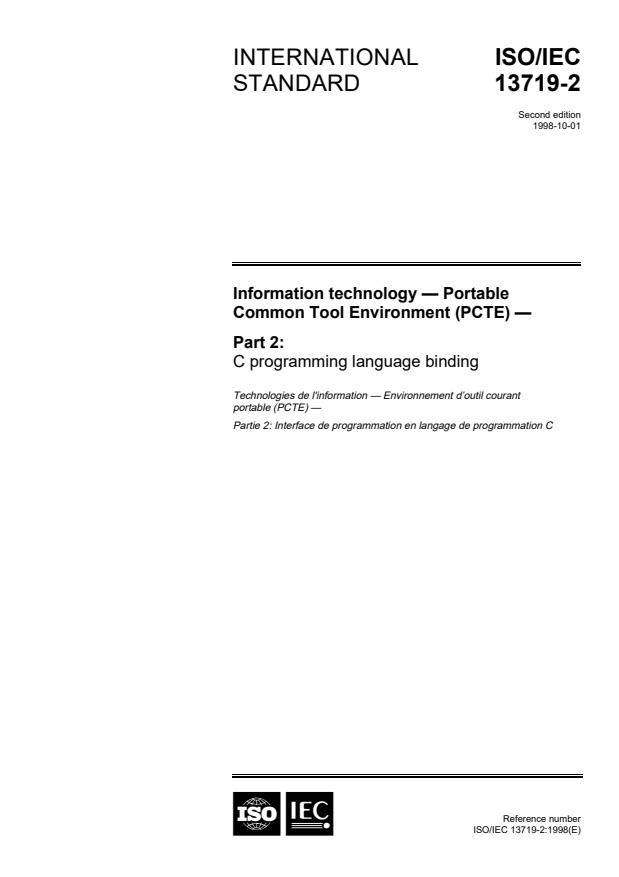
(Main)Information technology — Portable Common Tool Environment (PCTE) — Part 2: C programming language binding
Information technology — Portable Common Tool Environment (PCTE) — Part 2: C programming language binding
Technologies de l'information — Environnement d'outil courant portable (PCTE) — Partie 2: Interface de programmation en langage de programmation C
General Information
- Status
- Published
- Publication Date
- 14-Oct-1998
- Current Stage
- 9093 - International Standard confirmed
- Start Date
- 29-Apr-2021
- Completion Date
- 14-Feb-2026
Relations
- Effective Date
- 15-Apr-2008
Overview
ISO/IEC 13719-2:1998 defines the C programming language binding for the Portable Common Tool Environment (PCTE). It maps the abstract PCTE specification (ISO/IEC 13719-1) to a concrete, portable C API so that tools and environments for systems engineering can interoperate. This second edition standardizes datatype mappings, calling conventions, memory ownership, error reporting and a wide range of PCTE services when accessed from C.
Key topics and technical requirements
- Binding strategy: a one-to-one mapping of most abstract operations to C functions, following ISO/IEC TR 10182 guidelines for procedural language bindings. Functions return a Pcte_error_type status; all other outputs are via output parameters.
- Datatype mapping: rules for converting PCTE datatypes to C, including predefined and private datatypes, enumerations, records, choices, bounded sets and the special Pcte_sequence and Pcte_string types.
- Strings and text: String (8-bit octet sequences) is mapped to Pcte_string; Text (Latin‑1) is mapped to native C strings (char *) with NUL termination semantics.
- Sets and sequences: bounded sets map to bit-significant naturals; unbounded sets and sequences use the private Pcte_sequence type with creation, access and deletion operations.
- Memory allocation and ownership: clear rules for public vs. private types - callers allocate public types; implementations allocate private type storage and manage lifetime until explicitly discarded.
- References and names: object, attribute, link and type references are private types that support internal and external designations; name-based and reference-based interfaces are provided (reference-based APIs are prefixed with Pcte_h_).
- Operational areas: bindings covering object management, schema management, volumes/devices/archives, files/pipes/devices, process execution, message queues, notification, concurrency/integrity control, replication, networking, discretionary and mandatory security, auditing, accounting, references, limits and error conditions.
- Conformance & limits: specifies how implementations demonstrate conformance to ISO/IEC 13719-1 and documents implementation limits (clause 24).
Practical applications and users
- Tool and middleware vendors implementing PCTE services in C for integrated development environments (IDEs), configuration management, or systems engineering toolchains.
- Systems integrators and developers who need a portable C API to access PCTE features (object/schema management, security, process control, auditing).
- Organizations seeking interoperability between heterogeneous tools by adopting the PCTE C binding for consistent datatype, error and memory semantics.
Related standards
- ISO/IEC 13719-1 (PCTE abstract specification)
- ISO/IEC 13719-3 (Ada binding) and Part 4 (IDL binding)
- ISO 9899:1990 (C language standard)
- ISO/IEC 11404 (language-independent datatypes)
- ISO 8601 (date/time representation)
Get Certified
Connect with accredited certification bodies for this standard

BSI Group
BSI (British Standards Institution) is the business standards company that helps organizations make excellence a habit.

NYCE
Mexican standards and certification body.
Sponsored listings
Frequently Asked Questions
ISO/IEC 13719-2:1998 is a standard published by the International Organization for Standardization (ISO). Its full title is "Information technology — Portable Common Tool Environment (PCTE) — Part 2: C programming language binding". This standard covers: Information technology — Portable Common Tool Environment (PCTE) — Part 2: C programming language binding
Information technology — Portable Common Tool Environment (PCTE) — Part 2: C programming language binding
ISO/IEC 13719-2:1998 is classified under the following ICS (International Classification for Standards) categories: 35.060 - Languages used in information technology. The ICS classification helps identify the subject area and facilitates finding related standards.
ISO/IEC 13719-2:1998 has the following relationships with other standards: It is inter standard links to ISO/IEC 13719-2:1995. Understanding these relationships helps ensure you are using the most current and applicable version of the standard.
ISO/IEC 13719-2:1998 is available in PDF format for immediate download after purchase. The document can be added to your cart and obtained through the secure checkout process. Digital delivery ensures instant access to the complete standard document.
Standards Content (Sample)
INTERNATIONAL ISO/IEC
STANDARD 13719-2
Second edition
1998-10-01
Information technology — Portable
Common Tool Environment (PCTE) —
Part 2:
C programming language binding
Technologies de l'information — Environnement d’outil courant
portable (PCTE) —
Partie 2: Interface de programmation en langage de programmation C
Reference number
B C
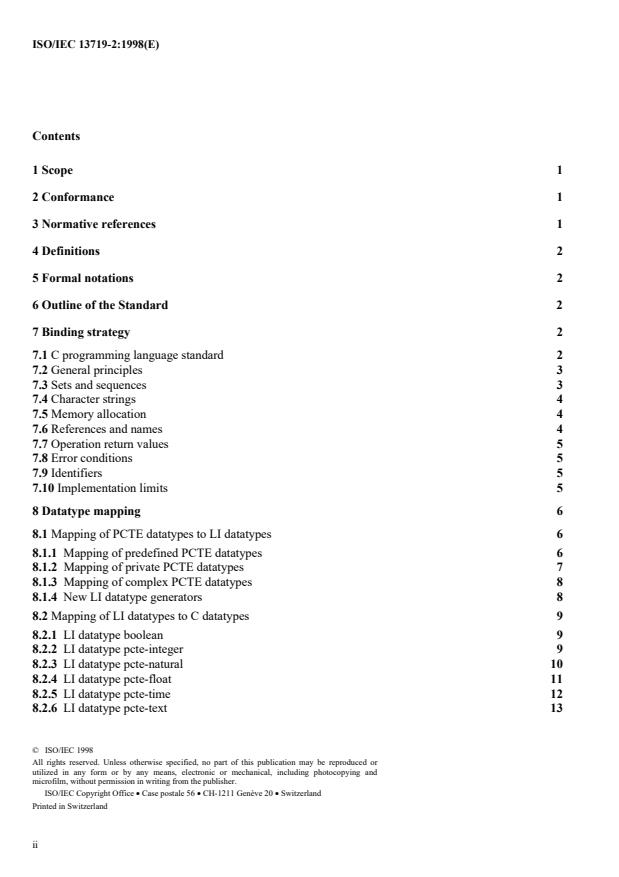
Contents
1 Scope 1
2 Conformance 1
3 Normative references 1
4 Definitions 2
5 Formal notations 2
6 Outline of the Standard 2
7 Binding strategy 2
7.1 C programming language standard 2
7.2 General principles 3
7.3 Sets and sequences 3
7.4 Character strings 4
7.5 Memory allocation 4
7.6 References and names 4
7.7 Operation return values 5
7.8 Error conditions 5
7.9 Identifiers 5
7.10 Implementation limits 5
8 Datatype mapping 6
8.1 Mapping of PCTE datatypes to LI datatypes 6
8.1.1 Mapping of predefined PCTE datatypes 6
8.1.2 Mapping of private PCTE datatypes 7
8.1.3 Mapping of complex PCTE datatypes 8
8.1.4 New LI datatype generators 8
8.2 Mapping of LI datatypes to C datatypes 9
8.2.1 LI datatype boolean 9
8.2.2 LI datatype pcte-integer 9
8.2.3 LI datatype pcte-natural 10
8.2.4 LI datatype pcte-float 11
8.2.5 LI datatype pcte-time 12
8.2.6 LI datatype pcte-text 13
© ISO/IEC 1998
All rights reserved. Unless otherwise specified, no part of this publication may be reproduced or
utilized in any form or by any means, electronic or mechanical, including photocopying and
microfilm, without permission in writing from the publisher.
ISO/IEC Copyright Office • Case postale 56 • CH-1211 Genève 20 • Switzerland
Printed in Switzerland
ii
©
ISO/IEC ISO/IEC 13719-2:1998(E)
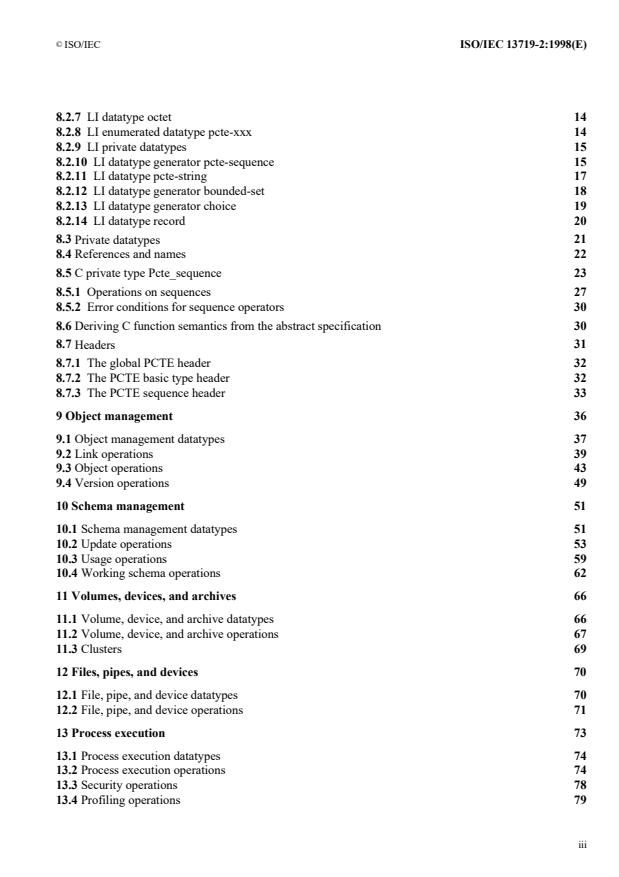
8.2.7 LI datatype octet 14
8.2.8 LI enumerated datatype pcte-xxx 14
8.2.9 LI private datatypes 15
8.2.10 LI datatype generator pcte-sequence 15
8.2.11 LI datatype pcte-string 17
8.2.12 LI datatype generator bounded-set 18
8.2.13 LI datatype generator choice 19
8.2.14 LI datatype record 20
8.3 Private datatypes 21
8.4 References and names 22
8.5 C private type Pcte_sequence 23
8.5.1 Operations on sequences 27
8.5.2 Error conditions for sequence operators 30
8.6 Deriving C function semantics from the abstract specification 30
8.7 Headers 31
8.7.1 The global PCTE header 32
8.7.2 The PCTE basic type header 32
8.7.3 The PCTE sequence header 33
9 Object management 36
9.1 Object management datatypes 37
9.2 Link operations 39
9.3 Object operations 43
9.4 Version operations 49
10 Schema management 51
10.1 Schema management datatypes 51
10.2 Update operations 53
10.3 Usage operations 59
10.4 Working schema operations 62
11 Volumes, devices, and archives 66
11.1 Volume, device, and archive datatypes 66
11.2 Volume, device, and archive operations 67
11.3 Clusters 69
12 Files, pipes, and devices 70
12.1 File, pipe, and device datatypes 70
12.2 File, pipe, and device operations 71
13 Process execution 73
13.1 Process execution datatypes 74
13.2 Process execution operations 74
13.3 Security operations 78
13.4 Profiling operations 79
iii
©
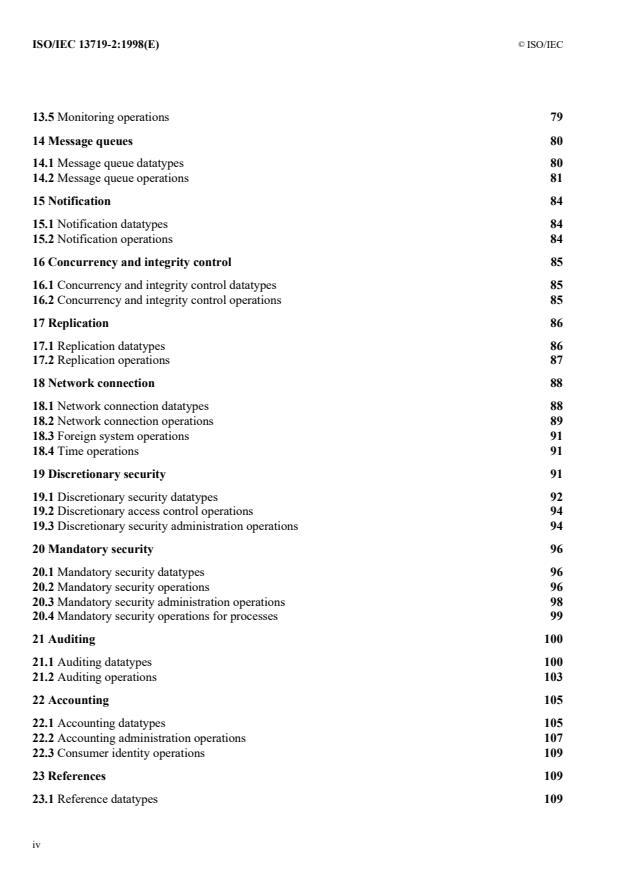
13.5 Monitoring operations 79
14 Message queues 80
14.1 Message queue datatypes 80
14.2 Message queue operations 81
15 Notification 84
15.1 Notification datatypes 84
15.2 Notification operations 84
16 Concurrency and integrity control 85
16.1 Concurrency and integrity control datatypes 85
16.2 Concurrency and integrity control operations 85
17 Replication 86
17.1 Replication datatypes 86
17.2 Replication operations 87
18 Network connection 88
18.1 Network connection datatypes 88
18.2 Network connection operations 89
18.3 Foreign system operations 91
18.4 Time operations 91
19 Discretionary security 91
19.1 Discretionary security datatypes 92
19.2 Discretionary access control operations 94
19.3 Discretionary security administration operations 94
20 Mandatory security 96
20.1 Mandatory security datatypes 96
20.2 Mandatory security operations 96
20.3 Mandatory security administration operations 98
20.4 Mandatory security operations for processes 99
21 Auditing 100
21.1 Auditing datatypes 100
21.2 Auditing operations 103
22 Accounting 105
22.1 Accounting datatypes 105
22.2 Accounting administration operations 107
22.3 Consumer identity operations 109
23 References 109
23.1 Reference datatypes 109
iv
©
ISO/IEC ISO/IEC 13719-2:1998(E)
23.2 Object reference operations 110
23.3 Link reference operations 112
23.4 Type reference operations 114
24 Limits 115
24.1 Implementation limit datatypes 115
24.2 Implementation limit operations 117
25 Error conditions 117
25.1 Error condition datatypes 117
25.2 Error condition operations 124
Annex A - The object orientation module 125
Index of abstract operations 130
Index of C subprograms 136
Index of C datatypes 143
v
©
Foreword
ISO (the International Organization for Standardization) and IEC (the International Electrotechnical Commission) form the
specialized system for worldwide standardization. National bodies that are members of ISO or IEC participate in the
development of International Standards through technical committees established by the respective organization to deal with
particular fields of technical activity. ISO and IEC technical committees collaborate in fields of mutual interest. Other
international organizations, governmental and non-governmental, in liaison with ISO and IEC, also take part in the work.
In the field of information technology, ISO and IEC have established a joint technical committee, ISO/IEC JTC 1. Draft
International Standards adopted by the joint technical committee are circulated to national bodies for voting. Publication as an
International Standard requires approval by at least 75 % of the national bodies casting a vote.
International Standard ISO/IEC 13719-2 was prepared by ECMA (as Standard ECMA-158) and was adopted, under a special
“fast-track procedure”, by Joint Technical Committee ISO/IEC JTC 1, Information technology, in parallel with its approval by
national bodies of ISO and IEC.
This second edition cancels and replaces the first edition (ISO/IEC 13719-2:1995), which has been technically revised.
ISO/IEC 13719 consists of the following parts, under the general title Information technology - Portable Common Tool
Environment (PCTE):
− Part 1: Abstract specification
− Part 2: C programming language binding
− Part 3: Ada programming language binding
− Part 4: IDL binding (Interface Definition Language)
Annex A forms an integral part of this part of ISO/IEC 13719.
vi
©
INTERNATIONAL STANDARD ISO/IEC ISO/IEC 13719-2:1998(E)
Information technology — Portable Common Tool
Environment (PCTE) —
Part 2:
C programming language binding
1 Scope
This part of ISO/IEC 13719 defines the binding of the Portable Common Tool Environment
(PCTE), as specified in ISO/IEC 13719-1, to the C programming language.
A number of features are not completely defined in ISO/IEC 13719-1, some freedom being
allowed to the implementor. Some of these features are specified as implementation limits. Some
constraints are placed on these implementation limits by this part of ISO/IEC 13719. These
constraints are specified in clause 24, Implementation Limits.
PCTE is an interface to a set of facilities that forms the basis for constructing environments
supporting systems engineering projects. These facilities are designed particularly to provide an
infrastructure for programs which may be part of such environments. Such programs, which are
used as aids to system development, are often referred to as tools.
2 Conformance
An implementation of PCTE conforms to this part of ISO/IEC 13719 if it conforms to 2.2 of
ISO/IEC 13719-1, where the binding referred to there is taken to be the C language binding
defined in clauses 1 to 5 and 8 to 25 of this part of ISO/IEC 13719. All other parts of this part of
ISO/IEC 13719 are provided as assistance to the reader and are not normative.
The C language binding defined in this part of ISO/IEC 13719 conforms to 2.1 of ISO/IEC
13719-1.
3 Normative references
The following standards contain provisions which, through reference in this text, constitute
provisions of this part of ISO/IEC 13719. At the time of publication, the editions indicated were
valid. All standards are subject to revision, and parties to agreements based on this part of ISO/IEC
13719 are encouraged to investigate the possibility of applying the most recent editions of the
standards indicated below. Members of IEC and ISO maintain registers of currently valid
International Standards.
ISO/IEC 13719-1:1998, Information technology - Portable Common Tool Environment
(PCTE) - Part 1: Abstract specification.
ISO/IEC 13719-3:1998,
Information technology - Portable Common Tool Environment
(PCTE) - Part 3: Ada programming language binding.
ISO 8601:1988,
Data elements and interchange formats - Information interchange -
Representation of dates and times.
ISO 9899:1990,
Programming languages - C.
©
ISO/IEC TR 10182:1993, Information technology - Programming languages, their
environments and system software interfaces - Guidelines for
language bindings.
ISO/IEC 11404:1996, Information technology - Programming languages, their
environments and system software interfaces - Language-independent
datatypes.
4 Definitions
All technical terms used in this part of ISO/IEC 13719, other than a few in widespread use, are
defined in the body of this part of ISO/IEC 13719 or in the referenced documents.
5 Formal notations
All datatypes and subprogram definitions are expressed using ISO/IEC 8652 conformant syntax.
For the C Language binding for each operation, the function prototype syntax is used as defined in
ISO 9899.
6 Outline of the Standard
Clause 7 describes the strategy used to develop this binding specification.
Clause 8 defines the mapping from the datatypes that are used in the abstract specification to C
language datatypes.
Clauses 9 to 22 define the bindings of datatypes and operations in the corresponding clauses of
ISO/IEC 13719-1. The extensions for fine-grain objects are added at the end of clause 11.
Clause 23 defines the binding of object and type references, as specified in 23.1.2 and 23.2 of
ISO/IEC 13719-1.
Clause 24 defines the binding of the implementation limit subprograms described in clause 24 of
ISO/IEC 13719-1.
Clause 25 defines the binding of the error conditions specified in annex C of ISO/IEC 13719-1,
and defines binding-defined error conditions for the C binding.
Annex A, which is normative, contains the extensions for object orientation, corresponding to
annex G of ISO/IEC 13719-1.
7 Binding strategy
7.1 C programming language standard
This part of ISO/IEC 13719 is a conforming program according to ISO 9899.
©
ISO/IEC ISO/IEC 13719-2:1998(E)
7.2 General principles
The following general principles were applied when generating the binding in this part of
ISO/IEC 13719.
ISO/IEC TR 10182: Guidelines for Language Bindings should be followed as far as possible for
binding method 1: provide a completely defined procedural interface.
Each operation in ISO/IEC 13719-1 should be represented by exactly one operation in this part of
ISO/IEC 13719 except possibly when the abstract operation has distinct functionality depending
on the values of one or more parameters.
Each operation in this part of ISO/IEC 13719 should have the same number of parameters as does
the corresponding operation in ISO/IEC 13719-1.
All operations in this part of ISO/IEC 13719 should return an integer status value. All other
values returned by the operation should be passed back to the caller via an output parameter. The
return value of the operation should indicate success or failure only.
Operation and parameter names should be the same in this part of ISO/IEC 13719 as they are in
ISO/IEC 13719-1, with the exception that identifiers with file scope should begin 'Pcte_' and
otherwise consist of lowercase letters and underscores. The PCTE standard guarantees that there
are no ambiguities in names prefixed by 'Pcte_'.
All additional names introduced in this part of ISO/IEC 13719 which are visible across the
interface (except header names, see 8.5) should begin 'Pcte_' and otherwise consist of lowercase
letters, underscores and digits, or begin 'PCTE_' and otherwise consist of uppercase letters,
underscores and digits. The PCTE standard guarantees that there are no ambiguities in names
prefixed by 'PCTE_' or 'Pcte_'.
Wherever practical, types introduced for passing complex data entities between caller and
operation (and vice versa) should be private types defined by this part of ISO/IEC 13719. The
principle should only be ignored for reasons of ease of use and efficiency of implementation.
Each simple datatype in ISO/IEC 13719-1 should be mapped to a corresponding type defined in
this part of ISO/IEC 13719. Each implementation of the binding should then be free to map the
binding-defined type to an efficient C Language basic type appropriate for the platform of the
implementation, within the constraints specified in this part of ISO/IEC 13719.
A general policy of memory allocation should be adopted; see 7.5.
7.3 Sets and sequences
Some complex data entities to be passed into or retrieved from an operation are defined as sets or
sequences of a base type in ISO/IEC 13719-1. Bounded set types are mapped individually to bit-
significant natural numbers; unbounded set and sequence types are mapped to a private type,
Pcte_sequence with operations for creation, population, retrieval and deletion. These operations
allow multiple elements of sets and sequences to be set and read in a single operation, from or to
an array object of an appropriate base type. Thus, the data for sets and sequences can be easily
manipulated using standard C Language paradigms, while allowing the implementation to choose
the best implementation for such sets and sequences.
©
7.4 Character strings
In ISO/IEC 13719-1, two different types are used to represent sequences of characters. String is a
sequence of Octets allowing all 8-bit values and Text is a sequence of Latin-1 graphic characters.
Contents, string attributes etc., are of type String; keys, type names etc., are of type Text.
In the C Bindings, String is mapped to Pcte_string (see 8.2.11). Text is mapped to the native C
language string with a possibly fixed length, i.e. char * with operations depending on NUL ('\0')
character termination (see 8.2.6).
7.5 Memory allocation
Communication between caller and operation is effected by the transfer of data into an operation
via an input parameter or back from an operation via an output parameter. There are two types of
such parameters: public and private.
All instances of a public type are allocated and managed by the caller of the operation. All
instances of a private type are allocated and managed by the implementation. However, the
extraction of data from a private type is again by data transfer in instances of a public type via an
operation on the private type. In these cases also, the caller of the operation is required to allocate
and manage the instances of the public type. The caller is further required to allocate sufficient
space to contain a handle to the private type, the type of which is always a pointer to an internal
data structure of undefined form. Operations on the private type are provided to create and
discard these internal data structures.
Data stored in an instance of a private type is owned by the implementation. The implementation
is responsible for allocating, managing and deallocating the memory used to store this data.
Furthermore, after a handle to an instance of a private type has been returned to the caller of an
operation, via an output parameter, the implementation is responsible for maintaining the data
stored therein, until the caller explicitly indicates that the data is no longer needed, by invoking
the discard operation on that instance.
Data stored in an instance of a public type and passed into an operation via an input parameter, is
owned by the caller of the operation. The caller is responsible for allocating, managing and
deallocating the memory used to store this data. The caller is further responsible for maintaining
the data stored therein for the duration of the operation. If the implementation needs to access the
data after the operation has completed, the implementation is responsible for allocating additional
memory and storing therein a copy of the data.
All the operations that have sequences as "out" parameters will allocate the sequence and return it
as result of operation. The user does not need to allocate the sequence in advance: the user only
needs to declare a Pcte_sequence variable and pass the address of that variable.
7.6 References and names
Objects, attributes, links, and types are referred to in this part of ISO/IEC 13719 using object
references, attribute references, link references and type references, respectively. References are
mapped to private datatypes encapsulating two ways of designating an object, attribute, link, or
type: by an external and by an internal reference (see clause 23 of ISO/IEC 13719-1).
©
ISO/IEC ISO/IEC 13719-2:1998(E)
Beside these references, in this part of ISO/IEC 13719 also attribute names, link names and type
names are used to refer to attributes, links, or types. These names represent external references
and they are mapped to the native C language string type.
Therefore two different interfaces are provided in this Binding for clauses 9 to 22:
- one interface using names for attributes, links, and types;
- one interface using references for attributes, links, and types. All operations of this interface
begin 'Pcte_h_'. These operations are defined if an operation of the previous interface uses
attributes, links, or types. Whenever new datatypes are necessary, they also begin 'Pcte_h_'
(see 8.7).
7.7 Operation return values
All the operations are mapped to functions which return a Pcte_error_type value, which indicates
success (PCTE_NO_ERROR equivalent to PCTE_OK) or failure (one of the other enumeration
values of Pcte_error_type) of the operation. All other information that is passed between the
caller and the operation is passed via "out" or "in-out" parameters.
7.8 Error conditions
Error conditions which are defined in ISO/IEC 13719-1 and which can be established and
returned by the operations defined in this part of ISO/IEC 13719 are described in clause 25.
All binding-defined errors are defined in 25.1.
7.9 Identifiers
Many of the identifiers in ISO/IEC 13719-1 are longer than 31 characters, but no two identifiers
are exactly the same within the first 31 characters. The C Programming Language Standard
requires that an internal name (i.e., a macro name or an identifier that does not have external
linkage) be unique within the first 31 characters. Thus there is no need for any identifiers to be
abbreviated in this Binding.
ISO 9899 requires all identifiers of enumeration values to be distinct. Where ISO/IEC 13719-1
uses the same identifier for values of enumeration types bound to different C Language
enumeration types, new names have been invented.
In a few cases an abstract operation has been bound to more than one C Language function, to
cater for optional parameters; in these cases also, new names have been invented.
7.10 Implementation limits
ISO/IEC 13719-1 defines a set of limits that must be honoured by all implementations of the
Language Bindings. Clause 24 describes the binding-defined identifiers for these limit values and
the way in which these limits can be retrieved.
©
8 Datatype mapping
This clause defines the mapping of the parameter and result datatypes of the operations of ISO/IEC
13719-1 (PCTE datatypes) to the parameter and result datatypes of the operations of this part of
ISO/IEC 13719 (C datatypes).
PCTE datatype names are printed in normal characters.
LI Datatypes names are printed in italics.
C datatype names are printed in bold except in displayed fragments of C.
The mapping from PCTE datatypes to C datatypes is done in two stages via LI datatypes defined
in ISO/IEC 11404.
8.1 Mapping of PCTE datatypes to LI datatypes
As far as possible the names of PCTE datatypes are retained for the corresponding LI datatypes,
but some new names are introduced.
The general strategy of this mapping is as follows.
- To select for each PCTE datatype a LI datatype definition which matches the requirements of
the PCTE datatype defined in ISO/IEC 13719-1. The LI datatype definition is, where
possible, a primitive LI datatype or otherwise a generated LI datatype.
- To define new datatype generators where needed.
- To map PCTE datatypes with the same properties to the same LI datatype.
8.1.1 Mapping of predefined PCTE datatypes
The mapping of these PCTE datatypes is as defined in clause 23 of ISO/IEC 13719-1, and is
summarized in table 1.
©
ISO/IEC ISO/IEC 13719-2:1998(E)
Table 1 - Mapping of predefined PCTE datatypes
PCTE datatype LI datatype
Boolean boolean
Integer pcte-integer = integer
range (MIN_INTEGER_ATTRIBUTE .
MAX_INTEGER_ATTRIBUTE)
Natural pcte-natural = integer
range (0 . MAX_NATURAL_ATTRIBUTE)
Float =
pcte-float
real (10, MAX_DIGITS_FLOAT_ATTRIBUTE)
range (MIN_FLOAT_ATTRIBUTE .
MAX_FLOAT_ATTRIBUTE)
Time pcte-time =
time (second, 10, Pcte_accuracy_factor)
range (MIN_TIME_ATTRIBUTE .
MAX_TIME_ATTRIBUTE)
Octet octet
Text pcte-text = characterstring (repertoire)
Enumerated type pcte-xx = enumerated (value1, value2, .)
xxx=VALUE1|VALUE2|.
8.1.2 Mapping of private PCTE datatypes
Table 2 - Mapping of other primitive PCTE datatypes
PCTE datatype LI datatype
Address address
Attribute_reference attribute_reference
Contents_handle contents-handle
Handler handler
Object_reference object-reference
Link_reference link-reference
Position_handle position-handle
Profile_handle profile-handle
Type_reference type-reference
©
8.1.3 Mapping of complex PCTE datatypes
PCTE sequence datatypes are mapped via the new datatype generator pcte-sequence (see 8.1.4).
PCTE set datatypes are divided into bounded set types and unbounded set types. Bounded set
types have values which are sets of enumeration values with at most 32 possible elements; all
others are unbounded set types. Bounded set types are mapped via the new LI datatype
generator Bounded-set. Unbounded set types are mapped via the new LI datatype generator
Sequence; the order of elements being irrelevant.
When used as input parameter of an operation in clauses 9 to 22, a sequence which represents a
PCTE unbounded set may contain repeated elements. The effect for the operation is as though
each element occurred only once.
When returned as the result of an operation in clauses 9 to 22, an unbounded set has no repeated
elements.
PCTE map datatypes are notionally mapped via a new LI datatype generator Map; their
mappings to C datatypes are defined directly. The mapping of Attribute_assignments is defined
in 9.1. The mapping of ACcess_rights, Acl, and Atomic_access_rights is defined in 19.1.
PCTE union datatypes other than enumerations are notionally mapped via the datatype generator
Choice.
PCTE composite and bracketed datatypes (except private PCTE datatypes, for which see 8.1.2)
are mapped to the datatype generator Record.
8.1.4 New LI datatype generators
Pcte-sequence
Description: Pcte-sequence is a datatype generator derived from Sequence by adding further
characterizing operations. In some operations, an index of LI datatype natural is used to
identify elements in the sequence. The first element is always indexed from 0.
The characterizing operations are: IsEmpty, Head, Tail, Equal, Empty, and Append from
Sequence, plus Get, Put, Copy, LengthOf, and IndexOf.
Get (s : sequence of base, index : Natural) : base
is undefined if InOrder (LengthOf(s), index) is true, or is Head(s).if Equal (index, 0) is true;
otherwise Get (Tail(s), Add (index, negate(1))).
Put (s : sequence of base, e : base, index : Natural) :sequence of base
is undefined if InOrder (Add (LengthOf(s), 1), index) is true, or is Append (Create(e), s) if
Equal (index, 0) is true; otherwise Append (Head(s), Put (Tail(s), e, Add (index, Negate(1)))).
Copy (s : sequence of base) : sequence of base
is Create() if IsEmpty(s) is true; otherwise Append (Head(s), Copy (Tail(s))).
LengthOf (s : sequence of base) : Natural
is 0 if IsEmpty(s); otherwise Add (LengthOf (Tail(s), 1).
IndexOf (s : sequence of base, e : base) : Natural
is undefined if IsEmpty(s) is true, or is 1 if Equal (Head(s), e) is true; otherwise Add (IndexOf
(Tail(s), e), 1).
©
ISO/IEC ISO/IEC 13719-2:1998(E)
Bounded-set
Description: Bounded-set is a datatype generator derived from Set by restricting the cardinality
of the values to 32 or less.
bounded-set of base = new set of (base) : size (0 . 32)
The characterizing operations are: IsIn, Subset, Equal, Difference, Union, Intersection, Empty,
SetOf, Select from Set.
8.2 Mapping of LI datatypes to C datatypes
8.2.1 LI datatype boolean
The LI datatype boolean is mapped to the C datatype Pcte_boolean
typedef Pcte_boolean;
where is a C integer type.
TRUE is represented by PCTE_TRUE, FALSE is represented by PCTE_FALSE:
#define PCTE_TRUE (Pcte_boolean) 1
#define PCTE_FALSE (Pcte_boolean) 0
In addition, if a value of type Pcte_boolean is supplied as or as part of an input parameter, it is
taken as TRUE if it is not 0.
Characterizing operations
Operation C Operation
Equal(b1, b2) : b if (b1 == b2)
b = PCTE_TRUE;
else
b = PCTE_FALSE;
Not (b1) : b if (b1 == PCTE_FALSE)
b = PCTE_TRUE;
else
b = PCTE_FALSE;
And (b1, b2) : b b = b1 && b2;
Or (b1, b2) : b b = b1 | b2;
8.2.2 LI datatype pcte-integer
The LI datatype pcte-integer is mapped to the C datatype Pcte_integer.
typedef Pcte_integer;
where is a C integer type including the range MIN_INTEGER_ATTRIBUTE to
MAX_INTEGER_ATTRIBUTE inclusive.
©
Characterizing operations
Operation C Operation
Equal (i1, i2) : b if (i1 == i2)
b = PCTE_TRUE;
else
b = PCTE_FALSE;
InOrder (i1, i2) : b if (i1 <= i2)
b = PCTE_TRUE;
else
b = PCTE_FALSE;
NonNegative (i) : b if (i >= 0)
b = PCTE_TRUE;
else
b = PCTE_FALSE;
Negate (i) : i i = -i1;
Add (i1, i2) : i i = i1 + i2;
Multiply (i1, i2) : i x * y;
8.2.3 LI datatype pcte-natural
The LI datatype pcte-natural is mapped to the C datatype Pcte_natural.
typedef Pcte_natural;
where is a C unsigned integer type including the range 0 to
MAX_NATURAL_ATTRIBUTE inclusive.
Furthermore, the unsigned integral datatype in C Language operates under modular arithmetic
rules; i.e. the result of any arithmetic operation is always reduced modulo the largest
representable value. Therefore, ULONG_MAX + 1 = 0, where ULONG_MAX is the largest
value of the chosen base unsigned integer value.
©
ISO/IEC ISO/IEC 13719-2:1998(E)
Characterizing operations
Operation C Operation
Equal (n1, n2) : b if (n1 == n2)
b = PCTE_TRUE;
else
b = PCTE_FALSE;
InOrder (n1, n2) : b if (n1 <= n2)
b = PCTE_TRUE;
else
b = PCTE_FALSE;
Add (n1, n2) : n n = n1 + n2;
Multiply (n1, n2) :n n = n1 * n2;
8.2.4 LI datatype pcte-float
The LI datatype is mapped to the C datatype Pcte_float.
pcte-float
typedef Pcte_float;
where is a C floating type including the range MIN_FLOAT_ATTRIBUTE to
MAX_FLOAT_ATTRIBUTE inclusive, with an accuracy of at least
MAX_DIGITS_FLOAT_ATTRIBUTE decimal digits, and able to represent
SMALLEST_FLOAT_ATTRIBUTE.
©
Characterizing operations
Operation C Operation
Equal (f1, f2) : b if (f1 == f2)
b = PCTE_TRUE;
else
b = PCTE_FALSE;
InOrder (f1, f2) : b if (f1 <= f2)
b = PCTE_TRUE;
else
b = PCTE_FALSE;
NonNegative (f) : b if (f >= 0.0)
b = PCTE_TRUE;
else
b = PCTE_FALSE;
Negate (f1) : f f = -f1;
Add (f1, f2) : f f = f1 + f2;
Multiply (f1, f2) : f f = f1 * f2;
Reciprocal (f1) : f f = 1.0 / f1;
8.2.5 LI datatype pcte-time
The LI datatype pcte-time is mapped to the C datatype Pcte_time, where
Pcte_time_accuracy_factor is an implementation-defined constant for the resolution of
'Pcte_time'. Pcte_reference_time is the default initial value for time attributes.
typedef time_t Pcte_time;
#define Pcte_time_accuracy_factor (Pcte_natural)
#define Pcte_reference_time (Pcte_time)
The datatype time_t is an arithmetic datatype that holds values representing time. The encoding
of the calendar time within a value of type time_t is undefined. Functions on values of type
time_t are provided to convert such a value into a meaningful and usable representation of
calendar time.
The implementation shall provide a constant defining an optional time parameter in the
operation Pcte_object_set_time_attributes.
# define Pcte_null_time (Pcte_time)
©
ISO/IEC ISO/IEC 13719-2:1998(E)
Characterizing operations
Operation C Operation
Equal (t1, t2) : b if (difftime (t1, t2) < radix_factor)
b = PCTE_TRUE;
else
b = PCTE_FALSE;
InOrder (t1, t2) : b if (difftime (t1, t2) >= 0)
b = PCTE_TRUE;
else
b = PCTE_FALSE;
Difference (t1, t2) : i i = (Pcte_integer) difftime(t1,t2);
Extend.res1tores2 (t1) : t2 t2 = t1 * radix_factor;
Round.res1tores2 (t1) : t2 t2 = floor (t1 + radix_factor);
-Pcte_time_accuracy_factor
In this table radix_factor is 10 .
8.2.6 LI datatype pcte-text
The LI datatype pcte-text is mapped to the native C language null terminated string type with a
fixed length. The character repertoire of the characters of such a sequence are the graphic
characters of ISO 8859-1. Pcte_octet is used to represent this character repertoire. Attribute
names, enumeral type images, exact identifier, keys, machine names, node names, link names,
names, type names, and type names in SDSs are of type Text.
#define PCTE_MAX_XXX_SIZE
typedef Pcte_octet Pcte_xxx[PCTE_MAX_XXX_SIZE + 1];
XXX is one of the following PCTE datatypes: Attribute_name, Enumeral_type_image,
Exact_identifier, Key, Link_name, Machine_name, Name, Node_name, and Type_name, or
Type_name_in_sds. All values of PCTE_XXX_SIZE defined in this Binding are minimum
values, which have to be respected by an implementation.
©
Characterizing operations
Operation C Operation
Equal (s1, s2) : b if (strcomp (s1, s2) == 0)
b = PCTE_TRUE;
else
b = PCTE_FALSE;
Empty () : s s[0] = '\0';
Head (s1) : c c = s[0];
Tail (s1) : s2 if (s1[0] != '\0') {
s2 = malloc (strlen(s1));
(void) strncpy (s2,s1+1,strlen(s1));
}
Append (s1, e) : s2 s2 = malloc (strlen(s1)+2);
(void) strcpy (s2,s1);
(void) strcat (s2,"e");
IsEmpty (s) : b if (s1[0] == '\0')
b = PCTE_TRUE;
else
b = PCTE_FALSE;
In this table memory errors like access at invalid addresses are not recognized.
8.2.7 LI datatype octet
The LI datatype octet is mapped to the C datatype char.
typedef char Pcte_octet;
Characterizing operations
Operation C Operation
Equal (o1, o2) : b if (o1 == o2)
b = PCTE_TRUE;
else
b = PCTE_FALSE;
8.2.8 LI enumerated datatype pcte-xxx
The LI datatype pcte-xxx, defined as enumerated (value1, value2, .), corresponds to the PCTE
enumeration datatype xxx (where the values of xxx are VALUE1, VALUE2, .). It is mapped to
the C datatype Pcte_xxx, defined as follows.
Case (1): if a bounded set of the enumeration type is not required the mapping is:
©
ISO/IEC ISO/IEC 13719-2:1998(E)
typedef enum {PCTE_VAL1, PCTE_VAL2, .} Pcte_xxx;
Case (2): if a bounded set of the enumeration type is required the mapping is as defined in
8.2.12.
Characterizing operations
Operation C Operation
Equal (e1, e2) : b if (e1 == e2)
b = PCTE_TRUE;
else
b = PCTE_FALSE;
InOrder (e1, e2) : b if (e1 <= e2)
b = PCTE_TRUE;
else
b = PCTE_FALSE;
Successor (e1) : e2 e2 = e1 + 1;
8.2.9 LI private datatypes
Each LI private datatype xxx is mapped to an opaque C datatype Pcte_xxx.
typedef void *Pcte_xxx;
8.2.10 LI datatype generator pcte-sequence
The LI datatypes of the family pcte-sequence are mapped to the C datatype Pcte_sequence
(except for pcte-sequence of octet, see 8.2.7).
Since Pcte_sequence is an opaque type in the C Language, objects of this type may be
manipulated only via the binding defined operations (see 8.5.1).
©
Characterizing operations
Operation C Operation
Equal (s1, s2) : b Pcte_sequences_are_equal (s1, s2, &b);
Empty () : s Pcte_sequence_create (-, NULL, 0, &s);
Head (s) : e Pcte_sequence_get (s, 0, &e);
Tail (s1) : s2 Pcte_sequence_create (-, NULL, 0, &s2);
Pcte_sequence_get_length (s1, &n);
Pcte_sequence_copy (s1, s2, 0, 1, n-1);
Append (s1, e) : s2 Pcte_natural n;
Pcte_sequence_get_length (s1, &n);
Pcte_sequence_create (–, NULL, 0, &s2);
Pcte_sequence_copy (s1, s2, 0, 0, n);
Pcte_sequence_insert (s2, n, &e);
IsEmpty (s) : b Pcte_natural n;
Pcte_sequence_get_length (s, &n);
if (n == 0)
b = PCTE_TRUE;
else
b = PCTE_FALSE;
Copy (s1) : s2 Pcte_natural n;
Pcte_sequence_get_length (s1, &n);
Pcte_sequence_create (–, NULL, 0, &s2);
Pcte_sequence_copy (s1, s2, 0, 0, n);
Get (s, n) : e Pcte_sequence_get (s, n, &e);
Put (s1, e, n) ; s2 Pcte_natural n;
Pcte_sequence_get_length (s1, &n);
Pcte_sequence_create (–, NULL, 0, &s2);
Pcte_sequence_copy (s1, s2, 0, 0, n);
Pcte_sequence_insert (s2, n, &e);
LengthOf (s) : n Pcte_sequence_get_length (s, &n);
IndexOf (s, e) : n Pcte_sequence_get_index (s, &e, &n);
If a sequence is to be created using Pcte_sequence_create, a type of Pcte_sequence_type has to
be supplied. In the table given above, this is indicated using '-'.
The sequence operations, Pcte_sequence_xxx, which are used above are defined in 8.5.1.
©
ISO/IEC ISO/IEC 13719-2:1998(E)
8.2.11 LI datatype pcte-string
The LI datatype pcte-string, which is a pcte-sequence of octets, is mapped to the C datatype
Pcte_string. Attribute values, contents, control data device characteristics, foreign devices,
foreign names, foreign parameters, messages, pathnames, process data, relative pathnames,
security labels, and volume characteristics are Strings.
typedef struct {
Pcte_natural size;
Pcte_octet*array;
} Pcte_string;
If a value of type Pcte_string is passed as or as part of an input parameter, size defines the valid
number of octets given by array. If size is bigger than the number of octets allocated in array,
the error PCTE_ACCESS_AT_INVALID_ADDRESS is raised.
If a value of type Pcte_string is passed as or as part of an output parameter, the space for the
string can be either allocated by the caller or by the implementation:
- if the supplied size is set to 0, the space is allocated by the implementation; in this case it is
in the responsibility of the caller to discard the space when the string is no longer needed, by
using the operation Pcte_string_discard.
- if the supplied size is non-zero, it indicates the number of octets allocated by the user in
array.
The implementation sets size to the number of returned octets, provided by the implementation
in array. If there is not enough space in array, the implementation raises the error
PCTE_STRING_TOO_SHORT or in case of a wrong set size
PCTE_ACCESS_AT_INVALID_ADDRESS.
In order to improve usability, there are four exceptions to this rule: CONTENTS_READ,
CONTENTS_WRITE, PROCESS_PEEK, and PROCESS_POKE. In all cases an array of
Pcte_octet and an additional size parameter has to be supplied. For these two parameters the
same rules apply for incoming and outgoing parameters as for pcte-string. In addition,
pathname and relative pathname are mapped to the native C language string type (see 23.1). For
these exceptions no characterizing operations are defined.
The following operation is provided.
Pcte_string_discard
Pcte_error_type Pcte_string_discard (
Pcte_string string
);
Pcte_string_discard discards the space allocated by the implementation for string string.
©
Characterizing operations
Operation C Operation
Equal (s1, s2) : b if ((s1.size == s2.size)
&& (memcmp(s1.array, s2.array, s1.size) == 0))
b = PCTE_TRUE;
else
b = PCTE_FALSE;
Empty () : s s.size == 0;
Head (s) : e c = s.array[0];
Tail (s1) : s2 s2.size = s1.size - 1;
s2.array = malloc (s2.size);
memcpy (s2.array, s1.array, s2.size);
Append (s1, e) : s2 s2@s2.size = s1.size + 1;
s2.array = malloc (s2.size);
memcpy (s2.array, s1.array, s2.size);
s2.array [s2.size] = e;
IsEmpty (s) : b if (s.size == 0)
b = PCTE_TRUE;
else
b = PCTE_FALSE;
Copy (s1) : s2 s2.size = s1.size;
s2.array = malloc(s2.size);
memcpy(s2.array, s1.array, s2.size);
Get (s, n) : e e = s.array[n];
Put (s1, e, n) ; s2 s2.size = s1.size;
s2.array = malloc(s2.size);
memcpy(s2.array, s1.array, s2.size);
s2.array[n] = e;
LengthOf (s) : n n = s.size;
IndexOf (s, e) : n n = 0;
while (s.array[n] != e) n++;
Note that in this table memory errors like access at invalid addresses are not recognized.
8.2.12 LI datatype generator bounded-set
Each LI datatype bounded-set of (base) is mapped to a different C datatype, defined as
Pcte_natural (see 8.2.3), with an enumeration definition mapping the names of element values
to bit positions. A natural value represents a set including an element value if the corresponding
©
ISO/IEC ISO/IEC 13719-2:1998(E)
bit is 1. Thus a bounded set , where is Pcte_access_events,
Pcte_categories, Pcte_definition_mode_values, Pcte_discretionary_access_modes, or
Pcte_work_status, with possible element values VALUE1, VALUE2, etc. is mapped as
follows, making use of the corresponding enumerated types , where
is Pcte_access_event, Pcte_category, Pcte_definition_mode_value,
Pcte_discretionary_access_mode, or Pcte_work_status_item, respectively:
enum {
PCTE_VALUE1 = 1<<0,
PCTE_VALUE2 = 1<<1,
PCTE_VALUE3 = 1<<2,
...
} ;
typedef Pcte_natural ;
Characterizing operations
Operation Ada Operation
Equal (s1, s2) : b if (s1 == s2)
b = PCTE_TRUE;
else
b = PCTE_FALSE;
Empty () : s s = 0;
IsIn (s, e) : b if (s1 & e)
b = PCTE_TRUE;
else
b = PCTE_FALSE;
Subset (s1, s2) : b if (s1 == (s2 & s1))
b = PCTE_TRUE;
else
b = PCTE_FALSE;
Complement (s1) : s2 s2 = ~s1;
Union (s1, s2) : s3 s3 = s1 | s2;
Intersection (s1, s2) : s3 s3 = s1 & s2;
SetOf (e) : s s = e;
Select (s) : e for (e=1; ; e<<1)
if (s & e) break;
8.2.13 LI datatype generator choice
The LI datatype pcte-xxx = choice (alt-1, alt-2, .)\fP is mapped to a C union datatype as
follows:
©
Each value is discriminated by an enumeration, the discriminator, with its origin type. The
position of the enumeration value of the discriminator corresponds to the position of the type of
the choice, i.e. if the discriminator has the value PCTE_TYPE_1, the value of the choice is of
type Pcte_type_1, etc.
typedef struct {
enum {
PCTE_TYPE_1,
PCTE_TYPE_2,
...
} union_type;
union {
Pcte_type_1 alt-1;
Pcte_type_2 alt-2;
...;
} choice;
} Pcte_xxx ;
Characterizing operations
Operation C Operation
Equal (c1, c2) : b if (c1 == c2)
b = PCTE_TRUE;
else
b = PCTE_FALSE;
Tag.type-n (x, type-n) : c c.union_type = PCTE_TYPE_N
c.choice = x;
IsType.type-n (c) : b if (c.union_type == PCTE_TYPE_N)
b = PCTE_TRUE;
else
b = PCTE_FALSE;
Case.type-n (c) : x x = c.choice;
8.2.14 LI datatype record
The LI datatype generator Record is mapped to the C language struct type as follows:
typedef struct {
Pcte_type_1 component_1;
Pcte_type_2 component_2;
Pcte_type_3 component_3;
...;
} Pcte_xxx ;
©
ISO/IEC ISO/IEC 13719-2:1998(E)
Characterizing operations
Operation C Operation
Equal (r1, r2) : b if (r1 == r2)
b = PCTE_TRUE;
else
b = PCTE_FALSE;
FieldSelect.c (r) : c c = r.c;
FieldReplace (r1, c)) : r2 r2 = r1;
r2.c = c;
8.3 Private datatypes
Private Datatypes are datatypes with a hidden representation, i.e. the implementation-defined
representation of such a datatype is not defined in any header. These datatypes are denoted in the
C language using void *. Table 3 shows all private types which are defined in this binding with
the corresponding operations to create and discards instances of these types.
©
Table 3 - Creation and deletion of private datatypes
Private C datatype Create operations Discard operations
Pcte_attribute_ Pcte_type_reference_copy Pcte_type_reference_unset
reference Pcte_type_reference_set
Pcte_contents_ Pcte_contents_open Pcte_contents_close
handle Pcte_contents_get_handle_from_key
Pcte_contents_handle_duplicate
Pcte_contents_handle_duplicate_to_key
Pcte_link_reference Pcte_link_reference_copy Pcte_link_reference_unset
Pcte_link_reference_set
Pcte_object_ Pcte_object_reference_copy Pcte_object_reference_unset
reference Pcte_object_reference_set_absolute
Pcte_object_reference_set_relative
Pcte_position_ Pcte_contents_get_position Pcte_position_handle_discard
handle Pcte_contents_close
Pcte_profile_handle Pcte_process_profiling_on Pcte_process_profiling_off
Pcte_sequence Pcte_sequence_create Pcte_sequence_discard
Pcte_type_reference Pcte_type_reference_copy Pcte_type_reference_unset
Pcte_type_reference_set
8.4 References and names
The LI datatypes attribute_reference, link_reference and type_reference are mapped to the C
datatypes Pcte_attribute_name, Pcte_link_name, and Pcte_type_name.
If an attribute reference, link reference, or type reference is passed as part of a parameter, the
corresponding parts of the LI datatype of that parameter is also mapped to the C datatypes
Pcte_attribute_name, Pcte_link_name, or Pcte_type_name.
Whenever a parameter of an operation in clause 9 to 22 is either an attribute reference, link
reference or type reference, a second interface is defined beginning 'Pcte_h_' instead of 'Pcte_'. In
this case, the LI datatypes attribute_reference, link_reference and type_reference are mapped to
the C datatypes Pcte_attribute_reference, Pcte_link_reference, and Pcte_type_reference (see
clause 23).
It may be necessary that if an attribute reference, link reference, or type reference is passed as part
of a parameter of the C datatype Pcte_xxx, a new C datatype Pcte_h_xxx is defined using the C
datatypes Pcte_attribute_reference, Pcte_link_reference, and Pcte_type_reference.
All definitions concerning operations beginning with 'Pcte_' also hold for 'Pcte_h_'.
©
ISO/IEC ISO/IEC 13719-2:1998(E)
8.5 C private type Pcte_sequence
The new LI datatype Sequence is mapped to a family of C datatypes defined by the C datatype
Pcte_sequence, defined as follows:
typedef void *Pcte_sequence;
#define Pcte_null_sequence (Pcte_sequence) NULL
In addition, there is for each LI datatype xxx which is a sequence, except text and Pcte_string, a C
datatype with the corresponding name Pcte_xxx. Instead of Pcte_h_attribute_references,
Pcte_h_link_references, and Pcte_h_type_references, the C datatypes Pcte_attribute_names,
Pcte_link_names, and Pcte_type_names are used.
As ACL and attribute assi
...
Questions, Comments and Discussion
Ask us and Technical Secretary will try to provide an answer. You can facilitate discussion about the standard in here.
Loading comments...