

ISO 5222-1:2023
(Main)Heat recovery ventilators and energy recovery ventilators — Testing and calculating methods for seasonal performance factor — Part 1: Sensible heating recovery seasonal performance factors of heat recovery ventilators (HRV)
General Information
- Abstract
This document specifies the testing and calculating methods for sensible heating recovery seasonal performance factor of heat recovery ventilators (HRV) covered by ISO 16494-1. This document also specifies the test conditions and the corresponding test procedures for determining the sensible heating recovery seasonal performance factor of HRV and is intended for use only in marking, comparison, and certification purposes. For the purposes of this document, the rating conditions are those specified in ISO 16494-1 and in Annex B. The procedures of this document may be used for other temperature conditions.
- Status
- Withdrawn
- Publication Date
- 28-Aug-2023
- Technical Committee
- ISO/TC 86/SC 6 - Testing and rating of air-conditioners and heat pumps
- Drafting Committee
- ISO/TC 86/SC 6/WG 10 - Energy recovery ventilators
- Current Stage
- 9599 - Withdrawal of International Standard
- Start Date
- 27-Oct-2025
- Completion Date
- 29-Aug-2026
Buy Documents

ISO 5222-1:2023 - Heat recovery ventilators and energy recovery ventilators — Testing and calculating methods for seasonal performance factor — Part 1: Sensible heating recovery seasonal performance factors of heat recovery ventilators (HRV) Released:29. 08. 2023
Overview
ISO 5222-1:2023 - "Heat recovery ventilators and energy recovery ventilators - Testing and calculating methods for seasonal performance factor - Part 1" specifies test and calculation methods for the sensible heating recovery seasonal performance factor (F_sh) of heat recovery ventilators (HRV) covered by ISO 16494-1. The standard defines test conditions, procedures and calculation steps used for marking, comparison and certification of HRV sensible heating performance, using the rating conditions in ISO 16494-1 and the default outdoor temperature bins in Annex B.
Key topics and technical requirements
- Scope and relationship with ISO 16494-1: Applies to HRV sensible heating recovery metrics defined in ISO 16494-1:2022.
- Standard test conditions (T5/T6/T7): Specifies three reference test conditions (e.g., T5 = 2 °C outdoor / 21 °C indoor, T6 = 5 °C / 20 °C, T7 = 7 °C / 20 °C) for evaluating heating-mode performance and selecting the most representative condition for a given region.
- Test methods: Procedures for measuring gross sensible heating effectiveness (ε_sh), airflow, static pressure and system power under standard conditions and application climate bins.
- Bypass ventilation and energy-saving stages: Defines how to determine the bypass outdoor temperature (T_b), verify bypass function, and measure power input when bypass or staged fan control is used.
- Calculations: Step-by-step methods for:
- Gross sensible heating effectiveness,
- Sensible heating coefficient of energy for ducted and unducted ventilators,
- Seasonal sensible heating capacity (E_sh) and seasonal power input (P_in,E),
- Final seasonal performance factor F_sh (ratio of seasonal recovered sensible heat plus moving-air power value to total HRV electricity input).
- Additional requirements: Frost temperature determination, outdoor temperature bin distributions (Annex B), test reporting template and normative annexes for specific calculations (Annexes C, D, E, F).
Practical applications
- Product labeling, certification and marketing of HRV sensible heating performance.
- Independent testing laboratories use the test procedures and reporting templates to verify manufacturer claims.
- Manufacturers and R&D teams apply the standard to design and optimize HRV controls (bypass, fan staging) for improved seasonal performance.
- HVAC specifiers, energy auditors and building designers use F_sh values for system selection, energy modelling and comparing HRV options for cold-climate heating efficiency.
- Regulators and certification bodies adopt the method for standardized performance comparisons and compliance programs.
Related standards
- ISO 16494-1:2022 - Method of test for performance; provides metrics and definitions used by ISO 5222-1.
- Refer to the broader ISO 5222 series for additional parts covering other seasonal performance aspects.
Keywords: ISO 5222-1:2023, heat recovery ventilators, HRV, seasonal performance factor, sensible heating recovery, testing methods, ISO 16494-1, bypass ventilation, gross effectiveness, temperature bins.
Relations
- Effective Date
- 27-Apr-2024
Buy Documents
ISO 5222-1:2023 - Heat recovery ventilators and energy recovery ventilators — Testing and calculating methods for seasonal performance factor — Part 1: Sensible heating recovery seasonal performance factors of heat recovery ventilators (HRV) Released:29. 08. 2023
Get Certified
Connect with accredited certification bodies for this standard

Institut za varilstvo d.o.o. (Welding Institute)
Slovenia's leading welding institute since 1952. ISO 3834, EN 1090, pressure equipment certification, NDT personnel, welder qualification. Only IIW Au
Sponsored listings
Frequently Asked Questions
ISO 5222-1:2023 is a standard published by the International Organization for Standardization (ISO). Its full title is "Heat recovery ventilators and energy recovery ventilators — Testing and calculating methods for seasonal performance factor — Part 1: Sensible heating recovery seasonal performance factors of heat recovery ventilators (HRV)". This standard covers: This document specifies the testing and calculating methods for sensible heating recovery seasonal performance factor of heat recovery ventilators (HRV) covered by ISO 16494-1. This document also specifies the test conditions and the corresponding test procedures for determining the sensible heating recovery seasonal performance factor of HRV and is intended for use only in marking, comparison, and certification purposes. For the purposes of this document, the rating conditions are those specified in ISO 16494-1 and in Annex B. The procedures of this document may be used for other temperature conditions.
This document specifies the testing and calculating methods for sensible heating recovery seasonal performance factor of heat recovery ventilators (HRV) covered by ISO 16494-1. This document also specifies the test conditions and the corresponding test procedures for determining the sensible heating recovery seasonal performance factor of HRV and is intended for use only in marking, comparison, and certification purposes. For the purposes of this document, the rating conditions are those specified in ISO 16494-1 and in Annex B. The procedures of this document may be used for other temperature conditions.
ISO 5222-1:2023 is classified under the following ICS (International Classification for Standards) categories: 23.120 - Ventilators. Fans. Air-conditioners. The ICS classification helps identify the subject area and facilitates finding related standards.
ISO 5222-1:2023 has the following relationships with other standards: It is inter standard links to ISO 5222-1:2025. Understanding these relationships helps ensure you are using the most current and applicable version of the standard.
ISO 5222-1:2023 is available in PDF format for immediate download after purchase. The document can be added to your cart and obtained through the secure checkout process. Digital delivery ensures instant access to the complete standard document.
Standards Content (Sample)
INTERNATIONAL ISO
STANDARD 5222-1
First edition
2023-08
Heat recovery ventilators and energy
recovery ventilators — Testing and
calculating methods for seasonal
performance factor —
Part 1:
Sensible heating recovery seasonal
performance factors of heat recovery
ventilators (HRV)
Ventilateurs récupérateurs de chaleur et ventilateurs récupérateurs
d'énergie — Méthodes d'essai et de calcul des facteurs de
performances saisonnières —
Partie 1: Facteurs de performances saisonnières de la récupération de
chaleur sensible des ventilateurs récupérateurs de chaleur (HRV)
Reference number
© ISO 2023
All rights reserved. Unless otherwise specified, or required in the context of its implementation, no part of this publication may
be reproduced or utilized otherwise in any form or by any means, electronic or mechanical, including photocopying, or posting on
the internet or an intranet, without prior written permission. Permission can be requested from either ISO at the address below
or ISO’s member body in the country of the requester.
ISO copyright office
CP 401 • Ch. de Blandonnet 8
CH-1214 Vernier, Geneva
Phone: +41 22 749 01 11
Email: copyright@iso.org
Website: www.iso.org
Published in Switzerland
ii
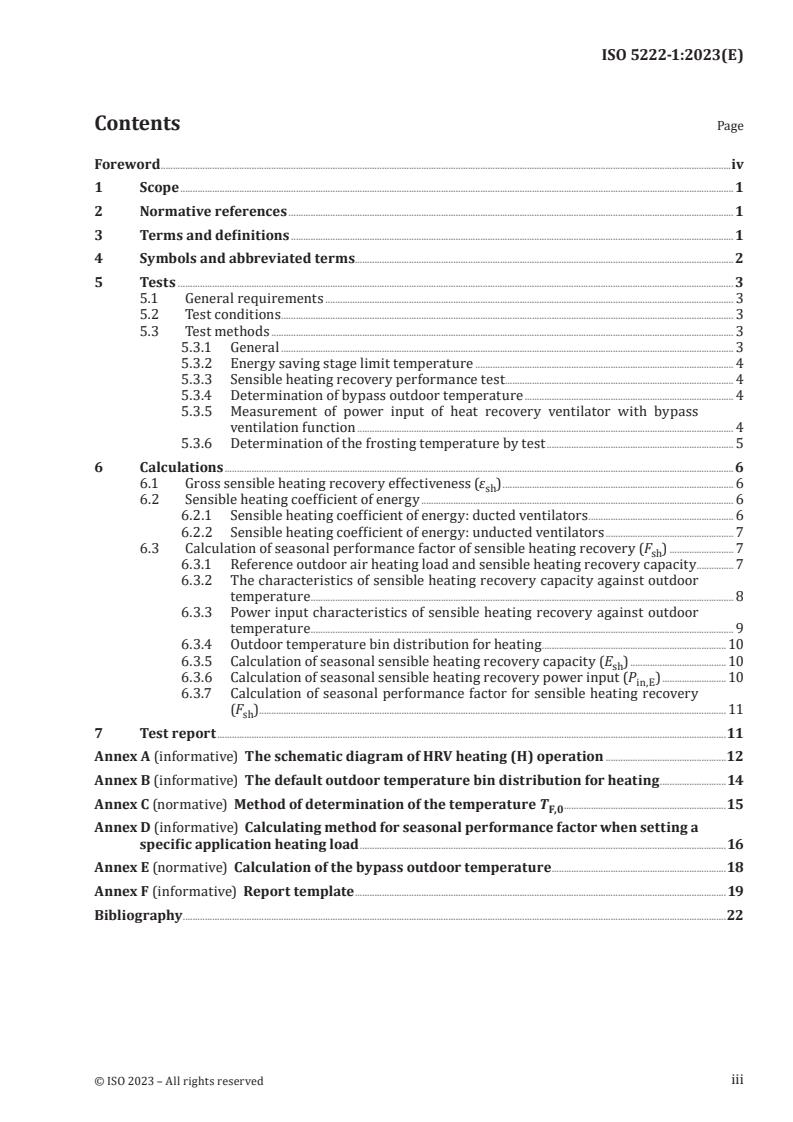
Contents Page
Foreword .iv
1 Scope . 1
2 Normative references . 1
3 Terms and definitions . 1
4 Symbols and abbreviated terms.2
5 Tests . 3
5.1 General requirements . 3
5.2 Test conditions . 3
5.3 Test methods . 3
5.3.1 General . 3
5.3.2 Energy saving stage limit temperature . 4
5.3.3 Sensible heating recovery performance test . . 4
5.3.4 Determination of bypass outdoor temperature . 4
5.3.5 Measurement of power input of heat recovery ventilator with bypass
ventilation function . 4
5.3.6 Determination of the frosting temperature by test . 5
6 Calculations . 6
6.1 Gross sensible heating recovery effectiveness (ε ) . 6
sh
6.2 Sensible heating coefficient of energy . 6
6.2.1 Sensible heating coefficient of energy: ducted ventilators . 6
6.2.2 Sensible heating coefficient of energy: unducted ventilators . 7
6.3 Calculation of seasonal performance factor of sensible heating recovery (F ) . 7
sh
6.3.1 Reference outdoor air heating load and sensible heating recovery capacity . 7
6.3.2 The characteristics of sensible heating recovery capacity against outdoor
temperature . 8
6.3.3 Power input characteristics of sensible heating recovery against outdoor
temperature . 9
6.3.4 Outdoor temperature bin distribution for heating . 10
6.3.5 Calculation of seasonal sensible heating recovery capacity (E ) . 10
sh
6.3.6 Calculation of seasonal sensible heating recovery power input (P ) . 10
in,E
6.3.7 Calculation of seasonal performance factor for sensible heating recovery
(F ) . 11
sh
7 Test report .11
Annex A (informative) The schematic diagram of HRV heating (H) operation .12
Annex B (informative) The default outdoor temperature bin distribution for heating .14
Annex C (normative) Method of determination of the temperature T .15
F,0
Annex D (informative) Calculating method for seasonal performance factor when setting a
specific application heating load .16
Annex E (normative) Calculation of the bypass outdoor temperature .18
Annex F (informative) Report template .19
Bibliography .22
iii
Foreword
ISO (the International Organization for Standardization) is a worldwide federation of national standards
bodies (ISO member bodies). The work of preparing International Standards is normally carried out
through ISO technical committees. Each member body interested in a subject for which a technical
committee has been established has the right to be represented on that committee. International
organizations, governmental and non-governmental, in liaison with ISO, also take part in the work.
ISO collaborates closely with the International Electrotechnical Commission (IEC) on all matters of
electrotechnical standardization.
The procedures used to develop this document and those intended for its further maintenance are
described in the ISO/IEC Directives, Part 1. In particular, the different approval criteria needed for the
different types of ISO documents should be noted. This document was drafted in accordance with the
editorial rules of the ISO/IEC Directives, Part 2 (see www.iso.org/directives).
Attention is drawn to the possibility that some of the elements of this document may be the subject of
patent rights. ISO shall not be held responsible for identifying any or all such patent rights. Details of
any patent rights identified during the development of the document will be in the Introduction and/or
on the ISO list of patent declarations received (see www.iso.org/patents).
Any trade name used in this document is information given for the convenience of users and does not
constitute an endorsement.
For an explanation of the voluntary nature of standards, the meaning of ISO specific terms and
expressions related to conformity assessment, as well as information about ISO's adherence to
the World Trade Organization (WTO) principles in the Technical Barriers to Trade (TBT), see
www.iso.org/iso/foreword.html.
This document was prepared by Technical Committee ISO/TC 86, Refrigeration and air-conditioning,
Subcommittee SC 6, Testing and rating of air-conditioners and heat pumps.
A list of all parts in the ISO 5222 series can be found on the ISO website.
Any feedback or questions on this document should be directed to the user’s national standards body. A
complete listing of these bodies can be found at www.iso.org/members.html.
iv
INTERNATIONAL STANDARD ISO 5222-1:2023(E)
Heat recovery ventilators and energy recovery
ventilators — Testing and calculating methods for seasonal
performance factor —
Part 1:
Sensible heating recovery seasonal performance factors of
heat recovery ventilators (HRV)
1 Scope
This document specifies the testing and calculating methods for sensible heating recovery seasonal
performance factor of heat recovery ventilators (HRV) covered by ISO 16494-1.
This document also specifies the test conditions and the corresponding test procedures for determining
the sensible heating recovery seasonal performance factor of HRV and is intended for use only in
marking, comparison, and certification purposes. For the purposes of this document, the rating
conditions are those specified in ISO 16494-1 and in Annex B. The procedures of this document may be
used for other temperature conditions.
2 Normative references
The following documents are referred to in the text in such a way that some or all of their content
constitutes requirements of this document. For dated references, only the edition cited applies. For
undated references, the latest edition of the referenced document (including any amendments) applies.
ISO 16494-1:2022, Heat recovery ventilators and energy recovery ventilators — Method of test for
performance — Part 1: Development of metrics for evaluation of energy related performance
3 Terms and definitions
For the purposes of this document, the terms and definitions given in ISO 16494-1 and the following
apply.
ISO and IEC maintain terminology databases for use in standardization at the following addresses:
— ISO Online browsing platform: available at https:// www .iso .org/ obp
— IEC Electropedia: available at https:// www .electropedia .org/
3.1
heat recovery
transfer of sensible energy from exhaust air to supply air in the HRV while heating
3.2
bypass ventilation function
function for reducing power input of the fans while the heat energy recovered is less than the additional
energy input due to overcoming the resistance of recovery heat exchanger during its operation time
Note 1 to entry: The bypass function makes the supply air and exhaust air go through the heat recovery exchanger
bypass with energy saving control.
3.3
coefficient of energy
total sensible heating energy exchanged between the air streams plus the power
value of moving air, divided by the power input
Note 1 to entry: The formula for determining C is given in 6.2.1 and C in 6.2.2.
sh,d,t,j sh,u,d,t,j
3.4
gross effectiveness
measured effectiveness, not adjusted for leakage, motor heat gain, or heat transfer
through the unit casing
Note 1 to entry: The sensible heating gross effectiveness of an HRV, at equal airflow, is described in
ISO 16494-1:2022, 9.5.
3.5
bypass outdoor temperature
T
b
outdoor temperature in heating conditions, at which the electric power reduction to the HRV by
operating in bypass mode is equal to the saving of electric power input to the heating system due to the
heat recovered by the HRV
3.6
seasonal performance factor of sensible heating recovery
F
sh
ratio of seasonal amount of sensible heat recovered together with power value of moving air to the
whole electricity input of HRV, under the rating conditions and seasonal outdoor temperature bins
selected from this standard
3.7
building heating balance temperature
T
BHB
outdoor air temperature at which building internal heat gain, solar radiation, and so on, equals to heat
loss through the building envelope
4 Symbols and abbreviated terms
Symbol Description Unit
E Capacity of seasonal sensible heating recovery Wh
sh
C Sensible heating coefficient of energy for ducted ventilator at outdoor air W/W
sh,d,t,j
bin temperature t
j
C Sensible heating coefficient of energy for unducted ventilator at outdoor W/W
sh,u,d,t,j
air bin temperature t
j
c Specific heat of leaving supply air (SA) kJ/kg· °C
p
L Reference outdoor air sensible heating load at outdoor air bin temperature t W
sh,t,j j
n Bin hours which the outdoor air bin temperature occurs h
j
n Number of temperature bins -
P Power input to ventilator at outdoor air bin temperature t W
in,t,j j
P Power input to the HRV to operate the fans at outdoor air bin temperature W
in,no,t,j
t for all stages, for HRVs without bypass
j
P Power input to the HRV at outdoor air bin temperature t for bin temper- W
in,by,t,j j
ature in stage 1 or 2, for HRVs with bypass
P Power input to a supplementary preheater at full capacity W
in,h,t,j
P Ventilation power input of the HRV at outdoor air bin temperature W
in,v,t,j
P Power value of moving air at outdoor air bin temperature t J/s or W
vma,t,j j
Symbol Description Unit
P Electricity power input of seasonal sensible heating recovery Wh
in,E
Q Net supply mass flow rate kg/s
m2, net
F Seasonal performance factor of sensible heating recovery Wh/Wh
sh
T Outdoor air temperature when HRV operates under air bypass function °C
b
T The outdoor air bin temperature at which the frost occurs °C
F
T Temperature defined in ISO 16494-1:2022, Table 2 as T5/T6/T7 °C
set,h
ε Gross sensible heating effectiveness of HRV %
sh
ϕ Sensible heat recovery capacity of the HRV at outdoor air bin temperature t W
sh,t,j j
5 Tests
5.1 General requirements
The test conditions used, the accuracy and uncertainties of the instruments used shall conform with
ISO 16494-1 and those in this document.
5.2 Test conditions
For the purpose of ε , E and F , there are three standard test conditions T5/T6/T7 corresponding to
sh sh sh
ISO 16494-1:2022, Table 2. The HRV shall be tested at one of the three test conditions, which shall be
selected to most closely represent the outdoor temperature bin distribution in the region as described
in Annex B and Annex D.
Outdoor temperature bin distribution and bin hours differ from region to region. If bin hours are set to a
certain value for a certain region, the integrated value of heating load and electric energy consumption
can be determined.
Table 1 shows the requirement of default values and the reference outdoor temperature bin distribution
for test and calculation. In case of setting other outdoor temperature bin distribution, refer to the
setting method as described in Annex D.
Table 1 — Conditions of performance test (heating)
Outdoor air temperature Indoor air temperature Application
(°C) (°C) temperature bin type
for calculation
Dry bulb Wet bulb Dry bulb Wet bulb
T5 2 1 21 14 In Annex B or D
T6 5 3 20 15
T7 7 6 20 12
NOTE Allowable variation of readings is given in Table F.2 in ISO 16494-1:2022.
5.3 Test methods
5.3.1 General
For higher seasonal energy performance, HRV can be designed with airflow bypass function integrating
fan speed control or airflow dampers adjust, which can change the fan power input according to
different outdoor temperature condition, while keeping necessary aerodynamic performance.
5.3.2 Energy saving stage limit temperature
To assess the energy saving ability of HRV, the operation stages under the application temperature bin
are shown in Annex A using a schematic diagram.
5.3.3 Sensible heating recovery performance test
5.3.3.1 Standard condition performance tests
The sensible heating recovery performance tests shall be conducted in accordance with ISO 16494-1.
The sensible heating recovery performance, efficiency, as well as airflow and static pressure shall be
measured corresponding to the selected standard heating performance tests conditions in Table 1.
5.3.3.2 Determination of performance at application climate
The sensible heating recovery performance under certain climate temperature bins shall also be
determined by calculation using the temperature bins see Annex B and Annex D.
5.3.4 Determination of bypass outdoor temperature
The manufacturer shall specify the value of bypass outdoor temperature. The laboratory shall verify
that the unit under test is functioning and what the test action temperature is. If it is not specified by
the manufacturer, the laboratory shall calculate the outdoor bypass temperature and set it as the T in
b
accordance with Annex E.
5.3.5 Measurement of power input of heat recovery ventilator with bypass ventilation function
5.3.5.1 The manufacturer may provide information on how to set the bypass function if requested by
the testing laboratories.
NOTE 1 Due to the additional air resistance of the heat recovery exchanger, when the heat energy recovered
is less than the additional energy input due to overcoming the resistance of recovery heat exchanger during
its operation time, the equipment can provide the bypass ventilation function to reduce the additional energy
consumption, when only ventilation is necessary.
NOTE 2 When the bypass ventilation function acts, there can be several means to reduce the additional energy
consumption (e.g. with fan speed control or valve control in the fan’s inlet or outlet, etc., to keep the same airflow
rate and pressure as rating performance condition).
5.3.5.2 The tests shall be conducted at the required control set which allows steady state operation of
the equipment at the given test conditions.
5.3.5.3 Test of unit with bypass ventilation function and fan speed control:
a) Set up the bypass ventilation function according to the manufacturer's instructions.
b) Adjust test auxiliary device to keep the average pressure value at air outlet and inlet of unit in
Figure A.1 of ISO 16494-1:2022, within the 5 % of tested unit’s nominal value, the airflow rate
larger or equal to its nominal value.
c) According to ISO 16494-1, measure and record the data of airflow rate, the pressure and electricity
power input.
d) Determine and record the outdoor temperature at which the bypass ventilation function acts,
either by manufacturer's statement, or by measure. The power input value measured when bypass
ventilation functions is activated is recorded as the bypass ventilation function power input, used
for calculation for F corresponding to each outdoor bin temperature in ventilation period.
sh
5.3.5.4 Test of unit with bypass ventilation function and with electric driving air damper
automatically, but without fan speed control:
a) Set up the bypass ventilation function according to the manufacturer's instructions.
b) Adjust the test auxiliary device to keep the average pressure value within the 5 % of the tested
unit’s nominal value, the airflow rate larger or equal to its nominal value.
c) Determine and record the outdoor temperature at which the bypass ventilation function acts,
either by the manufacturer's statement, or by measurement. The power input value measured when
bypass ventilation function is on shall be recorded as the bypass ventilation function power input,
used for the calculation of F corresponding to each outdoor bin temperature in the ventilation
sh
period.
5.3.5.5 Test of equipment with bypass ventilation function and without fan speed control and
without automatic adjust air damper:
a) Set up the bypass ventilation function according to manufacturer’s instruction.
b) According to ISO 16494-1, do not adjust any of the test auxiliary devices during test and record the
data of airflow rate, the pressure and power input.
c) Determine and record the outdoor temperature that the bypass ventilation function acts, either by
the manufacturer's statement, or by test.
d) The power input value measured when bypass ventilation functions on is recorded as the bypass
ventilation function power input, used for calculation for F corresponding to each outdoor bin
sh
temperature in ventilation period.
5.3.5.6 Test of equipment with no bypass ventilation function:
For the equipment with no bypass ventilation function, the power input is the value as same as in 5.3.3.1
all stages, which shall be used for calculation for F corresponding to each outdoor temperature in
sh
ventilation period.
5.3.6 Determination of the frosting temperature by test
5.3.6.1 The frost temperature test shall be conducted in accordance with ISO 16494-1.
The manufacturer may provide information on how to operate the equipment if requested by the
testing laboratories.
5.3.6.2 The test condition shall be as follows:
a) The airflow rate and static pressure shall keep the same as 5.3.3.1.
b) The entering exhaust air (RA) temperature shall be kept at conditions T5/T6/T7 specified in
Table 1 and entering supply air (OA) temperature shall be gradually reduced from 0 °C, or, in order
to reduce the duration time of the test, from the T , which is described in Annex C, plus 2 K.
F,0
NOTE The calculation of T refers to Annex C.
F,0
5.3.6.3 Confirmation of frost outdoor air temperature:
a) Turn off the supplement heat function for anti-frost.
b) Conduct the tests of gross sensible heating recovery effectiveness of HRV by changing outdoor
temperature from the T plus 2 K to lower temperature. While adjusting the outdoor air
F,0
temperature, keep the reducing rate of temperature not less than 0,5 K per hour and not greater
than 1,0 K per hour.
c) Record the inlet and outlet air parameters so that gross sensible heating effectiveness can be
calculated every 0,5 h.
d) Calculate the gross sensible heat effectiveness in accordance with ISO 16494-1:2022, 9.5.
e) If the absolute value of the change of the gross sensible heating effectiveness between the outdoor
temperature t and temperature t is greater than 5 %, the higher temperature of the outdoor
j j-1
temperatures is confirmed as a frost outdoor temperature.
f) Compare the tested T with the one in practice, if the tested T is lower than the one in practice,
F F
select the temperature in practice as the stage limitation temperature, otherwise, the tested T
F
shall be the stage limitation temperature.
5.3.6.4 Data collection:
During the frost temperature tests, airflow rate, static pressure, barometer pressure and power input
as well as air temperature shall be collected and recorded. A continuous air temperature variation
curve drawing shall be necessary.
6 Calculations
6.1 Gross sensible heating recovery effectiveness (ε )
sh
The gross sensible heating recovery effectiveness of HRV at rated test condition is described in
ISO 16494-1:2022, 9.5.
6.2 Sensible heating coefficient of energy
6.2.1 Sensible heating coefficient of energy: ducted ventilators
The sensible heating coefficient of energy for a ducted ventilator (C ) shall be calculated by
sh,d,t,j
Formula (1):
Qc×× Tt− ×+ε ×1 000 P
()
m2,netp 0 jvsh ma,t,j
C = (1)
sh,d,t,j
P
in,t,j
where
C is the sensible heating coefficient of energy for a ducted ventilator at outdoor air bin tem-
sh,d,t,j
perature
...