


ISO 8548-4:1998
(Main)Prosthetics and orthotics — Limb deficiencies — Part 4: Description of causal conditions leading to amputation
Prosthetics and orthotics — Limb deficiencies — Part 4: Description of causal conditions leading to amputation
Prothèses et orthèses — Malformations des membres — Partie 4: Description des causes qui conduisent à l'amputation
General Information
- Status
- Published
- Publication Date
- 22-Jul-1998
- Technical Committee
- ISO/TC 168 - Prosthetics and orthotics
- Drafting Committee
- ISO/TC 168/WG 1 - Nomenclature and classification
- Current Stage
- 9060 - Close of review
- Completion Date
- 04-Jun-2029
Overview
ISO 8548-4:1998 is an international standard developed by the International Organization for Standardization (ISO) under the technical committee ISO/TC 168, focused on prosthetics and orthotics. This standard provides a systematic method for describing the causal conditions that lead to limb amputation. It is part 4 of the ISO 8548 series, which addresses the classification and description of limb deficiencies and related clinical conditions.
The document aims to standardize the terminology and reporting related to the clinical and pathological causes of amputations, enabling consistent communication among healthcare professionals and facilitating accurate data collection, analysis, and comparison across institutions and countries.
Key Topics
Clinical Conditions Leading to Amputation
ISO 8548-4 defines various clinical states that precipitate amputation, including:- Life-threatening situations
- Limb non-viability
- Severe pain
- Serious injury
- Infections
- Ulcerations
- Tumors (neoplasms)
- Neurological disorders
- Congenital malformations or acquired deformities
Pathological Contexts Leading to Amputation
The standard categorizes pathologies causing amputations as:- Trauma (mechanical, thermal, electrical, chemical, radioactive)
- Vascular diseases (such as atherosclerosis, thrombosis, diabetes-related vascular disease)
- Infections (affecting soft tissue, bone, or joints; acute or chronic)
- Neurological disorders (from congenital anomalies, injuries, infections, systemic diseases)
- Neoplasms (benign or malignant, primary or secondary tumors)
- Congenital malformations or acquired deformities
Use of Disease Classification Codes
The standard recommends citing specific diseases leading to amputation using the International Classification of Diseases (ICD) coding system. This promotes uniformity in medical reporting and data sharing.Purpose and Benefits of Standardization
By defining a minimal set of descriptive information regarding amputation causes, ISO 8548-4 facilitates:- Improved clinical rehabilitation strategies tailored to individual patient conditions
- Enhanced interdisciplinary communication among surgeons, physicians, therapists, prosthetists, and epidemiologists
- Reliable data collection for epidemiological research and public health management
- Easier integration of clinical records into electronic health systems for analysis
Applications
ISO 8548-4 is highly valuable in numerous healthcare and research settings:
Clinical Rehabilitation
Assists multidisciplinary teams in understanding patient background, optimizing prosthetic fitting, and developing effective rehabilitation plans based on the cause of amputation.Medical Reporting and Documentation
Standardized descriptions improve the quality of medical records, insurance claims, and legal documentation related to amputations.Epidemiological Studies and Public Health
Enables consistent classification of amputation causes for statistical analysis, contributing to better prevention programs and resource allocation.Healthcare Policy and Administration
Provides a common framework for ministries of health and regulatory bodies to monitor limb deficiency trends and outcomes.Prosthetic and Orthotic Manufacturing
Supplies manufacturers with essential data to design devices tailored to specific amputation causes and patient needs.
Related Standards
ISO 8548-4 is part of a comprehensive series on limb malformations and amputations. Related ISO standards include:
ISO 8548-1:1989
Method for describing congenital limb malformations.ISO 8548-2:1993
Method for describing lower limb amputation stumps.ISO 8548-3:1993
Method for describing upper limb amputation stumps.ISO 8548-6
Description of the patient's condition requiring a prosthesis.ISO 8549 series
Vocabulary standards covering general prosthetic and orthotic terms, including terminology related to limb prostheses and their users.
Adherence to these interconnected standards supports comprehensive, harmonized documentation and enhances the overall quality of prosthetic and orthotic care worldwide.
Keywords: ISO 8548-4, prosthetics and orthotics standards, limb deficiencies, amputation causes, clinical conditions, pathological states, vascular disease, trauma, infection, neoplasm, congenital malformation, ICD codes, rehabilitation, medical documentation, prosthetic fitting, healthcare standards.


Get Certified
Connect with accredited certification bodies for this standard

BSI Group
BSI (British Standards Institution) is the business standards company that helps organizations make excellence a habit.

TÜV Rheinland
TÜV Rheinland is a leading international provider of technical services.

TÜV SÜD
TÜV SÜD is a trusted partner of choice for safety, security and sustainability solutions.
Sponsored listings
Frequently Asked Questions
ISO 8548-4:1998 is a standard published by the International Organization for Standardization (ISO). Its full title is "Prosthetics and orthotics — Limb deficiencies — Part 4: Description of causal conditions leading to amputation". This standard covers: Prosthetics and orthotics — Limb deficiencies — Part 4: Description of causal conditions leading to amputation
Prosthetics and orthotics — Limb deficiencies — Part 4: Description of causal conditions leading to amputation
ISO 8548-4:1998 is classified under the following ICS (International Classification for Standards) categories: 11.040.40 - Implants for surgery, prosthetics and orthotics. The ICS classification helps identify the subject area and facilitates finding related standards.
ISO 8548-4:1998 is available in PDF format for immediate download after purchase. The document can be added to your cart and obtained through the secure checkout process. Digital delivery ensures instant access to the complete standard document.
Standards Content (Sample)
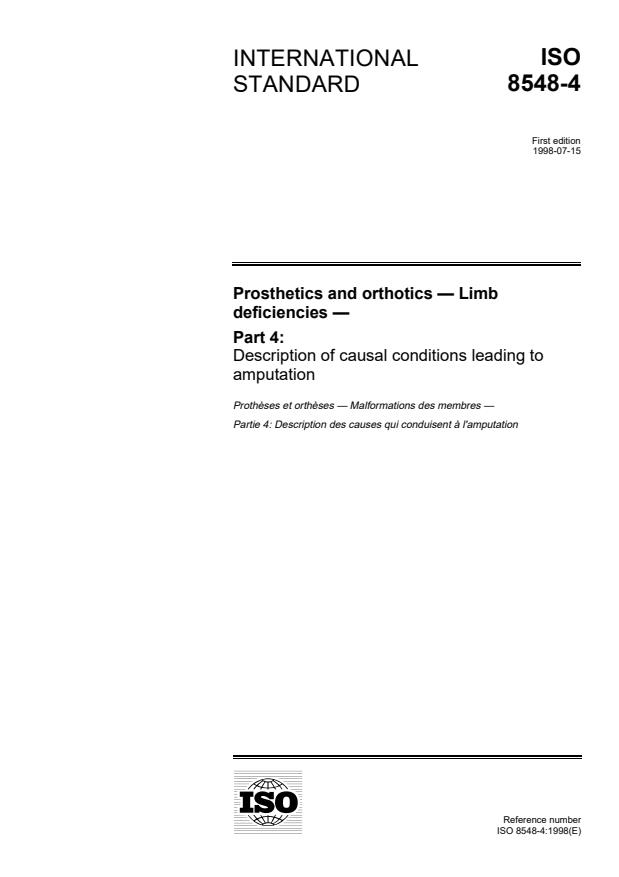
INTERNATIONAL ISO
STANDARD 8548-4
First edition
1998-07-15
Prosthetics and orthotics — Limb
deficiencies —
Part 4:
Description of causal conditions leading to
amputation
Prothèses et orthèses — Malformations des membres —
Partie 4: Description des causes qui conduisent à l'amputation
A
Reference number
Foreword
ISO (the International Organization for Standardization) is a worldwide
federation of national standards bodies (ISO member bodies). The work of
preparing International Standards is normally carried out through ISO
technical committees. Each member body interested in a subject for which
a technical committee has been established has the right to be represented
on that committee. International organizations, governmental and non-
governmental, in liaison with ISO, also take part in the work. ISO
collaborates closely with the International Electrotechnical Commission
(IEC) on all matters of electrotechnical standardization.
Draft International Standards adopted by the technical committees are
circulated to the member bodies for voting. Publication as an International
Standard requires approval by at least 75 % of the member bodies casting
a vote.
International Standard ISO 8548-4 was prepared by Technical Committee
ISO/TC 168, Prosthetics and orthotics.
ISO 8548 consists of the following parts under the general title Prosthetics
and orthotics — Limb deficiencies:
— Part 1: Method of describing limb deficiencies present at birth
— Part 2: Method of describing lower limb amputation stumps
— Part 3: Method of describing upper limb amputation stumps
— Part 4: Description of causal conditions leading to amputation
— Part 6: Description of condition of patient requiring a prosthesis
Future parts will deal with other descriptions of limb deficiencies.
© ISO 1998
All rights reserved. Unless otherwise specified, no part of this publication may be reproduced
or utilized in any form or by any means, electronic or mechanical, including photocopying and
microfilm, without permission in writing from the publisher.
International Organization for Standardization
Case postale 56 • CH-1211 Genève 20 • Switzerland
Internet iso@iso.ch
Printed in Switzerland
ii
©
ISO ISO 8548-4:1998(E)
Introduction
The outcome of the rehabilitation of a patient who has had an amputation
depends not only on the surgery performed and the prosthesis which may
be fitted, but also on the cause and underlying condition for which the
amputation was performed, and on other disabilities and attributes of the
patient. Members of clinic teams in different countries develop their own
nomenclature to meet their own needs. Hence there is a need for an
international system to be developed in order to compare one publication
with another and one patient with another. The different care groups who
would appreciate and use a standardized system of describing the reason
for amputation and the general state of the patient include surgeons, other
doctors (especially those concerned with rehabilitation), physical and
occupational therapists and prosthetists. Such a system would also be of
value to epidemiologists and government health officials.
The system proposed has to meet the needs of the different members of
the clinic team and to enable the description of the cause of amputation
and the underlying condition to be recorded in a way that can be easily
incorporated in reports. This part of ISO 8548 deliberately aims at defining
the minimum information to be described. It should be feasible for this
information to be included in forms designed by the individual institution
and be capable of ready adaptation for computer analysis.
iii
©
INTERNATIONAL STANDARD ISO ISO 8548-4:1998(E)
Prosthetics and orthotics — Limb deficiencies —
Part 4:
Description of causal conditions leading to amputation
1 Scope
This part of ISO 8548 establishes a method of describing the causal conditions leading to amputation and the
underlying pathology.
2 Normative references
The following standards contain provisions which, through reference in this text, constitute provisions of this part of
ISO 8548. At the time of publication, the editions indicated were valid. All standards are subject to revision, and
parties to agreements based on this part of ISO 8548 are encouraged to investigate the
...
NORME ISO
INTERNATIONALE 8548-4
Première édition
1998-07-15
Prothèses et orthèses — Malformations
des membres —
Partie 4:
Description des causes qui conduisent à
l'amputation
Prosthetics and orthotics — Limb deficiencies —
Part 4: Description of causal conditions leading to amputation
A
Numéro de référence
Avant-propos
L'ISO (Organisation internationale de normalisation) est une fédération
mondiale d'organismes nationaux de normalisation (comités membres de
l'ISO). L'élaboration des Normes internationales est en général confiée aux
comités techniques de l'ISO. Chaque comité membre intéressé par une
étude a le droit de faire partie du comité technique créé à cet effet. Les
organisations internationales, gouvernementales et non gouvernementales,
en liaison avec l'ISO participent également aux travaux. L'ISO collabore
étroitement avec la Commission électrotechnique internationale (CEI) en
ce qui concerne la normalisation électrotechnique.
Les projets de Normes internationales adoptés par les comités techniques
sont soumis aux comités membres pour vote. Leur publication comme
Normes internationales requiert l'approbation de 75 % au moins des
comités membres votants.
La Norme internationale ISO 8548-4 a été élaborée par le comité technique
ISO/TC 168, Prothèses et orthèses.
L'ISO 8548 comprend les parties suivantes, présentées sous le titre
général Prothèses et orthèses — Malformations des membres:
— Partie 1: Méthode de description des malformations congénitales des
membres
— Partie 2: Méthode de description des moignons d'amputation des
membres inférieurs
— Partie 3: Méthode de description des moignons d'amputation des
membres supérieurs
— Partie 4: Description des causes qui conduisent à l'amputation
— Partie 6: Description de la condition du patient nécessitant une
prothèse
D'autres descriptions relatives aux malformations des membres seront
traitées dans des parties à venir.
© ISO 1998
Droits de reproduction réservés. Sauf prescription différente, aucune partie de cette publi-
cation ne peut être reproduite ni utilisée sous quelque forme que ce soit et par aucun pro-
cédé, électronique ou mécanique, y compris la photocopie et les microfilms, sans l'accord
écrit de l'éditeur.
Organisation internationale de normalisation
Case postale 56 • CH-1211 Genève 20 • Suisse
Internet iso@iso.ch
Imprimé en Suisse
ii
©
ISO ISO 8548-4:1998(F)
Introduction
Le succès de la réhabilitation fonctionnelle d'un malade ayant subi une
amputation dépend non seulement de l'acte chirurgical réalisé et de la
prothèse susceptible d'être adaptée, mais aussi de la cause ayant conduit
à l'amputation et du contexte dans lequel elle a été effectuée, ainsi que
d'autres infirmités et attributs du malade. Les membres des équipes
cliniques des différents pays mettent au point des nomenclatures
différentes qui satisfont à leurs propres besoins. Par conséquent, il est
nécessaire de mettre au point un système international qui permette de
comparer une publication à une autre et un malade à un autre. Les divers
centres de soins qui apprécieraient et utiliseraient un système normalisé de
description de la cause de l'amputation et de l'état général du malade
comprendraient les chirurgiens, les médecins (en particulier ceux
concernés par la réhabilitation), les kinésithérapeutes, les ergothérapeutes
et les prothésistes. Un tel système intéresserait également les
épidémiologistes et les fonctionnaires du Ministère de la santé.
Le système proposé doit satisfaire aux besoins des différents membres de
l'équipe clinique et permettre d'enregistrer la description de la cause et du
contexte pathologique qui ont conduit à l'amputation, selon un mode qui
puisse être facilement adopté dans les rapports. La présente partie de
l'ISO 8548 a pour objectif de définir le minimum d'informations à décrire. Il
conviendrait que ces informations soient portées sur des formulaires
conçus par l'institution concernée et qu'elles puissent être aisément
soumises à une adaptation pour pouvoir être analysées par ordinateur.
iii
©
NORME INTERNATIONALE ISO ISO 8548-4:1998(F)
Prothèses et orthèses — Malformations des membres —
Partie 4:
Description des causes qui conduisent à l'amputation
1 Domaine d'application
La présente partie de l'ISO 8548 établit une méthode de description de l'état clinique et du contexte pathologique
conduisant à l'amputation.
2 Références normatives
Les normes suivantes contiennent des dispositions qui, par suite de la référence qui en est faite, constituent des
dispositions valables pour la présente partie de l'ISO 8548. Au moment de la publication, les éditions indiquées
étaient en vigueur. Toute norme est sujette à révision et les parties prenantes des accords fondés sur la présente
partie de l'ISO 8548 sont invitées à rechercher la possibilité d'appliquer les éditions les plus récentes des normes
indiquées ci-après. Les membres de la CEI et de l'ISO possèdent le registre de
...
Questions, Comments and Discussion
Ask us and Technical Secretary will try to provide an answer. You can facilitate discussion about the standard in here.
Loading comments...