


ISO/IEC 9579-1:1993
(Main)Information technology — Open Systems Interconnection — Remote Database Access — Part 1: Generic Model, Service and Protocol
Information technology — Open Systems Interconnection — Remote Database Access — Part 1: Generic Model, Service and Protocol
Technologies de l'information — Interconnexion de systèmes ouverts (OSI) — Accès aux bases de données à distance — Partie 1: Modèle, service et protocole
General Information
- Status
- Withdrawn
- Publication Date
- 22-Dec-1993
- Withdrawal Date
- 22-Dec-1993
- Technical Committee
- ISO/IEC JTC 1/SC 32 - Data management and interchange
- Drafting Committee
- ISO/IEC JTC 1/SC 32 - Data management and interchange
- Current Stage
- 9599 - Withdrawal of International Standard
- Start Date
- 10-Jun-1999
- Completion Date
- 14-Feb-2026
Relations
- Effective Date
- 06-Jun-2022
- Effective Date
- 15-Apr-2008
- Effective Date
- 15-Apr-2008
Get Certified
Connect with accredited certification bodies for this standard

BSI Group
BSI (British Standards Institution) is the business standards company that helps organizations make excellence a habit.

NYCE
Mexican standards and certification body.
Sponsored listings
Frequently Asked Questions
ISO/IEC 9579-1:1993 is a standard published by the International Organization for Standardization (ISO). Its full title is "Information technology — Open Systems Interconnection — Remote Database Access — Part 1: Generic Model, Service and Protocol". This standard covers: Information technology — Open Systems Interconnection — Remote Database Access — Part 1: Generic Model, Service and Protocol
Information technology — Open Systems Interconnection — Remote Database Access — Part 1: Generic Model, Service and Protocol
ISO/IEC 9579-1:1993 is classified under the following ICS (International Classification for Standards) categories: 35.100.70 - Application layer. The ICS classification helps identify the subject area and facilitates finding related standards.
ISO/IEC 9579-1:1993 has the following relationships with other standards: It is inter standard links to ISO/IEC 9579-1:1993/Cor 1:1995, ISO/IEC 9579:1999; is excused to ISO/IEC 9579-1:1993/Cor 1:1995. Understanding these relationships helps ensure you are using the most current and applicable version of the standard.
ISO/IEC 9579-1:1993 is available in PDF format for immediate download after purchase. The document can be added to your cart and obtained through the secure checkout process. Digital delivery ensures instant access to the complete standard document.
Standards Content (Sample)
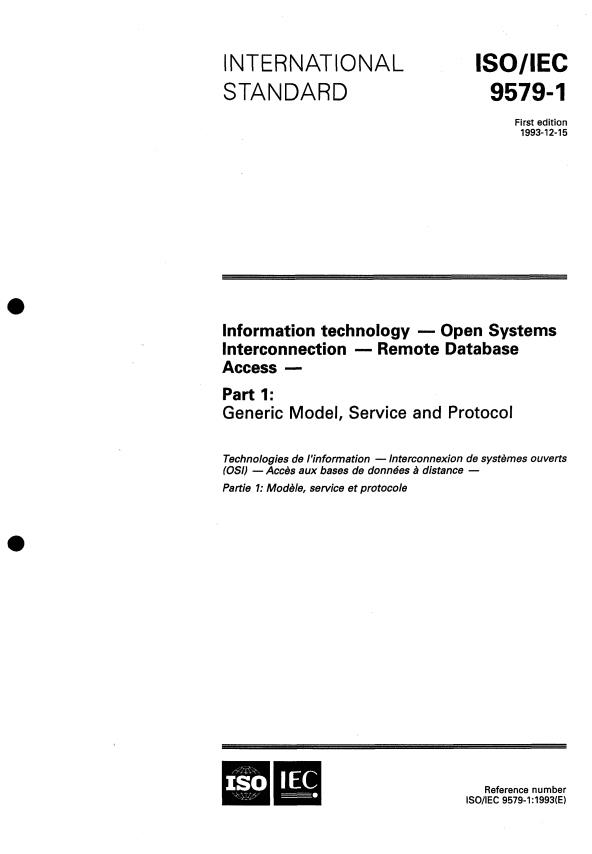
I N TE R NAT I O NA L ISO/IEC
S TA N DAR D 9579-7
First edition
1993-1 2-15
Information technology - Open Systems
Interconnection - Remote Database
Access -
Part 1:
Generic Model, Service and Protocol
Technologies de l'information - Interconnexion de systèmes ouverts
(OSI) -Accès aux bases de données à distance -
Pattie I: Modéle, service et protocole
Reference number
ISO/IEC 9579-1: 1993 (E)
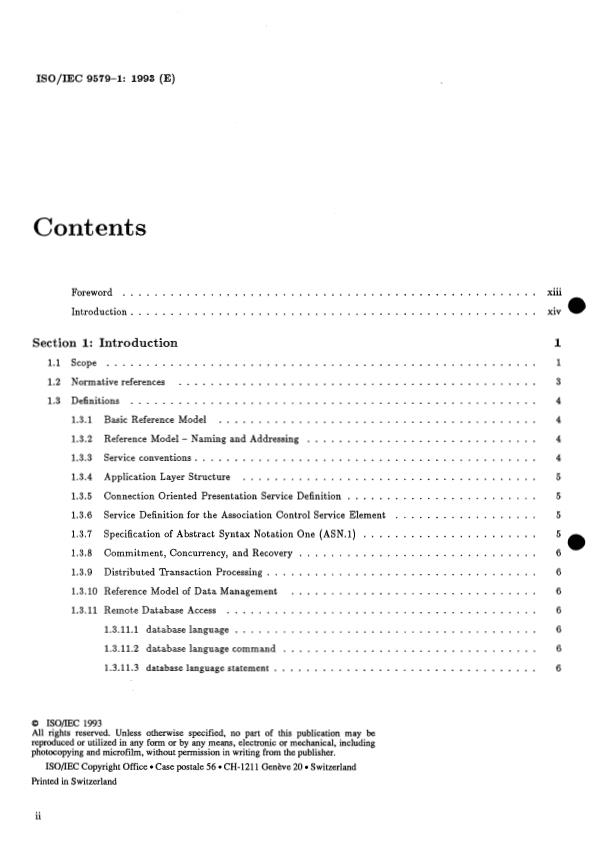
Contents
...
Foreword .
Introduction . xiv
xlll O
Section 1: Introduction 1
Scope . 1
1.1
1.2 Normative references . 3
Definitions . 4
1.3
1.3.1 Basic Reference Model . 4
1.3.2 Reference Model - Naming and Addressing . 4
1.3.3 Service conventions . 4
1.3.4 Application Layer Structure . 5
1.3.5 Connection Oriented Presentation Service Definition . 5
1.3.6 Service Definition for the Association Control Service Element . 5
1.3.7 Specification of Abstract Syntax Notation One (ASN.1) .
1.3.8 Commitment, Concurrency, and Recovery . 6
1.3.9 Distributed Transaction Processing . 6
1.3.10 Reference Model of Data Management . 6
1.3.11 Remote Database Access . 6
1.3.11.1 database language . 6
1.3.11.2 database language command . 6
1.3.1 1.3 database language statement . 6
(D ISO/IEC1993
Ail rights reserved . Unless otherwise specified. no part of this publication may be
reproduced or utilized in any form or by any means. electronic or mechanical. including
photocopying and microfilm. without permission in writing from the publisher .
ISO/IEC Copyright Office Case postale 56 CH-1211 Genève 20 Switzerland
Printed in Switzerland
ISO/IEC 9579-1: 1993 (E)
@ISO/IEC
1.3.11.4 database server . 6
1.3.11.5 data resource . 7
1.3.11.6 RDA client . 7
1.3.11.7 RDA Control service . 7
1.3.11.8 RDA dialogue . 7
1.3.11.9 RDA dialogue-state model . 7
1.3.11.10 RDA Generic Standard . 7
1.3.11.11 RDA operation . 7
1.3.11.12 RDA protocol machine . 7
1.3.11.13 RDA server . 7
e
1.3.11.14 RDA Service . 7
1.3.11.15 RDA Specialization Standard, RDA Specialization . 7
1.3.11.16 RDA transaction . 7
1.4 Abbreviations . 8
1.5 Conventions . 9
1.5.1 Service conventions . 9
1.5.2 Service parameter description . 9
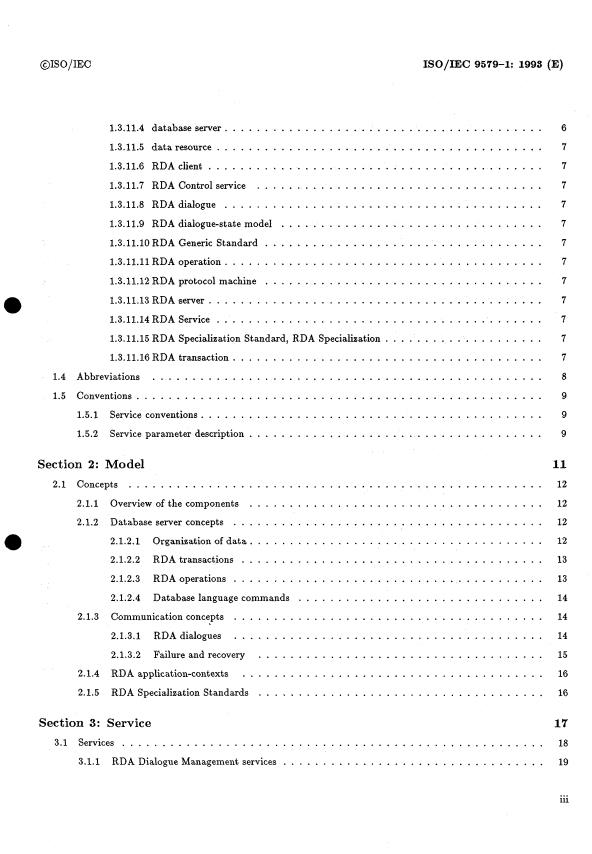
Section 2: Model 11
............................ ... 12
2.1 Concepts . . .
2.1.1 Overview of the components . 12
2.1.2 Database server concepts . 12
2.1.2.1 Organization of data . 12
a
2.1.2.2 RDA transactions . 13
2.1.2.3 RDA operations . 13
2.1.2.4 Database language commands . 14
2.1.3 Communication concepts . 14
2.1.3.1 RDA dialogues . 14
2.1.3.2 Failure and recovery . 15
2.1.4 RDA application-contexts . 16
2.1.5 RDA Specialization Standards . 16
Section 3: Service
3.1 Services . 18
3.1.1 RDA Dialogue Management services . 19
...
ISO/IEC 9579-1: 1993 (E)
@ISO/IEC
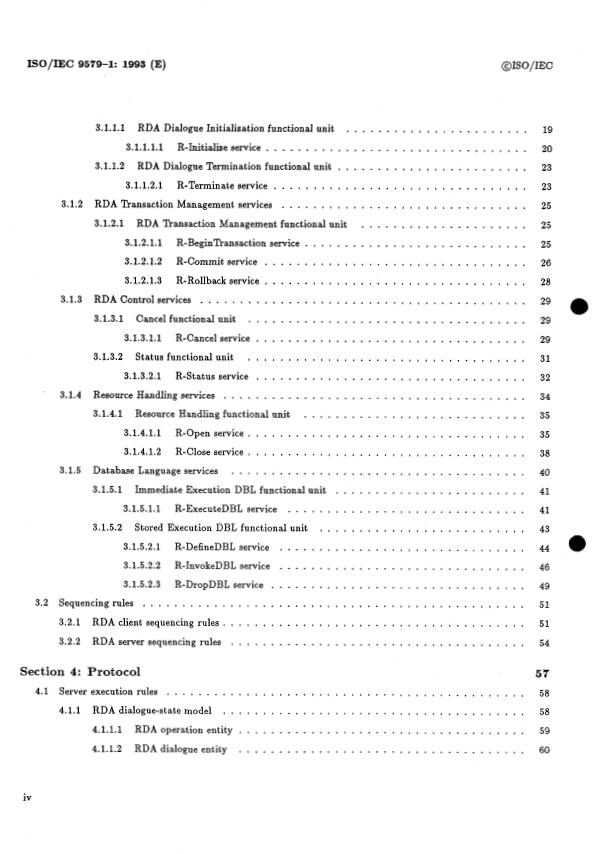
3.1.1.1 RDA Dialogue Initialization functional unit . 19
3.1.1.1.1 R-Initialbe service . 20
3.1.1.2 RDA Dialogue Termination functional unit . 23
3.1.1.2.1 R-Terminate service . 23
3.1.2 RDA Transaction Management services . 25
3.1.2.1 RDA Transaction Management functional unit . 25
3.1.2.1.1 R-BeginTransaction service . 25
3.1.2.1.2 R-Commit service . 26
3.1.2.1.3 R-Rollback service . 28
.........................................
3.1.3 RDA Control services 29
3.1.3.1 Cancel functional unit . 29
3.1.3.1.1 R-Cancel service . 29
3.1.3.2 Status functional unit . 31
3.1.3.2.1 R-Status service . 32
3.1.4 Resource Handling services . 34
3.1.4.1 Resource Handling functional unit . 35
3.1.4.1.1 R-Open service . 35
3.1.4.1.2 R-Close service . 38
3.1.5 Database Language services . 40
3.1.5.1 Immediate Execution DBL functional unit . 41
3.1.5.1.1 R-ExecuteDBL service . 41
3.1.5.2 Stored Execution DBL functional unit . 43
3.1.5.2.1 R-DefineDBL service . 44
e
3.1.5.2.2 R-InvokeDBL service . 46
3.1.5.2.3 R-DropDBL service . 49
................................................
3.2 Sequencing rules 51
3.2.1 RDA client sequencing rules . 51
3.2.2 RDA server sequencing rules . 54
Section 4: Protocol 57
.............................................
4.1 Server execution rules 58
4.1.1 RDA dialogue-state model . 58
4.1.1.1 RDA operation entity . 59
4.1.1.2 RDA dialogue entity . 60
iv
@ISO/IEC
ISO/IEC 9679-1: 199s (E)
4.1.1.3 Opened data resource entity .
4.1.1.4 Defined DBL entity .
4.1.2
General server execution rules . 62
4.1.2.1 Generation of the RDA operation entity .
4.1.2.2 Implementor defined errors .
4.1.2.3 Beginning of an RDA operation . 63
4.1.2.4 Cancellation of an RDA operation .
4.1.2.5 Execution of an RDA operation .
4.1.2.6 End of an RDA operation . 64
4.1.2.7 Response to an RDA operation . 64
4.1.2.8 Failure of the RDA dialogue .
4.1.3 RDA Dialogue Management services . 65
4.1.3.1 RDA Dialogue Initialization functional unit . 65
4.1.3.1.1 R-Initialize service .
4.1.3.2 RDA Dialogue Termination functional unit . 66
4.1.3.2.1 R-Terminate service . 66
4 RDA Transaction Management services . 66
4.1.4.1 RDA Transaction Management functional unit . 66
4.1.4.1.1 R-BeginTransaction service . 66
4.1.4.1.2 R-Commit service . 67
4.1.4.1.3 R-Rollback service . 67
4.1.5 RDA Control services . 68
4.1.5.1 Cancel functional unit . 68
4.1.5.1.1 R-Cancel service . 68
4.1.5.2 Status functional unit . 69
4.1.5.2.1 R-Status service . 69
4.1.6 Resource Handling services . 71
4.1.6.1 Resource Handling functional unit . 71
4.1.6.1.1 R-Open service .
4.1.6.1.2 R-Close service . 72
4.1.7 Database Language services . 73
4.1.7.1 Immediate Execution DBL functional unit . 73
4.1.7.1.1 R-ExecuteDBL service . 73
4.1.7.2 Stored Execution DBL functional unit . 74
V
ISO/IEC 9579-1: 1993 (E) @ISO/IEC
4.1.7.2.1 R-DefineDBL service . 74
4.1.7.2.2 R-InvokeDBL service . 75
4.1.7.2.3 R-DropDBL service .
4.2 RDA protocol machine . 77
4.2.1 Functional units . 77
Correspondence between RDA service primitives and RDA APDUs .
4.2.2 78
.............................................
4.2.3 Concatenation 78
...............................................
4.2.4 State tables 79
.........................................
4.2.4.1 Conventions 79
4.2.4.2 Actions to be taken by the RDAPM . 80
.............................................
4.2.4.3 States 81
.......................................
4.2.4.4 Incoming events 82
4.2.4.5 Outgoing actions .
..........................................
4.2.4.6 Predicates 85
4.2.4.7 RDAPM state tables . 86
4.2.4.7.1 RDA client state tables . 86
4.2.4.7.2 RDA server state tables . 90
4.2.4.7.3 Values of diagnosticInformation for invalidsequence error . 94
..........................................
4.2.5 Protocol procedures 94
4.2.5.1 Initialization of an RDA dialogue . 94
4.2.5.2 Termination of an RDA dialogue . 94
4.2.5.3 Initiation of an RDA transaction . 95
4.2.5.4 Termination of an RDA transaction . 95
4.3 Application-protocol-data-units . 96
..................................................
4.4 Conformance 112
4.4.1 Static conformance . 112
4.4.2 Dynamic conformance . 112
Sect ion 5: Applicat ion-context s
5.1 RDA Basic application-context . 114
5.1.1 Application-context name . 114
5.1.2 Purpose and scope . 114
5.1.2.1 General description . 114
5.1.2.2 RDA dialogue failure . 114
vi
@ISO/IEC ISO/IEC 9579-1: 1993
(E)
5.1.3 SetofASEs . 114
5.1.4
SACFrules . 114
5.1.4.1 Association establishment and release . 115
5.1.4.1.1 A-ASSOCIATE .
5.1.4.1.2 A-RELEASE . 115
5.1.4.1.3 A-ABORT . 115
5.1.4.1.4 A-P-ABORT . 115
5.1.4.2 RDA dialogue initialization and termination . 115
5.1.4.2.1 R-Initialize . 115
5.1.4.2.2 R-Terminate .
5.1.4.3 Mapping rules . 116
5.1.4.3.1 ACSE APDUs . 116
5.1.4.3.2 RDA APDUs .
5.1.5 State transition diagrams . 116
5.1.6 Use of optional features . 119
5.1.6.1 A-ASSOCIATE . 119
5.1.6.2 A-RELEASE .
5.1.6.3 A-ABORT . 119
5.1.6.4 A-P-ABORT . ). . 119
5.1.7 Conformance . 119
5.1.7.1 Static conformance . 119
5.1.7.2 Dynamic conformance . 120
5.2 RDA TP application-context . 121
5.2.1 Application-context name . 121
5.2.2 Purpose and scope . 121
5.2.3 Set of ASES . 121
5.2.4 SACF rules .
5.2.4.1 Sequencing rules . 122
5.2.4.1.1 RDA with TP Dialogue functional unit . 122
5.2.4.1.2 RDA with TP Polarized Control functional unit . 123
5.2.4.1.3 RDA with TP Shared Control functional unit .
5.2.4.1.4 RDA with TP Handshake functional unit .
5.2.4.1.5 RDA with TP Commit and Chained Transactions functional units . 123
5.2.4.1.6 RDA with TP Commit and Unchained Transactions functional units . 124
vii
@ISO/IEC
ISO/IEC 9579-1: 1993 (E)
5.2.4.1.7 R-Initialize . 124
5.2.4.2 Mapping rules . 124
5.2.4.2.1 TPAPDUs . 124
5.2.4.2.2 RDAAPDUs . 124
5.2.4.3 Concatenation rules . 124
5.2.4.4 Transaction states . 125
5.2.4.4.1 RDA with TP Dialogue functional unit . 125
5.2.4.4.2 RDA with TP Polarized Control functional unit . 125
5.2.4.4.3 RDA with TP Shared Control functional unit . 125
5.2.4.4.4 RDA with TP Handshake functional unit . 125
5.2.4.4.5 RDA with TP Commit and Chained Transactions functional units .
5.2.4.4.6 RDA with TP Commit and Unchained Transactions functional units .
5.2.5 State transition diagrams . 126
5.2.6 Use of optional features . 131
5.2.6.1 A-ASSOCIATE . 131
5.2.7 Conformance . 131
5.2.7.1 Static conformance . 131
5.2.7.2 Dynamic conformance . 131
Section 6: Specializations 133
6.1 RDA Specialization Standards . 134
6.1.1 General . 134
6.1.2 Model . 134
6.1.3 Service . 134
6.1.4 Protocol . 135
6.1.4.1 Server execution rules . 135
6.1.4.2 State tables . 135
6.1.4.3 Structure of RDA Specialization APDUs . 135
6.1.4.4 Conformance . 135
6.1.5 Application-contexts . 136
Annex A: Relationship to the Application Layer structure
A.1 Introduction . 137
A.2 RDA as an application-service-element .
A.3 RDA application-contexts . 137
viii
@ISO/IEC ISO/IEC 9579-1: 1993 (E)
A.4 RDA service-provider . . . . . . . . . . . . . . . . . . . . . . . . . . . . . . . . . . . . . . . . . . . . . 137
Index 141
ix
@ISO/IEC
1 RDA component relationships . 12
............................................
2 Overview of RDA states 15
O
3 Structure of RDA service primitives . 19
4 Relationship of RDAPM to RDA model . 79
5 State transition diagram for RDA Basic application-context . RDA client . 117
6 State transition diagram for RDA Basic application-context . RDA server .
7 State transition diagram for RDA TP application-context . RDA client (Chained Transactions) . 127
8 State transition diagram for RDA TP application-context . RDA server (Chained Transactions) . 128
9 State transition diagram for RDA TP application-context . RDA client (Unchained Transactions) . . 129
10 State transition diagram for RDA TP application-context . RDA server (Unchained Transactions) . . 130
The RDA Service viewed in the RDA Basic application-context .
A.l 138
A.2 The RDA Service viewed in the RDA TP application-context . 139
I X
@ISO/IEC
ISOIIEC 9579-1: 1993 (E)
Tables
1 RDA functional units and associated RDA services . 18
R-Initialize service primitives and their parameters . 20
R-Terminate service primitives and their parameters . 23
4 R-BeginTransaction service primitives and their parameters . 25
R-Commit service primitives and their parameters . 27
6 R-Rollback service primitives and their parameters . 28
7 R-Cancel service primitives and their parameters . 29
8 R-Status service primitives and their parameters . 32
R-Open service primitives and their parameters . 35
10 R-Close service primitives and their parameters . 38
11 R-ExecuteDBL service primitives and their parameters . 41
R-DefineDBL service primitives and their parameters . 44
I 12
13 R-InvokeDBL service primitives and their parameters . 46
14 R-DropDBL service primitives and their parameters . 49
~ e 15 State table for RDA client service primitives . 53
i
16 State table for RDA server service primitives . 55
17 RDA functional units and associated RDA APDUs . 77
18 States . 81
Incoming events: RDA Dialogue Management and RDA Transaction Management services . 82
20 Incoming events: RDA Control. Resource Handling. and Database Language services . 83
21 Outgoing actions: RDA Dialogue Management and RDA Transaction Management services . 84
22 Outgoing actions: RDA Control. Resource Handling. and Database Language services . 85
Predicates . 85
RDA client state table: RDA Dialogue Management services . 86
25 RDA client state table: RDA Transaction Management services . 87
26 RDA client state table: RDA Control and Resource Handling services . 88
xi
ISO/IEC 9579-1: 1993 (E)
@ISO/IEC
27 RDA client state table: Database Language services . 89
28 RDA server state table: RDA Dialogue Management services . 90
29 RDA server state table: RDA Transaction Management services . 91
30 RDA server state table: RDA Control and Resource Handling services
.................. 92
31 RDA server state table: Database Language services . 93
32 diagnosticInformation for invalidsequence error . 94
xii
@ISO/IEC ISO/IEC 9579-1: 1993 (E)
Foreword
IS0 (the International Organization for Standardization) and IEC (the Interna-
tional Electrotechnical Commission) form the specialized system for worldwide
standardization. National bodies that are members of IS0 or IEC participate in
the development of International Standards through technical committees estab-
lished by the respective organization to deal with particular fields of technical
activity. IS0 and IEC technical committees collaborate in fields of mutual inter-
est. Other international organizations, governmental and non-governmental, in
liaison with IS0 and IEC, also take part in the work.
In the field of information technology, IS0 and IEC have established a joint
technical committee, ISO/IEC JTC 1. Draft International Standards adopted by
the joint technical committee are circulated to national bodies for voting. hbli-
cation as an International Standard requires approval by at least 75 % of the na-
tional bodies casting a vote.
International Standard ISOAEC 9579- 1 was prepared by Joint Technical Com-
mittee ISOAEC JTC 1, Information technology, Subcommittee SC 21, Open
systems interconnection, data management and open distributed processing.
ISO/IEC 9579 consists of the following parts, under the general title Information
technology - Open Systems Interconnection - Remote Database Access:
- Part I: Generic Model, Service and Protocol
- Part 2: SQL specialization
Annex A of this part of ISO/IEC 9579 is for information only.
@ISO/IEC
ISO/IEC 9579-1: 1993 (E)
. Introduction
The Remote Database Access (RDA) standard is one of a set of International Standards produced to facilitate the
interworking of computer systems. It is positioned in the Application Layer of the Reference Model of Open Systems
Interconnection (OSI) and is related to other OS1 standards, as defined in IS0 7498.
The goal of Remote Database Access is to allow, with a minimum of technical agreement outside the interconnection
standards, the interconnection of applications and database systems:
0 from different manufacturers;
0 under different managements;
0 of different levels of complexity;
0 exploiting different technologies.
An application may itself be a database system and therefore RDA can be used to support multi-database system
interworking.
ISO/IEC 9579 defines a service provided to application programs which represents a boundary between the local
processing of an application and that part concerned with communications. There is a mapping between the RDA
Service elements defined in ISO/IEC 9579 and the services provided by lower layers of the Reference Model of Open
Systems Interconnection. This RDA Service, and the lower layer services, may be used to carry database language
statements and data between a client application and a database server to enable an application to read and update
data in a remote database.
This part of ISO/IEC 9579 is to be used together with an RDA Specialization Standard (specified in some other part of
ISO/IEC 9579) to define an RDA application providing interworking with a database management system supporting
a specific database language.
xiv
INTERNATIONAL STANDARD OISO/IEC ISO/IEC 9579-1: 1993 (E)
Information technology - Open Systems Interconnection -
Remote Database Access -
Part 1:
Generic Model, Service and Protocol
Section 1: Introduction
1.1 Scope
ISO/IEC 9579 specifies the OS1 Remote Database Access (RDA) Service in terms of
a) the behaviour, as perceived from the OS1 environment, of an application-process, called a database server, that
provides database storage facilities and database processing services (that is, provides a database management
system) to other application-processes; and
b) the behaviour, as perceived from the OS1 environment, of an application-process, called an RDA client, that
accesses remote database facilities.
e
This part of ISO/IEC 9579, called the “RDA Generic Standard”, specifies the general capabilities of an RDA Service.
These generic capabilities are intended to be used for interaction with many different database management systems.
Other parts of ISO/IEC 9579, called “RDA Specialization Standards”, pertain to particular database languages, and
augment the RDA Generic Standard by specifying how the generic capabilities of RDA are specialized for each of
those database languages.
Thus a complete RDA Service is specified, for a given database language, by the combination of two parts of
ISO/IEC 9579, one (this part) for the generic capabilities of RDA and a second (another part) for that particu-
lar database language.
The resulting specification is an OS1 Application Layer standard.
@ISO/IEC
ISO/IEC 9579-1: 1993 (E)
This part of ISO/IEC 9579 describes the generic capabilities of
a) the model of Remote Database Access (section 2, Model);
b) the RDA Service that supports interaction between the RDA client and the database server - specifically, its
communicating part, called the RDA server (section 3, Service);
c) the RDA Protocol by which the RDA client and the database server - specifically, the RDA server - communicate
with each other (section 4, Protocol); and
d) the application-contexts of which the RDA Service is a part, including additional rules and the mapping onto
underlying services (section 5, Application-contexts).
This part of ISO/IEC 9579 also specifies the rules for defining a specialized RDA Service and constructing an RDA
Specialization Standard for it (section 6, Specializations).
ISO/IEC 9579 does not specify individual implementations or products, nor does it constrain the implementation of
entities and interfaces within a computer system.
@ISO/IEC ISO/IEC 9579-1: 1993 (E)
1.2 Normative references
The following standards contain provisions which, through reference in this text, constitute provisions of this part of
ISO/IEC 9579.
At the time of publication, the editions indicated were valid. All standards are subject to revision, and parties to
agreements based on this part of ISO/IEC 9579 are encouraged to investigate the possibility of applying the most recent
editions of the standards listed below. Members of IEC and IS0 maintain registers of currently valid International
Standards.
IS0 7498: 1984, Information processing systems - Open Systems Interconnection - Basic Reference Model.
IS0 7498-3: 1989, Information processing systems - Open Systems Interconnection - Basic Reference Model - Part
3: Naming and Addressing.
IS0 8327: 1987, Information processing systems - Open Systems Interconnection - Basic connection oriented session
protocol specification.
IS0 8327: 1987/Add. 2: -I, Information processing systems - Open Systems Interconnection - Basic connection
oriented session protocol specification - Addendum 2: Unlimited user data.
IS0 JTR 8509: 1987, Information processing systems - Open Systems Interconnection - Service conventions.
IS0 8649: 1988, Information processing systems - Open Systems Interconnection - Service definition for the Associa-
tion Control Service Element.
IS0 8650: 1988, Information processing systems - Open Systems Interconnection - Protocol specification for the
Association Control Se rvice Element.
IS0 8822: 1988, Information processing systems - Open Systems Interconnection - Connection oriented presentation
service definition.
IS0 8823: 1988, Information processing systems - Open Systems Interconnection - Connection oriented presentation
protocol specification.
IS0 8823: 1988/Amd. 2: -I, Information processing systems - Open Systems Interconnection - Connection oriented
presentation protocol specification - Amendment 2: Unlimited user data.
ISO/IEC 8824: 1990, Information technology - Open Systems Interconnection - Specification of Abstract Syntax
Notation One (ASN.1).
IS0 JIEC 9545: 1989, Information technology - Open Systems Interconnection - Application Layer structure.
ISO/IEC 9804: 1990, Information technology - Open Systems Interconnection - Service definition for the Commitment,
Concurrency and Recovery service element.
ISO/IEC 10026-1: 1992, Information technology - Open Systems Interconnection - Distributed Transaction Processing
- Part 1: OSI TP Model.
ISO/IEC 10026-2: 1992, Information technology - Open Systems Interconnection - Distributed Transaction Processing
- Part 2: OSI TP Service.
ISO/IEC 10026-3: 1992, Information technology - Open Systems Interconnection - Distributed Transaction Processing
- Part 9: Protocol specification.
ISO/IEC 10032: Information technology - Open Systems Interconnection - Reference Model of Data Management.
'To be published.
ISO/IEC 9579-1: 1993 (E) @ISO/IEC
1.3 Definitions
For the purposes of this part of ISO/IEC 9579, the following definitions apply.
1.3.1 Basic Reference Model
This part of ISO/IEC 9579 uses the following terms defined in IS0 7498:
a) application-entity
b) Application Layer
c) application-process
d) application-protocol-data-unit a
e) open system
f) presentation-connection
g) transfer syntax
1.3.2 Reference Model - Naming and Addressing
This part of ISO/IEC 9579 uses the following terms defined in IS0 7498-3:
a) application-entity-invocation-identifier
b) application-entity-qualifier
c) application-process-invocation-identifier
d) application-process-title
a
1.3.3 Service conventions
This part of ISO/IEC 9579 uses the following terms defined in ISO/TR 8509:
a) confirm
b) indication
c) request
d) response
e) service primitive
f) service-provider
g) service-user
@ISO/IEC ISO/IEC
79-1: 1993 (E)
1.3.4 Application Layer Structure
This part of ISO/IEC 9579 uses the following terms defined in ISO/IEC 9545:
application-association, association
application-context
applicat ion-entity-invocation
application-process-invocation
applicat ion-service-element
multiple association control function
single association control function
single association object
1.3.5 Connect ion Oriented Presentation Service Definition
This part of ISO/IEC 9579 uses the following terms defined in IS0 8822:
a) abstract syntax
b) presentation data value
1.3.6 Service Definition for the Association Control Service Element
This part of ISO/IEC 9579 uses the following terms defined in IS0 8649:
a) Default Presentation Context Name
b) Presentation Context Definition List
1.3.7 Specification of Abstract Syntax Notation One (ASN.l)
This part of ISO/IEC 9579 uses the following terms defined in ISO/IEC 8824:
a) object descriptor
b) object identifier
c) module
4 tag
@ISO/IEC
ISO/IEC 9579-1: 1993 (E)
1.3.8 Commitment, Concurrency, and Recovery
This part of ISO/IEC 9579 uses the following terms defined in ISO/IEC 9804:
a) atomicity
b) consistency
c) durability
d) isolation
1.3.9 Distributed Transaction Processing
This part of ISO/IEC 9579 uses the following terms defined in ISO/IEC 10026-1:
a) control
b) distributed transaction
c) local resource
d) recovery
e) remote resource
f) resource
g) Dansaction Processing Service User Invocation
1.3.10 Reference Model of Data Management
This part of ISO/IEC 9579 uses the following term defined in ISO/IEC 10032:
a) database management system
1.3.11 Remote Database Access
For the purposes of this part of ISO/IEC 9579 the following definitions apply:
1.3.11.1 database language: A definition of the syntax and semantics of operations on a database.
1.3.11.2 database language command: A type of RDA operation that models a request for accessing or updating
a database. A database language command may have a command handle, always has a database language statement,
and may have argument and result specifications.
1.3.11.3 database language statement: Definition, in a database language, of an operation on a database.
1.3.11.4 database server: An application-process that supplies database storage facilities and provides, through
OS1 communication, database services to other application-processes called RDA clients.
@IS O / IEC
ISO/IEC 9579-1: 1993 (E)
1.3.11.5 data resource: A named collection of data and/or capabilities on the database server known to both the
RDA client and the RDA server. The RDA client opens a data resource in order to gain access to its data content or
capabilities.
NOTE - Further capabilities may be defined by RDA Specializations.
1.3.11.6
RDA client: The RDA service-user that initializes an RDA dialogue and requests database access from
a remote database server.
1.3.11.7 RDA Control service: A type of RDA service that allows the RDA client to control outstanding RDA
operations. RDA Control services allow an RDA client to (a) cancel outstanding RDA operations, and (b) query the
RDA server for the status of outstanding RDA operations.
1.3.11.8 RDA dialogue: The relationship between an RDA client and an RDA server in which all interactions
occur. The RDA dialogue is initialized by the RDA client and has a unique identifier which is assigned by the RDA
application-entity-invocation when the RDA dialogue is first initialized.
1.3.11.9 RDA dialogue-state model: A model of the state of an RDA dialogue, defined by a set of entity types
and their attributes.
1.3.11.10 RDA Generic Standard: The standard specifying the general capabilities of an RDA Service, which
is augmented by an RDA Specialization Standard to form a complete specification of a specialized RDA Service. The
RDA Generic Standard is this part of ISO/IEC 9579.
1.3.11.11 RDA operation: A request initiated by the RDA client and transferred to the RDA server for processing.
1.3.11.12 RDA protocol machine: The protocol machine of an RDA application-service-element.
RDA server: The RDA service-user within a database server that provides database access to remote
1.3.11.13
RDA clients.
1.3.11.14 RDA Service: The set of communication capabilities that are provided to RDA service-users (RDA
clients and RDA servers) for the purpose of remote database access.
1.3.11.15 RDA Specialization Standard, RDA Specialization: A standard that augments the RDA Generic
Standard by specifying how the generic capabilities of RDA are specialized for a particular database language.
1.3.11.16 RDA transaction: A logically complete unit of processing as determined by the RDA client. RDA
transactions are used to guarantee the consistency of remote database processing.
@ISO/IEC
ISO/IEC 9579-1: 1993 (E)
1.4 Abbreviations
For the purposes of this part of ISO/IEC 9579, the following abbreviations apply:
Association Control Service Element
ACSE
application-entity
AE
AEI application-entity-invocation
AP applicat ion-process
APDU application-protocol-dat a-unit
API application-process-invocat ion
applicat ion-service-element
ASE
ASN.l Abstract Syntax Notation One
CCR Commitment, Concurrency and Recovery
DBL database language
MACF multiple association control function
os1 Open Systems Interconnection
PM protocol machine
RDA Remote Database Access
RDAPM RDA protocol machine
SACF single association control function
SA0 single association object
TP Transaction Processing
TPSUI Transaction Processing Service User Invocation
@ISO/IEC ISO/IEC 9579-1: 1993 (E
1.5 Conventions
1.5.1 Service conventions
ISO/IEC 9579 applies the conventions of ISO/TR 8509, with the following extension:
0 RDA response and confirm service primitives are qualified with the term “result” when the result parameter
present and with the term “error” when the error parameter is present. Thus the following terms are used i
the RDA Service definition:
- request;
- indication;
- result response;
- result confirm;
- error response; and
- error confirm.
1.5.2 Service parameter description
A tabular format is used to describe the parameters of the RDA service primitives. Each table consists of five column
one column containing the name of the RDA parameter and a column each for the request (“Req”), indication (“Ind”
response (“Rsp”), and confirm (“Cnf“) primitives.
Each parameter is listed on a separate line.
Some parameters are composed of subparameters. The structure is indicated by indentation of the subparametei
beneath the structured parameter. Presence of subparameters is always dependent on presence of the parameter thi
they appear under (for example, an optional parameter may have subparameters; if the parameter is not supplie(
then no subparameters may be supplied).
Some RDA service parameters are named using a “listof .” convention. Unless otherwise noted, all parameters whor
names begin with “listof” specify a list of one or more of the item specified after the “listof”. In descriptions I
“listof” parameters, the word “item” means an instance of the collection composing the “listOf” parameter. Th
collection consists of all the subparameters shown under the “listof” parameter in the table of service primitives an
their parameters.
If “(SPEC)” follows the parameter name, then the meaning and structure of the parameter is defined in an RD
Specialization Standard. Unless the type of usage of such a parameter is “M”, the RDA Specialization Standard m:
omit the parameter. If such a parameter is included in an RDA Specialization and its parameter usage is “X”, tht
the RDA Specialisation specifies its usage as described later in this clause.
Under the appropriate service primitive columns, a code is used to specify the type of usage of the parameter on tl
primitive specified in the vertical column:
M - parameter is mandatory for the primitive.
U - parameter is a user option, and may or may not be provided depending on the dynamic requirements of the RD
client or RDA server.
C - parameter is conditional, and subject to rules stated in the parameter description.
(
When a parameter has a “C” usage code in the “Ind” or “Cnf“ column, then that parameter only appears
the indication or confirm primitive if the equivalent parameter appeared on the respective request or respon
primitive.
ISO/IEC 9579-1: 1993 (E) @ISO/IEC
S - parameter is a mandatory selection of one from a collection of two or more possible parameters. The parameters
that make up this collection are indicated in the table as follows:
a) each parameter in the collection is specified with the code “S”;
b) the name of each parameter in the collection is at the same indentation from the beginning of the parameter
column in the table;
c) either
1. each parameter is at the leftmost (outer) indentation in the table; or
2. each parameter is part of the same parameter group. A parameter group is a collection of parameters
where each group member has a common parent parameter. The parent parameter for any group
member is the first parameter above the member that is not indented as far as that member. In the
example below, parameterA and parameterB form a parameter group:
parameterx
parameterA
parameterB
parameterY
parameterc
Informally, wherever only one of a group of parameters is permissible, these all are specified as subordinate to
the same “higher level” parameter, marked “S”, and have the same level of indentation.
X -parameter usage is defined by each RDA Specialization. If such a parameter is included in the RDA Specialization,
then it may be made mandatory (“M”), optional (“U’’), or conditional (“C”).
A blank code indicates the parameter is never present.
The code “(=)” following the usage type indicates that the parameter is semantically equivalent to the parameter in
the service primitive to its immediate left in the table. (For instance, an “M(=)” code in the “Ind” column and an
“M” in the “Req” column means that the parameter in the indication primitive is semantically equivalent to that in
the request primitive.)
@ISO/IEC
ISO/IEC 9579-1: 199s (E)
Section 2:
Model
@ISO/IEC
ISO/IEC 9579-1: 1993 (E)
2.1 Concepts
This clause explains the structure and concepts of the database server, and of the Remote Database Access Service.
2.1.1 Overview of the compopents
An RDA client is am application-process, within an open system, that requests database services from another
application-process, @ded a database server).
A database server ïrp. an application-process, within the same or another open system, that supplies database storage
facilities and pmn6&s, through OS1 communication, database services to RDA clients.
An RDA client and a database server communicate by means of the RDA Service, supported by the RDA service-
provider. The part of a database server that uses the RDA service-provider to communicate with an RDA client is
called an RDA server.
The BDA client has the ability to initiate RDA service requests, while the RDA server can only issue RDA service
msponses to reply to such requests.
'Figure 1 shows the relationship between these components.
database server
RDA service-provider
I I
1 I
Figure 1 - RDA component relationships
2.1.2 Database server concepts
2.1.2.1 Organiaat4on of data
A data resource is a named collection of data and/or capabilities on the database server and known to both the RDA
client and the RDA server. The meaning of the data content and capabilities of a data resource depend upon the
application of RDA, which is determined by each RDA Specialization Standard.
The RDA client opens a data resource in order to gain access to the data content or capabilities of that data resource
through Database Language services. If the RDA client closes a data resource, it no longer has access to that data
resource.
Data resources may be nested, with subordinate data resources grouped within their parent data resource. The RDA
client is required to open a parent data resource before it can open subordinate data resources. If a parent data
resource is closed, all subordinate data resources are also closed.
@ISO/IEC ISO/IEC 9579-1: 1993 (E)
2.1.2.2 RDA transactions
An RDA transaction is a logically complete unit of processing as determined by the RDA client. Execution during an
RDA transaction of a sequence of database access services that change data resources enables the set of changes to be
handled as an atomic unit. When the RDA transaction is terminated, either the whole set of changes are applied to
the data resource or no changes are applied.
At any time at most one RDA transaction may be processed by the RDA server for a particular RDA dialogue.
NOTE - However, within a real open system, an implementation may be processing several RDA transactions concurrently,
each of them being related to independent RDA dialogues.
The RDA cl
...
Questions, Comments and Discussion
Ask us and Technical Secretary will try to provide an answer. You can facilitate discussion about the standard in here.
Loading comments...