

ISO 17420-5:2021
(Main)Respiratory protective devices — Performance requirements — Part 5: Special application fire and rescue services - Supplied breathable gas RPD and filtering RPD
General Information
- Abstract
This document specifies the minimum requirements for supplied breathable gas RPD and filtering RPD to be used for special application fire and rescue services.
- Status
- Published
- Publication Date
- 03-Jun-2021
- Technical Committee
- ISO/TC 94/SC 15 - Respiratory protective devices
- Drafting Committee
- ISO/TC 94/SC 15/JWG 1 - Respiratory Protective Device (RPD)
- Parallel Committee
- ISO/TC 94/SC 14 - Firefighters' personal equipment
- Current Stage
- 9092 - International Standard to be revised
- Start Date
- 15-Jan-2026
- Completion Date
- 29-Aug-2026
Buy Documents




ISO 17420-5:2021 - Respiratory protective devices -- Performance requirements

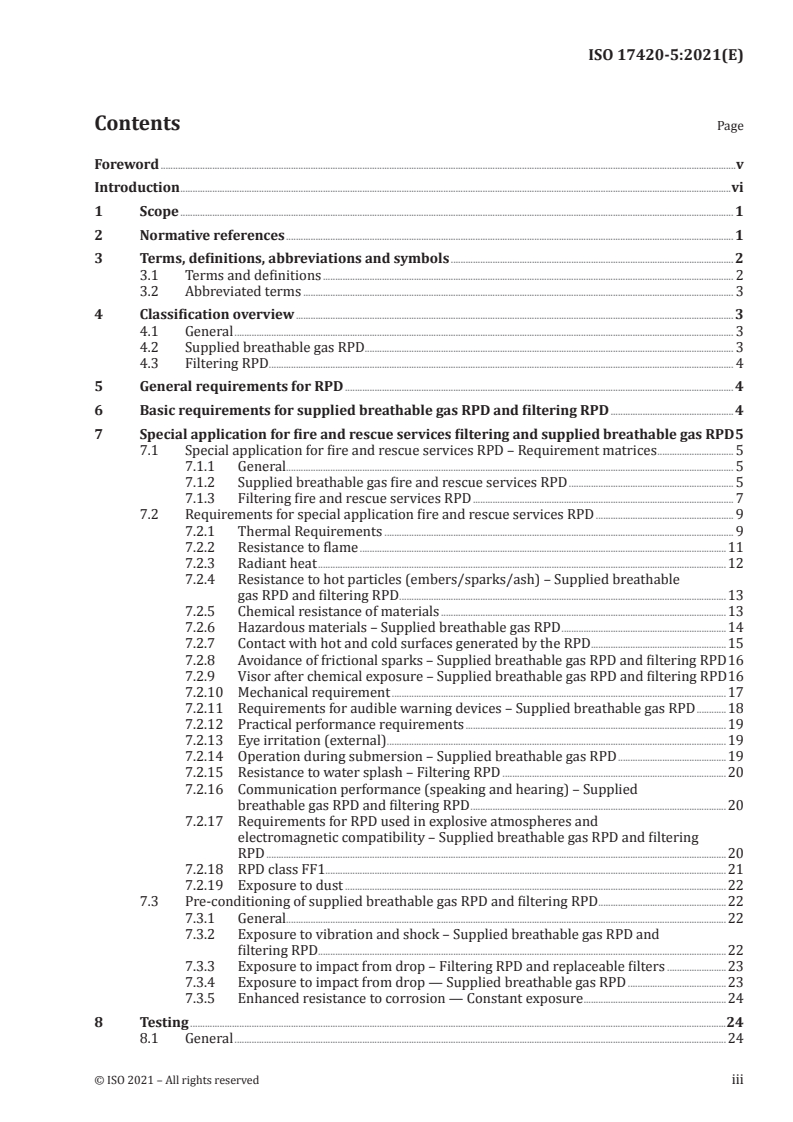

ISO 17420-5:2021 - Respiratory protective devices — Performance requirements — Part 5: Special application fire and rescue services - Supplied breathable gas RPD and filtering RPD/4/2021


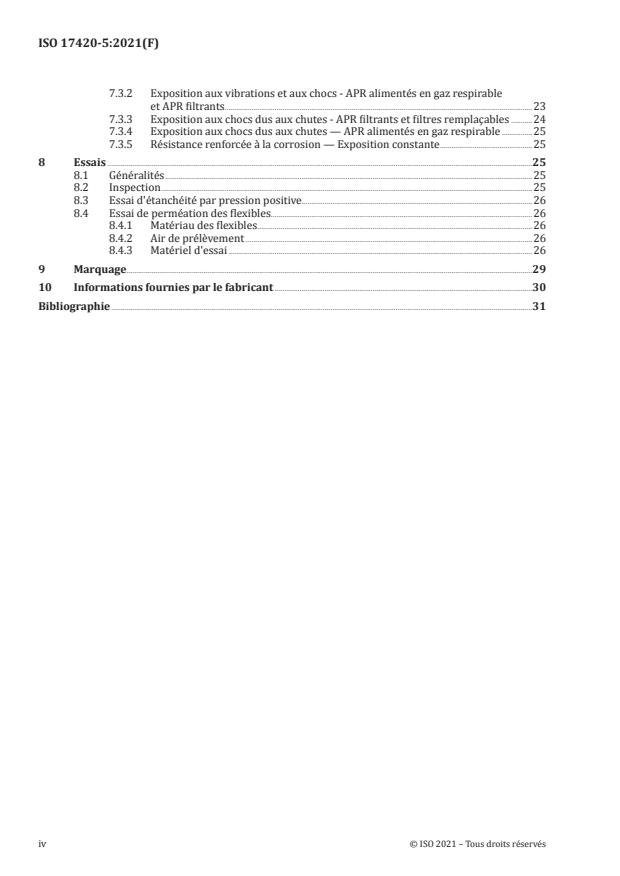
ISO 17420-5:2021 - Appareils de protection respiratoire -- Exigences de performances

ISO 17420-5:2021 - Appareils de protection respiratoire — Exigences de performances — Partie 5: Applications particulières pour lutte contre les feux et opérations de sauvetage - APR alimentés en gaz respirable et APR filtrants/4/2021
Overview
ISO 17420-5:2021 - "Respiratory protective devices - Performance requirements - Part 5: Special application fire and rescue services" defines the minimum performance requirements for both supplied breathable gas RPD and filtering RPD used in fire and rescue operations. It is a specialist part of the ISO 17420 series and is intended to ensure respiratory protective devices (RPD) perform reliably under the thermal, mechanical, chemical and operational stresses encountered by firefighters and rescue personnel.
Key topics and technical requirements
ISO 17420-5 organizes requirements, tests and documentation to address special application needs. Major technical topics include:
- Classification overview for supplied breathable gas and filtering RPD, including requirement matrices that define applicable performance levels.
- General and basic requirements for RPD construction, materials and components.
- Thermal performance (resistance to heat and radiant energy) and resistance to flame.
- Resistance to hot particles (embers, sparks, ash) and chemical resistance of materials.
- Hazardous-materials considerations specific to supplied breathable gas systems.
- Contact with hot/cold surfaces, avoidance of frictional sparks, and visor behaviour after chemical exposure.
- Mechanical strength tests and practical performance (including eye irritation and operation during submersion).
- Communication performance (speaking/hearing) and audible warning device requirements.
- Explosive-atmosphere compatibility and electromagnetic compatibility (EMC).
- Pre-conditioning (vibration, shock, drop, corrosion exposure) and sequence of destructive vs. non-destructive tests.
- Testing and inspection specifics such as leak tightness, hose permeation, sampling air, and test equipment requirements.
- Marking and information supplied by the manufacturer (user guidance and safety data).
Practical applications and who uses this standard
ISO 17420-5 is used for:
- Manufacturers of firefighter and rescue respiratory protective equipment to design and verify products for special applications.
- Test laboratories performing compliance and type testing for thermal, mechanical, chemical and communication performance.
- Fire and rescue services, procurement officers and safety managers selecting RPDs for high-risk environments.
- Regulatory bodies and conformity assessment organizations setting policy or certification schemes for emergency-response RPD.
Related standards (selection)
- ISO 17420-1:2021 (General RPD requirements) - foundational requirements.
- ISO 17420-2 and ISO 17420-4 - filtering and supplied breathable gas RPD requirements.
- ISO 16900 series (methods of test and test equipment) - referenced test methods.
- IEC/ISO standards on EMC, environmental testing and explosive atmospheres (e.g., IEC 60079, IEC 61000 series).
Keywords: ISO 17420-5, respiratory protective devices, supplied breathable gas RPD, filtering RPD, fire and rescue, performance requirements, RPD testing, thermal resistance, flame resistance, communication performance.
Buy Documents
ISO 17420-5:2021 - Respiratory protective devices -- Performance requirements
ISO 17420-5:2021 - Respiratory protective devices — Performance requirements — Part 5: Special application fire and rescue services - Supplied breathable gas RPD and filtering RPD/4/2021
ISO 17420-5:2021 - Appareils de protection respiratoire -- Exigences de performances
ISO 17420-5:2021 - Appareils de protection respiratoire — Exigences de performances — Partie 5: Applications particulières pour lutte contre les feux et opérations de sauvetage - APR alimentés en gaz respirable et APR filtrants/4/2021
Get Certified
Connect with accredited certification bodies for this standard

CIS Institut d.o.o.
Personal Protective Equipment (PPE) certification body. Notified Body NB-2890 for EU Regulation 2016/425 PPE.

Kiwa BDA Testing
Building and construction product certification.
Kmetijski inštitut Slovenije
Agricultural Institute of Slovenia. Soil testing, plant health, agricultural product analysis.
Sponsored listings
Frequently Asked Questions
ISO 17420-5:2021 is a standard published by the International Organization for Standardization (ISO). Its full title is "Respiratory protective devices — Performance requirements — Part 5: Special application fire and rescue services - Supplied breathable gas RPD and filtering RPD". This standard covers: This document specifies the minimum requirements for supplied breathable gas RPD and filtering RPD to be used for special application fire and rescue services.
This document specifies the minimum requirements for supplied breathable gas RPD and filtering RPD to be used for special application fire and rescue services.
ISO 17420-5:2021 is classified under the following ICS (International Classification for Standards) categories: 13.340.30 - Respiratory protective devices. The ICS classification helps identify the subject area and facilitates finding related standards.
ISO 17420-5:2021 is available in PDF format for immediate download after purchase. The document can be added to your cart and obtained through the secure checkout process. Digital delivery ensures instant access to the complete standard document.
Standards Content (Sample)
INTERNATIONAL ISO
STANDARD 17420-5
First edition
2021-06
Respiratory protective devices —
Performance requirements —
Part 5:
Special application fire and rescue
services - Supplied breathable gas
RPD and filtering RPD
Appareils de protection respiratoire — Exigences de performances —
Partie 5: Applications particulières pour lutte contre les feux et
opérations de sauvetage - APR alimentés en gaz respirable et APR
filtrants
Reference number
©
ISO 2021
© ISO 2021
All rights reserved. Unless otherwise specified, or required in the context of its implementation, no part of this publication may
be reproduced or utilized otherwise in any form or by any means, electronic or mechanical, including photocopying, or posting
on the internet or an intranet, without prior written permission. Permission can be requested from either ISO at the address
below or ISO’s member body in the country of the requester.
ISO copyright office
CP 401 • Ch. de Blandonnet 8
CH-1214 Vernier, Geneva
Phone: +41 22 749 01 11
Email: copyright@iso.org
Website: www.iso.org
Published in Switzerland
ii © ISO 2021 – All rights reserved
Contents Page
Foreword .v
Introduction .vi
1 Scope . 1
2 Normative references . 1
3 Terms, definitions, abbreviations and symbols . 2
3.1 Terms and definitions . 2
3.2 Abbreviated terms . 3
4 Classification overview . 3
4.1 General . 3
4.2 Supplied breathable gas RPD. 3
4.3 Filtering RPD . 4
5 General requirements for RPD . 4
6 Basic requirements for supplied breathable gas RPD and filtering RPD .4
7 Special application for fire and rescue services filtering and supplied breathable gas RPD 5
7.1 Special application for fire and rescue services RPD – Requirement matrices . 5
7.1.1 General. 5
7.1.2 Supplied breathable gas fire and rescue services RPD . 5
7.1.3 Filtering fire and rescue services RPD . 7
7.2 Requirements for special application fire and rescue services RPD . 9
7.2.1 Thermal Requirements . 9
7.2.2 Resistance to flame .11
7.2.3 Radiant heat .12
7.2.4 Resistance to hot particles (embers/sparks/ash) – Supplied breathable
gas RPD and filtering RPD .13
7.2.5 Chemical resistance of materials .13
7.2.6 Hazardous materials – Supplied breathable gas RPD .14
7.2.7 Contact with hot and cold surfaces generated by the RPD .15
7.2.8 Avoidance of frictional sparks – Supplied breathable gas RPD and filtering RPD 16
7.2.9 Visor after chemical exposure – Supplied breathable gas RPD and filtering RPD 16
7.2.10 Mechanical requirement .17
7.2.11 Requirements for audible warning devices – Supplied breathable gas RPD .18
7.2.12 Practical performance requirements .19
7.2.13 Eye irritation (external) .19
7.2.14 Operation during submersion – Supplied breathable gas RPD .19
7.2.15 Resistance to water splash – Filtering RPD .20
7.2.16 Communication performance (speaking and hearing) – Supplied
breathable gas RPD and filtering RPD .20
7.2.17 Requirements for RPD used in explosive atmospheres and
electromagnetic compatibility – Supplied breathable gas RPD and filtering
RPD .20
7.2.18 RPD class FF1 . . .21
7.2.19 Exposure to dust .22
7.3 Pre-conditioning of supplied breathable gas RPD and filtering RPD .22
7.3.1 General.22
7.3.2 Exposure to vibration and shock – Supplied breathable gas RPD and
filtering RPD.22
7.3.3 Exposure to impact from drop – Filtering RPD and replaceable filters .23
7.3.4 Exposure to impact from drop — Supplied breathable gas RPD .23
7.3.5 Enhanced resistance to corrosion — Constant exposure .24
8 Testing .24
8.1 General .24
8.2 Inspection .24
8.3 Testing of leak tightness using positive pressure .25
8.4 Testing of hose permeation .25
8.4.1 Hose material .25
8.4.2 Sampling air .25
8.4.3 Test equipment .25
9 Marking .28
10 Information supplied by the manufacturer .28
Bibliography .29
iv © ISO 2021 – All rights reserved
Foreword
ISO (the International Organization for Standardization) is a worldwide federation of national standards
bodies (ISO member bodies). The work of preparing International Standards is normally carried out
through ISO technical committees. Each member body interested in a subject for which a technical
committee has been established has the right to be represented on that committee. International
organizations, governmental and non-governmental, in liaison with ISO, also take part in the work.
ISO collaborates closely with the International Electrotechnical Commission (IEC) on all matters of
electrotechnical standardization.
The procedures used to develop this document and those intended for its further maintenance are
described in the ISO/IEC Directives, Part 1. In particular the different approval criteria needed for the
different types of ISO documents should be noted. This document was drafted in accordance with the
editorial rules of the ISO/IEC Directives, Part 2 (see www .iso .org/ directives).
Attention is drawn to the possibility that some of the elements of this document may be the subject of
patent rights. ISO shall not be held responsible for identifying any or all such patent rights. Details of
any patent rights identified during the development of the document will be in the Introduction and/or
on the ISO list of patent declarations received (see www .iso .org/ patents).
Any trade name used in this document is information given for the convenience of users and does not
constitute an endorsement.
For an explanation on the voluntary nature of standards, the meaning of ISO specific terms and
expressions related to conformity assessment, as well as information about ISO's adherence to the
World Trade Organization (WTO) principles in the Technical Barriers to Trade (TBT) see the following
URL: www .iso .org/ iso/ foreword .html.
This document was prepared by Technical Committee ISO/TC 94, Personal safety - Personal protective
equipment, Subcommittee SC 15, Respiratory protective devices in close cooperation with Subcommittee
SC 14, Firefighters' personal equipment.
A list of all parts in the ISO 17420 series can be found on the ISO website.
Any feedback or questions on this document should be directed to the user’s national standards body. A
complete listing of these bodies can be found at www .iso .org/ members .html.
Introduction
This document describes requirements for RPD used for special applications fire and rescue services
and its elements and components.
Some test methods are described. For other test methods references are given to the ISO 16900 series
"Methods of test and test equipment" or other test methods not developed by ISO/TC 94/SC 15.
The sequence of testing follows the principle to minimize the necessary number of samples by carrying
out destructive tests at the end. For safety reason it also includes that tests with test subjects are only
carried out after the test samples have shown their safe performance in other tests.
To apply this standard properly consider the following:
— ISO 17420-1 specifies the general requirements for supplied breathable gas RPD and filtering
RPD and cannot be used as a standard for "certification" alone. Therefore, compliance with the
requirements and tests of ISO 17420-2 or ISO 17420-4 is required in addition.
The structure of the standards is as follows:
ISO 17420-1 specifies the general requirements for RPD.
ISO 17420-2 and ISO 17420-4 gives requirements for filtering or supplied breathable gas RPD and give
information if any of the general requirements in Part 1 needs an addition.
EXAMPLE for ISO 17420-4 5.8.1 General
ISO 17420-1:2021, 5.8.1 applies with the following in addition:
ISO 17420-5 to ISO 17420-9 gives requirements for filtering or supplied breathable gas RPD — Special
application and some of the requirements will supersede requirements specified in ISO 17420-2 or
ISO 17420-4.
EXAMPLE for ISO 17420-5 7.2.1.3 Temperature of operation – level 0 — Supplied breathable gas
RPD
This clause supersedes ISO 17420-4:2021, 6.1.
For more information see also the introduction in the other parts of the ISO 17420 series.
vi © ISO 2021 – All rights reserved
INTERNATIONAL STANDARD ISO 17420-5:2021(E)
Respiratory protective devices — Performance
requirements —
Part 5:
Special application fire and rescue services - Supplied
breathable gas RPD and filtering RPD
1 Scope
This document specifies the minimum requirements for supplied breathable gas RPD and filtering RPD
to be used for special application fire and rescue services.
2 Normative references
The following documents are referred to in the text in such a way that some or all of their content
constitutes requirements of this document. For dated references, only the edition cited applies. For
undated references, the latest edition of the referenced document (including any amendments) applies.
ISO 6529:2013, Protective clothing — Protection against chemicals — Determination of resistance of
protective clothing materials to permeation by liquids and gases
ISO 8031, Rubber and plastics hoses and hose assemblies — Determination of electrical resistance and
conductivity
ISO 9227, Corrosion tests in artificial atmospheres — Salt spray tests
ISO 10297, Gas cylinders — Cylinder valves — Specification and type testing
ISO 13506-1, Protective clothing against heat and flame — Part 1: Test method for complete garments —
Measurement of transferred energy using an instrumented manikin
ISO 16900-1:2019, Respiratory protective devices — Methods of test and test equipment — Part 1:
Determination of inward leakage
ISO 16900-2, Respiratory protective devices — Methods of test and test equipment — Part 2: Determination
of breathing resistance
ISO 16900-5, Respiratory protective devices — Methods of test and test equipment — Part 5: Breathing
machine, metabolic simulator, RPD headforms and torso, tools and verification tools
ISO 16900-6, Respiratory protective devices — Methods of test and test equipment — Part 6: Mechanical
resistance/strength of components and connections
ISO 16900-7, Respiratory protective devices — Methods of test and test equipment — Part 7: Practical
performance test methods
ISO 16900-8, Respiratory protective devices — Methods of test and test equipment — Part 8: Measurement
of RPD air flow rates of assisted filtering RPD
ISO 16900-10, Respiratory protective devices — Methods of test and test equipment — Part 10: Resistance
to ignition, flame, radiant heat and heat
ISO 16900-12, Respiratory protective devices — Methods of test and test equipment — Part 12:
Determination of volume-averaged work of breathing and peak respiratory pressures
ISO 16900-14, Respiratory protective devices — Methods of test and test equipment — Part 14:
Measurement of sound pressure level
ISO 16972, Respiratory protective devices — Vocabulary and graphical symbols
ISO/TS 16975-1:2016, Respiratory protective devices — Selection, use and maintenance — Part 1:
Establishing and implementing a respiratory protective device programme
ISO 17420-1:2021, Respiratory protective devices — Performance requirements — Part 1: General
ISO 17420-2:2021, Respiratory protective devices — Performance requirements — Part 2: Requirements
for filtering RPD
ISO 17420-4:2021, Respiratory protective devices — Performance requirements — Part 4: Requirements
for supplied breathable gas RPD
ISO 80079-36:2016, Explosive atmospheres — Part 36: Non-electrical equipment for explosive
atmospheres — Basic method and requirements
IEC 60068-2-27:2010, Environmental testing — Part 2-27: Tests — Test Ea and guidance: Shock
IEC 60068-2-64, Environmental testing — Part 2-64: Tests — Test Fh: Vibration, broadband random and
guidance
IEC 60079-0, Explosive atmospheres — Part 0: Equipment — General requirements
IEC 60529:2013, Degrees of protection provided by enclosures (IP Code)
IEC 60721-1:2002, Classification of environmental conditions — Part 1: Environmental parameters and
their severities
IEC 60721-3-2:2018, Classification of environmental conditions — Part 3-2: Classification of groups of
environmental parameters and their severities — Transportation and Handling
IEC 61000-6-2, Electromagnetic compatibility (EMC) — Part 6-2: Generic standards — Immunity standard
for industrial environments
EN 15333-1:2008, Respiratory equipment - Open-circuit umbilical supplied compressed gas diving
apparatus - Part 1: Demand apparatus
ASTM D1003: 2013, Standard Test Method for Haze and Luminous Transmittance of Transparent Plastics
ASTM D6413, Standard Test Method for Flame Resistance of Textiles (Vertical Test)
NFPA 1981:2019, Standard on Open-Circuit Self-Contained Breathing Apparatus (SCBA) for Emergency
Services
3 Terms, definitions, abbreviations and symbols
3.1 Terms and definitions
For the purposes of this document, the terms and definitions given in ISO 16972 and the following apply.
ISO and IEC maintain terminological databases for use in standardization at the following addresses:
— ISO Online browsing platform: available at https:// www .iso .org/ obp
— IEC Electropedia: available at http:// www .electropedia .org/
2 © ISO 2021 – All rights reserved
3.1.1
non pre-conditioned state
without pre-conditioning but possibly modified to carry out tests or already used in non-destructive
tests
Note 1 to entry: This includes e.g., cleaning and disinfection.
3.1.2
RPD in as worn state
RPD where all components are connected and assembled in the way that it is intended to be used (e.g.
worn by the wearer, adapted to an RPD headform or RPD headform and torso or suitable holder)
Note 1 to entry: All of the various components (e.g. for an SCBA: cylinder, respiratory interface, demand valve,
harness etc.) have been completely assembled and then connected (RI connected to the demand valve) together
in accordance with the information supplied by the manufacturer.
3.1.3
component in ready for assembly state
component with seal, plug, packaging or other environmental protective means, still in place
3.1.4
RPD in ready for use state
RPD ready to be donned as described by the manufacturer
Note 1 to entry: In line with the information supplied by the manufacturer for donning the RPD, further actions
can be necessary.
3.2 Abbreviated terms
RI Respiratory Interface
RPD Respiratory protective devices
4 Classification overview
ISO 17420-2:2021, Clause 4 or ISO 17420-4:2021, Clause 4 applies.
4.1 General
ISO 17420-1:2021, 4.1 applies.
4.2 Supplied breathable gas RPD
This subclause applies in addition to ISO 17420-4:2021, Clause 4.
Additionally supplied breathable gas RPD may be classified for one or more special applications, as
given in Table 1.
Table 1 — Special application classification supplied breathable gas RPD
Special application Classes
a
FF5 (Firefighting type R2)
a
FF4 (Firefighting type R1)
Fire and rescue services FF3 (Hazardous material)
FF2 (Rescue)
FF1 (Wildland firefighting)
a
Selection of the RPD shall be based on a risk assessment, which includes compatibility of the selected RPD being
worn with other items of PPE, taking into consideration operational practices, environmental conditions, local building
regulations or standards and other technical standards. See e.g. ISO/TS 16075-1, ISO 17420-1:2021, 5.4 and ISO 11999-2.
FF4 (type R1) and FF5 (type R2) items of RPD have differing performance characteristics.
For example, type R1 provides material thermal performance tested at 180 °C maximum and is commonly used for
defensive firefighting and is generally not intended to be used for internal attack firefighting. Type R2 provides a material
thermal performance tested at 260 °C maximum and is commonly used for internal attack firefighting.
Example for a supplied breathable gas RPD for special application firefighting type R1 with protection
class (PC5), work rate class (W3), RI class (cT), supplied breathable gas capacity class (S1800) and
special application class (FF4)
Marking for the given example PC5 W3 cT S1800 FF4
4.3 Filtering RPD
This subclause applies in addition to ISO 17420-2:2021, Clause 4.
Additionally filtering RPD may be classified for one or more special applications, as given in Table 2.
Table 2 — Special application classification of filtering RPD
Special application Classes
FF2 (Rescue)
Fire and rescue services
FF1 (Wildland firefighting)
Example for a filtering RPD for special application wildland firefighting with protection class (PC3),
work rate class (W2), RI class (bT), particle filter performance class (F3) and special application class
(FF1).
Marking for the given example PC3 W2 bT F3 FF1
Multi-functional filtering RPD have separate classifications for each function, i.e. one classification for
the unassisted mode and one classification for the assisted mode.
5 General requirements for RPD
ISO 17420-1:2021, Clause 5 and ISO 17420-2:2021, Clause 5 or ISO 17420-4:2021, Clause 5 applies.
6 Basic requirements for supplied breathable gas RPD and filtering RPD
All requirements of ISO 17420-2:2021, Clause 6 or ISO 17420-4:2021, Clause 6 apply unless superseded
by this document and indicated in the relevant clauses.
NOTE 1 Optional features are also given in ISO 17420-2 or ISO 17420-4.
NOTE 2 Where requirements are superseded by those in Clause 7 of this document, the test schedules given in
ISO 17420-2:2021 Annex C or ISO 17420-4:2021, Annex C can be used as a guideline for testing.
4 © ISO 2021 – All rights reserved
7 Special application for fire and rescue services filtering and supplied
breathable gas RPD
7.1 Special application for fire and rescue services RPD – Requirement matrices
7.1.1 General
Supplied breathable gas fire and rescue services RPD shall fulfil all requirements specified in Table 3.
Filtering fire and rescue services RPD shall fulfil all requirements specified in Table 4.
7.1.2 Supplied breathable gas fire and rescue services RPD
Table 3 gives an overview about requirements and preconditioning of supplied breathable gas fire and
rescue services RPD.
Table 3 shall be read as follows:
In the first column the requirements are specified. In the third to seventh column the required pre-
conditioning for different fire and rescue services classes are specified.
For each pre-conditioning within one line of the cell different sample(s) shall be used. At least one RPD
shall be tested after each required pre-conditioning.
For the requirement 7.2.1.3 and class hazardous materials (FF3) the following applies.
At least one sample shall be pre-conditioned VS & CE (Exposure to vibration and shock – firefighting
and enhanced resistance to corrosion – constant exposure).
At least one further sample shall be pre-conditioned DR (Exposure to impact from drop).
Table 3 — Special application requirement overview – Supplied breathable gas fire and rescue
services RPD
Wildland Hazardous
Rescue Firefighting
firefighting materials
a a
FF1 FF2 FF3 FF4 FF5
Protection Protection Protection Protection Protection
class class class class class
Requirement Title
≥PC3 ≥PC3 ≥PC4 ≥PC5 ≥PC5
Work rate Work rate Work rate Work rate Work rate
class class class class class
≥W2 ≥W2 ≥W2 ≥W3 =W4
Pre-conditioning
VS&CE VS&CE VS&CE VS&CE VS&CE
Temperature of operation
7.2.1.3
– level 0
DR DR DR DR DR
Temperature of operation
7.2.1.5 AR/NP AR/NP AR/NP AR/NP AR/NP
– level 1
Temperature of operation
b b b b
7.2.1.7 — — — AR/NP —
– level 2- type R1
Temperature of operation
b b b b
7.2.1.8 — — — — AR/NP
– level 3- type R2
Temperature of operation
b b b
7.2.1.9 — — — AR/NP AR/NP
at level 2 and flammability
Temperature of operation
b b b b
7.2.1.10 — — — — AR/NP
at level 3 and flammability
Table 3 (continued)
Wildland Hazardous
Rescue Firefighting
firefighting materials
a a
FF1 FF2 FF3 FF4 FF5
Protection Protection Protection Protection Protection
class class class class class
Requirement Title
≥PC3 ≥PC3 ≥PC4 ≥PC5 ≥PC5
Work rate Work rate Work rate Work rate Work rate
class class class class class
≥W2 ≥W2 ≥W2 ≥W3 =W4
Pre-conditioning
b
7.2.1.11 Thermal shock — AR/NP AR/NP AR/NP AR/NP
Fabric material flame re-
b b
7.2.2.2 AR/NP AR/NP AR/NP — —
sistance performance
7.2.3.2 Radiant heat – level 1 AR/NP AR/NP AR/NP AR/NP AR/NP
b b b
7.2.3.3 Radiant heat – level 2 — — — AR/NP AR/NP
b b b b
7.2.3.4 Radiant heat – level 3 — — — — AR/NP
7.2.4 Resistance to hot particles AR/NP AR/NP AR/NP AR/NP AR/NP
Chemical resistance of
b
7.2.5.1 — AR/NP AR/NP AR/NP AR/NP
materials
b b
7.2.6 Hazardous materials — — AR/NP O O
Contact with hot and cold
7.2.7.1 AR/NP AR/NP AR/NP AR/NP AR/NP
surfaces
Avoidance of frictional
b
7.2.8 — AR/NP AR/NP AR/NP AR/NP
sparks
Visor after chemical expo-
b
7.2.9 — AR/NP AR/NP AR/NP AR/NP
sure
b
7.2.10.1 Connections — AR/NP AR/NP AR/NP AR/NP
Abrasion resistance of
b b
7.2.10.3 — — AR/NP AR/NP AR/NP
visor
Requirements for audible
b b
7.2.11 — — AR/NP AR/NP AR/NP
warning devices
Practical performance -
b
7.2.12 — AR/NP AR/NP AR/NP AR/NP
RPD
7.2.13 Eye irritation (external) AR/NP AR/NP AR/NP AR/NP AR/NP
Operating during submer-
7.2.14 AR/NP AR/NP AR/NP AR/NP AR/NP
sion
Communication perfor-
b b
7.2.16 mance (speaking and — — AR/NP AR/NP AR/NP
hearing)
Use in explosive atmos-
b
7.2.17.1 — AR/NP AR/NP AR/NP AR/NP
pheres
Electromagnetic compat-
b
7.2.17.2 — AR/NP AR/NP AR/NP AR/NP
ibility
b b b c c
7.2.19 Exposure to dust — — — X X
6 © ISO 2021 – All rights reserved
Table 3 (continued)
Wildland Hazardous
Rescue Firefighting
firefighting materials
a a
FF1 FF2 FF3 FF4 FF5
Protection Protection Protection Protection Protection
class class class class class
Requirement Title
≥PC3 ≥PC3 ≥PC4 ≥PC5 ≥PC5
Work rate Work rate Work rate Work rate Work rate
class class class class class
≥W2 ≥W2 ≥W2 ≥W3 =W4
Pre-conditioning
a
Selection of the RPD shall be based on a risk assessment, which includes compatibility of the selected RPD being
worn with other items of PPE, taking into consideration operational practices, environmental conditions, local
building regulations or standards and other technical standards. See e.g. ISO 17420-1:2021, 5.4 and ISO 11999-2.
FF4 (type R1) and FF5 (type R2) items of RPD have differing performance characteristics.
For example, type R1 provides material thermal performance tested at 180 °C maximum and is commonly used for
defensive firefighting and is generally not intended to be used for internal attack firefighting. Type R2 provides a
material thermal performance tested at 260 °C maximum and is commonly used for internal attack firefighting.
b
— means that a test is not required for this combination of requirement and special application class.
c
X means exposure to dust has to be addressed by the FMEA (see 7.2.19).
AR/NP as received or in non pre-conditioned.
VS & CE Exposure to vibration and shock (see 7.3.2) and enhanced resistance to corrosion –constant exposure
(see 7.3.5).
DR Exposure to impact from drop (see 7.3.4).
O Optional feature.
7.1.3 Filtering fire and rescue services RPD
Table 4 gives an overview about requirements and pre-conditioning of filtering fire and rescue services
RPD.
At least one RPD shall be tested after each required pre-conditioning. Pre-conditionings shall not be
combined.
Table 4 shall be read as follows:
In the first column the requirements are specified. In the third and fourth column the required pre-
conditioning for different fire and rescue services classes are specified.
For each pre-conditioning within one cell different sample(s) shall be used.
EXAMPLE For the requirement 7.2.1.4 and class rescue (FF2) the following applies.
At least one sample shall be pre-conditioned VS (Exposure to vibration and shock – fire and rescue
services).
Table 4 — Special application requirement overview – Filtering RPD – Fire and rescue services
Wildland Fire-
Rescue
fighting
FF1 FF2
Protection class Protection class
Requirement Title
≥PC3 ≥PC3
Work rate class Work rate class
≥W2 ≥W2
DRO DRO
ISO 17420-2:2021,
Particle filter
6.10.1.2
EA EA
DRO DRO
ISO 17420-2:2021,
a
Gas filter
6.10.1.3
EA EA
7.2.1.4 Temperature of operation – level 0 VS VS
a
7.2.1.6 Temperature of operation – level 1 AR/NP AR/NP
b
7.2.8 Avoidance of frictional sparks — AR/NP
a b
7.2.2.1 Six burner dynamic AR/NP —
a
7.2.3.2 Radiant heat – level 1 AR/NP AR/NP
a
7.2.4 Resistance to hot particles (embers, sparks, ash) AR/NP AR/NP
7.2.5.2 Chemical resistance of materials — AR/NP
7.2.7.2 Contact with hot surfaces generated by the RPD AR/NP AR/NP
b
7.2.10.2 Connections — AR/NP
7.2.10.3 Abrasion resistance of visor AR/NP AR/NP
7.2.17.1 Use in explosive atmospheres AR/NP AR/NP
7.2.17.2 Electromagnetic compatibility AR/NP AR/NP
7.2.13 Eye irritation (external) AR/NP AR/NP
b b
7.2.16 Communication performance (speaking and hearing) — —
7.2.15 Resistance to water splash AR/NP AR/NP
Filter capacity and filter performance for the test
b
7.2.18.2.1 AR/NP —
a
gas CO
Filter capacity for the test gases other than CO and
7.2.18.2.2 AR/NP AR/NP
a
particle filter efficiency
c c
7.2.19 Exposure to dust X X
a
If claimed for FF 1 (wildland firefighting).
b
— means that a test is not required for this combination of requirement and special application class.
c
X means exposure to dust has to be addressed by the FMEA (see 7.2.19).
AR/NP as received or in non pre-conditioned state.
DRO Exposure to impact from drop (see 7.3.3).
VS Exposure to vibration and shock (see 7.3.2).
EA Exposure to exhaled air, if applicable (see ISO 17420-2:2021 6.9.3.1).
8 © ISO 2021 – All rights reserved
7.2 Requirements for special application fire and rescue services RPD
7.2.1 Thermal Requirements
7.2.1.1 Temperature of operation – Supplied breathable gas RPD
After exposure to the relevant temperature levels outlined in 7.2.1.3, 7.2.1.5, 7.2.1.7, 7.2.1.8, 7.2.1.9,
7.2.1.10 and 7.2.1.11 warning and monitoring devices, if applicable, shall continue to function.
The preheating shall be homogenous around the RPD.
Deformation or superficial damage of components does not constitute a failure.
Check in accordance with 8.2.
7.2.1.2 Temperature of operation – Filtering RPD
After exposure to the relevant temperature levels outlined in 7.2.1.4 and 7.2.1.6, warning and monitoring
devices, if applicable, shall continue to function.
Deformation or superficial damage of components does not constitute a failure.
Check in accordance with 8.2.
7.2.1.3 Temperature of operation – level 0 – Supplied breathable gas RPD
This clause supersedes clause ISO 17420-4:2021, 6.1.
RPD in ready for use state or the RPD component in ready for assembly state shall be exposed to the
pre-conditioning in accordance with 7.3.2 and 7.3.5 and the relevant subclauses as given in Table 3.
+2
One RPD shall be equilibrated for a minimum of 4 h and tested at −32 °C.
One RPD shall be equilibrated for a minimum of 4 h and tested at 60 °C.
−2
The RPD shall continue to meet the work of breathing/breathing resistance requirements at the work
rate regime for the RPD class, as specified in ISO 17420-4:2021, 6.2.
Testing shall be performed in accordance with ISO 16900-12.
For RPD having cylinder valve(s), the valve(s) shall meet the requirements of ISO 10297 at the
+2
temperature of operation of −32 °C and an impact of 120 J.
7.2.1.4 Temperature of operation – level 0 – Assisted filtering RPD
The influence of temperature of flow rate shall be determined in accordance with ISO 17420-2:2021, 6.2
+2 0
but using the temperatures of −32 °C and 60 °C.
0 −2
RPD shall continue to meet the work of breathing/breathing resistance requirements at the test regime
for the RPD work rate class, as specified in ISO 17420-2:2021, 6.3.1 or 6.3.2.
Testing shall be performed in accordance with ISO 16900-12.
7.2.1.5 Temperature of operation – level 1 – Supplied breathable gas RPD
One RPD in as worn state shall be exposed to 100 °C whilst the RPD is ventilated with the settings
−2
of the test equipment at 35 l/min for 30 min or the service life of the RPD, whatever is shorter. Testing
shall be started 2 min before the end of the exposure time or service life. The RPD shall continue to
meet the work of breathing/breathing resistance requirements at 35 l/min setting of the test equipment,
as specified in ISO 17420-4:2021, 6.2.
Testing shall be performed in accordance with ISO 16900-12.
7.2.1.6 Temperature of operation – level 1 – Assisted filtering RPD
To determine the influence of temperature the RPD shall be tested for flow after each of the following:
One RPD in as worn state shall be exposed to 100 °C for 30 min. Testing shall be started within
−2
3 min after the exposure at ambient laboratory temperature.
Taking into account the influencing parameters as specified in ISO 17420-2:2021, 6.1, the measured
minimum and the measured maximum flow rate shall be determined in accordance with ISO 16900-8.
The RPD shall continue to meet the work of breathing/breathing resistance requirements as specified
in ISO 17420-2:2021, 6.3.2.
Testing shall be performed in accordance with and ISO 16900-12.
7.2.1.7 Temperature of operation – level 2- FF4 (type R1) – Supplied breathable gas RPD
One RPD in as worn state shall be tested as received at (180 ± 5) °C for 5 min.
Testing shall be performed as part of 7.2.1.9.
7.2.1.8 Temperature of operation – level 3-FF5 (type R2) – Supplied breathable gas RPD
One RPD in as worn state shall be tested as received at ()260±5 °C for 5 min.
Testing shall be performed as part of 7.2.1.10.
7.2.1.9 Temperature of operation – level 2 and flammability – Supplied breathable gas RPD
Temperature of operation level 3 is specified by a flame engulfment test after pre-conditioning at
180±5 °C .
()
One RPD, as received and in as worn state shall be subjected to (950 ± 50) °C for 10 s at 105 l/min
(42 cycles/min and 2,5 l/cycle) after the temperature exposure of (180 ± 5) °C for 5 min at a ventilation
rate of 40 l/min (20 cycles/min and 2 l/cycle) in accordance with the flame engulfment test specified in
ISO 16900-10.
The change of the ventilation rate from 40 l/min to 105 l/min shall be completed prior to the start of
the flame exposure. The transition period between one flow rate and the next flow rate shall be no
more than 60 s whilst the RPD remains in the operational mode.
No after-flame shall continue for more than 2,2 s after the test flame extinguishes.
Additionally, no component that secures the apparatus to the user’s body or that secures the cylinder
to the apparatus shall separate or be displaced to such an extent that would cause the RPD to become
detached from the wearer’s body or the cylinder to become unsecured.
10 © ISO 2021 – All rights reserved
Check in accordance with 8.2.
The breathing resistance shall not exceed 1 200 Pa at both flow rates.
Testing shall be performed in accordance with ISO 16900-10.
7.2.1.10 Temperature of operation – level 3 and flammability – Supplied breathable gas RPD
Temperature of operation level 4 is specified by a flame engulfment test after pre-conditioning at
(260 ± 5) °C.
One RPD, as received and in as worn state shall be subjected to (950 ± 50) °C for 10 s at 105 l/min after
the temperature exposure of (260 ± 5) °C for 5 min at a ventilation rate of 40 l/min (20 l/min × 2) in
accordance with the flame engulfment test ISO 16900-10.
The change of the ventilation rate from 40 l/min to 105 l/min shall be completed prior to the start of
the flame exposure. The transition period between one flow rate and the next flow rate shall be no
more than 60 s whilst the RPD remains in the operational mode.
Additionally, no component that secures the apparatus to the user’s body or that secures the cylinder
to the apparatus shall separate or be displaced to such an extent that would cause the RPD to become
detached from the wearer’s body or the cylinder to become unsecured.
Check in accordance with 8.2.
The breathing resistance shall not exceed 1 200 Pa at both flow rates.
Testing shall be performed in accordance with ISO 16900-10.
7.2.1.11 Thermal shock – Supplied breathable gas RPD
+2
One RPD in ready for use state shall be equilibrated for a minimum of 4 h at −32 °C and tested
within 10 min at (60 ± 5) °C.
One RPD in ready for use state shall be equilibrated for a minimum of 4 h at 60 °C and tested
−2
within 10 min at (-32 ± 5) °C.
The RPD shall continue to meet the work of breathing/breathing resistance requirements specified in
ISO 17420-4:2021, 6.3 at the work rate regime for the RPD class, as specified in ISO 17420-4:2021, 6.2.
7.2.2 Resistance to flame
7.2.2.1 Six burner dynamic – Filtering RPD
This clause supersedes ISO 17420-1:2021, 5.3 for the RI only.
One RI as received shall be tested for flame and heat resistance as specified in ISO 16900-10. Prior to
testing, all components and accessories, which are claimed by the manufacturer as part of the RPD,
shall be assembled with the RI. The components and accessories shall be in as received state. There
shall be no dripping at all, and the assembly under test shall not continue to burn for more than 5 s.
Deformation/decomposition is allowed, as long as it does not drip or burn through or present any other
hazard to the wearer.
The tip of each burner shall be set at 250 mm from the closest point upon which that flame will impinge,
following the contour of the RI and component contour.
The RPD or the RI does not need to fulfil any other requirement of this standard after this test.
Check in accordance with 8.2.
After exposure to flame the RPD or RI shall not leak at a rate of more than one bubble per second.
Testing shall be performed in accordance with 8.3.
7.2.2.2 Fabric material flame resistance performance – Supplied breathable gas RPD
This clause supersedes ISO 17420-1:2021, 5.3 for fabric materials only.
Three test samples shall be conditioned by five cycles of washing and drying in accordance with the
procedures specified in the information supplied by the RPD manufacturer.
If washing is not intended in accordance with the information supplied by the RPD manufacturer, three
samples shall be tested as received.
All fabric material of RPD used to secure the RPD to the wearer shall be tested as designed for its
function for flame resistance as specified in ISO 16900-10, in accordance with ASTM D6413 and shall
not
— exceed an average char length of 100 mm,
— exceed an after flame time of 2,0 s,
— drip.
7.2.3 Radiant heat
7.2.3.1 General
One RPD shall be tested as received in as worn state for resistance to radiant heat specified in 7.2.3.2,
7.2.3.3 or 7.2.3.4. When exposed to the relevant conditions given in 7.2.3.2 or 7.2.3.3, while ventilated
and subsequently returned to ambient conditions, no component of the RPD shall melt through or burn
through as checked in accordance with ISO 17420-1:2021, 6.2 and the RPD shall continue to meet the
breathing resistance requirements specified in ISO 17420-2:2021, 6.2.
Deformation of components does not constitute a failure.
For levels 1 and 2 exposures, one RPD shall be tested on a head and torso with a radiant heat panel in
the front and, after the RPD has cooled down to ambient temperature, from the back.
The donning of the RPD shall be performed in accordance with the information supplied by the
manufacturer. If more than one position is possible chose that which exposes functional parts to the
heat flux the most.
Heat-Flux shall be measured at the point of the RPD closest to the radiant heat panel.
Level 3 exposure is assessed in the instrumented manikin test, in accordance with ISO 13506-1 and
ISO 16900-10.
Test in accordance with ISO 13506-1 and ISO 16900-10.
7.2.3.2 Radiant heat – level 1 – Supplied breathable gas RPD and filtering RPD
One RPD shall be exposed to a radiant heat of 1,25 kW/m for 30 min at the flow rate of 35 l/min
(dynamic sinusoidal) and the setting of the test equipment in accordance with ISO 17420-4:2021 Table 2
and following the requirements given in 7.2.3.
12 © ISO 2021 – All rights reserved
Breathing resistance (peak pressure) shall be measured during the exposure. The breathing resistance
(peak pressure) shall not exceed 1 200 Pa. For supplied breathable gas RPD and assisted filtering RPD
with work rate class ≥3 the inhalation breathing resistance (peak pressure) shall be greater than
...
INTERNATIONAL ISO
STANDARD 17420-5
First edition
2021-06
Respiratory protective devices —
Performance requirements —
Part 5:
Special application fire and rescue
services - Supplied breathable gas
RPD and filtering RPD
Appareils de protection respiratoire — Exigences de performances —
Partie 5: Applications particulières pour lutte contre les feux et
opérations de sauvetage - APR alimentés en gaz respirable et APR
filtrants
Reference number
©
ISO 2021
© ISO 2021
All rights reserved. Unless otherwise specified, or required in the context of its implementation, no part of this publication may
be reproduced or utilized otherwise in any form or by any means, electronic or mechanical, including photocopying, or posting
on the internet or an intranet, without prior written permission. Permission can be requested from either ISO at the address
below or ISO’s member body in the country of the requester.
ISO copyright office
CP 401 • Ch. de Blandonnet 8
CH-1214 Vernier, Geneva
Phone: +41 22 749 01 11
Email: copyright@iso.org
Website: www.iso.org
Published in Switzerland
ii © ISO 2021 – All rights reserved
Contents Page
Foreword .v
Introduction .vi
1 Scope . 1
2 Normative references . 1
3 Terms, definitions, abbreviations and symbols . 2
3.1 Terms and definitions . 2
3.2 Abbreviated terms . 3
4 Classification overview . 3
4.1 General . 3
4.2 Supplied breathable gas RPD. 3
4.3 Filtering RPD . 4
5 General requirements for RPD . 4
6 Basic requirements for supplied breathable gas RPD and filtering RPD .4
7 Special application for fire and rescue services filtering and supplied breathable gas RPD 5
7.1 Special application for fire and rescue services RPD – Requirement matrices . 5
7.1.1 General. 5
7.1.2 Supplied breathable gas fire and rescue services RPD . 5
7.1.3 Filtering fire and rescue services RPD . 7
7.2 Requirements for special application fire and rescue services RPD . 9
7.2.1 Thermal Requirements . 9
7.2.2 Resistance to flame .11
7.2.3 Radiant heat .12
7.2.4 Resistance to hot particles (embers/sparks/ash) – Supplied breathable
gas RPD and filtering RPD .13
7.2.5 Chemical resistance of materials .13
7.2.6 Hazardous materials – Supplied breathable gas RPD .14
7.2.7 Contact with hot and cold surfaces generated by the RPD .15
7.2.8 Avoidance of frictional sparks – Supplied breathable gas RPD and filtering RPD 16
7.2.9 Visor after chemical exposure – Supplied breathable gas RPD and filtering RPD 16
7.2.10 Mechanical requirement .17
7.2.11 Requirements for audible warning devices – Supplied breathable gas RPD .18
7.2.12 Practical performance requirements .19
7.2.13 Eye irritation (external) .19
7.2.14 Operation during submersion – Supplied breathable gas RPD .19
7.2.15 Resistance to water splash – Filtering RPD .20
7.2.16 Communication performance (speaking and hearing) – Supplied
breathable gas RPD and filtering RPD .20
7.2.17 Requirements for RPD used in explosive atmospheres and
electromagnetic compatibility – Supplied breathable gas RPD and filtering
RPD .20
7.2.18 RPD class FF1 . . .21
7.2.19 Exposure to dust .22
7.3 Pre-conditioning of supplied breathable gas RPD and filtering RPD .22
7.3.1 General.22
7.3.2 Exposure to vibration and shock – Supplied breathable gas RPD and
filtering RPD.22
7.3.3 Exposure to impact from drop – Filtering RPD and replaceable filters .23
7.3.4 Exposure to impact from drop — Supplied breathable gas RPD .23
7.3.5 Enhanced resistance to corrosion — Constant exposure .24
8 Testing .24
8.1 General .24
8.2 Inspection .24
8.3 Testing of leak tightness using positive pressure .25
8.4 Testing of hose permeation .25
8.4.1 Hose material .25
8.4.2 Sampling air .25
8.4.3 Test equipment .25
9 Marking .28
10 Information supplied by the manufacturer .28
Bibliography .29
iv © ISO 2021 – All rights reserved
Foreword
ISO (the International Organization for Standardization) is a worldwide federation of national standards
bodies (ISO member bodies). The work of preparing International Standards is normally carried out
through ISO technical committees. Each member body interested in a subject for which a technical
committee has been established has the right to be represented on that committee. International
organizations, governmental and non-governmental, in liaison with ISO, also take part in the work.
ISO collaborates closely with the International Electrotechnical Commission (IEC) on all matters of
electrotechnical standardization.
The procedures used to develop this document and those intended for its further maintenance are
described in the ISO/IEC Directives, Part 1. In particular the different approval criteria needed for the
different types of ISO documents should be noted. This document was drafted in accordance with the
editorial rules of the ISO/IEC Directives, Part 2 (see www .iso .org/ directives).
Attention is drawn to the possibility that some of the elements of this document may be the subject of
patent rights. ISO shall not be held responsible for identifying any or all such patent rights. Details of
any patent rights identified during the development of the document will be in the Introduction and/or
on the ISO list of patent declarations received (see www .iso .org/ patents).
Any trade name used in this document is information given for the convenience of users and does not
constitute an endorsement.
For an explanation on the voluntary nature of standards, the meaning of ISO specific terms and
expressions related to conformity assessment, as well as information about ISO's adherence to the
World Trade Organization (WTO) principles in the Technical Barriers to Trade (TBT) see the following
URL: www .iso .org/ iso/ foreword .html.
This document was prepared by Technical Committee ISO/TC 94, Personal safety - Personal protective
equipment, Subcommittee SC 15, Respiratory protective devices in close cooperation with Subcommittee
SC 14, Firefighters' personal equipment.
A list of all parts in the ISO 17420 series can be found on the ISO website.
Any feedback or questions on this document should be directed to the user’s national standards body. A
complete listing of these bodies can be found at www .iso .org/ members .html.
Introduction
This document describes requirements for RPD used for special applications fire and rescue services
and its elements and components.
Some test methods are described. For other test methods references are given to the ISO 16900 series
"Methods of test and test equipment" or other test methods not developed by ISO/TC 94/SC 15.
The sequence of testing follows the principle to minimize the necessary number of samples by carrying
out destructive tests at the end. For safety reason it also includes that tests with test subjects are only
carried out after the test samples have shown their safe performance in other tests.
To apply this standard properly consider the following:
— ISO 17420-1 specifies the general requirements for supplied breathable gas RPD and filtering
RPD and cannot be used as a standard for "certification" alone. Therefore, compliance with the
requirements and tests of ISO 17420-2 or ISO 17420-4 is required in addition.
The structure of the standards is as follows:
ISO 17420-1 specifies the general requirements for RPD.
ISO 17420-2 and ISO 17420-4 gives requirements for filtering or supplied breathable gas RPD and give
information if any of the general requirements in Part 1 needs an addition.
EXAMPLE for ISO 17420-4 5.8.1 General
ISO 17420-1:2021, 5.8.1 applies with the following in addition:
ISO 17420-5 to ISO 17420-9 gives requirements for filtering or supplied breathable gas RPD — Special
application and some of the requirements will supersede requirements specified in ISO 17420-2 or
ISO 17420-4.
EXAMPLE for ISO 17420-5 7.2.1.3 Temperature of operation – level 0 — Supplied breathable gas
RPD
This clause supersedes ISO 17420-4:2021, 6.1.
For more information see also the introduction in the other parts of the ISO 17420 series.
vi © ISO 2021 – All rights reserved
INTERNATIONAL STANDARD ISO 17420-5:2021(E)
Respiratory protective devices — Performance
requirements —
Part 5:
Special application fire and rescue services - Supplied
breathable gas RPD and filtering RPD
1 Scope
This document specifies the minimum requirements for supplied breathable gas RPD and filtering RPD
to be used for special application fire and rescue services.
2 Normative references
The following documents are referred to in the text in such a way that some or all of their content
constitutes requirements of this document. For dated references, only the edition cited applies. For
undated references, the latest edition of the referenced document (including any amendments) applies.
ISO 6529:2013, Protective clothing — Protection against chemicals — Determination of resistance of
protective clothing materials to permeation by liquids and gases
ISO 8031, Rubber and plastics hoses and hose assemblies — Determination of electrical resistance and
conductivity
ISO 9227, Corrosion tests in artificial atmospheres — Salt spray tests
ISO 10297, Gas cylinders — Cylinder valves — Specification and type testing
ISO 13506-1, Protective clothing against heat and flame — Part 1: Test method for complete garments —
Measurement of transferred energy using an instrumented manikin
ISO 16900-1:2019, Respiratory protective devices — Methods of test and test equipment — Part 1:
Determination of inward leakage
ISO 16900-2, Respiratory protective devices — Methods of test and test equipment — Part 2: Determination
of breathing resistance
ISO 16900-5, Respiratory protective devices — Methods of test and test equipment — Part 5: Breathing
machine, metabolic simulator, RPD headforms and torso, tools and verification tools
ISO 16900-6, Respiratory protective devices — Methods of test and test equipment — Part 6: Mechanical
resistance/strength of components and connections
ISO 16900-7, Respiratory protective devices — Methods of test and test equipment — Part 7: Practical
performance test methods
ISO 16900-8, Respiratory protective devices — Methods of test and test equipment — Part 8: Measurement
of RPD air flow rates of assisted filtering RPD
ISO 16900-10, Respiratory protective devices — Methods of test and test equipment — Part 10: Resistance
to ignition, flame, radiant heat and heat
ISO 16900-12, Respiratory protective devices — Methods of test and test equipment — Part 12:
Determination of volume-averaged work of breathing and peak respiratory pressures
ISO 16900-14, Respiratory protective devices — Methods of test and test equipment — Part 14:
Measurement of sound pressure level
ISO 16972, Respiratory protective devices — Vocabulary and graphical symbols
ISO/TS 16975-1:2016, Respiratory protective devices — Selection, use and maintenance — Part 1:
Establishing and implementing a respiratory protective device programme
ISO 17420-1:2021, Respiratory protective devices — Performance requirements — Part 1: General
ISO 17420-2:2021, Respiratory protective devices — Performance requirements — Part 2: Requirements
for filtering RPD
ISO 17420-4:2021, Respiratory protective devices — Performance requirements — Part 4: Requirements
for supplied breathable gas RPD
ISO 80079-36:2016, Explosive atmospheres — Part 36: Non-electrical equipment for explosive
atmospheres — Basic method and requirements
IEC 60068-2-27:2010, Environmental testing — Part 2-27: Tests — Test Ea and guidance: Shock
IEC 60068-2-64, Environmental testing — Part 2-64: Tests — Test Fh: Vibration, broadband random and
guidance
IEC 60079-0, Explosive atmospheres — Part 0: Equipment — General requirements
IEC 60529:2013, Degrees of protection provided by enclosures (IP Code)
IEC 60721-1:2002, Classification of environmental conditions — Part 1: Environmental parameters and
their severities
IEC 60721-3-2:2018, Classification of environmental conditions — Part 3-2: Classification of groups of
environmental parameters and their severities — Transportation and Handling
IEC 61000-6-2, Electromagnetic compatibility (EMC) — Part 6-2: Generic standards — Immunity standard
for industrial environments
EN 15333-1:2008, Respiratory equipment - Open-circuit umbilical supplied compressed gas diving
apparatus - Part 1: Demand apparatus
ASTM D1003: 2013, Standard Test Method for Haze and Luminous Transmittance of Transparent Plastics
ASTM D6413, Standard Test Method for Flame Resistance of Textiles (Vertical Test)
NFPA 1981:2019, Standard on Open-Circuit Self-Contained Breathing Apparatus (SCBA) for Emergency
Services
3 Terms, definitions, abbreviations and symbols
3.1 Terms and definitions
For the purposes of this document, the terms and definitions given in ISO 16972 and the following apply.
ISO and IEC maintain terminological databases for use in standardization at the following addresses:
— ISO Online browsing platform: available at https:// www .iso .org/ obp
— IEC Electropedia: available at http:// www .electropedia .org/
2 © ISO 2021 – All rights reserved
3.1.1
non pre-conditioned state
without pre-conditioning but possibly modified to carry out tests or already used in non-destructive
tests
Note 1 to entry: This includes e.g., cleaning and disinfection.
3.1.2
RPD in as worn state
RPD where all components are connected and assembled in the way that it is intended to be used (e.g.
worn by the wearer, adapted to an RPD headform or RPD headform and torso or suitable holder)
Note 1 to entry: All of the various components (e.g. for an SCBA: cylinder, respiratory interface, demand valve,
harness etc.) have been completely assembled and then connected (RI connected to the demand valve) together
in accordance with the information supplied by the manufacturer.
3.1.3
component in ready for assembly state
component with seal, plug, packaging or other environmental protective means, still in place
3.1.4
RPD in ready for use state
RPD ready to be donned as described by the manufacturer
Note 1 to entry: In line with the information supplied by the manufacturer for donning the RPD, further actions
can be necessary.
3.2 Abbreviated terms
RI Respiratory Interface
RPD Respiratory protective devices
4 Classification overview
ISO 17420-2:2021, Clause 4 or ISO 17420-4:2021, Clause 4 applies.
4.1 General
ISO 17420-1:2021, 4.1 applies.
4.2 Supplied breathable gas RPD
This subclause applies in addition to ISO 17420-4:2021, Clause 4.
Additionally supplied breathable gas RPD may be classified for one or more special applications, as
given in Table 1.
Table 1 — Special application classification supplied breathable gas RPD
Special application Classes
a
FF5 (Firefighting type R2)
a
FF4 (Firefighting type R1)
Fire and rescue services FF3 (Hazardous material)
FF2 (Rescue)
FF1 (Wildland firefighting)
a
Selection of the RPD shall be based on a risk assessment, which includes compatibility of the selected RPD being
worn with other items of PPE, taking into consideration operational practices, environmental conditions, local building
regulations or standards and other technical standards. See e.g. ISO/TS 16075-1, ISO 17420-1:2021, 5.4 and ISO 11999-2.
FF4 (type R1) and FF5 (type R2) items of RPD have differing performance characteristics.
For example, type R1 provides material thermal performance tested at 180 °C maximum and is commonly used for
defensive firefighting and is generally not intended to be used for internal attack firefighting. Type R2 provides a material
thermal performance tested at 260 °C maximum and is commonly used for internal attack firefighting.
Example for a supplied breathable gas RPD for special application firefighting type R1 with protection
class (PC5), work rate class (W3), RI class (cT), supplied breathable gas capacity class (S1800) and
special application class (FF4)
Marking for the given example PC5 W3 cT S1800 FF4
4.3 Filtering RPD
This subclause applies in addition to ISO 17420-2:2021, Clause 4.
Additionally filtering RPD may be classified for one or more special applications, as given in Table 2.
Table 2 — Special application classification of filtering RPD
Special application Classes
FF2 (Rescue)
Fire and rescue services
FF1 (Wildland firefighting)
Example for a filtering RPD for special application wildland firefighting with protection class (PC3),
work rate class (W2), RI class (bT), particle filter performance class (F3) and special application class
(FF1).
Marking for the given example PC3 W2 bT F3 FF1
Multi-functional filtering RPD have separate classifications for each function, i.e. one classification for
the unassisted mode and one classification for the assisted mode.
5 General requirements for RPD
ISO 17420-1:2021, Clause 5 and ISO 17420-2:2021, Clause 5 or ISO 17420-4:2021, Clause 5 applies.
6 Basic requirements for supplied breathable gas RPD and filtering RPD
All requirements of ISO 17420-2:2021, Clause 6 or ISO 17420-4:2021, Clause 6 apply unless superseded
by this document and indicated in the relevant clauses.
NOTE 1 Optional features are also given in ISO 17420-2 or ISO 17420-4.
NOTE 2 Where requirements are superseded by those in Clause 7 of this document, the test schedules given in
ISO 17420-2:2021 Annex C or ISO 17420-4:2021, Annex C can be used as a guideline for testing.
4 © ISO 2021 – All rights reserved
7 Special application for fire and rescue services filtering and supplied
breathable gas RPD
7.1 Special application for fire and rescue services RPD – Requirement matrices
7.1.1 General
Supplied breathable gas fire and rescue services RPD shall fulfil all requirements specified in Table 3.
Filtering fire and rescue services RPD shall fulfil all requirements specified in Table 4.
7.1.2 Supplied breathable gas fire and rescue services RPD
Table 3 gives an overview about requirements and preconditioning of supplied breathable gas fire and
rescue services RPD.
Table 3 shall be read as follows:
In the first column the requirements are specified. In the third to seventh column the required pre-
conditioning for different fire and rescue services classes are specified.
For each pre-conditioning within one line of the cell different sample(s) shall be used. At least one RPD
shall be tested after each required pre-conditioning.
For the requirement 7.2.1.3 and class hazardous materials (FF3) the following applies.
At least one sample shall be pre-conditioned VS & CE (Exposure to vibration and shock – firefighting
and enhanced resistance to corrosion – constant exposure).
At least one further sample shall be pre-conditioned DR (Exposure to impact from drop).
Table 3 — Special application requirement overview – Supplied breathable gas fire and rescue
services RPD
Wildland Hazardous
Rescue Firefighting
firefighting materials
a a
FF1 FF2 FF3 FF4 FF5
Protection Protection Protection Protection Protection
class class class class class
Requirement Title
≥PC3 ≥PC3 ≥PC4 ≥PC5 ≥PC5
Work rate Work rate Work rate Work rate Work rate
class class class class class
≥W2 ≥W2 ≥W2 ≥W3 =W4
Pre-conditioning
VS&CE VS&CE VS&CE VS&CE VS&CE
Temperature of operation
7.2.1.3
– level 0
DR DR DR DR DR
Temperature of operation
7.2.1.5 AR/NP AR/NP AR/NP AR/NP AR/NP
– level 1
Temperature of operation
b b b b
7.2.1.7 — — — AR/NP —
– level 2- type R1
Temperature of operation
b b b b
7.2.1.8 — — — — AR/NP
– level 3- type R2
Temperature of operation
b b b
7.2.1.9 — — — AR/NP AR/NP
at level 2 and flammability
Temperature of operation
b b b b
7.2.1.10 — — — — AR/NP
at level 3 and flammability
Table 3 (continued)
Wildland Hazardous
Rescue Firefighting
firefighting materials
a a
FF1 FF2 FF3 FF4 FF5
Protection Protection Protection Protection Protection
class class class class class
Requirement Title
≥PC3 ≥PC3 ≥PC4 ≥PC5 ≥PC5
Work rate Work rate Work rate Work rate Work rate
class class class class class
≥W2 ≥W2 ≥W2 ≥W3 =W4
Pre-conditioning
b
7.2.1.11 Thermal shock — AR/NP AR/NP AR/NP AR/NP
Fabric material flame re-
b b
7.2.2.2 AR/NP AR/NP AR/NP — —
sistance performance
7.2.3.2 Radiant heat – level 1 AR/NP AR/NP AR/NP AR/NP AR/NP
b b b
7.2.3.3 Radiant heat – level 2 — — — AR/NP AR/NP
b b b b
7.2.3.4 Radiant heat – level 3 — — — — AR/NP
7.2.4 Resistance to hot particles AR/NP AR/NP AR/NP AR/NP AR/NP
Chemical resistance of
b
7.2.5.1 — AR/NP AR/NP AR/NP AR/NP
materials
b b
7.2.6 Hazardous materials — — AR/NP O O
Contact with hot and cold
7.2.7.1 AR/NP AR/NP AR/NP AR/NP AR/NP
surfaces
Avoidance of frictional
b
7.2.8 — AR/NP AR/NP AR/NP AR/NP
sparks
Visor after chemical expo-
b
7.2.9 — AR/NP AR/NP AR/NP AR/NP
sure
b
7.2.10.1 Connections — AR/NP AR/NP AR/NP AR/NP
Abrasion resistance of
b b
7.2.10.3 — — AR/NP AR/NP AR/NP
visor
Requirements for audible
b b
7.2.11 — — AR/NP AR/NP AR/NP
warning devices
Practical performance -
b
7.2.12 — AR/NP AR/NP AR/NP AR/NP
RPD
7.2.13 Eye irritation (external) AR/NP AR/NP AR/NP AR/NP AR/NP
Operating during submer-
7.2.14 AR/NP AR/NP AR/NP AR/NP AR/NP
sion
Communication perfor-
b b
7.2.16 mance (speaking and — — AR/NP AR/NP AR/NP
hearing)
Use in explosive atmos-
b
7.2.17.1 — AR/NP AR/NP AR/NP AR/NP
pheres
Electromagnetic compat-
b
7.2.17.2 — AR/NP AR/NP AR/NP AR/NP
ibility
b b b c c
7.2.19 Exposure to dust — — — X X
6 © ISO 2021 – All rights reserved
Table 3 (continued)
Wildland Hazardous
Rescue Firefighting
firefighting materials
a a
FF1 FF2 FF3 FF4 FF5
Protection Protection Protection Protection Protection
class class class class class
Requirement Title
≥PC3 ≥PC3 ≥PC4 ≥PC5 ≥PC5
Work rate Work rate Work rate Work rate Work rate
class class class class class
≥W2 ≥W2 ≥W2 ≥W3 =W4
Pre-conditioning
a
Selection of the RPD shall be based on a risk assessment, which includes compatibility of the selected RPD being
worn with other items of PPE, taking into consideration operational practices, environmental conditions, local
building regulations or standards and other technical standards. See e.g. ISO 17420-1:2021, 5.4 and ISO 11999-2.
FF4 (type R1) and FF5 (type R2) items of RPD have differing performance characteristics.
For example, type R1 provides material thermal performance tested at 180 °C maximum and is commonly used for
defensive firefighting and is generally not intended to be used for internal attack firefighting. Type R2 provides a
material thermal performance tested at 260 °C maximum and is commonly used for internal attack firefighting.
b
— means that a test is not required for this combination of requirement and special application class.
c
X means exposure to dust has to be addressed by the FMEA (see 7.2.19).
AR/NP as received or in non pre-conditioned.
VS & CE Exposure to vibration and shock (see 7.3.2) and enhanced resistance to corrosion –constant exposure
(see 7.3.5).
DR Exposure to impact from drop (see 7.3.4).
O Optional feature.
7.1.3 Filtering fire and rescue services RPD
Table 4 gives an overview about requirements and pre-conditioning of filtering fire and rescue services
RPD.
At least one RPD shall be tested after each required pre-conditioning. Pre-conditionings shall not be
combined.
Table 4 shall be read as follows:
In the first column the requirements are specified. In the third and fourth column the required pre-
conditioning for different fire and rescue services classes are specified.
For each pre-conditioning within one cell different sample(s) shall be used.
EXAMPLE For the requirement 7.2.1.4 and class rescue (FF2) the following applies.
At least one sample shall be pre-conditioned VS (Exposure to vibration and shock – fire and rescue
services).
Table 4 — Special application requirement overview – Filtering RPD – Fire and rescue services
Wildland Fire-
Rescue
fighting
FF1 FF2
Protection class Protection class
Requirement Title
≥PC3 ≥PC3
Work rate class Work rate class
≥W2 ≥W2
DRO DRO
ISO 17420-2:2021,
Particle filter
6.10.1.2
EA EA
DRO DRO
ISO 17420-2:2021,
a
Gas filter
6.10.1.3
EA EA
7.2.1.4 Temperature of operation – level 0 VS VS
a
7.2.1.6 Temperature of operation – level 1 AR/NP AR/NP
b
7.2.8 Avoidance of frictional sparks — AR/NP
a b
7.2.2.1 Six burner dynamic AR/NP —
a
7.2.3.2 Radiant heat – level 1 AR/NP AR/NP
a
7.2.4 Resistance to hot particles (embers, sparks, ash) AR/NP AR/NP
7.2.5.2 Chemical resistance of materials — AR/NP
7.2.7.2 Contact with hot surfaces generated by the RPD AR/NP AR/NP
b
7.2.10.2 Connections — AR/NP
7.2.10.3 Abrasion resistance of visor AR/NP AR/NP
7.2.17.1 Use in explosive atmospheres AR/NP AR/NP
7.2.17.2 Electromagnetic compatibility AR/NP AR/NP
7.2.13 Eye irritation (external) AR/NP AR/NP
b b
7.2.16 Communication performance (speaking and hearing) — —
7.2.15 Resistance to water splash AR/NP AR/NP
Filter capacity and filter performance for the test
b
7.2.18.2.1 AR/NP —
a
gas CO
Filter capacity for the test gases other than CO and
7.2.18.2.2 AR/NP AR/NP
a
particle filter efficiency
c c
7.2.19 Exposure to dust X X
a
If claimed for FF 1 (wildland firefighting).
b
— means that a test is not required for this combination of requirement and special application class.
c
X means exposure to dust has to be addressed by the FMEA (see 7.2.19).
AR/NP as received or in non pre-conditioned state.
DRO Exposure to impact from drop (see 7.3.3).
VS Exposure to vibration and shock (see 7.3.2).
EA Exposure to exhaled air, if applicable (see ISO 17420-2:2021 6.9.3.1).
8 © ISO 2021 – All rights reserved
7.2 Requirements for special application fire and rescue services RPD
7.2.1 Thermal Requirements
7.2.1.1 Temperature of operation – Supplied breathable gas RPD
After exposure to the relevant temperature levels outlined in 7.2.1.3, 7.2.1.5, 7.2.1.7, 7.2.1.8, 7.2.1.9,
7.2.1.10 and 7.2.1.11 warning and monitoring devices, if applicable, shall continue to function.
The preheating shall be homogenous around the RPD.
Deformation or superficial damage of components does not constitute a failure.
Check in accordance with 8.2.
7.2.1.2 Temperature of operation – Filtering RPD
After exposure to the relevant temperature levels outlined in 7.2.1.4 and 7.2.1.6, warning and monitoring
devices, if applicable, shall continue to function.
Deformation or superficial damage of components does not constitute a failure.
Check in accordance with 8.2.
7.2.1.3 Temperature of operation – level 0 – Supplied breathable gas RPD
This clause supersedes clause ISO 17420-4:2021, 6.1.
RPD in ready for use state or the RPD component in ready for assembly state shall be exposed to the
pre-conditioning in accordance with 7.3.2 and 7.3.5 and the relevant subclauses as given in Table 3.
+2
One RPD shall be equilibrated for a minimum of 4 h and tested at −32 °C.
One RPD shall be equilibrated for a minimum of 4 h and tested at 60 °C.
−2
The RPD shall continue to meet the work of breathing/breathing resistance requirements at the work
rate regime for the RPD class, as specified in ISO 17420-4:2021, 6.2.
Testing shall be performed in accordance with ISO 16900-12.
For RPD having cylinder valve(s), the valve(s) shall meet the requirements of ISO 10297 at the
+2
temperature of operation of −32 °C and an impact of 120 J.
7.2.1.4 Temperature of operation – level 0 – Assisted filtering RPD
The influence of temperature of flow rate shall be determined in accordance with ISO 17420-2:2021, 6.2
+2 0
but using the temperatures of −32 °C and 60 °C.
0 −2
RPD shall continue to meet the work of breathing/breathing resistance requirements at the test regime
for the RPD work rate class, as specified in ISO 17420-2:2021, 6.3.1 or 6.3.2.
Testing shall be performed in accordance with ISO 16900-12.
7.2.1.5 Temperature of operation – level 1 – Supplied breathable gas RPD
One RPD in as worn state shall be exposed to 100 °C whilst the RPD is ventilated with the settings
−2
of the test equipment at 35 l/min for 30 min or the service life of the RPD, whatever is shorter. Testing
shall be started 2 min before the end of the exposure time or service life. The RPD shall continue to
meet the work of breathing/breathing resistance requirements at 35 l/min setting of the test equipment,
as specified in ISO 17420-4:2021, 6.2.
Testing shall be performed in accordance with ISO 16900-12.
7.2.1.6 Temperature of operation – level 1 – Assisted filtering RPD
To determine the influence of temperature the RPD shall be tested for flow after each of the following:
One RPD in as worn state shall be exposed to 100 °C for 30 min. Testing shall be started within
−2
3 min after the exposure at ambient laboratory temperature.
Taking into account the influencing parameters as specified in ISO 17420-2:2021, 6.1, the measured
minimum and the measured maximum flow rate shall be determined in accordance with ISO 16900-8.
The RPD shall continue to meet the work of breathing/breathing resistance requirements as specified
in ISO 17420-2:2021, 6.3.2.
Testing shall be performed in accordance with and ISO 16900-12.
7.2.1.7 Temperature of operation – level 2- FF4 (type R1) – Supplied breathable gas RPD
One RPD in as worn state shall be tested as received at (180 ± 5) °C for 5 min.
Testing shall be performed as part of 7.2.1.9.
7.2.1.8 Temperature of operation – level 3-FF5 (type R2) – Supplied breathable gas RPD
One RPD in as worn state shall be tested as received at ()260±5 °C for 5 min.
Testing shall be performed as part of 7.2.1.10.
7.2.1.9 Temperature of operation – level 2 and flammability – Supplied breathable gas RPD
Temperature of operation level 3 is specified by a flame engulfment test after pre-conditioning at
180±5 °C .
()
One RPD, as received and in as worn state shall be subjected to (950 ± 50) °C for 10 s at 105 l/min
(42 cycles/min and 2,5 l/cycle) after the temperature exposure of (180 ± 5) °C for 5 min at a ventilation
rate of 40 l/min (20 cycles/min and 2 l/cycle) in accordance with the flame engulfment test specified in
ISO 16900-10.
The change of the ventilation rate from 40 l/min to 105 l/min shall be completed prior to the start of
the flame exposure. The transition period between one flow rate and the next flow rate shall be no
more than 60 s whilst the RPD remains in the operational mode.
No after-flame shall continue for more than 2,2 s after the test flame extinguishes.
Additionally, no component that secures the apparatus to the user’s body or that secures the cylinder
to the apparatus shall separate or be displaced to such an extent that would cause the RPD to become
detached from the wearer’s body or the cylinder to become unsecured.
10 © ISO 2021 – All rights reserved
Check in accordance with 8.2.
The breathing resistance shall not exceed 1 200 Pa at both flow rates.
Testing shall be performed in accordance with ISO 16900-10.
7.2.1.10 Temperature of operation – level 3 and flammability – Supplied breathable gas RPD
Temperature of operation level 4 is specified by a flame engulfment test after pre-conditioning at
(260 ± 5) °C.
One RPD, as received and in as worn state shall be subjected to (950 ± 50) °C for 10 s at 105 l/min after
the temperature exposure of (260 ± 5) °C for 5 min at a ventilation rate of 40 l/min (20 l/min × 2) in
accordance with the flame engulfment test ISO 16900-10.
The change of the ventilation rate from 40 l/min to 105 l/min shall be completed prior to the start of
the flame exposure. The transition period between one flow rate and the next flow rate shall be no
more than 60 s whilst the RPD remains in the operational mode.
Additionally, no component that secures the apparatus to the user’s body or that secures the cylinder
to the apparatus shall separate or be displaced to such an extent that would cause the RPD to become
detached from the wearer’s body or the cylinder to become unsecured.
Check in accordance with 8.2.
The breathing resistance shall not exceed 1 200 Pa at both flow rates.
Testing shall be performed in accordance with ISO 16900-10.
7.2.1.11 Thermal shock – Supplied breathable gas RPD
+2
One RPD in ready for use state shall be equilibrated for a minimum of 4 h at −32 °C and tested
within 10 min at (60 ± 5) °C.
One RPD in ready for use state shall be equilibrated for a minimum of 4 h at 60 °C and tested
−2
within 10 min at (-32 ± 5) °C.
The RPD shall continue to meet the work of breathing/breathing resistance requirements specified in
ISO 17420-4:2021, 6.3 at the work rate regime for the RPD class, as specified in ISO 17420-4:2021, 6.2.
7.2.2 Resistance to flame
7.2.2.1 Six burner dynamic – Filtering RPD
This clause supersedes ISO 17420-1:2021, 5.3 for the RI only.
One RI as received shall be tested for flame and heat resistance as specified in ISO 16900-10. Prior to
testing, all components and accessories, which are claimed by the manufacturer as part of the RPD,
shall be assembled with the RI. The components and accessories shall be in as received state. There
shall be no dripping at all, and the assembly under test shall not continue to burn for more than 5 s.
Deformation/decomposition is allowed, as long as it does not drip or burn through or present any other
hazard to the wearer.
The tip of each burner shall be set at 250 mm from the closest point upon which that flame will impinge,
following the contour of the RI and component contour.
The RPD or the RI does not need to fulfil any other requirement of this standard after this test.
Check in accordance with 8.2.
After exposure to flame the RPD or RI shall not leak at a rate of more than one bubble per second.
Testing shall be performed in accordance with 8.3.
7.2.2.2 Fabric material flame resistance performance – Supplied breathable gas RPD
This clause supersedes ISO 17420-1:2021, 5.3 for fabric materials only.
Three test samples shall be conditioned by five cycles of washing and drying in accordance with the
procedures specified in the information supplied by the RPD manufacturer.
If washing is not intended in accordance with the information supplied by the RPD manufacturer, three
samples shall be tested as received.
All fabric material of RPD used to secure the RPD to the wearer shall be tested as designed for its
function for flame resistance as specified in ISO 16900-10, in accordance with ASTM D6413 and shall
not
— exceed an average char length of 100 mm,
— exceed an after flame time of 2,0 s,
— drip.
7.2.3 Radiant heat
7.2.3.1 General
One RPD shall be tested as received in as worn state for resistance to radiant heat specified in 7.2.3.2,
7.2.3.3 or 7.2.3.4. When exposed to the relevant conditions given in 7.2.3.2 or 7.2.3.3, while ventilated
and subsequently returned to ambient conditions, no component of the RPD shall melt through or burn
through as checked in accordance with ISO 17420-1:2021, 6.2 and the RPD shall continue to meet the
breathing resistance requirements specified in ISO 17420-2:2021, 6.2.
Deformation of components does not constitute a failure.
For levels 1 and 2 exposures, one RPD shall be tested on a head and torso with a radiant heat panel in
the front and, after the RPD has cooled down to ambient temperature, from the back.
The donning of the RPD shall be performed in accordance with the information supplied by the
manufacturer. If more than one position is possible chose that which exposes functional parts to the
heat flux the most.
Heat-Flux shall be measured at the point of the RPD closest to the radiant heat panel.
Level 3 exposure is assessed in the instrumented manikin test, in accordance with ISO 13506-1 and
ISO 16900-10.
Test in accordance with ISO 13506-1 and ISO 16900-10.
7.2.3.2 Radiant heat – level 1 – Supplied breathable gas RPD and filtering RPD
One RPD shall be exposed to a radiant heat of 1,25 kW/m for 30 min at the flow rate of 35 l/min
(dynamic sinusoidal) and the setting of the test equipment in accordance with ISO 17420-4:2021 Table 2
and following the requirements given in 7.2.3.
12 © ISO 2021 – All rights reserved
Breathing resistance (peak pressure) shall be measured during the exposure. The breathing resistance
(peak pressure) shall not exceed 1 200 Pa. For supplied breathable gas RPD and assisted filtering RPD
with work rate class ≥3 the inhalation breathing resistance (peak pressure) shall be greater than
...
NORME ISO
INTERNATIONALE 17420-5
Première édition
2021-06
Appareils de protection
respiratoire — Exigences de
performances —
Partie 5:
Applications particulières pour
lutte contre les feux et opérations
de sauvetage - APR alimentés en gaz
respirable et APR filtrants
Respiratory protective devices — Performance requirements —
Part 5: Special application fire and rescue services - Supplied
breathable gas RPD and filtering RPD
Numéro de référence
©
ISO 2021
DOCUMENT PROTÉGÉ PAR COPYRIGHT
© ISO 2021
Tous droits réservés. Sauf prescription différente ou nécessité dans le contexte de sa mise en œuvre, aucune partie de cette
publication ne peut être reproduite ni utilisée sous quelque forme que ce soit et par aucun procédé, électronique ou mécanique,
y compris la photocopie, ou la diffusion sur l’internet ou sur un intranet, sans autorisation écrite préalable. Une autorisation peut
être demandée à l’ISO à l’adresse ci-après ou au comité membre de l’ISO dans le pays du demandeur.
ISO copyright office
Case postale 401 • Ch. de Blandonnet 8
CH-1214 Vernier, Genève
Tél.: +41 22 749 01 11
E-mail: copyright@iso.org
Web: www.iso.org
Publié en Suisse
ii © ISO 2021 – Tous droits réservés
Sommaire Page
Avant-propos .v
Introduction .vi
1 Domaine d'application . 1
2 Références normatives . 1
3 Termes, définitions, abréviations et symboles . 2
3.1 Termes et définitions . 2
3.2 Abréviations . 3
4 Présentation des classifications . 3
4.1 Généralités . 3
4.2 APR alimentés en gaz respirable . 3
4.3 APR filtrants . 4
5 Exigences générales applicables aux APR . 4
6 Exigences de base pour APR alimentés en gaz respirable et APR filtrants .5
7 Application particulière pour APR filtrants et APR alimentés en gaz respirable pour
lutte contre les feux et opérations de sauvetage . 5
7.1 APR pour applications particulières pour lutte contre les feux et opérations de
sauvetage - Matrices d'exigences . 5
7.1.1 Généralités . 5
7.1.2 APR alimentés en gaz respirable pour lutte contre les feux et opérations
de sauvetage . 5
7.1.3 APR filtrants pour lutte contre les feux et opérations de sauvetage . 7
7.2 Exigences relatives aux APR pour applications particulières pour lutte contre les
feux et opérations de sauvetage . 9
7.2.1 Exigences thermiques . 9
7.2.2 Résistance à la flamme . .11
7.2.3 Chaleur radiante .12
7.2.4 Résistance aux particules chaudes (braises, étincelles, cendres) - APR
alimentés en gaz respirable et APR filtrants .13
7.2.5 Résistance chimique des matériaux .14
7.2.6 Matières dangereuses - APR alimentés en gaz respirable .15
7.2.7 Contact avec les surfaces chaudes et froides générées par l'APR .16
7.2.8 Absence d'étincelles par frottement - APR alimentés en gaz respirable et
APR filtrants .16
7.2.9 Oculaire après exposition aux produits chimiques - APR alimentés en gaz
respirable et APR filtrants .17
7.2.10 Exigences mécaniques .17
7.2.11 Exigences pour dispositifs d'avertissement sonore - APR alimentés en gaz
respirable .19
7.2.12 Exigences de performance pratique .20
7.2.13 Irritation oculaire (externe) .20
7.2.14 Fonctionnement en submersion - APR alimentés en gaz respirable .20
7.2.15 Résistance aux projections d'eau - APR filtrants .21
7.2.16 Performance de communication (parler et entendre) - APR alimentés en
gaz respirable et APR filtrants . .21
7.2.17 Exigence pour APR utilisé dans des atmosphères explosives et
compatibilité électromagnétique- APR alimentés en gaz respirable et APR
filtrants .21
7.2.18 APR de classe FF1 .22
7.2.19 Exposition à la poussière .23
7.3 Préconditionnement pour APR alimentés en gaz respirable et APR filtrants .23
7.3.1 Généralités .23
7.3.2 Exposition aux vibrations et aux chocs - APR alimentés en gaz respirable
et APR filtrants . .23
7.3.3 Exposition aux chocs dus aux chutes - APR filtrants et filtres remplaçables .24
7.3.4 Exposition aux chocs dus aux chutes — APR alimentés en gaz respirable .25
7.3.5 Résistance renforcée à la corrosion — Exposition constante .25
8 Essais .25
8.1 Généralités .25
8.2 Inspection .25
8.3 Essai d'étanchéité par pression positive.26
8.4 Essai de perméation des flexibles .26
8.4.1 Matériau des flexibles .26
8.4.2 Air de prélèvement .26
8.4.3 Matériel d'essai .26
9 Marquage .29
10 Informations fournies par le fabricant .30
Bibliographie .31
iv © ISO 2021 – Tous droits réservés
Avant-propos
L'ISO (Organisation internationale de normalisation) est une fédération mondiale d'organismes
nationaux de normalisation (comités membres de l'ISO). L'élaboration des Normes internationales est
en général confiée aux comités techniques de l'ISO. Chaque comité membre intéressé par une étude
a le droit de faire partie du comité technique créé à cet effet. Les organisations internationales,
gouvernementales et non gouvernementales, en liaison avec l'ISO participent également aux travaux.
L'ISO collabore étroitement avec la Commission électrotechnique internationale (IEC) en ce qui
concerne la normalisation électrotechnique.
Les procédures utilisées pour élaborer le présent document et celles destinées à sa mise à jour sont
décrites dans les Directives ISO/IEC, Partie 1. Il convient, en particulier de prendre note des différents
critères d'approbation requis pour les différents types de documents ISO. Le présent document a été
rédigé conformément aux règles de rédaction données dans les Directives ISO/IEC, Partie 2 (voir www
.iso .org/ directives).
L'attention est attirée sur le fait que certains des éléments du présent document peuvent faire l'objet de
droits de propriété intellectuelle ou de droits analogues. L'ISO ne saurait être tenue pour responsable
de ne pas avoir identifié de tels droits de propriété et averti de leur existence. Les détails concernant
les références aux droits de propriété intellectuelle ou autres droits analogues identifiés lors de
l'élaboration du document sont indiqués dans l'Introduction et/ou dans la liste des déclarations de
brevets reçues par l'ISO (voir www .iso .org/ brevets).
Les appellations commerciales éventuellement mentionnées dans le présent document sont données
pour information, par souci de commodité, à l'intention des utilisateurs et ne sauraient constituer un
engagement.
Pour une explication de la nature volontaire des normes, la signification des termes et expressions
spécifiques de l'ISO liés à l'évaluation de la conformité, ou pour toute information au sujet de l'adhésion
de l'ISO aux principes de l'Organisation mondiale du commerce (OMC) concernant les obstacles
techniques au commerce (OTC), voir le lien suivant: www .iso .org/ iso/ fr/ avant -propos.
Le présent document a été élaboré par le comité technique ISO/TC 94, Sécurité individuelle — Équipement
de protection individuelle, sous-comité SC 15, Appareils de protection respiratoire en étroite collaboration
avec le sous-comité SC 14, Équipements individuels pour les sapeurs-pompiers.
Une liste de toutes les parties de la série ISO 17420 se trouve sur le site web de l'ISO.
Il convient que l'utilisateur adresse tout retour d'information ou toute question concernant le présent
document à l'organisme national de normalisation de son pays. Une liste exhaustive desdits organismes
se trouve à l'adresse www .iso .org/ fr/ members .html.
Introduction
Le présent document décrit les exigences relatives aux APR utilisés pour des applications particulières
pour lutte contre les feux et opérations de sauvetage, ainsi que pour leurs éléments et composants.
Certaines méthodes d'essai sont décrites. Pour les autres méthodes d'essai, il est fait référence à la série
ISO 16900, «Méthodes d'essai et équipement d'essai», ou à d'autres méthodes d'essai non élaborées par
l'ISO/TC 94/SC 15.
Les séquences d'essais ont pour principe de réduire autant que possible le nombre d'échantillons
nécessaires en prévoyant des essais destructifs à la fin. Pour des raisons de sécurité, il est également
prévu que les essais faisant intervenir des sujets d'essai ne soient effectués qu'après que les échantillons
pour essai ont prouvé la sécurité de leur fonctionnement, lors d'autres essais.
Pour l'application de la présente norme, veiller à prendre en considération ce qui suit:
— l'ISO 17420-1 spécifie les exigences générales applicables aux APR alimentés en gaz respirable et aux
APR filtrants et ne peut être utilisée comme norme suffisante pour la «certification». C'est pourquoi
la conformité aux exigences et aux essais de l'ISO 17420-2 ou de l'ISO 17420-4 est également requise.
La structure des normes se présente comme suit:
L'ISO 17420-1 spécifie les exigences générales applicables aux APR.
L'ISO 17420-2 et l'ISO 17420-4 fournissent les exigences relatives aux APR filtrants ou aux APR alimentés
en gaz respirable et fournissent des informations si l'une des exigences générales de la Partie 1 doit être
complétée.
EXEMPLE concernant l'ISO 17420-4 5.8.1 Généralités
L'ISO 17420-1:2021, 5.8.1 s'applique avec les exigences supplémen-
taires suivantes:
Les ISO 17420-5 à ISO 17420-9 fournissent les exigences applicables aux APR alimentés en gaz respirable
ou aux APR filtrants dans des applications particulières, où certaines exigences prévaudront sur les
exigences spécifiées dans l'ISO 17420-2 ou l'ISO 17420-4.
EXEMPLE concernant l'ISO 17420-5 7.2.1.3 Température de fonctionnement — Niveau 0 — APR
alimentés en gaz respirable
Le présent paragraphe remplace le paragraphe 6.1 de l'ISO 17420-
4:2021.
Pour plus d'informations, consulter également l'introduction des autres parties de la série ISO 17420.
vi © ISO 2021 – Tous droits réservés
NORME INTERNATIONALE ISO 17420-5:2021(F)
Appareils de protection respiratoire — Exigences de
performances —
Partie 5:
Applications particulières pour lutte contre les feux et
opérations de sauvetage - APR alimentés en gaz respirable
et APR filtrants
1 Domaine d'application
Le présent document spécifie les exigences minimales pour les APR alimentés en gaz respirable et les
APR filtrants utilisés pour des applications particulières pour lutte contre les feux et opérations de
sauvetage.
2 Références normatives
Les documents suivants sont cités dans le texte de sorte qu'ils constituent, pour tout ou partie de leur
contenu, des exigences du présent document. Pour les références datées, seule l'édition citée s'applique.
Pour les références non datées, la dernière édition du document de référence s'applique (y compris les
éventuels amendements).
ISO 6529:2013, Vêtements de protection — Protection contre les produits chimiques — Détermination de
la résistance des matériaux utilisés pour la confection des vêtements de protection à la perméation par des
liquides et des gaz
ISO 8031, Tuyaux et flexibles en caoutchouc et en plastique — Détermination de la résistance et de la
conductivité électriques
ISO 9227, Essais de corrosion en atmosphères artificielles — Essais aux brouillards salins
ISO 10297, Bouteilles à gaz — Robinets de bouteilles — Spécifications et essais de type
ISO 13506-1, Vêtements de protection contre la chaleur et les flammes — Partie 1: Méthode d'essai pour
vêtements complets — Mesurage de l'énergie transférée à l'aide d'un mannequin instrumenté
ISO 16900-1:2019, Appareils de protection respiratoire — Méthodes d'essai et équipement d'essai — Partie
1: Détermination des fuites vers l'intérieur
ISO 16900-2, Appareils de protection respiratoire — Méthodes d'essai et équipement d'essai — Partie 2:
Détermination de la résistance respiratoire
ISO 16900-5, Appareils de protection respiratoire — Méthodes d'essai et équipement d'essai — Partie 5:
Machine respiratoire, simulateur métabolique, têtes factices et torses APR, outils et outils de vérification
ISO 16900-6, Appareils de protection respiratoire — Méthodes d’essai et équipement d’essai —
Partie 6: Résistance mécanique — Résistance des composants
ISO 16900-7, Appareils de protection respiratoire — Méthodes d'essai et équipement d'essai — Partie 7:
Essai de performance pratique
ISO 16900-8, Appareils de protection respiratoire — Méthodes d'essai et équipement d'essai — Partie 8:
Mesurage des débit d'air des APR filtrants à ventilation assistée
ISO 16900-10, Appareils de protection respiratoire — Méthodes d'essai et équipement d'essai — Partie 10:
Résistance à la combustion, à la flamme, à la chaleur radiante et à la chaleur
ISO 16900-12, Appareils de protection respiratoire — Méthodes d'essai et équipement d'essai — Partie
12: Détermination du travail respiratoire en fonction du volume respiratoire et détermination des pics de
pressions respiratoires
ISO 16900-14, Appareils de protection respiratoire — Méthodes d'essai et équipement d'essai — Partie 14:
Mesurage du niveau de pression acoustique
ISO 16972, Appareils de protection respiratoire — Vocabulaire et symboles graphiques
ISO/TS 16975-1:2016, Appareils de protection respiratoire — Choix, utilisation et entretien — Partie 1:
Élaboration et mise en oeuvre d'un programme pour les appareils de protection respiratoire
ISO 17420-1:2021, Appareils de protection respiratoire — Exigences de performances — Partie 1:
Généralités
ISO 17420-2:2021, Appareils de protection respiratoire — Exigences de performances — Partie 2:
Dispositifs de filtration
ISO 17420-4:2021, Appareils de protection respiratoire — Exigences de performances — Partie 4:
Exigences pour les équipements de protection respiratoire alimentés en gaz respirable
ISO 80079-36:2016, Atmosphères explosives — Partie 36: Appareils non électriques destinés à être utilisés
en atmosphères explosives — Méthodologie et exigences
IEC 60068-2-27:2010, Essais d’environnement — Partie 2-27: Essais — Essai Ea et guide: Chocs
IEC 60068-2-64, Essais d’environnement — Partie 2-64: Essais — Essai Fh: Vibrations aléatoires à large
bande et guide
IEC 60079-0, Atmosphères explosives — Partie 0: Matériel — Exigences générales
IEC 60529:2013, Degrés de protection procurés par les enveloppes (Code IP)
IEC 60721-1:2002, Classification des conditions d’environnement — Partie 1: Agents d’environnement et
leurs sévérités
IEC 60721-3-2:2018, Classification des conditions d’environnement — Partie 3-2: Classification des
groupements des agents d’environnement et de leurs sévérités — Transport et manutention
IEC 61000-6-2, Compatibilité électromagnétique (CEM) — Partie 6-2: Normes génériques — Norme
d’immunité pour les environnements industriels
EN 15333-1:2008, Équipements respiratoires — Appareils de plongée narguilé à gaz comprimé et à circuit
ouvert — Partie 1: Appareils à la demande
A S T M D10 03: 2013, Standard Test Method for Haze and Luminous Transmittance of Transparent Plastics
ASTM D6413, Standard Test Method for Flame Resistance of Textiles (Vertical Test)
NFPA 1981:2019, Standard on Open-Circuit Self-Contained Breathing Apparatus (SCBA) for Emergency
Services
3 Termes, définitions, abréviations et symboles
3.1 Termes et définitions
Pour les besoins du présent document, les termes et définitions de l'ISO 16972 ainsi que les suivants,
s'appliquent.
2 © ISO 2021 – Tous droits réservés
L'ISO et l'IEC tiennent à jour des bases de données terminologiques destinées à être utilisées en
normalisation, consultables aux adresses suivantes:
— ISO Online browsing platform: disponible à l'adresse https:// www .iso .org/ obp
— IEC Electropedia: disponible à l'adresse https:// www .electropedia .org/ .
3.1.1
état non préconditionné
sans préconditionnement, mais éventuellement modifié pour effectuer des essais ou déjà utilisé dans
des essais non destructifs
Note 1 à l'article: Cela inclut, par exemple, le nettoyage et la désinfection.
3.1.2
APR tel qu'il est porté
APR où tous les composants sont connectés et assemblés de la manière dont ils sont destinés à être
utilisés (par exemple, porté par l'utilisateur, adapté à une tête factice pour APR ou à un ensemble tête
factice-torse pour APR, ou encore, à un support approprié)
Note 1 à l'article: Tous les différents composants [par exemple, pour un ARI: bouteille, interface respiratoire (IR),
soupape à la demande, harnais, etc.] sont entièrement assemblés, puis raccordés (IR raccordée à la soupape à la
demande) selon les informations fournies par le fabricant.
3.1.3
composant prêt à assembler
composant équipé de joint, du bouchon, d'emballage ou d'autres moyens de protection contre
l'environnement toujours en place
3.1.4
APR prêt à l'emploi
APR prêt à être mis en œuvre comme décrit par le fabricant
Note 1 à l'article: En fonction des informations fournies par le fabricant concernant la mise en place de l'APR, des
actions complémentaires peuvent être nécessaires.
3.2 Abréviations
APR Appareils de protection respiratoire
IR Interface respiratoire
4 Présentation des classifications
L'ISO 17420-2:2021, Article 4, ou l'ISO 17420-4:2021, Article 4, s'applique.
4.1 Généralités
L'ISO 17420-1:2021, 4.1, s'applique.
4.2 APR alimentés en gaz respirable
Ce paragraphe s'applique en plus de ceux donnés à l'Article 4 de l'ISO 17420-4:2021.
Les APR alimentés en gaz respirable peuvent également être classés pour une ou plusieurs applications
particulières, comme indiqué dans le Tableau 1.
Tableau 1 — Classification des applications particulières des APR alimentés en gaz respirable
Application particulière Classes
a
FF5 (Lutte contre les feux type R2)
a
FF4 (Lutte contre les feux type R1)
Lutte contre les feux et opérations de
FF3 (Matières dangereuses)
sauvetage
FF2 (Sauvetage)
FF1 (Lutte contre les feux d'espaces naturels)
a
Le choix de l'APR doit reposer sur une évaluation du risque, qui comprend la compatibilité de l'APR choisi avec
d'autres articles d'EPI, en prenant en considération les pratiques opérationnelles, les conditions environnementales, les
réglementations ou normes locales de construction et d'autres normes techniques. Voir par exemple l'ISO/TS 16975-1,
l'ISO 17420-1:2021, 5.4 et l'ISO 11999-2.
Les articles d'APR FF4 (type R1) et FF5 (type R2) ont des caractéristiques de performance différentes.
Par exemple, le type R1 offre une performance thermique de matériaux soumis à essai à une température maximale
de 180 °C et est couramment utilisé pour la lutte défensive contre les feux, mais n'est pas généralement conçu pour la
lutte contre les feux d'attaque interne. Le type R2 offre une performance thermique de matériaux soumis à essai à une
température maximale de 260 °C et est couramment utilisé pour la lutte contre les feux d'attaque interne.
Exemple pour un APR alimenté en gaz respirable pour application particulière de lutte contre les feux
de type R1 avec classe de protection (PC5), classe de rythme de travail (W3), classe d'IR (cT), classe de
capacité d'alimentation en gaz respirable (S1800) et classe d'application particulière (FF4).
Marquage pour l'exemple donné PC5 W3 cT S1800 FF4
4.3 APR filtrants
Le paragraphe suivant s'applique en plus de l'ISO 17420-2:2021, Article 4.
Les APR filtrants peuvent également être classés pour une ou plusieurs applications particulières,
comme indiqué dans le Tableau 2.
Tableau 2 — Applications particulières des APR filtrants
Application particulière Classes
FF2 (Sauvetage)
Lutte contre les feux et opérations de
sauvetage
FF1 (Lutte contre les feux d'espaces naturels)
Exemple pour un APR filtrant pour application particulière de lutte contre les feux d'espaces naturels
avec classe de protection (PC3), classe de rythme de travail (W2), classe d'IR (bT), classe de performance
de filtre à particules (F3) et classe d'application particulière (FF1).
Marquage pour l'exemple donné PC3 W2 bT F3 FF1
Les APR filtrants multi-fonctionnels ont une classification distincte pour chaque fonction, à savoir une
classification pour le mode sans assistance et une classification pour le mode assisté.
5 Exigences générales applicables aux APR
L’ISO 17420-1:2021, Article 5 et l’ISO 17420-2:2021, Article 5 ou l’ISO 17420-4:2021, Article 5,
s’appliquent.
4 © ISO 2021 – Tous droits réservés
6 Exigences de base pour APR alimentés en gaz respirable et APR filtrants
Toutes les exigences de l'ISO 17420-2:2021, Article 6 ou de l'ISO 17420-4:2021, Article 6, s'appliquent à
moins d'être remplacées par le présent document et indiquées dans les articles pertinents.
NOTE 1 Des fonctionnalités optionnelles sont également données dans l'ISO 17420-2 ou l'ISO 17420-4.
NOTE 2 Lorsque des exigences sont remplacées par celles de l'Article 7 du présent document, les programmes
d'essais donnés dans l'ISO 17420-2:2021 Annexe C, ou l'ISO 17420-4:2021, Annexe C, peuvent être utilisés comme
lignes directrices pour les essais.
7 Application particulière pour APR filtrants et APR alimentés en gaz respirable
pour lutte contre les feux et opérations de sauvetage
7.1 APR pour applications particulières pour lutte contre les feux et opérations de
sauvetage - Matrices d'exigences
7.1.1 Généralités
Les APR alimentés en gaz respirable pour lutte contre les feux et opérations de sauvetage doivent
satisfaire aux exigences spécifiées dans le Tableau 3.
Les APR filtrants pour lutte contre les feux et opérations de sauvetage doivent satisfaire aux exigences
spécifiées dans le Tableau 4.
7.1.2 APR alimentés en gaz respirable pour lutte contre les feux et opérations de sauvetage
Le Tableau 3 donne une vue d'ensemble des exigences et du préconditionnement des APR alimentés en
gaz respirable pour lutte contre les feux et opérations de sauvetage.
Le Tableau 3 doit être interprété de la manière suivante:
Les exigences sont spécifiées dans la première colonne. Le préconditionnement requis pour différentes
classes de lutte contre les feux et opérations de sauvetage est spécifié dans la troisième à la septième
colonne.
Différent(s) échantillon(s) doivent être utilisés pour chaque préconditionnement dans une cellule. Au
moins un APR doit être soumis à essai après chaque préconditionnement requis.
Pour l'exigence 7.2.1.3 et les matières dangereuses de classe (FF3), les exigences suivantes s'appliquent:
Au moins un échantillon doit être préconditionné VS & CE (Exposition aux vibrations et aux chocs –
lutte contre les feux et résistance renforcée à la corrosion – exposition constante).
Au moins un échantillon supplémentaire doit être préconditionné DR (Exposition aux chocs dus aux
chutes).
Tableau 3 — Vue d'ensemble des applications particulières - APR alimentés en gaz respirable
pour lutte contre les feux et opérations de sauvetage
Lutte
contre Matières
les feux Sauvetage dange- Lutte contre les feux
d'espaces reuses
naturels
a a
FF1 FF2 FF3 FF4 FF5
Classe de Classe de Classe de Classe de Classe de protec-
protection protection protection protection tion
Exigence Titre
≥ PC3 ≥ PC3 ≥ PC4 ≥ PC5 ≥ PC5
Classe de Classe de Classe de Classe de
Classe de rythme
rythme de rythme de rythme de rythme de
de travail
travail travail travail travail
= W4
≥ W2 ≥ W2 ≥ W2 ≥ W3
Préconditionnement
VS&CE VS&CE VS&CE VS&CE VS&CE
Température de fonctionnement
7.2.1.3
– niveau 0
DR DR DR DR DR
Température de fonctionnement
7.2.1.5 AR/NP AR/NP AR/NP AR/NP AR/NP
– niveau 1
Température de fonctionnement
b b b b
7.2.1.7 — — — AR/NP —
– niveau 2 - type R1
Température de fonctionnement
b b b b
7.2.1.8 — — — — AR/NP
– niveau 3 - type R2
Température de fonctionnement
b b b
7.2.1.9 — — — AR/NP AR/NP
au niveau 2 et inflammabilité
Température de fonctionnement
b b b b
7.2.1.10 — — — — AR/NP
au niveau 3 et inflammabilité
b
7.2.1.11 Choc thermique — AR/NP AR/NP AR/NP AR/NP
Performance de résistance à la
b b
7.2.2.2 AR/NP AR/NP AR/NP — —
flamme du tissu
7.2.3.2 Chaleur radiante – niveau 1 AR/NP AR/NP AR/NP AR/NP AR/NP
b b b
7.2.3.3 Chaleur radiante – niveau 2 — — — AR/NP AR/NP
b b b b
7.2.3.4 Chaleur radiante – niveau 3 — — — — AR/NP
Résistance aux particules
7.2.4 AR/NP AR/NP AR/NP AR/NP AR/NP
chaudes
Résistance chimique des maté-
b
7.2.5.1 — AR/NP AR/NP AR/NP AR/NP
riaux
b b
7.2.6 Matières dangereuses — — AR/NP O O
Contact avec surfaces chaudes
7.2.7.1 AR/NP AR/NP AR/NP AR/NP AR/NP
et froides
Absence d'étincelles par frotte-
b
7.2.8 — AR/NP AR/NP AR/NP AR/NP
ment
Oculaire après exposition aux
b
7.2.9 — AR/NP AR/NP AR/NP AR/NP
produits chimiques
b
7.2.10.1 Raccordements — AR/NP AR/NP AR/NP AR/NP
Résistance de l'oculaire à l'abra-
b b
7.2.10.3 — — AR/NP AR/NP AR/NP
sion
Exigences pour dispositifs
b b
7.2.11 — — AR/NP AR/NP AR/NP
d'avertissement sonore
b
7.2.12 Performance pratique - APR — AR/NP AR/NP AR/NP AR/NP
7.2.13 Irritation oculaire (externe) AR/NP AR/NP AR/NP AR/NP AR/NP
7.2.14 Fonctionnement en submersion AR/NP AR/NP AR/NP AR/NP AR/NP
6 © ISO 2021 – Tous droits réservés
Tableau 3 (suite)
Lutte
contre Matières
les feux Sauvetage dange- Lutte contre les feux
d'espaces reuses
naturels
a a
FF1 FF2 FF3 FF4 FF5
Classe de Classe de Classe de Classe de Classe de protec-
protection protection protection protection tion
Exigence Titre
≥ PC3 ≥ PC3 ≥ PC4 ≥ PC5 ≥ PC5
Classe de Classe de Classe de Classe de
Classe de rythme
rythme de rythme de rythme de rythme de
de travail
travail travail travail travail
= W4
≥ W2 ≥ W2 ≥ W2 ≥ W3
Préconditionnement
Performance de communication
b b
7.2.16 — — AR/NP AR/NP AR/NP
(parler et entendre)
Utilisation en atmosphères
b
7.2.17.1 — AR/NP AR/NP AR/NP AR/NP
explosives
Compatibilité électromagné-
b
7.2.17.2 — AR/NP AR/NP AR/NP AR/NP
tique
b b b c c
7.2.19 Exposition à la poussière — — — X X
a
Le choix de l'APR doit reposer sur une évaluation du risque, qui comprend la compatibilité de l'APR choisi avec d'autres
articles d'EPI, en prenant en considération les pratiques opérationnelles, les conditions environnementales, les réglementations
ou normes locales de construction et d'autres normes techniques. Voir par exemple: l'ISO 17420-1:2021, 5.4 et l'ISO 11999-2.
Les articles d'APR FF4 (type R1) et FF5 (type R2) ont des caractéristiques de performance différentes.
Par exemple, le type R1 offre une performance thermique de matériaux soumis à essai à une température maximale de 180 °C
et est couramment utilisé pour la lutte défensive contre les feux, mais n'est pas généralement conçu pour la lutte contre les
feux d'attaque interne. Le type R2 offre une performance thermique de matériaux soumis à essai à une température maximale
de 260 °C et est couramment utilisé pour la lutte contre les feux d'attaque interne.
b —
signifie qu'un essai n'est pas nécessaire pour cette combinaison d'exigence et de classe d'application particulière
c
X signifie que l'exposition à la poussière doit être traitée via l'AMDE (voir 7.2.19).
AR/NP à réception ou non préconditionné
VS& CE Exposition aux vibrations et aux chocs (voir 7.3.2) et résistance renforcée à la corrosion – exposition constante (voir
7.3.5)
DR Exposition aux chocs dus aux chutes (voir 7.3.4)
O Fonctions facultatives
7.1.3 APR filtrants pour lutte contre les feux et opérations de sauvetage
Le Tableau 4 donne une vue d'ensemble des exigences et du préconditionnement des APR filtrants pour
lutte contre les feux et opérations de sauvetage.
Au moins un APR doit être soumis à essai après chaque préconditionnement requis. Les
préconditionnements ne doivent pas être combinés.
Le Tableau 4 doit être interprété de la manière suivante:
Les exigences sont spécifiées dans la première colonne. Le préconditionnement requis pour différentes
classes de lutte contre les feux et opérations de sauvetage est spécifié dans la troisième à la quatrième
colonne.
Différent(s) échantillon(s) doivent être utilisés pour chaque préconditionnement dans une cellule.
EXEMPLE Pour l'exigence 7.2.1.4 et la classe d'évacuation (FF2), les exigences suivantes s'appliquent:
Au moins un échantillon doit être préconditionné VS (Exposition aux vibrations et aux chocs – (lutte
contre les feux et opérations de sauvetage).
Tableau 4 — Vue d'ensemble des applications particulières - APR filtrants - Lutte contre les feux
et opérations de sauvetage
Lutte contre les
feux d'espaces Sauvetage
naturels
FF1 FF2
Classe de protec- Classe de protec-
Exigence Titre
tion tion
≥ PC3 ≥ PC3
Classe de rythme Classe de rythme
de travail de travail
≥ W2 ≥ W2
DRO DRO
ISO 17420-2:2021,
Filtre à particules
6.10.1.2
EA EA
DRO DRO
ISO 17420-2:2021,
a
Filtres anti-gaz
6.10.1.3
EA EA
7.2.1.4 Température de fonctionnement – niveau 0 VS VS
a
7.2.1.6 Température de fonctionnement – niveau 1 AR/NP AR/NP
b
7.2.8 Absence d'étincelles par frottement — AR/NP
a b
7.2.2.1 Essai dynamique à six brûleurs AR/NP —
a
7.2.3.2 Chaleur radiante – niveau 1 AR/NP AR/NP
Résistance aux particules chaudes (braises, étincelles,
7.2.4 AR/NP AR/NP
a
cendres)
7.2.5.2 Résistance chimique des matériaux — AR/NP
7.2.7.2 Contact avec les surfaces chaudes générées par l'APR AR/NP AR/NP
b
7.2.10.2 Raccordements — AR/NP
7.2.10.3 Résistance de l'oculaire à l'abrasion AR/NP AR/NP
7.2.17.1 Utilisation en atmosphères explosives AR/NP AR/NP
7.2.17.2 Compatibilité électromagnétique AR/NP AR/NP
7.2.13 Irritation oculaire (externe) AR/NP AR/NP
b b
7.2.16 Performance de communication (parler et entendre) — —
7.2.15 Résistance aux projections d'eau AR/NP AR/NP
a b
7.2.18.2.1 Capacité et performance des filtres pour gaz d'essai CO AR/NP —
Capacité des filtres pour gaz d'essai autres que CO et
7.2.18.2.2 AR/NP AR/NP
a
efficacité des filtres à particules
c c
7.2.19 Exposition à la poussière X X
a
Si réclamé pour FF 1 (lutte contre les incendies de forêt).
b —
signifie qu'un essai n'est pas nécessaire pour cette combinaison d'exigence et de classe d'application particulière
c
X signifie que l'exposition à la poussière doit être traitée via l'AMDE (voir 7.2.19).
AR/NP tel que reçu ou à l'état non préconditionné.
DRO Exposition aux chocs dus aux chutes (voir 7.3.3)
VS Exposition aux vibrations et aux chocs (voir 7.3.2).
EA Exposition à l'air expiré, le cas échéant (ISO 17420-2:2021 6.9.3.1)
8 © ISO 2021 – Tous droits réservés
7.2 Exigences relatives aux APR pour applications particulières pour lutte contre les
feux et opérations de sauvetage
7.2.1 Exigences thermiques
7.2.1.1 Température de fonctionnement - APR alimentés en gaz respirable
Après exposition aux niveaux de température applicables indiqués aux 7.2.1.3, 7.2.1.5, 7.2.1.7, 7.2.1.8,
7.2.1.9, 7.2.1.10 et 7.2.1.11, les dispositifs d'avertissement et de contrôle, le cas échéant, doivent continuer
de fonctionner.
Le préchauffage doit être homogène autour de l'APR.
Une déformation ou un endommagement superficiel des composants ne constitue pas un échec.
Procéder aux vérifications nécessaires conformément à 8.2.
7.2.1.2 Température de fonctionnement - APR filtrants
Après exposition aux niveaux de température applicables indiqués aux 7.2.1.4 et 7.2.1.6, les dispositifs
d'avertissement et de contrôle, le cas échéant, doivent continuer de fonctionner.
Une déformation ou un endommagement superficiel des composants ne constitue pas un échec.
Procéder aux vérifications nécessaires conformément à 8.2.
7.2.1.3 Température de fonctionnement - Niveau 0 - APR alimentés en gaz respirable
Le présent paragraphe remplace le paragraphe 6.1 de l'ISO 17420-4:2021,
Les APR prêts à l'emploi ou le composant d'APR prêt à assembler doivent être exposés au
préconditionnement conformément à 7.3.2 et 7.3.5 et aux paragraphes applicables donnés dans le
Tableau 3.
+2
Un APR doit être équilibré pendant au moins 4 h et soumis à essai à −32 °C.
Un APR doit être équilibré pendant au moins 4 h et soumis à essai à 60 °C.
−2
L'APR doit continuer à satisfaire aux exigences de travail respiratoire/de résistance respiratoire en
suivant le programme associé à sa classe de rythme de travail, comme spécifié dans l'ISO 17420-4:2021,
6.2.
L'essai doit être effectué conformément à l'ISO 16900-12.
Pour les APR munis de robinet(s) de bouteille, les robinet(s) doivent satisfaire aux exigences de
+2
l'ISO 10297 à la température de fonctionnement de −32 °C et un impact de 120 J.
7.2.1.4 Température de fonctionnement - Niveau 0 - APR filtrants à ventilation assistée
L'influence de la température de débit doit être déterminée conformément à l'ISO 17420-2:2021, 6.2,
+2 0
mais avec les températures de −32 °C et de 60 °C.
0 −2
L'APR doit continuer à satisfaire aux exigences de travail respiratoire/de résistance respiratoire
en suivant le programme d'essai associé à sa classe de rythme de travail, comme spécifié dans
l'ISO 17420 2:2021, 6.3.1 ou 6.3.2.
L'essai doit être effectué conformément à l'ISO 16900-12.
7.2.1.5 Température de fonctionnement - Niveau 1 - APR alimentés en gaz respirable
Un APR tel qu'il est porté doit être exposé à 100 °C pendant que l'APR est ventilé avec les réglages
−2
de l'équipement d'essai à 35 l/min pendant 30 min ou la durée de fonctionnement de l'APR, la durée la
plus courte étant retenue. L'essai doit débuter dans les 2 min avant la fin de la durée d'exposition ou de
durée de vie. L'APR doit continuer à satisfaire aux exigences de travail respiratoire/de résistance
respiratoire pour un réglage de l'équipement d'essai à 35 l/min, comme spécifié dans l'ISO 17420-4:2021,
6.2.
L'essai doit être effectué conformément à l'ISO 16900-12.
7.2.1.6 Température de fonctionnement - Niveau 1 - APR filtrants à ventilation assistée
Pour déterminer l'influence de la température, les débits des APR doivent être vérifiés après chacune
des étapes suivantes:
Un APR tel qu'il est porté doit être exposé à 100 °C pendant 30 min. L'essai doit débuter dans les
−2
3 min qui suivent l'exposition à la température ambiante du laboratoire.
Compte tenu des facteurs d'influence spécifiés dans l'ISO 17420-2:2021, 6.1, le débit minimal et le débit
maximal mesurés doivent être déterminés conformément à l'ISO 16900-8.
L'APR doit continuer à satisfaire aux exigences de travail respiratoire/de résistance respiratoire comme
spécifié dans l'ISO 17420-2:2021, 6.3.2.
L'essai doit être effectué conformément à l'ISO 16900-12.
7.2.1.7 Température de fonctionnement - Niveau 2- FF4 (type R1) – APR alimentés en gaz
respirable
Un APR tel qu'il est porté doit être soumis à essai tel que reçu à (180 ± 5) °C pendant 5 min.
L'essai doit être réalisé selon le 7.2.1.9.
7.2.1.8 Température de fonctionnement - Niveau 3-FF5 (type R2) – APR alimentés en gaz
respirable
Un APR tel qu'il est porté doit être soumis à essai tel que reçu à 260±5 °C pendant 5 min.
()
L'essai doit être réalisé selon le 7.2.1.10.
7.2.1.9 Température de fonctionnement - Niveau 2 et inflammabilité - APR alimentés en gaz
respirable RPD
La température de fonctionnement au niveau 3 est spécifiée par un essai d'embrasement dans les
flammes après préconditionnement à ()180±5 °C .
Un APR, tel que reçu et tel qu'il est porté, doit être soumis, en mode opérationnel à 105 l/min (42 cycles/
min et 2,5 l/cycle), à une température de (950 ± 50) °C pendant 10 s après l'exposition, en mode
opérationnel à 40 l/min (20 cycles/min et 2 l/cycle) à une température de (180 ± 5) °C pendant 5 min
conformément à l'essai d'embrasement dans les flammes de l'ISO 16900-10.
Le changement de débit de ventilation de 40 l/min à 105 l/min doit être terminé avant le début de
l'exposition à la flamme. La période de transition entre un débit et le débit suivant ne doit pas excéder
60 s, alors que l'APR demeure en mode opérationnel.
10 © ISO 2021 – Tous droits réservés
Aucune persistance de flamme ne doit subsister pendant plus de 2,2 s après l'extinction de la flamme
d'essai.
En outre, aucun composant attachant l'appareil au corps de l'utilisateur ou la bouteille à l'appareil ne
doit se détacher ou être déplacé à un point tel que l'APR se détache du corps de l'utilisateur ou que la
bouteille ne se desserre.
Procéder aux vérifications nécessaires conformément à 8.2.
La résistance respiratoire ne doit pas dépasser 1 200 Pa aux deux débits ventilatoires.
L'essai doit être effectué conformément à l'ISO 16900-10.
7.2.1.10 Température de fonctionnement - Niveau 3 et inflammabilité - APR alimentés en gaz
respirable
La température de fonctionnement au niveau 4 est spécifiée par un essai d'embrasement dans les
flammes après pré
...
NORME ISO
INTERNATIONALE 17420-5
Première édition
2021-06
Appareils de protection
respiratoire — Exigences de
performances —
Partie 5:
Applications particulières pour
lutte contre les feux et opérations
de sauvetage - APR alimentés en gaz
respirable et APR filtrants
Respiratory protective devices — Performance requirements —
Part 5: Special application fire and rescue services - Supplied
breathable gas RPD and filtering RPD
Numéro de référence
©
ISO 2021
DOCUMENT PROTÉGÉ PAR COPYRIGHT
© ISO 2021
Tous droits réservés. Sauf prescription différente ou nécessité dans le contexte de sa mise en œuvre, aucune partie de cette
publication ne peut être reproduite ni utilisée sous quelque forme que ce soit et par aucun procédé, électronique ou mécanique,
y compris la photocopie, ou la diffusion sur l’internet ou sur un intranet, sans autorisation écrite préalable. Une autorisation peut
être demandée à l’ISO à l’adresse ci-après ou au comité membre de l’ISO dans le pays du demandeur.
ISO copyright office
Case postale 401 • Ch. de Blandonnet 8
CH-1214 Vernier, Genève
Tél.: +41 22 749 01 11
E-mail: copyright@iso.org
Web: www.iso.org
Publié en Suisse
ii © ISO 2021 – Tous droits réservés
Sommaire Page
Avant-propos .v
Introduction .vi
1 Domaine d'application . 1
2 Références normatives . 1
3 Termes, définitions, abréviations et symboles . 2
3.1 Termes et définitions . 2
3.2 Abréviations . 3
4 Présentation des classifications . 3
4.1 Généralités . 3
4.2 APR alimentés en gaz respirable . 3
4.3 APR filtrants . 4
5 Exigences générales applicables aux APR . 4
6 Exigences de base pour APR alimentés en gaz respirable et APR filtrants .5
7 Application particulière pour APR filtrants et APR alimentés en gaz respirable pour
lutte contre les feux et opérations de sauvetage . 5
7.1 APR pour applications particulières pour lutte contre les feux et opérations de
sauvetage - Matrices d'exigences . 5
7.1.1 Généralités . 5
7.1.2 APR alimentés en gaz respirable pour lutte contre les feux et opérations
de sauvetage . 5
7.1.3 APR filtrants pour lutte contre les feux et opérations de sauvetage . 7
7.2 Exigences relatives aux APR pour applications particulières pour lutte contre les
feux et opérations de sauvetage . 9
7.2.1 Exigences thermiques . 9
7.2.2 Résistance à la flamme . .11
7.2.3 Chaleur radiante .12
7.2.4 Résistance aux particules chaudes (braises, étincelles, cendres) - APR
alimentés en gaz respirable et APR filtrants .13
7.2.5 Résistance chimique des matériaux .14
7.2.6 Matières dangereuses - APR alimentés en gaz respirable .15
7.2.7 Contact avec les surfaces chaudes et froides générées par l'APR .16
7.2.8 Absence d'étincelles par frottement - APR alimentés en gaz respirable et
APR filtrants .16
7.2.9 Oculaire après exposition aux produits chimiques - APR alimentés en gaz
respirable et APR filtrants .17
7.2.10 Exigences mécaniques .17
7.2.11 Exigences pour dispositifs d'avertissement sonore - APR alimentés en gaz
respirable .19
7.2.12 Exigences de performance pratique .20
7.2.13 Irritation oculaire (externe) .20
7.2.14 Fonctionnement en submersion - APR alimentés en gaz respirable .20
7.2.15 Résistance aux projections d'eau - APR filtrants .21
7.2.16 Performance de communication (parler et entendre) - APR alimentés en
gaz respirable et APR filtrants . .21
7.2.17 Exigence pour APR utilisé dans des atmosphères explosives et
compatibilité électromagnétique- APR alimentés en gaz respirable et APR
filtrants .21
7.2.18 APR de classe FF1 .22
7.2.19 Exposition à la poussière .23
7.3 Préconditionnement pour APR alimentés en gaz respirable et APR filtrants .23
7.3.1 Généralités .23
7.3.2 Exposition aux vibrations et aux chocs - APR alimentés en gaz respirable
et APR filtrants . .23
7.3.3 Exposition aux chocs dus aux chutes - APR filtrants et filtres remplaçables .24
7.3.4 Exposition aux chocs dus aux chutes — APR alimentés en gaz respirable .25
7.3.5 Résistance renforcée à la corrosion — Exposition constante .25
8 Essais .25
8.1 Généralités .25
8.2 Inspection .25
8.3 Essai d'étanchéité par pression positive.26
8.4 Essai de perméation des flexibles .26
8.4.1 Matériau des flexibles .26
8.4.2 Air de prélèvement .26
8.4.3 Matériel d'essai .26
9 Marquage .29
10 Informations fournies par le fabricant .30
Bibliographie .31
iv © ISO 2021 – Tous droits réservés
Avant-propos
L'ISO (Organisation internationale de normalisation) est une fédération mondiale d'organismes
nationaux de normalisation (comités membres de l'ISO). L'élaboration des Normes internationales est
en général confiée aux comités techniques de l'ISO. Chaque comité membre intéressé par une étude
a le droit de faire partie du comité technique créé à cet effet. Les organisations internationales,
gouvernementales et non gouvernementales, en liaison avec l'ISO participent également aux travaux.
L'ISO collabore étroitement avec la Commission électrotechnique internationale (IEC) en ce qui
concerne la normalisation électrotechnique.
Les procédures utilisées pour élaborer le présent document et celles destinées à sa mise à jour sont
décrites dans les Directives ISO/IEC, Partie 1. Il convient, en particulier de prendre note des différents
critères d'approbation requis pour les différents types de documents ISO. Le présent document a été
rédigé conformément aux règles de rédaction données dans les Directives ISO/IEC, Partie 2 (voir www
.iso .org/ directives).
L'attention est attirée sur le fait que certains des éléments du présent document peuvent faire l'objet de
droits de propriété intellectuelle ou de droits analogues. L'ISO ne saurait être tenue pour responsable
de ne pas avoir identifié de tels droits de propriété et averti de leur existence. Les détails concernant
les références aux droits de propriété intellectuelle ou autres droits analogues identifiés lors de
l'élaboration du document sont indiqués dans l'Introduction et/ou dans la liste des déclarations de
brevets reçues par l'ISO (voir www .iso .org/ brevets).
Les appellations commerciales éventuellement mentionnées dans le présent document sont données
pour information, par souci de commodité, à l'intention des utilisateurs et ne sauraient constituer un
engagement.
Pour une explication de la nature volontaire des normes, la signification des termes et expressions
spécifiques de l'ISO liés à l'évaluation de la conformité, ou pour toute information au sujet de l'adhésion
de l'ISO aux principes de l'Organisation mondiale du commerce (OMC) concernant les obstacles
techniques au commerce (OTC), voir le lien suivant: www .iso .org/ iso/ fr/ avant -propos.
Le présent document a été élaboré par le comité technique ISO/TC 94, Sécurité individuelle — Équipement
de protection individuelle, sous-comité SC 15, Appareils de protection respiratoire en étroite collaboration
avec le sous-comité SC 14, Équipements individuels pour les sapeurs-pompiers.
Une liste de toutes les parties de la série ISO 17420 se trouve sur le site web de l'ISO.
Il convient que l'utilisateur adresse tout retour d'information ou toute question concernant le présent
document à l'organisme national de normalisation de son pays. Une liste exhaustive desdits organismes
se trouve à l'adresse www .iso .org/ fr/ members .html.
Introduction
Le présent document décrit les exigences relatives aux APR utilisés pour des applications particulières
pour lutte contre les feux et opérations de sauvetage, ainsi que pour leurs éléments et composants.
Certaines méthodes d'essai sont décrites. Pour les autres méthodes d'essai, il est fait référence à la série
ISO 16900, «Méthodes d'essai et équipement d'essai», ou à d'autres méthodes d'essai non élaborées par
l'ISO/TC 94/SC 15.
Les séquences d'essais ont pour principe de réduire autant que possible le nombre d'échantillons
nécessaires en prévoyant des essais destructifs à la fin. Pour des raisons de sécurité, il est également
prévu que les essais faisant intervenir des sujets d'essai ne soient effectués qu'après que les échantillons
pour essai ont prouvé la sécurité de leur fonctionnement, lors d'autres essais.
Pour l'application de la présente norme, veiller à prendre en considération ce qui suit:
— l'ISO 17420-1 spécifie les exigences générales applicables aux APR alimentés en gaz respirable et aux
APR filtrants et ne peut être utilisée comme norme suffisante pour la «certification». C'est pourquoi
la conformité aux exigences et aux essais de l'ISO 17420-2 ou de l'ISO 17420-4 est également requise.
La structure des normes se présente comme suit:
L'ISO 17420-1 spécifie les exigences générales applicables aux APR.
L'ISO 17420-2 et l'ISO 17420-4 fournissent les exigences relatives aux APR filtrants ou aux APR alimentés
en gaz respirable et fournissent des informations si l'une des exigences générales de la Partie 1 doit être
complétée.
EXEMPLE concernant l'ISO 17420-4 5.8.1 Généralités
L'ISO 17420-1:2021, 5.8.1 s'applique avec les exigences supplémen-
taires suivantes:
Les ISO 17420-5 à ISO 17420-9 fournissent les exigences applicables aux APR alimentés en gaz respirable
ou aux APR filtrants dans des applications particulières, où certaines exigences prévaudront sur les
exigences spécifiées dans l'ISO 17420-2 ou l'ISO 17420-4.
EXEMPLE concernant l'ISO 17420-5 7.2.1.3 Température de fonctionnement — Niveau 0 — APR
alimentés en gaz respirable
Le présent paragraphe remplace le paragraphe 6.1 de l'ISO 17420-
4:2021.
Pour plus d'informations, consulter également l'introduction des autres parties de la série ISO 17420.
vi © ISO 2021 – Tous droits réservés
NORME INTERNATIONALE ISO 17420-5:2021(F)
Appareils de protection respiratoire — Exigences de
performances —
Partie 5:
Applications particulières pour lutte contre les feux et
opérations de sauvetage - APR alimentés en gaz respirable
et APR filtrants
1 Domaine d'application
Le présent document spécifie les exigences minimales pour les APR alimentés en gaz respirable et les
APR filtrants utilisés pour des applications particulières pour lutte contre les feux et opérations de
sauvetage.
2 Références normatives
Les documents suivants sont cités dans le texte de sorte qu'ils constituent, pour tout ou partie de leur
contenu, des exigences du présent document. Pour les références datées, seule l'édition citée s'applique.
Pour les références non datées, la dernière édition du document de référence s'applique (y compris les
éventuels amendements).
ISO 6529:2013, Vêtements de protection — Protection contre les produits chimiques — Détermination de
la résistance des matériaux utilisés pour la confection des vêtements de protection à la perméation par des
liquides et des gaz
ISO 8031, Tuyaux et flexibles en caoutchouc et en plastique — Détermination de la résistance et de la
conductivité électriques
ISO 9227, Essais de corrosion en atmosphères artificielles — Essais aux brouillards salins
ISO 10297, Bouteilles à gaz — Robinets de bouteilles — Spécifications et essais de type
ISO 13506-1, Vêtements de protection contre la chaleur et les flammes — Partie 1: Méthode d'essai pour
vêtements complets — Mesurage de l'énergie transférée à l'aide d'un mannequin instrumenté
ISO 16900-1:2019, Appareils de protection respiratoire — Méthodes d'essai et équipement d'essai — Partie
1: Détermination des fuites vers l'intérieur
ISO 16900-2, Appareils de protection respiratoire — Méthodes d'essai et équipement d'essai — Partie 2:
Détermination de la résistance respiratoire
ISO 16900-5, Appareils de protection respiratoire — Méthodes d'essai et équipement d'essai — Partie 5:
Machine respiratoire, simulateur métabolique, têtes factices et torses APR, outils et outils de vérification
ISO 16900-6, Appareils de protection respiratoire — Méthodes d’essai et équipement d’essai —
Partie 6: Résistance mécanique — Résistance des composants
ISO 16900-7, Appareils de protection respiratoire — Méthodes d'essai et équipement d'essai — Partie 7:
Essai de performance pratique
ISO 16900-8, Appareils de protection respiratoire — Méthodes d'essai et équipement d'essai — Partie 8:
Mesurage des débit d'air des APR filtrants à ventilation assistée
ISO 16900-10, Appareils de protection respiratoire — Méthodes d'essai et équipement d'essai — Partie 10:
Résistance à la combustion, à la flamme, à la chaleur radiante et à la chaleur
ISO 16900-12, Appareils de protection respiratoire — Méthodes d'essai et équipement d'essai — Partie
12: Détermination du travail respiratoire en fonction du volume respiratoire et détermination des pics de
pressions respiratoires
ISO 16900-14, Appareils de protection respiratoire — Méthodes d'essai et équipement d'essai — Partie 14:
Mesurage du niveau de pression acoustique
ISO 16972, Appareils de protection respiratoire — Vocabulaire et symboles graphiques
ISO/TS 16975-1:2016, Appareils de protection respiratoire — Choix, utilisation et entretien — Partie 1:
Élaboration et mise en oeuvre d'un programme pour les appareils de protection respiratoire
ISO 17420-1:2021, Appareils de protection respiratoire — Exigences de performances — Partie 1:
Généralités
ISO 17420-2:2021, Appareils de protection respiratoire — Exigences de performances — Partie 2:
Dispositifs de filtration
ISO 17420-4:2021, Appareils de protection respiratoire — Exigences de performances — Partie 4:
Exigences pour les équipements de protection respiratoire alimentés en gaz respirable
ISO 80079-36:2016, Atmosphères explosives — Partie 36: Appareils non électriques destinés à être utilisés
en atmosphères explosives — Méthodologie et exigences
IEC 60068-2-27:2010, Essais d’environnement — Partie 2-27: Essais — Essai Ea et guide: Chocs
IEC 60068-2-64, Essais d’environnement — Partie 2-64: Essais — Essai Fh: Vibrations aléatoires à large
bande et guide
IEC 60079-0, Atmosphères explosives — Partie 0: Matériel — Exigences générales
IEC 60529:2013, Degrés de protection procurés par les enveloppes (Code IP)
IEC 60721-1:2002, Classification des conditions d’environnement — Partie 1: Agents d’environnement et
leurs sévérités
IEC 60721-3-2:2018, Classification des conditions d’environnement — Partie 3-2: Classification des
groupements des agents d’environnement et de leurs sévérités — Transport et manutention
IEC 61000-6-2, Compatibilité électromagnétique (CEM) — Partie 6-2: Normes génériques — Norme
d’immunité pour les environnements industriels
EN 15333-1:2008, Équipements respiratoires — Appareils de plongée narguilé à gaz comprimé et à circuit
ouvert — Partie 1: Appareils à la demande
A S T M D10 03: 2013, Standard Test Method for Haze and Luminous Transmittance of Transparent Plastics
ASTM D6413, Standard Test Method for Flame Resistance of Textiles (Vertical Test)
NFPA 1981:2019, Standard on Open-Circuit Self-Contained Breathing Apparatus (SCBA) for Emergency
Services
3 Termes, définitions, abréviations et symboles
3.1 Termes et définitions
Pour les besoins du présent document, les termes et définitions de l'ISO 16972 ainsi que les suivants,
s'appliquent.
2 © ISO 2021 – Tous droits réservés
L'ISO et l'IEC tiennent à jour des bases de données terminologiques destinées à être utilisées en
normalisation, consultables aux adresses suivantes:
— ISO Online browsing platform: disponible à l'adresse https:// www .iso .org/ obp
— IEC Electropedia: disponible à l'adresse https:// www .electropedia .org/ .
3.1.1
état non préconditionné
sans préconditionnement, mais éventuellement modifié pour effectuer des essais ou déjà utilisé dans
des essais non destructifs
Note 1 à l'article: Cela inclut, par exemple, le nettoyage et la désinfection.
3.1.2
APR tel qu'il est porté
APR où tous les composants sont connectés et assemblés de la manière dont ils sont destinés à être
utilisés (par exemple, porté par l'utilisateur, adapté à une tête factice pour APR ou à un ensemble tête
factice-torse pour APR, ou encore, à un support approprié)
Note 1 à l'article: Tous les différents composants [par exemple, pour un ARI: bouteille, interface respiratoire (IR),
soupape à la demande, harnais, etc.] sont entièrement assemblés, puis raccordés (IR raccordée à la soupape à la
demande) selon les informations fournies par le fabricant.
3.1.3
composant prêt à assembler
composant équipé de joint, du bouchon, d'emballage ou d'autres moyens de protection contre
l'environnement toujours en place
3.1.4
APR prêt à l'emploi
APR prêt à être mis en œuvre comme décrit par le fabricant
Note 1 à l'article: En fonction des informations fournies par le fabricant concernant la mise en place de l'APR, des
actions complémentaires peuvent être nécessaires.
3.2 Abréviations
APR Appareils de protection respiratoire
IR Interface respiratoire
4 Présentation des classifications
L'ISO 17420-2:2021, Article 4, ou l'ISO 17420-4:2021, Article 4, s'applique.
4.1 Généralités
L'ISO 17420-1:2021, 4.1, s'applique.
4.2 APR alimentés en gaz respirable
Ce paragraphe s'applique en plus de ceux donnés à l'Article 4 de l'ISO 17420-4:2021.
Les APR alimentés en gaz respirable peuvent également être classés pour une ou plusieurs applications
particulières, comme indiqué dans le Tableau 1.
Tableau 1 — Classification des applications particulières des APR alimentés en gaz respirable
Application particulière Classes
a
FF5 (Lutte contre les feux type R2)
a
FF4 (Lutte contre les feux type R1)
Lutte contre les feux et opérations de
FF3 (Matières dangereuses)
sauvetage
FF2 (Sauvetage)
FF1 (Lutte contre les feux d'espaces naturels)
a
Le choix de l'APR doit reposer sur une évaluation du risque, qui comprend la compatibilité de l'APR choisi avec
d'autres articles d'EPI, en prenant en considération les pratiques opérationnelles, les conditions environnementales, les
réglementations ou normes locales de construction et d'autres normes techniques. Voir par exemple l'ISO/TS 16975-1,
l'ISO 17420-1:2021, 5.4 et l'ISO 11999-2.
Les articles d'APR FF4 (type R1) et FF5 (type R2) ont des caractéristiques de performance différentes.
Par exemple, le type R1 offre une performance thermique de matériaux soumis à essai à une température maximale
de 180 °C et est couramment utilisé pour la lutte défensive contre les feux, mais n'est pas généralement conçu pour la
lutte contre les feux d'attaque interne. Le type R2 offre une performance thermique de matériaux soumis à essai à une
température maximale de 260 °C et est couramment utilisé pour la lutte contre les feux d'attaque interne.
Exemple pour un APR alimenté en gaz respirable pour application particulière de lutte contre les feux
de type R1 avec classe de protection (PC5), classe de rythme de travail (W3), classe d'IR (cT), classe de
capacité d'alimentation en gaz respirable (S1800) et classe d'application particulière (FF4).
Marquage pour l'exemple donné PC5 W3 cT S1800 FF4
4.3 APR filtrants
Le paragraphe suivant s'applique en plus de l'ISO 17420-2:2021, Article 4.
Les APR filtrants peuvent également être classés pour une ou plusieurs applications particulières,
comme indiqué dans le Tableau 2.
Tableau 2 — Applications particulières des APR filtrants
Application particulière Classes
FF2 (Sauvetage)
Lutte contre les feux et opérations de
sauvetage
FF1 (Lutte contre les feux d'espaces naturels)
Exemple pour un APR filtrant pour application particulière de lutte contre les feux d'espaces naturels
avec classe de protection (PC3), classe de rythme de travail (W2), classe d'IR (bT), classe de performance
de filtre à particules (F3) et classe d'application particulière (FF1).
Marquage pour l'exemple donné PC3 W2 bT F3 FF1
Les APR filtrants multi-fonctionnels ont une classification distincte pour chaque fonction, à savoir une
classification pour le mode sans assistance et une classification pour le mode assisté.
5 Exigences générales applicables aux APR
L’ISO 17420-1:2021, Article 5 et l’ISO 17420-2:2021, Article 5 ou l’ISO 17420-4:2021, Article 5,
s’appliquent.
4 © ISO 2021 – Tous droits réservés
6 Exigences de base pour APR alimentés en gaz respirable et APR filtrants
Toutes les exigences de l'ISO 17420-2:2021, Article 6 ou de l'ISO 17420-4:2021, Article 6, s'appliquent à
moins d'être remplacées par le présent document et indiquées dans les articles pertinents.
NOTE 1 Des fonctionnalités optionnelles sont également données dans l'ISO 17420-2 ou l'ISO 17420-4.
NOTE 2 Lorsque des exigences sont remplacées par celles de l'Article 7 du présent document, les programmes
d'essais donnés dans l'ISO 17420-2:2021 Annexe C, ou l'ISO 17420-4:2021, Annexe C, peuvent être utilisés comme
lignes directrices pour les essais.
7 Application particulière pour APR filtrants et APR alimentés en gaz respirable
pour lutte contre les feux et opérations de sauvetage
7.1 APR pour applications particulières pour lutte contre les feux et opérations de
sauvetage - Matrices d'exigences
7.1.1 Généralités
Les APR alimentés en gaz respirable pour lutte contre les feux et opérations de sauvetage doivent
satisfaire aux exigences spécifiées dans le Tableau 3.
Les APR filtrants pour lutte contre les feux et opérations de sauvetage doivent satisfaire aux exigences
spécifiées dans le Tableau 4.
7.1.2 APR alimentés en gaz respirable pour lutte contre les feux et opérations de sauvetage
Le Tableau 3 donne une vue d'ensemble des exigences et du préconditionnement des APR alimentés en
gaz respirable pour lutte contre les feux et opérations de sauvetage.
Le Tableau 3 doit être interprété de la manière suivante:
Les exigences sont spécifiées dans la première colonne. Le préconditionnement requis pour différentes
classes de lutte contre les feux et opérations de sauvetage est spécifié dans la troisième à la septième
colonne.
Différent(s) échantillon(s) doivent être utilisés pour chaque préconditionnement dans une cellule. Au
moins un APR doit être soumis à essai après chaque préconditionnement requis.
Pour l'exigence 7.2.1.3 et les matières dangereuses de classe (FF3), les exigences suivantes s'appliquent:
Au moins un échantillon doit être préconditionné VS & CE (Exposition aux vibrations et aux chocs –
lutte contre les feux et résistance renforcée à la corrosion – exposition constante).
Au moins un échantillon supplémentaire doit être préconditionné DR (Exposition aux chocs dus aux
chutes).
Tableau 3 — Vue d'ensemble des applications particulières - APR alimentés en gaz respirable
pour lutte contre les feux et opérations de sauvetage
Lutte
contre Matières
les feux Sauvetage dange- Lutte contre les feux
d'espaces reuses
naturels
a a
FF1 FF2 FF3 FF4 FF5
Classe de Classe de Classe de Classe de Classe de protec-
protection protection protection protection tion
Exigence Titre
≥ PC3 ≥ PC3 ≥ PC4 ≥ PC5 ≥ PC5
Classe de Classe de Classe de Classe de
Classe de rythme
rythme de rythme de rythme de rythme de
de travail
travail travail travail travail
= W4
≥ W2 ≥ W2 ≥ W2 ≥ W3
Préconditionnement
VS&CE VS&CE VS&CE VS&CE VS&CE
Température de fonctionnement
7.2.1.3
– niveau 0
DR DR DR DR DR
Température de fonctionnement
7.2.1.5 AR/NP AR/NP AR/NP AR/NP AR/NP
– niveau 1
Température de fonctionnement
b b b b
7.2.1.7 — — — AR/NP —
– niveau 2 - type R1
Température de fonctionnement
b b b b
7.2.1.8 — — — — AR/NP
– niveau 3 - type R2
Température de fonctionnement
b b b
7.2.1.9 — — — AR/NP AR/NP
au niveau 2 et inflammabilité
Température de fonctionnement
b b b b
7.2.1.10 — — — — AR/NP
au niveau 3 et inflammabilité
b
7.2.1.11 Choc thermique — AR/NP AR/NP AR/NP AR/NP
Performance de résistance à la
b b
7.2.2.2 AR/NP AR/NP AR/NP — —
flamme du tissu
7.2.3.2 Chaleur radiante – niveau 1 AR/NP AR/NP AR/NP AR/NP AR/NP
b b b
7.2.3.3 Chaleur radiante – niveau 2 — — — AR/NP AR/NP
b b b b
7.2.3.4 Chaleur radiante – niveau 3 — — — — AR/NP
Résistance aux particules
7.2.4 AR/NP AR/NP AR/NP AR/NP AR/NP
chaudes
Résistance chimique des maté-
b
7.2.5.1 — AR/NP AR/NP AR/NP AR/NP
riaux
b b
7.2.6 Matières dangereuses — — AR/NP O O
Contact avec surfaces chaudes
7.2.7.1 AR/NP AR/NP AR/NP AR/NP AR/NP
et froides
Absence d'étincelles par frotte-
b
7.2.8 — AR/NP AR/NP AR/NP AR/NP
ment
Oculaire après exposition aux
b
7.2.9 — AR/NP AR/NP AR/NP AR/NP
produits chimiques
b
7.2.10.1 Raccordements — AR/NP AR/NP AR/NP AR/NP
Résistance de l'oculaire à l'abra-
b b
7.2.10.3 — — AR/NP AR/NP AR/NP
sion
Exigences pour dispositifs
b b
7.2.11 — — AR/NP AR/NP AR/NP
d'avertissement sonore
b
7.2.12 Performance pratique - APR — AR/NP AR/NP AR/NP AR/NP
7.2.13 Irritation oculaire (externe) AR/NP AR/NP AR/NP AR/NP AR/NP
7.2.14 Fonctionnement en submersion AR/NP AR/NP AR/NP AR/NP AR/NP
6 © ISO 2021 – Tous droits réservés
Tableau 3 (suite)
Lutte
contre Matières
les feux Sauvetage dange- Lutte contre les feux
d'espaces reuses
naturels
a a
FF1 FF2 FF3 FF4 FF5
Classe de Classe de Classe de Classe de Classe de protec-
protection protection protection protection tion
Exigence Titre
≥ PC3 ≥ PC3 ≥ PC4 ≥ PC5 ≥ PC5
Classe de Classe de Classe de Classe de
Classe de rythme
rythme de rythme de rythme de rythme de
de travail
travail travail travail travail
= W4
≥ W2 ≥ W2 ≥ W2 ≥ W3
Préconditionnement
Performance de communication
b b
7.2.16 — — AR/NP AR/NP AR/NP
(parler et entendre)
Utilisation en atmosphères
b
7.2.17.1 — AR/NP AR/NP AR/NP AR/NP
explosives
Compatibilité électromagné-
b
7.2.17.2 — AR/NP AR/NP AR/NP AR/NP
tique
b b b c c
7.2.19 Exposition à la poussière — — — X X
a
Le choix de l'APR doit reposer sur une évaluation du risque, qui comprend la compatibilité de l'APR choisi avec d'autres
articles d'EPI, en prenant en considération les pratiques opérationnelles, les conditions environnementales, les réglementations
ou normes locales de construction et d'autres normes techniques. Voir par exemple: l'ISO 17420-1:2021, 5.4 et l'ISO 11999-2.
Les articles d'APR FF4 (type R1) et FF5 (type R2) ont des caractéristiques de performance différentes.
Par exemple, le type R1 offre une performance thermique de matériaux soumis à essai à une température maximale de 180 °C
et est couramment utilisé pour la lutte défensive contre les feux, mais n'est pas généralement conçu pour la lutte contre les
feux d'attaque interne. Le type R2 offre une performance thermique de matériaux soumis à essai à une température maximale
de 260 °C et est couramment utilisé pour la lutte contre les feux d'attaque interne.
b —
signifie qu'un essai n'est pas nécessaire pour cette combinaison d'exigence et de classe d'application particulière
c
X signifie que l'exposition à la poussière doit être traitée via l'AMDE (voir 7.2.19).
AR/NP à réception ou non préconditionné
VS& CE Exposition aux vibrations et aux chocs (voir 7.3.2) et résistance renforcée à la corrosion – exposition constante (voir
7.3.5)
DR Exposition aux chocs dus aux chutes (voir 7.3.4)
O Fonctions facultatives
7.1.3 APR filtrants pour lutte contre les feux et opérations de sauvetage
Le Tableau 4 donne une vue d'ensemble des exigences et du préconditionnement des APR filtrants pour
lutte contre les feux et opérations de sauvetage.
Au moins un APR doit être soumis à essai après chaque préconditionnement requis. Les
préconditionnements ne doivent pas être combinés.
Le Tableau 4 doit être interprété de la manière suivante:
Les exigences sont spécifiées dans la première colonne. Le préconditionnement requis pour différentes
classes de lutte contre les feux et opérations de sauvetage est spécifié dans la troisième à la quatrième
colonne.
Différent(s) échantillon(s) doivent être utilisés pour chaque préconditionnement dans une cellule.
EXEMPLE Pour l'exigence 7.2.1.4 et la classe d'évacuation (FF2), les exigences suivantes s'appliquent:
Au moins un échantillon doit être préconditionné VS (Exposition aux vibrations et aux chocs – (lutte
contre les feux et opérations de sauvetage).
Tableau 4 — Vue d'ensemble des applications particulières - APR filtrants - Lutte contre les feux
et opérations de sauvetage
Lutte contre les
feux d'espaces Sauvetage
naturels
FF1 FF2
Classe de protec- Classe de protec-
Exigence Titre
tion tion
≥ PC3 ≥ PC3
Classe de rythme Classe de rythme
de travail de travail
≥ W2 ≥ W2
DRO DRO
ISO 17420-2:2021,
Filtre à particules
6.10.1.2
EA EA
DRO DRO
ISO 17420-2:2021,
a
Filtres anti-gaz
6.10.1.3
EA EA
7.2.1.4 Température de fonctionnement – niveau 0 VS VS
a
7.2.1.6 Température de fonctionnement – niveau 1 AR/NP AR/NP
b
7.2.8 Absence d'étincelles par frottement — AR/NP
a b
7.2.2.1 Essai dynamique à six brûleurs AR/NP —
a
7.2.3.2 Chaleur radiante – niveau 1 AR/NP AR/NP
Résistance aux particules chaudes (braises, étincelles,
7.2.4 AR/NP AR/NP
a
cendres)
7.2.5.2 Résistance chimique des matériaux — AR/NP
7.2.7.2 Contact avec les surfaces chaudes générées par l'APR AR/NP AR/NP
b
7.2.10.2 Raccordements — AR/NP
7.2.10.3 Résistance de l'oculaire à l'abrasion AR/NP AR/NP
7.2.17.1 Utilisation en atmosphères explosives AR/NP AR/NP
7.2.17.2 Compatibilité électromagnétique AR/NP AR/NP
7.2.13 Irritation oculaire (externe) AR/NP AR/NP
b b
7.2.16 Performance de communication (parler et entendre) — —
7.2.15 Résistance aux projections d'eau AR/NP AR/NP
a b
7.2.18.2.1 Capacité et performance des filtres pour gaz d'essai CO AR/NP —
Capacité des filtres pour gaz d'essai autres que CO et
7.2.18.2.2 AR/NP AR/NP
a
efficacité des filtres à particules
c c
7.2.19 Exposition à la poussière X X
a
Si réclamé pour FF 1 (lutte contre les incendies de forêt).
b —
signifie qu'un essai n'est pas nécessaire pour cette combinaison d'exigence et de classe d'application particulière
c
X signifie que l'exposition à la poussière doit être traitée via l'AMDE (voir 7.2.19).
AR/NP tel que reçu ou à l'état non préconditionné.
DRO Exposition aux chocs dus aux chutes (voir 7.3.3)
VS Exposition aux vibrations et aux chocs (voir 7.3.2).
EA Exposition à l'air expiré, le cas échéant (ISO 17420-2:2021 6.9.3.1)
8 © ISO 2021 – Tous droits réservés
7.2 Exigences relatives aux APR pour applications particulières pour lutte contre les
feux et opérations de sauvetage
7.2.1 Exigences thermiques
7.2.1.1 Température de fonctionnement - APR alimentés en gaz respirable
Après exposition aux niveaux de température applicables indiqués aux 7.2.1.3, 7.2.1.5, 7.2.1.7, 7.2.1.8,
7.2.1.9, 7.2.1.10 et 7.2.1.11, les dispositifs d'avertissement et de contrôle, le cas échéant, doivent continuer
de fonctionner.
Le préchauffage doit être homogène autour de l'APR.
Une déformation ou un endommagement superficiel des composants ne constitue pas un échec.
Procéder aux vérifications nécessaires conformément à 8.2.
7.2.1.2 Température de fonctionnement - APR filtrants
Après exposition aux niveaux de température applicables indiqués aux 7.2.1.4 et 7.2.1.6, les dispositifs
d'avertissement et de contrôle, le cas échéant, doivent continuer de fonctionner.
Une déformation ou un endommagement superficiel des composants ne constitue pas un échec.
Procéder aux vérifications nécessaires conformément à 8.2.
7.2.1.3 Température de fonctionnement - Niveau 0 - APR alimentés en gaz respirable
Le présent paragraphe remplace le paragraphe 6.1 de l'ISO 17420-4:2021,
Les APR prêts à l'emploi ou le composant d'APR prêt à assembler doivent être exposés au
préconditionnement conformément à 7.3.2 et 7.3.5 et aux paragraphes applicables donnés dans le
Tableau 3.
+2
Un APR doit être équilibré pendant au moins 4 h et soumis à essai à −32 °C.
Un APR doit être équilibré pendant au moins 4 h et soumis à essai à 60 °C.
−2
L'APR doit continuer à satisfaire aux exigences de travail respiratoire/de résistance respiratoire en
suivant le programme associé à sa classe de rythme de travail, comme spécifié dans l'ISO 17420-4:2021,
6.2.
L'essai doit être effectué conformément à l'ISO 16900-12.
Pour les APR munis de robinet(s) de bouteille, les robinet(s) doivent satisfaire aux exigences de
+2
l'ISO 10297 à la température de fonctionnement de −32 °C et un impact de 120 J.
7.2.1.4 Température de fonctionnement - Niveau 0 - APR filtrants à ventilation assistée
L'influence de la température de débit doit être déterminée conformément à l'ISO 17420-2:2021, 6.2,
+2 0
mais avec les températures de −32 °C et de 60 °C.
0 −2
L'APR doit continuer à satisfaire aux exigences de travail respiratoire/de résistance respiratoire
en suivant le programme d'essai associé à sa classe de rythme de travail, comme spécifié dans
l'ISO 17420 2:2021, 6.3.1 ou 6.3.2.
L'essai doit être effectué conformément à l'ISO 16900-12.
7.2.1.5 Température de fonctionnement - Niveau 1 - APR alimentés en gaz respirable
Un APR tel qu'il est porté doit être exposé à 100 °C pendant que l'APR est ventilé avec les réglages
−2
de l'équipement d'essai à 35 l/min pendant 30 min ou la durée de fonctionnement de l'APR, la durée la
plus courte étant retenue. L'essai doit débuter dans les 2 min avant la fin de la durée d'exposition ou de
durée de vie. L'APR doit continuer à satisfaire aux exigences de travail respiratoire/de résistance
respiratoire pour un réglage de l'équipement d'essai à 35 l/min, comme spécifié dans l'ISO 17420-4:2021,
6.2.
L'essai doit être effectué conformément à l'ISO 16900-12.
7.2.1.6 Température de fonctionnement - Niveau 1 - APR filtrants à ventilation assistée
Pour déterminer l'influence de la température, les débits des APR doivent être vérifiés après chacune
des étapes suivantes:
Un APR tel qu'il est porté doit être exposé à 100 °C pendant 30 min. L'essai doit débuter dans les
−2
3 min qui suivent l'exposition à la température ambiante du laboratoire.
Compte tenu des facteurs d'influence spécifiés dans l'ISO 17420-2:2021, 6.1, le débit minimal et le débit
maximal mesurés doivent être déterminés conformément à l'ISO 16900-8.
L'APR doit continuer à satisfaire aux exigences de travail respiratoire/de résistance respiratoire comme
spécifié dans l'ISO 17420-2:2021, 6.3.2.
L'essai doit être effectué conformément à l'ISO 16900-12.
7.2.1.7 Température de fonctionnement - Niveau 2- FF4 (type R1) – APR alimentés en gaz
respirable
Un APR tel qu'il est porté doit être soumis à essai tel que reçu à (180 ± 5) °C pendant 5 min.
L'essai doit être réalisé selon le 7.2.1.9.
7.2.1.8 Température de fonctionnement - Niveau 3-FF5 (type R2) – APR alimentés en gaz
respirable
Un APR tel qu'il est porté doit être soumis à essai tel que reçu à 260±5 °C pendant 5 min.
()
L'essai doit être réalisé selon le 7.2.1.10.
7.2.1.9 Température de fonctionnement - Niveau 2 et inflammabilité - APR alimentés en gaz
respirable RPD
La température de fonctionnement au niveau 3 est spécifiée par un essai d'embrasement dans les
flammes après préconditionnement à ()180±5 °C .
Un APR, tel que reçu et tel qu'il est porté, doit être soumis, en mode opérationnel à 105 l/min (42 cycles/
min et 2,5 l/cycle), à une température de (950 ± 50) °C pendant 10 s après l'exposition, en mode
opérationnel à 40 l/min (20 cycles/min et 2 l/cycle) à une température de (180 ± 5) °C pendant 5 min
conformément à l'essai d'embrasement dans les flammes de l'ISO 16900-10.
Le changement de débit de ventilation de 40 l/min à 105 l/min doit être terminé avant le début de
l'exposition à la flamme. La période de transition entre un débit et le débit suivant ne doit pas excéder
60 s, alors que l'APR demeure en mode opérationnel.
10 © ISO 2021 – Tous droits réservés
Aucune persistance de flamme ne doit subsister pendant plus de 2,2 s après l'extinction de la flamme
d'essai.
En outre, aucun composant attachant l'appareil au corps de l'utilisateur ou la bouteille à l'appareil ne
doit se détacher ou être déplacé à un point tel que l'APR se détache du corps de l'utilisateur ou que la
bouteille ne se desserre.
Procéder aux vérifications nécessaires conformément à 8.2.
La résistance respiratoire ne doit pas dépasser 1 200 Pa aux deux débits ventilatoires.
L'essai doit être effectué conformément à l'ISO 16900-10.
7.2.1.10 Température de fonctionnement - Niveau 3 et inflammabilité - APR alimentés en gaz
respirable
La température de fonctionnement au niveau 4 est spécifiée par un essai d'embrasement dans les
flammes après pré
...