

ISO 17356-1:2005
(Main)Road vehicles — Open interface for embedded automotive applications — Part 1: General structure and terms, definitions and abbreviated terms
General Information
- Abstract
ISO 17356-1:2005 outlines the general structure of, and defines terms and abbreviations used in relation to, the specification of the software open interface for embedded automotive applications given by the other parts of ISO 17356.
- Status
- Published
- Publication Date
- 11-Jan-2005
- Technical Committee
- ISO/TC 22/SC 31 - Data communication
- Drafting Committee
- ISO/TC 22/SC 31/WG 5 - Test equipment/Data eXchange Formats
- Current Stage
- 9093 - International Standard confirmed
- Start Date
- 27-May-2026
- Completion Date
- 29-Aug-2026

Overview
ISO 17356-1:2005 - "Road vehicles - Open interface for embedded automotive applications - Part 1" defines the general structure, terms, definitions and abbreviations used across the ISO 17356 family. It establishes the vocabulary and organization for the software open interface used in embedded automotive systems (commonly associated with OSEK/VDX specifications). ISO 17356-1:2005 does not itself specify operational APIs in full; instead it frames and harmonizes the concepts that Parts 2–6 implement (OS, COM, NM, OIL and binding specifications).
Keywords: ISO 17356-1:2005, open interface, embedded automotive applications, OSEK/VDX, automotive software standards.
Key Topics
ISO 17356-1:2005 focuses on structured terminology and the architecture needed for consistent implementation of automotive embedded software. Important technical topics and definitions included are:
- Structure of the ISO 17356 series and relationship between parts (Part 1 through Part 6).
- Application Program Interface (API) concept as the interface between application and OS/COM/NM.
- Operating system concepts: basic and extended tasks, conformance classes (BCC/ECC), scheduling (including full pre-emptive scheduling), task states and activation.
- Timing and synchronization: counters, alarms, alarm callbacks, deadline monitoring, interrupt latency, ISR categories.
- Communication concepts: interaction layer (IL), data link layer (DLL), I-PDUs (message packing), address-related vs group addressing, arbitration, broadcast/multicast.
- Network management (NM): alive messages, direct/indirect node monitoring, limp-home behavior, logical ring for NM synchronization.
- Error handling and hooks: error hooks, fatal vs application errors, centralized shutdown and certification considerations.
- Configurability and conformance: static configuration parameters, conformance classes and their purpose.
- References to relevant models such as the ISO/OSI reference model (ISO 7498-1) and the Controller Area Network (CAN).
Applications
ISO 17356-1:2005 is practical for:
- Automotive software architects and embedded system engineers implementing or integrating OSEK/VDX-compatible ECUs.
- Suppliers and OEMs aligning software modules (OS, COM, NM, OIL) to a common terminology and architecture.
- System integrators and test/certification groups that need a consistent reference model and vocabulary for conformance assessment.
- Technical writers, trainers and tool vendors creating documentation, configuration tools, or code generators for automotive embedded stacks.
Related Standards
- ISO 17356 series:
- Part 2: OSEK/VDX specifications for binding OS, COM and NM
- Part 3: OSEK/VDX operating system (OS)
- Part 4: OSEK/VDX communication (COM)
- Part 5: OSEK/VDX network management (NM)
- Part 6: OSEK/VDX implementation language (OIL)
- ISO 7498-1 (ISO/OSI reference model) is referenced for communication-layer concepts.
This part is essential for anyone using ISO 17356 to ensure consistent terminology and correct interpretation of the OSEK/VDX open interface for embedded automotive applications.
Get Certified
Connect with accredited certification bodies for this standard

TÜV Rheinland
TÜV Rheinland is a leading international provider of technical services.

TÜV SÜD
TÜV SÜD is a trusted partner of choice for safety, security and sustainability solutions.

DEKRA Certification Inc.
DEKRA US certification services.
Sponsored listings
Frequently Asked Questions
ISO 17356-1:2005 is a standard published by the International Organization for Standardization (ISO). Its full title is "Road vehicles — Open interface for embedded automotive applications — Part 1: General structure and terms, definitions and abbreviated terms". This standard covers: ISO 17356-1:2005 outlines the general structure of, and defines terms and abbreviations used in relation to, the specification of the software open interface for embedded automotive applications given by the other parts of ISO 17356.
ISO 17356-1:2005 outlines the general structure of, and defines terms and abbreviations used in relation to, the specification of the software open interface for embedded automotive applications given by the other parts of ISO 17356.
ISO 17356-1:2005 is classified under the following ICS (International Classification for Standards) categories: 43.040.15 - Car informatics. On board computer systems. The ICS classification helps identify the subject area and facilitates finding related standards.
ISO 17356-1:2005 is available in PDF format for immediate download after purchase. The document can be added to your cart and obtained through the secure checkout process. Digital delivery ensures instant access to the complete standard document.
Standards Content (Sample)
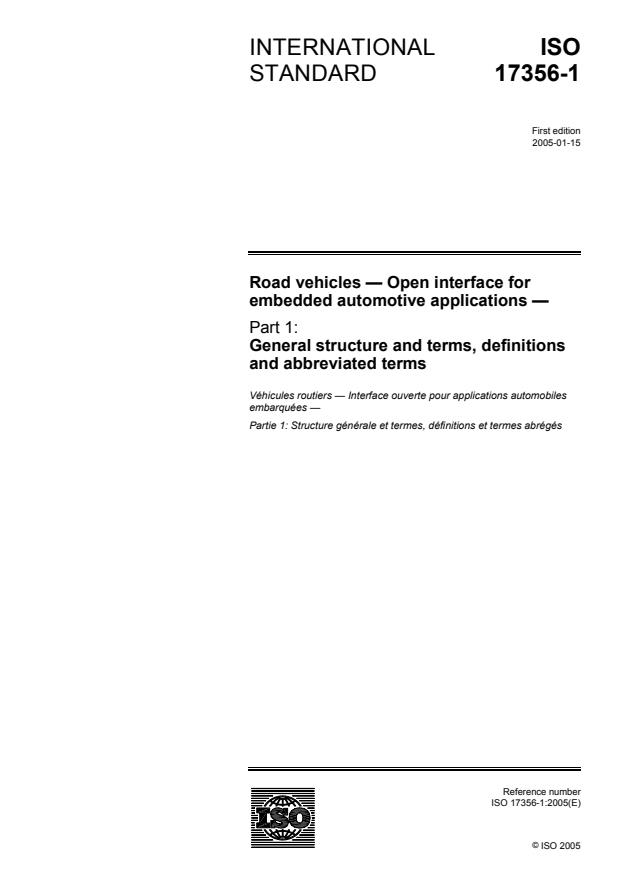
INTERNATIONAL ISO
STANDARD 17356-1
First edition
2005-01-15
Road vehicles — Open interface for
embedded automotive applications —
Part 1:
General structure and terms, definitions
and abbreviated terms
Véhicules routiers — Interface ouverte pour applications automobiles
embarquées —
Partie 1: Structure générale et termes, définitions et termes abrégés
Reference number
©
ISO 2005
PDF disclaimer
This PDF file may contain embedded typefaces. In accordance with Adobe's licensing policy, this file may be printed or viewed but
shall not be edited unless the typefaces which are embedded are licensed to and installed on the computer performing the editing. In
downloading this file, parties accept therein the responsibility of not infringing Adobe's licensing policy. The ISO Central Secretariat
accepts no liability in this area.
Adobe is a trademark of Adobe Systems Incorporated.
Details of the software products used to create this PDF file can be found in the General Info relative to the file; the PDF-creation
parameters were optimized for printing. Every care has been taken to ensure that the file is suitable for use by ISO member bodies. In
the unlikely event that a problem relating to it is found, please inform the Central Secretariat at the address given below.
© ISO 2005
All rights reserved. Unless otherwise specified, no part of this publication may be reproduced or utilized in any form or by any means,
electronic or mechanical, including photocopying and microfilm, without permission in writing from either ISO at the address below or
ISO's member body in the country of the requester.
ISO copyright office
Case postale 56 • CH-1211 Geneva 20
Tel. + 41 22 749 01 11
Fax + 41 22 749 09 47
E-mail copyright@iso.org
Web www.iso.org
Published in Switzerland
ii © ISO 2005 – All rights reserved
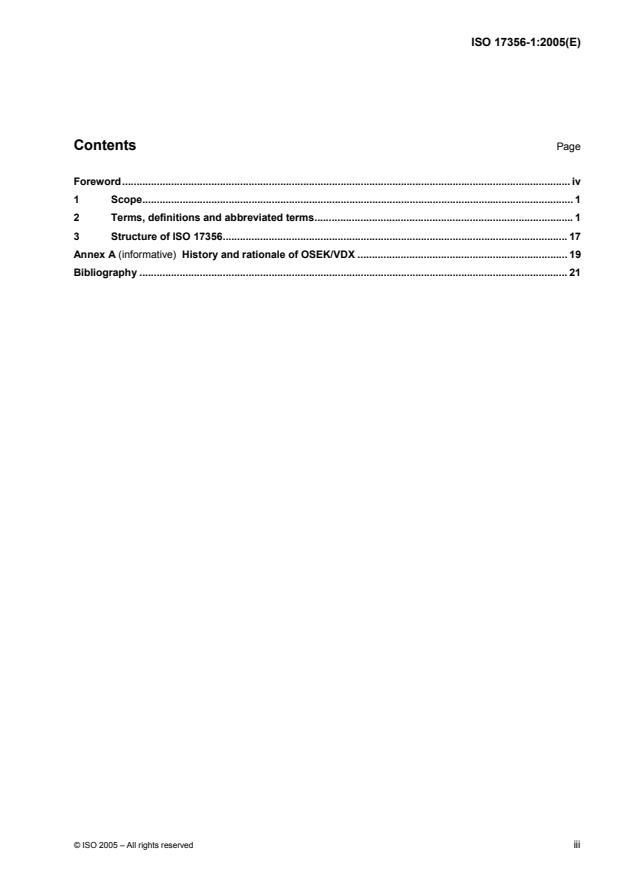
Contents Page
Foreword. iv
1 Scope. 1
2 Terms, definitions and abbreviated terms. 1
3 Structure of ISO 17356. 17
Annex A (informative) History and rationale of OSEK/VDX . 19
Bibliography . 21
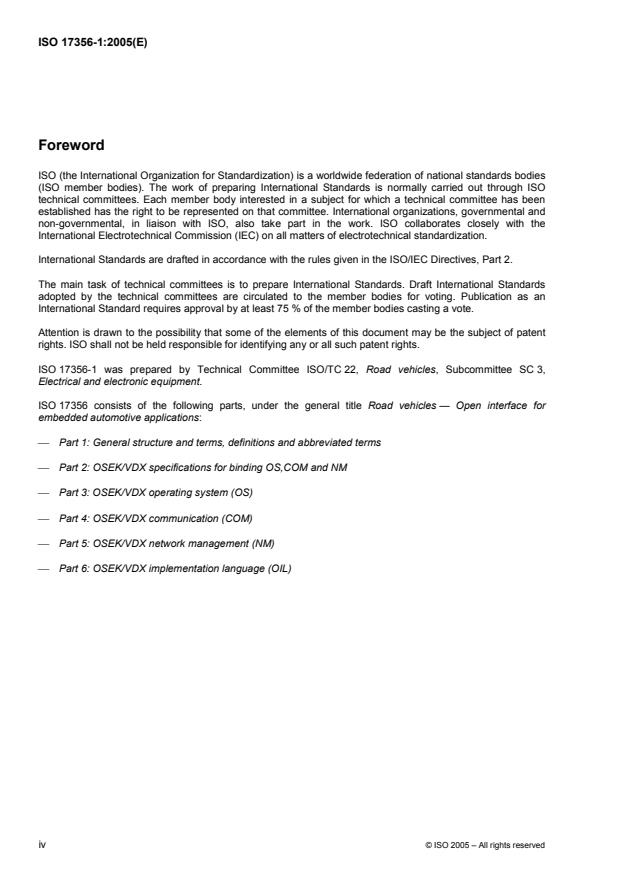
Foreword
ISO (the International Organization for Standardization) is a worldwide federation of national standards bodies
(ISO member bodies). The work of preparing International Standards is normally carried out through ISO
technical committees. Each member body interested in a subject for which a technical committee has been
established has the right to be represented on that committee. International organizations, governmental and
non-governmental, in liaison with ISO, also take part in the work. ISO collaborates closely with the
International Electrotechnical Commission (IEC) on all matters of electrotechnical standardization.
International Standards are drafted in accordance with the rules given in the ISO/IEC Directives, Part 2.
The main task of technical committees is to prepare International Standards. Draft International Standards
adopted by the technical committees are circulated to the member bodies for voting. Publication as an
International Standard requires approval by at least 75 % of the member bodies casting a vote.
Attention is drawn to the possibility that some of the elements of this document may be the subject of patent
rights. ISO shall not be held responsible for identifying any or all such patent rights.
ISO 17356-1 was prepared by Technical Committee ISO/TC 22, Road vehicles, Subcommittee SC 3,
Electrical and electronic equipment.
ISO 17356 consists of the following parts, under the general title Road vehicles — Open interface for
embedded automotive applications:
Part 1: General structure and terms, definitions and abbreviated terms
Part 2: OSEK/VDX specifications for binding OS,COM and NM
Part 3: OSEK/VDX operating system (OS)
Part 4: OSEK/VDX communication (COM)
Part 5: OSEK/VDX network management (NM)
Part 6: OSEK/VDX implementation language (OIL)
iv © ISO 2005 – All rights reserved
INTERNATIONAL STANDARD ISO 17356-1:2005(E)
Road vehicles — Open interface for embedded automotive
applications —
Part 1:
General structure and terms, definitions and abbreviated terms
1 Scope
This part of ISO 17356 outlines the general structure of, and defines terms and abbreviations used in relation
to, the specification of the software open interface for embedded automotive applications given by the other
parts of ISO 17356.
2 Terms, definitions and abbreviated terms
For the purposes of this document, the following terms, definitions and abbreviated terms apply.
2.1
acceptance filtering
mechanism which decides whether each received protocol frame is to be taken into account by the local node
or ignored
2.2
activate
action of changing a task from the suspended to the ready state
NOTE The transition is achieved by a system service.
2.3
actual configuration
set of all operable nodes to which communication access is possible
NOTE See operability of a node (2.81).
2.4
address-related communication
type of communication between nodes using node addresses where each address-related communication
message contains certain data and — either explicitly or implicitly — the node address of the transmitter and
the receiver
NOTE 1 See node addressing (2.76).
NOTE 2 The communication of the network management is based completely on address-related communication.
2.5
alarm
association between a counter and a task, event or callback such that the task, event or callback occurs when
a particular counter value is reached
NOTE 1 The expiry value can be defined relative to the current counter value or can be an absolute value.
NOTE 2 Alarms can be defined to be either single-shot or cyclic.
NOTE 3 An alarm is statically assigned at system generation time to one counter and a task, event or alarm callback
routine.
2.6
alarm callback
short function, provided by the application, called when an alarm expires but before any task is activated or
event set
2.7
alarm management
manipulation of an alarm’s running/cancelled state, and the counter value at which it next expires
NOTE Alarm management is based on the counter concept. Alarms are a way of linking alarm callbacks, task
activation or event setting to counter values.
2.8
alive message
message used to announce an initialized and operable node for integration in the actual configuration
NOTE 1 See operability of a node (2.81).
NOTE 2 A dedicated NM message is used for this purpose.
2.9
application program interface
API
description of the application's interface to the operating system, communications and network management
functions
2.10
application error
error where the operating system cannot execute the requested service correctly, but assumes the
correctness of its internal data, and calls centralized error treatment
2.11
arbitration
mechanism that guarantees that a simultaneous access made by multiple stations results in contention where
one frame will survive uncorrupted
2.12
basic conformance class
BCC
conformance class of the operating system in which only basic tasks are permitted
NOTE Two basic conformance classes are distinguished: BCC1 and BCC2.
2.13
basic task
BT
task that can only release the processor when it terminates, when the operating system executes a
higher-priority task or when an interrupt occurs
NOTE 1 A basic task can only enter the task states suspended, ready and running.
NOTE 2 It is not possible for a basic task to wait for an event.
2.14
broadcast
case of multicast whereby a single message is addressed to all nodes simultaneously
2.15
busOff
condition of switching off from the bus so that protocol frames can neither be sent nor received
2 © ISO 2005 – All rights reserved
2.16
callout
general mechanism, based upon function calls, allowing the behaviour of the interaction layer to be
customized and enhanced
NOTE 1 Callouts are configured statically, are invoked in response to the passage of a message or I-PDU and cannot
be changed at run-time.
NOTE 2 The prototype for a callout allows it to return a value that determines further treatment by the IL of the
message or I-PDU.
2.17
controller area network
CAN
protocol originally defined for use as a communication network for control application in vehicles
2.18
certification
process of determining whether an implementation is consistent with a given reference model
NOTE The scope of the reference model has to be settled according to the objectives of the project and all
constraints necessary to fulfil those objectives incorporated in the reference model.
2.19
COM-callback
short function, provided by the application, which can be called by the interaction layer as a notification
mechanism (class 1)
NOTE No parameters are passed to a COM-callback routine and it does not have a return value. A COM-callback
routine runs either on interrupt level or on task level.
2.20
communication layer
set of all entities and elements which constitute a communication layer based on the ISO/OSI reference model
NOTE For the basic model, see ISO 7498-1.
2.21
configurability
ability to set the parameters of a system in terms of static values
EXAMPLE Number of tasks, RAM size for stack, size of message buffer.
2.22
confirmation
service primitive via which a service provider informs a service user about the result of a preceding service
request
NOTE The confirmation service primitive is defined by the ISO/OSI reference model (ISO 7498).
2.23
conformance class
CC
subset of services chosen by the application
NOTE 1 In each module (operating system, communication, network management), a pool of services is provided, with
each of these being divided into a number of defined subsets. Applications can choose to use a particular subset of the
services in order to reduce demands on the CPU and memory.
NOTE 2 The subsets are upwardly compatible and are described as conformance classes.
2.24
connection
logical communication channel between a transmitter and a receiver
NOTE A message is sent by exactly one transmitter and is received by exactly one receiver.
2.25
constructional element
definition and declaration services for system objects
2.26
counter
system object that registers recurring events such as time or angle
NOTE A counter is represented by a count and some counter-specific constants.
2.27
critical section
sequence of instructions where mutual exclusion is ensured
NOTE Such a section is called “critical” because shared data is modified within it.
2.28
data consistency
content of a given message correlating unambiguously to the operation performed on the message by the
application such that no unforeseen sequence of operations may alter the content and thereby render it
inconsistent with respect to its allowed and expected value
2.29
data link layer
communication layer, consisting of the communication hardware and the communication driver software, that
provides services for the transfer of I-PDUs
2.30
deadlock
tasks that block one another so that further processing of the tasks concerned is no longer possible
EXAMPLE Each of two tasks waits for the reception of a message to be sent by the other task before sending its
own message.
2.31
direct node monitoring
active monitoring of a node by another node in the network
NOTE For this purpose, the monitored node sends an NM message according to a dedicated and uniform algorithm.
For the network-wide synchronization of NM messages, a logical ring is used.
2.32
deadline monitoring
informing of the application via the notification mechanism that a message has not been received from
another node within a specified interval, or if a request to send an I-PDU has not been completed by the DLL
within a specified interval
2.33
error handling
error service provided to handle errors detected by the operating system
NOTE The basic framework is predefined and has to be completed by the user, thus giving the user a choice of
efficient centralized or decentralized error handling.
4 © ISO 2005 – All rights reserved
2.34
error hook
routine (ErrorHook) called when a system service returns a StatusType value not equal to E_OK or when an
error is detected during task activation or event setting
2.35
event
method of task synchronization peculiar to extended task whereby a task may suspend its execution without
terminating
NOTE The task suspends its execution by waiting for an event and continues when an appropriate event is set. Basic
tasks cannot use events.
2.36
event mechanism
means of task synchronization using events
2.37
extended conformance class
ECC
conformance class of the operating system in which basic and extended tasks are permitted
NOTE Two extended conformance classes are distinguished: ECC1 and ECC2.
2.38
extended task
ET
task that is allowed to use additional operating system services, which may result in a waiting state
NOTE An extended task can enter the task state suspended, ready, running or waiting.
2.39
fatal error
error where the operating system can no longer assume correctness of its internal data
NOTE In this case, the operating system calls the centralized system shutdown.
2.40
frame
data unit determined according to the data link protocol specifying the arrangement and meaning of bits or bit
fields in the data transferred across the transfer medium
2.41
full pre-emptive scheduling
scheduling where a task which is presently running may be pre-empted at any instruction by the occurrence of
a trigger condition pre-set by the operating system that puts the running task into the ready state as soon as a
higher-priority task becomes ready
NOTE The pre-emptee's context is saved so that it can be continued at the location where it was pre-empted.
2.42
group addressing
addressing of several receiver nodes, implemented using multicast connections, in a single address-related
NM message
NOTE See address-related communication (2.4).
2.43
hook routine
user-defined function which will be called by the operating system only under certain circumstances and in a
defined context
NOTE Hook routines may be used for tracing or application-dependent debugging purposes, user-defined extensions
to context switches and in error handling. Most operating system services are not allowed in hook routines.
2.44
indication
service primitive where a service provider informs a service user about the occurrence of either an internal
event or a service request issued by another service user
NOTE The indication service primitive is defined by the ISO/OSI reference model (ISO 7498).
2.45
indirect node monitoring
monitoring of a node by “listening” to dedicated application communication messages
NOTE Indirect node monitoring is based on monitored state messages which are sent periodically.
2.46
interaction layer
communication layer that implements the interface between the application and other potential communication
layers such as the DLL and network layers
NOTE 1 The communication services of the interaction layer are independent of both microcontroller and network
protocol.
NOTE 2 The interaction layer enables internal and network-wide communication by means of UnQueued messages
and Queued messages.
2.47
internal communication
exchange of messages between tasks belonging to the same node
2.48
internal resource
resource which is not visible to the user and therefore cannot be addressed by the system functions
GetResource and ReleaseResource
NOTE Internal resources are managed strictly internally within a clearly defined set of system functions.
2.49
interrupt
enforced suspension of the execution of the current program section
2.50
interrupt latency
time between the moment an interrupt occurs and the execution of the first instruction of the interrupt service
routine
2.51
interrupt level
priority level provided by the CPU for ISRs
NOTE To keep the interrupt latency as short as possible, it is preferable that only absolutely indispensable actions be
performed at interrupt level.
6 © ISO 2005 – All rights reserved
2.52
interrupt service routine
function that provides the main processing of an interrupt
2.53
intertask communication
mode of information interchange between tasks
NOTE In the course of intertask communication, messages are logically copied from the local area of a task
(transmitter) to the local area of another task (receiver).
2.53
I-PDU
collection of messages for simultaneous transfer between nodes in a network
NOTE At the sending node, the interaction layer (IL) is responsible for packing messages into an I-PDU and then
sending it to the underlying layer (transport layer or DLL) for transmission; at the receiving node, the DLL (or transport
layer) rebuilds the I-PDU and passes it to the IL, which then unpacks the messages.
2.54
ISR category
trade-off between ISR response time and API complexity
NOTE Interrupt processing is subdivided into two categories of ISRs: Category 1 comprises all ISRs which do not
use operating system services and are, therefore, typically faster for entry and exit than category 2 ISRs. Category 1 ISRs
are only allowed to use a very restricted set of operating system services, whereas category 2 ISRs are allowed to use a
less restricted set but are typically inherently slower.
2.55
latency time
time delay between the request of an activity and its execution
2.56
limp home
operating mode in NM which is entered in case of an error which cannot be corrected
2.57
limp home configuration
set of all nodes which cannot participate in direct node monitoring due to failure
2.58
limp home message
dedicated NM message used for notifying a node that the system has entered the limp home state
2.59
logical ring
structure imposed by software rather than physical arrangement that orders the nodes within a network such
that every node has exactly one successor and one predecessor and a pathway exists from any node to any
other node
NOTE 1 The nodes are arranged in terms of a ring. The logical ring is used for the network-wide synchronization of NM
messages. In a logical ring, the communication sequence is defined independently of the network structure; therefore,
each node is assigned a logical successor — the first logical node is the successor of the last logical node in the ring.
NOTE 2 A ring message is always sent from a node to its logical successor.
2.60
message
fundamental unit of data transfer between an application and a COM's IL and, therefore, also of intra- and
inter-ECU communications
NOTE A message can be 0 or more bits long and could contain some application-specific data ranging from a bit to a
large array or structure. Therefore, messages can support event and signal-based communication as well as more
complex interfaces.
2.61
mixed pre-emptive scheduling
scheduling policy which enables the use of both full-pre-emptive and non-pre-emptive scheduling policies for
the execution of different tasks on the same system
NOTE The distinction is made via a task attribute (pre-emptable/non-pre-emptable).
2.62
multiple task requesting
property of a task that allows it to have more than one activation outstanding
NOTE 1 See activate (2.2).
NOTE 2 The operating system receives and records activation. On terminating the task (see terminate), the operating
system checks whether any activation are outstanding. If there are any, the task immediately re-enters the running state.
2.63
mutual exclusion
prevention by one task of one or more other tasks running for a specified section of code
2.64
one–to–N connection
1:N connection
logical communication channel between a transmitter and N receivers
NOTE A message is sent by exactly one transmitter and is received by N receivers.
2.65
network configuration
set of nodes in the network
NOTE Within network management (NM), two configurations are distinguished: actual configuration and limp home
configuration.
2.66
network management
NM
ensuring of the safety and availability of a communications network of autonomous control units
EXAMPLE 1 Initialization of the node and network-related (global) activities.
EXAMPLE 2 Co-ordination of global NM operating modes.
NOTE NM distinguishes between node-related (local) and network-related (global) activities.
2.67
NMBus-sleep
non-participation in NM communication
NOTE This is an NM operating mode. A request for this mode request must be confirmed by all nodes in the network.
2.68
NM callback
short function provided by the application which can be called by the interaction layer as a notification
mechanism (class 1) so that NM can be informed of the network’s state
NOTE 1 A parameter can be passed to an NM-ca
...