


ISO 9768:1994
(Main)Tea — Determination of water extract
General Information
- Abstract
The principle of the method specified is extraction of soluble matter from a test portion by boiling water under reflux, filtration, washing, drying and weighing of the hot-water-insoluble residue, calculation of the water extract.
- Status
- Published
- Publication Date
- 27-Jul-1994
- Technical Committee
- ISO/TC 34/SC 8 - Tea
- Drafting Committee
- ISO/TC 34/SC 8 - Tea
- Current Stage
- 9020 - International Standard under periodical review
- Start Date
- 15-Jul-2026
- Completion Date
- 15-Jul-2026
Buy Documents

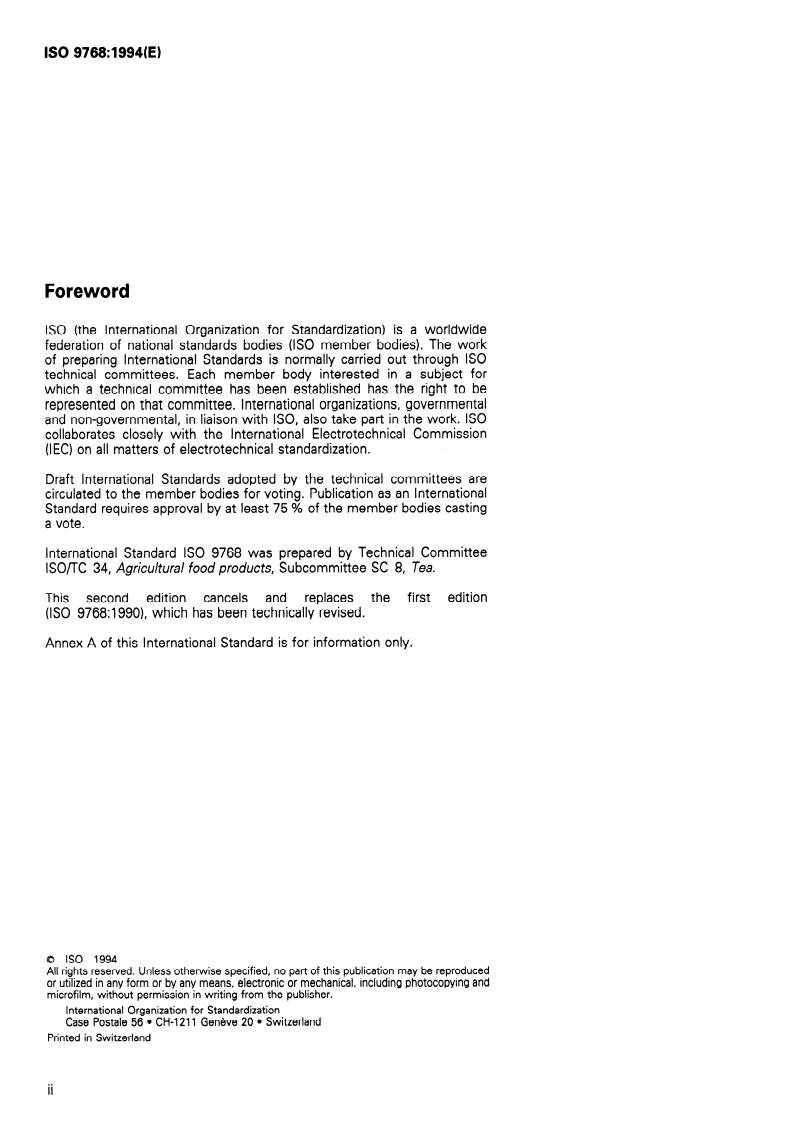

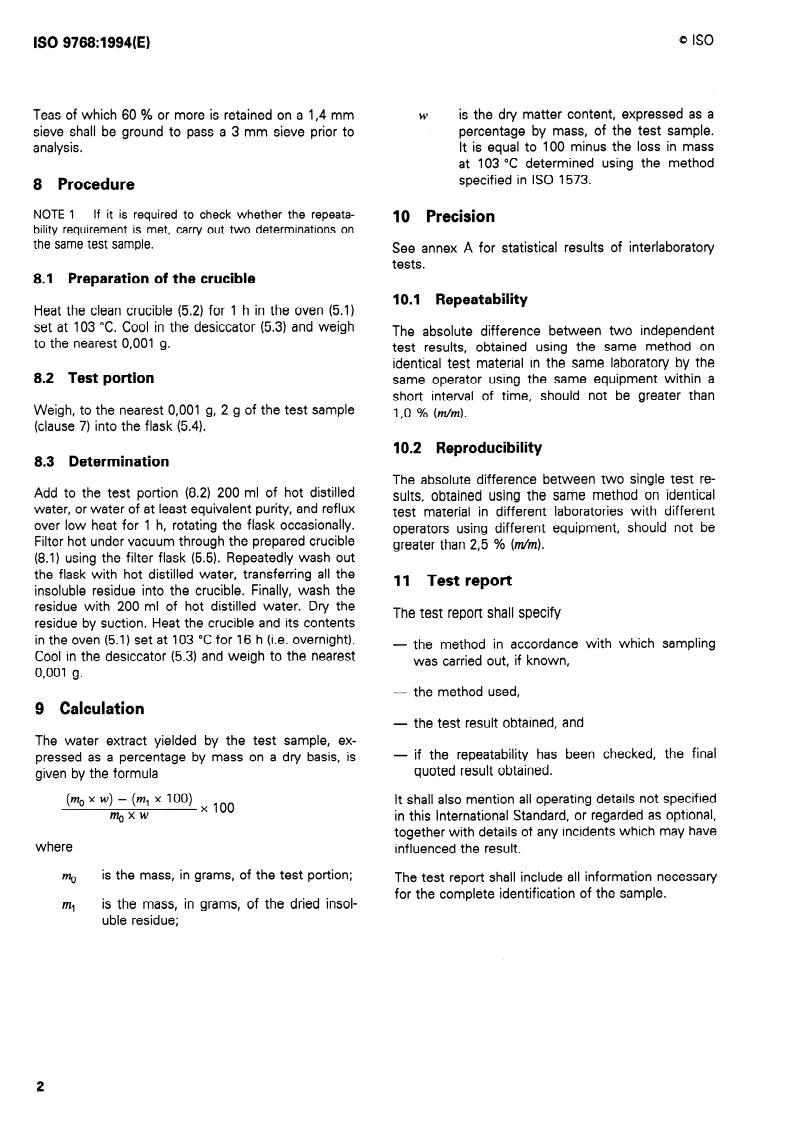
ISO 9768:1994 - Tea — Determination of water extract Released:7/28/1994

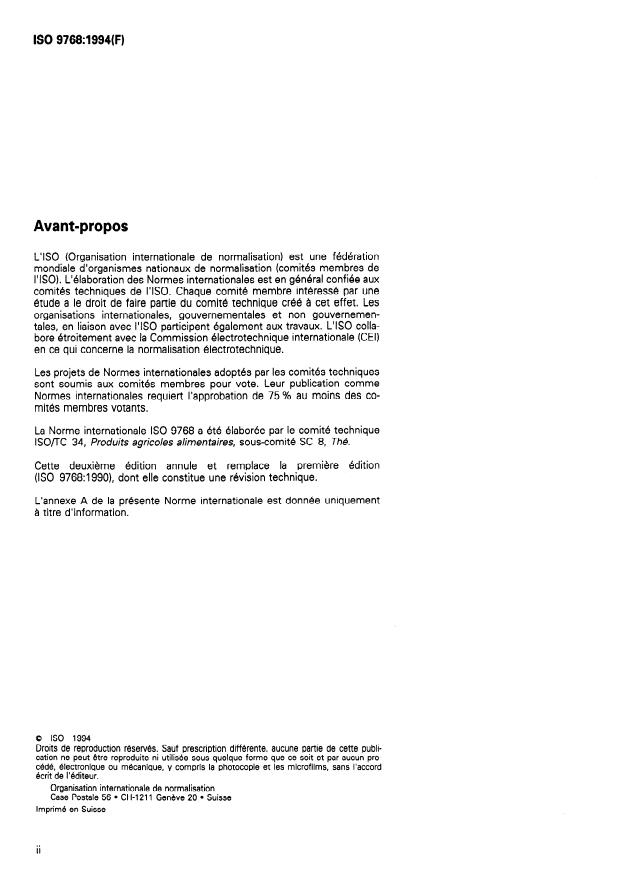
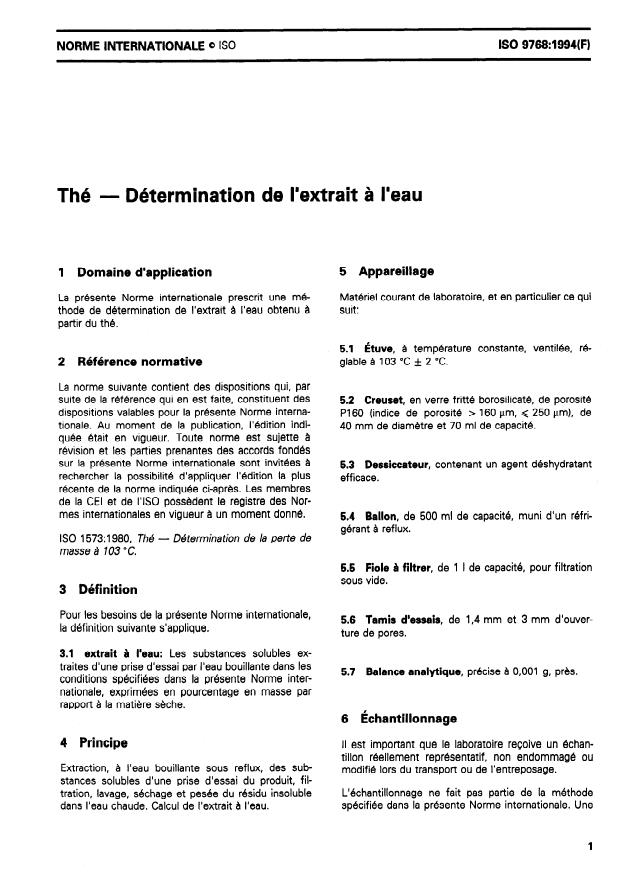
ISO 9768:1994 - Thé — Détermination de l'extrait a l'eau Released:7/28/1994


ISO 9768:1994 - Thé — Détermination de l'extrait a l'eau Released:7/28/1994
Overview
ISO 9768:1994 is an internationally recognized standard established by the International Organization for Standardization (ISO) that specifies a reliable and standardized method for the determination of water extract in tea. This method involves the extraction of soluble matter from a tea sample by boiling water under reflux conditions, followed by filtration, drying, and weighing of the insoluble residue. The water extract content is calculated as a percentage of dry matter, providing essential quality parameters for tea products worldwide.
This standard ensures uniformity and accuracy in testing, essential for manufacturers, quality control laboratories, and researchers involved in tea production and analysis. It replaces the previous 1990 edition, incorporating technical revisions for improved precision and usability.
Key Topics
- Scope: Defines the procedure to determine the water extract in tea expressed as a percentage by mass on a dry basis.
- Principle: Extraction of soluble material with boiling water under reflux, filtration, drying of insoluble residues, and calculation of water extract.
- Apparatus Required:
- Oven with controlled temperature (103 °C ± 2 °C)
- Borosilicate glass crucibles with defined porosity for filtration
- Reflux condensers and filtration flasks
- Analytical balances precise to 0.001 g
- Test sieves (1.4 mm and 3 mm apertures)
- Sampling and Preparation:
- Use a representative sample that has not been damaged during transport.
- Grind tea to pass through a 3 mm sieve if necessary.
- Dry matter content determination as per ISO 1573 before analysis.
- Testing Procedure:
- Weigh a 2 g test portion of dried tea.
- Reflux with 200 ml distilled water for 1 hour.
- Filter under vacuum, wash with hot distilled water.
- Dry residue at 103 °C for 16 hours.
- Weigh residue and calculate water extract percentage.
- Calculation Formula:
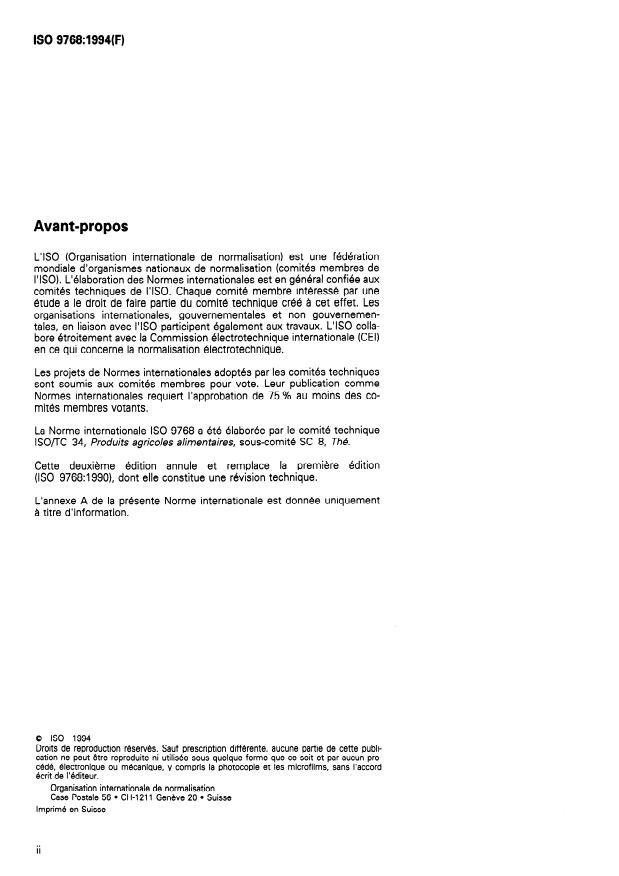
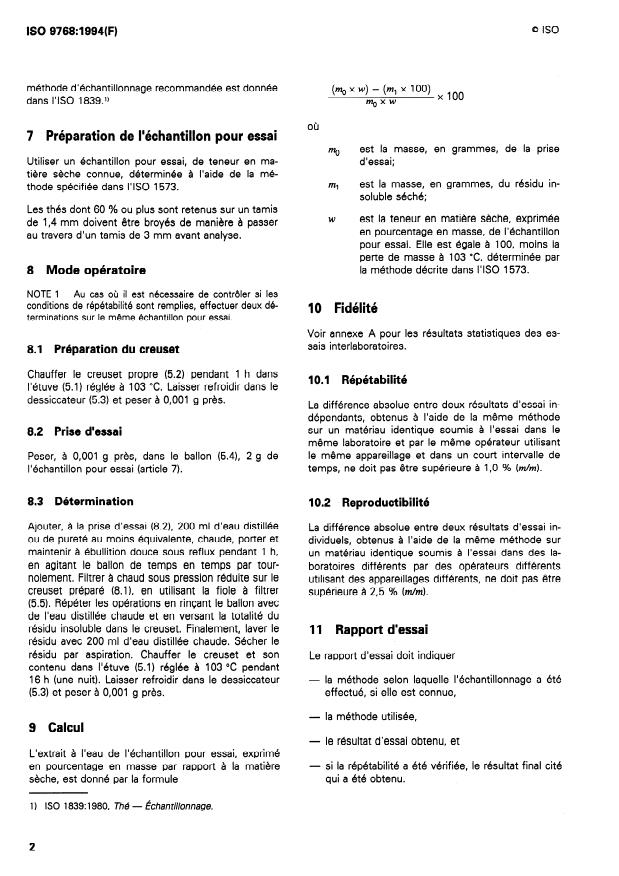
[ \text{Water extract % (dry basis)} = \frac{(m_1 - m_h)}{m_0 \times W} \times 100 ] where:- (m_0) = mass of test portion
- (m_1) = mass of dried insoluble residue
- (m_h) = mass of crucible
- (W) = dry matter content (%)
- Precision and Accuracy:
- Repeatability limit: 1.0% (dry matter basis)
- Reproducibility limit: 2.5% (m/m) among different laboratories
- Statistical validation confirmed through interlaboratory testing (Annex A)
- Reporting: Test reports must clearly state the method used, sampling details, drying method, test results, and any deviations or incidents affecting results.
Applications
- Quality Control in Tea Production: ISO 9768:1994 provides an essential method for tea manufacturers and quality laboratories to evaluate the extraction efficiency and soluble content of tea, directly influencing flavor and consumer satisfaction.
- Research and Development: Scientific studies on tea composition and processing effects rely on this standardized method for reproducible results in water extract analysis.
- Trade and Compliance: The standardized test allows producers and traders to comply with international quality requirements and ensures uniform evaluation of tea products globally.
- Regulatory and Certification Use: Authorities and certifying bodies use this method to confirm adherence to product standards, supporting labeling and quality assurance claims.
- Agricultural Quality Assessment: Tea growers assess the quality of raw materials, leveraging the water extract determination to gauge leaf maturity and processing suitability.
Related Standards
- ISO 1573:1980 – Tea: Determination of loss in mass at 103 °C
Used to establish the dry matter content prior to water extract testing, crucial for accurate results. - ISO 1839:1980 – Tea: Sampling
Provides guidelines on proper tea sampling ensuring representativity and consistency. - ISO 5725:1986 – Accuracy (trueness and precision) of measurement methods and results
Framework for evaluating repeatability and reproducibility of testing methods like ISO 9768.
By integrating ISO 9768:1994 into laboratory practices, stakeholders in the tea industry can achieve precise, repeatable, and globally accepted water extract analysis - a vital parameter for tea quality and consumer satisfaction.
Relations
- Effective Date
- 15-Apr-2008
Buy Documents
ISO 9768:1994 - Tea — Determination of water extract Released:7/28/1994
ISO 9768:1994 - Thé — Détermination de l'extrait a l'eau Released:7/28/1994
ISO 9768:1994 - Thé — Détermination de l'extrait a l'eau Released:7/28/1994
Get Certified
Connect with accredited certification bodies for this standard

BSI Group
BSI (British Standards Institution) is the business standards company that helps organizations make excellence a habit.

Bureau Veritas
Bureau Veritas is a world leader in laboratory testing, inspection and certification services.

DNV
DNV is an independent assurance and risk management provider.
Sponsored listings
Frequently Asked Questions
ISO 9768:1994 is a standard published by the International Organization for Standardization (ISO). Its full title is "Tea — Determination of water extract". This standard covers: The principle of the method specified is extraction of soluble matter from a test portion by boiling water under reflux, filtration, washing, drying and weighing of the hot-water-insoluble residue, calculation of the water extract.
The principle of the method specified is extraction of soluble matter from a test portion by boiling water under reflux, filtration, washing, drying and weighing of the hot-water-insoluble residue, calculation of the water extract.
ISO 9768:1994 is classified under the following ICS (International Classification for Standards) categories: 67.140.10 - Tea. The ICS classification helps identify the subject area and facilitates finding related standards.
ISO 9768:1994 has the following relationships with other standards: It is inter standard links to ISO 9768:1990. Understanding these relationships helps ensure you are using the most current and applicable version of the standard.
ISO 9768:1994 is available in PDF format for immediate download after purchase. The document can be added to your cart and obtained through the secure checkout process. Digital delivery ensures instant access to the complete standard document.
Standards Content (Sample)
ISO
INTERNATIONAL
STANDARD
Second edition
1994-08-01
Tea - Determination of water extract
Th6
- Determination de I ’extrait a I ’eau
Reference number
Foreword
ISO (the International Organization for Standardization) is a worldwide
federation of national Standards bodies (ISO member bodies). The work
of preparing International Standards is normally carried out through ISO
technical committees. Esch member body interested in a subject for
which a technical committee has been established has the right to be
represented on that committee. International organizations, governmental
and non-governmental, in liaison with ISO, also take part in the work. ISO
collaborates closely with the International Electrotechnical Commission
(1 EC) on all matters of electrotechnical standardization.
Draft International Standards adopted by the technical committees are
circulated to the member bodies for voting. Publication as an International
Standard requires approval by at least 75 % of the member bodies casting
a vote.
International Standard ISO 9768 was prepared by Technical Committee
lSO/rC 34, Agricultural food products, Subcommittee SC 8, Tea.
This second edition cancels and replaces the first edition
(ISO 9768:1990), which has been technically revised.
Annex A of this International Standard is for information only.
0 ISO 1994
All rights reserved. Unless otherwise specified, no part of this publication may be reproduced
or utilized in any form or by any means, electronie or mechanical, including photocopying and
microfilm, without Permission in writing from the publisher.
International Organkation for Standardization
Case Postale 56 l CH-l 211 Geneve 20 l Switzerland
Printed in Switzerland
ii
INTERNATIONAL STANDARD Q ISO ISO 9768:1994(E)
Tea - Determination of water extract
1 Scope 5 Apparatus
Usual laboratoty apparatus and, in particular, the fol-
This International Standard specifies a method for the
determination of the water extract from tea. lowing.
5.1 Oven, constant-temperature and fan-assisted,
2 Normative reference capable of being operated at 103 “C & 2 “C.
The following Standard contains provisions which,
5.2 Crucible, made of sintered borosilicate glass, of
through reference in this text, constitute provisions
porosity grade Pl60 (Pore size index B 160 Pm,
of this International Standard. At the time of publi-
< 250 km), 40 mm in diameter and of 70 ml capacity.
cation, the edition indicated was valid. All Standards
are subject to revision, and Parties to agreements
5.3 Desiccator, containing an efficient desiccant.
based on this International Standard are encouraged
to investigate the possibility of applying the most re-
5.4 Flask, of 500 ml capacity, fitted with a reflux
cent edition of the Standard indicated below. Mem-
condenser.
bers of IEC and ISO maintain registers of currently
valid International Standards.
5.5 Filter flask, of 1 litre capacity, for vacuum fil-
tration.
ISO 1573:1980, Tea - Determination of loss in mass
at 103°C.
5.6 Test sieves, of nominal aperture size 1,4 mm
and 3 mm.
3 Definition
5.7 Analytical balance, capable of weighing to an
accuracy of 0,001 g.
For the purposes of this International Standard, the
following definition applies.
6 Sampling
3.1 water extract: The soluble matter extracted
from a test portion by boiling water, under the con- lt is important that the laboratory receive a Sample
ditions specified in this International Standard, ex- which is truly representative and has not been dam-
pressed as a percentage by mass on a dry basis. aged or changed during transport or storage.
Sampling is not part of the method specified in this
International Standard. A recommended sampling
4 Principle
method is given in ISO 1839.l)
Extraction of soluble matter from a test Portion of the
product by means of water boiling under reflux. Fil-
7 Preparation of test Sample
tration, washing, drying and weighing of the hot-
...
NORME
ISO
INTERNATIONALE
Deuxibme edition
1994-08-01
Thé - Détermination de l’extrait à l’eau
Tea - Determination of water extract
Numéro de référence
ISO 9768:4994(F)
Avant-propos
L’ISO (Organisation internationale de normalisation) est une fedération
mondiale d’organismes nationaux de normalisation (comités membres de
I’ISO). L’elaboration des Normes internationales est en général confiée aux
comites techniques de I’ISO. Chaque comite membre interesse par une
etude a le droit de faire partie du comite technique cree à cet effet. Les
organisations internationales, gouvernementales et non gouvernemen-
tales, en liaison avec I’ISO participent également aux travaux. L’ISO colla-
bore etroitement avec la Commission électrotechnique internationale (CEI)
en ce qui concerne la normalisation électrotechnique.
Les projets de Normes internationales adoptes par les comites techniques
sont soumis aux comités membres pour vote. Leur publication comme
Normes internationales requiert l’approbation de 75 % au moins des co-
mites membres votants.
La Norme internationale ISO 9768 a ete Alaboree par le comité technique
lSO/TC 34, Produits agricoles alimentaires, sous-comité SC 8, Th&
Cette deuxieme Adition annule et remplace la première édition
(ISO 9768:1990), dont elle constitue une revision technique.
L’annexe A de la presente Norme internationale est donnée uniquement
à titre d’information.
0 60 1994
Droits de reproduction reserves. Sauf prescription differente, aucune partie de cette publi-
cation ne peut être reproduite ni utilisee sous quelque forme que ce soit et par aucun pro-
cedé, electronique ou mécanique, y compris la photocopie et les microfilms, sans l’accord
ecrit de I’editeur.
Organisation internationale de normalisation
Case Postale 56 l CH-l 211 Geneve 20 l Suisse
Imprime en Suisse
ii
NORME INTERNATIONALE Q ISO
Thé - Détermination de l‘extrait à l’eau
5 Appareillage
1 Domaine d’application
La présente Norme internationale prescrit une me- Materiel courant de laboratoire, et en particulier ce qui
suit:
thode de détermination de l’extrait à l’eau obtenu à
partir du the.
5.1 Étuve, à temperature constante, ventilee, r&
glable à 103 OC & 2 OC.
2 Référence normative
La norme suivante contient des dispositions qui, par
suite de la reférence qui en est faite, constituent des 5.2 Creuset, en verre fritte borosilicaté, de porosité
dispositions valables pour la présente Norme interna-
P160 (indice de porosité B 160 prn, < 250 pm), de
tionale. Au moment de la publication, l’édition indi-
40 mm de diametre et 70 ml de capacite.
quée etait en vigueur. Toute norme est sujette à
révision et les parties prenantes des accords fondes
sur la présente Norme internationale sont invitées à
5.3 Dessiccateur, contenant un agent déshydratant
rechercher la possibilite d’appliquer l’édition la plus
efficace.
récente de la norme indiquee ci-apres. Les membres
de la CEI et de I’ISO possedent le registre des Nor-
mes internationales en vigueur à un moment donne.
5.4 Ballon, de 500 ml de capacité, muni d’un réfri-
gerant à reflux.
Ddtermination de la perte de
ISO 1573:1980, Th6 -
masse à 103 OC.
5.5 Fiole h filtrer, de 1 I de capacité, pour filtration
sous vide.
3 Définition
Pour les besoins de la presente Norme internationale,
5.6 Tamis d’essais, de 1,4 mm et 3 mm d’ouver-
la definition suivante s’applique.
ture de pores.
3.1 extrait B l’eau: Les substances solubles ex-
traites d’une prise d’essai par l’eau bouillante dans les
5.7 Balance analytique, precise à 0,001 g, pres.
conditions spécifiées dans la presente Norme inter-
nationale, exprimées en pourcentage en masse par
rapport à la matiere sèche.
6 Échantillonnage
4 Principe
II est important que le laboratoire reçoive un Achan-
tillon reellement représentatif, non endommage ou
Extraction, à l’eau bouillante sous reflux, des sub-
modifie lors du transport ou de l’entreposage.
stances solubles d’une prise d’essai du produit, fil-
tration, lavage, sechage et pesbe du rbsidu insoluble L’échantillonnage ne fait pas partie de la m&hode
dans l’eau chaude. Calcul de l’extrait à l’eau. spécifiée dans la présente Norme internationale. Une
methode d’échantillonnage recommandee est donnee
(~xw)-(“lxloo) xl()o
dans I’ISO 1839.l)
moxw
où
7 Préparation de l’échantillon pour essai
est la masse, en grammes, de la prise
nio
Utilise
...
NORME
ISO
INTERNATIONALE
Deuxibme edition
1994-08-01
Thé - Détermination de l’extrait à l’eau
Tea - Determination of water extract
Numéro de référence
ISO 9768:4994(F)
Avant-propos
L’ISO (Organisation internationale de normalisation) est une fedération
mondiale d’organismes nationaux de normalisation (comités membres de
I’ISO). L’elaboration des Normes internationales est en général confiée aux
comites techniques de I’ISO. Chaque comite membre interesse par une
etude a le droit de faire partie du comite technique cree à cet effet. Les
organisations internationales, gouvernementales et non gouvernemen-
tales, en liaison avec I’ISO participent également aux travaux. L’ISO colla-
bore etroitement avec la Commission électrotechnique internationale (CEI)
en ce qui concerne la normalisation électrotechnique.
Les projets de Normes internationales adoptes par les comites techniques
sont soumis aux comités membres pour vote. Leur publication comme
Normes internationales requiert l’approbation de 75 % au moins des co-
mites membres votants.
La Norme internationale ISO 9768 a ete Alaboree par le comité technique
lSO/TC 34, Produits agricoles alimentaires, sous-comité SC 8, Th&
Cette deuxieme Adition annule et remplace la première édition
(ISO 9768:1990), dont elle constitue une revision technique.
L’annexe A de la presente Norme internationale est donnée uniquement
à titre d’information.
0 60 1994
Droits de reproduction reserves. Sauf prescription differente, aucune partie de cette publi-
cation ne peut être reproduite ni utilisee sous quelque forme que ce soit et par aucun pro-
cedé, electronique ou mécanique, y compris la photocopie et les microfilms, sans l’accord
ecrit de I’editeur.
Organisation internationale de normalisation
Case Postale 56 l CH-l 211 Geneve 20 l Suisse
Imprime en Suisse
ii
NORME INTERNATIONALE Q ISO
Thé - Détermination de l‘extrait à l’eau
5 Appareillage
1 Domaine d’application
La présente Norme internationale prescrit une me- Materiel courant de laboratoire, et en particulier ce qui
suit:
thode de détermination de l’extrait à l’eau obtenu à
partir du the.
5.1 Étuve, à temperature constante, ventilee, r&
glable à 103 OC & 2 OC.
2 Référence normative
La norme suivante contient des dispositions qui, par
suite de la reférence qui en est faite, constituent des 5.2 Creuset, en verre fritte borosilicaté, de porosité
dispositions valables pour la présente Norme interna-
P160 (indice de porosité B 160 prn, < 250 pm), de
tionale. Au moment de la publication, l’édition indi-
40 mm de diametre et 70 ml de capacite.
quée etait en vigueur. Toute norme est sujette à
révision et les parties prenantes des accords fondes
sur la présente Norme internationale sont invitées à
5.3 Dessiccateur, contenant un agent déshydratant
rechercher la possibilite d’appliquer l’édition la plus
efficace.
récente de la norme indiquee ci-apres. Les membres
de la CEI et de I’ISO possedent le registre des Nor-
mes internationales en vigueur à un moment donne.
5.4 Ballon, de 500 ml de capacité, muni d’un réfri-
gerant à reflux.
Ddtermination de la perte de
ISO 1573:1980, Th6 -
masse à 103 OC.
5.5 Fiole h filtrer, de 1 I de capacité, pour filtration
sous vide.
3 Définition
Pour les besoins de la presente Norme internationale,
5.6 Tamis d’essais, de 1,4 mm et 3 mm d’ouver-
la definition suivante s’applique.
ture de pores.
3.1 extrait B l’eau: Les substances solubles ex-
traites d’une prise d’essai par l’eau bouillante dans les
5.7 Balance analytique, precise à 0,001 g, pres.
conditions spécifiées dans la presente Norme inter-
nationale, exprimées en pourcentage en masse par
rapport à la matiere sèche.
6 Échantillonnage
4 Principe
II est important que le laboratoire reçoive un Achan-
tillon reellement représentatif, non endommage ou
Extraction, à l’eau bouillante sous reflux, des sub-
modifie lors du transport ou de l’entreposage.
stances solubles d’une prise d’essai du produit, fil-
tration, lavage, sechage et pesbe du rbsidu insoluble L’échantillonnage ne fait pas partie de la m&hode
dans l’eau chaude. Calcul de l’extrait à l’eau. spécifiée dans la présente Norme internationale. Une
methode d’échantillonnage recommandee est donnee
(~xw)-(“lxloo) xl()o
dans I’ISO 1839.l)
moxw
où
7 Préparation de l’échantillon pour essai
est la masse, en grammes, de la prise
nio
Utilise
...