

ISO 19563:2017
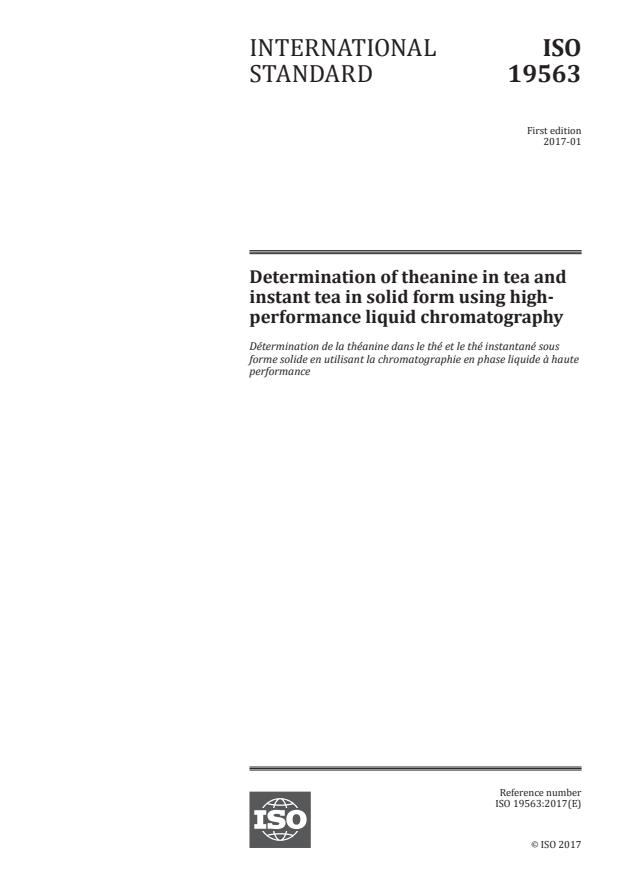
(Main)Determination of theanine in tea and instant tea in solid form using high-performance liquid chromatography
- Abstract
ISO 19563:2016 specifies a high-performance liquid chromatographic (HPLC) method for the determination of theanine content in tea (Camellia sinensis). It is applicable to both tea and instant tea samples. Separation of L- and D-theanine is not possible using this method; however, the L-enantiomer is the major form in tea.
- Status
- Published
- Publication Date
- 09-Jan-2017
- Technical Committee
- ISO/TC 34/SC 8 - Tea
- Drafting Committee
- ISO/TC 34/SC 8 - Tea
- Current Stage
- 9092 - International Standard to be revised
- Start Date
- 16-Oct-2026
- Completion Date
- 17-Oct-2026
Buy Documents
ISO 19563:2017 - Determination of theanine in tea and instant tea in solid form using high-performance liquid chromatography
ISO 19563:2017 - Determination of theanine in tea and instant tea in solid form using high-performance liquid chromatography/10/2017
Overview - ISO 19563:2017 (Theanine analysis by HPLC)
ISO 19563:2017 specifies a validated high-performance liquid chromatography (HPLC) method for the quantitative determination of theanine in tea (Camellia sinensis) and instant tea in solid form. The procedure covers sample preparation, optional polyamide clean-up to remove polyphenols, chromatographic conditions using a reversed-phase C18 column, and method performance characteristics (precision, repeatability, reproducibility). The method does not separate L- and D‑theanine; L‑theanine is the predominant enantiomer in tea.
Key technical topics and requirements
- Scope: Applicable to leaf tea and instant tea samples; results expressed per dry matter.
- Principle: Reversed-phase (RP) C18 column with UV detection at 210 nm; water and acetonitrile used as mobile phases.
- Reagents & standards: Grade 1 water (ISO 3696), HPLC‑grade acetonitrile, methanol, polyamide (Polyamide CC 6) for clean-up, and anhydrous L‑theanine standard (>99%).
- Calibration range: Working standards prepared in the 5 µg/ml to 200 µg/ml range (from a 1 mg/ml stock).
- Sample preparation:
- Leaf tea: 1.00 g brewed in 100 ml boiling water for 5 min, cooled, made to volume and filtered (0.45 µm) or centrifuged.
- Instant tea: 0.100 g dissolved in ≈50 °C water, sonicated, filtered or centrifuged.
- Optional clean-up: Polyamide column chromatography to retain polyphenols while eluting theanine - recommended where interfering peaks occur.
- Chromatography: Binary gradient-capable HPLC with thermostatted column compartment; suggested column (e.g., Phenomenex Aqua 250 × 4.6 mm or 2 mm equivalent). Flow rates: ~1.0 ml/min for 4.6 mm columns, ~0.25 ml/min for 2 mm columns.
- Method performance: Includes interlaboratory test data and stated repeatability/reproducibility criteria.
Practical applications and users
- Quality control in tea production and instant tea manufacturing - routine monitoring of theanine content to support flavor and product specifications.
- Food testing laboratories and regulatory bodies conducting compositional analysis or compliance testing.
- Research labs studying tea chemistry, sensory compounds (umami), or nutritional content of tea-derived products and supplements.
- Dietary supplement and novel food developers assessing theanine levels in ingredient sourcing and product formulation.
Related standards and references
- ISO 1839 (Tea - Sampling), ISO 1572 / ISO 1573 (sample preparation & moisture/dry matter), ISO 7513 / ISO 7516 (instant tea sampling and moisture). These referenced standards support representative sampling and dry-matter correction required by ISO 19563:2017.
Keywords: ISO 19563:2017, theanine analysis, HPLC, tea analysis, Camellia sinensis, L-theanine, polyamide clean-up, reversed-phase C18, UV 210 nm, instant tea.
Buy Documents
ISO 19563:2017 - Determination of theanine in tea and instant tea in solid form using high-performance liquid chromatography
ISO 19563:2017 - Determination of theanine in tea and instant tea in solid form using high-performance liquid chromatography/10/2017
Get Certified
Connect with accredited certification bodies for this standard

BSI Group
BSI (British Standards Institution) is the business standards company that helps organizations make excellence a habit.

Bureau Veritas
Bureau Veritas is a world leader in laboratory testing, inspection and certification services.

DNV
DNV is an independent assurance and risk management provider.
Sponsored listings
Frequently Asked Questions
ISO 19563:2017 is a standard published by the International Organization for Standardization (ISO). Its full title is "Determination of theanine in tea and instant tea in solid form using high-performance liquid chromatography". This standard covers: ISO 19563:2016 specifies a high-performance liquid chromatographic (HPLC) method for the determination of theanine content in tea (Camellia sinensis). It is applicable to both tea and instant tea samples. Separation of L- and D-theanine is not possible using this method; however, the L-enantiomer is the major form in tea.
ISO 19563:2016 specifies a high-performance liquid chromatographic (HPLC) method for the determination of theanine content in tea (Camellia sinensis). It is applicable to both tea and instant tea samples. Separation of L- and D-theanine is not possible using this method; however, the L-enantiomer is the major form in tea.
ISO 19563:2017 is classified under the following ICS (International Classification for Standards) categories: 67.140.10 - Tea. The ICS classification helps identify the subject area and facilitates finding related standards.
ISO 19563:2017 is available in PDF format for immediate download after purchase. The document can be added to your cart and obtained through the secure checkout process. Digital delivery ensures instant access to the complete standard document.
Standards Content (Sample)
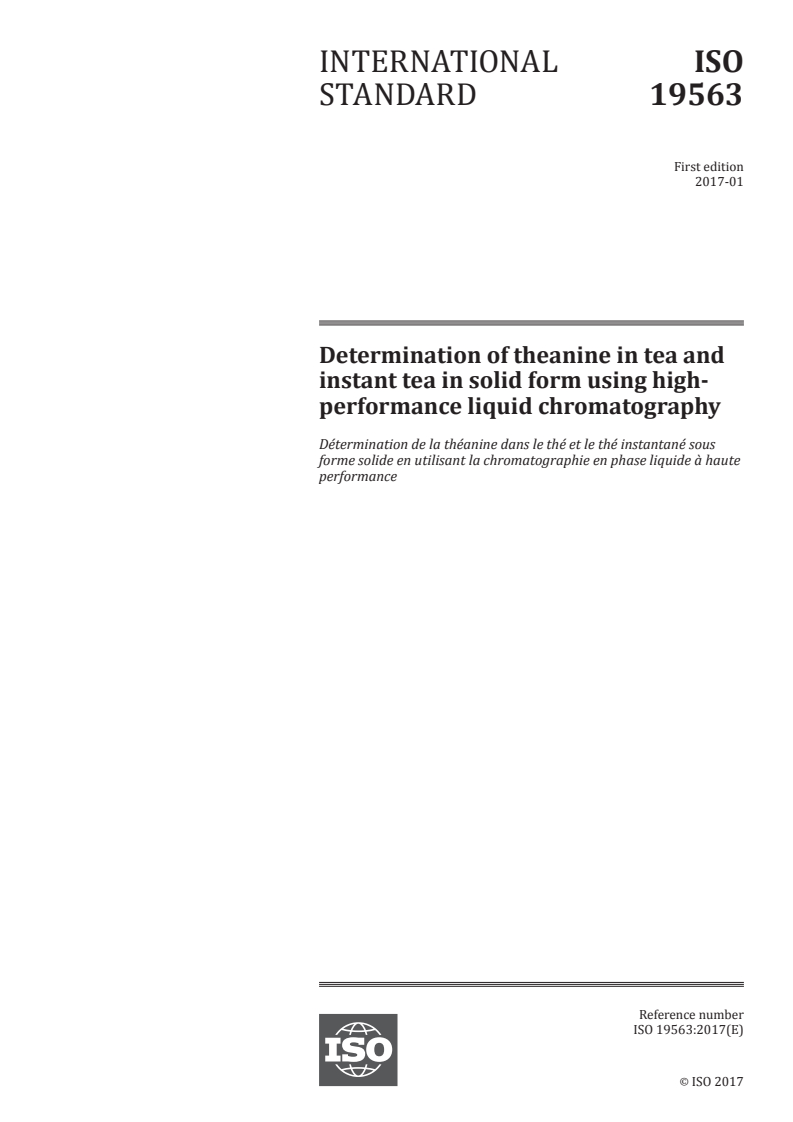
INTERNATIONAL ISO
STANDARD 19563
First edition
2017-01
Determination of theanine in tea and
instant tea in solid form using high-
performance liquid chromatography
Détermination de la théanine dans le thé et le thé instantané sous
forme solide en utilisant la chromatographie en phase liquide à haute
performance
Reference number
©
ISO 2017
© ISO 2017, Published in Switzerland
All rights reserved. Unless otherwise specified, no part of this publication may be reproduced or utilized otherwise in any form
or by any means, electronic or mechanical, including photocopying, or posting on the internet or an intranet, without prior
written permission. Permission can be requested from either ISO at the address below or ISO’s member body in the country of
the requester.
ISO copyright office
Ch. de Blandonnet 8 • CP 401
CH-1214 Vernier, Geneva, Switzerland
Tel. +41 22 749 01 11
Fax +41 22 749 09 47
copyright@iso.org
www.iso.org
ii © ISO 2017 – All rights reserved
Contents Page
Foreword .iv
Introduction .v
1 Scope . 1
2 Normative references . 1
3 Terms and definitions . 1
4 Principle . 1
5 Reagents . 2
6 Apparatus . 3
7 Sampling . 3
8 Preparation of test samples . 3
9 Procedure. 3
9.1 General . 3
9.2 Determination of dry matter content . 4
9.3 Test portion . 4
9.3.1 Sample preparations . 4
9.3.2 Sample clean-up (using a polyamide column) — Optional . 4
9.4 Determination . 5
9.4.1 Adjustment of the apparatus . 5
9.4.2 HPLC analysis. 5
9.4.3 Identification . 5
10 Calculation . 6
11 Precision . 6
11.1 Interlaboratory test. 6
11.2 Repeatability . 6
11.3 Reproducibility . 6
12 Test report . 7
Annex A (informative) Typical theanine calibration graph . 8
Annex B (informative) Typical chromatograms . 9
Annex C (informative) Results of interlaboratory tests .12
Bibliography .13
Foreword
ISO (the International Organization for Standardization) is a worldwide federation of national standards
bodies (ISO member bodies). The work of preparing International Standards is normally carried out
through ISO technical committees. Each member body interested in a subject for which a technical
committee has been established has the right to be represented on that committee. International
organizations, governmental and non-governmental, in liaison with ISO, also take part in the work.
ISO collaborates closely with the International Electrotechnical Commission (IEC) on all matters of
electrotechnical standardization.
The procedures used to develop this document and those intended for its further maintenance are
described in the ISO/IEC Directives, Part 1. In particular the different approval criteria needed for the
different types of ISO documents should be noted. This document was drafted in accordance with the
editorial rules of the ISO/IEC Directives, Part 2 (see www .iso .org/ directives).
Attention is drawn to the possibility that some of the elements of this document may be the subject of
patent rights. ISO shall not be held responsible for identifying any or all such patent rights. Details of
any patent rights identified during the development of the document will be in the Introduction and/or
on the ISO list of patent declarations received (see www .iso .org/ patents).
Any trade name used in this document is information given for the convenience of users and does not
constitute an endorsement.
For an explanation on the meaning of ISO specific terms and expressions related to conformity assessment,
as well as information about ISO’s adherence to the World Trade Organization (WTO) principles in the
Technical Barriers to Trade (TBT) see the following URL: www . i so .org/ iso/ foreword .html.
The committee responsible for this document is ISO/TC 34, Food products, Subcommittee SC 8, Tea.
iv © ISO 2017 – All rights reserved
Introduction
Theanine (N-ethyl-γ-L-glutamine) is a non-protein derived (free) amino acid. In the plant world, it is a
unique amino acid found in Camellia genus and the mushroom Boletus badius and Ilex guayusa. The most
common and the most prominent occurrence is in Camellia sinensis (L.) O. Kuntze species.
Theanine constitutes circa 0,1 % to 2 % w/w of the dry weight in tea leaves (Camellia sinensis) and
is approximately 50 % of the total free amino acids. Separation of L- and D-theanine by HPLC is not
[2][3]
achieved by this method; however, L-theanine is the major form (more than 95 %) in all teas .
Theanine has been associated with the typical tea umami taste and is also being studied to evaluate
potential beneficial effects to health.
The umami taste characteristic has been associated with theanine which is also being evaluated for its
potential benefits to health. This is also creating interest in theanine as an important novel food and
dietary supplement ingredient.
INTERNATIONAL STANDARD ISO 19563:2017(E)
Determination of theanine in tea and instant tea in solid
form using high-performance liquid chromatography
1 Scope
This document specifies a high-performance liquid chromatographic (HPLC) method for the
determination of theanine content in tea (Camellia sinensis). It is applicable to both tea and instant tea
samples. Separation of L- and D-theanine is not possible using this method; however, the L-enantiomer
is the major form in tea.
2 Normative references
The following documents are referred to in the text in such a way that some or all of their content
constitutes requirements of this document. For dated references, only the edition cited applies. For
undated references, the latest edition of the referenced document (including any amendments) applies.
ISO 1572, Tea — Preparation of ground sample of known dry matter content
ISO 1573, Tea — Determination of loss in mass at 103 °C
ISO 1839, Tea — Sampling
ISO 3696, Water for analytical laboratory use — Specification and test methods
ISO 7513, Instant tea in solid form — Determination of moisture content (loss in mass at 103 °C)
ISO 7516, Instant tea in solid form — Sampling
3 Terms and definitions
No terms and definitions are listed in this document.
ISO and IEC maintain terminological databases for use in standardization at the following addresses:
— IEC Electropedia: available at http:// www .electropedia .org/
— ISO Online browsing platform: available at http:// www .iso .org/ obp
4 Principle
A reversed-phase (RP)-C18 column is used which is capable of separating more polar compounds using
water as an eluent and UV detection at 210 nm. Theanine is separated from the other amino acids;
however, the potential co-elution of theanine with methionine is not relevant due to the very small
concentration of methionine in tea. It is recommended that polyamide column extract clean-up is used
to remove interfering polyphenols for column protection when separation of theanine from other
constituents in the extract sample is difficult. Alternatively, the column should be washed after each tea
sample using acetonitrile.
5 Reagents
Use only reagents of recognized analytical grade, unless otherwise specified.
5.1 Water, conforming to grade 1 of ISO 3696.
5.2 Acetonitrile, HPLC grade (however, super grade is preferable).
5.3 Methanol, regular laboratory distilled grade.
1)
5.4 Polyamide (Polyamide CC 6 , Particle size: 0,05 mm to 0,16 mm for column chromatography).
5.5 L-theanine reference standard, >99 %, anhydrous.
5.6 HPLC mobile phases.
WARNING — Wear gloves and eye protection and dispense reagents in a fume cupboard.
5.6.1 Mobile phase A, 100 % purified water (5.1).
5.6.2 Mobile phase B, 100 % acetonitrile (5.2).
5.7 Standard solution.
5.7.1 Standard stock solution, corresponding to 1 mg/ml.
Weigh (0,050 0 ± 0,000 1) g of pure L-theanine (5.5) in a 50 ml
...
INTERNATIONAL ISO
STANDARD 19563
First edition
2017-01
Determination of theanine in tea and
instant tea in solid form using high-
performance liquid chromatography
Détermination de la théanine dans le thé et le thé instantané sous
forme solide en utilisant la chromatographie en phase liquide à haute
performance
Reference number
©
ISO 2017
© ISO 2017, Published in Switzerland
All rights reserved. Unless otherwise specified, no part of this publication may be reproduced or utilized otherwise in any form
or by any means, electronic or mechanical, including photocopying, or posting on the internet or an intranet, without prior
written permission. Permission can be requested from either ISO at the address below or ISO’s member body in the country of
the requester.
ISO copyright office
Ch. de Blandonnet 8 • CP 401
CH-1214 Vernier, Geneva, Switzerland
Tel. +41 22 749 01 11
Fax +41 22 749 09 47
copyright@iso.org
www.iso.org
ii © ISO 2017 – All rights reserved
Contents Page
Foreword .iv
Introduction .v
1 Scope . 1
2 Normative references . 1
3 Terms and definitions . 1
4 Principle . 1
5 Reagents . 2
6 Apparatus . 3
7 Sampling . 3
8 Preparation of test samples . 3
9 Procedure. 3
9.1 General . 3
9.2 Determination of dry matter content . 4
9.3 Test portion . 4
9.3.1 Sample preparations . 4
9.3.2 Sample clean-up (using a polyamide column) — Optional . 4
9.4 Determination . 5
9.4.1 Adjustment of the apparatus . 5
9.4.2 HPLC analysis. 5
9.4.3 Identification . 5
10 Calculation . 6
11 Precision . 6
11.1 Interlaboratory test. 6
11.2 Repeatability . 6
11.3 Reproducibility . 6
12 Test report . 7
Annex A (informative) Typical theanine calibration graph . 8
Annex B (informative) Typical chromatograms . 9
Annex C (informative) Results of interlaboratory tests .12
Bibliography .13
Foreword
ISO (the International Organization for Standardization) is a worldwide federation of national standards
bodies (ISO member bodies). The work of preparing International Standards is normally carried out
through ISO technical committees. Each member body interested in a subject for which a technical
committee has been established has the right to be represented on that committee. International
organizations, governmental and non-governmental, in liaison with ISO, also take part in the work.
ISO collaborates closely with the International Electrotechnical Commission (IEC) on all matters of
electrotechnical standardization.
The procedures used to develop this document and those intended for its further maintenance are
described in the ISO/IEC Directives, Part 1. In particular the different approval criteria needed for the
different types of ISO documents should be noted. This document was drafted in accordance with the
editorial rules of the ISO/IEC Directives, Part 2 (see www .iso .org/ directives).
Attention is drawn to the possibility that some of the elements of this document may be the subject of
patent rights. ISO shall not be held responsible for identifying any or all such patent rights. Details of
any patent rights identified during the development of the document will be in the Introduction and/or
on the ISO list of patent declarations received (see www .iso .org/ patents).
Any trade name used in this document is information given for the convenience of users and does not
constitute an endorsement.
For an explanation on the meaning of ISO specific terms and expressions related to conformity assessment,
as well as information about ISO’s adherence to the World Trade Organization (WTO) principles in the
Technical Barriers to Trade (TBT) see the following URL: www . i so .org/ iso/ foreword .html.
The committee responsible for this document is ISO/TC 34, Food products, Subcommittee SC 8, Tea.
iv © ISO 2017 – All rights reserved
Introduction
Theanine (N-ethyl-γ-L-glutamine) is a non-protein derived (free) amino acid. In the plant world, it is a
unique amino acid found in Camellia genus and the mushroom Boletus badius and Ilex guayusa. The most
common and the most prominent occurrence is in Camellia sinensis (L.) O. Kuntze species.
Theanine constitutes circa 0,1 % to 2 % w/w of the dry weight in tea leaves (Camellia sinensis) and
is approximately 50 % of the total free amino acids. Separation of L- and D-theanine by HPLC is not
[2][3]
achieved by this method; however, L-theanine is the major form (more than 95 %) in all teas .
Theanine has been associated with the typical tea umami taste and is also being studied to evaluate
potential beneficial effects to health.
The umami taste characteristic has been associated with theanine which is also being evaluated for its
potential benefits to health. This is also creating interest in theanine as an important novel food and
dietary supplement ingredient.
INTERNATIONAL STANDARD ISO 19563:2017(E)
Determination of theanine in tea and instant tea in solid
form using high-performance liquid chromatography
1 Scope
This document specifies a high-performance liquid chromatographic (HPLC) method for the
determination of theanine content in tea (Camellia sinensis). It is applicable to both tea and instant tea
samples. Separation of L- and D-theanine is not possible using this method; however, the L-enantiomer
is the major form in tea.
2 Normative references
The following documents are referred to in the text in such a way that some or all of their content
constitutes requirements of this document. For dated references, only the edition cited applies. For
undated references, the latest edition of the referenced document (including any amendments) applies.
ISO 1572, Tea — Preparation of ground sample of known dry matter content
ISO 1573, Tea — Determination of loss in mass at 103 °C
ISO 1839, Tea — Sampling
ISO 3696, Water for analytical laboratory use — Specification and test methods
ISO 7513, Instant tea in solid form — Determination of moisture content (loss in mass at 103 °C)
ISO 7516, Instant tea in solid form — Sampling
3 Terms and definitions
No terms and definitions are listed in this document.
ISO and IEC maintain terminological databases for use in standardization at the following addresses:
— IEC Electropedia: available at http:// www .electropedia .org/
— ISO Online browsing platform: available at http:// www .iso .org/ obp
4 Principle
A reversed-phase (RP)-C18 column is used which is capable of separating more polar compounds using
water as an eluent and UV detection at 210 nm. Theanine is separated from the other amino acids;
however, the potential co-elution of theanine with methionine is not relevant due to the very small
concentration of methionine in tea. It is recommended that polyamide column extract clean-up is used
to remove interfering polyphenols for column protection when separation of theanine from other
constituents in the extract sample is difficult. Alternatively, the column should be washed after each tea
sample using acetonitrile.
5 Reagents
Use only reagents of recognized analytical grade, unless otherwise specified.
5.1 Water, conforming to grade 1 of ISO 3696.
5.2 Acetonitrile, HPLC grade (however, super grade is preferable).
5.3 Methanol, regular laboratory distilled grade.
1)
5.4 Polyamide (Polyamide CC 6 , Particle size: 0,05 mm to 0,16 mm for column chromatography).
5.5 L-theanine reference standard, >99 %, anhydrous.
5.6 HPLC mobile phases.
WARNING — Wear gloves and eye protection and dispense reagents in a fume cupboard.
5.6.1 Mobile phase A, 100 % purified water (5.1).
5.6.2 Mobile phase B, 100 % acetonitrile (5.2).
5.7 Standard solution.
5.7.1 Standard stock solution, corresponding to 1 mg/ml.
Weigh (0,050 0 ± 0,000 1) g of pure L-theanine (5.5) in a 50 ml
...