


ISO/IEC 23094-1:2020
(Main)Information technology -- General video coding
Information technology -- General video coding
This document specifies a video coding technology known as essential video coding (EVC), which contains syntax format, semantics and an associated decoding process. The decoding process is designed to guarantee that all EVC decoders conform to a specified combination of capabilities known as the profile, level and toolset. Any decoding process that produces identical cropped decoded output pictures to those produced by the described process is considered to be in conformance with the requirements of this document. This document is designed to cover a wide range of application, including but not limited to digital storage media, television broadcasting and real-time communications.
Technologies de l'information -- Codage vidéo général
General Information
- Status
- Published
- Publication Date
- 28-Oct-2020
- Current Stage
- 5060 - Close of voting Proof returned by Secretariat
- Start Date
- 30-Sep-2020
- Completion Date
- 29-Sep-2020
Relations
- Effective Date
- 06-Jun-2022
Overview
ISO/IEC 23094-1:2020 - Essential Video Coding (EVC) specifies a general video coding technology called Essential Video Coding (EVC). The standard defines the bitstream syntax and semantics, and a complete decoding process that ensures interoperable decoders. Conformance is defined by producing identical cropped decoded output pictures for a specified combination of profile, level and toolset. ISO/IEC 23094-1:2020 is intended for a wide range of applications including digital storage media, television broadcasting, and real‑time communications.
Key Topics and Requirements
The standard covers both high-level and detailed technical components necessary for implementing compliant EVC decoders:
- Bitstream and picture formats: raw bitstream layouts, NAL units, RBSPs and byte alignment rules.
- Partitioning and scanning: picture partitioning into slices, tiles and coding tree units (CTUs); scanning orders.
- Syntax and semantics: exhaustive tabular definitions of syntax elements and their meanings.
- Decoding process: step‑by‑step decoding for NAL units, slices, intra/inter/IBC prediction, motion vectors, reference picture management, and residual reconstruction.
- Scaling, transform and quantization: processes for coefficient scaling, inverse transforms and picture construction.
- In-loop filters: deblocking, advanced deblocking and Adaptive Loop Filter (ALF) procedures to improve visual quality.
- DRA process: decoding range/adaptation procedures (document describes DRA derivation and inverse mapping).
- Parsing and entropy coding: parsing rules for Exp‑Golomb codes and the CABAC parsing process including initialization and binarization.
- Conformance and tooling (normative annexes): profiles, levels and toolsets; raw bitstream storage format; hypothetical reference decoder; supplemental enhancement information (SEI) and video usability information (VUI).
Applications
ISO/IEC 23094-1:2020 is designed for practical video applications where interoperable, efficient compression is required:
- Broadcast and OTT streaming - standards‑compliant encoding/decoding for distribution.
- Real‑time communications - low‑latency decoder implementations for conferencing and streaming.
- Consumer and professional storage - coded formats for disks, files and archives.
- Silicon and device vendors - hardware and firmware decoders in SoCs, TVs and set‑top boxes.
- Software codec developers and test labs - implementation, validation and conformance testing.
Who Should Use This Standard
- Codec implementers and decoder vendors
- Video streaming platforms and broadcasters
- Semiconductor/SoC engineers and device manufacturers
- QA, interoperability and conformance testing organizations
- Researchers and developers working on video compression
Related Standards
ISO/IEC 23094-1 is Part 1 of the ISO/IEC 23094 series and complements other international video coding standards and normative documents addressing bitstream storage, SEI and usability metadata.
For implementers and integrators, ISO/IEC 23094-1:2020 provides the definitive specification for EVC decoders and the authoritative basis for conformance and interoperability.



Frequently Asked Questions
ISO/IEC 23094-1:2020 is a standard published by the International Organization for Standardization (ISO). Its full title is "Information technology -- General video coding". This standard covers: This document specifies a video coding technology known as essential video coding (EVC), which contains syntax format, semantics and an associated decoding process. The decoding process is designed to guarantee that all EVC decoders conform to a specified combination of capabilities known as the profile, level and toolset. Any decoding process that produces identical cropped decoded output pictures to those produced by the described process is considered to be in conformance with the requirements of this document. This document is designed to cover a wide range of application, including but not limited to digital storage media, television broadcasting and real-time communications.
This document specifies a video coding technology known as essential video coding (EVC), which contains syntax format, semantics and an associated decoding process. The decoding process is designed to guarantee that all EVC decoders conform to a specified combination of capabilities known as the profile, level and toolset. Any decoding process that produces identical cropped decoded output pictures to those produced by the described process is considered to be in conformance with the requirements of this document. This document is designed to cover a wide range of application, including but not limited to digital storage media, television broadcasting and real-time communications.
ISO/IEC 23094-1:2020 is classified under the following ICS (International Classification for Standards) categories: 35.040.40 - Coding of audio, video, multimedia and hypermedia information. The ICS classification helps identify the subject area and facilitates finding related standards.
ISO/IEC 23094-1:2020 has the following relationships with other standards: It is inter standard links to ISO/IEC 23094-1:2020/Amd 1:2023. Understanding these relationships helps ensure you are using the most current and applicable version of the standard.
ISO/IEC 23094-1:2020 is available in PDF format for immediate download after purchase. The document can be added to your cart and obtained through the secure checkout process. Digital delivery ensures instant access to the complete standard document.
Standards Content (Sample)
INTERNATIONAL ISO/IEC
STANDARD 23094-1
First edition
2020-10
Information technology — General
video coding —
Part 1:
Essential video coding
Technologies de l'information — Codage vidéo général —
Partie 1: Codage vidéo essentiel
Reference number
©
ISO/IEC 2020
© ISO/IEC 2020
All rights reserved. Unless otherwise specified, or required in the context of its implementation, no part of this publication may
be reproduced or utilized otherwise in any form or by any means, electronic or mechanical, including photocopying, or posting
on the internet or an intranet, without prior written permission. Permission can be requested from either ISO at the address
below or ISO’s member body in the country of the requester.
ISO copyright office
CP 401 • Ch. de Blandonnet 8
CH-1214 Vernier, Geneva
Phone: +41 22 749 01 11
Email: copyright@iso.org
Website: www.iso.org
Published in Switzerland
ii © ISO/IEC 2020 – All rights reserved
ISO/IEC 23094-1:2020(E)
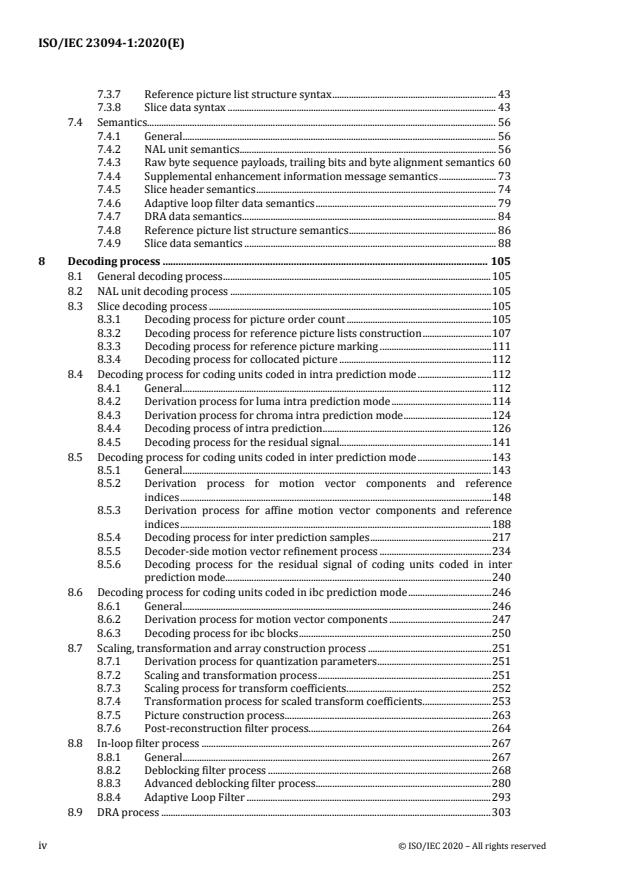
Contents Page
Foreword . vi
Introduction . vii
1 Scope . 1
2 Normative references . 1
3 Terms and definitions . 1
4 Abbreviated terms . 11
5 Conventions . 12
5.1 General . 12
5.2 Arithmetic operators . 13
5.3 Logical operators . 13
5.4 Relational operators . 13
5.5 Bit-wise operators . 13
5.6 Assignment operators . 14
5.7 Range notation . 14
5.8 Mathematical functions . 14
5.9 Order of operation precedence . 16
5.10 Variables, syntax elements and tables . 16
5.11 Text description of logical operations . 18
5.12 Processes . 19
6 Bitstream and picture formats, partitionings, scanning processes and neighbouring
relationships . 19
6.1 Bitstream formats . 19
6.2 Source, decoded and output picture formats . 20
6.3 Partitioning of pictures, slices, tiles, and CTUs . 22
6.3.1 Partitioning of pictures into slices and tiles . 22
6.3.2 Spatial or component-wise partitionings . 23
6.4 Availability processes . 24
6.4.1 Derivation process for neighbouring block availability . 24
6.4.2 Derivation process for left and right neighbouring blocks availabilities . 24
6.4.3 Derivation process for neighbouring block motion vector candidate
availability . 25
6.4.4 Derivation process for ALF neighbouring block availability . 25
6.5 Scanning processes. 26
6.5.1 CTB raster and tile scanning process . 26
6.5.2 Zig-zag scan order 1D array initialization process . 28
6.5.3 Inverse scan order 1D array initialization process . 29
7 Syntax and semantics . 29
7.1 Method of specifying syntax in tabular form . 29
7.2 Specification of syntax functions and descriptors . 31
7.3 Syntax in tabular form. 32
7.3.1 NAL unit syntax . 32
7.3.2 Raw byte sequence payloads, trailing bits and byte alignment syntax . 33
7.3.3 Supplemental enhancement information message syntax . 38
7.3.4 Slice header syntax . 39
7.3.5 Adaptive loop filter data syntax . 41
7.3.6 DRA data syntax . 42
© ISO/IEC 2020 – All rights reserved iii
7.3.7 Reference picture list structure syntax . 43
7.3.8 Slice data syntax . 43
7.4 Semantics. 56
7.4.1 General . 56
7.4.2 NAL unit semantics . 56
7.4.3 Raw byte sequence payloads, trailing bits and byte alignment semantics 60
7.4.4 Supplemental enhancement information message semantics . 73
7.4.5 Slice header semantics . 74
7.4.6 Adaptive loop filter data semantics . 79
7.4.7 DRA data semantics . 84
7.4.8 Reference picture list structure semantics . 86
7.4.9 Slice data semantics . 88
8 Decoding process . 105
8.1 General decoding process . 105
8.2 NAL unit decoding process . 105
8.3 Slice decoding process . 105
8.3.1 Decoding process for picture order count . 105
8.3.2 Decoding process for reference picture lists construction . 107
8.3.3 Decoding process for reference picture marking . 111
8.3.4 Decoding process for collocated picture . 112
8.4 Decoding process for coding units coded in intra prediction mode . 112
8.4.1 General . 112
8.4.2 Derivation process for luma intra prediction mode . 114
8.4.3 Derivation process for chroma intra prediction mode . 124
8.4.4 Decoding process of intra prediction . 126
8.4.5 Decoding process for the residual signal. 141
8.5 Decoding process for coding units coded in inter prediction mode . 143
8.5.1 General . 143
8.5.2 Derivation process for motion vector components and reference
indices . 148
8.5.3 Derivation process for affine motion vector components and reference
indices . 188
8.5.4 Decoding process for inter prediction samples . 217
8.5.5 Decoder-side motion vector refinement process . 234
8.5.6 Decoding process for the residual signal of coding units coded in inter
prediction mode . 240
8.6 Decoding process for coding units coded in ibc prediction mode . 246
8.6.1 General . 246
8.6.2 Derivation process for motion vector components . 247
8.6.3 Decoding process for ibc blocks . 250
8.7 Scaling, transformation and array construction process . 251
8.7.1 Derivation process for quantization parameters . 251
8.7.2 Scaling and transformation process . 251
8.7.3 Scaling process for transform coefficients . 252
8.7.4 Transformation process for scaled transform coefficients . 253
8.7.5 Picture construction process . 263
8.7.6 Post-reconstruction filter process. 264
8.8 In-loop filter process . 267
8.8.1 General . 267
8.8.2 Deblocking filter process . 268
8.8.3 Advanced deblocking filter process. 280
8.8.4 Adaptive Loop Filter . 293
8.9 DRA process . 303
iv © ISO/IEC 2020 – All rights reserved
ISO/IEC 23094-1:2020(E)
8.9.1 General . 303
8.9.2 Derivation of samples of output decoded picture by DRA process . 303
8.9.3 Inverse mapping process for a luma sample . 304
8.9.4 Inverse mapping process for a chroma sample . 305
8.9.5 Identification of the range index of piecewise function . 305
8.9.6 DRA chroma scale value derivaton process . 306
8.9.7 Derivation of output chroma DRA parameters . 306
8.9.8 Derivation of adjusted chroma DRA scales. 307
9 Parsing process . 309
9.1 General . 309
9.2 Parsing process for 0-th order Exp-Golomb codes . 310
9.2.1 General . 310
9.2.2 Mapping process for signed Exp-Golomb codes . 311
9.3 CABAC parsing process for slice data . 312
9.3.1 General . 312
9.3.2 Initialization process . 312
9.3.3 Binarization process . 326
9.3.4 Decoding process flow . 333
(normative) Profiles, levels and toolsets . 349
(normative) Raw bitstream file storage format . 361
(normative) Hypothetical reference decoder . 362
(normative) Supplemental enhancement information . 374
(normative) Video usability information. 389
Bibliography . 414
© ISO/IEC 2020 – All rights reserved v
Foreword
ISO (the International Organization for Standardization) and IEC (the International Electrotechnical
Commission) form the specialized system for worldwide standardization. National bodies that are
members of ISO or IEC participate in the development of International Standards through technical
committees established by the respective organization to deal with particular fields of technical activity.
ISO and IEC technical committees collaborate in fields of mutual interest. Other international
organizations, governmental and non-governmental, in liaison with ISO and IEC, also take part in the
work.
The procedures used to develop this document and those intended for its further maintenance are
described in the ISO/IEC Directives, Part 1. In particular, the different approval criteria needed for the
different types of document should be noted. This document was drafted in accordance with the editorial
rules of the ISO/IEC Directives, Part 2 (see www.iso.org/directives).
Attention is drawn to the possibility that some of the elements of this document may be the subject of
patent rights. ISO and IEC shall not be held responsible for identifying any or all such patent rights. Details
of any patent rights identified during the development of the document will be in the Introduction and/or
on the ISO list of patent declarations received (see www.iso.org/patents) or the IEC list of patent
declarations received (see http://patents.iec.ch).
Any trade name used in this document is information given for the convenience of users and does not
constitute an endorsement.
For an explanation of the voluntary nature of standards, the meaning of ISO specific terms and
expressions related to conformity assessment, as well as information about ISO's adherence to the World
Trade Organization (WTO) principles in the Technical Barriers to Trade (TBT)
see www.iso.org/iso/foreword.html.
This document was prepared by Joint Technical Committee ISO/IEC JTC 1, Information technology,
Subcommittee SC 29, Coding of audio, picture, multimedia and hypermedia information.
A list of all parts in the ISO/IEC 23094 series can be found on the ISO website.
Any feedback or questions on this document should be directed to the user’s national standards body. A
complete listing of these bodies can be found at www.iso.org/members.html.
vi © ISO/IEC 2020 – All rights reserved
ISO/IEC 23094-1:2020(E)
Introduction
The International Organization for Standardization (ISO) and International Electrotechnical Commission
(IEC) draw attention to the fact that it is claimed that compliance with this document may involve the use
of a patent.
ISO and IEC take no position concerning the evidence, validity and scope of this patent right.
The holder of this patent right has assured ISO and IEC that he/she is willing to negotiate licences under
reasonable and non-discriminatory terms and conditions with applicants throughout the world. In this
respect, the statement of the holder of this patent right is registered with ISO and IEC. Information may
be obtained from the patent database available at www.iso.org/patents.
Attention is drawn to the possibility that some of the elements of this document may be the subject of
patent rights other than those in the patent database. ISO and IEC shall not be held responsible for
identifying any or all such patent rights.
© ISO/IEC 2020 – All rights reserved vii
INTERNATIONAL STANDARD ISO/IEC 23094-1:2020(E)
Information technology — General video coding —
Part 1:
Essential video coding
1 Scope
This document specifies a video coding technology known as essential video coding (EVC), which
contains syntax format, semantics and an associated decoding process. The decoding process is designed
to guarantee that all EVC decoders conform to a specified combination of capabilities known as the
profile, level and toolset. Any decoding process that produces identical cropped decoded output pictures
to those produced by the described process is considered to be in conformance with the requirements of
this document.
This document is designed to cover a wide range of application, including but not limited to digital storage
media, television broadcasting and real-time communications.
2 Normative references
The following documents are referred to in the text in such a way that some or all of their content
constitutes requirements of this document. For dated references, only the edition cited applies. For
undated references, the latest edition of the referenced document (including any amendments) applies.
ISO 11664-1, Colorimetry — Part 1: CIE standard colorimetric observers
3 Terms and definitions
For the purposes of this document, the following definitions apply.
ISO and IEC maintain terminological databases for use in standardization at the following addresses:
— ISO Online browsing platform: available at https://www.iso.org/obp
— IEC Electropedia: available at http://www.electropedia.org/
3.1
access unit
set of NAL units (3.53) that are associated with each other according to a specified classification rule, are
consecutive in decoding order (3.28), and contain exactly one coded picture (3.16)
3.2
adaptive loop filter
ALF
filtering process that is applied as part of the decoding process (3.29) and is controlled by parameters
(3.58) conveyed in an APS (3.4)
© ISO/IEC 2020 – All rights reserved 1
3.3
ALF APS
APS (3.4) that controls the ALF (3.2) process
3.4
adaptation parameter set
APS
syntax structure (3.87) containing syntax elements (3.86) that apply to zero or more slices (3.81) or
pictures (3.60) as determined by zero or more syntax elements (3.86) found in slice headers (3.82)
3.5
bi-predictive slice
B slice
slice (3.81) that is decoded using intra prediction (3.43) or using inter prediction (3.40) with at most two
motion vectors (3.52) and reference indices (3.74) to predict the sample values of each block (3.11)
3.6
bin
one bit of a bin string (3.7)
3.7
bin string
intermediate binary representation of values of syntax elements (3.86) from the binarization (3.8) of the
syntax element (3.86)
3.8
binarization
set of bin strings (3.7) for all possible values of a syntax element (3.86)
3.9
binarization process
unique mapping process of all possible values of a syntax elements (3.86) from the binarization (3.8) of
the syntax element (3.86)
3.10
bitstream
sequence of bits, in the form of a NAL unit stream (3.54) or a raw bitstream (3.71), that forms the
representation of coded pictures (3.16) and associated data forming one or more coded video sequences
(3.19)
3.11
block
MxN (M-column by N-row) array of samples, or an MxN array of transform coefficients (3.93)
3.12
buffering period
set of access units (3.1) starting with an access unit (3.1) that contains a buffering period suplemental
enhancement information (SEI) message and containing all subsequent access units (3.1) in decoding
order (3.28) up to but not including the next access unit (3.1) (when present) that contains a buffering
period SEI message
3.13
byte
sequence of 8 bits, within which, when written or read as a sequence of bit values, the left-most and right-
most bits represent the most and least significant bits, respectively
2 © ISO/IEC 2020 – All rights reserved
3.14
byte-aligned
position in a bitstream (3.10) where the position is an integer multiple of 8 bits from the position of the
first bit in the bitstream (3.10)
Note 1 to entry: A bit or byte (3.13) or syntax element (3.86) is said to be byte-aligned when the position at which it
appears in a bitstream (3.10) is byte-aligned.
3.15
chroma
sample array or single sample representing one of the two colour difference signals related to the primary
colours, represented by the symbols Cb and Cr
Note 1 to entry: The term chroma is used rather than the term chrominance in order to avoid the implication of the
use of linear light transfer characteristics that are often associated with the term chrominance.
3.16
coded picture
coded representation (3.18) of a picture (3.60) containing all CTUs (3.22) of the picture (3.60)
3.17
coded picture buffer
CPB
first-in first-out buffer containing access units (3.1) in decoding order (3.28)
Note 1 to entry: Specified in the hypothetical reference decoder (3.36) in Annex C.
3.18
coded representation
data element as represented in its coded form
3.19
coded video sequence
CVS
sequence of access units (3.1) that consists, in decoding order (3.28), of an IDR access unit (3.38), followed
by zero or more access units (3.1) that are not IDR access units (3.38), including all subsequent access units
(3.1) up to but not including any subsequent access unit (3.1) that is an IDR access unit (3.38)
3.20
coding block
CB
MxN block (3.11) of samples for some values of M and N such that the division of a CTB (3.21) into coding
blocks is a partitioning (3.59)
3.21
coding tree block
CTB
NxN block (3.11) of samples for some value of N such that the division of a component (3.24) into coding
tree blocks is a partitioning (3.59)
3.22
coding tree unit
CTU
CTB (3.21) of luma (3.51) samples, two corresponding CTBs (3.21) of chroma (3.15) samples of a picture
(3.60) that has three sample arrays, or a CTB of samples of a monochrome picture (3.60) or a picture
© ISO/IEC 2020 – All rights reserved 3
(3.60) that is coded using three separate colour planes and syntax structures (3.87) used to code the
samples
3.23
coding unit
CU
coding block (3.20) of luma (3.51) samples, two corresponding coding blocks (3.20) of chroma (3.15)
samples of a picture (3.60) that has three sample arrays, or a coding block (3.20) of samples of a
monochrome picture (3.60) or a picture (3.60) that is coded using three separate colour planes and syntax
structures (3.87) used to code the samples
3.24
component
array or single sample from one of the three arrays (luma (3.51) and two chroma (3.15)) that compose a
picture (3.60) in 4:2:0, 4:2:2, or 4:4:4 colour format or the array or a single sample of the array that
compose a picture (3.60) in monochrome format
3.25
decoded picture
derived by decoding a coded picture (3.16)
3.26
decoded picture buffer
DPB
buffer holding decoded pictures (3.25) for reference, output reordering, or output delay
Note 1 to entry: Specified for the hypothetical reference decoder (3.36) in Annex C.
3.27
decoder
embodiment of a decoding process (3.29)
3.28
decoding order
order in which syntax elements (3.86) are processed by the decoding process (3.29)
3.29
decoding process
process specified that reads a bitstream (3.10) and derives decoded pictures (3.25) from it
3.30
dynamic range adjustment
DRA
mapping process that is applied to decoded picture (3.25) prior to cropping and output as part of the
decoding process (3.29) and is controlled by parameters conveyed in an APS (3.4)
3.31
DRA APS
APS (3.4) that controls the DRA (3.30) process
4 © ISO/IEC 2020 – All rights reserved
3.32
decoder under test
DUT
decoder (3.27) that is tested for conformance to this document
Note 1 to entry: A decoder (3.27) is tested by operating the hypothetical stream scheduler (3.37) to deliver a
conforming bitstream (3.10) to the decoder (3.27) and to the hypothetical reference decoder (3.36) and comparing
the values and timing of the output of the two decoders (3.27).
3.33
encoder
embodiment of an encoding process (3.34)
3.34
encoding process
process that produces a bitstream (3.10) conforming to this document
3.35
flag
variable or single-bit syntax element (3.86) that can take one of the two possible values: 0 and 1
3.36
hypothetical reference decoder
HRD
hypothetical decoder (3.27) model that specifies constraints on the variability of conforming NAL unit
streams (3.54) or conforming raw bitstreams (3.10) produced by an encoding process
3.37
hypothetical stream scheduler
HSS
hypothetical delivery mechanism for the timing and data flow of the input of a bitstream (3.10) into the
hypothetical reference decoder (3.36)
Note 1 to entry: The HSS is used for checking the conformance of a bitstream (3.10) or a decoder (3.36).
3.38
IDR access unit
access unit in which the coded picture is an IDR picture
3.39
IDR picture
coded picture (3.16) for which each VCL NAL unit (3.96) has NalUnitType equal to IDR_NUT
3.40
inter prediction
prediction (3.63) derived in a manner that is dependent on data elements (e.g., sample values or motion
vectors) of one or more reference pictures (3.75)
Note 1 to entry: A prediction (3.63) from a reference picture (3.75) that is the current picture (3.60) itself is also inter
prediction.
© ISO/IEC 2020 – All rights reserved 5
3.41
intra block copy
IBC
prediction (3.63) derived in a manner that is dependent on data elements (e.g., sample values or block
vectors) of the same decoded slice (3.81) without referring to a reference picture (3.75)
3.42
intra coding
coding of a coding block (3.20), slice (3.81), or picture (3.60) that uses intra prediction (3.43)
3.43
intra prediction
prediction (3.63) derived from only data elements (e.g., sample values) of the same decoded slice (3.81)
without referring to a reference picture (3.75)
3.44
intra slice
I slice
slice (3.81) that is decoded using intra prediction (3.43) only
3.45
level
defined set of constraints on the values that may be taken by the syntax elements (3.86) and variables of
this document, or the value of a transform coefficient (3.93) prior to scaling
Note 1 to entry: The same set of levels is defined for all profiles (3.67), with most aspects of the definition of each
level being in common across different profiles (3.67). Individual implementations can, within the specified
constraints, support a different level for each supported profile (3.67).
3.46
list 0 motion vector
motion vector (3.52) associated with a reference index (3.74) pointing into a reference picture list 0 (3.77)
3.47
list 0 prediction
inter prediction (3.40) of the content of a slice (3.81) using a reference index (3.74) pointing into a
reference picture list 0 (3.77)
3.48
list 1 motion vector
motion vector (3.52) associated with a reference index (3.74) pointing into a reference picture list 1 (3.78)
3.49
list 1 prediction
inter prediction (3.40) of the content of a slice (3.81) using a reference index (3.74) pointing into a
reference picture list 1 (3.78)
3.50
long-term reference picture
LTRP
picture (3.60) that is marked as "used for long-term reference"
6 © ISO/IEC 2020 – All rights reserved
3.51
luma
sample array or single sample is representing the monochrome signal related to the primary colours,
represented by the symbol or subscript Y or L
Note 1 to entry: The term luma is used rather than the term luminance in order to avoid the implication of the use
of linear light transfer characteristics that are often associated with the term luminance. The symbol L is sometimes
used instead of the symbol Y to avoid confusion with the symbol y as used for vertical location.
3.52
motion vector
two-dimensional vector used for inter prediction (3.40) that provides an offset from the coordinates in
the decoded picture (3.25) to the coordinates in a reference picture (3.75)
3.53
NAL unit
syntax structure (3.87) containing an indication of the type of data to follow and bytes (3.13) containing
that data in the form of an RBSP (3.72) interspersed as necessary
3.54
NAL unit stream
sequence of NAL units (3.53)
3.55
non-IDR picture
coded picture (3.16) that is not an IDR picture (3.39)
3.56
non-VCL NAL unit
NAL unit (3.53) that is not a VCL NAL unit (3.96)
3.57
output order
order in which the decoded pictures (3.25) are output from the decoded picture buffer (3.26) [for the
decoded pictures (3.25) that are to be output from the decoded picture buffer (3.26)]
3.58
parameter
syntax element (3.86) of an SPS (3.79), PPS (3.61) or APS (3.4)
3.59
partitioning
division of a set into subsets such that each element of the set is in exactly one of the subsets
3.60
picture
array of luma (3.51) samples in monochrome format or an array of luma (3.51) samples and two
corresponding arrays of chroma (3.15) samples in 4:2:0, 4:2:2, and 4:4:4 colour format
Note 1 to entry: A picture can be either a frame or a field. However, in one CVS (3.19), either all pictures are frames
or all pictures are fields.
© ISO/IEC 2020 – All rights reserved 7
3.61
picture parameter set
PPS
syntax structure (3.87) containing syntax elements (3.86) that apply to zero or more entire coded pictures
(3.16) as determined by a syntax element (3.86) found in each slice header (3.82)
3.62
picture order count
POC
variable that is associated with each picture (3.60), uniquely identifies the associated picture (3.60)
among all pictures (3.60) in the CVS (3.19), and, when the associated picture (3.60) is to be output from
the decoded picture buffer (3.26), indicates the position of the associated picture (3.60) in output order
(3.57) relative to the output order (3.57) positions of the other pictures (3.60) in the same CVS (3.19) that
are to be output from the decoded picture buffer (3.26)
3.63
prediction
embodiment of the prediction process (3.63)
3.64
prediction process
use of a predictor (3.66) to provide an estimate of the data element [e.g., sample value or motion vector
(3.52)] currently being decoded
3.65
predictive slice
P slice
slice (3.81) that is decoded using intra prediction (3.43) or using inter prediction (3.40) with at most one
motion vector (3.52) and reference index (3.74) to predict the sample values of each block (3.11)
3.66
predictor
combination of specified values or previously decoded data elements [e.g., sample value or motion vector
(3.52)] used in the decoding process (3.29) of subsequent data elements
3.67
profile
specified subset of the syntax of this document
3.68
quantization parameter
QP
variable used by the decoding process (3.29) for scaling of transform coefficient (3.93) levels
3.69
random access
act of starting the decoding process for a bitstream (3.10) at a point other than the beginning of the stream
3.70
raster scan
mapping of a rectangular two-dimensional pattern to a one-dimensional pattern such that the first entries
in the one-dimensional pattern are from the first top row of the two-dimensional pattern scanned from
left to right, followed similarly by the second, third, etc., rows of the pattern (going down) each scanned
from left to right
8 © ISO/IEC 2020 – All rights reserved
3.71
raw bitstream
encapsulation of a NAL unit stream (3.54) containing NAL unit (3.53) length field and NAL units (3.53)
Note 1 to entry: Specified in Annex A.
3.72
raw byte sequence payload
RBSP
syntax structure (3.87) containing an integer number of bytes (3.13) that is encapsulated in a NAL unit
(3.53) and that is either empty or has the form of a string of data bits (3.85) containing syntax elements
(3.86) followed by an RBSP stop bit (3.73) and zero or more subsequent bits equal to 0
3.73
raw byte sequence payload stop bit
RBSP stop bit
bit equal to 1 present within a raw byte sequence payload (3.72) after a string of data bits (3.85), for which
the location of the end within an RBSP (3.72) can be identified by searching from the end of the RBSP
(3.72) for the RBSP stop bit, which is the last non-zero bit in the RBSP (3.72)
3.74
reference index
index into a reference picture list (3.76)
3.75
reference picture
picture (3.60) that is a short-term reference picture (3.80) or long-term reference picture (3.50)
Note 1 to entry: A reference picture contains samples that can be used for inter prediction (3.40) in the decoding
process (3.29) of subsequent pictures (3.60) in decoding order (3.28).
3.76
reference picture list
list of reference pictures (3.80) that is used for inter prediction (3.40) of a P slice (3.65) or B slice (3.5)
Note 1 to entry: For the decoding process (3.29) of a P slice (3.65), there is one reference picture list – reference
picture list 0 (3.77). For the decoding process (3.28) of a B slice (3.5), there are two reference picture lists – reference
picture list 0 (3.77) and reference picture list 1 (3.78).
3.77
reference picture list 0
reference picture list (3.76) used for inter prediction of a P slice (3.65) or the first reference picture list
(3.76) used for inter prediction (3.40) of a B slice (3.5)
3.78
reference picture list 1
second reference picture list (3.76) used for inter prediction (3.40) of a B slice (3.5)
3.79
sequence parameter set
SPS
syntax structure (3.87) containing syntax elements (3.86) that apply to zero or more entire CVSs as
determined by the content of a syntax element (3.86) found in the PPS (3.61) referred to by a syntax
element (3.86) found in each slice header (3.82)
© ISO/IEC 2020 – All rights reserved 9
3.80
short-term reference picture
STRP
picture (3.60) that is marked as "used for short-term reference"
3.81
slice
integer number of tiles (3.88) of a picture (3.60) in the tile scan (3.91) of the picture (3.60) and that are
exclusively contained in a single NAL unit (3.53)
3.82
slice header
part of a coded slice (3.81) containing the data elements pertaining to the first or all tiles (3.88)
represented in the slice (3.81)
3.83
source
term used to describe the video material or some of its attributes before encoding process (3.34)
3.84
split unit
SU
MxN block (3.11) of samples for some values and M and N such that the division of a component (3.24)
into four quad blocks (3.11), or three horizontal blocks (3.11) or two horizontal blocks (3.11), or three
vertical blocks (3.11) or two vertical blocks (3.11)
3.85
string of data bits
SODB
sequence of some number of bits representing syntax elements (3.86) present within a raw byte sequence
payload (3.72) prior to the raw byte sequence payload stop bit (3.73), where the left-most bit is considered
to be the first and most significant bit, and the right-most bit is considered to be the last and least
significant bit
3.86
syntax element
element of data represented in the bitstream (3.10)
3.87
syntax structure
zero or more syntax elements (3.86) present together in the bitstream (3.10) in a specified order
3.88
tile
rectangular region of CTUs (3.22) within a particular tile column (3.89) and a particular tile row (3.90) in
a picture (3.60)
3.89
tile column
rectangular region of CTUs (3.22) having a height equal to the height of the picture (3.60) and width
specified by syntax elements (3.86) in the PPS (3.61)
10 © ISO/IEC 2020 – All rights reserved
3.90
tile row
rectangular region of CTUs (3.22) having a height specified by syntax elements (3.86) in the PPS (3.61)
and a width equal to the width of the picture (3.60)
3.91
tile scan
specific sequential ordering of CTUs (3.22) partitioning (3.59) a picture (3.60) in which the CTUs (3.22)
are ordered consecutively in CTU (3.22) raster scan (3.70) in a tile (3.88) whereas tiles (3.88) in a picture
(3.60) are ordered consecutively in a raster scan (3.70) of the tiles (3.88) of the picture (3.60)
3.92
transform block
TB
rectangular MxN block (3.11) of samples resulting from a transform in the decoding process (3.29)
3.93
transform coefficient
scalar quantity, considered to be in a frequency domain, that is associated with a particular one-
dimensional or two-dimensional frequency index in a transform in the decoding process (3.29)
3.94
transform unit
TU
transform block (3.94) of luma (3.51) samples and two corresponding transform blocks (3.94) of chroma
(3.15) samples of a picture (3.60)
3.95
tree
tree is a finite set of nodes with a unique root node
3.96
VCL NAL unit
collectively, coded slice (3.81) NAL units (3.53) and the subset of NAL units (3.53) that have reserved
values of NalUnitType that are classified as VCL NAL units in this document
4 Abbreviated terms
ATS adaptive transform selection
B bi-predictive
CABAC context-based adaptive binary arithmetic coding
CBR constant bit rate
CIE International Commission on Illumination (Commission Internationale de l'Eclairage)
DMVR decoder-side motion vector refinement
EG exponential-Golomb
EGk k-th order exponential-Golomb
FCC Federal Communications Commission (of the United States)
FIR finite impulse response
© ISO/IEC 2020 – All rights reserved 11
FL fixed length
GOP group of pictures
HMVP history-based motion vector prediction
I intra
IDR instantaneous decoding refresh
LSB least significant bit
LPS least probable symbol
MAC multiplexed analogue components
MMVD merge with motion vector difference
MPS most probable symbol
MSB most significant bit
MVP motion vector prediction
NAL network abstraction layer
NTSC National Television System Committee (of the United States)
P predictive
PAL phase alternating line
RGB same as GBR
RPL reference picture list
SAR sample aspect ratio
SECAM sequential colour with memory (séquentiel couleur avec mémoire)
SEI supplemental enhancement information
SMPTE Society of Motion Picture and Television Engineers
TB truncated binary
TR truncated rice
U unary
UCS universal coded character set
UTF UCS transmission format
VBR variable bit rate
VCL video coding layer
VUI video usability information
5 Conventions
5.1 General
NOTE The mathematical operators used in this document are similar to those used in the C programming
language. However, the results of integer division and arithmetic shift operations are defined more precisely, and
additional operations are defined, such as exponentiation and real-valued division. Numbering and counting
conventions generally begin from 0, e.g., "the first" is equivalent to the 0-th, "the second" is equivalent to the 1-th,
etc.
12 © ISO/IEC 2020 – All rights reserved
5.2 Arithmetic operators
+ addition
− subtraction (as a two-argument operator) or negation (as a unary prefix operator)
* multiplication, including matrix multiplication
× multiplication, including matrix multiplication
exponentiation. Specifies x to the power of y. In other contexts, such notation is used for
y
x
superscripting not intended for interpretation as exponentiation
integer division with truncation of the result toward zero. For example, 7 / 4 and −7 / −4
...
Questions, Comments and Discussion
Ask us and Technical Secretary will try to provide an answer. You can facilitate discussion about the standard in here.
Loading comments...