

ISO 24517-1:2008
(Main)Document management — Engineering document format using PDF — Part 1: Use of PDF 1.6 (PDF/E-1)
General Information
- Abstract
ISO 24517-:2008 specifies the use of the Portable Document Format (PDF) Version 1.6 for the creation of documents used in engineering workflows. ISO 24517-:2008 does not define the following: method of electronic distribution; method of creation or conversion from paper or electronic documents to the PDF/E format; specific technical design, user interface, or implementation; required computer hardware and/operating systems; or methods for validating the conformance of PDF/E files or readers.
- Status
- Published
- Publication Date
- 13-May-2008
- Current Stage
- 9093 - International Standard confirmed
- Start Date
- 06-Sep-2022
- Completion Date
- 29-Aug-2026


Overview
ISO 24517-1:2008 - Document management: Engineering document format using PDF - Part 1: Use of PDF 1.6 (PDF/E-1) defines how to use the Portable Document Format PDF 1.6 for engineering documents. The standard constrains and clarifies which PDF features are required, recommended, restricted or prohibited for reliable on‑screen display, printing and exchange within engineering workflows. It focuses on consistent representation of complex, often large‑format engineering deliverables rather than on distribution methods, creation/conversion tools, user interfaces, hardware, or specific validation procedures.
Key Topics
The standard addresses technical areas essential to engineering document interoperability and fidelity:
- Syntax and file structure: file header/trailer, document IDs, cross‑reference tables/streams, linearization and implementation limits.
- Graphics and rendering: color spaces, images, shadings, form and PostScript XObjects, rendering intents, optional content and print scaling.
- Fonts and text: font types, composite fonts, embedded font programs, subsets and character encodings to preserve layout and legibility.
- Annotations and forms: annotation types, interactive forms and their dictionaries for review and mark‑up workflows.
- Actions and presentations: hypertext links, actions, and presentation capabilities for interactive documents.
- Metadata and provenance: XMP headers, document information, version identification, file identifiers and provenance data to support lifecycle management.
- Embedded content and multimedia: handling of embedded files, multimedia playback constraints, and alternate presentations.
- 3D support: presentation of 3D annotations and supported 3D formats for CAD and model visualization.
- Security and integrity: encryption versions, user permissions and digital signatures including signature dictionaries and detection of changes.
- Unrecognized data and extensions: guidance for extending PDF without breaking conformance.
Applications
ISO 24517-1:2008 is used where consistent, high‑fidelity exchange of engineering documents is critical:
- Engineering and design teams sharing drawings, schematics, and large‑format plans.
- AEC (architecture, engineering, construction) firms and contractors for reliable printing and mark‑ups.
- Manufacturers and suppliers exchanging technical documentation and specifications.
- Document management and PLM/PDM systems that store, render or archive engineering PDFs.
- Software vendors building PDF/E‑compliant readers, writers, validators and printing tools. Benefits include improved interoperability, predictable print output, secure signoff with digital signatures, and smoother collaboration across organizations.
Related Standards
- ISO 24517 series (PDF/E family) - multi‑part standard for engineering document formats.
- The Adobe PDF specification (PDF 1.6) - normative background for PDF/E‑1.
- AIIM application notes - practical guidance for implementing ISO 24517‑1 (referenced by the standard).
Get Certified
Connect with accredited certification bodies for this standard

BSI Group
BSI (British Standards Institution) is the business standards company that helps organizations make excellence a habit.

NYCE
Mexican standards and certification body.
Sponsored listings
Frequently Asked Questions
ISO 24517-1:2008 is a standard published by the International Organization for Standardization (ISO). Its full title is "Document management — Engineering document format using PDF — Part 1: Use of PDF 1.6 (PDF/E-1)". This standard covers: ISO 24517-:2008 specifies the use of the Portable Document Format (PDF) Version 1.6 for the creation of documents used in engineering workflows. ISO 24517-:2008 does not define the following: method of electronic distribution; method of creation or conversion from paper or electronic documents to the PDF/E format; specific technical design, user interface, or implementation; required computer hardware and/operating systems; or methods for validating the conformance of PDF/E files or readers.
ISO 24517-:2008 specifies the use of the Portable Document Format (PDF) Version 1.6 for the creation of documents used in engineering workflows. ISO 24517-:2008 does not define the following: method of electronic distribution; method of creation or conversion from paper or electronic documents to the PDF/E format; specific technical design, user interface, or implementation; required computer hardware and/operating systems; or methods for validating the conformance of PDF/E files or readers.
ISO 24517-1:2008 is classified under the following ICS (International Classification for Standards) categories: 35.240.30 - IT applications in information, documentation and publishing; 37.100.99 - Other standards related to graphic technology. The ICS classification helps identify the subject area and facilitates finding related standards.
ISO 24517-1:2008 is available in PDF format for immediate download after purchase. The document can be added to your cart and obtained through the secure checkout process. Digital delivery ensures instant access to the complete standard document.
Standards Content (Sample)
INTERNATIONAL ISO
STANDARD 24517-1
First edition
2008-05-15
Document management — Engineering
document format using PDF —
Part 1:
Use of PDF 1.6 (PDF/E-1)
Gestion de documents — Format de documents d'ingénierie utilisant le
PDF —
Partie 1: Utilisation du PDF 1.6 (PDF/E-1)
Reference number
©
ISO 2008
PDF disclaimer
This PDF file may contain embedded typefaces. In accordance with Adobe's licensing policy, this file may be printed or viewed but
shall not be edited unless the typefaces which are embedded are licensed to and installed on the computer performing the editing. In
downloading this file, parties accept therein the responsibility of not infringing Adobe's licensing policy. The ISO Central Secretariat
accepts no liability in this area.
Adobe is a trademark of Adobe Systems Incorporated.
Details of the software products used to create this PDF file can be found in the General Info relative to the file; the PDF-creation
parameters were optimized for printing. Every care has been taken to ensure that the file is suitable for use by ISO member bodies. In
the unlikely event that a problem relating to it is found, please inform the Central Secretariat at the address given below.
© ISO 2008
All rights reserved. Unless otherwise specified, no part of this publication may be reproduced or utilized in any form or by any means,
electronic or mechanical, including photocopying and microfilm, without permission in writing from either ISO at the address below or
ISO's member body in the country of the requester.
ISO copyright office
Case postale 56 • CH-1211 Geneva 20
Tel. + 41 22 749 01 11
Fax + 41 22 749 09 47
E-mail copyright@iso.org
Web www.iso.org
Published in Switzerland
ii © ISO 2008 – All rights reserved
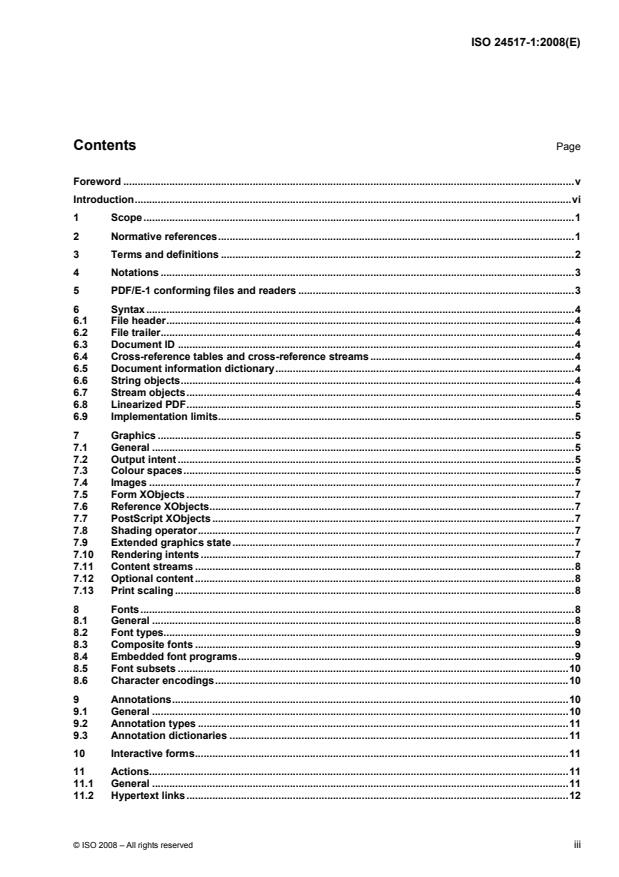
Contents Page
Foreword .v
Introduction.vi
1 Scope.1
2 Normative references.1
3 Terms and definitions .2
4 Notations .3
5 PDF/E-1 conforming files and readers .3
6 Syntax.4
6.1 File header.4
6.2 File trailer.4
6.3 Document ID .4
6.4 Cross-reference tables and cross-reference streams.4
6.5 Document information dictionary.4
6.6 String objects.4
6.7 Stream objects.4
6.8 Linearized PDF.5
6.9 Implementation limits.5
7 Graphics .5
7.1 General .5
7.2 Output intent .5
7.3 Colour spaces.5
7.4 Images .7
7.5 Form XObjects .7
7.6 Reference XObjects.7
7.7 PostScript XObjects.7
7.8 Shading operator.7
7.9 Extended graphics state.7
7.10 Rendering intents .7
7.11 Content streams .8
7.12 Optional content .8
7.13 Print scaling .8
8 Fonts.8
8.1 General .8
8.2 Font types.9
8.3 Composite fonts .9
8.4 Embedded font programs.9
8.5 Font subsets .10
8.6 Character encodings.10
9 Annotations.10
9.1 General .10
9.2 Annotation types .11
9.3 Annotation dictionaries .11
10 Interactive forms.11
11 Actions.11
11.1 General .11
11.2 Hypertext links.12
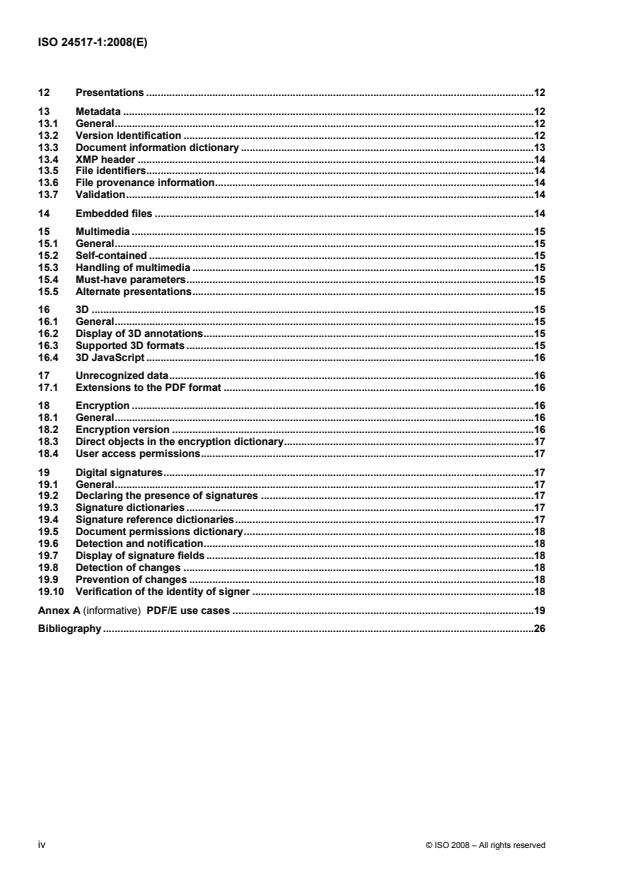
12 Presentations .12
13 Metadata .12
13.1 General.12
13.2 Version Identification .12
13.3 Document information dictionary .13
13.4 XMP header .14
13.5 File identifiers.14
13.6 File provenance information.14
13.7 Validation.14
14 Embedded files .14
15 Multimedia .15
15.1 General.15
15.2 Self-contained .15
15.3 Handling of multimedia .15
15.4 Must-have parameters.15
15.5 Alternate presentations.15
16 3D .15
16.1 General.15
16.2 Display of 3D annotations.15
16.3 Supported 3D formats .15
16.4 3D JavaScript .16
17 Unrecognized data.16
17.1 Extensions to the PDF format .16
18 Encryption .16
18.1 General.16
18.2 Encryption version .16
18.3 Direct objects in the encryption dictionary.17
18.4 User access permissions.17
19 Digital signatures.17
19.1 General.17
19.2 Declaring the presence of signatures .17
19.3 Signature dictionaries .17
19.4 Signature reference dictionaries.17
19.5 Document permissions dictionary.18
19.6 Detection and notification.18
19.7 Display of signature fields .18
19.8 Detection of changes .18
19.9 Prevention of changes .18
19.10 Verification of the identity of signer .18
Annex A (informative) PDF/E use cases .19
Bibliography .26
iv © ISO 2008 – All rights reserved
Foreword
ISO (the International Organization for Standardization) is a worldwide federation of national standards bodies
(ISO member bodies). The work of preparing International Standards is normally carried out through ISO
technical committees. Each member body interested in a subject for which a technical committee has been
established has the right to be represented on that committee. International organizations, governmental and
non-governmental, in liaison with ISO, also take part in the work. ISO collaborates closely with the
International Electrotechnical Commission (IEC) on all matters of electrotechnical standardization.
International Standards are drafted in accordance with the rules given in the ISO/IEC Directives, Part 2.
The main task of technical committees is to prepare International Standards. Draft International Standards
adopted by the technical committees are circulated to the member bodies for voting. Publication as an
International Standard requires approval by at least 75 % of the member bodies casting a vote.
Attention is drawn to the possibility that some of the elements of this document may be the subject of patent
rights. ISO shall not be held responsible for identifying any or all such patent rights.
ISO 24517-1 was prepared by Technical Committee ISO/TC 171, Document management applications,
Subcommittee SC 2, Application issues.
ISO 24517 consists of the following parts, under the general title Document management — Engineering
document format using PDF:
⎯ Part 1: Use of PDF 1.6 (PDF/E-1)
Introduction
The ISO 24517 series defines a file format for the exchange of engineering documents based on the PDF
format for various communities working with engineering documentation. It is a multi-part standard with
subsequent parts expected to address future workflow and data requirements. The ISO 24517 series
improves document exchange, collaboration, and print accuracy within engineering workflows, both inside
companies and with extended enterprises of partners, suppliers, customers, government organizations and
citizens. It will enable organizations to streamline engineering workflows that incorporate diverse sets of
complex documents, resulting in improved productivity and the ability to more quickly deliver better products to
market. It defines the features of PDF that are required, recommended, restricted, or prohibited when creating,
viewing, marking up, printing, analysing, and distributing engineering documents. It takes into consideration
the differing needs of both interactive and non-interactive readers.
The ISO 24517 series specifies the proper use of PDF for on-screen display and printing of engineering
documents. Printed engineering documents are assemblies of a page (or pages) created by different
organizations which can be inter-departmental or inter-company. It also defines a framework for representing
the logical structure and other semantic information of engineering documents within conforming files.
The ISO 24517 series is intended to provide a format for the development of various applications, such as
products that read, render, write, print, and validate PDF conforming documents. Different products will
incorporate various capabilities to prepare, interpret, and process conforming objects. Adobe Systems
Incorporated makes the PDF specification publicly available. However, the inclusive, feature-rich nature of the
format requires that additional constraints be placed on its use to make it suitable for engineering workflow
documents.
PDF/E allows engineering professionals to reliably create, exchange, and review engineering documentation,
including large format documents. PDF/E enables organizations to work more effectively when creating or
exchanging engineering documentation.
AIIM, an accredited standards developing organization, maintains an ongoing series of application notes for
guiding developers and users of this part of ISO 24517. These application notes are available at
http://www.aiim.org/. AIIM will also retain copies of the specific non-ISO normative references of this part of
ISO 24517 which are publicly available electronic documents.
vi © ISO 2008 – All rights reserved
INTERNATIONAL STANDARD ISO 24517-1:2008(E)
Document management — Engineering document format using
PDF —
Part 1:
Use of PDF 1.6 (PDF/E-1)
1 Scope
This part of ISO 24517 specifies the use of the Portable Document Format (PDF) Version 1.6 for the creation
of documents used in engineering workflows.
This part of ISO 24517 does not define the following:
⎯ method of electronic distribution;
⎯ method of creation or conversion from paper or electronic documents to the PDF/E format;
⎯ specific technical design, user interface, or implementation;
⎯ required computer hardware and/operating systems; or
⎯ methods for validating the conformance of PDF/E files or readers.
2 Normative references
The following referenced documents are indispensable for the application of this document. For dated
references, only the edition cited applies. For undated references, the latest edition of the referenced
document (including any amendments) applies.
ISO 19005-1:2005, Document management — Electronic document file format for long-term preservation —
Part 1: Use of PDF 1.4 (PDF/A-1)
ICC.1:2004-10 (Profile version 4.2.0.0), Image technology colour management — Architecture, profile format,
and data structure, International Color Consortium (available from www.color.org)
Adobe PDF Reference, fifth edition version 1.6, ISBN 0-321-30474-8 (available from
)
Errata for Adobe PDF Reference, fifth edition version 1.6, 31 August 2005 (available from
)
Addendum on Blend Modes. Adobe Systems Incorporated, January 23, 2006 (available from
)
XMP Specification, XMP™: Adding Intelligence to Media, Adobe Systems Incorporated, September 2005
(available from http://partners.adobe.com/public/developer/en/xmp/sdk/xmpspecification.pdf)
3 Terms and definitions
For the purposes of this document, the following terms and definitions apply.
3.1
reader
software application that is able to read and process files
3.2
PDF/E-1 conforming reader
software application that is able to read and process PDF/E-1 files in accordance with this part of ISO 24517
3.3
interactive PDF/E-1 conforming reader
PDF/E-1 conforming reader that provides an enhanced level of functionality for some or all of the interactive
features of PDF/E-1
3.4
non-interactive PDF/E-1 conforming reader
PDF/E-1 conforming reader that provides no enhanced level of functionality for the interactive features of
PDF/E-1
3.5
electronic document
electronic representation of a page-oriented aggregation of text and graphic data, and metadata useful to
identify, understand, and render that data, that can be reproduced on paper or optical microform without
significant loss of its information content
3.6
EOF marker
end-of-file marker
five character sequence denoted as “%%EOF” marking the end of a PDF file
3.7
EOL marker
end-of-line marker
one or two character sequence marking the end of a line of text, consisting of a CARRIAGE RETURN
character (0Dh) or a LINE FEED character (0Ah) or a CARRIAGE RETURN followed immediately by a LINE
FEED
3.8
PDF
Portable Document Format
file format defined in Portable Document Format Version 1.6 and its Errata
3.9
writer
software application that is able to write files
3.10
PDF/E-1 conforming file
PDF/E-1 file
file encompassing all requirements of this part of ISO 24517
2 © ISO 2008 – All rights reserved
4 Notations
For the purposes of this part of ISO 24517, references to “PDF Reference” are to the Adobe PDF Reference,
fifth edition version 1.6, as modified by Errata for PDF Reference, fifth edition version 1.6, and by Addendum
on Blend Modes as identified in Clause 2.
PDF operators, PDF keywords, the names of keys in PDF dictionaries, and other predefined names are
written in bold sans serif font; operands of PDF operators or values of PDF dictionary keys are written in italic
sans serif font.
EXAMPLE 1 The Default value for the TR2 key.
Token characters used to delimit objects and describe the structure of PDF files, as defined in PDF Reference,
3.1, may be identified by their ISO/IEC 10646 character name written in uppercase in bold sans serif font
followed by a parenthetic two digit hexadecimal character value with the suffix “h”.
EXAMPLE 2 CARRIAGE RETURN (0Dh).
Text string characters in content streams, as defined by PDF Reference, 3.8.1, may be identified by their
ISO/IEC 10646 character name written in uppercase in bold sans serif font followed by a parenthetic four-digit
hexadecimal character code value with the prefix “U+”.
EXAMPLE 3 EN SPACE (U+2002).
5 PDF/E-1 conforming files and readers
This part of ISO 24517 specifies the use of the PDF file format for the exchange of digital data representing a
compound entity.
A PDF/E-1 conforming file is a PDF file in which those features necessary for the exchange of a compound
entity are in accordance with this part of ISO 24517. A PDF/E-1 conforming file may also include other valid
PDF features that do not affect display or function of the compound entity.
PDF/E-1 conformance is identified by use of the pdfe:ISO_PDFEVersion property as defined in 13.3. The
value of the ISO_PDFEVersion key in the document information dictionary shall be PDF/E-1 for a PDF/E-1
conforming file. Neither the version number in the header of a PDF file, nor the value of the Version key in the
Catalog of a PDF file indicates that a file is in accordance with this part of ISO 24517.
NOTE 1 These values are specified in Table 1 of 13.3.
Although PDF Reference permits compliance with earlier versions of PDF, features described in versions of
the PDF specification earlier than 1.6, but not described in PDF Reference, shall not be used in a PDF/E-1
conforming file.
A PDF/E-1 conforming writer is a software application that is able to write files in accordance with the
requirements of this part of ISO 24517.
A PDF/E-1 conforming reader is a software application that shall be able to read and appropriately process all
PDF/E-1 files in a manner conforming to the requirements for PDF/E-1 files as defined in this part of
ISO 24517.
A PDF/E-1 conforming reader may parse PDF files that are not PDF/E-1 conforming files. The behaviour of a
PDF/E-1 conforming reader on non-conforming files is beyond the scope of this part of ISO 24517.
Rendering of PDF/E-1 conforming files shall be performed as defined in the PDF Reference and as restricted
by this part of ISO 24517. To the extent that the PDF Reference and this part of ISO 24517 permit more than
one rendering of a PDF/E-1 conforming file, a PDF/E-1 conforming reader may use embedded job ticket or
metadata information to control the rendering of the file more precisely. Furthermore, interactive PDF/E-1
conforming readers may provide user interface elements to control dynamic features of PDF/E-1 such as
optional content, three dimensional (3D) and multimedia.
NOTE 2 A PDF/E-1 conforming file is not obligated to use any PDF feature other than those explicitly required by the
PDF Reference or this part of ISO 24517.
6 Syntax
6.1 File header
The % character of the file header shall occur at byte offset 0 of the file.
6.2 File trailer
The file trailer dictionary shall contain the ID keyword. The value for the ID entry shall be an array of length
two, containing two non-empty string objects.
6.3 Document ID
If the document catalog contains an Encrypt entry, the value for the ID entry in the document trailer and the
strings contained in the ID array shall be direct.
NOTE This provision ensures that the ID entry can always be located and read when the document is encrypted. A
circular dependency condition arises when encryption algorithms use the document ID strings and those strings are
indirect, because the PDF Reference states that all indirect objects outside the encryption dictionary itself require
encryption. These problems are further compounded when object streams are present in the file, because the ID strings
could be embedded inside an encrypted object stream.
6.4 Cross-reference tables and cross-reference streams
Any indirect object whose offset is not referenced in a cross-reference table or cross-reference stream shall
be exempt from all requirements of this part of ISO 24517. A PDF/E-1 conforming reader shall not use any
such objects in any sort of processing or presentation of a PDF/E document.
6.5 Document information dictionary
A document information dictionary may be defined in a PDF/E-1 conforming file. If defined, its elements shall
be consistent with analogous XMP metadata properties defined in the XMP Specification as specified in
Clause 13.
6.6 String objects
Hexadecimal strings shall contain an even number of non-white-space characters, each in the range 0 to 9,
A to F, or a to f.
6.7 Stream objects
The value of the Length key specified in the stream dictionary shall match the number of bytes in the file
following the LINE FEED character after the stream keyword and preceding the EOL marker before the
endstream keyword.
NOTE 1 These requirements remove potential ambiguity regarding the ending of stream content.
A stream object dictionary shall not contain the F, FFilter, or FDecodeParams keys.
NOTE 2 These keys are used to point to document content external to the file. The explicit preclusion of these keys
has the implicit effect of disallowing external content that can create external dependencies and hinder portability efforts.
4 © ISO 2008 – All rights reserved
6.8 Linearized PDF
Linearization shall be permitted but any linearization information supplied within a file may be ignored by
PDF/E-1 conforming readers.
6.9 Implementation limits
PDF/E-1 conforming files shall not violate the following implementation limits for objects outside of stream
data or comments (as defined in PDF Reference, 3.1.2).
31 31
All integer values shall be in the range [ −2 , (2 − 1) ].
All decimal numbers shall be within the range representable by IEEE single-precision floating-point numbers.
The length of a name object shall be at least one byte and at most 127 bytes.
Indirect object numbers shall be at least one and at most 8 388 607.
The number of colourants or tint components in a DeviceN colour space shall be at least one and at most 32.
The value of a CID (character identifier) shall be at least zero and at most 65 535.
NOTE 1 By complying with these limits, a PDF/E-1 conforming file is compatible with the widest possible range of
readers.
NOTE 2 The restriction on the size of integers imposes a limit on the size of a linearized PDF/E file of (2 − 1) bytes,
due to the fact that the T entry in the linearization dictionary is an integer equal to the size of the file.
7 Graphics
7.1 General
Restrictions placed on both PDF/E-1 conforming files and reader are described in 7.2 to 7.13. They are
intended to address the rendering of graphical page contents, including text and font issues.
7.2 Output intent
A PDF/E-1 conforming file may specify the colour characteristics of the device on which it is intended to be
rendered by using a PDF/E-1 OutputIntent. A PDF/E-1 OutputIntent is an OutputIntent dictionary, as
defined by PDF Reference, 10.10.4, that is included in the file’s OutputIntents array and has ISO_PDFE1 as
the value of its S key and a valid ICC profile stream as the value of its DestOutputProfile key.
If a file's OutputIntents array contains more than one entry, then all entries that contain a DestOutputProfile
key shall have as the value of that key the same indirect object, which shall be a valid ICC profile stream.
NOTE This subclause is not in conflict with similar requirements in ISO 19005-1 because multiple OutputIntent
dictionaries are allowed by both.
7.3 Colour spaces
7.3.1 General
All colours shall be specified in a device-independent manner, either directly by the use of a device
independent colour space, or indirectly by the use of an OutputIntent. A PDF/E-1 conforming file may use
any colour space specified in PDF Reference, except as restricted in 7.3.2 to 7.3.4.
NOTE Specifying colour in the device-independent manner described in 7.3 enables predictable colour-rendering
based on a colorimetric definition and without reliance on assumptions or information external to the PDF/E-1 conforming
file. It also provides a mechanism whereby a colorimetric definition can be associated with device-dependent colour data.
7.3.2 ICCBased colour spaces
All ICCBased colour spaces shall be embedded as ICC profile streams as described in PDF Reference, 4.5.4.
A PDF/E-1 conforming reader shall render ICCBased colour spaces as specified by ICC.1:2004-10 and shall
not use the Alternate colour space specified in an ICC profile stream dictionary.
7.3.3 Uncalibrated colour spaces
A PDF/E-1 conforming file may use either the DeviceRGB or DeviceCMYK colour space but shall not use
both. If an uncalibrated colour space is used in a file then that file shall contain a PDF/E-1 OutputIntent, as
defined in 7.2. DeviceRGB may be used only if the file has a PDF/E-1 OutputIntent that uses an RGB colour
space. DeviceCMYK may be used only if the file has a PDF/E-1 OutputIntent that uses a CMYK colour
space.
When rendering a DeviceGray colour specification in a file whose OutputIntent is an RGB profile, a PDF/E-1
conforming reader shall convert the DeviceGray colour specification to RGB by the method described in PDF
Reference, 6.2.1.
When rendering a DeviceGray colour specification in a file whose OutputIntent is a CMYK profile, a PDF/E-1
conforming reader shall convert the DeviceGray colour specification to DeviceCMYK by the method
described in PDF Reference, 6.2.2.
When rendering colours specified in a device-dependent colour space a PDF/E-1 conforming reader shall use
the file’s PDF/E-1 OutputIntent dictionary, as defined in 7.2, as the source colour space.
7.3.4 Separation and DeviceN colour spaces
A PDF/E-1 conforming file shall not make use of DeviceN colour spaces with an NChannel subtype.
A PDF/E-1 conforming reader shall obey the following rules when rendering colour spaces based on DeviceN
or Separation colour spaces.
⎯ If the named colourants in the colour space are all from the list Cyan, Magenta, Yellow, Black, the file
has an OutputIntent, and that OutputIntent is a CMYK profile, then the colourants shall be treated as
components of the colour space specified by the PDF/E-1 OutputIntent dictionary, as defined in 7.2, and
the alternate colour space shall not be used.
⎯ If the output device does not support the Separation colour space or DeviceN colorants, the Alternate
colour space shall be used.
The Alternate colour space of a Separation or DeviceN colour space shall obey all restrictions on colour
spaces specified in 7.3.2 and 7.3.3.
7.3.5 3D content
3D content is specified in an unqualified RGB colour space; a PDF/E-1 conforming reader is not required to
colour manage 3D content. However, a PDF/E-1 conforming reader that does colour manage 3D content shall
follow the rules specified in 7.3.3 for handling DeviceRGB colours. The colour management shall be
performed after the 3D content is rendered. If the reader cannot render the 3D content and uses the normal
appearance of the 3D annotation, the provisions described in 7.3.2 to 7.3.4 shall be applied.
NOTE This means that the PDF/E-1 specification does not ensure consistent colour-rendering of 3D content across
devices and reader applications.
6 © ISO 2008 – All rights reserved
7.4 Images
If an image dictionary contains alternate images, the image dictionary and each alternate image dictionary
shall contain OC keys as defined in Tables 4.39 and 4.41 in the PDF Reference.
An image dictionary shall not contain the OPI key.
If an image dictionary contains the Interpolate key, its value shall be false.
The use of the Intent key shall conform to the rules given in 7.10.
7.5 Form XObjects
A form XObject dictionary shall not contain any of the following:
⎯ the OPI key;
⎯ the Subtype2 key with a value of PS; or
⎯ the PS key.
NOTE In earlier versions of PDF, the Subtype2 key with a value of PS and the PS key were used to define arbitrary
executable PostScript code streams, which have the potential to interfere with reliable and predictable rendering.
7.6 Reference XObjects
A PDF/E-1 conforming file shall not contain reference XObjects.
NOTE Reference XObjects refer to arbitrary document content in external PDF files, creating external references
that complicate predictable rendering.
7.7 PostScript XObjects
A PDF/E-1 conforming file shall not contain PostScript XObjects.
NOTE PostScript XObjects contain arbitrary executable PostScript code streams that have the potential to interfere
with reliable and predictable rendering.
7.8 Shading operator
The shading dictionary, when referenced by the sh operator shall contain a valid BBox entry.
7.9 Extended graphics state
An ExtGState dictionary shall not contain the TR key. An ExtGState dictionary shall not contain the TR2 key
with a value other than Default. A PDF/E-1 conforming reader may ignore any instance of the HT key in an
ExtGState dictionary.
Use of the RI key shall conform to the rules of 7.10.
7.10 Rendering intents
Where a rendering intent is specified, its value shall be one of the four values defined in PDF Reference, i.e.
RelativeColorimetric, AbsoluteColorimetric, Perceptual, or Saturation.
NOTE The default rendering intent is RelativeColorimetric.
7.11 Content streams
A PDF/E-1 conforming file shall not include operators in a Contents stream that are not described in the PDF
Reference, even if they are encapsulated between BX and EX operators.
A PDF/E-1 conforming reader shall process every page operator according to the PDF Reference, even when
they are encapsulated between BX and EX operators.
It is recommended that a PDF/E-1 writer not use the BX/EX operators.
NOTE 1 The operators BX (begin section where undefined page operators are not reported) and EX (end section
where undefined page operators are not reported) designate areas in a page description that according to the PDF
Reference can be ignored and not rendered by a reader that does not understand some or all of the page operators in
between BX and EX.
Use of the ri operator shall conform to the rules of 7.10.
NOTE 2 Content streams are used for page descriptions, e.g. the Contents stream of a page object or the stream of a
form XObject, as well as for the appearance stream of annotations, including form fields or Widget annotations.
NOTE 3 In earlier versions of the PDF format a PostScript operator PS was defined. As this operator is not defined in
PDF Reference, its use is implicitly prohibited by 7.10.
NOTE 4 Set line width (LW) operator is explicitly not restricted to values greater than 0. A line width of 0 is allowed;
however the results are device dependent. The resulting one-pixel-wide line might not be visible on high resolution
devices.
7.12 Optional content
The category array in a usage application dictionary shall not contain a CreatorInfo or User entry.
NOTE This restriction allows the OCG to carry the CreatorInfo or User entries in their Usage dictionaries, but
ensures that those entries will not be used to control the states of the OCGs. In other words, the CreatorInfo and User
entries would be present as descriptive information, not actionable information.
7.13 Print scaling
A PDF/E-1 conforming reader shall obey the contents of the PrintScaling key in the viewer preferences
dictionary (PDF Reference, 8.1). If the PrintScaling key is present in the dictionary and set to None, the
behaviour of readers shall be the following.
⎯ Non interactive printing readers shall only print the document if all the pages can be printed without
performing any scaling. If the document cannot be printed, the non interactive printing reader may issue
an error.
⎯ Interactive readers shall not allow any scaling factor when performing a print operation.
8 Fonts
8.1 General
The intent of the requirements in 8.2 to 8.6 is to ensure that future rendering of the textual content of a
PDF/E-1 conforming file match, on a glyph by glyph basis, the static appearance of the file as originally
created and to allow the recovery of semantic properties for each character of the textual content.
It is recommended that text searchability be accommodated in PDF/E files, but it is not required. In situations
where full text searchability is required, then the file shall follow the recommendations of PDF/A-1a (Level A
conformance).
8 © ISO 2008 – All rights reserved
8.2 Font types
All fonts used in a PDF/E-1 conforming file shall conform to the font specifications defined in PDF Reference,
5.5.
For the purposes of this part of ISO 24517, multiple master fonts shall be considered a special case of Type 1
fonts; any requirement explicitly stated with regard to Type 1 fonts shall be implicitly required with regard to
multiple master fonts.
NOTE 1 It is the responsibility of the writer to ensure the conformance of all fonts. This part of ISO 24517 does not
prescribe the manner in which font conformance is determined.
The value of the Subtype key in a font dictionary shall be one of the values listed in Table 5.7 of the PDF
Reference.
NOTE 2 This requirement resolves an ambiguity in the PDF Reference regarding validity of unknown values for
Subtype.
A PDF/E-1 conforming reader may ignore hinting information present in Type 1 fonts.
NOTE 3 The Type 1 font specification is incomplete with regard to the use of hinting information. It is nevertheless
possible to produce acceptable rasterizations of font outlines without the use of this data.
8.3 Composite fonts
8.3.1 General
For any given composite (Type 0) font referenced within a PDF/E-1 conforming file, the CIDSystemInfo
entries of its CIDFont and CMap dictionaries shall be compatible, as described in PDF Reference, 5.6.2; in
other words, the Registry and Ordering strings of the CIDSystemInfo dictionaries for that font shall be
identical, unless the value of the CMap dictionary UserCMap key is Identity-H or Identity-V.
8.3.2 CIDFonts
For all Type 2 CIDFonts, the CIDFont dictionary shall contain a CIDToGIDMap entry that shall be a stream
mapping from CIDs to glyph indices or the name Identity, as described in PDF Reference, Table 5.14.
8.3.3 CMaps
All CMaps used within a PDF/E-1 conforming file, except Identity-H and Identity-V, shall be embedded in that
file as described in PDF Reference, 6.5.4. For those CMaps that are embedded, the integer value of the
WMode entry in the CMap dictionary shall be identical to the WMode value in the embedded CMap stream.
8.4 Embedded font programs
The font programs for all fonts used within a PDF/E-1 conforming file shall be embedded within that file, as
defined in PDF Reference, 5.8, except when the fonts are used exclusively with text-rendering mode 3. A font
is considered to be used if any of its glyphs are referenced in any of the following contexts:
⎯ the Contents stream of a page object;
⎯ the stream of a Form XObject;
⎯ the appearance stream of an annotation, including form fields;
⎯ the content stream of a Type 3 font glyph; or
⎯ the stream of a tiling pattern.
Only fonts that are legally embeddable in a file for unlimited, universal rendering shall be used.
All PDF/E-1 conforming readers shall use the embedded fonts, rather than other locally resident, substituted,
or simulated fonts for rendering.
NOTE 1 As discussed in PDF Reference, text-rendering mode 3 specifies that glyphs are not stroked, filled, or used as
a clipping boundary. A font referenced for use solely in this mode is therefore not rendered an
...