


ISO/IEC TR 10000-2:1994
(Main)Information technology — Framework and taxonomy of International Standardized Profiles — Part 2: Principles and Taxonomy for OSI Profiles
Information technology — Framework and taxonomy of International Standardized Profiles — Part 2: Principles and Taxonomy for OSI Profiles
Technologies de l'information — Cadre et taxonomie des profils normalisés internationaux — Partie 2: Principes et taxonomie pour profils OSI
General Information
- Status
- Withdrawn
- Publication Date
- 07-Dec-1994
- Withdrawal Date
- 07-Dec-1994
- Technical Committee
- ISO/IEC JTC 1 - Information technology
- Drafting Committee
- ISO/IEC JTC 1 - Information technology
- Current Stage
- 9599 - Withdrawal of International Standard
- Start Date
- 27-Dec-1995
- Completion Date
- 12-Feb-2026
Relations
- Effective Date
- 15-Apr-2008
- Effective Date
- 15-Apr-2008

Get Certified
Connect with accredited certification bodies for this standard

BSI Group
BSI (British Standards Institution) is the business standards company that helps organizations make excellence a habit.

NYCE
Mexican standards and certification body.
Sponsored listings
Frequently Asked Questions
ISO/IEC TR 10000-2:1994 is a technical report published by the International Organization for Standardization (ISO). Its full title is "Information technology — Framework and taxonomy of International Standardized Profiles — Part 2: Principles and Taxonomy for OSI Profiles". This standard covers: Information technology — Framework and taxonomy of International Standardized Profiles — Part 2: Principles and Taxonomy for OSI Profiles
Information technology — Framework and taxonomy of International Standardized Profiles — Part 2: Principles and Taxonomy for OSI Profiles
ISO/IEC TR 10000-2:1994 is classified under the following ICS (International Classification for Standards) categories: 35.100.05 - Multilayer applications. The ICS classification helps identify the subject area and facilitates finding related standards.
ISO/IEC TR 10000-2:1994 has the following relationships with other standards: It is inter standard links to ISO/IEC TR 10000-2:1995, ISO/IEC TR 10000-2:1992. Understanding these relationships helps ensure you are using the most current and applicable version of the standard.
ISO/IEC TR 10000-2:1994 is available in PDF format for immediate download after purchase. The document can be added to your cart and obtained through the secure checkout process. Digital delivery ensures instant access to the complete standard document.
Standards Content (Sample)
TECHNICAL ISOJIEC
REPORT
TR '10000-2
Third edition
1994-1 2-1 5
Information technology - Framework and
taxonomy of International Standardized
Profiles -
Part 2:
Principles and Taxonomy for OS1 Profiles
Technologies de l'information - Cadre et taxonomie des profils
normalisés internationaux -
Partie 2: Principes et taxonomie pour profils OS1
Reference number
ISOllEC TR 10000-2: 1994 (E)
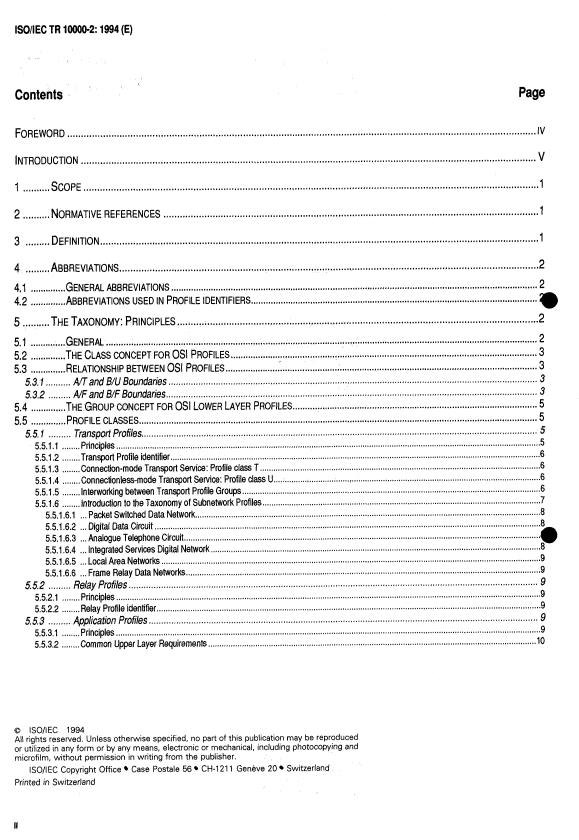
Contents
FOREWORD .,.,.,.,.,,.,,,.,.,,.,.,.,.,.,.,,.,,.,,.,,,.,,,.,,.,.,,.,,,.,,.,.,.,.,.,.,,.IV
INTRODUCTION v
......................................................................................................................................................................
1 . SCOPE .
2 1
.......... NORMATIVE REFERENCES .........................................................................................................................................
................................................................................................................................................................ 1
3 . DEFINITION
4 . ABBRE~IATI~N~ .
4.1 . GENERAL ABBREVIATIONS . 2
.............. ...................................................................................................................
4.2 ABBREVIATIONS USED IN PROFILE IDENTIFIERS *
5 . THE TAXONOMY: PRINCIPLES ,,,,,.,.,,,.,,,,.,,.,,.,.,.~.,.,,.,.,,.~.2
5.1 . GENERAL . 2
5.2 . THE CLASS CONCEPT FOR OS1 PROFILES . 3
5.3 . RELATIONSHIP BETWEEN os1 PROFILES . 3
5.3.1 . M and B/U Boundaries . . .
..................................................... 3
5.3.2 . AiF and BIF Boundaries., .
5.4 . THE GROUP CONCEPT FOR os1 LOWER LAYER PROFILES . 5
5.5 . PROFILE CLASSES . 5
5.5.1 . Transport Pro
5.5.1.1 . Principles . . .
............................. 6
5.5.1.5 . lnterworki . 6
5.5.1.6.2 . Digital Data Circuit .
5.5.1.6.5 ,.,Local Area Networks . . . 9
................................................................. 9
........................ ........................................... 9
.................................. ........................................ ............................ 9
5.5.3 . Application Profiles .
..................................................
..................... ..................... .............................................. 10
8 ISO/IEC 1994
All rights reserved Unless otherwise specified, no part of this publication may be reproduced
or utilized in any form or by any means, electronic or mechanical, including photocopying and
microfilm, without permission in writing from the publisher.
ISO/IEC Copyright Office Case Postale 56 CH-1 21 1 Genève 20 Switzerland
Printed in Switzerland
II
i
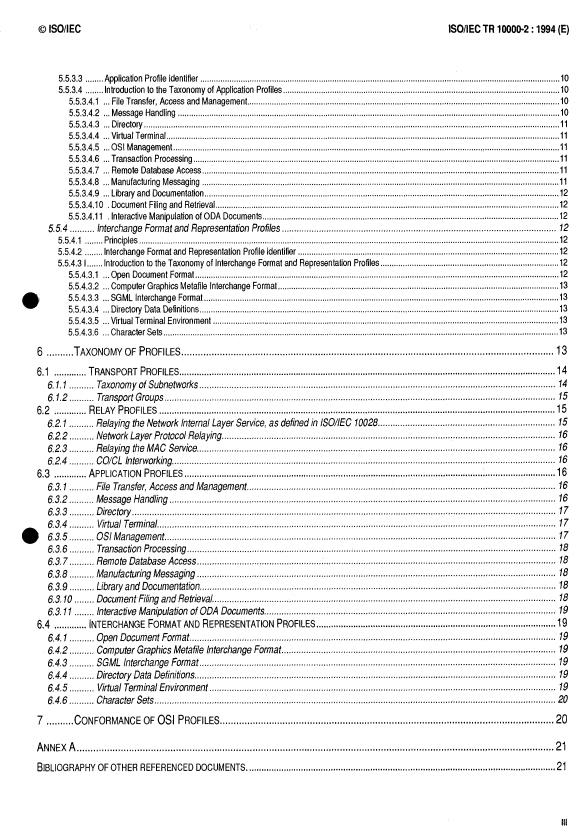
0 ISOllEC ISOllEC TR 10000-2 : 1994 (E)
5.5.3.3 . Application Profile identifier . 10
..................................................................... 10
............................................................... il
5.5.3.4.1 1 . Interactive Manipulation of ODA Docume
................... ..........................
5.5.4.3.3 . SGML Interchange Format .
5.5.4.3.4 . Directory Data Definitions
6 . TAXONOMY OF PROFILES . 13
6.1 . TRANSPORT PROFILES . 14
................................................... 14
.......................................................................................... 15
6.2 . RELAY PROFILES . 15
6.2.1 . Relaying the Network Internal Layer Service, as defined in ISO/IEC 10028 .
Network Layer Protocol Relaying . .
Relaying the MAC Service .
COKL Interworking . . 16
6.3 . APPLICATION PROFILES . 16
............................................ 16
.................................................................... 17
........................................................... 18
..................................... 18
6.3.9 . Library and Documen
................ ........................................................................... 18
6.4 . INTERCHANGE FORMAT AND REPRESENTATION PROFILES . 19
.................................... 19
6.4.1 . Open Document Format
.................................... 19
.................................... 19
.............................................................. 19
.................................... 19
.................................... 20
7 . CONFORMANCE OF os1 PROFILES . 20
ANNEX A . 21
BIBLIOGRAPHY OF OTHER REFERENCED DOCUMENTS . 21
0 ISOIIEC
ISOIIEC TR 10000-2: 1994 (E)
Foreword
IS0 (the International Organization for Standardization) and IEC (the
International Electrotechnical Commission) form the specialized system for
worldwide standardization. National bodies that are members of IS0 or IEC
participate in the development of International Standards through technical
committees established by the respective organization to deal with particular
fields of technical activity. IS0 and IEC technical committees collaborate in
fields of mutual interest. Other international organizations, governmental and
non-governmental, in liaison with IS0 and IEC, also take part in the work.
In the field of information technology, IS0 and IEC have established a joint
technical committee, ISOAEC JTC 1.
The main task of technical committees is to prepare International Standards,
but in exceptional circumstances a technical committee may propose the
publication of a Technical Report of one of the following types:
- type 1, when the required support cannot be obtained for the publication
of an International Standard, despite repeated efforts;
- type 2, when the subject is still under technical development or where for
any other reason there is the future but not immediate possibility of an
agreement on an International Standard;
- type 3, when a technical committee has collected data of a different kind
from that which is normally published as an International Standard ("state
of the art", for example).
1 and 2 are subject to review within three years of
Technical Reports of types
publication, to decide whether they can be transformed into International Stan-
3 do not necessarily have to be reviewed until
dards. Technical Reports of type
the data they provide are considered to be no longer valid or useful.
ISOIIEC TR 1oooO-2, which is a Technical Report of type 3, was prepared by
Joint Technical Committee ISO/IEC JTC 1, Information technology.
This third edition cancels and replaces the second edition
(ISO/IEC TR 10000-2:1992), which has been technically revised.
ISO/IEC TR 10000 consists of the following parts, under the general title
Information technology - Framework and taxonomy of International
Standardized Profiles:
- Part 1: Framework
- Part 2: Principles and Taxonomy for OS1 Profiles
O ISOIIEC
ISOIIEC TR 10000-2 : 1994 (E)
I
Introduction
The context of Functional Standardization is one part of the overall field of Information
Technology standardization activities covering
Base standards, which define fundamentals and generalized procedures. They
provide an infrastructure that can be used by a variety of applications, each of which
can make its own selection from the options offered by them.
Profiles, which define conforming subsets or combinations of base standards used to
provide specific functions. Profiles identify the use of particular options available in
the base standards, and provide a basis for the development of uniform,
internationally recognized, conformance tests.
a
Registration mechanisms, which provide the means to specify detailed
parameterization within the framework of the base standards or Profiles.
Within ISOllEC JTC 1, the process of Functional Standardization is concerned with the
methodology of defining Profiles, and their publication in documents called "International
Standardized Profiles" (ISPs) in accordance with procedures contained in Directives of
JTC 1.
In addition to ISOllEC TR 10000, the secretariat of the Special Group on Functional
Standardization maintains a standing document (SD-4) entitled "Directory of ISPs and
Profiles contained therein". This is a factual record of which ISPs exist, or are in preparation,
together with an executive summary of each Profile. It is subject to regular updating by the
Secretariat of ISO/IEC JTC l/SGFS.
a
TECHNICAL REPORT O ISO/IEC
ISOllEC TR 10000-2 : 1994 (E)
lnformation technology - Framework and taxonomy of
International Standardized Profiles
Part 2:
Principles and Taxonomy for OS1 Profiles
1 Scope 2 References
The purpose of this part of lSOllEC TR 10000 is to provide a ISO/IEC 9646-6: 1 994, lnformation technology - Open
classification for Profiles (Taxonomy) which may be or have been - Conformance testing
Systems lnterconnection
- Part 6: Protocol profile
.submitted for ratification as International Standardized Profiles methodology and framework
{ITU-T Rec. X.295 (1 994))
(ISPs). test specification.
ISOIIEC TR 10000-1 defines the concept of Profiles, as ISO/I EC 9646-7:--' , lnformation technology - Open
in ISPs, and gives guidance to organizations making - Conformance testing
documented Systems lnterconnection
proposals for Draft ISPs, on the nature and content of the docu- - Part 7: Implementation
methodology and framework
ments they are producing. {ITU-T Rec. X.296 (1 994))
conformance statements.
The existence of a Profile classification in this part of ISO/IEC TR 10000-1 :1992, lnformation technology -
ISO/IEC TR 10000 does not reflect a judgment by Framework and taxonomy of International Standard-
ISOllEC JTC IISGFS that a Profile is required for such capabi- ized Profiles - Part 7: Framework.
lity. It merely provides a capability to identify uniquely such a
function and to enable evaluation of PDISPs.
3 Definition
Since Profiles will be proposed according to needs identified to
SGFS and according to the progress of international base For the purposes of this part of ISOllEC TR 10000, the following
standardization, the Taxonomy will be periodically updated or definition applies:
have new parts added in order to reflect the progress reached. It
is also recognized that there will be proposals for the extension of Group: A set of OS1 Profiles that are compatible, in the sense
Othe Taxonomy to cover functions which were not identified during that a system implementing one Profile from a Group can
preparation of this edition of ISO/IEC TR 10000. These
interwork, according to OSI, with another system implementing a
different Profile from the same Group, in terms of the operation of
extensions may be identified by a variety of proposers and
involve simple extensions to the existing Taxonomy or the the protocols specified within these Profiles.
addition of new functional areas not currently covered by
ISO/IEC TR 10000. The inclusion of such extensions is admi-
nistered following the procedures elaborated by SGFS.
A distinction has been made between a Profile and an ISP
documenting one or more Profiles. The Taxonomy is only
concerned with Profiles, but further information is given in the
"Directory of lSPs and Profiles contained therein" as to which ISP
contains the documentation of a Profile.
This Directory is maintained as an SGFS standing document
SD-4 (see Annex A). For each draft Profile submitted to SGFS, it
will also provide additional information, including the status of the
identified Profiles.
1 To be published
identifiers
4.1 General abbreviations
&& Profile sub-cla@pDlicationd
ADF Document Filing and Retrieval
CL Connectionless-mode
I Directory
AD
CLNS Connectionless-mode Network Service
AFT File Transfer, Access and Management
CLTS Connectionless-mode Transport Service
Library, Documentation
CO Connection-mode ALD
AMH Message Handling
CONS Connection-mode Network Service
AMM Manufacturing Messaging
COTS Connection-mode Transport Service
AD I Directory
CSDN Circuit Switched Data Network
AOD Interactive Manipulation of ODA Documents
CSMNCD Carrier Sense, Multiple Access 1 Collision Detection
ARD Remote Database Access
CULR Common Upper Layer Requirements
ATP Transaction Processing
DSA Directory Service Agent
AVT Virtual Terminal
DTE Data Terminal Equipment
DUA Directory User Agent
Profile Wb-clm (Formats)
EDI Electronic Data Interchange
Computer Graphics Metafile Interchange Format
FCG
EDlM EDI Messaging
a
FCS Character Sets
FDDl Fibre Distributed Data Interface
FDI Directory Data Definitions
FR PVC Frame Relay Permanent Virtual Circuit
FOD Open Document Format
FR SVC Frame Relay Switched Virtual Call
FSG SGML Interchange Format
FRBS Frame Relay Bearer Service
FVT Virtual Terminal Registered Objects
FRDN Frame Relay Data Network
FRDTS Frame Relay Data Transmission Service
Profile sub-class (Lower Layas)
IPM Interpersonal Message &
COTS over CLNS
TA
ISDN Integrated Services Digital Network
COTS over CONS
TB
~ ISP International Standardized Profile
COTS over CONS
TC
~ LAN Local Area Network
COTS over CONS
TD
MAC Media Access Control
COTS over CONS
TE
1 MMS Manufacturing Message Specification
CLTS over CLNS
UA
Message Oriented Text Interchange System
MOTE
CLTS over CONS
UB
MS Message Store
RA Relaying the CLNS
MTA Message Transfer Agent
RB Relaying the CONS
MTS Message Transfer System
RC X.25 Protocol Relaying
ODA Open Document Architecture
Relaying the MAC Service using transparent bridging
RD
PI Message Transfer Protocol
Relaying the MAC Service using source routing
RE
P2 Interpersonal Messaging Protocol
Relaying between CLNS and CONS
RZ
P3 MTS Access Protocol
P7 MS Access Protocol
PSDN Packet Switched Data Network
5 The Taxonomy: Principles
PSTN Public Switched Telephone Network
PVC X.25 Permanent Virtual Circuit
QOS Quality of Service
5.1 General
ISOAEC JTC IISpecial Group on Functional
SGFS
Standardization
Profiles are primarily arranged into classes, each class
SGML Standardized General Markup Language
representing a category of functionality of reasonable
TP Transaction Processing
independence from other classes. The different classes of profile
TPSU TP Service User
correspond to the major divisions of the taxonomy.
UA User Agent
ISOllEC TR 10000-1 provides some further information about the
vc X.25 Virtual Call
principles used in this primary classification.
VT Virtual Terminal
Within each class, a class-specific subdivision will be used.
Profile identifiers have been introduced such that each Profile is
identified by a character string commencing with one letter (indi-
cating the primary class of the Profile), and continuing with as
many further letters or digits as are necessary to reflect its
0 ISOllEC ISOllEC TR 10000-2 : 1994 (E)
position within the hierarchic structure of the class. The syntax of For the identification of sub-classes and a further subdivision
all but the first letter is subject to individual definitions for each within a given class, a class-dependent methodology is applied.
class (see below). This is explained in the subsequent class-individual sections.
The Class concept for OS1 Profiles 5.3 Relationship between OS1 Profiles
5.2
In order to decouple representation of information or objects from
communication protocols, and application-related protocol from
The schematic illustration in Figure 1 brings together examples of
subnetwork types, OS1 and OSI-related Profiles are divided into
the relationships which exist between OS1 Profiles, particularly
the following classes:
the three main subdivisions of the Taxonomy, and the
combinations which can be made between Profiles from different
T - Transport Profiles providing connection-mode Transport
classes.
Service
5.3.1 A/T and B/U Boundaries
Transport Profiles providing connectionless-mode
U -
Transport Service
Actual use of an A- or B-Profile requires that a system operate it
in combination with a T- or U-Profile, in order to provide a
Relay Profiles
particular application protocol over a particular subnetwork type.
OR- The separation of A- and B-Profiles from T- and U-Profiles is
Application Profiles requiring connection-mode Transport
A - represented by an AIT or B/U boundary. This relationship is
Service illustrated vertically in Figure 1. The location of a set of A-Profiles
above a set of T-Profiles, separated by a common NT boundary,
B - Application Profiles requiring connectionless-mode
represents the possibility of combining any pair of A- and
Transport Service
T-Profiles, one from each of the two classes.
F - Interchange format and representation Profiles
A similar situation exists for the B- and U-Profiles. The AIT
boundaries correspond to the OS1 Connection-mode Transport
Other classes may be required.
Service, and the BIU-boundaries to the OS1 Connectionless
mode Transport Service. The possibility of making the
Transport Profiles of classes T and U specify how the two modes
combination arises from the fact that a T- or U-Profile is specified
of OS1 Transport Service are provided over the two modes of OS1
to provide the OS1 Transport Service and an A- or B-Profile is
Network Service, and over specific subnetwork types, such as in-
specified to use the OS1 Transport Service.
dividual types of LANs, PSDNs, etc. In this way they isolate the
NB-Profiles and F-Profiles from network technology.
5.3.2 A/F and B/F Boundaries
T- and U-Profiles are further subdivided into Grouris.
The combination of an A- or B-Profile with one or more F-Profiles
See.5.4 The Group concept for OS1 Lower Layer Profiles" for
will be selected by the user to meet the functional requirements in
0 details.
each case. The various general possibilities are illustrated by the
vertical relationships in Figure 1. The location of one or more
Application Profiles of classes A and B specify communications
F-Profiles above one or more A-/B-Profiles, represents the
protocol support for particular application types over the two
possibility of combining Profiles from each class.
modes of OS1 Transport Service, respectively.
Unlike the AIT and BIU boundaries, the NF and B/F boundaries
F-Profiles specify the characteristics and representation of
are not characterised by a single service definition.
various types of information interchanged by A- and B-Profiles.
The Application Layer base standards require, implicitly or
Fi-Profiles specify Relay functionality needed to enable systems
explicitly, the structure of information carried or referenced by
using different T- or U-Profiles to interwork. lnterworking between
them to be specified for each instance of communication. The
T- and U-Profiles is not contemplated in any JTC 1 work.
combination of A-/B-Profiles with one or more F-Profiles will be
selected by the user to meet the functional requirements in each
Within each of these classes, sub-classes of Profiles are
case. However, the choice may be subject to constraints which
identified which, again, may require further subdivision such that
can be expressed within either A-/B-Profiles, F-Profiles, or both.
the granularity of the Taxonomy meets the requirements outlined
in ISO/IEC TR 10000-1. This leads to a hierarchical structure of
In other A-/B-Profiles, the Application Layer base standards
Profile {sub-)classes which is given in full in clause ,,6 Taxonomy
themselves constrain the choice of presentation context.
of Profiles".
0 ISOllEC
ISOllEC TR 10000-2: 1994 (E)
I
constraints will limit the A-IB-Profiles which can be used to
Constraints may also exist within an F-Profile, arising either from
transfer the information.
its base standard, or as a result of Profile creation. These
I
Fxxnn
Fxxnn
Fxxnn
Fxxnn
F- Profiles
A- and B-
Bxxnn
Profiles AFïnn
T- and U-
Profiles
NOTE - Tt. figure illustrates logical structuring possibilities, not the interrelationships of specfflc identified Profiles.
Figure 1: Examples of relationships between Profiles in the OS1 Taxonomy
0 ISOllEC ISOllEC TR 10000-2 : 1994 (E)
In summary, therefore, there are three forms of constraints
5.5 Profile classes
affecting the combination of A-IB- and F-Profiles:
5.5.1 Transport Profiles
the choice of information to be transferred may be
a)
constrained by the Application Layer base standards, and
5.5.1 .I Principles
possibly further constrained by the A-/B-Profile;
Transport Profiles define the use of protocol standards from OS1
some interchange and representation base standards
b) layers 1 to 4, to provide the OS1 Transport Service.
may limit transfer to particular Application base
standards; this choice may be further constrained by the
A primary distinction is made between Transport Profiles, based
F-Profiles;
on the mode of Transport Service offered:
the combinations are not constrained by base standards,
c) - Connection-mode Transport Service:
but may be constrained by either A-/B- or F-Profiles to
Profile class T
achieve some general function.
- Connectionless-mode Transport Service:
Note that, as always, in making his choice of combination, a user
Profile class U
must in practice take account not only of the constraints derived
.from Profiles, but also the capabilities implemented in the end
For the Transport Profile classification within each class, the
systems involved in each instance of communication, to support
following methodology is applied:
the various Profiles.
As a first level distinction the Group concept
a)
(see,,5.4 The Group concept for OS1 Lower Layer
5.4 The Group concept for OS1 Lower
Profiles") is used in the following way:
Layer Profiles
A lower layer Group is a collection of Profiles which:
The Group concept is used in the Taxonomy as follows:
support the same combination of modes of Transport
and Network Service;
A Group is a set of T- or U-Profiles that are compatible in the
sense that a system implementing one Profile from the Group
support the same Transport Protocol Class(es);
and another system implementing a Profile from the same Group
can be expected to interwork, according to OSI, to some mini-
The notion of a Group is incorporated in the classification.
mum level which is determined by the mandatory features of the
Profiles in the Group.
The Second level distinction between Profiles, i.e. within a
b)
Group, is made according to the subnetwork type
to OS1 means end-to-end operation
lnterworking according
supported
.across a single subnetwork, or across multiple subnetworks
(see ,,6.1.1 Taxonomy of Subnetworks" for examples of
linked by means of Network (or lower) Layer relays.
subnetwork types).
An example of a Group is the set of T-Profiles that provide the
c) Further subd ivisions are made according to the
Connection-mode Transport Service, using Class 4 Transport
characteristics of a particular subnetwork, e.g., switched
Protocol over the Connectionless-mode Network Service, pro-
vided by lSOilEC8473. This Group has members which versus leased line
(see 6.1 .I for examples of such characteristics).
correspond to different subnetwork technologies but interworking
between systems conforming to them is made possible by LAN
bridges andlor Network Layer relays.
A Group is identified by labels of the form YXnnn, where Y is the
class identifier and X is a letter identifying the Group.
0 ISOIIEC
ISOllEC TR 10000-2: 1994 (E)
5.5.1.2 Transport Profile identifier
The Connection-mode Transport Service (COTS) is provided over
the Connection-mode Network Service (CONS).
The identifier for a Profile in the lower layers is of the form:
Y Xabcde Profiles of this characteristic are further grouped according to
their required support of Transport Protocol class(es):
where:
mandatory (see note 1)
transport protocol classes
Y = class designator, indicating the Transport Service
mode:
O and 2 and 4 (see note 2)
Group TB:
T for Connection-mode Group TC: O and 2 (see note 2)
U for Connectionless-mode Group TD: O
Group TE: 2 (see note 3)
X = one letter indicating the lower-layer Group within the
NOTES
class, as defined in ,,5.5.1.3 Connection-mode
'Mandatory' means those Transport Protocol classes made mandatory by the
Transport Service: Profile class T and 3.5.1.4
base standard, iSO/IEC 8073, plus any class required for Group membership
Connectionless-mode Transport Service: Profile
2 The class negotiation rules to be employed are those in ITU-T
class U" below.
Recommendation X.224.
A system implementing a profile from Group TE and claiming conformance to
abcde = the structured numerical identifier indicating the 3
ITU-T Recommendation X224 also has to implement transport protocol
subnetwork type supported in this Profile. It is
class O.
possible that a further level of identifier may become
necessary. In general, when referencing a Profile,
5.5.1.4 Connectionless-mode Transport
only that level of identifier which is necessary for
Service: Profile class U
uniqueness needs to be used.
a) Connectionless-mode Transport Service over
The identifier structure is not meant to capture the
Connectionless-mode Network Service:
variety of details and options of OS1 layer 1 such as
attachment speeds and connectors. However, it is re-
Group UA
cognized that this issue must be covered by the ap-
propriate Profile specification.
The Connectionless-mode Transport Service (CLTS) is provided
using the ITU-T Rec. X.234 I ISO/IEC8602 Connection-
5.5.1.3 Connection-mode Transport Service: Profile
less-mode Transport Protocol. This Group supports the
class T
1 ISO/IEC 8602,
mandatory operation of the ITU-T Rec. X.234
over Connectionless-mode Network Service.
Based on functional standardization already under way in organi-
zations represented in SGFS and on standards already
b) Connectionless-mode Transport Service over
developed, the following lower layer Groups are identified as be-
Connection-mode Network Service:
ing of value. They are characterized as follows:
Group UB
a) Connection-mode Transport Service over
Connectionless-mode Network Service:
The Connectionless-mode Transport Service (CLTS) is provided
using the ITU-T Rec. X.234 1 ISO/IEC8602 Connection-
Group TA
less-mode Transport Protocol. This Group supports the option of
ITU-T Rec. X.234 1 lSOllEC8602 that operates over
the
The Connection-mode Transport Service (COTS) is provided over
Connection-mode Network Service.
the Connectionless-mode Network Service (CLNS) by requiring
the use of the Class4 Transport Protocol as defined in ITU-T NOTE . A system implementing a profile from Group UB and claiming conformance to
Rec X 234 1 iSOliEC 8602 also has to implement the mandatory
the iTU-T
Rec. X.224 1 ISOIIEC 8073.
operation over CLNS as required by the ITU-T Rec. X 234 1 ISOllEC 8602
NOTE . A system implementing a profile from Group TA and claiming conformance to
5.5.1.5 Interworking between Transport Profile
ITU-T Rec. X.224 I ISO/IEC 8073 also has to implement the mandatory
Groups
transport protocol ciasses for operation over CONS as required by ITU-T Rec.
X.224 I ISOllEC 8073.
The following tables 1 and 2 show the interworking capabilities
b) Connection-mode Transport Service over
between Profiles. Table 1 shows the interworking between
Connection-mode Network Service
Profiles in Profile class T, and table 2 shows the interworking
O ISOllEC ISOllEC TR 10000-2 : 1994 (E)
among Profiles in Profile class U. Successful establishment of a working is dependent on the satisfactory out-
Transport Connection is dependent upon successful negotiation
come of class negotiation.
of parameters, some of which are not considered in the following
tables.
Special: Non-OS1 relay required for interworking
(see also .5.5.2.1 Principles")
No interworking is possible between Groups in class T and U
because of the different mode of Transport Service provided.
Special 1 : Special restrictions for interworking exist
(see ,,6.2.4 COlCL Interworking").
Entries in the tables have the following meaning:
Special 2: lnterworking between these Profile types is
Full: Full OS1 interworking (an OS1 relay may be
not contemplated in any JTC 1 work.
required (see ,,6.2 Relay Profiles"))
NOTE . Successful interworking depends not onlyon the satisfactory outcome of the
transport protocol class negotiation but also on dynamic responses during
Restricted: lnterworking capabilities are restricted in the
transport inlation. Such dynamic responses can include, amongst others, re-
sense that the choice of Transport Protocol sponder reactions to the offered Quaïly of Service (CüS) or to the specific
options requested by the initiator.
classes may be restricted by the static
capability of the responder. Successful inter-
Table 1 lnterworking amongst Groups in class T
Service mode
Table 2 - Interworking amongst Groups in class U
II Responder in Initiator in Group
I II
I
special 2
UA I full
UB
special 2 1 full
5.5.1.6
Introduction to the Taxonomy of subnetwork types, as identified by the first digit of the subnetwork
Subnetwork Profiles identifier, are the following:
Subnetwork types are characterized by a structured numerical 1 Packet Switched Data Network (PSDN)
identifier. The first digit of the numerical identifier classifies the
2 Digital Data Circuit
major subnetwork type being used for system interconnection 3 Analogue Telephone Circuit
while the subsequent digits represent a subdivision of the
4 Integrated Services Digital Network (ISDN)
subnetwork type, indicating how use is made of the subnetwork 5 Local Area Network (LAN)
type, or describing how the subnetwork is accessed. The major
6 Frame Relay Data Network (FRDN)
O ISO/IEC
ISOllEC TR 10000-2: 1994 (E)
The number of ways in which subnetworks may be implemented further subdivision of the Digital Data Circuit subnetwork
and used is potentially very large. There are also cases where taxonomy identifier.
one subnetwork type is used to access another subnetwork type
5.5.1.6.3 Analogue Telephone Circuit
which has a higher network functionality. For example, an ISDN
or a FRDN may be used to access a PSDN which offers a higher
The subnetwork identifiers for Analogue Telephone Circuits are
functionality. The subnetwork taxonomy needs to reflect such
structured identically to the subnetwork identifiers for Digital Data
combinations which are defined by ITU recommendations and
Circuits, i.e. the second digit of the subnetwork identifier indicates
offered by public network service providers.
whether the analogue circuit is established permanently (leased
service) or by circuit- switching (dial-up).
Other subnetwork variations have been deemed to be, in
practice, less important to the goal of end system interoperability,
5.5.1.6.4 Integrated Services Digital Network
e.g. some electrical and physical interfaces that are prerequisites
to subnetwork connection establishment but transparent to data
The second digit of the ISDN subnetwork taxonomy identifier
exchange. Therefore, aspects such as line speed, connector type,
indicates the type of service being assumed from the ISDN. Four
or modem type have, in general, not been reflected in the
types of such service have been identified at this time; these
subnetwork taxonomy. Such requirements may be included in
being permanent service (including semi-permanent service),
actual ISPs, if considered important, or this area may be left as a
circuit-mode service, packet-mode service and frame relay bearer
local matter for system installation.
service. a
5.5.1.6.1 Packet Switched Data Network The permanent and circuit-mode services operate on ISDN B-
channels (indicated by the third digit of the subnetwork identifier)
through which the communicating DTEs are connected
The second digit of the subnetwork taxonomy identifier makes the
transparently. In this case, the taxonomy uses the fourth digit to
overall distinction as to whether the access to the PSDN is
indicate whether the B-channel is used to operate the X.25
permanent or switched. For each of these two major types of
packet layer protocol between DTEs or whether the connection is
access to the PSDN, the third digit of the subnetwork identifier
used to operate the IS0 8473 connectionless-mode network
denotes the type of network used to gain access to the PSDN.
protocol between DTEs. This last case of operating the IS0 8473
Currently defined networks for gaining access to the PSDN are a
PSTN line, a CSDN line, an ISDN B-channel, and a FRDN. connectionless-mode network protocol without an underlying X.25
protocol is applicable only to the RA and TA groups of profiles
Except for the more complicated case of a FRDN access, the whereas the X.25 operation over an ISDN subnetwork may be
fourth digit of the PSDN subnetwork taxonomy identifier indicates used to provide either the connection-mode network service or
whether the X.25 logical channel operates on a Virtual Call or a the connectionless-mode network service.
Permanent Virtual Circuit. In the case of switched access to the
In the case of packet-mode service or frame relay bearer service
PSDN, only Virtual Call operation is possible.
being used from the ISDN, the third digit of the ISDN subnetwork
In the case of FRDN access to a PSDN, the fourth digit of the taxonomy identifier determines the type of ISDN channel being
subnetwork identifier indicates that a Frame Relay Permanent used to access the service. Such channels may be a@
Virtual Circuit (FR PVC) is used while a fifth digit indicates that (semi-)permanent B-channel, a demand access B-channel, a
the PSDN is used to provide for X.25 DTE operation. D-channel, or a permanent H-channel.
Place holders have been left in the PSDN subnetwork taxonomy For packet-mode service or frame relay bearer service over ISDN,
to allow for future specification of access to the PSDN through the fourth digit of the ISDN taxonomy identifier indicates the type
other means, e.g. through an ISDN D-channel or H-channel, or of virtual path being used (Virtual Call, Permanent Virtual Circuit
or Switched Virtual Call) while the fifth digit, if present, provides
through various combinations of a Frame Relay service operating
further detail on call control (with or without use of ITU-T Rec.
over ISDN.
(2.931) or the type of DTE operation (TE1 operation for frame
5.5.1.6.2 Digital Data Circuit relay bearer service).
A Digital Data Circuit is typically an X.21 based service offering Place holders have been left in the ISDN subnetwork taxonomy
to allow for future expansion of the level of detail in operation of
although other interfaces are conceivable, e.g. ITU-T Rec. G.703
the frame relay bearer service, as well as addition of a frame
based service offerings. The taxonomy currently makes no
switching bearer service over ISDN.
distinction on this point which is left to actual profile definitions.
The second digit of the subnetwork taxonomy identifier
determines whether the circuit is established permanently (leased
service) or established by circuit-switching (dial-up). There is no
O ISOllEC
ISOll EC TR 10000-2 : 1994 (E)
5.5.1.6.5 Local Area Networks 5.5.2.2 Relay Profile identifier
The subnetwork identifier has only two digits where the second The identifier for a Relay Profile is of the form
digit indicates the type of LAN, no matter what protocol is
operating over such LAN. The types of LAN that are currently
recognized in the taxonomy are CSMNCD, Token Bus, Token
Ring and FDDI. where
5.5.1.6.6 Frame Relay Data Networks
R = relay function
The FRDN subnetwork taxonomy is applicable to situations
X = relay type identifier
where a FRDN is used directly to interconnect systems. Frame
relay subnetwork technology may also be used to access a This identifier will cover
PSDN (covered under the PSDN subnetwork taxonomy) or to
operate as a service within an ISDN (covered under the ISDN - the layer at which the relay operates
subnetwork taxonomy).
- the service mode being supported
The second digit of the subnetwork taxonomy denotes whether
access to the FRDN is permanent (leased service) or switched - the type of relay
(dial-up). The third digit of the FRDN taxonomy indicates the type
of network used to access the FRDN. This may be an analogue p, q= subnetwork type identifier
data circuit (PSTN leased or dial-up) or a special FRDTS (Frame
Relay Data Transmission Service, permanent or switched p and q may each take the value of the abcde-structured
access). numerical identifier defined for Transport Profiles. The
fully qualified structure need only be used where ne-
The fourth digit of the FRDN taxonomy is used to distinguish cessary (e.g., for circumstances where a distinction must
between the types of frame relay virtual connection (permanent be made between LANs).
virtual circuit or switched virtual call) whereas a fifth digit is used
RXP, represents a relay of type X between subnetwork type p
to indicate the type of terminal operation (Frame Relay TE1 as
and I metwork type q.
defined by the ITU-T).
A relay RXp.q is considered to provide the same functionality as
Place holders have been left in the FRDN subnetwork taxonomy
RXq.p unless otherwise stated.
to allow for future expansion of the level of detail in operation of
the frame relay service.
5.5.3 Application Profiles
e.5.2 Relay Profiles
5.5.3.1 Principles
5.5.2.1 Principles
Application Profiles define the use of protocol standards from OS1
layers 5 to 7, to provide for the structured transfer of information
Relay Profiles define the use of standards from OS1 layers 1 to 4,
between end systems.
to provide relaying functions between OS1 Transport Profiles.
Each Application Profile is a complete definition of the use of
No relays exist between different Profiles of different Transport
protocol standards from OS1 layers 5 to 7, though it may share
Profile classes (T, U).
one or more common definitions of some part of its content with
other Application Profiles.
Relays may operate at various layers up to layer 4. However,
To avoid, wherever appropriate, duplication of text related to
relays operating at layer 4 are not OS1 relays and hence some
common parts, the concept of the Common Upper Layer
restrictions or limitations may be expected in their operation.
Requirements has been introduced. These Common Upper Layer
Many proposals for such relays have significant architectural
Requirements can be documented in a separate ISP or part
issues associated with them relating to integrity, security, QOS,
thereof, to be referenced by using Application Profiles
etc., and the fact that an identifier has been allocated to them
(see ,,5.5.3.2 Common Upper Layer Requirements").
does not indicate that such issues have been resolved.
Furthermore, Application Profiles can build on each other in such
a way that one Application Profile makes use of services provided
by another Application Profile for specific modes of
O ISOIIEC
ISOIIEC TR 10000-2: 1994 (E)
A for Profiles requiring Connection-mode
communication (i.e. ALD22 profile, which is based on AMH2n
Transport Service
profiles and AMH2n profiles, which themselves are based on
AMHl n profiles). The resulting combination of A-IB-Profiles with
B for Profiles requiring Connectionless-mode
one or more underlaying A-/B-Profile@) will be selected by the
Transport Service
user to meet the functional requirements in each case. However,
the choice may be subject to constraints which can be expressed
XY = two letters corresponding to the names of the primary
within either A-/E-Profile.
subdivisions. These subdivisions are taken from the
main categories of application functions and OS1 ma-
In analogy with the primary distinction made between Transport
nagement, as identified as main projects in JTC i.
Profiles, a primary distinction is made between Application
Profiles, based on the mode of Transport Service they require:
abc = the structured numerical identifier for the member@)
Application Profiles requiring Con- of the subdivision. It is possible that a further level of
Profile class A:
nection-mode Transport Service, i.e., using subdivision may become necessary. Only that level of
T-Profiles identifier will be used which is necessary for
uniqueness. This level may vary among application
Profile class B: Application Profiles requiring Connec- functions (see Note).
tionless-mode Transport Service, i.e., using
NOTE - An extension has been adopted for the use by the
...
Questions, Comments and Discussion
Ask us and Technical Secretary will try to provide an answer. You can facilitate discussion about the standard in here.
Loading comments...