

ISO/IEC 9646-7:1995
(Main)Information technology — Open Systems Interconnection — Conformance testing methodology and framework — Part 7: Implementation Conformance Statements
General Information
- Abstract
Gives guidance on the concepts of Implementation Conformance Statements (ICSs) and System Conformance Statements (SCSs) related zu OSI specifications and specifies requirements and gives guidance on the production of ICSs, ICS proformas, ICS templates and profile Requirements List (RLs). This part specifies the structure, the questions to be asked, the syntax and notation to be used and the semantics of the questions and expected answers for these documents.
- Status
- Published
- Publication Date
- 20-Sep-1995
- Technical Committee
- ISO/IEC JTC 1 - Information technology
- Drafting Committee
- ISO/IEC JTC 1 - Information technology
- Current Stage
- 9093 - International Standard confirmed
- Start Date
- 28-Jun-2001
- Completion Date
- 29-Aug-2026
Overview
ISO/IEC 9646-7:1995 - "Information technology - Open Systems Interconnection - Conformance testing methodology and framework - Part 7: Implementation Conformance Statements" defines how to create and use Implementation Conformance Statements (ICSs) and System Conformance Statements (SCSs) for OSI specifications. It specifies the structure, the questions to be asked, the syntax/notation and the semantics of questions and expected answers for ICS proformas, ICS templates and profile Requirements Lists (RLs). This part of the ISO/IEC 9646 series supports conformance testing by describing the information suppliers must provide to show which protocol/profile features an implementation supports.
Key topics and requirements
- Scope and purpose: Guidance on ICSs/SCSs related to OSI specifications; requirements for producing ICS proformas, templates and profile RLs.
- Structure and notation: Prescribes the structure of ICS proformas and the exact syntax, status values and support answers to be used so conformance information is unambiguous.
- Questionnaire model: ICS proformas are questionnaire/check‑list forms covering mandatory, optional and conditional features, PDUs, timers, parameters and other capabilities identified in OSI specs.
- Profile handling: Rules for combining base specification ICSs with profile‑specific ICS proformas and for producing profile Requirements Lists (RLs).
- Relation to testing: Defines how ICS/SCS data relate to Abstract Test Suites (ATS) and conformance assessment outputs.
- Annex guidance: Includes annexes with detailed interpretation of status values and support answers, examples of PICS/RL tables, IXIT guidance, multi‑specification dependency handling and information object ICSs.
- No single generic template: Because OSI specifications vary, the standard sets general requirements rather than a single universal ICS template.
Applications
- Creating standardized ICS proformas and profile RLs that suppliers complete to declare implemented features.
- Supporting conformance testing and test-reporting workflows (PICS, PCTR, SCTR).
- Informing test laboratories and conformance assessors so test cases map unambiguously to declared functionality.
- Documenting feature-level support of PDUs, timers, parameters and negotiation/error handling options.
- Integrating with Abstract Test Suites (TTCN-based ATS) and profile test specifications.
Who should use this standard
- Protocol and profile authors and standards bodies producing OSI specifications.
- Implementors and suppliers completing ICSs/PICS for products.
- Conformance test laboratories and accreditation bodies.
- Test-suite developers and systems integrators who need precise implementation declarations.
- Organizations preparing documentation for profile-based interoperability testing.
Related standards
- ISO/IEC 9646 (Parts 1–6) - general conformance testing framework, ATS, TTCN, test realization, test lab requirements, profile test specs.
- ISO/IEC 10165-6 and ISO/IEC TR 10000-1 - related guidance on management information and profile frameworks.
- Published in parallel as ITU‑T Recommendation X.296 (non‑identical text).
Relations
- Effective Date
- 10-Feb-2026
- Referred By
EN 15509:2023 - Electronic fee collection - Interoperability application profile for DSRC - Effective Date
- 09-Feb-2026
- Effective Date
- 09-Feb-2026
- Effective Date
- 09-Feb-2026
- Referred By
EN 15509:2014 - Electronic fee collection - Interoperability application profile for DSRC - Effective Date
- 09-Feb-2026
- Effective Date
- 09-Feb-2026
- Effective Date
- 09-Feb-2026
- Effective Date
- 09-Feb-2026
Get Certified
Connect with accredited certification bodies for this standard

BSI Group
BSI (British Standards Institution) is the business standards company that helps organizations make excellence a habit.

NYCE
Mexican standards and certification body.
Sponsored listings
Frequently Asked Questions
ISO/IEC 9646-7:1995 is a standard published by the International Organization for Standardization (ISO). Its full title is "Information technology — Open Systems Interconnection — Conformance testing methodology and framework — Part 7: Implementation Conformance Statements". This standard covers: Gives guidance on the concepts of Implementation Conformance Statements (ICSs) and System Conformance Statements (SCSs) related zu OSI specifications and specifies requirements and gives guidance on the production of ICSs, ICS proformas, ICS templates and profile Requirements List (RLs). This part specifies the structure, the questions to be asked, the syntax and notation to be used and the semantics of the questions and expected answers for these documents.
Gives guidance on the concepts of Implementation Conformance Statements (ICSs) and System Conformance Statements (SCSs) related zu OSI specifications and specifies requirements and gives guidance on the production of ICSs, ICS proformas, ICS templates and profile Requirements List (RLs). This part specifies the structure, the questions to be asked, the syntax and notation to be used and the semantics of the questions and expected answers for these documents.
ISO/IEC 9646-7:1995 is classified under the following ICS (International Classification for Standards) categories: 35.100.01 - Open systems interconnection in general. The ICS classification helps identify the subject area and facilitates finding related standards.
ISO/IEC 9646-7:1995 has the following relationships with other standards: It is inter standard links to EN IEC 61375-2-8:2021, EN 15509:2023, EN 16062:2015, EN ISO 18750:2018, EN 15509:2014, CEN ISO/TS 21189:2019, EN ISO 12855:2015, EN ISO 12813:2024. Understanding these relationships helps ensure you are using the most current and applicable version of the standard.
ISO/IEC 9646-7:1995 is available in PDF format for immediate download after purchase. The document can be added to your cart and obtained through the secure checkout process. Digital delivery ensures instant access to the complete standard document.
Standards Content (Sample)
INTERNATIONAL ISO/IEC
STANDARD
9646-7
First edition
1995-09-I 5
Information technology - Open Systems
Interconnection
- Conformance testing
methodology and framework -
Part 7:
Implementation Conformance Statements
Technologies de I’informa tion - Interconnexion de systemes ouverts
- Essais de conformit - Mkthodologie g6n6rale et
fOS1)
pro&dues -
Partie 7: Dklarations de conform& des mises en euvre
Reference number
lSO/I EC 9646-7: 1995(E)
ISO/IEC 9646-7 : 1995 (E)
Page
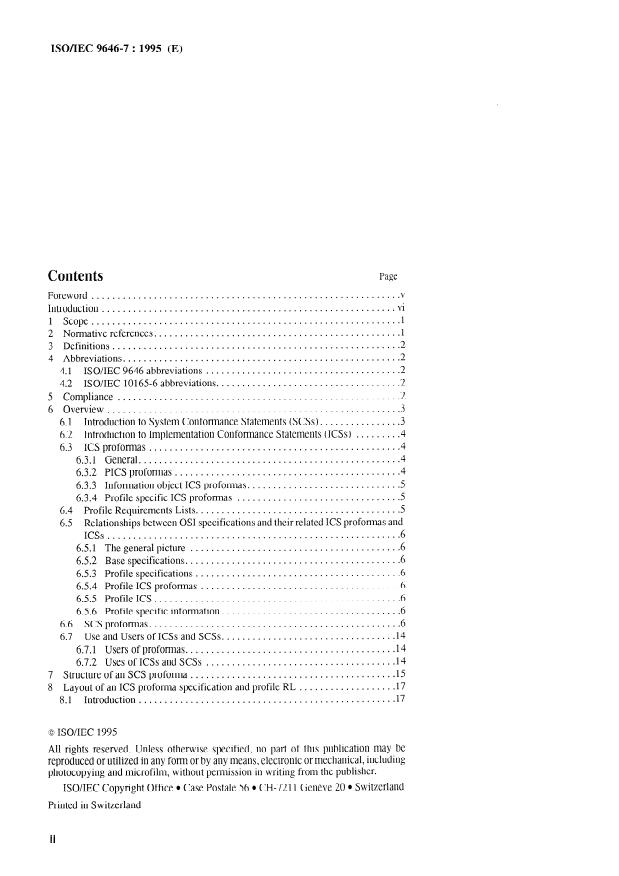
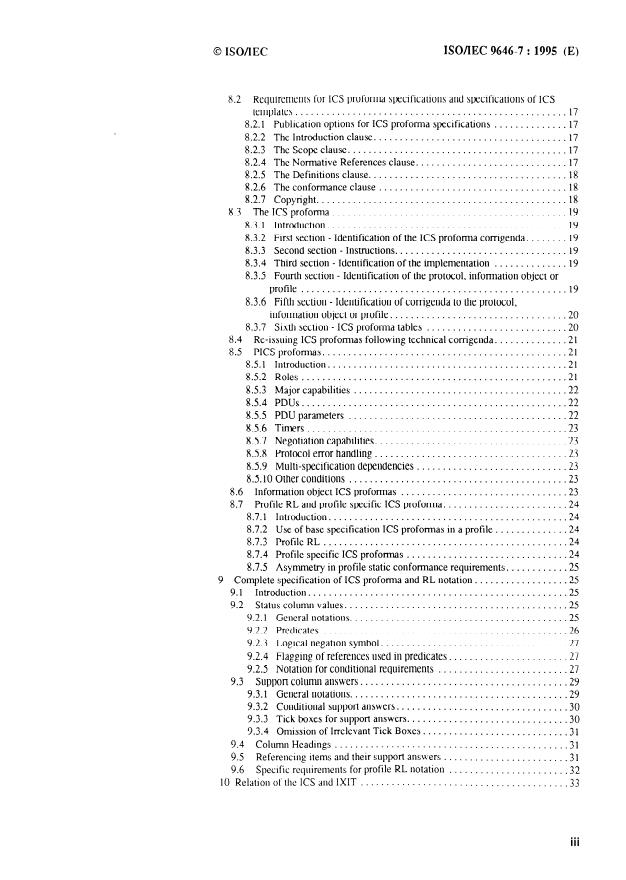
Contents
/
Foreword .
..v i
Introductiou .
..l
1 Scope .
.............................................. .l
2 Normative references.
.
3 Definitions .
4 Abbreviations . .2
.....................................
4.1 ISO/IEC 9646 abbreviations .2
..................................
4.2 ISO/IEC 10165-6 abbreviations. .2
......................................................
.2
5 Compliance
...3
6 Overvie~l .
............... .3
6.1 Introduction to System Conformance Statements (SCSs)
........ .4
6.2 Introduction to Irqlementatiou Conformance Statements (ICSs)
................................................ .4
6.3 ICS proformas
.................................................. .4
6.3.1 General
........................................... .4
6.3.2 PICS lxoformas
............................. .5
6.3.3 Information object ICS proformas
............................... .5
6.3.4 Profile specific ICS profonnas
...................................... .5
6.4 Profile Requirements Lists.
6.5 Relationships between OS1 specifications and their related ICS lx-oformas aud
...6
ICSs .
........................................ .6
6.5.1 The general picture
........................................ .6
6.5.2 Base specifications.
....................................... .6
6.5.3 Profile specifications
...................................... .6
6.5.4 Profile ICS proformas
............................................... .6
6.5.5 Profile ICS
.................................. .6
6.5.6 Profile specific information
................................................ .6
6.6 SCSproformas
.14
6.7 UseandUsersofICSsaudSCSs. .
.......................................
.14
6.7.1 Users of profomlas.
.................................... .14
6.7.2 Uses of ICSs and SCSs
....................................... .15
7 Structure of an SCS proforma
.................. .17
8 Layout of au ICS proforma specification aud profile RL
.................................................
8.1 Introduction .17
0 ISO/IEC 1995
All rights reserved. Unless otherwise specified, no part of this publication may be
reproduced or utilized in any foml or by any means, electronic or mechanical, iucludiug
photocopying and microfilm, without pemksion in writing from the publisher.
ISO/IEC Copyright Office l Case Postale 56 l W-721 1 Genkve 20 l Switzerland
Printed in Switzerland
ii
ISOAEC 9646-7 : 1995 (E)
0 ISO/IEC
8.2 Rquirmxnts for ICS proforma specifications and specifications of ICS
templates.l7
.............. 17
8.2.1 Publication options for ICS profotma specifications
.....................................
8.2.2 The Introduction clause
8.2.3 The Scope clause. .
............................ 17
8.2.4 The Normative References clause.
.....................................
8.2.5 The Definitions clause.
....................................
8.2.6 The conformance clause
8.2.7 Copyright .
8.3 The ICS profomm .
8.3.1 It~troductiot~ .
....... 19
8.3.2 First section - Identification of the ICS profotma corrigenda.
.................................
8.3.3 Second section - Instructions
..............
8.3.4 Third section - Identification of the implementation
8.3.5 Fourth section - Identification of the protocol, infornlation object or
..19
profile. .
8.3.6 Fifth section - Identification of corrigenda to the protocol,
.20
infomlation object or profile. .
.......................... .20
8.3.7 Sixth section - ICS proforma tables
............ .2 1
8.4 Re-issuing ICS profomlas following technical corrigenda.
-21
8.5 PIGS proformas .
.2 1
8.5.1 Introduction. .
.21
8.5.2 Roles .
.22
8.5.3 Major capabilities .
8.5.4 PDUS.~ 2
.22
.........................................
8.5.5 PDU parameters
8.5.6 Tinlers.2 3
.23
...................................
8.5.7 Negotiation capabilities.
.................................... .23
8.5.8 Protocol error handling
.23
............................
8.5.9 Multi-specification dependencies
.23
8.5.10 Other conditions .
............................... .23
8.6 Information object ICS proformas
...................... .24
8.7 Profile RL and profile specific ICS proforma.
.24
8.7.1 Introduction. .
............. .24
8.7.2 Use of base specification ICS proformas in a profile
.24
8.7.3 Profile RL .
.24
Profile specific ICS profonnas .
8.7.4
.......... .25
8.7.5 Asymmetry in profile static conformance requiremen&.
................. .25
9 Complete specification of ICS proforma and RL notation
.25
9.1 Introduction. .
.25
9.2 Status column values. .
-25
........................................
9.2.1 General notations.
.26
9.2.2 Predicates .
.27
..................................
9.2.3 Logical negation symbol.
...................... .27
9.2.4 Flagging of references used in predicates
.27
........................
9.2.5 Notation for conditional requirements
.29
.......................................
9.3 Support column answers
.29
General notations. .
9.3.1
.30
................................
9.3.2 Cotiditiotial support answers
.30
9.3.3 Tick boxes for support answers. .
........................... .3 1
9.3.4 Omission of Irrelevant Tick Boxes
.31
............................................
9.4 Colurml Headings
........................ 31
9.5 Referencing items and their sup1>ort answers
.32
......................
9.6 Specific requirements for profile RL notation
.33
.......................................
IO Relation ol’lhe ICS and 1XlT
. . .
III
ISO/lEC 9646-7 : 1995 (E) 0 ISO/IEC
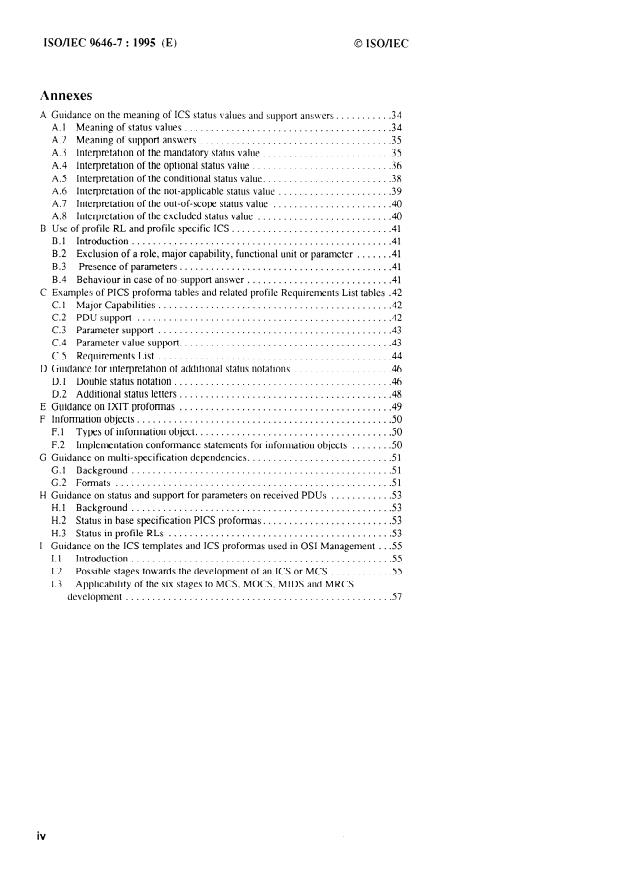
Annexes
.34
A Guidance on the meaning of KS status values and support answers .
A.1 Meaning of status values . .34
A.2 Meaning of support answers . .35
A.3 Interpretation of the mandatory status value . .35
A.4 Interpretation of the optional status value . .36
A.5 Interpretation of the conditional status value. . .38
A.6 Interpretation of the not-applicable status value . .39
A.7 Interpretation of the out-of-scope status value . .4O
A.8 Interpretation of the excluded status value . .40
B Use of profile RL and profile specific ICS . .41
B. 1 Introduction .41
.................................................
B.2 Exclusion of a role, major capability, functional unit or parameter . .41
B.3 Presence of parameters . .41
B.4 Behaviour in case of no-support answer . .41
C Examples of PICS proforma tables and related profile Requirements List tables .42
C. 1 Major Capabilities . .42
C.2 PDUsu1,por-t . .4 2
C.3 Parameter support . .43
C.4 Parameter value support. . .43
C.5 Requirements List . .44
D Guidance for interpretation of additional status notations . .46
D.1 Double status notation . .46
D.2 Additional status letters . .48
E Guidance on IXIT proformas .
.49
F Information objects. . .50
F.1 Types of information object. .50
....................................
F.2 Implementation conformance statements for infomlation objects . .50
..........................
G Guidance on multi-specification dependencies. .5 1
G.1 Back~round.5 1
G.2 Fomlats . .5 1
H Guidance on status and support for parameters on received PDUs . .53
H.1 Backl.routld.5 3
H.2 Status in base specification PICS profomlas. .
.53
H.3 Status in profile RLs .
.53
I Guidance on the ICS templates and ICS proformas used in OS1 Management . .55
1.1 Introduction. . .5 5
I.2 Possible stages towards the development of an ICS or MCS . .55
I.3 Applicability of the six stages to MCS, MOCS, MIDS and MRCS
.57
development .
iv
ISO/IEC 9646-7: 1995 (E)
0 ISO/IEC
Foreword
IS0 (the International Organization for Standardization) and IEC (the International
Electrotechnical Commission) foml the specialized system for worldwide
standardization. National bodies that are members of IS0 or IEC participate in the
development of International Standards through technical committees established
by the respective organization to deal with particular fields of technical activity.
IS0 and IEC technical committees collaborate in field of mutual interest. Other
international organizations, governmental and non-governmental, in liaison with
IS0 and IEC, also take part in the work.
In the field of infomlation technology, IS0 and IEC have established a joint
technical committee, ISO/IEC JTC 1. Draft International Standards adopted by the
joint technical committee are circulated to national bodies for voting. Publication as
an International Standard requires approval by at least 75% of the national bodies
casting a vote.
International Standard ISO/IEC 9646-7 was prepared by Joint Technical
Committee ISO/IEC JTC 1, Information technology, Subcommittee 21, Open
Systems Interconnection, data management and open distributed processing.
ISO/IEC 9646 consists of the following parts, under the general title lnformtion
technology - Open Systems Interconnection - Conformunce testing methodology
and flamework:
- Part 1: General concepts
- Part 2: Abstract Test Suite specification
- Part 3: Tree and Tabular Combined Notation
- Part 4: Test realization
- Part 5: Requirements on test laboratories and clients for the conformunce
assessment process
- Part 6: Protocol profile test specification
- Part 7: Implementation Conformance Statements
Annexes A to I of this part of ISO/IEC 9646 are for infomlation only.
ISO/IEC 9646-7: 1995 (E)
0 ISO/IEC
Introduction
IS01IEC 9646-l defines terminology and introduces general concepts for both
protocol and profile testing. ISO!IEC 9646-2 specifies the requirements on the
production of OS1 conformance testing standards and standardized abstract test
suites. ISO/IEC 9646-3 defines a standardized test notation, the Tree and Tabular
Combined Notation (TTCN) for the specification of a standardized Abstract Test
Suite. ISO/IEC 9646-4 places requirements on test realization and ISO/IEC 9646-5
places requirements on the conformance assessment process. ISO/IEC 9646-6
specifies
requirements for the production of OS1 protocol Profile Test
Specifications.
This part of ISO/IEC 9646 specifies requirements for the development of
Implementation Conformance Statements (ICS) for protocols, profiles and
information objects (such as managed objects).
An ICS contains the necessary information required for conformance testing to the
relevant requirements specified in OS1 specifications and their related profiles.
The ICS proforma is in the form of a questionnaire or check-list that is intended to
cover all requirements, all optional and conditional functions, elements of
procedure, parameters, PDUs, timers, etc. and other capabilities identified in the
specification. The ICS proforma is to be completed by the supplier or the
implementor.
An overview of the System Conformance Statements (SCSs), ICSs and their
proformas is given in clause 6.
Clause 7 describes the structure of SCS proformas.
Clause 8 describes the requirements and layout of ICS proforma specifications and
profile Requirements Lists (RLs).
Clause 9
provides a complete specification for ICS proformas, as well as profile
RLs, alld describes requirements on the notation.
Annex A provides guidance on the meaning of ICS status values and support
answers.
Annex B provides examples of profile RLs and profile specific ICSs.
Annex C provides examples of PICS proforma tables and profile RL tables.
Annex D provides guidance for interpreting additional status notations.
Annex E provides guidance on IXIT proformas.
Annex F provides infomlation on infomlation objects.
Annex G provides guidance on multi-specification dependencies.
vi
ISO/IEC 9646-7: 1995 (E)
0 ISO/IEC
Annex I-I pro\‘ides guidance on status values for parameters on received Protocol
Data Units.
Annex I provides guidance on ICS templates.
This part of ISO/IEC 9646 is also to be published by ITU as ITU-T
Recommendation X.296, but not as identical text.
vii
This intentionally left blank
page
INTERNATIONAL STANDARD 0 ISO/IEC
ISO/IEC 9646-7: 1995 (E)
Information technology - Open Systems Interconnection -
Conformance testing methodology and framework - Part 7:
Implementation Conformance Statements
1 Scope
This part of ISO/IEC 9646 gives guidance on the concepts of Implementation Conformance Statements (ICSs) and System
Conformance Statements (SCSs) related to OS1 specifications and specifies requirements and gives guidance on the productiou
of ICSs, ICS profomus, ICS templates and profile Requirements Lists (RLs).
This part of ISO/IEC 9646 specifies for these documents, the structure, the questions to be asked, the syntax and notation to be
used and the semantics of the questions and expected answers.
No generic ICS template is provided because of the wide variety of OS1 specifications for which coufomlauce requirements arc
stated. Nevertheless, this part of ISO/IEC 9646 specifies general requirements that are applicable to auy OS1 specification.
Other than guidance on the relation between an ICS and Implementation extra Infomlation for Testing (IXIT), requirements and
guidance on IXIT are outside the scope of this part of ISO/IEC 9646.
2 Normative references
The following standards contain provisions which, through reference in this text, constitute provisions of this part of ISO/IEC
9646. At the time of publication, the editions indicated were valid. All standards are subject to revision, and parties to agreements
based on this part of ISO/IEC 9646 are encouraged to investigate the possibility of applying the most recent editions of the
standards indicated below. Members of IEC and IS0 maintain registers of currently valid International Standards.
ISO/IEC 749% 1: 1994, Information technology - Open Systems Interconnection - Basic Reference Model: The Basic Model.
(See also ITU-T Recommendation X.200 (1994)). -
Open Systems Interconnection -
ISO/IEC 9646- 1: 1994, Information technology - Conformance testing methodology and
framework - Part 1: General concepts.
(See also ITU-T Recommendation X.290 (1995)).
ISO/IEC 9646-2: 1994, Information technology - Open Systems Interconnection - Conformance testing methodology and
framework - Part 2: Abstract Test Suite specification.
(See also ITU-T Recommendation X.291 (1995)).
- C‘oriformurice testiq methodology urld
ISOIIEC 9646-5: 1994, lnformution technology - Open Systems lntercorlrlectio~l
framework - Part 5: Requirements on test laborutories und clients for the conformunce assessment process.
‘(See also ITU-T Recommendation X.294 (1995)).
Open Systems Interconnection - Cor2formance testing methodoloCgy und
ISO/IEC 9646-6: 1994, lnformution technology -
flamework - Part 6: Protocol profile test specificution.
(See also ITU-T Recommendation X.295 (1995)).
ISO/IEC 10 165-6: 1994, Information technology - Open Systems Interconnection - Structure of manugement informorion:
requiremellts and guidelirles for implemer2tation co~lformance statement proformus associated with OS! mar2agement.
(See also ITU-T Recommendation X.724 (1993)).
ISO/IEC TR 1 OOOO- 1: 1990, lnformutiorz technology - Frumework and taxonomy of lnternutionul Standurdized Profiles - Purt
I : Framework.
ISO/IEC 9646-7: 1995 (E) 0 ISO/lEC
3 Definitions
For the purposes of this part of ISO/IEC 9646, all definitions given in ISO/IEC 9646- 1 and the following definitions apply.
3.1 ICS proforma specification: The specification which provides a complete KS proforma.
3.2 ICS template: A template which is to be used as the basis for developing an ICS profomla.
4 Abbreviations
4.1 ISO/IEC 9646 abbreviations
For the purposes of this part of ISO/IEC 9646, the following abbreviations defined in ISO/IEC 9646-l apply:
abstract test suite
ATS:
implementation conformance statement
ICS:
ISP: international standardized profile
I
IUT: implementation under test
implementation extra infomMion for testing
IXIT:
MOT: means of testing
OSI: open systems interconnection
PCTR: protocol confomlance test report
PDU: protocol data unit
protocol implementation confomlance statement
PIGS:
profile specific test specification
PSTS:
profile test specification
PTS:
requirements list
RI,:
scs: system conformance statement
SCTR: system conformance test report
SUT: system under test
TTCN: tree and tabular combined notation
XRL: IXIT requirements list
NO’E - ‘I‘he following abbreviations were defined in ISO/IEC ‘I‘RloooO- 1 but are superseded in ISO/IEC 9646 by more general terms:
IYHI.: ISP requirements list (general term is profile RL)
ISP Implementation conformance statement (general term is profile ICS)
ISYICS:
ISYIXIT: ISP Implementation extra information for testing (general term is profile IXIT)
4.2 ISO/IEC 101654 abbreviations
For the purposes of this part of ISOlIEC 9646, the following abbreviations defined in ISO/IEC 10165-6 apply:
MCS: management confomlance summary
MIDS: management infomlation definition statement
MOCS: managed object confomlance statement
MRCS: management relationship confomlance summary
5 Compliance
5.1 AI] OS1 specification to which an implementation may be claimed to conform (i.e. specifying a protocol, infomlation object
or one or more profiles) shall
a) incorporate or reference the specification of an Implementation Conformance Statement (ICS) profomia;
b) include, within its conformance clause, text which is effectively equivalent to the following:
0 ISO/IEC ISO/IEC 9646-7: 1995 (E)
- “The supplier of an implementation which is claimed to confoml to this shall provide an ICS by
completing an profomla which conforms to the profomla specification in , and shall
provide the information necessary to identifjf both the supplier and the implementation.”
5.2 An OS1 specification that specifies an ICS proforma in compliance with this part of ISOLIEC 9646 shall satisfy the
requirements stated in 8.1 to 8.4,9.1 to 9.5 and clause 10.
An OS1 specification that specifies a Protocol ICS (PICS) proforma in compliance with this part of ISO/IEC 9646 shall
also satisfy the requirements stated in 8.5. An OS1 specification that specifies an information object ICS proforma in
compliance with this part of ISO/IEC 9646 shall also satisfy the requirements stated in 8.6. An OSI specification that
specifies a profile ICS proforma in compliance with this part of ISO/IEC 9646 shall also satisfy the requirements stated
in 6.5.4. An OS1 specification that specifies a profile specific ICS proforma in compliance with this part of ISO/IEC 9646
shall also satisfy the requirements stated in 8.7.2 and 8.7.4.
5.3 An OS1 specification that specifies a profile Requirements List (RL) in compliance with this part of ISOIIEC 9646
shall satisfy the requirements stated in 8.7.3 and clause 9 (with the exception of 9.3).
5.4 An OS1 specification that specifies an KS template in compliance with this part of ISO/IEC 9646 shall specify
requirements applicable to some ICS profomlas, such that any ICS proforma which complies with the ICS template also
complies with this part of ISO/IEC 9646.
NOTE - In addition, the following conformance and compliance relationships are relevant to ICSs, ICS proformas and ICS templates:
a) the actual ICS proforma used by a supplier should conform to the relevant ICS proforma specification;
b) an ICS should conform to the relevant ICS proforma specification;
c) an ICS proforma should comply with the specification of an applicable ICS template, if any;
d) an ICS template may comply with the specification of a more general ICS template, if any.
5.5 An SCS proforma which is claimed to comply with this part of ISO/IEC 9646 shall satisfy the requirements of the
SCS template and other applicable requirements specified in 6.6 and clause 7.
6 Overview
6.1 Introduction to System Conformance Statements (SCSs)
A conforming system or implementation is one which satisfies an identified and consistent set of static and dynamic
conformance requirements specified in a set of related OS1 protocol, profile, abstract syntax, encoding rule and
information object specifications. Claims of confomlance for a system are made in an SCS and associated ICSs which
explicitly state conformance to static conformance requirements and thereby imply conformance to the associated
dynamic conformance requirements.
An SCS, as defined in ISO/IEC 9646-l) is required to identify the OS1 protocols, abstract syntaxes, encoding rules, and
infomlation objects to which conformance is claimed. An SCS is also required to identify the profiles to which
conformance is claimed and to identify any other supported combinations of the protocols, abstract syntaxes, encoding
rules and infomlation objects, and the supported relationships between them.
A Management Confomlance Summary (MCS), as defined in ISO/IEC 10165-6, is a special type of SCS, focusing on
management aspects of the system. If there is an MCS for a system, the SCS shall reference the MCS.
An SCS contains the following information as a minimum
a) information related to both the real open system and the client:
1) administrative infomlation to identify the client;
2) system information identify the appropriate OS1 specific for example, product and ver-
part of the system,
sion number;
b) information related to those specifications for which a11 ICS is provided:
1) the identification of the specifications to which conformance is claimed, including version numbers,
and in the
case of a profile, the profile identification;
2) a reference to the related ICSs;
3) the identification of combinations of specifications that are supported, if those combinations are not covered by a
profile
ISO/IEC 9646-7: 1995 (E)
0 ISOKIEC
4) information on whether the suplx,~ of specific profiles or other combinations of specifications involves static reconfig-
uration, dynamic reconfiguration, or no reconfiguration of the system.
The SCS may contain an indication of whether a System Conformance Test Report (SCTR) and its referenced Protocol
Conformance Test Reports (PCTRs), received from a previous conformance assessment, are available for information.
When an SCS is submitted to a test laboratory for a conformance assessment process, the SCS should indicate which profiles
or combinations of specifications are to be tested. It may also indicate if the System Under Test (SUT) is a complete or partial
(N)-open system, if it is to be tested as an end-system or a relay system, and what protocols are within the SUT but not part of
the IUT. For instance, if the WI’ is an implementation of an application profile over layers 5 to 7, the SCS may indicate which
protocols or profiles are used to provide the Transport service.
6.2 Introduction to Implementation Conformance Statements (ICSs)
For each of the specifications referenced in the SCS, the detailed statement of supported capabilities (i.e. of the static
conformance requirements satisfied by the system) is provided in an ICS.
For each protocol specification for which confomlance is claimed, the detailed statement of supported capabilities is called a
Protocol Implementation Conformance Statement (PICS).
For each information object specification for which confomlance is claimed, the detailed statement of supported capabilities is
called an information object Implementation Confomlance Statement (information object ICS). Specific examples of
information object ICSs are Managed Object Confomlance Statement (MOCS), Management Information Definition
Statement (MIDS) and Management Relationship Conformance Summary (MRCS), for details, see ISO/IEC 10165-6.
For each profile or set of profiles for which conformance is claimed, the set of detailed statements of supported capabilities for
that profile is called a profile Implementation Conformance Statement (profile ICS). A profile ICS includes all the relevant
PICSs and information object ICSs. It may also include a profile specific statement of supported capabilities, which arc not
covered by any of the PICSs or information object ICSs; this is called a profile specific ICS.
NOTE - TO avoid potential confusion, it is not recommended to create new abbreviations of the form xxxICS or xxxCS.
6.3 ICS proformas
6.3.1 General
To ensure consistency of an ICS with the static conformance requirements of the relevant OS1 specification, all OS1
specifications stating static conformance requirements are required to have an associated ICS proforma.
An ICS proforma is in the form of a questionnaire to be completed by the supplier or implementor of an implementation of the
relevant OS1 specification, to become an ICS.
An ICS proforma is essentially a set of items. An item is provided for each optional capability and for each major mandatory
capability. Each item includes an item number, an item description, a status value specifying the support requirement, and room
for a support answer to be provided by the implementor.
A minimal ICS profomla item is shown in figure 1. This; example shows that item number 1 is Capability-A which, because
the status value is bbo”, is optional. This means that the question to be answered by the implementor is “does your
implementation support Capability-A (in the context applying to this table)?“.
.
Item Item Status support
Number Description Value Answer
I
1 Capability-A 0
.
Figure 1 - A minimal ICS proforma item
The ICS proforma is a normative document to express in compact form the static conformance requirements of a specification.
AS such, it serves as a reference to the static confomlance review. For particular cases requiring specific information, the ICS
profomla can refer to the appropriate clause of the related specification by means of notes and comments.
6.3.2 PICS proformas
Each OS1 protocol defining group is responsible for specifying the conformance requirements associated with the protocol.
They are also responsible for ensuring that a PIGS proforma is produced consistent with these conformance requirements, in a
separate PICS proforma specification or in a normative annex of the protocol specification.
ISOAEC 9646-7: 1995 (E)
0 ISO/IEC
A PICS proforma captures the mandatory capabilities and implementation flexibility allowed by the protocol
specification. It details which options are left to the implementor, and which are conditionally dependent on other options
taken by the implementor. It also emphasizes global implementation options that can be taken in a system supporting the
protocol, in terms of roles of the implementation (e.g. initiator, responder or relay) or providing for service capabilities
(e.g. OS1 Transport expedited data). It does not repeat the dynamic conformance requirements of the protocol
specification.
6.3.3 Information object ICS yroformas
For each information object specification to which conformance may be claimed, there should be an information object
ICS proforma defined together with the information object definition. For example, managed object specifications should
each have an associated MOCS proforma in compliance with ISO/IEC 10165-6.
The relationship between the support of an information object and the support of particular protocols or profiles should
be specified in the relevant System Conformance Statement. Thus, there is no need for information object KS proformas
to include questions about the related protocols or profiles.
6.3.4 Profile specific ICS yroformas
A profile may specify requirements on an implementation that cannot be mapped onto existing items in the base
slxcification ICS proforma(s) relevant to the profile. In this case, a profile specific ICS profomla is required.
6.4 Profile Requirements Lists
A profile Requirements List is provided for each profile and captures
a) the general options of the profile as a whole;
b) a list of the specifications selected and combined in the profile, and references to the related ICS proformas;
c) for each of these referenced base specifications, a section of the profile RL expressing the restrictions upon allowed
support answers in the corresponding PICS profonna and information object ICS proforma. This section of the profile
RL is derived from the ICS proformas of the relevant base specifications, indicating the changes of status values
necessary to express the profile requirements.
A minimal profile RL item is shown in figure 2. This example shows that the profile has changed the status of Capability-
A, which is item number 1 in the PICS profomla, from “0” (i.e. optional) to 3-n” (i.e. mandatory). This means that
conformance to the profile requires a support answer of “Yes” for this item in the PICS.
.
t
Protocol Profile
Item Item
Status Status
Number Description
Value Value
/ I
1 Capability-A o m
.
Figure 2 - A minimal profile RL item
Notice that a profile RL is not an ICS profomla; it does not contain any questions, but rather restricts the acceptable
answers to questions in the ICS profomlas relevant to the profile. Thus, to use a profile RL, each table in it needs to be
put alongside the corresponding table from the relevant ICS proforma. This is illustrated in figure 3.
PICS profomla table Profile RL table
Item Item status
SuPWt
Number Description Value Answer
1 Capability-A o
*
Figure 3 - A profile RL item alongside the corresponding PICS proforma item
ISOKIEC 9646-7: 1995 (E)
0 ISOLIEC
6.5 Relationships between OS1 specifications and their related ICS proformas and ICSs
6.5.1 The general picture
Figure 4 shows the general picture of relationships between OS1 specifications (protocol, information object and profile), their
ICS proformas, a profile RL, and the completed ICSs. The ICS proforrnas are derived from their respective specifications by
converting the static conformance requirements into questions presented in a tabular format. The profile RL is derived from
both the profile and the relevant ICS proformas by presenting the profile requirements as changes in status values. Finally, the
ICSs are derived from the ICS proformas by providing appropriate answers to the questions.
6.5.2 Base specifications
Figure 5 highlights the part of the general picture related to base specifications. This shows the base specifications (for
and information objects), their ICS
protocols proformas and their ICSs.
6.5.3 Profile specifications
Figure 6 highlights the part of the general picture related to the production of a profile specification based on the relevant
protocol and information object specifications.
6.5.4 Profile ICS proformas
Profile specifications do not provide a single ICS profomla for the whole profile. Instead profile specifications
a) reference the relevant PICS profomlas and information object ICS proformas;
b) specify a profile specific ICS proforma if necessary to ask additional questions;
c) specify a profile RL to modify the status values where appropriate.
This complete collection of ICS profomlas plus the profile RL is called the profile ICS proforma. It is highlighted in figure 7
and formula 1 below (where: c means “set of all relevant” and [.I means “optional”):
Profile ICS proforma = x(PICS proforrnas) +C(Information Object ICS proforms) -+
(1)
[Profile Specific ICS profomu] + Profile RL
NOTE - The profile RL may contain within it the profile RL of a common (sub)profile. Similarly, the profile specific ICS proforma may
contain within it the profile specific ICS proforma for a common (sub)profile. See 8.7.3 and 8.7.4.
Profile specifications may include not just the profile RL and any necessary profile specific ICS proforma, but also the whole
profile ICS proforma. However, if the profile ICS profomla is included in the profile specification, then the copies of the base
specification ICS proformas shall be informative; the normative versions of the base specification ICS proformas shall be the
ones specified for the base specifications. Nevertheless, it may be useful to include copies of these ICS proformas in the profile
specification, in order to ensure that implementors of the profile have ready access to the correct versions of the ICS profomlas
for the profile.
NOTE - This is particularly true for the common (sub)profile.
6.5.5 Profile ICS
A profile ICS is a profile ICS profomla with all the relevant answers provided for a given system. Thus, a profile ICS consists
of the set of relevant PICSs and infomlation object ICSs, the profile specific ICS if any, plus the profile RL, as highlighted in
figure 8 and fonula 2 below (where: c means “set of all relevant” and [ . .I means “optional”):
Profile ICS = c(PICS) + x( Information Object ICS) + [Profile Specific ICS] + Profile RL
(2)
The profile RL specifies restrictions on answers in each of the PICSs and information object ICSs to meet the requirements of
the profile specification
6.5.6 Profile specific information
To complete this overview of the relationships between OS1 specifications and their related ICS proformas and ICSs, figure 9
highlights the part of the general picture which is specific to a profile. This shows the profile specification, the profile specific
ICS profomla, the profile RL and the profile specific ICS.
6.6 SCS proformas
Figure 10 shows a graphic representation of an SCS for a system supporting two profiles, three protocols and three infomlation
objects. Profile A comprises of protocols 1, 2 and 3 with information objects X and Y, whilst profile B comprises protocols 1,
2 and 3 with information object Z. The SCS refers to all these OS1 specifications plus the related ICSs, SCTRs, PCTRs and
MCS if relevant. The SCS also refers to the related SCTR(s) and PCTR(s), if any, resulting from previous test campaigns for
some of the relevant specifications implemented in the same SUT, if any.
ISO/IEC 9646-7: 1995 (E)
0 ISO/IEC
SUOII~IJ~S~J Qddv
. .
suor~~~~sa~ Alddv I
.
.
v3
s
E
suor~3I.I)sa~
. .
awa
K
v)
suor]oU)Sa’tI
. .
awa
~3U3.GpJ
m
z d) v//////A Specification
Profile requiremkts
I
-)F List
.
r
Profile
Specification
(Profile1
Provide - Provide
* Specific
Answers
ICS
J
ICS completed
+- Specified by Standards Organizations
* for a specific
system
Figure 5 - Base specifications and their ICS proformas and ICSs
Answers
I
-7 Object
ICS Proforma
I
t
I v
Protocol ICS I A_ -- ‘I I
Provide
I,
--- 1 1 MQuestions
(PIGS)
c-x-
L
Answers
d
Proforma
F -
I
I
PrOtile
Requirements
Profile requirements
List
m
Profile
IProfile
Provide
r ,PrnvidP
I
b Specific 1
Answers
I’cs ]
ICS completed
-+
d- Specified by Standards Organizations +4- for a specific
system
Figure 6 - The specifications to which conformance may be claimed
/ nswers t
IV* / /
‘orma
Specification
,
r
I ,
,
.
v-d-9
l~l~~~~Ir IW
I
Base Protocol --I
PIGS
---i e
/
‘/~~o2Tz./y//1 --
I I
-
Specification
L
1 Profile
Specification
ICS completed
d4Specified by Standards Organizations for a specific
system
Figure 7 - The profile KS proforma
0 ISO/IEC ISO/IEC 9646-7: 1995 (E)
I
I
1 1
,
Provide Provide
Information L
Whnformation
Answers
Object
b$+jqp
Base Protocol
Provide
questions
Answers
ICS completed
Specified by Standards Organizations 4
*4- for a specific
system
Figure 9 - Profile specific information
ISO/IEC 9646-7: 1995 (E)
0 ISO/IEC
Referenced Specifications
scs
Protocols Information
Profiles
References to
Object
Specifications
Profiles ,-
9x1
A
Protocols
3’
f
+Z
/ /
Information X -
Y
Objects
Z
Implementation Conformance Statements
References to related
ICSS
Informati on
Profile
PIGS
Object ICS
Specific ICS
Profile
t 4
I
A
Specific ICS -
B
PIGS
X
Information
Y
Object ICS
Z
Test Reports
References to related
Reports
previous Test PCTRs
SCTRs
A
SCTRs
B
PCTRs
PCTRs
Figure 10 - Relationship between an SCS and its referenced documents
ISOAEC 9646-7: 1995 (E)
0 ISO/IEC
NOTE - It is acceptable not to list an OS1 specification and its ICS in the SCS if it is identified fully in an attachment to another ICS e.g.
abstract syntaxes and encoding rules may be dealt with in an attachment to a PIGS.
In addition , in the above examp le, the scs shall clarify what reconfiguration of the system is necessary in order to switch from
using profi le A to using profile B:
a) no reconfiguration needed - in other words the profile used is determined by the other system and if the other system
chooses to use some combination of protocol capabilities partly from A and partly from B, then this is also likely to be
supported, provided that it does not violate the base protocol specifications;
in
dynamic reconfiguration is negotiation mechanisms to determine which profile is to be used
b) used, using the protocol
an instance of communication;
c) static reconfiguration is used, using some
loCal mechanism (e.g. selection of the profile through the user interface), rather
than by using protocol mechanisms.
An SCS shall be produced by using an SCS proforma. The general requirements on the structure and format of an SCS profomla
are specified in clause 7. The SCS proforma may be provided by a test laboratory, procurement agency, or profile defining
group. If no suitable SCS profomla is available from one of these sources, the supplier may provide its own SCS proforma.
6.7 Use and Users of ICSs and SCSs
6.7.1 Users of yroformas
Possible users of ICS proformas are as follows:
a) the implementors or suppliers, who need to document their implementations;
b) Abstract Test Suite (ATS) specifiers, who need to ensure that the structure of the test suite is consistent with the allowed
implementation flexibility;
c) the specifiers of OS1 protocol profiles, who require a detailed definition of the implementation flexibility available in each
base protocol specification, on which to base their profile RLs.
Profile RLs complement the ICS proformas relevant to a profile and therefore have the same users as ICS proformas, even other
profile specifiers if they are specifying profiles which include by reference other profiles (e.g. common (sub)profiles).
6.7.2 Uses of ICSs and SCSs
6.7.2.1 Use in testing
The main purpose of an SCS and its associated ICSs is to support ISO/IEC 9646-3,
the conformance assessment process (see
where they are used in the following:
a) the static conformance review;
b) the test selection process, as a means of adapting Executable Test Suites to the options supported by the implementation;
c) the results analysis process, as a reference document.
For confomlance testing, each protocol to be tested will be required to have a PICS and each information object to be tested
will be required to have an infomlation object KS (see ISO/IEC 9646-l). Furthermore, a profile ICS is necessary to test
conformance of an implementation to a profile.
6.7.2.2 Other uses
An SCS and its ICSs
can also be used, outside the context of conformance testing, to provide an overview of the system’s
capabilities for which conformance is claimed.
An SCS and its ICSs can also be used to assess the ability of two systems to interwork. This can be done by a comparison of
the options and parameters stated in the ICSs of the two systems. See ISO/IEC 9646-l) on interworking and conformance.
6.7.2.3 Aspects of the system covered by the SCS and ICSs
An SCS and its associated ICSs may be filled out to cover any one of the following aspects of the system’s support of the
relevant OS1 specifications:
a) base specification support, without any reference to profiles which may or may not be supported;
b) single-profile support, without any indication whether or not tilt: system also supports other profiles or other base
specification capabilities, but with the implication that the system may be configured so that it supports only the single
profile;
c) configurable multiple-profile support, i.e. with the capability for the system to be con fi gured t 0 support each of the
profiles individually, using conditional statements as support answers as necessary;
0 ISO/IEC ISO/IEC 9646-7: 1995 (E)
d) non-configurable multiple-profile support, i.e. without the capability for the system to support each of the profiles
separately.
Suppliers have the right to produce an SCS and its associated ICSs for whichever of these aspects of the system’s support
is appropriate for their purposes. A submission to a test laboratory for profile conformance assessment may be
accompanied by an SCS and its ICSs covering any one of b), c) or d) in the above list, even though the test laboratory will
test conformance to one profile at a time.
7 St
...