

ISO 105-X08:1994
(Main)Textiles — Tests for colour fastness — Part X08: Colour fastness to degumming
General Information
- Abstract
Describes a method for determining the resistance of the colour of textiles of all kinds, except loose fibre, to the action of soap solutions such as those used in degumming raw silk. A specimen of the textile in contact with adjacent fabrics is treated with a soap solution, then rinsed and dried. The change in colour of the specimen and the staining of the adjacent fabrics are assessed with the grey scales.
- Status
- Published
- Publication Date
- 24-Aug-1994
- Technical Committee
- ISO/TC 38/SC 1 - Tests for coloured textiles and colorants
- Drafting Committee
- ISO/TC 38/SC 1 - Tests for coloured textiles and colorants
- Current Stage
- 9093 - International Standard confirmed
- Start Date
- 02-Apr-2026
- Completion Date
- 29-Aug-2026
Buy Documents
ISO 105-X08:1994 - Textiles — Tests for colour fastness — Part X08: Colour fastness to degumming Released:8/25/1994
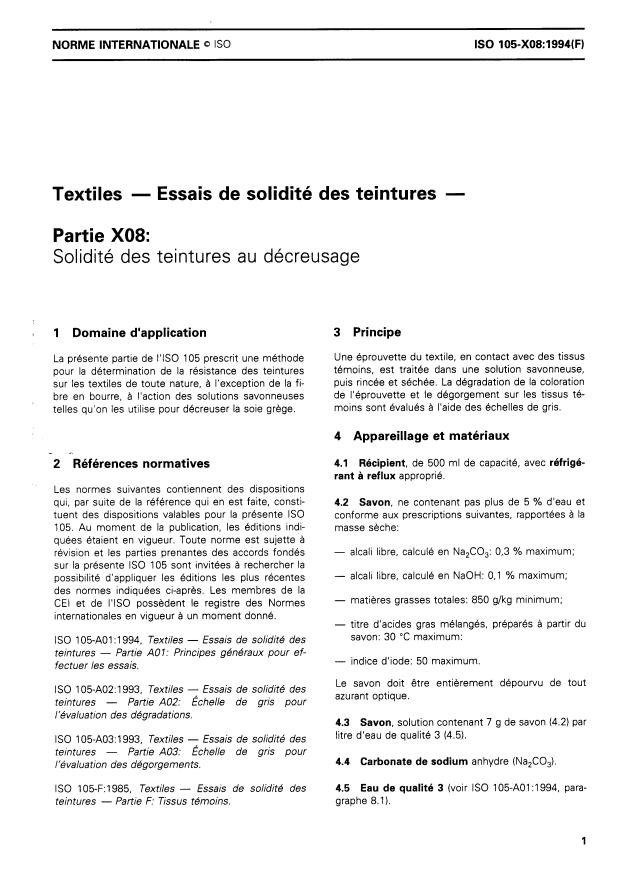
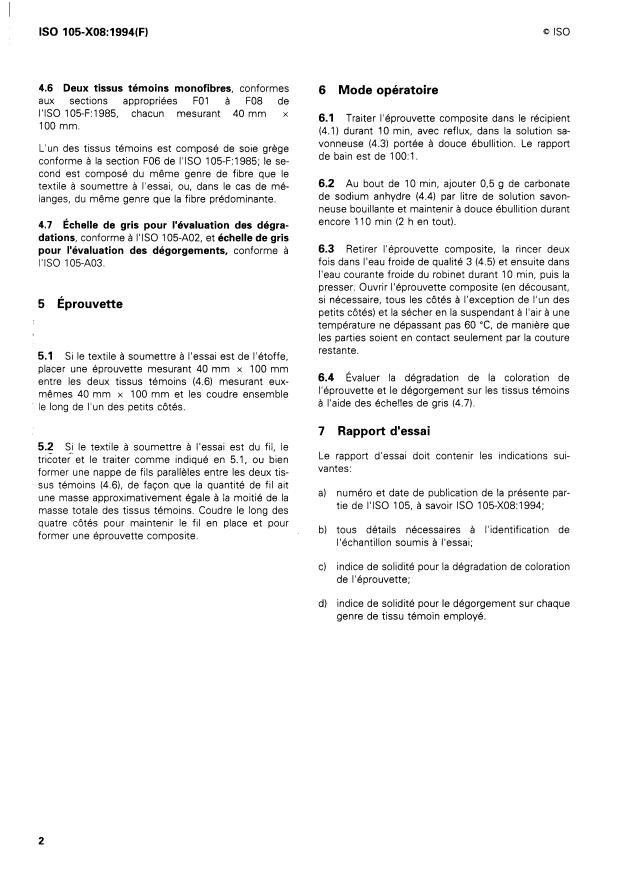
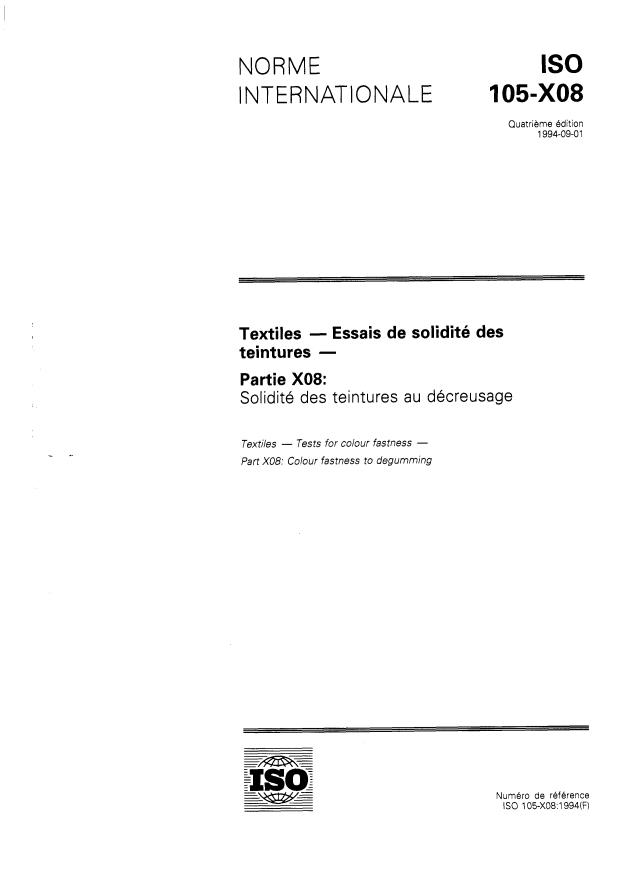
ISO 105-X08:1994 - Textiles — Essais de solidité des teintures — Partie X08: Solidité des teintures au décreusage Released:8/25/1994
ISO 105-X08:1994 - Textiles — Essais de solidité des teintures — Partie X08: Solidité des teintures au décreusage Released:8/25/1994
Overview
ISO 105-X08:1994 - Textiles - Tests for Colour Fastness - Part X08: Colour Fastness to Degumming sets out a standardized method for determining the colour fastness of textiles, other than loose fibres, to the effects of soap solutions used during the degumming process-especially relevant for raw silk. Degumming is a crucial process in the textile industry, particularly for silk, as it removes sericin (silk gum) with soap solutions. This standard evaluates a textile’s resistance to colour change and staining under these conditions, using grey scales for assessment.
Key Topics
- Colour fastness assessment: Establishes a process to measure a textile’s resistance to colour change and staining when exposed to degumming soap solutions.
- Applicability: Relevant for fabrics and yarns of all textile types except loose fibre.
- Standardized procedure: Involves treating the textile specimen, in contact with adjacent fabrics, with a defined soap solution, then rinsing and drying under controlled conditions.
- Evaluation criteria: The colour change in the tested specimen and the degree of staining on adjacent fabrics are measured using ISO standard grey scales, providing objective, repeatable results.
- Adjacent fabrics: Includes the use of raw silk and another fabric matching the type being tested or predominant in blends.
Applications
The ISO 105-X08:1994 standard is widely used in the textiles sector for:
- Quality control in silk production: Ensures dyed silk fabrics maintain their shade during the degumming process, critical for manufacturers and exporters of silk textiles.
- Textile research and development: Assists textile technologists and dye manufacturers to improve dye formulations and fabric treatments for better colour retention.
- Global textile trade: Standardization helps buyers and suppliers across countries align on product quality specifications, reducing disputes related to colour fastness.
- Certification and compliance: Textile producers can demonstrate compliance with recognized international standards, enhancing credibility and acceptance in global markets.
- Consumer safety and satisfaction: Helps manufacturers produce textiles that retain their appearance and do not bleed colour, leading to higher consumer confidence.
Related Standards
For comprehensive evaluation of colour fastness in textiles, ISO 105-X08:1994 references and complements several other standards:
- ISO 105-A01:1994 - General principles of testing for colour fastness in textiles.
- ISO 105-A02:1993 - Grey scale for assessing change in colour, used to evaluate the degree of shade alteration in tested specimens.
- ISO 105-A03:1993 - Grey scale for assessing staining, essential for measuring dye transfer to adjacent fabrics.
- ISO 105-F:1985 - Specification for standard adjacent fabrics, which ensures consistency in testing environments.
Practical Value
Implementing ISO 105-X08:1994 ensures consistent and reliable results in evaluating textile colour fastness to degumming. By following this standard:
- Manufacturers produce textiles that meet international quality benchmarks.
- Laboratories can compare results worldwide, facilitating clear communication in the textile supply chain.
- Brands and retailers can trust that the colour of their silk and other fabrics will remain stable through common wet processing steps, especially important for high-value garments and interior textiles.
Adhering to this method supports sustainable practices and reduces waste by enabling early detection of colour fastness issues, helping suppliers deliver textiles that meet expectations in durability and appearance. Using internationally recognized ISO standards ensures lasting customer satisfaction and global market access in the textile industry.
Relations
- Revises
ISO 105-X08:1987 - Textiles — Tests for colour fastness — Part X08: Colour fastness to degumming - Effective Date
- 15-Apr-2008
Buy Documents
ISO 105-X08:1994 - Textiles — Tests for colour fastness — Part X08: Colour fastness to degumming Released:8/25/1994
ISO 105-X08:1994 - Textiles — Essais de solidité des teintures — Partie X08: Solidité des teintures au décreusage Released:8/25/1994
ISO 105-X08:1994 - Textiles — Essais de solidité des teintures — Partie X08: Solidité des teintures au décreusage Released:8/25/1994
Get Certified
Connect with accredited certification bodies for this standard

Control Union Certifications
Global certification for agriculture and sustainability.

Hohenstein Institut
Textile testing and certification.

Bureau Veritas Bangladesh
Bureau Veritas certification services in Bangladesh.
Sponsored listings
Frequently Asked Questions
ISO 105-X08:1994 is a standard published by the International Organization for Standardization (ISO). Its full title is "Textiles — Tests for colour fastness — Part X08: Colour fastness to degumming". This standard covers: Describes a method for determining the resistance of the colour of textiles of all kinds, except loose fibre, to the action of soap solutions such as those used in degumming raw silk. A specimen of the textile in contact with adjacent fabrics is treated with a soap solution, then rinsed and dried. The change in colour of the specimen and the staining of the adjacent fabrics are assessed with the grey scales.
Describes a method for determining the resistance of the colour of textiles of all kinds, except loose fibre, to the action of soap solutions such as those used in degumming raw silk. A specimen of the textile in contact with adjacent fabrics is treated with a soap solution, then rinsed and dried. The change in colour of the specimen and the staining of the adjacent fabrics are assessed with the grey scales.
ISO 105-X08:1994 is classified under the following ICS (International Classification for Standards) categories: 59.080.01 - Textiles in general. The ICS classification helps identify the subject area and facilitates finding related standards.
ISO 105-X08:1994 has the following relationships with other standards: It is inter standard links to ISO 105-X08:1987. Understanding these relationships helps ensure you are using the most current and applicable version of the standard.
ISO 105-X08:1994 is available in PDF format for immediate download after purchase. The document can be added to your cart and obtained through the secure checkout process. Digital delivery ensures instant access to the complete standard document.
Standards Content (Sample)
INTERNATIONAL ISO
STANDARD 105-X08
Fourth edition
1994-09-01
Textiles - Tests for colour fastness -
Part X08:
Colour fastness to degumming
Textiles - Essais de soliditb des teintures -
Partie XO8: Soliditg des teintures au dkreusage
Reference number
ISO 105-X08: 1994(E)
Foreword
ISO (the International Organization for Standardization) is a worldwide
federation of national Standards bodies (ISO member bodies). The work
of preparing International Standards is normally carried out through ISO
technical committees. Esch member body interested in a subject for
which a technical committee has been established has the right to be re-
presented on that committee. International organizations, governmental
and non-governmental, in liaison with ISO, also take part in the work. ISO
collaborates closely with the International Electrotechnical Commission
(IEC) on all matters of electrotechnical standardization.
Draft International Standards adopted by the technical committees are
circulated to the member bodies for voting. Publication as an International
Standard requires approval by at least 75 % of the member bodies casting
a vote.
International Standard ISO 105-X08 was prepared by Technical Committee
lSO/TC 38, Textiles, Subcommittee SC 1, Tests for coloured textiles and
coloran ts.
This fourth edition cancels and replaces the third edition
(ISO 105-XO8:1987), of which it constitutes a technical revision.
ISO 105 was previously published in thirteen “parts ”, each designated by
a letter (e.g. “Part A ”), with publication dates between 1978 and 1985.
Esch part contained a series of “sections ”, each designated by the re-
spective part letter and by a two-digit serial number (e.g. “Section AO1 “).
These sections are now being republished as separate documents, them-
selves designated “Parts” but retaining their earlier alphanumeric desig-
nations. A complete list of these Parts is given in ISO 105-AOI .
0 ISO 1994
All rights reserved. Unless otherwise specified, no part of this publication may be reproduced
or utilized in any form or by any means, electronie or mechanical, including photocopying and
microfilm, without Permission in writing from the publisher.
International Organization for Standardization
Case Postale 56 l CH-l 211 Geneve 20 l Switzerland
Printed in Switzerland
ii
INTERNATIONAL STANDARD 0 ISO ISO 105-X08:1994(E)
- Tests for colour fastness -
Textiles
Part X08:
Colour fastness to degumming
fabrics is treated with a soap Solution, then rinsed and
1 Scope
dried. The Change in colour of the specimen and the
staining of the adjacent fabrics are assessed by com-
This part of ISO 105 specifies a method for deter-
parison with the grey scales.
mining the resistance of the colour of textiles of all
kinds, except loose fibre, to the action of soap sol-
utions such as those used in degumming raw silk.
4 Apparatus and reagents
4.1 Vessel, of capacity 500 ml, with appropriate re-
2 Normative references
flux condenser.
The following Standards contain provisions which,
4.2 Soap, containing not more than 5 % moisture
through reference in this text, constitute provisions
and complying with the following requirements based
of ISO 105. At the time of publication, the editions
on dry mass:
indicated were valid. All Standards are subject to re-
Vision, and Parties to agreements based on ISO 105
- free alkali, calculated as Na,CO,: 0,3 g/kg maxi-
are encouraged to investigate the possibility of apply-
mum;
ing the most recent editions of the Standards indi-
cated below. Members of IEC and ISO maintain
- free alkali, calculated as NaOH: 1 g/kg maximum;
registers of currently valid International
...
NORME
IS0
I NT E R N AT I0 N A LE
105-X08
Quatribme Bdition
1994-09-01
Textiles - Essais de solidite des
teintures -
Partie X08:
Solidite des teintures au decreusage
Textiles - Tests for colour fastness -
Part X08: Colour fastness to degumming
Numero de reference
IS0 105-XO8:I 994(F)
IS0 105-XO8: 1994( F)
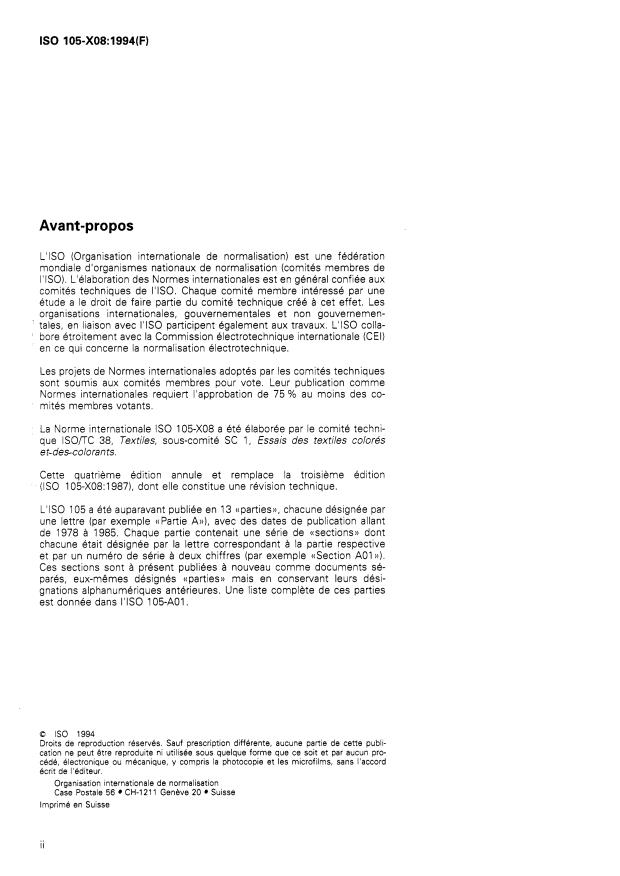
Avant-propos
L'ISO (Organisation internationale de normalisation) est une federation
mondiale d'organismes nationaux de normalisation (comites membres de
I'ISO). L'elaboration des Normes internationales est en general confiee aux
comites techniques de I'ISO. Chaque comite membre interesse par une
etude a le droit de faire partie du comite technique Cree cet effet. Les
organisations internationales, gouvernementales et non gouvernemen-
. tales, en liaison avec I'ISO participent 6galement aux travaux. L'ISO colla-
' bore etroitement avec la Commission electrotechnique internationale (CEI)
en ce qui concerne la normalisation electrotechnique.
Les projets de Normes internationales adopt& par les comites techniques
sont soumis aux comites membres pour vote. Leur publication comme
Normes internationales requiert I'approbation de 75 % au moins des co-
mites membres votants.
La Norme internationale IS0 105-X08 a et6 Blaboree par le comite techni-
que ISOflC 38, Textiles, sous-comite SC 1, Essais des textiles colores
et-des-colorants.
Cette quatrieme edition annule et remplace la troisieme edition
(IS0 105-X08:1987), dont elle constitue une revision technique.
L'ISO 105 a ete auparavant publiee en 13 ((parties)), chacune designee par
une lettre (par exemple ((Partie AD), avec des dates de publication allant
de 1978 a 1985. Chaque partie contenait une serie de ((sections)) dont
chacune etait designee par la lettre correspondant a la partie respective
et par un numero de serie a deux chiffres (par exemple ((Section A01 ))I.
Ces sections sont 4 present publikes a nouveau comme documents se-
pares, eux-memes designes ((parties)) mais en conservant leurs desi-
gnations alphanumeriques anterieures. Une liste compl6te de ces parties
est donnee dans I'ISO 105-AOI.
8 IS0 1994
Droits de reproduction reserves. Sauf prescription differente. aucune partie de cette publi-
cation ne peut Btre reproduite ni utilisee sous quelque forme que ce soit et par aucun pro-
cede, Blectronique ou mecanique, y compris la photocopie et les microfilms, sans I'accord
Bcrit de 1'6diteur.
Organisation internationale de normalisation
Case Postale 56 CH-1211 Geneve 20 Suisse
Imprime en Suisse
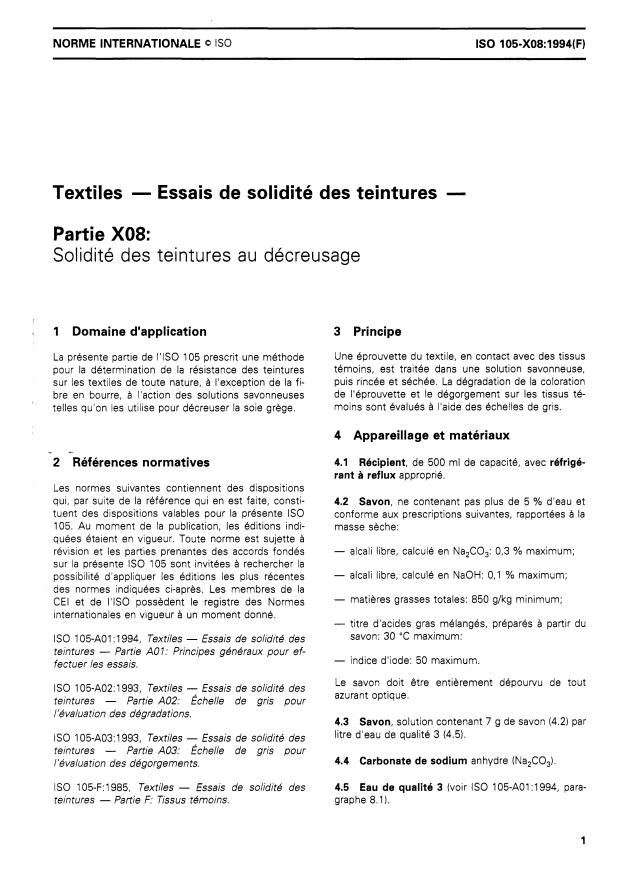
NORME INTERNATIONALE 0 IS0 IS0 105-X08:1994(F)
Textiles - Essais de solidite des teintures -
Partie X08:
Solidite des teintures au decreusage
3 Principe
l 1 Domaine d'application
Une Bprouvette du textile, en contact avec des tissus
La presente partie de I'ISO 105 prescrit une methode
temoins, est traitee dans une solution savonneuse,
pour la determination de la resistance des teintures
puis rincee et sechee. La degradation de la coloration
sur les textiles de toute nature, 3 I'exception de la fi-
de I'eprouvette et le degorgement sur les tissus t6-
bre en bourre, a I'action des solutions savonneuses
moins sont evalues a I'aide des Bchelles de gris.
telles qu'on les utilise pour decreuser la soie grege.
4 Appareillage et materiaux
--
4.1 Recipient, de 500 ml de capacite, avec refrige-
2 References normatives
rant a reflux approprie.
Les normes suivantes contiennent des dispositions
qui, par suite de la reference qui en est faite, consti- 4.2 Savon, ne contenant pas plus de 5 % d'eau et
tuent des dispositions valables pour la presente IS0 conforme aux prescriptions suivantes, rapportees a la
105. Au moment de la publication, les editions indi-
masse seche:
quees etaient en vigueur. Toute norme est sujette a
- alcali libre, calcuk en Na,CO,: 0,3 % maximum;
revision et les parties prenantes des accords fond&
sur la presente IS0 105 sont invitees a rechercher la
- alcali libre, calcule en NaOH: 0,l % maximum;
possibilite d'appliquer les editions les plus recentes
des normes indiquees ci-apres. Les membres d
...
IS0
NORME
105-X08
I NTERNAT IO NALE
Quatrieme Bdition
1994-09-01
Textiles - Essais de solidite des
-
teintures
Partie X08:
Solidite des teintures au decreusage
Textiles - Tests for colour fastness -
Part X08: Colour fastness to degumming
NumBro de reference
IS0 105-X08:1 994(F)
IS0 105-X08:1994(F)
Avant-propos
L'ISO (Organisation internationale de normalisation) est une federation
mondiale d'organismes nationaux de normalisation (comites membres de
I'ISO). L'elaboration des Normes internationales est en general confiee aux
comites techniques de I'ISO. Chaque comite membre interesse par une
etude a le droit de faire partie du comite technique cr& 8 cet effet. Les
organisations internationales, gouvernementales et non gouvernemen-
tales, en liaison avec I'ISO participent 6galement aux travaux. L'ISO colla-
bore etroitement avec la Commission electrotechnique internationale (CEI)
en ce qui concerne la normalisation electrotechnique.
Les projets de Normes internationales adoptes par les comites techniques
sont soumis aux comites membres pour vote. Leur publication comme
Normes internationales requiert I'approbation de 75 YO au moins des co-
mites membres votants.
La Norme internationale IS0 105-X08 a et6 Blaboree par le comite techni-
que ISO/TC 38, Textiles, sous-comite SC 1, Essais des textiles colores
et-des-coloran ts.
Cette quatrieme edition annule et remplace la troisieme edition
(IS0 105-X08:1987), dont elle constitue une revision technique.
L'ISO 105 a &e auparavant publiee en 13 ((parties)), chacune designee par
une lettre (par exemple ((Partie An), avec des dates de publication allant
de 1978 a 1985. Chaque partie contenait une serie de ((sections)) dont
chacune etait designee par la lettre correspondant 8 la partie respective
et par un numero de serie B deux chiffres (par exemple ((Section A01 ))).
Ces sections sont B present publiees 8 nouveau comme documents se-
pares, eux-memes designes ((parties)) mais en conservant leurs desi-
gnations alphanumeriques anterieures. Une liste complete de ces parties
est donnee dans I'ISO 105-AOl.
0 IS0 1994
Droits de reproduction r6servBs. Sauf prescription differente, aucune partie de cette publi-
cation ne peut &re reproduite ni utilisee sous quelque forme que ce soit et par aucun pro-
cede, Blectronique ou rnbcanique, y cornpris la photocopie et les microfilms, sans I'accord
Bcrit de 1'6diteur.
Organisation internationale de normalisation
Case Postale 56 CH-1211 Geneve 20 Suisse
ImprirnB en Suisse
NORME INTERNATIONALE 0 IS0 IS0 105-X08:1994(F)
Textiles - Essais de solidite des teintures -
Partie X08:
Solidite des teintures au decreusage
I 1 Domaine d'application 3 Principe
La presente partie de I'ISO 105 prescrit une methode Une 6prouvette du textile, en contact avec des tissus
pour la determination de la resistance des teintures temoins, est traitee dans une solution savonneuse,
sur les textiles de toute nature, A I'exception de la fi- puis rincee et sechee. La degradation de la coloration
de 1'6prouvette et le degorgement sur les tissus te-
bre en bourre, B I'action des solutions savonneuses
moins sont evalues a I'aide des Bchelles de gris.
telles qu'on les utilise pour decreuser la soie grege.
4 Appareillage et materiaux
--
4.1 Recipient, de 500 ml de capacite, avec refrige-
2 References normatives
rant a reflux approprie.
Les normes suivantes contiennent des dispositions
qui, par suite de la reference qui en est faite, consti-
4.2 Savon, ne contenant pas plus de 5 % d'eau et
tuent des dispositions valables pour la presente IS0
conforme aux prescriptions suivantes, rapportees a la
105. Au moment de la publication, les editions indi-
masse seche:
a
quees etaient en vigueur. Toute norme est sujette
- alcali libre, calcule en Na,CO,: 0,3 % maximum;
revision et les parties prenantes des accords fondes
sur la presente IS0 105 sont invitees rechercher la
- alcali libre, calcule en NaOH: 0,l % maximum;
possi
...