

ISO 16332:2018
(Main)Diesel engines — Fuel filters — Method for evaluating fuel/water separation efficiency
General Information
- Abstract
ISO 16332:2018 specifies a fuel/water separator comparison test under defined and simplified laboratory conditions. This test is intended for pressure side fuel/water separators as well as for suction side fuel/water separators. Pressure side fuel/water separators are tested with fine droplets and suction side filters are tested with coarse droplets using the same test rig layout. The rated flow (in litres per hour) is intended for the range between 50 l/h and 1 500 l/h. By agreement between customer and fuel/water separator manufacturer, and with some modifications, the procedures can be used for fuel/water separators with higher or lower flow rates.
- Status
- Published
- Publication Date
- 04-Apr-2018
- Technical Committee
- ISO/TC 22/SC 34 - Propulsion, powertrain and powertrain fluids
- Drafting Committee
- ISO/TC 22/SC 34/WG 1 - Fuel filters
- Current Stage
- 9093 - International Standard confirmed
- Start Date
- 13-Oct-2023
- Completion Date
- 29-Aug-2026


Overview
ISO 16332:2018 - "Diesel engines - Fuel filters - Method for evaluating fuel/water separation efficiency" defines a laboratory comparison test for fuel/water separators used in diesel systems. The standard specifies a simplified, repeatable test rig and procedures to measure how effectively a separator removes undissolved water (both finely and coarsely emulsified) from fuel. It covers both pressure‑side separators (tested with fine droplets) and suction‑side separators (tested with coarse droplets) using the same test layout. The nominal flow range addressed is 50–1 500 l/h, with provisions to adapt the method by agreement for other flow rates.
Key topics and technical requirements
- Test scope and objectives: Provides a controlled laboratory method for comparing separator performance and for evaluating field‑like behavior using untreated fuels.
- Test fluids and conditioning: Defines test fuel preparation, water emulsification, and options to use commercially untreated fuel for field‑relevant tests or conditioned fuel for repeatability.
- Droplet size distribution (DSD): Differentiates test procedures for fine (pressure side) and coarse (suction side) droplet regimes; DSD is a defined test parameter.
- Test rig and equipment: Specifies laboratory equipment, sampling bottles, water detection systems, and a fuel/water separator test circuit.
- Measurement methods: Includes inline water detection and reference methods such as Karl Fischer titration for quantitative water determination.
- Interfacial tension (IFT): IFT measurement (drop volume method) is required for some tests; ISO 16332 notes a default interface age of 10 s for IFT when additives are present.
- Test conditions and validation: Defines temperature, flow rate, upstream undissolved water concentration, back pressure, sampling, test duration, accuracy requirements, and validation procedures (including preconditioning and validation cycles).
- Reporting and annexes: Requires a standardized test report and includes normative annexes on fuel treatment, emulsifying devices, IFT parameters, sampling validation, and example reports and round‑robin results.
Practical applications - who uses this standard
- Fuel/water separator manufacturers for product development, comparative benchmarking, and quality assurance.
- Automotive and engine OEMs and suppliers to validate component performance for diesel fuel systems.
- Independent testing laboratories performing certification or supplier comparison tests.
- Procurement and quality engineers specifying minimum separation performance for in‑service reliability.
- R&D teams studying the effect of fuel composition, additives or bio‑components on water separation.
Related standards and methods
- ISO 9101 - interfacial tension (drop volume)
- ISO 12937 - water determination by Coulometric Karl Fischer titration
- ISO 13320 - particle size analysis (laser diffraction)
- ASTM D4176 - visual inspection for free water in distillate fuels
Keywords: ISO 16332, fuel/water separator, water separation efficiency, diesel fuel filters, Karl Fischer, interfacial tension, emulsified water, pressure side, suction side, separator test method.
Relations
- Effective Date
- 28-Feb-2009
Get Certified
Connect with accredited certification bodies for this standard

TÜV Rheinland
TÜV Rheinland is a leading international provider of technical services.

TÜV SÜD
TÜV SÜD is a trusted partner of choice for safety, security and sustainability solutions.

DEKRA Certification Inc.
DEKRA US certification services.
Sponsored listings
Frequently Asked Questions
ISO 16332:2018 is a standard published by the International Organization for Standardization (ISO). Its full title is "Diesel engines — Fuel filters — Method for evaluating fuel/water separation efficiency". This standard covers: ISO 16332:2018 specifies a fuel/water separator comparison test under defined and simplified laboratory conditions. This test is intended for pressure side fuel/water separators as well as for suction side fuel/water separators. Pressure side fuel/water separators are tested with fine droplets and suction side filters are tested with coarse droplets using the same test rig layout. The rated flow (in litres per hour) is intended for the range between 50 l/h and 1 500 l/h. By agreement between customer and fuel/water separator manufacturer, and with some modifications, the procedures can be used for fuel/water separators with higher or lower flow rates.
ISO 16332:2018 specifies a fuel/water separator comparison test under defined and simplified laboratory conditions. This test is intended for pressure side fuel/water separators as well as for suction side fuel/water separators. Pressure side fuel/water separators are tested with fine droplets and suction side filters are tested with coarse droplets using the same test rig layout. The rated flow (in litres per hour) is intended for the range between 50 l/h and 1 500 l/h. By agreement between customer and fuel/water separator manufacturer, and with some modifications, the procedures can be used for fuel/water separators with higher or lower flow rates.
ISO 16332:2018 is classified under the following ICS (International Classification for Standards) categories: 43.060.40 - Fuel systems. The ICS classification helps identify the subject area and facilitates finding related standards.
ISO 16332:2018 has the following relationships with other standards: It is inter standard links to ISO/TS 16332:2006. Understanding these relationships helps ensure you are using the most current and applicable version of the standard.
ISO 16332:2018 is available in PDF format for immediate download after purchase. The document can be added to your cart and obtained through the secure checkout process. Digital delivery ensures instant access to the complete standard document.
Standards Content (Sample)
INTERNATIONAL ISO
STANDARD 16332
First edition
2018-04
Diesel engines — Fuel filters —
Method for evaluating fuel/water
separation efficiency
Moteurs diesel — Filtres à carburant — Méthode d'évaluation de
l'efficacité de séparation carburant-eau
Reference number
©
ISO 2018
© ISO 2018
All rights reserved. Unless otherwise specified, or required in the context of its implementation, no part of this publication may
be reproduced or utilized otherwise in any form or by any means, electronic or mechanical, including photocopying, or posting
on the internet or an intranet, without prior written permission. Permission can be requested from either ISO at the address
below or ISO’s member body in the country of the requester.
ISO copyright office
CP 401 • Ch. de Blandonnet 8
CH-1214 Vernier, Geneva
Phone: +41 22 749 01 11
Fax: +41 22 749 09 47
Email: copyright@iso.org
Website: www.iso.org
Published in Switzerland
ii © ISO 2018 – All rights reserved
Contents Page
Foreword .v
Introduction .vi
1 Scope . 1
2 Normative references . 1
3 Terms and definitions . 1
4 Symbols . 3
5 Test equipment. 3
5.1 Test fluids . 3
5.1.1 Test fuels . 3
5.1.2 Test water . . 4
5.2 Laboratory equipment . 5
5.2.1 General. 5
5.2.2 Sampling bottles and glassware . 5
5.2.3 Water detection system . 5
5.2.4 Equipment for determination of IFT . 5
5.3 Test stand . 5
5.3.1 General. 5
5.3.2 Fuel/water separator test circuit . 5
6 Test conditions .10
6.1 Volume of test fuel V .10
T
6.2 Test fuel temperature T .10
6.3 Test flow rate Q .10
T
6.4 Upstream undissolved water concentration c .10
U,up
6.4.1 General.10
6.4.2 Water injection flow rate Q .11
W
6.5 Back pressure .11
6.6 Sampling .11
6.7 Droplet size distribution DSD .11
6.8 Test duration t .11
test
7 Accuracy of measuring instruments and test conditions .11
8 Validation procedures.12
8.1 General .12
8.2 Water detection system .12
8.2.1 Inline water concentration measurement device (optional) .12
8.2.2 Karl Fischer titration sytem .12
8.3 Emulsifying device .13
8.4 Filter test circuit and water injection system .13
8.4.1 General.13
8.4.2 Validation preparation .13
8.4.3 Preconditioning cycle .14
8.4.4 Validation cycle .14
9 Simplified laboratory test .15
9.1 Test procedure .15
9.1.1 General.15
9.1.2 Pre-test preparation.15
9.1.3 Preconditioning cycle .15
9.1.4 Efficiency measurement .16
9.2 Calculation of water separation efficiency and reporting of test results .17
10 Test report .18
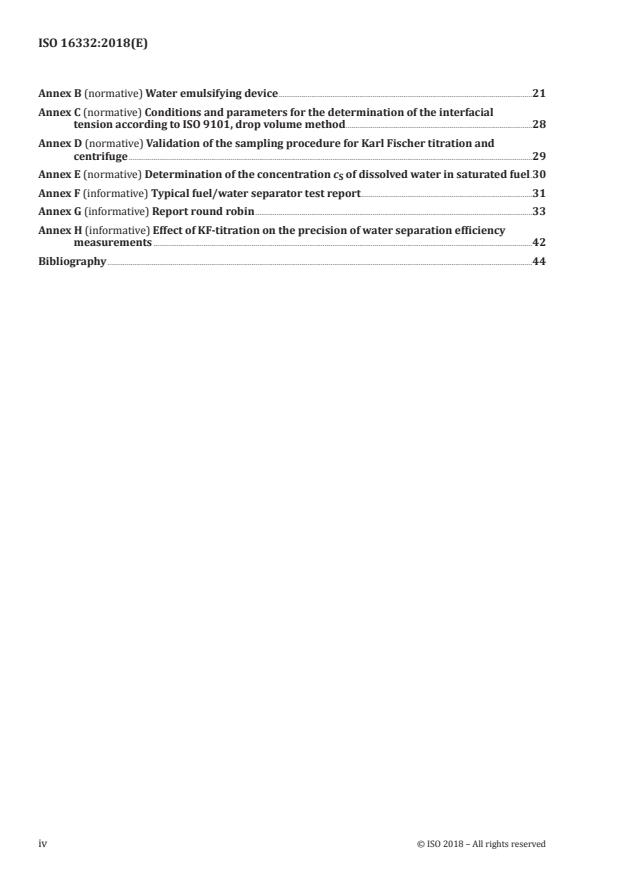
Annex A (normative) Fuel treatment to obtain test fuel F2 .19
Annex B (normative) Water emulsifying device .21
Annex C (normative) Conditions and parameters for the determination of the interfacial
tension according to ISO 9101, drop volume method .28
Annex D (normative) Validation of the sampling procedure for Karl Fischer titration and
centrifuge .29
Annex E (normative) Determination of the concentration c of dissolved water in saturated fuel .30
S
Annex F (informative) Typical fuel/water separator test report .31
Annex G (informative) Report round robin .33
Annex H (informative) Effect of KF-titration on the precision of water separation efficiency
measurements .42
Bibliography .44
iv © ISO 2018 – All rights reserved
Foreword
ISO (the International Organization for Standardization) is a worldwide federation of national standards
bodies (ISO member bodies). The work of preparing International Standards is normally carried out
through ISO technical committees. Each member body interested in a subject for which a technical
committee has been established has the right to be represented on that committee. International
organizations, governmental and non-governmental, in liaison with ISO, also take part in the work.
ISO collaborates closely with the International Electrotechnical Commission (IEC) on all matters of
electrotechnical standardization.
The procedures used to develop this document and those intended for its further maintenance are
described in the ISO/IEC Directives, Part 1. In particular the different approval criteria needed for the
different types of ISO documents should be noted. This document was drafted in accordance with the
editorial rules of the ISO/IEC Directives, Part 2 (see www .iso .org/directives).
Attention is drawn to the possibility that some of the elements of this document may be the subject of
patent rights. ISO shall not be held responsible for identifying any or all such patent rights. Details of
any patent rights identified during the development of the document will be in the Introduction and/or
on the ISO list of patent declarations received (see www .iso .org/patents).
Any trade name used in this document is information given for the convenience of users and does not
constitute an endorsement.
For an explanation on the voluntary nature of standards, the meaning of ISO specific terms and
expressions related to conformity assessment, as well as information about ISO's adherence to the
World Trade Organization (WTO) principles in the Technical Barriers to Trade (TBT) see the following
URL: www .iso .org/iso/foreword .html
This document was prepared by Technical Committee ISO/TC 22, Road vehicles, Subcommittee SC 34,
Vehicle propulsion, powertrain, and powertrain fluids.
This document cancels and replaces the first edition ISO/TS 16332:2006 which has been technically
revised. The main changes compared to the previous edition are as follows:
— test fuel definition;
— change of IFT measurement standard and interface age;
— droplet size distribution;
— test duration;
— additional preconditioning cycle; and
— validation of test procedure by conduction of two round robin tests (see Annex G).
Introduction
Modern fuel injection systems, installed in passenger cars, as well as in heavy duty or off-road
applications, require high and stable separation efficiencies for all insoluble contaminants in the fuel to
ensure a prolonged life. Beside solid contamination, undissolved water, in finely or coarsely emulsified
form, can also reduce the lifetime of injection systems. Suitable fuel/water separators, having a high
level water separation efficiency, are an absolute necessity for system longevity.
Factors found to affect the separation efficiency of undissolved water in the field are mainly due to the
fuel quality, which can differ widely in different regions of the world and which can also differ when
biogenic components are added to the fuel. Additionally the separation efficiency is strongly influenced
by fuel composition.
Separation efficiency tests can be applied mainly for two purposes:
— To evaluate the field performance of a fuel/water separator
To evaluate the performance of a fuel/water separator close to field conditions, the usage of
commercially, untreated fuel as test fluid is necessary.
— To compare fuel/water separators under repeatable test conditions
For a fuel/water separator comparison in the laboratory, fuel conditioning is necessary to achieve
constant and repeatable test conditions. Water separation efficiency results obtained with treated
fuel can be significantly different from those with commercially available, untreated fuel.
Tests performed with new fuel/water separators can lead to considerably higher water separation
efficiencies.
NOTE Ageing of the fuel/water separator due to operational conditions can strongly affect the water
separation function of a fuel/water separator. To test a fuel/water separator in an “end of life” state, it can be aged
in advance. It is proposed to do this by a standardized ageing procedure, to get comparable “end of life” states.
However, it is not a part of this document nor any other ISO standard. This procedure may be explored in future.
vi © ISO 2018 – All rights reserved
INTERNATIONAL STANDARD ISO 16332:2018(E)
Diesel engines — Fuel filters — Method for evaluating fuel/
water separation efficiency
1 Scope
This document specifies a fuel/water separator comparison test under defined and simplified
laboratory conditions.
This test is intended for pressure side fuel/water separators as well as for suction side fuel/water
separators. Pressure side fuel/water separators are tested with fine droplets and suction side filters
are tested with coarse droplets using the same test rig layout.
The rated flow (in litres per hour) is intended for the range between 50 l/h and 1 500 l/h. By agreement
between customer and fuel/water separator manufacturer, and with some modifications, the
procedures can be used for fuel/water separators with higher or lower flow rates.
2 Normative references
The following documents are referred to in the text in such a way that some or all of their content
constitutes requirements of this document. For dated references, only the edition cited applies. For
undated references, the latest edition of the referenced document (including any amendments) applies.
ISO 1219-1, Fluid power systems and components — Graphical symbols and circuit diagrams — Part 1:
Graphical symbols for conventional use and data-processing applications
ISO 9101, Surface active agents — Determination of interfacial tension — Drop volume method
ISO 6889, Surface active agents — Determination of interfacial tension by drawing up liquid films
ISO 12937, Petroleum products — Determination of water — Coulometric Karl Fischer titration method
ISO 13320, Particle size analysis — Laser diffraction methods
ASTM D4176–04 (2009), Standard Test Method for Free Water and Particulate Contamination in Distillate
Fuels (Visual Inspection Procedures)
3 Terms and definitions
For the purpose of this document, the following terms and definitions apply.
ISO and IEC maintain terminological databases for use in standardization at the following addresses:
— IEC Electropedia: available at http: //www .electropedia .org/
— ISO Online browsing platform: available at https: //www .iso .org/obp
3.1
interfacial tension
IFT
work which is required to increase the interface of the liquid by one surface area unit
Note 1 to entry: In case of additivated liquids, the IFT-value has a significant time dependency. Therefore the
default value for the interface age within ISO 16332-usage is defined at 10 s.
Note 2 to entry: The conditions and parameters for determination of IFT by the drop volume method according
to ISO 9101 are defined in Annex C.
Note 3 to entry: Interfacial tension is equivalent to the specific interfacial energy and is expressed in Millinewtons
per meter (mN/m). Alternative methods to determine the IFT (at 10 s) can be used, as long as the comparability
to ISO 9101 is ensured.
3.2
droplet size distribution
DSD
percentage of the droplet population in different size ranges
Note 1 to entry: For further information, see B.3.
3.3
water concentration at the saturation level of dissolved water
c
S
concentration of water in water saturated test fuel with the IFT adjusted by Monoolein
Note 1 to entry: The determination of c is defined in Annex E.
S
3.4
base water concentration
c
B
concentration of water in the test fuel, determined after the preconditioning cycle
Note 1 to entry: See 8.4.3 or 9.1.3.
Note 2 to entry: In case one of the c -values [determined in 9.1.4 c) and d)] is lower than c (determined in
T,down,i B
9.1.3) take the lowest value as c .
B
3.5
undissolved water concentration
c
U
concentration of free water, that is concentration above base water concentration
3.6
total water concentration
c
T
summation of base water concentration and undissolved water concentration
Note 1 to entry: c = c + c .
T U B
3.7
sample index
i
integer from 1 to n, where n equals the number of samples
3.8
instantaneous water separation efficiency
η
i
water separation efficiency, at test time t
i
3.9
average water separation efficiency
η
av
average water separation efficiency, calculated based on the average downstream water concentration
Note 1 to entry: Calculation according to 9.2 e).
2 © ISO 2018 – All rights reserved
3.10
calibration flow rate
Q
C
fuel flow rate, which is adjusted for calibration purpose of the emulsifying device
Note 1 to entry: The calibration procedure is defined in B.4.
3.11
sampling point index
< up> reference to the upstream sampling point
3.12
sampling point index
< down> reference to the downstream sampling point
4 Symbols
Graphical symbols used in this document for fluid power system components are in accordance with
ISO 1219-1.
5 Test equipment
5.1 Test fluids
5.1.1 Test fuels
For the validation and for each filter test one of the following three kinds of fuels can be used as test fuel.
— F1 Unmodified service station fuel
— F2 Standard test fuels: Fuels, treated according to Annex A
Test fuel F2.1: High IFT test fuel
— IFT (10 s): 22 ± 2 mN/m, according to ISO 9101, parameterized according to Annex C
Alternatively IFT (60 s): 20 ± 2 mN/m, according to ISO 9101 or ISO 6889.
— Separability (ASTM D 1401): To be reported
Test fuel F2.2: Low IFT test fuel
— IFT (10 s): 13 ± 2 mN/m, according to ISO 9101
Alternatively IFT (60 s): 11 ± 2 mN/m, according to ISO 9101 or ISO 6889.
To describe the test fuel used, the following parameters shall be determined:
— IFT(10 s) and IFT(60 s);
— separability (ASTM D 1401);
— water saturation level according to Annex E;
— bio diesel content (optional);
— density (optional);
— kinematic viscosity (optional);
— CFPP (optional).
Key
t interface age (s)
IFT interfacial tension (mN/m)
1 F1 (B0 Premium field fuel)
2 F1 (B7 Premium field fuel)
3 F 2.1
4 F 2.2
Figure 1 — Time dependency of interfacial tension [IFT(t)] for F1 fuels, F2.1 and F2.2 fuel
Figure 1 is showing two typical IFT(t)-curves for commercially available F1 fuels and for F 2.1 and
F 2.2 fuel.
Depending on the F1-quality, the brand/product specific slope in IFT(t) does not allow to deduct the F1
IFT(10 s) value based on the measured F1 IFT(60 s) value.
The Monoolein specific slope in IFT(t) of F2 fuel is stable and reproducible, therefore the deduction of
the F2 IFT(10 s)value - based on the measured F2 IFT(60 s) value - is valid and proven.
The test fuel shall be stored in a sealed container, protected from humidity, dust and light.
For each filter test fresh fuel shall be used. In the case of F2 fuel, fresh fuel can be achieved by retreating
used fuel according to Annex A.
5.1.2 Test water
Clean, distilled or deionised water, with a surface tension of 70 mN/m -72 mN/m, measured at
20 °C ± 1,5 °C.
4 © ISO 2018 – All rights reserved
5.2 Laboratory equipment
5.2.1 General
All laboratory equipment and glassware, required to determine the water concentration, shall be
according to ISO 12937.
5.2.2 Sampling bottles and glassware
100 ml sampling bottles carefully cleaned and dried, free of any residuals from the cleaning process.
5.2.3 Water detection system
5.2.3.1 Karl Fischer (KF) titrator
As commercially available.
For biodiesel and biodiesel containing fuels the direct Karl Fischer method is recommended.
Humidity is probably the largest source of error during the titration process. Special precautions shall
be taken during setup and testing. The amount of water per sample should be ≥50 µg to reach a good
relation between titration time and accuracy.
5.2.3.2 Centrifuge
For higher water concentration as specified in 6.4.1, 20 000 ppm water concentration, a centrifuge
according to D.2 can be used. The measurement accuracy according to Table 1 shall be confirmed.
5.2.4 Equipment for determination of IFT
The equipment for determination of the interfacial tension shall be according to ISO 9101.
5.3 Test stand
5.3.1 General
The test stand, shown diagrammatically in Figure 2, shall comprise a fuel/water separator test circuit
as described in 5.3.2.
All parts in contact with fuel, should be made of stainless steel.
5.3.2 Fuel/water separator test circuit
5.3.2.1 Fuel sump (1)
The container with a conical bottom should be made of stainless steel. The fuel outlet shall be located
at the lowest point of bottom. The container shall be able to contain the volume as specified in 6.1. The
fuel sump shall be covered with a non-transparent cover to protect the fuel from light. The fuel sump
shall contain a suitable device to maintain homogeneity of its content.
5.3.2.2 Water sump (6)
The container should be made of stainless steel or corrosion resistant material with appropriate volume.
NOTE Instead of the container, a continuous water supply unit can be used.
5.3.2.3 Heat exchanger (3)
The heat exchanger shall be able to maintain the test fuel temperature T within the tolerances given in
Table 1.
Alternative to the position of the heat exchanger depicted in Figure 2, the heat exchanger can as well be
positioned downstream the back pressure gauge (16).
5.3.2.4 Test pump (2)
A pump type shall be chosen, which does not exhibit pressure pulsation with an amplitude greater than
10 % of the average pressure at the inlet of the water emulsifying device.
5.3.2.5 Water injection pump (7)
The pump type shall be adjustable to enable a water concentration in the test circuit between 1 500 ppm
and 20 000 ppm over the complete flow rate of test fluid.
5.3.2.6 Fuel flow meter (5a)
The equipment shall be suitable for the complete range of the flow rate of test fluid with an accuracy as
specified in Table 1.
5.3.2.7 Water flow meter (5b)
The equipment shall be suitable for the complete range of the required injection range with an accuracy
as specified in Table 1.
5.3.2.8 Injection device (8)
The concept shall allow a continuous water injection. The resulting DSD at the injection point shall be
validated. The validation criterion is defined by:
d shall be greater or equal to the d value chosen according to 6.7
3,50 3,50
5.3.2.9 Water emulsifying device (9)
The concept shall be able to generate a DSD as specified according to 6.7. Jet emulsification - as described
in Annex B is recommended to be applied.
For each combination of emulsifying device, test fuel, flow rate and temperature a calibration curve is
mandatory
In case the jet emulsification concept in accordance with Annex B is used, the calibration procedure is
described in B.4.
5.3.2.10 Operating pressure gauge (10)
The operating pressure is defined at the up-stream side of the test fuel water separator (14). The
required accuracy is specified in Table 1.
5.3.2.11 Differential pressure gauges (11)
The required accuracy is specified in Table 1.
5.3.2.12 Upstream sampling point (12)
The upstream sampling point shall be designed as illustrated in Figure 4.
6 © ISO 2018 – All rights reserved
5.3.2.13 Temperature indicator (13)
The required accuracy is specified in Table 1.
5.3.2.14 Water drainage system (15)
Realized as a graduated and transparent collector (e.g. laboratory measuring cylinder), located directly
below the test fuel/water separator (14). The internal diameter of the connecting pipe between the test
fuel/water separator (14) and the graduated water drainage system (15) shall be of at least 10 mm an
unconstrained removal of water. It shall be realized with pressure-tight fittings. The collector volume
shall be drainable at its lowest point.
The collector volume shall be adjusted to the total amount of water injected, with a maximum of 5 % of
the volume of test fuel V (according to 6.1).
T
In case the collected amount of water is reaching 80 % of the collector volume, the water shall be drained
out of the collector within approx. 1 min. The collector outlet valve shall be adjusted adequately. Care
should be taken, not to take samples during or immediately after the water draining.
5.3.2.15 Back pressure gauge (16)
For determination of back pressure with an accuracy as specified in Table 1.
5.3.2.16 Back pressure control valve (17) (optional equipment)
The backpressure control valve is to ease test fuel/water separator venting, to adjust the back pressure
and allow sufficient sampling at the upstream sampling point. When adjusting the back pressure, the
test fuel/water separator design pressure shall be taken into consideration.
5.3.2.17 Downstream sampling point (18)
For manual sampling the operating conditions at sampling point 18 shall fulfil the requirements defined
in D.1.1. Proper sampling can be reached by adjustment of a suitable back pressure value.
The downstream sampling point shall be designed as illustrated in Figure 4.
5.3.2.18 Clean-up system (19)
A suitable fuel water clean-up system with the capability to separate the water – such that not more
than 50 ppm by volume of undissolved water is recycled on an average basis under test conditions –
shall be installed.
5.3.2.19 Droplet size distribution measurement device (20)
Laser diffraction measurement device according to ISO 13320.
The measurement device shall not influence the droplet size distribution. This is especially valid for an
inline measurement cell, which is designed as a full flow concept.
In case no droplet size measurement device is used and the jet emulsification concept according to
Annex B is applied, for each combination of orifice, batch of test fuel (independent of it being F1 or F2
fuel), flow rate and temperature, a calibration curve shall be used (further explanation is given in B.4).
5.3.2.20 Bypass line (21)
The total length of the bypass line shall be as short as possible.
5.3.2.21 Inline water concentration measurement device (22) (Optional equipment)
Suitable inline water concentration measurement devices can be used. The measurement accuracy
according Table 1 shall be confirmed.
The inline water concentration measurement device shall be placed into the pipe in the full flow at the
position of the up- and/or downstream sampling points (optional installation) as defined in Figure 2.
5.3.2.22 General requirements on the hydraulic piping system
The test stand piping shall be designed to enable the drainage of the total test fuel volume out of the
test stand. This is to ensure the correct adjustment of the test fuel volume within the limits specified in
Table 1.
The test stand pipes shall be made of stainless steel; painted or coated pipes are not allowed.
For the adaptation of the test fuel/water separator (14) to the test stand piping, flexible lines are
allowed.
The piping shall be designed with a minimum number of flanges or fittings and grounded upstream
near the test fuel/water separator (potential difference <10 V between each point).
The test stand section line inner diameter d between water injection device (8) and downstream
i
sampling point (18) shall allow a flow velocity ≥0,75 m/s. The overall pipe length between the water
emulsifying device (9) and test fuel/water separator (14) shall not to exceed 1 m. (Figure 3).
The pipes, outside of Figure 3, shall be as short as possible.
8 © ISO 2018 – All rights reserved
Key
1 fuel sump including homogenizing device 12 upstream sampling point
2 test pump 13 temperature indicator
3 heat exchanger 14 test fuel/water separator
4 sampling point 15 graduated water drainage system
5a fuel flow meter 16 back pressure gauge
5b water flow meter 17 back pressure control valve (optional)
6 water sump 18 downstream sampling point
7 adjustable water injection pump 19 clean-up system
8 injection device 20 DSD measurement device
9 water emulsifying device (orifice) 21 bypass line
10 operating pressure gauge 22 inline water concentration measurement devices
11 differential pressure gauges (2) (optional)
Figure 2 — Fuel/water separator test stand (diagrammatically)
Key
d inner pipe diameter
i
a
for d < 10 mm: ≤ 10 d
i i
Figure 3 — Distances of components and inner diameter d of test stand pipes
i
Dimension in millimetres
Key
l d /4 < l < d /3
i i
d inner pipe diameter
i
a
Flow of test fluid.
b
Sampling flow.
Figure 4 — Upstream and downstream sampling point
6 Test conditions
6.1 Volume of test fuel V
T
The total volume of the fuel in litres filled into the empty test stand shall be 20 % of the test flow rate
Q (l/h), with a minimum of 45 l and a maximum of 200 l.
T
Therefore for flow rates lower than 225 L/h, the volume will be 45 L and for flow rates higher than
1000 L/h, the volume will be 200 L
The total circuit volume – including the fuel sump, piping, fuel/water separator and the clean-up system
shall not exceed a critical value. Thus, a suitable filling level in the fuel sump is given, when the test
procedure is started.
6.2 Test fuel temperature T
The test shall be conducted at a test fuel temperature T = 23 ± 2 °C. The test fuel temperature is
measured at the test fuel/water separator inlet (13).
6.3 Test flow rate Q
T
The test flow rate Q (l/h) is specified by the customer and is defined as the flow rate of fuel through
T
the test fuel/water separator.
6.4 Upstream undissolved water concentration c
U,up
6.4.1 General
One of the following two conditions for the concentration c shall be used for the test:
U,up
— standard condition: 1 500 ppm volume fraction ± 100 ppm volume fraction;
— optional condition: 20 000 ppm volume fraction ± 1 000 ppm volume fraction.
10 © ISO 2018 – All rights reserved
6.4.2 Water injection flow rate Q
W
The water injection flow rate Q [ml/min] for the efficiency testing is calculated by the following
W
equation:
ml
Q *1000
T
l
Q = *c
W u,up
min
h
6.5 Back pressure
The back pressure is adjusted by the back pressure control valve (17) to ≥0,5 bar.
6.6 Sampling
The upstream sampling shall be taken at sampling point (12).
The downstream sampling shall be taken at sampling point (18).
In case of manual sampling according to D.1, the sampling volume shall be approximately 50 ml, and the
sampling time shall be between 5 s and 10 s.
6.7 Droplet size distribution DSD
For standard test conditions, two droplets size distributions, fine and coarse, are defined. As following:
Fine DSD, to test pressure side fuel/water separators:
— D : 10 ± 1,5 µm;
3,50
— D : ≤30 µm.
3,90
Coarse DSD, to test suction side fuel/water separators:
— D : 150 ± 10 µm;
3,50
— D : ≤350 µm.
3,90
The choice of whether to use the fine, coarse or a customer specified DSD, depends on the application
and shall be specified by the customer.
6.8 Test duration t
test
The test duration t shall be 90 min, the test duration t does not include the pre-test preparation
test test
according to 9.1.2 and the Preconditioning cycle according to 9.1.3
The test may be performed at test parameters as agreed between customer and fuel/water separator
manufacturer. This shall be recorded in the test report.
In any case the test configuration shall be checked regarding the relevancy to the application.
7 Accuracy of measuring instruments and test conditions
The measuring instruments shall be capable of measuring to the levels of accuracy given in Table 1. In
addition, Table 1 specifies the limits, within which the test conditions shall be maintained.
Table 1 — Instrument accuracy and test condition variation
Units Measurement Allowed test condition
Test condition
accuracy variation
Fuel volume l ±2 % ±5 %
Fuel flow rate (Q Q ) l/h ±1 % ±2 %
C, T
(fuel flow meter)
Water flow rate ml/min ±1 % ±2 %
(water flow meter)
Pressure hPa ±2 % —
Differential pressure Δp hPa ±0,5 % —
O
(gauge at orifice plate)
Differential pressure Δp hPa ±2 % —
F
(gauge at test fuel/water separator)
Interfacial tension mN/m ±0,5 mN/m ±1 mN/m
Temperature °C ±1 °C ±2 °C
(temperature indicator)
µm According to ±20 %, or
ISO 13320 a minimum of ± 2 µm,
DSD
whichever is larger, and
D
3,50
a maximum of ±10 µm,
whichever is smaller
% Volume Precision accord- —
Water concentration
fraction ing to ISO 12937
NOTE The overall tolerance range, resulting out of the allowed test condition variation does already include
the measurement accuracy, the tolerances are not to be considered in a cumulative sense. Allowed test condition
variation is valid for the whole test duration.
8 Validation procedures
8.1 General
These validation procedures reveal the effectiveness of the test circuit and the water injection system in
maintaining the required DSD and water concentration. The frequency of revalidation shall be defined
by internal quality specifications of the user.
8.2 Water detection system
8.2.1 Inline water concentration measurement device (optional)
The inline water concentration measurement device shall be calibrated. In case the test fuel is changed,
the validity of the calibration shall be confirmed.
NOTE Depending on the detection principle, either the total water concentration c or only the free water
T
concentration c will be detected.
U
8.2.2 Karl Fischer titration sytem
The Karl Fischer Titrator shall be calibrated.
In case of manual sampling, the KF titration system including the primary and secondary sampling
procedure shall be validated according to Annex D.
12 © ISO 2018 – All rights reserved
In case of automated sampling, the KF system shall be validated by the sample concentrations obtained
according to 8.4
The validation procedures reveal the effectiveness of a correct and representative sampling and
transfer procedure out of the test circuit to the KF titration.
8.3 Emulsifying device
The validation of the DSD upstream the test fuel/water separator shall be done with a droplet size
distribution measurement device (20) according 5.3.2.19 for each combination of:
— specified droplet size distribution;
— test fuel;
— flow rate; and
— temperature.
In case the emulsifying device calibrated according to B.4 is used, the validation is confirmed by
the corresponding calibration data. In case a different emulsifying device is used, the droplet size
distribution shall be measured in situ with the online DSD measurement device according to 5.3.2.19
and adjusted to the specified DSD.
8.4 Filter test circuit and water injection system
8.4.1 General
The validation of the test stand shall be performed at the minimum and maximum design flow rates for
every test section line size.
For each of these two flow rates, perform the following procedure in the order given.
8.4.2 Validation preparation
The following validation preparation procedure shall be followed:
a) Use fresh fuel.
b) Determine all relevant test fuel characteristics prior to usage, as specified in Annex F.
c) Ensure that the hydraulic system is free from any residuals (e.g. remaining fuel from previous test,
additives and impurities). The complete hydraulic system shall be flushed with the specified test
fuel. The verification of the cleanliness level is based on the IFT value. The flushing process shall be
repeated until the IFT of the flushing fuel is equal to the IFT of the fuel as out of the drum within
the tolerances according to Clause 7.
d) Drain the flushing fuel completely.
e) Replace the clean-up filters if another test fuel is used (e.g. for F1: change from B7 to B20, etc.). In
case identical test fuel is used, they can be reused.
f) Fill the specified volume of test fuel (see 6.1) into the fuel sump (1).
g) Install a straight section of pipe in place of a fuel/water separator during the validation procedure.
h) Choose an orifice plate with a suitable orifice for the required DSD and fuel flow rate Q according
T
to Annex B.
i) Install the orifice plate into the water emulsifying device (9).
j) Utilized the clean-up system (19).
k) Start circulation at the specified test flow rate Q (see 6.3) and test fuel temperature T (see 6.2).
T
Bleed air from the system including water drainage system (15). Record an initial pressure loss
reading at the orifice (9) immediately after the start.
8.4.3 Preconditioning cycle
The preconditioning cycle is to saturate the test system between the point of water injection (8) and the
clean- up system (19) including pipes, clean-up system, test fuel etc. with water.
Perform the preconditioning cycle in the following order:
a) Apply the nominal fuel flow rate Q . Switch on the clean-up system (19).
T
b) Start the water injection for a duration of 20 min, with a water injection flow rate Q [ml/min]
W
calculated by the following equation:
ml
Q *1000
T
l
Q = *1500ppm
W
min
h
c) Continue the circulation of the test fuel through the clean-up system until the test fuel is showing
a clarity and brightness-level which is higher or equal as the fresh fuel appearance (e.g. out of the
drum). Terminate the circulation when the clarity and brightness-level is comparable to the fresh
fuel (according to ASTM D4176 or suitable method). Report the clean-up time.
d) Take a sample at sampling point (12) to determine the base water concentration c :
B
— if the base water concentration c , is below the saturation level c + 50 ppm, the circulation can
B s
be stopped and the preconditioning cycle is completed;
— if the water concentration c is above c + 50 ppm, the circulation through the clean-up system
B S
shall be continued for further 20 min. Repeat Step d).
8.4.4 Validation cycle
The validation cycle shall be started subsequently to the preconditioning cycle. Perform the following
procedure in the order given.
a) Start the water injection to achieve the required concentration c according to 6.4.1.
U,up
b) Allow the system to stabilize for at least 10 min.
c) Take samples every 10 min for a period of 90 min:
1) at the sampling point (4), for the validation of the clean-up system (19);
2) at the upstream sampling point (12) and downstream sampling point (18) for the validation of
the injection system and sampling devices;
3) measure the water content of each sample.
NOTE Optionally, the validation can be performed in subsequent steps for the clean-up and water injection
and sampling devices, when the sampling system does not allow to take 3 samples at the same point of time.
The validation shall be accepted only if:
— at the sampling point (4), the variation between the total water concentration of each sample is
less than 50 ppm by volume and the average total water concentration is below the saturation level
c + 50 ppm. For reference, the saturation level c – determined in 8.4.2 b) – shall be used;
s s
14 © ISO 2018 – All rights reserved
...