

ISO 26603:2026
(Main)Plastics — Aromatic isocyanates for use in the production of polyurethanes — Determination of total chlorine
General Information
- Abstract
This document specifies the determination of the total chlorine content of aromatic isocyanates used in the preparation of polyurethanes. The difference between the total chlorine content and the hydrolyzable chlorine content (see ISO 15028) is a measure of the process solvents left in the product. All the test methods are applicable to a variety of organic compounds, including aliphatic isocyanates, but the amount of sample used might need to be adjusted. These test methods can be used for research or for quality control.
- Status
- Published
- Publication Date
- 07-Apr-2026
- Technical Committee
- ISO/TC 61/SC 12 - Thermosetting materials
- Drafting Committee
- ISO/TC 61/SC 12/WG 6 - Polyurethane raw materials
- Current Stage
- 6060 - International Standard published
- Start Date
- 08-Apr-2026
- Due Date
- 20-Nov-2027
- Completion Date
- 08-Apr-2026
Overview
ISO 26603:2026 establishes standardized methods for determining the total chlorine content in aromatic isocyanates used in the production of polyurethanes. This ISO standard specifies procedures for distinguishing total chlorine from hydrolyzable chlorine - the difference is key in assessing residual process solvents within isocyanate products. The document describes multiple test methods that are applicable to a variety of organic compounds, including both aromatic and aliphatic isocyanates. These procedures serve essential functions in research environments as well as in industrial quality control processes, ensuring product consistency and regulatory compliance in polyurethane manufacturing.
Key Topics
- Total Chlorine Determination: Outlines precise laboratory procedures for quantifying all chlorine forms (both organic and inorganic) present post-combustion or chemical conversion.
- Test Methods:
- Oxygen Bomb Combustion: A method using pressurized combustion to convert chlorine to titratable chloride, measured by potentiometric titration.
- Schöniger Oxygen Flask Combustion: Combustion takes place at atmospheric pressure, again converting chlorine compounds for quantification.
- Microcoulometry: Chlorinated organic compounds are pyrolyzed, and the resulting chloride ions are measured using a coulometric titration cell.
- Product Quality Assessment: Total chlorine, coupled with hydrolyzable chlorine (ISO 15028), provides an indicator of residual process solvents, crucial for quality control.
- Interference and Sampling: Details potential interference from substances like sulphides, bromides, and the need for moisture-free sampling to maintain sample integrity.
Applications
ISO 26603:2026 is vital for sectors involved in the manufacture and quality assurance of polyurethanes and raw isocyanate materials. Key practical applications include:
- Quality Control in Polyurethane Production: Ensures aromatic isocyanates meet specifications, particularly in automotive, construction, and consumer goods industries reliant on polyurethanes.
- Research and Development: Provides standardized approaches for laboratory analysis during product innovation or formulation.
- Regulatory Compliance: Facilitates adherence to health, safety, and environmental standards by accurately quantifying potentially hazardous chlorine compounds and solvents.
- Cross-Industry Use: Though tailored for aromatic isocyanates, the described methods can be adapted for aliphatic isocyanates and other organochlorine compounds, with adjustments for sample size as appropriate.
Related Standards
Organizations implementing ISO 26603:2026 should also be aware of complementary international standards to ensure comprehensive compliance and robust quality systems:
- ISO 15028 - Plastics - Determination of hydrolyzable chlorine in isocyanates
- ISO 1042 - Laboratory glassware - One-mark volumetric flasks
- ISO 3696 - Water for analytical laboratory use - Specification and test methods
- ISO 6353-2/3 - Reagents for chemical analysis - Specifications for reagents
- ASTM D4661 - Standard Test Method for Determination of Total Chlorine in New and Used Petroleum Products by Oxidative Microcoulometry (comparable methodology)
Summary
By adopting ISO 26603:2026, laboratories and manufacturers can standardize and optimize the measurement of total chlorine in isocyanates, supporting improved product purity and environmental responsibility. Incorporating these methods into routine quality control and research processes enables enhanced product performance and regulatory compliance throughout the polyurethane supply chain.
Relations
- Effective Date
- 07-Jan-2025
Get Certified
Connect with accredited certification bodies for this standard

DIN CERTCO
DIN Group product certification.

Smithers Quality Assessments
US management systems and product certification.
Sponsored listings
Frequently Asked Questions
ISO 26603:2026 is a standard published by the International Organization for Standardization (ISO). Its full title is "Plastics — Aromatic isocyanates for use in the production of polyurethanes — Determination of total chlorine". This standard covers: This document specifies the determination of the total chlorine content of aromatic isocyanates used in the preparation of polyurethanes. The difference between the total chlorine content and the hydrolyzable chlorine content (see ISO 15028) is a measure of the process solvents left in the product. All the test methods are applicable to a variety of organic compounds, including aliphatic isocyanates, but the amount of sample used might need to be adjusted. These test methods can be used for research or for quality control.
This document specifies the determination of the total chlorine content of aromatic isocyanates used in the preparation of polyurethanes. The difference between the total chlorine content and the hydrolyzable chlorine content (see ISO 15028) is a measure of the process solvents left in the product. All the test methods are applicable to a variety of organic compounds, including aliphatic isocyanates, but the amount of sample used might need to be adjusted. These test methods can be used for research or for quality control.
ISO 26603:2026 is classified under the following ICS (International Classification for Standards) categories: 83.080.10 - Thermosetting materials. The ICS classification helps identify the subject area and facilitates finding related standards.
ISO 26603:2026 has the following relationships with other standards: It is inter standard links to ISO 26603:2017. Understanding these relationships helps ensure you are using the most current and applicable version of the standard.
ISO 26603:2026 is available in PDF format for immediate download after purchase. The document can be added to your cart and obtained through the secure checkout process. Digital delivery ensures instant access to the complete standard document.
Standards Content (Sample)
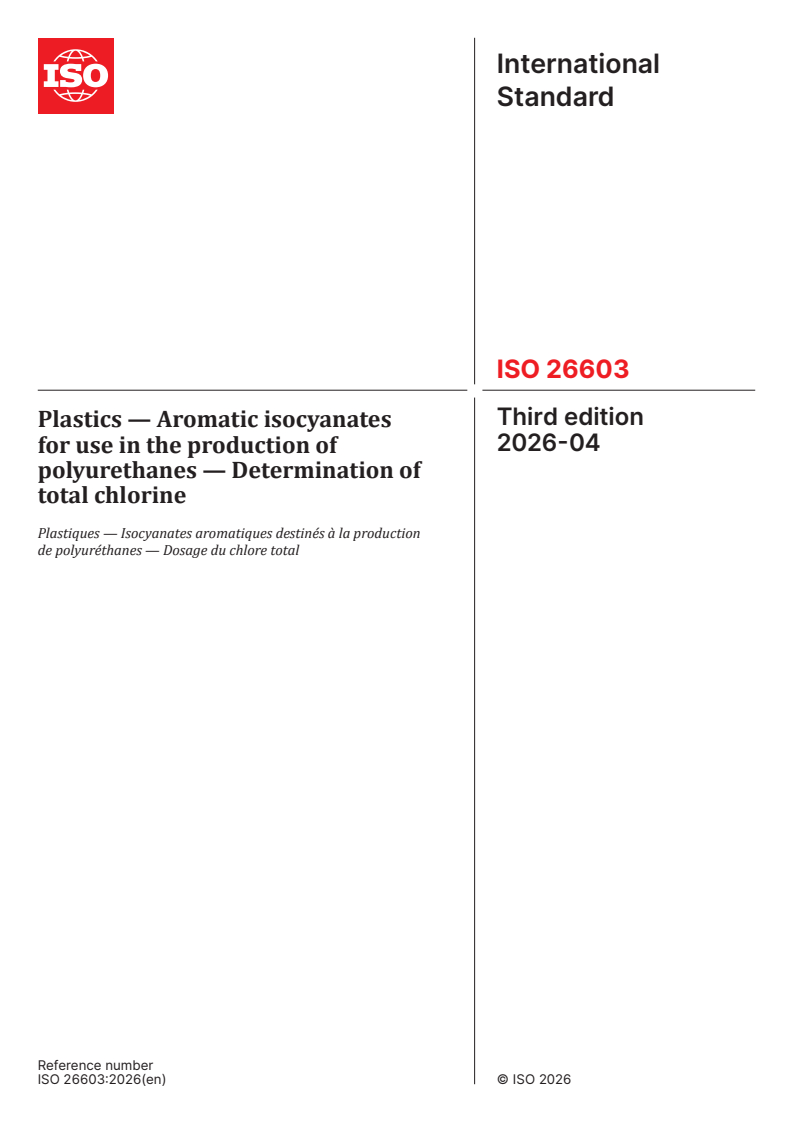
International
Standard
ISO 26603
Third edition
Plastics — Aromatic isocyanates
2026-04
for use in the production of
polyurethanes — Determination of
total chlorine
Plastiques — Isocyanates aromatiques destinés à la production
de polyuréthanes — Dosage du chlore total
Reference number
© ISO 2026
All rights reserved. Unless otherwise specified, or required in the context of its implementation, no part of this publication may
be reproduced or utilized otherwise in any form or by any means, electronic or mechanical, including photocopying, or posting on
the internet or an intranet, without prior written permission. Permission can be requested from either ISO at the address below
or ISO’s member body in the country of the requester.
ISO copyright office
CP 401 • Ch. de Blandonnet 8
CH-1214 Vernier, Geneva
Phone: +41 22 749 01 11
Email: copyright@iso.org
Website: www.iso.org
Published in Switzerland
ii
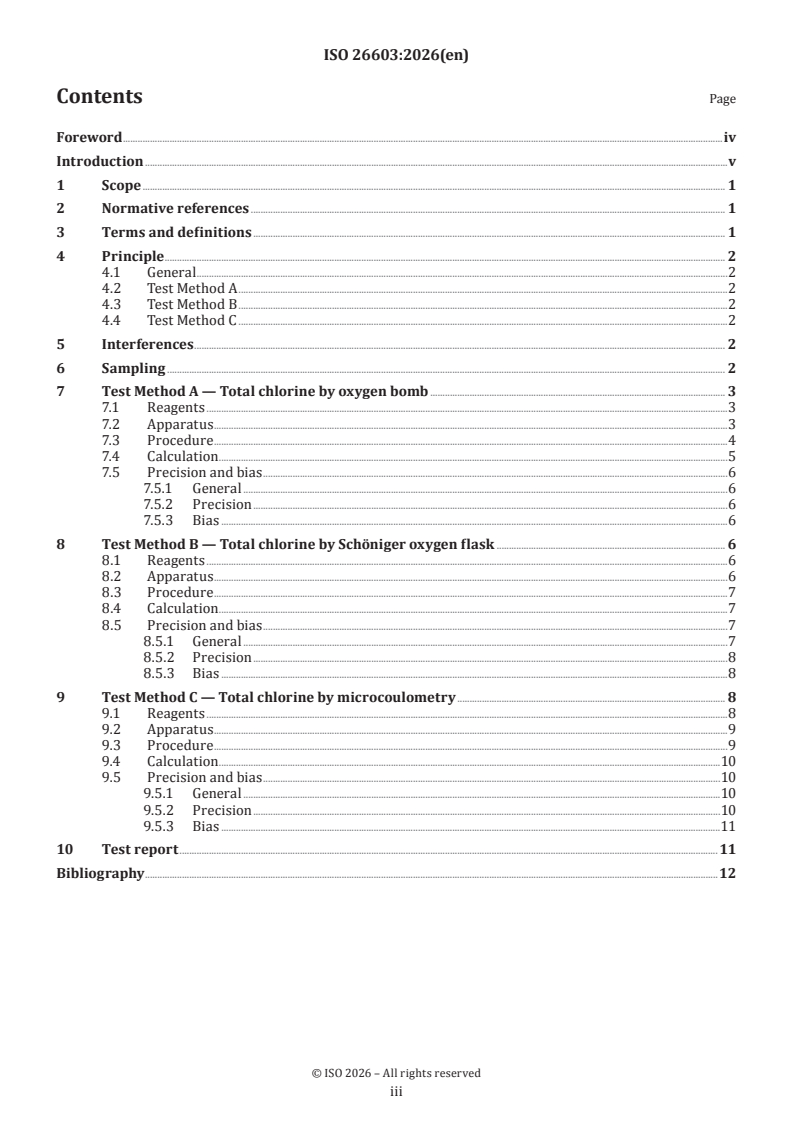
Contents Page
Foreword .iv
Introduction .v
1 Scope . 1
2 Normative references . 1
3 Terms and definitions . 1
4 Principle . 2
4.1 General .2
4.2 Test Method A .2
4.3 Test Method B .2
4.4 Test Method C .2
5 Interferences . 2
6 Sampling . 2
7 Test Method A — Total chlorine by oxygen bomb . 3
7.1 Reagents .3
7.2 Apparatus .3
7.3 Procedure .4
7.4 Calculation .5
7.5 Precision and bias .6
7.5.1 General .6
7.5.2 Precision .6
7.5.3 Bias .6
8 Test Method B — Total chlorine by Schöniger oxygen flask . 6
8.1 Reagents .6
8.2 Apparatus .6
8.3 Procedure .7
8.4 Calculation .7
8.5 Precision and bias .7
8.5.1 General .7
8.5.2 Precision .8
8.5.3 Bias .8
9 Test Method C — Total chlorine by microcoulometry . 8
9.1 Reagents .8
9.2 Apparatus .9
9.3 Procedure .9
9.4 Calculation .10
9.5 Precision and bias .10
9.5.1 General .10
9.5.2 Precision .10
9.5.3 Bias .11
10 Test report .11
Bibliography .12
iii
Foreword
ISO (the International Organization for Standardization) is a worldwide federation of national standards
bodies (ISO member bodies). The work of preparing International Standards is normally carried out through
ISO technical committees. Each member body interested in a subject for which a technical committee
has been established has the right to be represented on that committee. International organizations,
governmental and non-governmental, in liaison with ISO, also take part in the work. ISO collaborates closely
with the International Electrotechnical Commission (IEC) on all matters of electrotechnical standardization.
The procedures used to develop this document and those intended for its further maintenance are described
in the ISO/IEC Directives, Part 1. In particular, the different approval criteria needed for the different types
of ISO document should be noted. This document was drafted in accordance with the editorial rules of the
ISO/IEC Directives, Part 2 (see www.iso.org/directives).
ISO draws attention to the possibility that the implementation of this document may involve the use of (a)
patent(s). ISO takes no position concerning the evidence, validity or applicability of any claimed patent
rights in respect thereof. As of the date of publication of this document, ISO had not received notice of (a)
patent(s) which may be required to implement this document. However, implementers are cautioned that
this may not represent the latest information, which may be obtained from the patent database available at
www.iso.org/patents. ISO shall not be held responsible for identifying any or all such patent rights.
Any trade name used in this document is information given for the convenience of users and does not
constitute an endorsement.
For an explanation of the voluntary nature of standards, the meaning of ISO specific terms and expressions
related to conformity assessment, as well as information about ISO's adherence to the World Trade
Organization (WTO) principles in the Technical Barriers to Trade (TBT), see www.iso.org/iso/foreword.html.
This document was prepared by Technical Committee ISO/TC 61, Plastics, Subcommittee SC 12, Thermosetting
materials.
This third edition cancels and replaces the second edition (ISO 26603:2017), which has been technically
revised.
The main changes are as follows:
— Test Method C has been added:
— in Clause 4, a new subclause 4.4 has been added;
— a new Clause 9 has been added and subsequent clauses have been renumbered.
Any feedback or questions on this document should be directed to the user’s national standards body. A
complete listing of these bodies can be found at www.iso.org/members.html.
iv
Introduction
Isocyanates are typically produced by phosgenation of an aromatic amine using chlorine-substituted
benzenes (e.g. o-dichlorobenzene) as reaction solvents. ISO 15028 is used to determine the hydrolyzable
chlorine content of the isocyanates. The test methods in this document are used to determine the total
chlorine content of aromatic isocyanates. The difference between the total chlorine content and the
hydrolyzable chlorine content is a measure of the reaction solvents left in the product, and therefore is a
useful tool for assessing product quality.
NOTE This document is technically equivalent to ASTM D4661–03.
v
International Standard ISO 26603:2026(en)
Plastics — Aromatic isocyanates for use in the production of
polyurethanes — Determination of total chlorine
SAFETY PRECAUTIONS — Persons using this document should be familiar with normal laboratory
practice, if applicable. This document does not purport to address all of the safety concerns, if any,
associated with its use. It is the responsibility of the user of this document to establish appropriate
safety and health practices, and to determine any regulatory requirements before use.
1 Scope
This document specifies the determination of the total chlorine content of aromatic isocyanates used in the
preparation of polyurethanes.
The difference between the total chlorine content and the hydrolyzable chlorine content (see ISO 15028) is a
measure of the process solvents left in the product. All the test methods are applicable to a variety of organic
compounds, including aliphatic isocyanates, but the amount of sample used might need to be adjusted.
These test methods can be used for research or for quality control.
2 Normative references
The following documents are referred to in the text in such a way that some or all of their content constitutes
requirements of this document. For dated references, only the edition cited applies. For undated references,
the latest edition of the referenced document (including any amendments) applies.
ISO 1042, Laboratory glassware — One-mark volumetric flasks
ISO 3696, Water for analytical laboratory use — Specification and test methods
ISO 6353-2, Reagents for chemical analysis — Part 2: Specifications — First series
ISO 6353-3, Reagents for chemical analysis — Part 3: Specifications — Second series
3 Terms and definitions
For the purposes of this document, the following terms and definitions apply.
ISO and IEC maintain terminology databases for use in standardization at the following addresses:
— ISO Online browsing platform: available at https:// www .iso .org/ obp
— IEC Electropedia: available at https:// www .electropedia .org/
3.1
isocyanate
organic compound containing one or more NCO groups
3.2
polyurethane
polymer prepared by the reaction of an organic di- or polyisocyanate with compounds containing two or
more hydroxyl groups
3.3
hydrolyzable chlorine
organic or inorganic chlorine compounds formed in the production of isocyanates that react with methanol
under the conditions of ISO 15028 to liberate hydrogen chloride
3.4
total chlorine
inorganic and organically bound chlorine present in isocyanates that is converted to titratable chlorides
under the combustion conditions of the test
4 Principle
4.1 General
In test methods A and B, the organic matter in the sample is destroyed by combustion with oxygen, thus
converting the organically combined chlorine to ionic chloride. The chloride is determined potentiometrically
by titration with silver nitrate (AgNO ) solution.
4.2 Test Method A
Combustion of the sample is done in a pressurized oxygen bomb.
4.3 Test Method B
Combustion is done at atmospheric pressure in a Schöniger oxygen flask.
NOTE For information on the Schöniger flask, see Reference [6].
4.4 Test Method C
Organic chlorine compounds are converted into hydrogen chloride through a pyrolysis furnace.
+ -
Hydrogen chloride dissolves in the electrolyte and dissociates into hydrogen and chloride ions (H , Cl ) in the
Titration Cell. The chloride ions react with silver ions created via electrolysis to form silver chloride (AgCl)
The end point of titration is displayed by potentiometry. In accordance with Faraday's law, the amount of
chloride ions can be calculated based on the amount of charge consumed to produce silver ions.
5 Interferences
Thiocyanate, cyanide, sulphide, bromide, iodide or other substances capable of reacting with silver ion, as
well as substances capable of reducing silver ion in acid solution, interferes with the determination.
6 Sampling
Since organic isocyanates react with atmospheric moisture, take special precautions in sampling. Usual
sampling methods, even when conducted rapidly, can expose the isocyanate to moisture and cause
contamination of the sample with insoluble ureas; therefore, blanket the sample with a dry inert gas (e.g.
nitrogen, argon or dried air) at all times.
WARNING — Organic isocyanates are hazardous when absorbed through the skin, or when the
vapours are breathed.
CAUTION — Provide adequate ventilation and wear protective gloves and eyeglasses.
7 Test Method A — Total chlorine by oxygen bomb
7.1 Reagents
7.1.1 Purity of reagents
Reagent-grade chemicals shall be used in all tests. Other grades may be used, provided that it is first
determined that the reagent is of sufficiently high purity to permit its use without lessening the accuracy of
the determination. Unless otherwise indicated, all reagents shall conform to the specifications of ISO 6353-2
and ISO 6353-3.
7.1.2 Purity of water
Unless otherwise indicated, references to water shall be understood to mean grade 2 water as defined by
ISO 3696.
7.1.3 Ethyl alcohol, conforming to ISO 6353-2.
7.1.4 Nitric acid (diluted). While stirring vigorously, add 100 ml of nitric acid (HNO , specific gravity
1,42) to 100 ml of water cooled in an ice bath.
7.1.5 Oxygen, free of combustible materials and halogen compounds.
7.1.6 Silver nitrate, standard solution (0,01 M). Prepare a 0,01 M silver nitrate (AgNO ) solution and
check frequently enough to detect changes of 0,000 5 M, either gravimetrically or potentiometrically, using
standard hydrochloric acid (HCl).
7.1.7 Sodium carbonate solution (50 g/l). Dissolve 135 g of sodium carbonate decahydrate
(Na CO ·10H O) in water and dilute to 1 l.
2 3 2
7.2 Apparatus
7.2.1 Weighing bottle and balance, suitable for weighing a liquid sample by difference to the nearest
0,5 mg.
7.2.2 Oxygen bomb apparatus. A corrosion-resistant steel reactor capable of being pressurized to 40
atmospheres of pure oxygen, followed by electrical ignition of the sample by use of an internal fuse wire. The
bomb shall be capable of withstanding the pressure build-up caused by the combustion of the sample. Parr
Bomb No. 1108 is a suitable device (see Figure 1). Equivalent apparatus may be substituted with appropriate
changes in the procedure.
7.2.3 Fuse wire, iron-nickel-chromium, No. 34 B and S gage.
7.2.4 Titrimeter, automatic (preferred) or manual, equipped with a silver/silver chloride electrode pair
and a 10 ml capacity m
...