

ISO 18949:2019
(Main)Imaging materials — Reflection colour photographic prints — Method for testing stability under low humidity conditions
General Information
- Abstract
This document describes test methods to evaluate reflection colour photographic prints with regard to changes in image appearance resulting from exposure to low relative humidity. The observed changes relate primarily to substrate yellowing. Other observed humidity related physical damage factors such as curl, cockle, cracking, or delamination due to humidity cycling are also within the scope of this test method.
- Status
- Published
- Publication Date
- 18-Jul-2019
- Technical Committee
- ISO/TC 42 - Photography
- Current Stage
- 9093 - International Standard confirmed
- Start Date
- 17-Jun-2024
- Completion Date
- 29-Aug-2026

Overview
ISO 18949:2019 - "Imaging materials - Reflection colour photographic prints - Method for testing stability under low humidity conditions" specifies standardized test methods to evaluate how reflection colour photographic prints respond to low relative humidity. The method focuses on measurable changes in image appearance (primarily substrate yellowing) and includes visual assessment of humidity-related physical damage such as curl, cockle, cracking, or delamination. The standard is intended for comparative laboratory testing (not for making time‑based lifetime claims).
Key topics and requirements
- Test goal: Quantify image appearance change caused by sustained low relative humidity (expressed as CIELAB ΔE* values) and report observed physical damage.
- Sample preparation: Print an eight‑patch test target at controlled ambient printing conditions (23 °C ± 2 °C, 50 % RH ± 10 % RH). Condition samples 24 h ± 2 h at the same environment with unrestricted airflow before exposure.
- Humidity exposure: Fixed low‑humidity exposure specified (example condition: 25 °C at 10 % RH for 12 months). Equipment and environment control, calibration and operational uniformity are required.
- Colorimetric measurement: Use CIE colorimetry conforming to ISO 13655 (M2 conditions; M1 optional). Measure Lab* of the eight patches before and after exposure and calculate individual ΔE*ab for each patch.
- Data analysis & reporting: Report measured deterioration (average ΔE* and individual ΔE* values) and visual observations of physical degradation. Tests are for comparative stability and screening; they must not be used alone to claim absolute print lifetimes.
- Accuracy considerations: Address measurement uncertainty, operational control/ fluctuation/uniformity, and calibration per referenced documents.
Applications and users
- Who uses ISO 18949:2019: Print material developers, ink manufacturers, paper and media producers, quality assurance labs, conservation scientists, and imaging R&D teams.
- Practical uses:
- Screen inkjet papers, dye diffusion, and silver‑halide prints for susceptibility to low‑humidity substrate yellowing.
- Compare formulations and coatings for humidity fastness.
- Support product development, internal QA and controlled comparative testing of humidity‑related failure modes.
- Inform conservation decisions where prints may be stored in low‑RH environments (cold climates, heated indoor air, air‑conditioned dry climates).
Related standards
- ISO 13655 - Spectral measurement and colorimetric computation (referenced for colorimetry)
- ISO 18913 - Imaging materials - Permanence - Vocabulary
- ISO/TR 18931 - Recommendations for humidity measurement and control
- ISO 18941 - Test method for ozone gas fading stability
- ISO 18946 - Testing stability under high relative humidity
Keywords: ISO 18949:2019, low humidity testing, reflection colour photographic prints, substrate yellowing, ΔE* colorimetry, ISO 13655, humidity exposure, print stability.
Frequently Asked Questions
ISO 18949:2019 is a standard published by the International Organization for Standardization (ISO). Its full title is "Imaging materials — Reflection colour photographic prints — Method for testing stability under low humidity conditions". This standard covers: This document describes test methods to evaluate reflection colour photographic prints with regard to changes in image appearance resulting from exposure to low relative humidity. The observed changes relate primarily to substrate yellowing. Other observed humidity related physical damage factors such as curl, cockle, cracking, or delamination due to humidity cycling are also within the scope of this test method.
This document describes test methods to evaluate reflection colour photographic prints with regard to changes in image appearance resulting from exposure to low relative humidity. The observed changes relate primarily to substrate yellowing. Other observed humidity related physical damage factors such as curl, cockle, cracking, or delamination due to humidity cycling are also within the scope of this test method.
ISO 18949:2019 is classified under the following ICS (International Classification for Standards) categories: 37.040.20 - Photographic paper, films and plates. Cartridges. The ICS classification helps identify the subject area and facilitates finding related standards.
ISO 18949:2019 is available in PDF format for immediate download after purchase. The document can be added to your cart and obtained through the secure checkout process. Digital delivery ensures instant access to the complete standard document.
Standards Content (Sample)
INTERNATIONAL ISO
STANDARD 18949
First edition
2019-07
Imaging materials — Reflection colour
photographic prints — Method for
testing stability under low humidity
conditions
Matériaux pour l'image — Tirages photographiques en couleurs par
réflexion — Méthode d'essai de la stabilité dans des conditions de
faible humidité
Reference number
©
ISO 2019
© ISO 2019
All rights reserved. Unless otherwise specified, or required in the context of its implementation, no part of this publication may
be reproduced or utilized otherwise in any form or by any means, electronic or mechanical, including photocopying, or posting
on the internet or an intranet, without prior written permission. Permission can be requested from either ISO at the address
below or ISO’s member body in the country of the requester.
ISO copyright office
CP 401 • Ch. de Blandonnet 8
CH-1214 Vernier, Geneva
Phone: +41 22 749 01 11
Fax: +41 22 749 09 47
Email: copyright@iso.org
Website: www.iso.org
Published in Switzerland
ii © ISO 2019 – All rights reserved
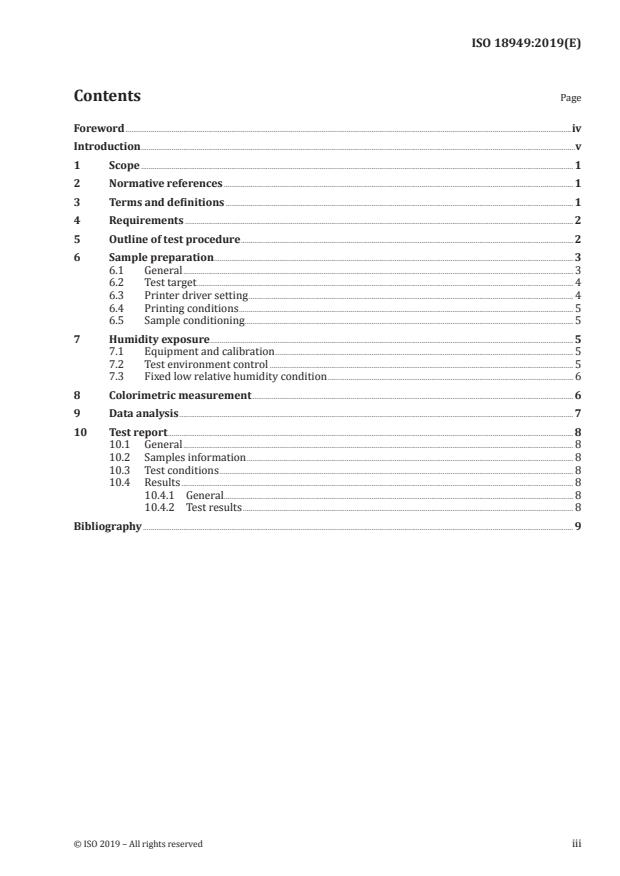
Contents Page
Foreword .iv
Introduction .v
1 Scope . 1
2 Normative references . 1
3 Terms and definitions . 1
4 Requirements . 2
5 Outline of test procedure . 2
6 Sample preparation . 3
6.1 General . 3
6.2 Test target . 4
6.3 Printer driver setting . 4
6.4 Printing conditions . 5
6.5 Sample conditioning. 5
7 Humidity exposure . 5
7.1 Equipment and calibration . 5
7.2 Test environment control . 5
7.3 Fixed low relative humidity condition . 6
8 Colorimetric measurement . 6
9 Data analysis . 7
10 Test report . 8
10.1 General . 8
10.2 Samples information . 8
10.3 Test conditions . 8
10.4 Results . 8
10.4.1 General. 8
10.4.2 Test results . 8
Bibliography . 9
Foreword
ISO (the International Organization for Standardization) is a worldwide federation of national standards
bodies (ISO member bodies). The work of preparing International Standards is normally carried out
through ISO technical committees. Each member body interested in a subject for which a technical
committee has been established has the right to be represented on that committee. International
organizations, governmental and non-governmental, in liaison with ISO, also take part in the work.
ISO collaborates closely with the International Electrotechnical Commission (IEC) on all matters of
electrotechnical standardization.
The procedures used to develop this document and those intended for its further maintenance are
described in the ISO/IEC Directives, Part 1. In particular, the different approval criteria needed for the
different types of ISO documents should be noted. This document was drafted in accordance with the
editorial rules of the ISO/IEC Directives, Part 2 (see www .iso .org/directives).
Attention is drawn to the possibility that some of the elements of this document may be the subject of
patent rights. ISO shall not be held responsible for identifying any or all such patent rights. Details of
any patent rights identified during the development of the document will be in the Introduction and/or
on the ISO list of patent declarations received (see www .iso .org/patents).
Any trade name used in this document is information given for the convenience of users and does not
constitute an endorsement.
For an explanation of the voluntary nature of standards, the meaning of ISO specific terms and
expressions related to conformity assessment, as well as information about ISO's adherence to the
World Trade Organization (WTO) principles in the Technical Barriers to Trade (TBT) see www .iso
.org/iso/foreword .html.
This document was prepared by Technical Committee ISO/TC 42, Photography.
Any feedback or questions on this document should be directed to the user’s national standards body. A
complete listing of these bodies can be found at www .iso .org/members .html.
iv © ISO 2019 – All rights reserved
Introduction
This document covers the methods and procedures for testing the low humidity fastness of reflection
colour photographic prints. Low relative humidity exposure is covered; for high relative humidity
testing see ISO 18946. Both low and high relative humidity testing is of particular relevance to dye- and
pigment-based inkjet prints printed on swellable and porous media, dye diffusion process prints, and
silver halide prints, see References [11] to[17].
In this test method the impact on the sample to be measured is the result of low moisture content in the
sample, caused by low absolute humidity. When a temperature is fixed and equilibrium reached in the
test environment, the measurement of the moisture content in the test environment is most easily done
by specifying the relative humidity, not the humidity or absolute humidity. Therefore, the term “low
relative humidity” will be used throughout this document.
The method and procedures described in this document can be used to test any colour hardcopy
technology. Some types of colour photographic prints experience changes in image appearance when
exposed to a low relative humidity environment. It has been observed that low relative humidities
can accelerate the substrate yellowing of certain types of inkjet papers and this increase in the
blue D (substrate white) has been observed with certain types of porous media, resulting in a
min
yellow appearance. A possible mechanism for this effect is degradation of optical brighteners, see
Reference [12].
The low relative humidity indoor environment can arise from cold dry air being drawn into the storage
environment and heated to room temperature. Indoor low relative humidities are common in colder
climates and can be especially prevalent in higher latitude countries in winter where outside air dew
point temperatures can be well below 0 °C. When this air is warmed to room temperature in the print
storage environment, relative humidities as low as 5 % or lower can be encountered.
Indoor low relative humidities are also common in hot, dry climates in combination with air
conditioning. Low relative humidity environment is often encountered in desert environments or areas
with long dry seasons.
In addition to substrate yellowing, very low relative humidities have also been shown to cause physical
degradation of image receiving layers. Visual assessment and reporting of physical degradation are
included.
INTERNATIONAL STANDARD ISO 18949:2019(E)
Imaging materials — Reflection colour photographic
prints — Method for testing stability under low humidity
conditions
1 Scope
This document describes test methods to evaluate reflection colour photographic prints with regard to
changes in image appearance resulting from exposure to low relative humidity.
The observed changes relate primarily to substrate yellowing. Other observed humidity related
physical damage factors such as curl, cockle, cracking, or delamination due to humidity cycling are also
within the scope of this test method.
2 Normative references
The following documents are referred to in the text in such a way that some or all of their content
constitutes requirements of this document. For dated references, only the edition cited applies. For
undated references, the latest edition of the referenced document (including any amendments) applies.
ISO 13655, Graphic technology — Spectral measurement and colorimetric computation for graphic
arts images
ISO 18913, Imaging materials — Permanence — Vocabulary
ISO/TR 18931, Imaging materials - Recommendations for humidity measurement and control
ISO 18941, Imaging materials — Colour reflection prints — Test method for ozone gas fading stability
3 Terms and definitions
For the purposes of this document, the terms and definitions used in ISO 18913 and the following apply.
ISO and IEC maintain terminological databases for use in standardization at the following addresses:
— ISO Online browsing platform: available at https: //www .iso .org/obp
— IEC Electropedia: available at http: //www .electropedia .org/
3.1
operational control point
set point for equilibrium conditions measured at sensor location(s) in an exposure device
[SOURCE: ASTM G113]
3.2
operational fluctuation
positive and negative deviations from the setting of the sensor at the operational control set point
during equilibrium conditions in a laboratory accelerated weathering device
Note 1 to entry: The operational fluctuations are the result of unavoidable machine variables and do not include
measurement uncertainty. The operational fluctuations apply only at the location of the control sensor and do
not imply uniformity of conditions throughout the test chamber.
[SOURCE: ASTM G113]
3.3
operational uniformity
range around the operational control point (3.1) for measured parameters within the intended exposure
area within the limits of intended operational range
[SOURCE: ASTM G113]
3.4
uncertainty (of measurement)
parameter, associated with the result of a measurement, that characterizes the dispersion of the values
that could be reasonably attributed to the measurement
Note 1 to entry: The parameter can be, for example, a standard deviation (or a given multiple of it), or the half-
width of an interval having a stated confidence level.
Note 2 to entry: Uncertainty of measurement comprises, in general, many components. Some of these components
can be evaluated from statistical distribution of the results of series of measurements and can be characterized
by experimental standard deviations. The other components, which can also be characterized by standard
deviations, are evaluated from assumed probability distributions based on experience or other information.
Note 3 to entry: It is understood that the result of the measurement is the best estimate of the value of the
measurement, and that all components of uncertainty, including those arising from systematic effects, such as
components associated with corrections and reference standards, contribute to the dispersion.
[SOURCE: ASTM G113]
3.5
delamination
separation of a laminate into its constituent layers
3.6
cockle
planar distortion in flat materials, especially paper or vellum, that is characterized by puckering, waves,
or rippling
4 Requirements
This document specifies a set of recommended test methods with associated requirements for permitted
reporting. Data from these tests shall not be used to make life expectancy claims, such as time-based
print lifetime claims, either comparative or absolute. Conversion of data obtained from these methods
for the purpose of making public statements regarding product life shall be in accordance with the
applicable International Standard(s) for specification of print life.
The test methods in this document may be useful as stand-alone test methods for comparison of the
stability of image materials with respect to one specific failure mode. Data from the test methods of
this document may be used in stand-alone reporting of the absolute or comparative stability of image
materials with respect to the specific failure mode dealt with in this document, when reported in
compliance with the reporting requirements of this document. Comparisons shall be limited to test
cases using test equipment with matching specifications.
5 Outline of test procedure
The eight-patch test target shown in Figure 1 shall be printed at 23 °C ± 2 °C and 50 % RH ± 10 % RH.
The test samples shall be conditioned, positioned with unrestricted airflow, for 24 h ± 2 h at 23 °C ± 2 °C
and 50 % RH ± 10 % RH.
The printed samples shall be exposed to low humidity as specified in Clause 7.
Colorimetric measurements shall be taken from ISO 13655 as specified in Clause 8.
2 © ISO 2019 – All rights reserved
The colour and minimum density, D , patches shall be measured using CIELAB colorimetry before
min
and after the relative humidity exposures. The CIELAB colour difference, ΔE* , for each of the eight
ab
test patches of the test target shall be calculated.
This document specifies a test method that demonstrates the degree of the deterioration (average ΔE
of the printed image) quantitatively in a fixed relative humidity condition. This includes demonstrating
the propensity of the image receiving layer or underlying substrate to yellow upon exposure to low
relative humidities, i.e. 25 °C at 10 % RH for 12 months, see Reference [19]. This test method is most
useful for research and development of printing systems or printing materials where humidity fastness
of many samples can be screened and closely compared.
NOTE To achieve relative humidities as low as 10 %, it can be necessary to either reduce the ambient relative
humidity in and around the test chamber environment to well below 50 %, or install a dry air tank to provide
separate dry air to the humidity test chamber.
The test procedure is summarized in Table 1.
Table 1 — Summary of the test procedures
Steps Procedures and test conditions
Sample preparation Test target Eight patch target shown in Figure 1
Temp and RH 23 °C ± 2 °C and 50 % RH ± 10 % RH
Sample conditioning Temp and RH 23 °C ± 2 °C and 50 % RH ± 10 % RH
Duration 24 h ± 2 h, unrestricted airflow
Measurement Method CIE colorimetry conforming to ISO 13655, M2 conditions.
Optionally, condition M1 may also be used
Parameter L*a*b* of eight patches in the test target before the humidity
exposure
Humidity exposure Method 25 °C at 10 % RH for 12 months
Measurement Method CIE colorimetry conforming to ISO 13655, M2 conditions.
Optionally, condition M1 may also be used
Parameter L*a*b* of eight patches in the test target after the humidity
exposure.
Visual observations for physical changes
Calculation Individual ΔE* of eight colour patches in the test target after
ab
the humidity exposure. All ΔE* measurements calculated from
measurements taken before and after the humidity exposure.
Report Measured deterioration at a fixed relative humidity, both ΔE*
and physical
6 Sample preparation
6.1 General
The test target shown in Figure 1 shall be printed at 23 °C ± 2 °C and 50 % RH ± 10 % RH.
NOTE The sample printing conditions in this test method refer only to the ambient printing environment,
not the conditions inside the printer during the printing process.
The test samples shall be conditioned for 24 h ± 2 h at 23 °C ± 2 °C and 50 % RH ± 5 % RH before the
humidity exposure, positioned with unrestricted airflow.
The sample holding environment shall be ozone free (<2 nl/l average concentration over any 24 h period)
for ozone sensitive samples, as determined according to ISO 18941. A material that is not sensitive to
ozone shall have demonstrated no measurable D or printed patch colour change at
...