


ISO 13756:2015
(Main)Jewellery — Determination of silver in silver jewellery alloys — Volumetric (potentiometric) method using sodium chloride or potassium chloride
Jewellery — Determination of silver in silver jewellery alloys — Volumetric (potentiometric) method using sodium chloride or potassium chloride
ISO 13756:2015 specifies a volumetric method for the determination of silver in silver jewellery alloys, preferably within the range of fineness stated in ISO 9202. These alloys may contain copper, zinc, cadmium, and palladium. Apart from palladium, which must be precipitated before commencing titration, these elements do not interfere with this method of determination. NOTE This method is an alternative recommended method to ISO 11427.
Joaillerie — Dosage de l'argent dans les alliages d'argent pour la bijouterie-joaillerie — Méthode volumétrique (potentiométrique) utilisant le chlorure de sodium ou le chlorure de potassium
General Information
- Status
- Withdrawn
- Publication Date
- 19-Jan-2015
- Technical Committee
- ISO/TC 174 - Jewellery and precious metals
- Drafting Committee
- ISO/TC 174/WG 1 - Methods for determining fineness
- Current Stage
- 9599 - Withdrawal of International Standard
- Start Date
- 08-Apr-2024
- Completion Date
- 12-Feb-2026
Relations
- Referred By
EN ISO 9202:2019 - Jewellery and precious metals - Fineness of precious metal alloys (ISO 9202:2019) - Effective Date
- 09-Feb-2026
- Effective Date
- 06-Jun-2022
- Effective Date
- 13-Nov-2010
Frequently Asked Questions
ISO 13756:2015 is a standard published by the International Organization for Standardization (ISO). Its full title is "Jewellery — Determination of silver in silver jewellery alloys — Volumetric (potentiometric) method using sodium chloride or potassium chloride". This standard covers: ISO 13756:2015 specifies a volumetric method for the determination of silver in silver jewellery alloys, preferably within the range of fineness stated in ISO 9202. These alloys may contain copper, zinc, cadmium, and palladium. Apart from palladium, which must be precipitated before commencing titration, these elements do not interfere with this method of determination. NOTE This method is an alternative recommended method to ISO 11427.
ISO 13756:2015 specifies a volumetric method for the determination of silver in silver jewellery alloys, preferably within the range of fineness stated in ISO 9202. These alloys may contain copper, zinc, cadmium, and palladium. Apart from palladium, which must be precipitated before commencing titration, these elements do not interfere with this method of determination. NOTE This method is an alternative recommended method to ISO 11427.
ISO 13756:2015 is classified under the following ICS (International Classification for Standards) categories: 39.060 - Jewellery. The ICS classification helps identify the subject area and facilitates finding related standards.
ISO 13756:2015 has the following relationships with other standards: It is inter standard links to EN ISO 9202:2019, ISO 13756:2024, ISO 13756:1997. Understanding these relationships helps ensure you are using the most current and applicable version of the standard.
ISO 13756:2015 is available in PDF format for immediate download after purchase. The document can be added to your cart and obtained through the secure checkout process. Digital delivery ensures instant access to the complete standard document.
Standards Content (Sample)
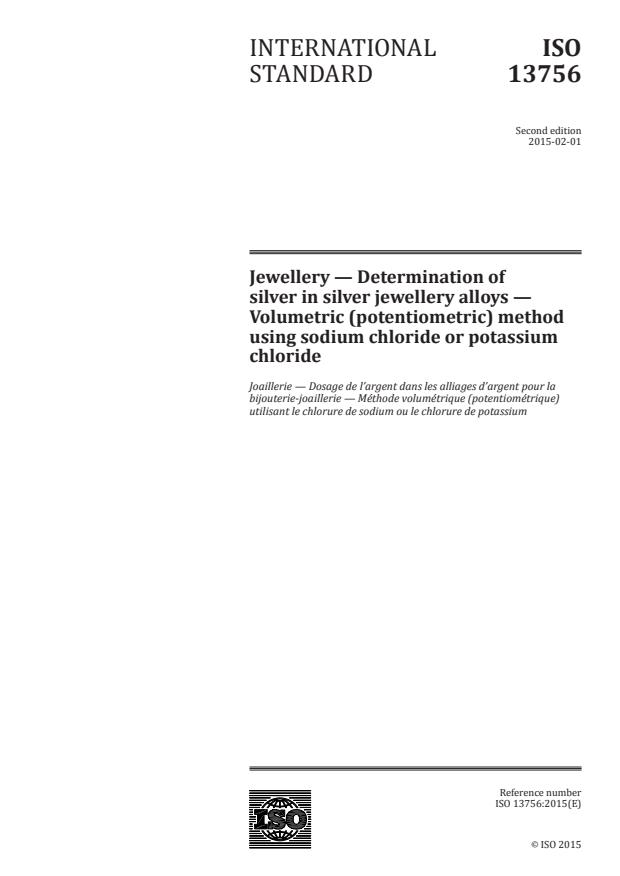
INTERNATIONAL ISO
STANDARD 13756
Second edition
2015-02-01
Jewellery — Determination of
silver in silver jewellery alloys —
Volumetric (potentiometric) method
using sodium chloride or potassium
chloride
Joaillerie — Dosage de l’argent dans les alliages d’argent pour la
bijouterie-joaillerie — Méthode volumétrique (potentiométrique)
utilisant le chlorure de sodium ou le chlorure de potassium
Reference number
©
ISO 2015
© ISO 2015
All rights reserved. Unless otherwise specified, no part of this publication may be reproduced or utilized otherwise in any form
or by any means, electronic or mechanical, including photocopying, or posting on the internet or an intranet, without prior
written permission. Permission can be requested from either ISO at the address below or ISO’s member body in the country of
the requester.
ISO copyright office
Case postale 56 • CH-1211 Geneva 20
Tel. + 41 22 749 01 11
Fax + 41 22 749 09 47
E-mail copyright@iso.org
Web www.iso.org
Published in Switzerland
ii © ISO 2015 – All rights reserved
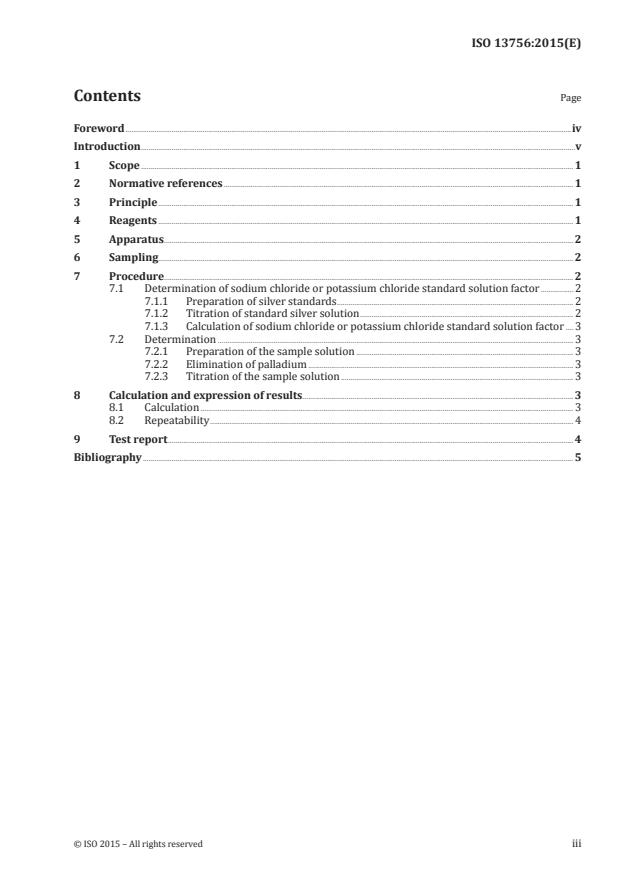
Contents Page
Foreword .iv
Introduction .v
1 Scope . 1
2 Normative references . 1
3 Principle . 1
4 Reagents . 1
5 Apparatus . 2
6 Sampling . 2
7 Procedure. 2
7.1 Determination of sodium chloride or potassium chloride standard solution factor . 2
7.1.1 Preparation of silver standards . 2
7.1.2 Titration of standard silver solution . 2
7.1.3 Calculation of sodium chloride or potassium chloride standard solution factor . 3
7.2 Determination . 3
7.2.1 Preparation of the sample solution . 3
7.2.2 Elimination of palladium . 3
7.2.3 Titration of the sample solution . 3
8 Calculation and expression of results . 3
8.1 Calculation . 3
8.2 Repeatability . 4
9 Test report . 4
Bibliography . 5
Foreword
ISO (the International Organization for Standardization) is a worldwide federation of national standards
bodies (ISO member bodies). The work of preparing International Standards is normally carried out
through ISO technical committees. Each member body interested in a subject for which a technical
committee has been established has the right to be represented on that committee. International
organizations, governmental and non-governmental, in liaison with ISO, also take part in the work.
ISO collaborates closely with the International Electrotechnical Commission (IEC) on all matters of
electrotechnical standardization.
The procedures used to develop this document and those intended for its further maintenance are
described in the ISO/IEC Directives, Part 1. In particular the different approval criteria needed for the
different types of ISO documents should be noted. This document was drafted in accordance with the
editorial rules of the ISO/IEC Directives, Part 2 (see www.iso.org/directives).
Attention is drawn to the possibility that some of the elements of this document may be the subject of
patent rights. ISO shall not be held responsible for identifying any or all such patent rights. Details of any
patent rights identified during the development of the document will be in the Introduction and/or on
the ISO list of patent declarations received (see www.iso.org/patents).
Any trade name used in this document is information given for the convenience of users and does not
constitute an endorsement.
For an explanation on the meaning of ISO specific terms and expressions related to conformity
assessment, as well as information about ISO’s adherence to the WTO principles in the Technical Barriers
to Trade (TBT), see the following URL: Foreword — Supplementary information.
The committee responsible for this document is ISO/TC 174, Jewellery.
This second edition cancels and replaces the first edition (ISO 13756:1997), which has been technically
revised with the following changes:
— addition of an analytical balance in Clause 5;
— change of requirement for sampling in Clause 6;
— addition of a warning in Clause 7 that suitable health and safety procedures should be followed;
— International Standard editorially revised.
iv © ISO 2015 – All rights reserved
Introduction
The following definitions apply in understanding how to implement an ISO International Standard and
other normative ISO deliverables (TS, PAS, IWA):
— “shall” indicates a requirement;
— “should” indicates a recommendation;
— “may” is used to indicate that something is permitted;
— “can” is used to indicate that something is possible, for example, that an organization or individual
is able to do something.
ISO/IEC Directives, Part 2 (sixth edition, 2011), 3.3.1 defines a requirement as an “expression in the
content of a document conveying criteria to be fulfilled if compliance with the document is to be claimed
and from which no deviation is permitted.”
ISO/IEC Directives, Part 2 (sixth edition, 2011), 3.3.2 defines a recommendation as an “expression in the
content of a document conveyi
...
Questions, Comments and Discussion
Ask us and Technical Secretary will try to provide an answer. You can facilitate discussion about the standard in here.
Loading comments...