

ISO 2482:1973
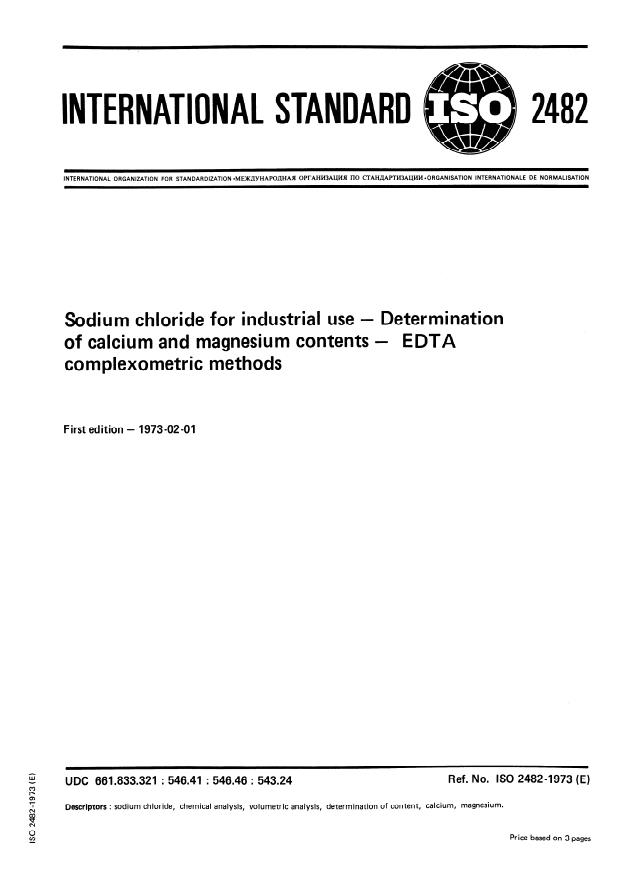
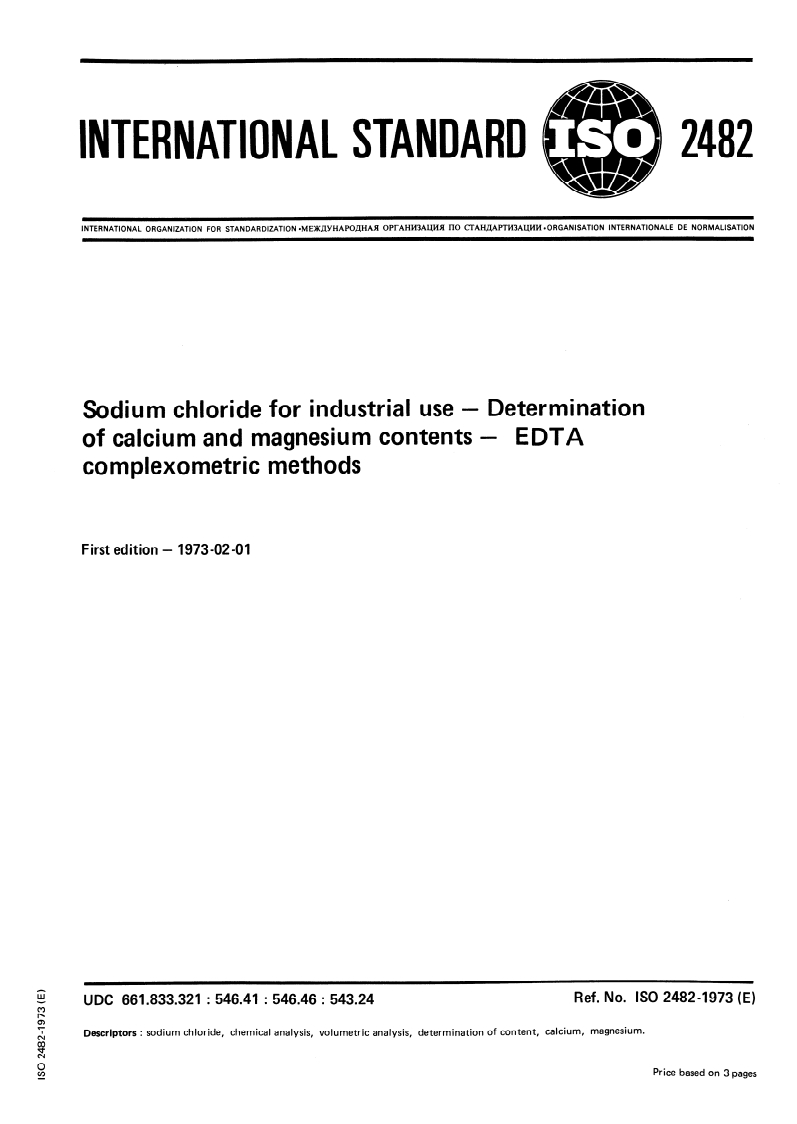
(Main)Sodium chloride for industrial use — Determination of calcium and magnesium contents — EDTA complexometric methods
General Information
- Abstract
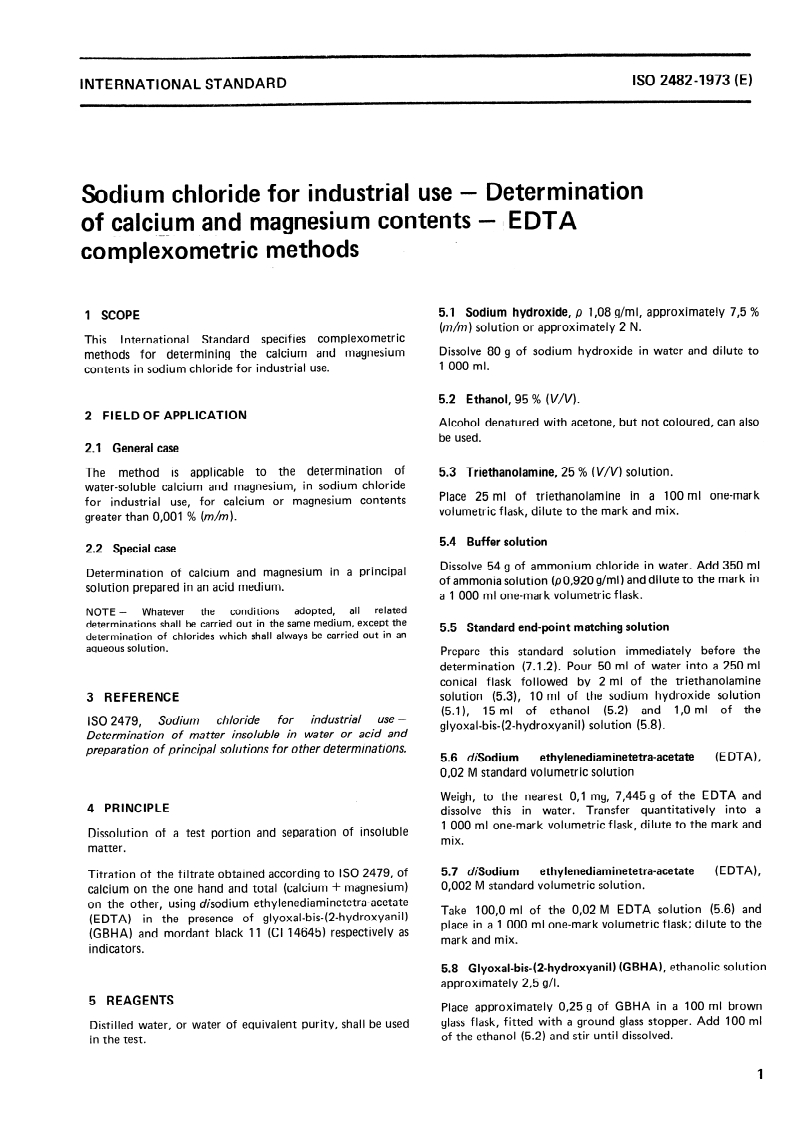
The method is applicable to water-soluble salts for contents greater than 0,001 % (m/m). In a special case, the determination of ions in a principal solution prepared in an acid medium is pooible. The principle consists in dissolution of a test portion and separation of insoluble matter. Titration of the filtrate obtained according to ISO 2479 using disodium ethylendiamintetraacetate (EDTA) in the presence of glyoxal-bis-(2-hydroxyanil) (GBHA) and mordant black 11 (Cl 14645) respectively as indicators.
- Status
- Published
- Publication Date
- 31-Jan-1973
- Technical Committee
- ISO/TC 47 - Chemistry
- Drafting Committee
- ISO/TC 47 - Chemistry
- Current Stage
- 9093 - International Standard confirmed
- Start Date
- 29-Nov-2023
- Completion Date
- 29-Aug-2026
Buy Documents
ISO 2482:1973 - Sodium chloride for industrial use -- Determination of calcium and magnesium contents -- EDTA complexometric methods
ISO 2482:1973 - Sodium chloride for industrial use — Determination of calcium and magnesium contents — EDTA complexometric methods/1/1973
ISO 2482:1973 - Chlorure de sodium a usage industriel -- Dosage du calcium et du magnésium -- Méthodes complexométriques a l'EDTA
ISO 2482:1973 - Chlorure de sodium a usage industriel -- Dosage du calcium et du magnésium -- Méthodes complexométriques a l'EDTA
ISO 2482:1973 - Chlorure de sodium à usage industriel — Dosage du calcium et du magnésium — Méthodes complexométriques à l'EDTA/1/1973
ISO 2482:1973 - Chlorure de sodium à usage industriel — Dosage du calcium et du magnésium — Méthodes complexométriques à l'EDTA/1/1973
Overview
ISO 2482:1973 is an International Standard developed by the International Organization for Standardization (ISO) that specifies complexometric titration methods for determining calcium and magnesium contents in sodium chloride for industrial use. Utilizing EDTA (ethylenediaminetetraacetic acid) as the titrant and specific colorimetric indicators, this standard addresses accurate quantification of water-soluble calcium and magnesium ions, essential for quality control in industrial salt applications. The method applies to calcium and magnesium concentrations above 0.001% by mass and can be adapted for samples prepared in acidic media.
Key Topics
Scope and Application
- Applicable to sodium chloride for industrial use containing calcium and magnesium ions exceeding 0.001% (m/m).
- Supports testing in both neutral and acidic sample preparations.
- Governs water-soluble salt analysis, focusing on calcium and magnesium contaminants.
Principle of Method
- Dissolution of the test sample and separation of insoluble matter.
- Volumetric titration of filtrate with disodium EDTA standard solutions.
- Use of glyoxal-bis-(2-hydroxyanil) (GBHA) and mordant black 11 as indicators for calcium and magnesium endpoint detection.
- pH-adjusted titration ensuring reliable complexometric reaction.
Reagents and Apparatus
- Standardized sodium hydroxide, ethanol, triethanolamine, and buffer solutions to maintain optimal pH.
- Preparation of 0.02 M and 0.002 M EDTA standard solutions for titration sensitivity.
- Ordinary laboratory glassware and titrators.
Detailed Procedure
- Specific steps for calcium determination including sample preparation, pH adjustment (>12), and titration endpoint identification (red to yellow color change).
- Total calcium plus magnesium assessment in heated samples with buffer addition and color change from wine red to blue indicating endpoint.
- Special provisions for samples prepared in acid medium, maintaining consistent testing conditions.
Calculation and Expression of Results
- Formulas for calculating calcium and magnesium percentages based on titrant volume, sample mass, and molar masses.
- Recommendations for repeat tests and statistical repeatability data from inter-laboratory tests to ensure reliability.
Applications
Industrial Sodium Chloride Quality Control
Ensures compliance with purity specifications by detecting calcium and magnesium impurities that can affect salt quality, processing, and end-use performance.Chemical and Pharmaceutical Industries
Provides a standardized analytical technique for salt manufacturers aiming to control contaminant levels critical for chemical reactions and pharmaceutical formulations.Water Treatment and Environmental Monitoring
Enables quality assessment of sodium chloride used in water conditioning, ensuring that calcium and magnesium concentrations meet required thresholds.Research and Development
Offers a reliable method to quantify calcium and magnesium ions in experimental sodium chloride samples, facilitating product formulation and process optimization.
Related Standards
ISO 2479:1973
Specifies determination of insoluble matter in water or acid and preparation of principal solutions, referenced for sample preparation in ISO 2482.ISO 9001 Series
Quality management guidelines supporting analytical and testing laboratories in maintaining process control and result accuracy.ISO/IEC 17025
Specifies general requirements for the competence of testing and calibration laboratories performing procedures like those in ISO 2482.ASTM E1209 - 17
Standard test method for calcium, magnesium, and iron in salt by EDTA titration, which complements ISO 2482 procedures in similar contexts.
Keywords: ISO 2482, sodium chloride analysis, calcium determination, magnesium content, EDTA complexometric method, industrial salt purity, chemical analysis, volumetric titration, GBHA indicator, mordant black 11, quality control sodium chloride, water-soluble ions detection.
Relations
- Effective Date
- 25-Aug-2026
- Effective Date
- 25-Aug-2026
- Effective Date
- 25-Aug-2026
- Effective Date
- 25-Aug-2026
- Effective Date
- 25-Aug-2026
- Effective Date
- 25-Aug-2026
Buy Documents
ISO 2482:1973 - Sodium chloride for industrial use -- Determination of calcium and magnesium contents -- EDTA complexometric methods
ISO 2482:1973 - Sodium chloride for industrial use — Determination of calcium and magnesium contents — EDTA complexometric methods/1/1973
ISO 2482:1973 - Chlorure de sodium a usage industriel -- Dosage du calcium et du magnésium -- Méthodes complexométriques a l'EDTA
ISO 2482:1973 - Chlorure de sodium a usage industriel -- Dosage du calcium et du magnésium -- Méthodes complexométriques a l'EDTA
ISO 2482:1973 - Chlorure de sodium à usage industriel — Dosage du calcium et du magnésium — Méthodes complexométriques à l'EDTA/1/1973
ISO 2482:1973 - Chlorure de sodium à usage industriel — Dosage du calcium et du magnésium — Méthodes complexométriques à l'EDTA/1/1973
Get Certified
Connect with accredited certification bodies for this standard

ECOCERT
Organic and sustainability certification.

Eurofins Food Testing Global
Global leader in food, environment, and pharmaceutical product testing.

Intertek Bangladesh
Intertek certification and testing services in Bangladesh.
Sponsored listings
Frequently Asked Questions
ISO 2482:1973 is a standard published by the International Organization for Standardization (ISO). Its full title is "Sodium chloride for industrial use — Determination of calcium and magnesium contents — EDTA complexometric methods". This standard covers: The method is applicable to water-soluble salts for contents greater than 0,001 % (m/m). In a special case, the determination of ions in a principal solution prepared in an acid medium is pooible. The principle consists in dissolution of a test portion and separation of insoluble matter. Titration of the filtrate obtained according to ISO 2479 using disodium ethylendiamintetraacetate (EDTA) in the presence of glyoxal-bis-(2-hydroxyanil) (GBHA) and mordant black 11 (Cl 14645) respectively as indicators.
The method is applicable to water-soluble salts for contents greater than 0,001 % (m/m). In a special case, the determination of ions in a principal solution prepared in an acid medium is pooible. The principle consists in dissolution of a test portion and separation of insoluble matter. Titration of the filtrate obtained according to ISO 2479 using disodium ethylendiamintetraacetate (EDTA) in the presence of glyoxal-bis-(2-hydroxyanil) (GBHA) and mordant black 11 (Cl 14645) respectively as indicators.
ISO 2482:1973 is classified under the following ICS (International Classification for Standards) categories: 71.060.50 - Salts. The ICS classification helps identify the subject area and facilitates finding related standards.
ISO 2482:1973 has the following relationships with other standards: It is inter standard links to EN 16370:2013, EN 973:2009, EN 14805:2008, EN 16370:2022, EN 14805:2022, EN 16811-1:2016. Understanding these relationships helps ensure you are using the most current and applicable version of the standard.
ISO 2482:1973 is available in PDF format for immediate download after purchase. The document can be added to your cart and obtained through the secure checkout process. Digital delivery ensures instant access to the complete standard document.
Standards Content (Sample)
INTERNATIONAL STANDARD
INTERNATIONAL ORGAf’Jl~TlON FOR STANDARDlZATlON l MEX~YHAPO~HAJI OPTAHW3AISUl l-IO CTAHAAPTW3AI.JWW .ORGANISATION INTERNATIONALE DE NORMALISATION
Sodium chloride for industrial use - Determination
of calcium and magnesium contents - EDTA
complexometric methods
First edition - 1973-02-01
UDC 661.833.321 : 546.41 : 546.46 : 543.24 Ref. No. IS0 2482-1973 (E)
Descriptors : sodium chloride, chemical analysis, volumetric analysis, determination of content, calcium, magnesium.
Price based on 3 pages
IS0 (the International Organization for Standardization) is a worldwide federation
of national standards institutes (IS0 Member Bodies). The work of developing
International Standards is carried out through IS0 Technical Committees. Every
Member Body interested in a subject for which a Technical Committee has been set
up has the right to be represented on that Committee. International organizations,
governmental and non-governmental, in liaison with ISO, also take part in the work.
Draft International Standards adopted by the Technical Committees are circulated
to the Member Bodies for approval before their acceptance as International
Standards by the IS0 Council.
International Standard IS0 2482 was drawn up by Technical Committee
ISO/TC 47, Chemistry-
It was approved in January 1972 by the Member Bodies of the following countries :
Austria Ireland South Africa, Rep. of
Belgium Italy Spain
Chile Korea, Dem.P.Rep. of Switzerland
Czechoslovakia Morocco Thailand
United Kingdom
Egypt, Arab Rep. of Netherlands
France U.S.A.
New Zealand
Germany U.S.S.R.
Poland
Hungary Portuga I
India
Romania
No Member Body expressed disapproval of the document.
0 International Organization for Standardization, 1973 l
Printed in Switzerland
IS0 2482-1973 (E)
INTERNATIONAL STANDARD
Sodium chloride for industrial use - Determination
of calcium and magnesium contents - ‘EDT/l
complexometric methods
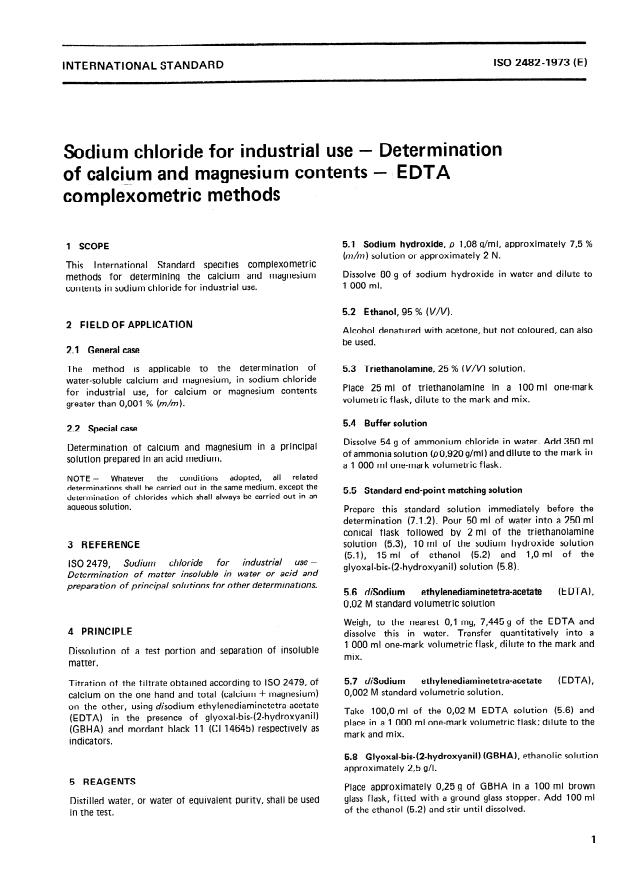
5.1 Sodium hydroxide, p I,08 g/ml, approximately 7,5 %
I SCOPE
(m/m) solution or approximately 2 N.
This International Standard specifies complexometric
methods for determining the calcium and magnesium Dissolve 80 g of sodium hydroxide in water and dilute to
1 000 ml.
contents in sodium chloride for industrial use.
5.2 Ethanol, 95 % (V/V).
2 FIELD OF APPLICATION
Alcohol denatured with acetone, but not coloured, can also
be used.
2.1 General case
The method is applicable to the determination of
5.3 Triethanolamine, 25 % (V/V) solution.
water-soluble calcium and magnesium, in sodium chloride
Place 25 ml of triethanolamine in a 100 ml one-mark
for industrial use, for calcium or magnesium contents
volumetric flask, dilute to the mark and mix.
greater than 0,001 % (m/m).
5.4 Buffer solution
2.2 Special case
Dissolve 54 g of ammonium chloride in water. Add 350 ml
Determination of calcium and magnesium in a principal
of ammonia solution (p&920 g/ml) and dilute to the mark in
solution prepared in an acid medium.
a 1 000 ml one-mark volumetric flask.
NOTE - Whatever the conditions adopted, all related
determinations shall be carried out in the same medium, except the
5.5 Standard end-point matching solution
determination of chlorides which shall always be carried out in an
aqueous solution.
Prepare this standard solution immediately before the
determination (7.1-Z). Pour 50 ml of water into a 250 ml
conical flask followed by 2 ml of the triethanolamine
3 REFERENCE
solution (5.3), IO ml of the sodium hydroxide solution
(5.1), 15 ml of ethanol (5.2) and I,0 ml of the
use -
IS0 2479, Sodium chloride for industrial
glyoxal-bis-(Z-hydroxyanil) solution (5.8).
Determination of matter insoluble in water or acid and
preparation of principal solutions for other determinations.
5.6 disodium ethylenediaminetetra-acetate
ED-W,
0,02 M standard volumetric solution
Weigh, to the nearest 0,l mg, 7,445 g of the EDTA and
4 PRINCIPLE
dissolve this in water. Transfer quantitatively into a
1 000 ml one-mark volumetric flask, dilute to the mark and
Dissolution of a test portion and separation of insoluble
mix.
matter.
5.7 disodium ethylenediaminetetra-acetate
Titration of the filtrate obtained according to IS0 2479, of EDTN,
0,002 M standard volumetric solution.
calcium on the one hand and total (calcium i- magnesium)
on the other, using disodium ethylenediaminetetra-acetate
Take 100,O ml of the 0,02 M EDTA solution (5.6) and
(EDTA) in the presence of glyoxal-bis-(Z-hydroxyanil)
place in a 1 000 ml one-mark volumetric flask; dilute to the
(GBHA) and mordant black 11 (Cl 14645) respectively as
mark and mix.
indicators.
5.8 Glyoxal-b&(2-hydroxyanil) (GBHA), ethanolic solution
approximately 2,5 g/l.
5 REAGENTS
Place approximately 0,25 g of GBHA in a 100 ml brown
glass flask, fitted with a ground glass stopper. Add 100 ml
Distilled water, or water of equivalent purity, shall be used
of the ethanol (5.2) and stir until dissolved.
in the test.
IS0 2482-1973 (E)
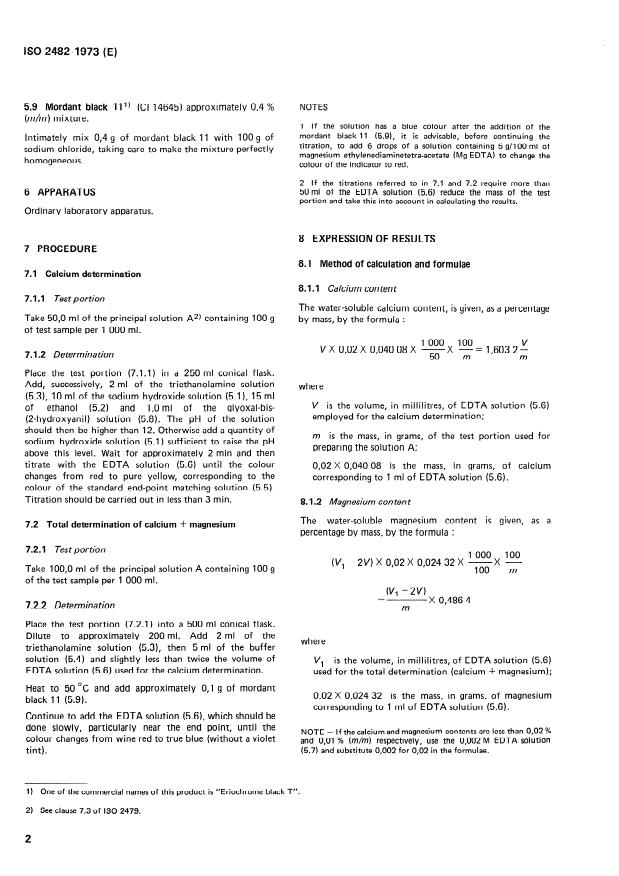
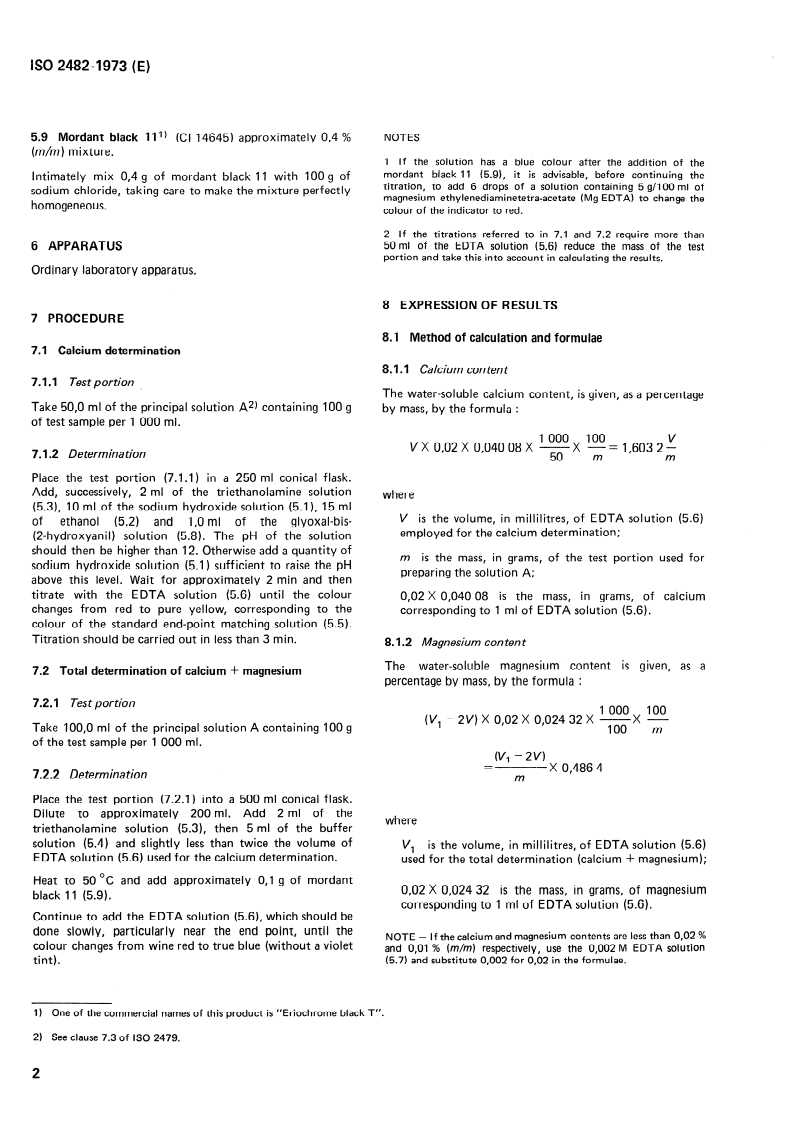
5.9 Mordant black II I) (Cl 14645) approximately 0,4 %
(m/m) mixture.
1 If the solution has a blue colour after the addition of the
mordant black II (5.9), it is advisable, before continuing the
Intimately mix 0,4 g of mordant black 1 I with 100 g of
titration, to add 6 drops of a solution containing 5 g/l00 ml of
sodium chloride, taking care to make the mixture perfectly
magnesium ethylenediaminetetra-acetate (Mg EDTA) to change the
homogeneous.
colour of the indicator to red.
2 If the titrations referred to in 7.1 and 7.2 require more than
...
INTERNATIONAL STANDARD
INTERNATIONAL ORGAf’Jl~TlON FOR STANDARDlZATlON l MEX~YHAPO~HAJI OPTAHW3AISUl l-IO CTAHAAPTW3AI.JWW .ORGANISATION INTERNATIONALE DE NORMALISATION
Sodium chloride for industrial use - Determination
of calcium and magnesium contents - EDTA
complexometric methods
First edition - 1973-02-01
UDC 661.833.321 : 546.41 : 546.46 : 543.24 Ref. No. IS0 2482-1973 (E)
Descriptors : sodium chloride, chemical analysis, volumetric analysis, determination of content, calcium, magnesium.
Price based on 3 pages
IS0 (the International Organization for Standardization) is a worldwide federation
of national standards institutes (IS0 Member Bodies). The work of developing
International Standards is carried out through IS0 Technical Committees. Every
Member Body interested in a subject for which a Technical Committee has been set
up has the right to be represented on that Committee. International organizations,
governmental and non-governmental, in liaison with ISO, also take part in the work.
Draft International Standards adopted by the Technical Committees are circulated
to the Member Bodies for approval before their acceptance as International
Standards by the IS0 Council.
International Standard IS0 2482 was drawn up by Technical Committee
ISO/TC 47, Chemistry-
It was approved in January 1972 by the Member Bodies of the following countries :
Austria Ireland South Africa, Rep. of
Belgium Italy Spain
Chile Korea, Dem.P.Rep. of Switzerland
Czechoslovakia Morocco Thailand
United Kingdom
Egypt, Arab Rep. of Netherlands
France U.S.A.
New Zealand
Germany U.S.S.R.
Poland
Hungary Portuga I
India
Romania
No Member Body expressed disapproval of the document.
0 International Organization for Standardization, 1973 l
Printed in Switzerland
IS0 2482-1973 (E)
INTERNATIONAL STANDARD
Sodium chloride for industrial use - Determination
of calcium and magnesium contents - ‘EDT/l
complexometric methods
5.1 Sodium hydroxide, p I,08 g/ml, approximately 7,5 %
I SCOPE
(m/m) solution or approximately 2 N.
This International Standard specifies complexometric
methods for determining the calcium and magnesium Dissolve 80 g of sodium hydroxide in water and dilute to
1 000 ml.
contents in sodium chloride for industrial use.
5.2 Ethanol, 95 % (V/V).
2 FIELD OF APPLICATION
Alcohol denatured with acetone, but not coloured, can also
be used.
2.1 General case
The method is applicable to the determination of
5.3 Triethanolamine, 25 % (V/V) solution.
water-soluble calcium and magnesium, in sodium chloride
Place 25 ml of triethanolamine in a 100 ml one-mark
for industrial use, for calcium or magnesium contents
volumetric flask, dilute to the mark and mix.
greater than 0,001 % (m/m).
5.4 Buffer solution
2.2 Special case
Dissolve 54 g of ammonium chloride in water. Add 350 ml
Determination of calcium and magnesium in a principal
of ammonia solution (p&920 g/ml) and dilute to the mark in
solution prepared in an acid medium.
a 1 000 ml one-mark volumetric flask.
NOTE - Whatever the conditions adopted, all related
determinations shall be carried out in the same medium, except the
5.5 Standard end-point matching solution
determination of chlorides which shall always be carried out in an
aqueous solution.
Prepare this standard solution immediately before the
determination (7.1-Z). Pour 50 ml of water into a 250 ml
conical flask followed by 2 ml of the triethanolamine
3 REFERENCE
solution (5.3), IO ml of the sodium hydroxide solution
(5.1), 15 ml of ethanol (5.2) and I,0 ml of the
use -
IS0 2479, Sodium chloride for industrial
glyoxal-bis-(Z-hydroxyanil) solution (5.8).
Determination of matter insoluble in water or acid and
preparation of principal solutions for other determinations.
5.6 disodium ethylenediaminetetra-acetate
ED-W,
0,02 M standard volumetric solution
Weigh, to the nearest 0,l mg, 7,445 g of the EDTA and
4 PRINCIPLE
dissolve this in water. Transfer quantitatively into a
1 000 ml one-mark volumetric flask, dilute to the mark and
Dissolution of a test portion and separation of insoluble
mix.
matter.
5.7 disodium ethylenediaminetetra-acetate
Titration of the filtrate obtained according to IS0 2479, of EDTN,
0,002 M standard volumetric solution.
calcium on the one hand and total (calcium i- magnesium)
on the other, using disodium ethylenediaminetetra-acetate
Take 100,O ml of the 0,02 M EDTA solution (5.6) and
(EDTA) in the presence of glyoxal-bis-(Z-hydroxyanil)
place in a 1 000 ml one-mark volumetric flask; dilute to the
(GBHA) and mordant black 11 (Cl 14645) respectively as
mark and mix.
indicators.
5.8 Glyoxal-b&(2-hydroxyanil) (GBHA), ethanolic solution
approximately 2,5 g/l.
5 REAGENTS
Place approximately 0,25 g of GBHA in a 100 ml brown
glass flask, fitted with a ground glass stopper. Add 100 ml
Distilled water, or water of equivalent purity, shall be used
of the ethanol (5.2) and stir until dissolved.
in the test.
IS0 2482-1973 (E)
5.9 Mordant black II I) (Cl 14645) approximately 0,4 %
(m/m) mixture.
1 If the solution has a blue colour after the addition of the
mordant black II (5.9), it is advisable, before continuing the
Intimately mix 0,4 g of mordant black 1 I with 100 g of
titration, to add 6 drops of a solution containing 5 g/l00 ml of
sodium chloride, taking care to make the mixture perfectly
magnesium ethylenediaminetetra-acetate (Mg EDTA) to change the
homogeneous.
colour of the indicator to red.
2 If the titrations referred to in 7.1 and 7.2 require more than
...
~~~~~~
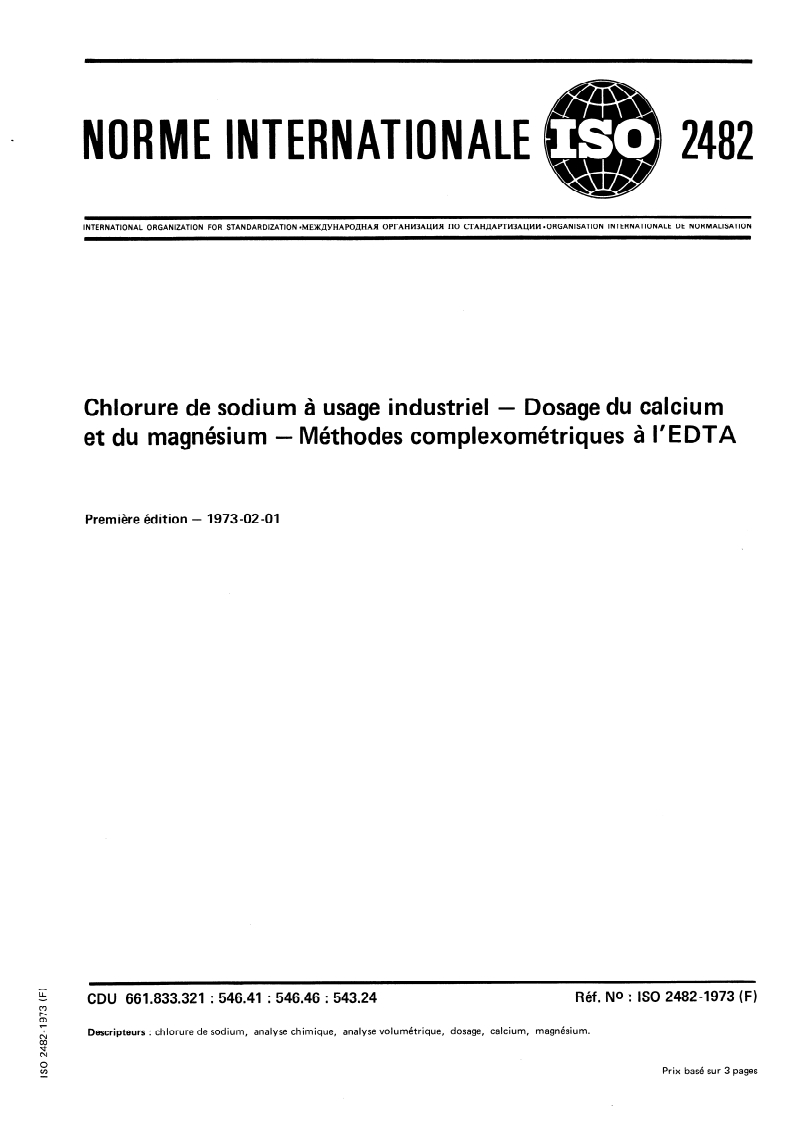
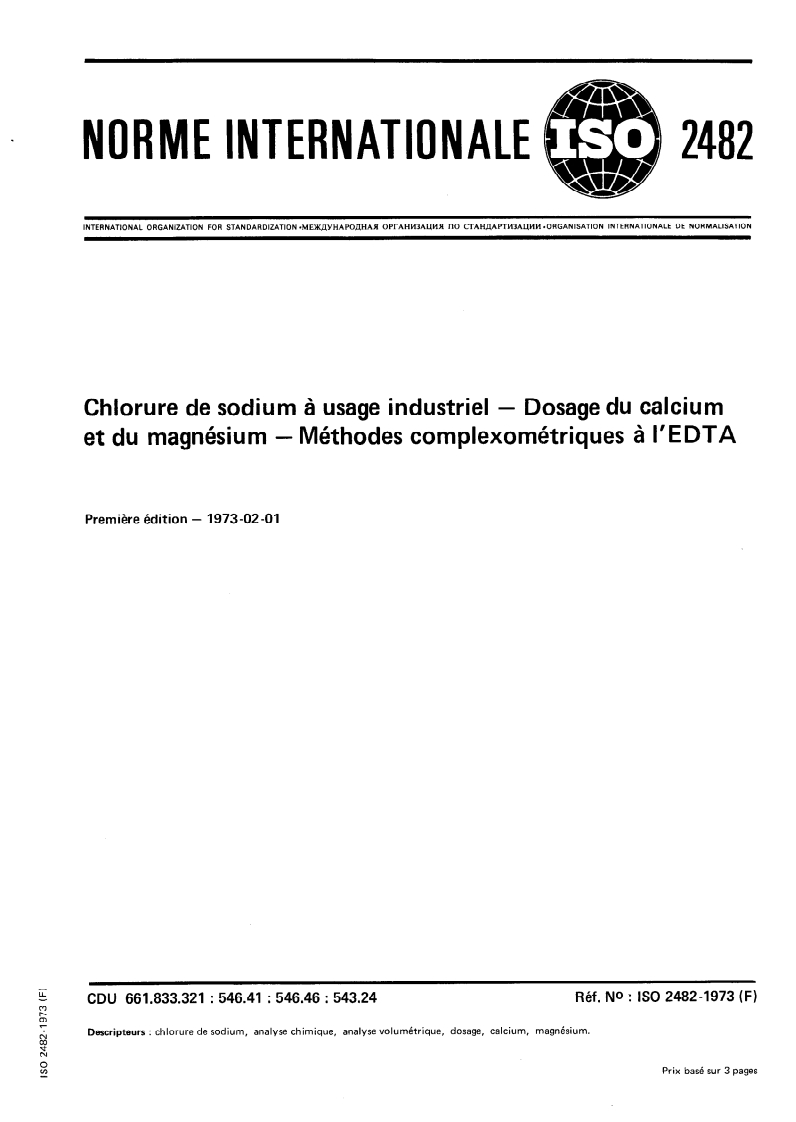
NORME INTERNATIONALE
INTERNATIONAL ORGANIZATION FOR STANDARDIZATION l MEXAYHAPO&HAR OPl-AHM3ALWl l-I0 CTAHflAPTL13ALJWM~ORGANISATION INTERNATIONALE DE NORMALISATION
Chlorure de sodium à usage industriel - Dosage du calcium
et du magnésium - Méthodes complexométriques à I’EDTA
Première édition - 1973-02-01
Réf. No : ISO 2482-1973 (F)
CDU 661.833.321 : 546.41 : 546.46 : 543.24
: chlorure de sodium, analyse chimique, analyse volumétrique, dosage, calcium, magnésium.
Descripteurs
Prix basé sur 3 pages
AVANT-PROPOS
ISO (Organisation Internationale de Normalisation) est une fédération mondiale
d’organismes nationaux de normalisation (Comités Membres KO). L’élaboration de
Normes Internationales est confiée aux Comités Techniques ISO. Chaque Comité
Membre intéressé par une étude a le droit de faire partie du Comité Technique
correspondant. Les organisations internationales, gouvernementales et non
gouvernementales, en liaison avec I’ISO, participent également aux travaux.
Les Projets de Normes Internationales adoptés par les Comités Techniques sont
soumis aux Comités Membres pour approbation, avant leur acceptation comme
Normes Internationales par le Conseil de I’ISO.
La Norme Internationale ISO 2482 a été établie par le Comité Technique
Chimie.
ISO/TC 47,
Elle fut approuvée en janvier 1972 par les Comités Membres des pays suivants :
Afrique du Sud, Rép. d’ Hongrie Roumanie
Inde Royaume-Uni
Allemagne
Autriche Irlande Suisse
Belgique Italie Tchécoslovaquie
Chili Maroc Thaïlande
Corée, Rép. dém.p. de Nouvelle-Zélande U.R.S.S.
Egypte, Rép. arabe d’ Pays-Bas U.S.A.
Pologne
Espagne
Portugal
France
Aucun Comité Membre n’a désapprouvé le document.
0 Organisation Internationale de Normalisation, 1973 l
Imprimé en Suisse
ISO 2482-1973 (F)
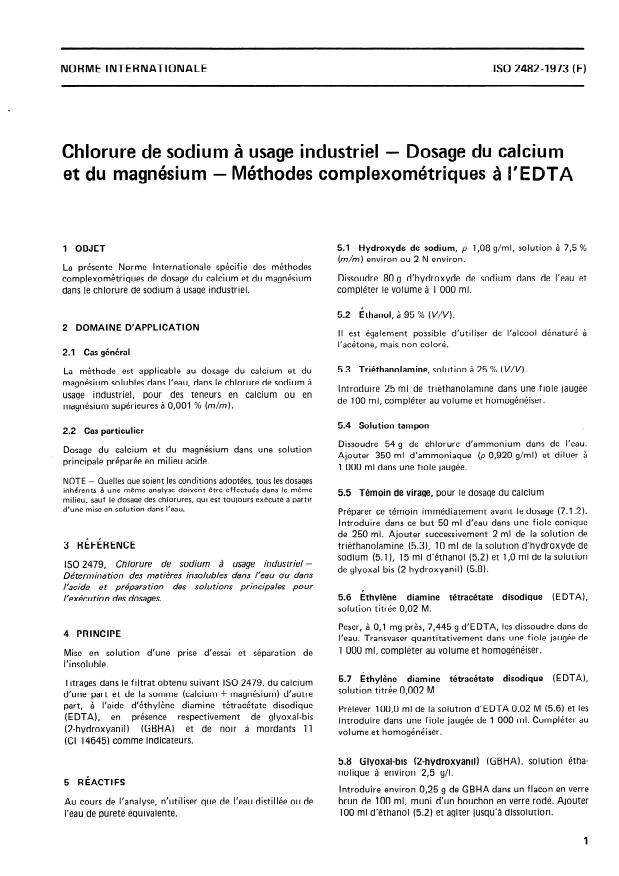
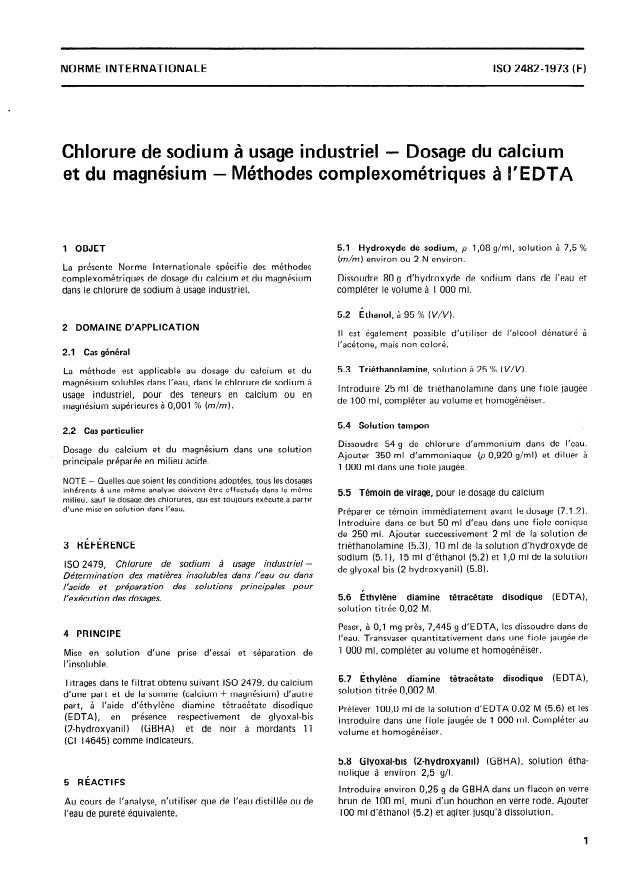
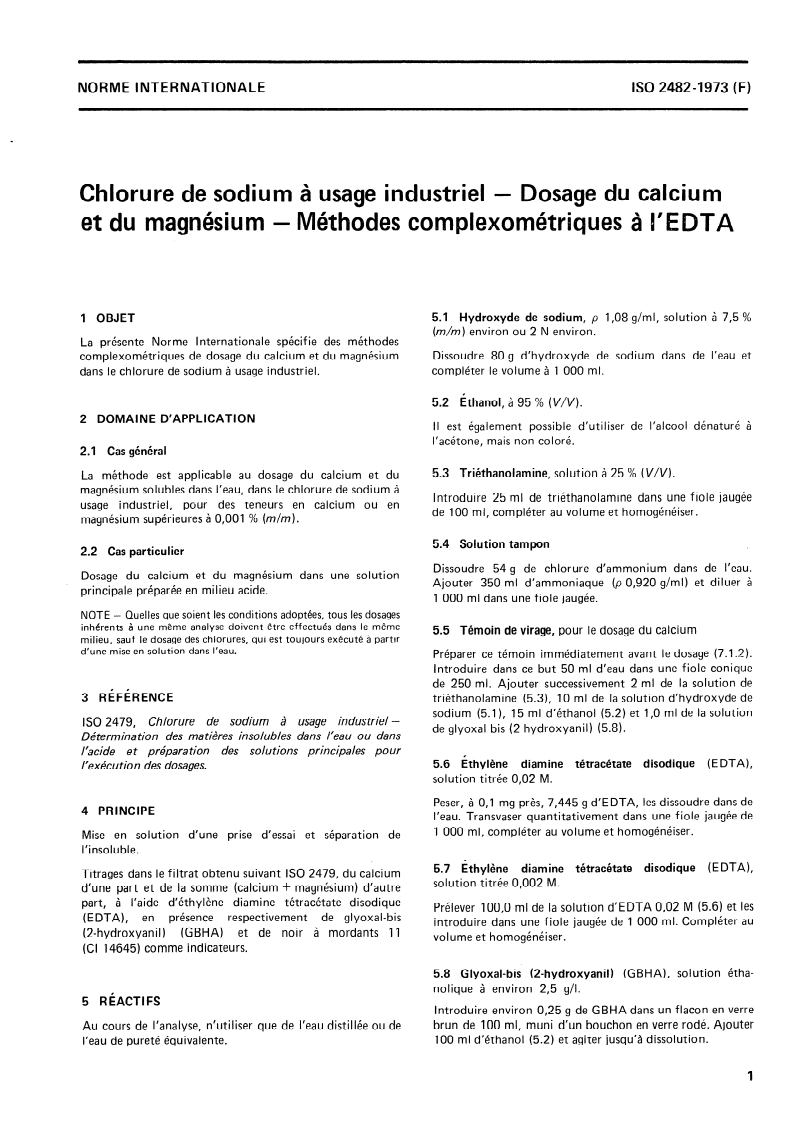
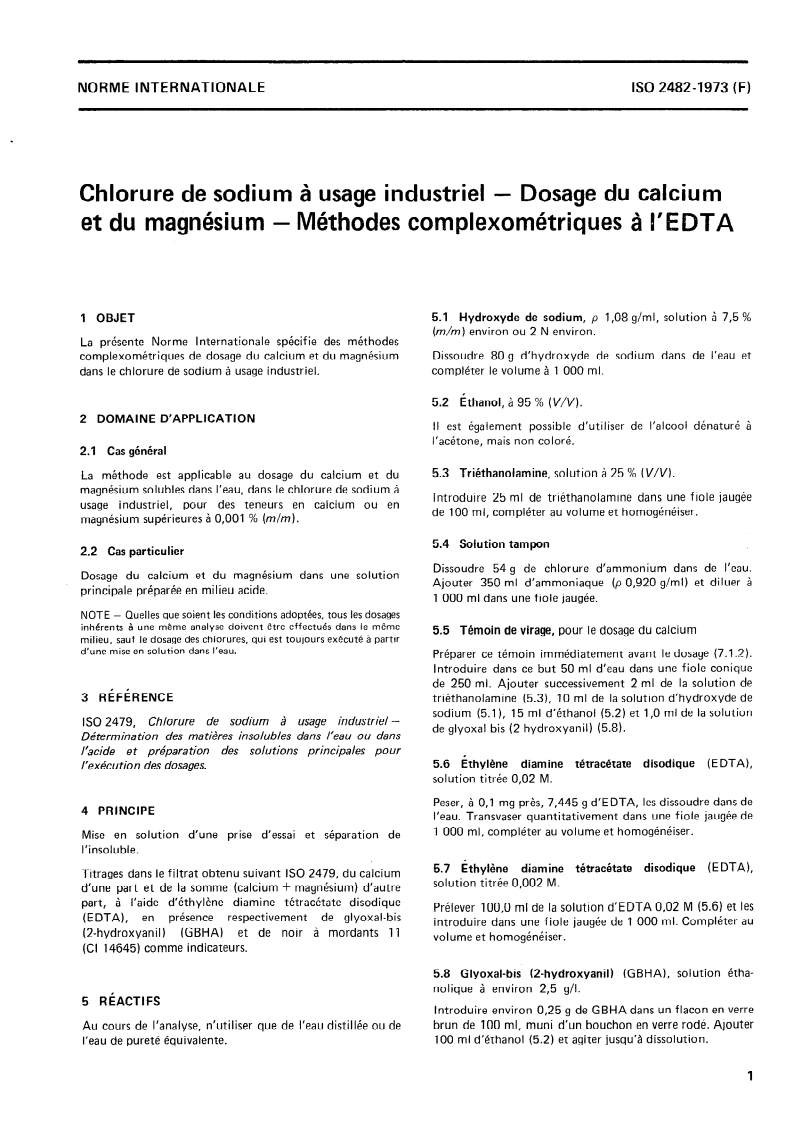
NORME INTERNATIONALE
Chlorure de sodium à usage industriel - Dosage du calcium
et du magnésium - Méthodes complexométriques à I’EDTA
5.1 Hydroxyde de sodium, p 1,08 g/ml, solution à 7,5 %
1 OBJET
(m/m) environ ou 2 N environ.
La présente Norme Internationale spécifie des méthodes
complexométriques de dosage du calcium et du magnésium Dissoudre 80 g d’hydroxyde de sodium dans de l’eau et
dans le chlorure de sodium à usage industriel. compléter le volume à 1 000 ml.
5.2 Éthanol, à 95 % (WV).
2 DOMAINE D’APPLICATION
II est également possible d’utiliser de l’alcool dénaturé à
l’acétone, mais non coloré.
2.1 Cas général
5.3 Triéthanolamine, solution à 25 % (WV).
La méthode est applicable au dosage du calcium et du
magnésium solubles dans l’eau, dans le chlorure de sodium à
Introduire 25 ml de triéthanolamine dans une fiole jaugée
usage industriel, pour des teneurs en calcium ou en
de 100 ml, compléter au volume et homogénéiser.
magnésium supérieures à 0,001 % (mlm).
5.4 Solution tampon
2.2 Cas particulier
Dissoudre 54 g de chlorure d’ammonium dans de l’eau.
Dosage du calcium et du magnésium dans une solution
Ajouter 350 ml d’ammoniaque (p 0,920 g/mI) et diluer à
principale préparée en milieu acide.
1 000 ml dans une fiole jaugée.
NOTE - Quelles que soient les conditions adoptées, tous les dosages
inhérents à une même analyse doivent être effectués dans le même
5.5 Témoin de virage, pour le dosage du calcium
milieu, sauf le dosage des chlorures, qui est toujours exécuté à partir
d’une mise en solution dans l’eau.
Préparer ce témoin immédiatement avant le dosage (7.1.2).
Introduire dans ce but 50 ml d’eau dans une fiole conique
de 250 ml. Ajouter successivement 2 ml de la solution de
3 RÉFÉRENCE
triéthanolamine (5.3), 10 ml de la solution d’hydroxyde de
sodium (5.1), 15 ml d’éthanol (5.2) et 1,O ml de la solution
ISO 2479, Chlorure de sodium à usage industriel -
de glyoxal bis (2 hydroxyanil) (5.8).
Détermination des matières insolubles dans l’eau ou dans
l’acide et préparation des solutions principales pour
5.6 Éthylène diamine tétracétate disodique (E DTA),
l’exécution des dosages.
solution titrée 0,02 M.
Peser, à 0,l mg près, 7,445 g d’EDTA, les dissoudre dans de
4 PRINCIPE
l’eau. Transvaser quantitativement dans une fiole jaugée de
1 000 ml, compléter au volume et homogénéiser.
Mise en solution d’une prise d’essai et séparation de
l’insoluble.
diamine tétracétate disodique (E DTA),
5.7 Ethylène
Titrages dans le filtrat obtenu suivant ISO 2479, du calcium
solution titrée 0,002 M.
d’une part et de la somme (calcium -t- magnésium) d’autre
part, à l’aide d’éthylène diamine tétracétate disodique
Prélever 100,O ml de la solution d’EDTA 0,02 M (5.6) et les
(EDTA), en présence respectivement de glyoxal-bis
introduire dans une fiole jaugée de 1 000 ml. Compléter au
(2-hydroxyanil) (GBHA) et de noir à mordants 11
volume et homogénéiser.
(Cl 14645) comme indicateurs.
5.8 Glyoxal-bis (2-hydroxyanil) (GBHA), solution étha-
nolique à environ 2,5 g/l.
5 RÉACTIFS
Introduire environ 0,25 g de GBHA dans un flacon en verre
brun de 100 ml, muni d’un bouchon en verre rodé. Ajouter
Au cours de l’analyse, n’utiliser que de l’eau distillée ou de
100 ml d’éthanol (5.2) et agiter jusqu’à dissolution.
l’eau de pureté équivalente.
ISO 24824973 (F)
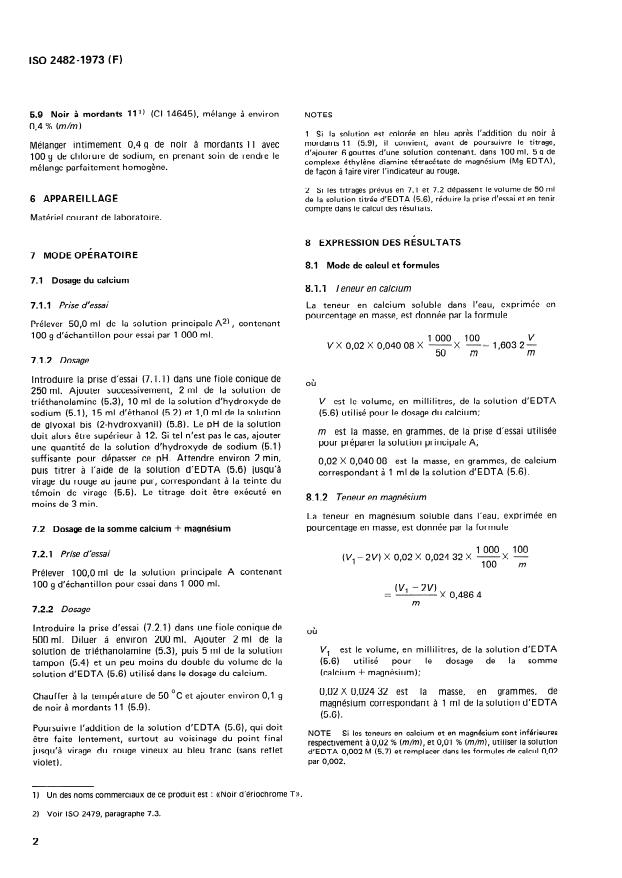
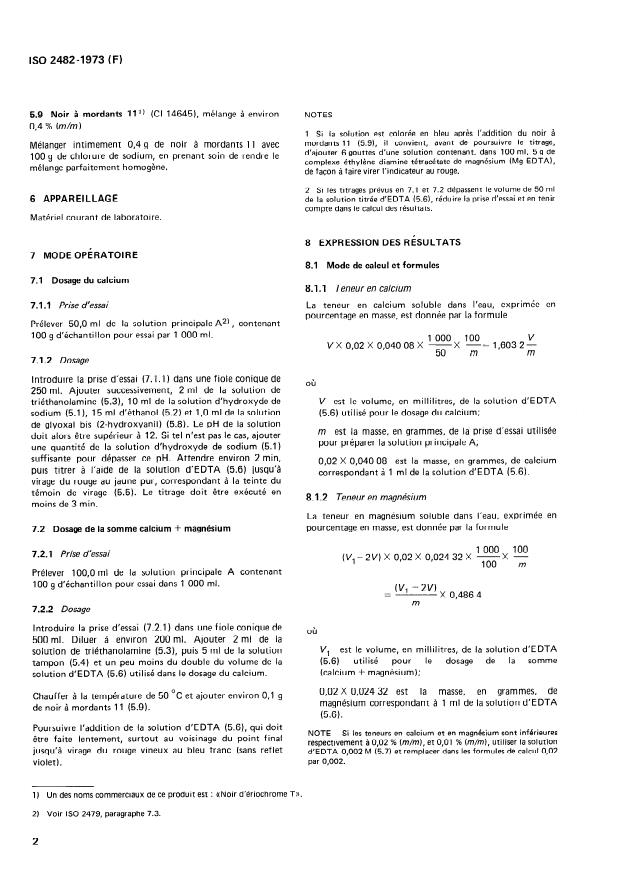
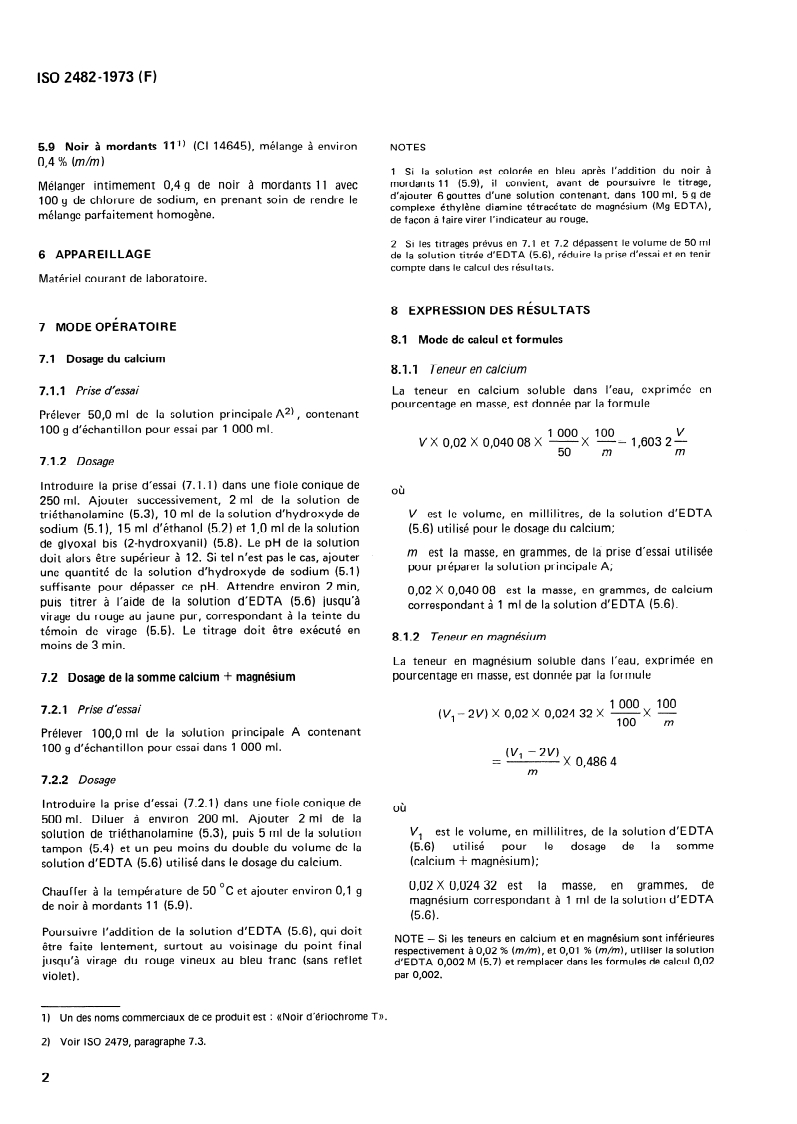
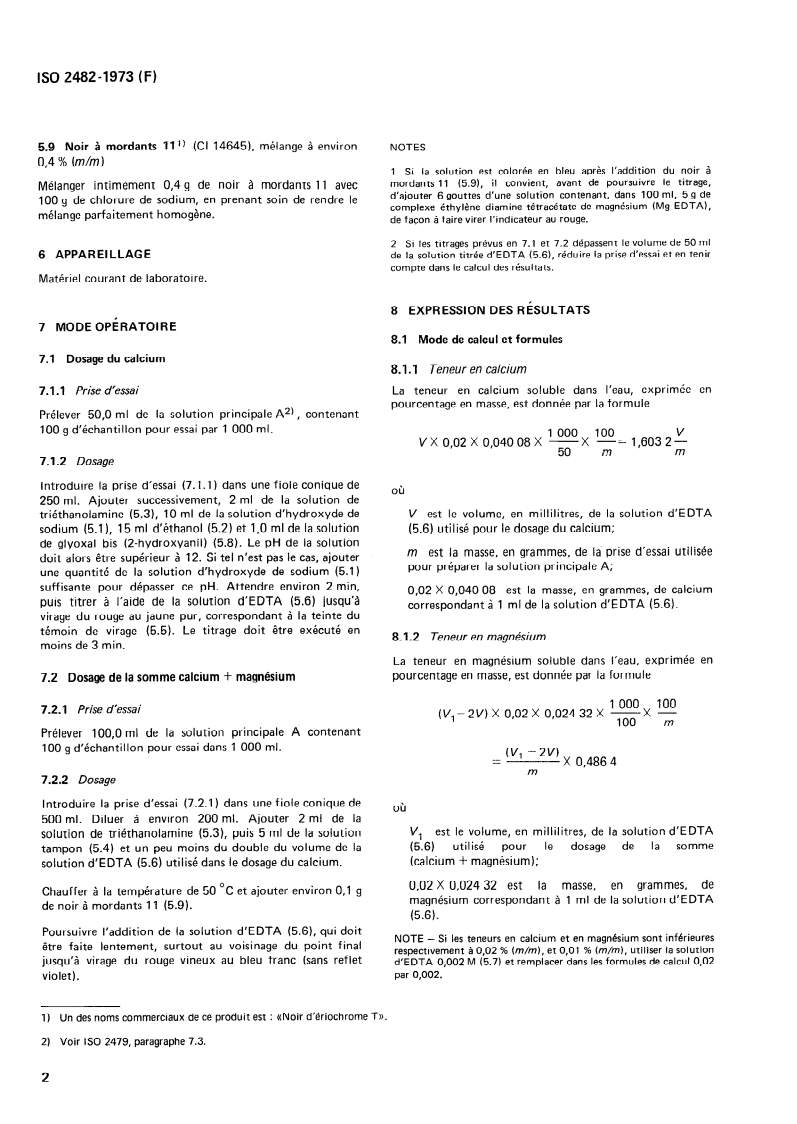
5.9 Noir à mordants 11 l) (Cl 14645), mélange à environ
NOTES
0,4 % (m/m)
1 Si la solution est colorée en bleu après l’addition du noir à
mordants 11 (5.9), il convient, avant de poursuivre le titrage,
Mélanger intimement 0,4 g de noir à mordants 11 avec
d’ajouter 6 gouttes d’une solution contenant, dans 100 ml, 5 g de
100 g de chlorure de sodium, en prenant soin de rendre le
complexe éthylène diamine tétracétate de magnésium (Mg EDTA),
mélange parfaitement homogène.
de facon à faire virer l’indicateur au rouge.
2 Si les titrages prévus en 7.1 et 7.2 dépassent le volume de 50 ml
6 APPAREILLAGE
de la solution titrée d’EDTA (5X), réduire la
...
~~~~~~
NORME INTERNATIONALE
INTERNATIONAL ORGANIZATION FOR STANDARDIZATION l MEXAYHAPO&HAR OPl-AHM3ALWl l-I0 CTAHflAPTL13ALJWM~ORGANISATION INTERNATIONALE DE NORMALISATION
Chlorure de sodium à usage industriel - Dosage du calcium
et du magnésium - Méthodes complexométriques à I’EDTA
Première édition - 1973-02-01
Réf. No : ISO 2482-1973 (F)
CDU 661.833.321 : 546.41 : 546.46 : 543.24
: chlorure de sodium, analyse chimique, analyse volumétrique, dosage, calcium, magnésium.
Descripteurs
Prix basé sur 3 pages
AVANT-PROPOS
ISO (Organisation Internationale de Normalisation) est une fédération mondiale
d’organismes nationaux de normalisation (Comités Membres KO). L’élaboration de
Normes Internationales est confiée aux Comités Techniques ISO. Chaque Comité
Membre intéressé par une étude a le droit de faire partie du Comité Technique
correspondant. Les organisations internationales, gouvernementales et non
gouvernementales, en liaison avec I’ISO, participent également aux travaux.
Les Projets de Normes Internationales adoptés par les Comités Techniques sont
soumis aux Comités Membres pour approbation, avant leur acceptation comme
Normes Internationales par le Conseil de I’ISO.
La Norme Internationale ISO 2482 a été établie par le Comité Technique
Chimie.
ISO/TC 47,
Elle fut approuvée en janvier 1972 par les Comités Membres des pays suivants :
Afrique du Sud, Rép. d’ Hongrie Roumanie
Inde Royaume-Uni
Allemagne
Autriche Irlande Suisse
Belgique Italie Tchécoslovaquie
Chili Maroc Thaïlande
Corée, Rép. dém.p. de Nouvelle-Zélande U.R.S.S.
Egypte, Rép. arabe d’ Pays-Bas U.S.A.
Pologne
Espagne
Portugal
France
Aucun Comité Membre n’a désapprouvé le document.
0 Organisation Internationale de Normalisation, 1973 l
Imprimé en Suisse
ISO 2482-1973 (F)
NORME INTERNATIONALE
Chlorure de sodium à usage industriel - Dosage du calcium
et du magnésium - Méthodes complexométriques à I’EDTA
5.1 Hydroxyde de sodium, p 1,08 g/ml, solution à 7,5 %
1 OBJET
(m/m) environ ou 2 N environ.
La présente Norme Internationale spécifie des méthodes
complexométriques de dosage du calcium et du magnésium Dissoudre 80 g d’hydroxyde de sodium dans de l’eau et
dans le chlorure de sodium à usage industriel. compléter le volume à 1 000 ml.
5.2 Éthanol, à 95 % (WV).
2 DOMAINE D’APPLICATION
II est également possible d’utiliser de l’alcool dénaturé à
l’acétone, mais non coloré.
2.1 Cas général
5.3 Triéthanolamine, solution à 25 % (WV).
La méthode est applicable au dosage du calcium et du
magnésium solubles dans l’eau, dans le chlorure de sodium à
Introduire 25 ml de triéthanolamine dans une fiole jaugée
usage industriel, pour des teneurs en calcium ou en
de 100 ml, compléter au volume et homogénéiser.
magnésium supérieures à 0,001 % (mlm).
5.4 Solution tampon
2.2 Cas particulier
Dissoudre 54 g de chlorure d’ammonium dans de l’eau.
Dosage du calcium et du magnésium dans une solution
Ajouter 350 ml d’ammoniaque (p 0,920 g/mI) et diluer à
principale préparée en milieu acide.
1 000 ml dans une fiole jaugée.
NOTE - Quelles que soient les conditions adoptées, tous les dosages
inhérents à une même analyse doivent être effectués dans le même
5.5 Témoin de virage, pour le dosage du calcium
milieu, sauf le dosage des chlorures, qui est toujours exécuté à partir
d’une mise en solution dans l’eau.
Préparer ce témoin immédiatement avant le dosage (7.1.2).
Introduire dans ce but 50 ml d’eau dans une fiole conique
de 250 ml. Ajouter successivement 2 ml de la solution de
3 RÉFÉRENCE
triéthanolamine (5.3), 10 ml de la solution d’hydroxyde de
sodium (5.1), 15 ml d’éthanol (5.2) et 1,O ml de la solution
ISO 2479, Chlorure de sodium à usage industriel -
de glyoxal bis (2 hydroxyanil) (5.8).
Détermination des matières insolubles dans l’eau ou dans
l’acide et préparation des solutions principales pour
5.6 Éthylène diamine tétracétate disodique (E DTA),
l’exécution des dosages.
solution titrée 0,02 M.
Peser, à 0,l mg près, 7,445 g d’EDTA, les dissoudre dans de
4 PRINCIPE
l’eau. Transvaser quantitativement dans une fiole jaugée de
1 000 ml, compléter au volume et homogénéiser.
Mise en solution d’une prise d’essai et séparation de
l’insoluble.
diamine tétracétate disodique (E DTA),
5.7 Ethylène
Titrages dans le filtrat obtenu suivant ISO 2479, du calcium
solution titrée 0,002 M.
d’une part et de la somme (calcium -t- magnésium) d’autre
part, à l’aide d’éthylène diamine tétracétate disodique
Prélever 100,O ml de la solution d’EDTA 0,02 M (5.6) et les
(EDTA), en présence respectivement de glyoxal-bis
introduire dans une fiole jaugée de 1 000 ml. Compléter au
(2-hydroxyanil) (GBHA) et de noir à mordants 11
volume et homogénéiser.
(Cl 14645) comme indicateurs.
5.8 Glyoxal-bis (2-hydroxyanil) (GBHA), solution étha-
nolique à environ 2,5 g/l.
5 RÉACTIFS
Introduire environ 0,25 g de GBHA dans un flacon en verre
brun de 100 ml, muni d’un bouchon en verre rodé. Ajouter
Au cours de l’analyse, n’utiliser que de l’eau distillée ou de
100 ml d’éthanol (5.2) et agiter jusqu’à dissolution.
l’eau de pureté équivalente.
ISO 24824973 (F)
5.9 Noir à mordants 11 l) (Cl 14645), mélange à environ
NOTES
0,4 % (m/m)
1 Si la solution est colorée en bleu après l’addition du noir à
mordants 11 (5.9), il convient, avant de poursuivre le titrage,
Mélanger intimement 0,4 g de noir à mordants 11 avec
d’ajouter 6 gouttes d’une solution contenant, dans 100 ml, 5 g de
100 g de chlorure de sodium, en prenant soin de rendre le
complexe éthylène diamine tétracétate de magnésium (Mg EDTA),
mélange parfaitement homogène.
de facon à faire virer l’indicateur au rouge.
2 Si les titrages prévus en 7.1 et 7.2 dépassent le volume de 50 ml
6 APPAREILLAGE
de la solution titrée d’EDTA (5X), réduire la
...
~~~~~~
NORME INTERNATIONALE
INTERNATIONAL ORGANIZATION FOR STANDARDIZATION l MEXAYHAPO&HAR OPl-AHM3ALWl l-I0 CTAHflAPTL13ALJWM~ORGANISATION INTERNATIONALE DE NORMALISATION
Chlorure de sodium à usage industriel - Dosage du calcium
et du magnésium - Méthodes complexométriques à I’EDTA
Première édition - 1973-02-01
Réf. No : ISO 2482-1973 (F)
CDU 661.833.321 : 546.41 : 546.46 : 543.24
: chlorure de sodium, analyse chimique, analyse volumétrique, dosage, calcium, magnésium.
Descripteurs
Prix basé sur 3 pages
AVANT-PROPOS
ISO (Organisation Internationale de Normalisation) est une fédération mondiale
d’organismes nationaux de normalisation (Comités Membres KO). L’élaboration de
Normes Internationales est confiée aux Comités Techniques ISO. Chaque Comité
Membre intéressé par une étude a le droit de faire partie du Comité Technique
correspondant. Les organisations internationales, gouvernementales et non
gouvernementales, en liaison avec I’ISO, participent également aux travaux.
Les Projets de Normes Internationales adoptés par les Comités Techniques sont
soumis aux Comités Membres pour approbation, avant leur acceptation comme
Normes Internationales par le Conseil de I’ISO.
La Norme Internationale ISO 2482 a été établie par le Comité Technique
Chimie.
ISO/TC 47,
Elle fut approuvée en janvier 1972 par les Comités Membres des pays suivants :
Afrique du Sud, Rép. d’ Hongrie Roumanie
Inde Royaume-Uni
Allemagne
Autriche Irlande Suisse
Belgique Italie Tchécoslovaquie
Chili Maroc Thaïlande
Corée, Rép. dém.p. de Nouvelle-Zélande U.R.S.S.
Egypte, Rép. arabe d’ Pays-Bas U.S.A.
Pologne
Espagne
Portugal
France
Aucun Comité Membre n’a désapprouvé le document.
0 Organisation Internationale de Normalisation, 1973 l
Imprimé en Suisse
ISO 2482-1973 (F)
NORME INTERNATIONALE
Chlorure de sodium à usage industriel - Dosage du calcium
et du magnésium - Méthodes complexométriques à I’EDTA
5.1 Hydroxyde de sodium, p 1,08 g/ml, solution à 7,5 %
1 OBJET
(m/m) environ ou 2 N environ.
La présente Norme Internationale spécifie des méthodes
complexométriques de dosage du calcium et du magnésium Dissoudre 80 g d’hydroxyde de sodium dans de l’eau et
dans le chlorure de sodium à usage industriel. compléter le volume à 1 000 ml.
5.2 Éthanol, à 95 % (WV).
2 DOMAINE D’APPLICATION
II est également possible d’utiliser de l’alcool dénaturé à
l’acétone, mais non coloré.
2.1 Cas général
5.3 Triéthanolamine, solution à 25 % (WV).
La méthode est applicable au dosage du calcium et du
magnésium solubles dans l’eau, dans le chlorure de sodium à
Introduire 25 ml de triéthanolamine dans une fiole jaugée
usage industriel, pour des teneurs en calcium ou en
de 100 ml, compléter au volume et homogénéiser.
magnésium supérieures à 0,001 % (mlm).
5.4 Solution tampon
2.2 Cas particulier
Dissoudre 54 g de chlorure d’ammonium dans de l’eau.
Dosage du calcium et du magnésium dans une solution
Ajouter 350 ml d’ammoniaque (p 0,920 g/mI) et diluer à
principale préparée en milieu acide.
1 000 ml dans une fiole jaugée.
NOTE - Quelles que soient les conditions adoptées, tous les dosages
inhérents à une même analyse doivent être effectués dans le même
5.5 Témoin de virage, pour le dosage du calcium
milieu, sauf le dosage des chlorures, qui est toujours exécuté à partir
d’une mise en solution dans l’eau.
Préparer ce témoin immédiatement avant le dosage (7.1.2).
Introduire dans ce but 50 ml d’eau dans une fiole conique
de 250 ml. Ajouter successivement 2 ml de la solution de
3 RÉFÉRENCE
triéthanolamine (5.3), 10 ml de la solution d’hydroxyde de
sodium (5.1), 15 ml d’éthanol (5.2) et 1,O ml de la solution
ISO 2479, Chlorure de sodium à usage industriel -
de glyoxal bis (2 hydroxyanil) (5.8).
Détermination des matières insolubles dans l’eau ou dans
l’acide et préparation des solutions principales pour
5.6 Éthylène diamine tétracétate disodique (E DTA),
l’exécution des dosages.
solution titrée 0,02 M.
Peser, à 0,l mg près, 7,445 g d’EDTA, les dissoudre dans de
4 PRINCIPE
l’eau. Transvaser quantitativement dans une fiole jaugée de
1 000 ml, compléter au volume et homogénéiser.
Mise en solution d’une prise d’essai et séparation de
l’insoluble.
diamine tétracétate disodique (E DTA),
5.7 Ethylène
Titrages dans le filtrat obtenu suivant ISO 2479, du calcium
solution titrée 0,002 M.
d’une part et de la somme (calcium -t- magnésium) d’autre
part, à l’aide d’éthylène diamine tétracétate disodique
Prélever 100,O ml de la solution d’EDTA 0,02 M (5.6) et les
(EDTA), en présence respectivement de glyoxal-bis
introduire dans une fiole jaugée de 1 000 ml. Compléter au
(2-hydroxyanil) (GBHA) et de noir à mordants 11
volume et homogénéiser.
(Cl 14645) comme indicateurs.
5.8 Glyoxal-bis (2-hydroxyanil) (GBHA), solution étha-
nolique à environ 2,5 g/l.
5 RÉACTIFS
Introduire environ 0,25 g de GBHA dans un flacon en verre
brun de 100 ml, muni d’un bouchon en verre rodé. Ajouter
Au cours de l’analyse, n’utiliser que de l’eau distillée ou de
100 ml d’éthanol (5.2) et agiter jusqu’à dissolution.
l’eau de pureté équivalente.
ISO 24824973 (F)
5.9 Noir à mordants 11 l) (Cl 14645), mélange à environ
NOTES
0,4 % (m/m)
1 Si la solution est colorée en bleu après l’addition du noir à
mordants 11 (5.9), il convient, avant de poursuivre le titrage,
Mélanger intimement 0,4 g de noir à mordants 11 avec
d’ajouter 6 gouttes d’une solution contenant, dans 100 ml, 5 g de
100 g de chlorure de sodium, en prenant soin de rendre le
complexe éthylène diamine tétracétate de magnésium (Mg EDTA),
mélange parfaitement homogène.
de facon à faire virer l’indicateur au rouge.
2 Si les titrages prévus en 7.1 et 7.2 dépassent le volume de 50 ml
6 APPAREILLAGE
de la solution titrée d’EDTA (5X), réduire la
...
~~~~~~
NORME INTERNATIONALE
INTERNATIONAL ORGANIZATION FOR STANDARDIZATION l MEXAYHAPO&HAR OPl-AHM3ALWl l-I0 CTAHflAPTL13ALJWM~ORGANISATION INTERNATIONALE DE NORMALISATION
Chlorure de sodium à usage industriel - Dosage du calcium
et du magnésium - Méthodes complexométriques à I’EDTA
Première édition - 1973-02-01
Réf. No : ISO 2482-1973 (F)
CDU 661.833.321 : 546.41 : 546.46 : 543.24
: chlorure de sodium, analyse chimique, analyse volumétrique, dosage, calcium, magnésium.
Descripteurs
Prix basé sur 3 pages
AVANT-PROPOS
ISO (Organisation Internationale de Normalisation) est une fédération mondiale
d’organismes nationaux de normalisation (Comités Membres KO). L’élaboration de
Normes Internationales est confiée aux Comités Techniques ISO. Chaque Comité
Membre intéressé par une étude a le droit de faire partie du Comité Technique
correspondant. Les organisations internationales, gouvernementales et non
gouvernementales, en liaison avec I’ISO, participent également aux travaux.
Les Projets de Normes Internationales adoptés par les Comités Techniques sont
soumis aux Comités Membres pour approbation, avant leur acceptation comme
Normes Internationales par le Conseil de I’ISO.
La Norme Internationale ISO 2482 a été établie par le Comité Technique
Chimie.
ISO/TC 47,
Elle fut approuvée en janvier 1972 par les Comités Membres des pays suivants :
Afrique du Sud, Rép. d’ Hongrie Roumanie
Inde Royaume-Uni
Allemagne
Autriche Irlande Suisse
Belgique Italie Tchécoslovaquie
Chili Maroc Thaïlande
Corée, Rép. dém.p. de Nouvelle-Zélande U.R.S.S.
Egypte, Rép. arabe d’ Pays-Bas U.S.A.
Pologne
Espagne
Portugal
France
Aucun Comité Membre n’a désapprouvé le document.
0 Organisation Internationale de Normalisation, 1973 l
Imprimé en Suisse
ISO 2482-1973 (F)
NORME INTERNATIONALE
Chlorure de sodium à usage industriel - Dosage du calcium
et du magnésium - Méthodes complexométriques à I’EDTA
5.1 Hydroxyde de sodium, p 1,08 g/ml, solution à 7,5 %
1 OBJET
(m/m) environ ou 2 N environ.
La présente Norme Internationale spécifie des méthodes
complexométriques de dosage du calcium et du magnésium Dissoudre 80 g d’hydroxyde de sodium dans de l’eau et
dans le chlorure de sodium à usage industriel. compléter le volume à 1 000 ml.
5.2 Éthanol, à 95 % (WV).
2 DOMAINE D’APPLICATION
II est également possible d’utiliser de l’alcool dénaturé à
l’acétone, mais non coloré.
2.1 Cas général
5.3 Triéthanolamine, solution à 25 % (WV).
La méthode est applicable au dosage du calcium et du
magnésium solubles dans l’eau, dans le chlorure de sodium à
Introduire 25 ml de triéthanolamine dans une fiole jaugée
usage industriel, pour des teneurs en calcium ou en
de 100 ml, compléter au volume et homogénéiser.
magnésium supérieures à 0,001 % (mlm).
5.4 Solution tampon
2.2 Cas particulier
Dissoudre 54 g de chlorure d’ammonium dans de l’eau.
Dosage du calcium et du magnésium dans une solution
Ajouter 350 ml d’ammoniaque (p 0,920 g/mI) et diluer à
principale préparée en milieu acide.
1 000 ml dans une fiole jaugée.
NOTE - Quelles que soient les conditions adoptées, tous les dosages
inhérents à une même analyse doivent être effectués dans le même
5.5 Témoin de virage, pour le dosage du calcium
milieu, sauf le dosage des chlorures, qui est toujours exécuté à partir
d’une mise en solution dans l’eau.
Préparer ce témoin immédiatement avant le dosage (7.1.2).
Introduire dans ce but 50 ml d’eau dans une fiole conique
de 250 ml. Ajouter successivement 2 ml de la solution de
3 RÉFÉRENCE
triéthanolamine (5.3), 10 ml de la solution d’hydroxyde de
sodium (5.1), 15 ml d’éthanol (5.2) et 1,O ml de la solution
ISO 2479, Chlorure de sodium à usage industriel -
de glyoxal bis (2 hydroxyanil) (5.8).
Détermination des matières insolubles dans l’eau ou dans
l’acide et préparation des solutions principales pour
5.6 Éthylène diamine tétracétate disodique (E DTA),
l’exécution des dosages.
solution titrée 0,02 M.
Peser, à 0,l mg près, 7,445 g d’EDTA, les dissoudre dans de
4 PRINCIPE
l’eau. Transvaser quantitativement dans une fiole jaugée de
1 000 ml, compléter au volume et homogénéiser.
Mise en solution d’une prise d’essai et séparation de
l’insoluble.
diamine tétracétate disodique (E DTA),
5.7 Ethylène
Titrages dans le filtrat obtenu suivant ISO 2479, du calcium
solution titrée 0,002 M.
d’une part et de la somme (calcium -t- magnésium) d’autre
part, à l’aide d’éthylène diamine tétracétate disodique
Prélever 100,O ml de la solution d’EDTA 0,02 M (5.6) et les
(EDTA), en présence respectivement de glyoxal-bis
introduire dans une fiole jaugée de 1 000 ml. Compléter au
(2-hydroxyanil) (GBHA) et de noir à mordants 11
volume et homogénéiser.
(Cl 14645) comme indicateurs.
5.8 Glyoxal-bis (2-hydroxyanil) (GBHA), solution étha-
nolique à environ 2,5 g/l.
5 RÉACTIFS
Introduire environ 0,25 g de GBHA dans un flacon en verre
brun de 100 ml, muni d’un bouchon en verre rodé. Ajouter
Au cours de l’analyse, n’utiliser que de l’eau distillée ou de
100 ml d’éthanol (5.2) et agiter jusqu’à dissolution.
l’eau de pureté équivalente.
ISO 24824973 (F)
5.9 Noir à mordants 11 l) (Cl 14645), mélange à environ
NOTES
0,4 % (m/m)
1 Si la solution est colorée en bleu après l’addition du noir à
mordants 11 (5.9), il convient, avant de poursuivre le titrage,
Mélanger intimement 0,4 g de noir à mordants 11 avec
d’ajouter 6 gouttes d’une solution contenant, dans 100 ml, 5 g de
100 g de chlorure de sodium, en prenant soin de rendre le
complexe éthylène diamine tétracétate de magnésium (Mg EDTA),
mélange parfaitement homogène.
de facon à faire virer l’indicateur au rouge.
2 Si les titrages prévus en 7.1 et 7.2 dépassent le volume de 50 ml
6 APPAREILLAGE
de la solution titrée d’EDTA (5X), réduire la
...