

ISO 13616-2:2020
(Main)Financial services — International bank account number (IBAN) — Part 2: Role and responsibilities of the Registration Authority
General Information
- Abstract
This document describes the Registration Authority (RA) responsible for the registry of IBAN formats that conform with ISO 13616-1, the procedures for registering IBAN formats that conform with the ISO 13616 series and the structure of the registry.
- Status
- Published
- Publication Date
- 30-Sep-2020
- Technical Committee
- ISO/TC 68/SC 8 - Reference data for financial services
- Drafting Committee
- ISO/TC 68/SC 8 - Reference data for financial services
- Current Stage
- 9093 - International Standard confirmed
- Start Date
- 15-Apr-2026
- Completion Date
- 29-Aug-2026
Buy Documents
ISO 13616-2:2020 - Financial services -- International bank account number (IBAN)
ISO 13616-2:2020 - Financial services — International bank account number (IBAN) — Part 2: Role and responsibilities of the Registration Authority/1/2020
Overview
ISO 13616-2:2020 is an international standard published by ISO, focusing on the role and responsibilities of the Registration Authority (RA) for the International Bank Account Number (IBAN) registry. As part of the ISO 13616 series, this document specifically defines procedures associated with the registration and maintenance of IBAN formats that comply with ISO 13616-1. The standard aims to support global financial services by ensuring consistency, accuracy, and transparency in the registration and use of IBANs, which are crucial for international payments and cross-border transactions.
Key Topics
Appointment of the Registration Authority
The RA is appointed under an agreement with ISO and is responsible for creating, maintaining, and publishing the IBAN registry, as well as reporting to ISO technical committees.Responsibilities of the Registration Authority
- Maintaining a comprehensive IBAN registry conforming to ISO 13616 series standards
- Publishing the registry online and submitting updates for ISO review
- Retaining records of all registry applications and their outcomes
Procedures for IBAN Format Registration
- National standards bodies or competent authorities submit IBAN formats for their countries
- Submissions must adhere to requirements outlined in ISO 13616-1, including country codes, IBAN structure, and examples in electronic and print formats
- The RA validates and publishes the IBAN formats after review
Structure of the IBAN Registry
- The registry contains key data for each country, such as country name, ISO code, bank identifier details, BBAN structure, and sample IBANs
- Data submitted include both mandatory elements (like country code, IBAN length) and practical examples for clarity
Service Level Agreement (SLA)
- The RA acknowledges receipt and validates new submissions within defined timeframes
- Updates and approved formats are published promptly to ensure accuracy and reliability
Intellectual Property and Data Ownership
- Contributing organizations retain intellectual property rights over submitted information
- Data in the registry is licensed for public use to encourage widespread adoption and uniformity
Applications
ISO 13616-2:2020 is essential for organizations and authorities involved in international banking and financial transactions. Key applications include:
- Harmonizing International Account Numbering: The standard underpins reliable account identification for cross-border payments, reducing errors and manual intervention.
- Supporting Automated Payment Processing: Machine-readable and validated IBAN formats facilitate straight-through processing (STP), improving speed and confidence in financial transactions.
- Guiding National Implementation: National standards bodies and competent authorities use this standard to register and maintain their country-specific IBAN formats, ensuring global consistency.
- Enabling Transparent Registry Access: By standardizing registry structure and access, the RA ensures that financial institutions, regulators, and service providers have trustworthy reference data for transaction validation.
Related Standards
- ISO 13616-1: Financial services - International bank account number (IBAN) - Part 1: Structure of the IBAN. This standard defines the technical requirements for the construction and validation of IBANs.
- ISO 3166-1: Codes for the representation of names of countries and their subdivisions. This standard is crucial for the consistent use of country codes in IBAN formats.
- Relevant ISO/IEC Directives: These outline the governance, maintenance, and compliance processes for all ISO standards.
For those engaged in payment services, compliance, and international fund transfers, adhering to ISO 13616-2:2020 helps ensure that IBAN-related operations remain efficient, uniform, and secure on a global scale.
Relations
- Effective Date
- 09-May-2020
Buy Documents
ISO 13616-2:2020 - Financial services -- International bank account number (IBAN)
ISO 13616-2:2020 - Financial services — International bank account number (IBAN) — Part 2: Role and responsibilities of the Registration Authority/1/2020
Get Certified
Connect with accredited certification bodies for this standard

Great Wall Tianjin Quality Assurance Center
Established 1993, first batch to receive national accreditation with IAF recognition.
Hong Kong Quality Assurance Agency (HKQAA)
Hong Kong's leading certification body.

Innovative Quality Certifications Pvt. Ltd. (IQCPL)
Known for integrity, providing ethical & impartial Assessment & Certification. CMMI Institute Partner.
Sponsored listings
Frequently Asked Questions
ISO 13616-2:2020 is a standard published by the International Organization for Standardization (ISO). Its full title is "Financial services — International bank account number (IBAN) — Part 2: Role and responsibilities of the Registration Authority". This standard covers: This document describes the Registration Authority (RA) responsible for the registry of IBAN formats that conform with ISO 13616-1, the procedures for registering IBAN formats that conform with the ISO 13616 series and the structure of the registry.
This document describes the Registration Authority (RA) responsible for the registry of IBAN formats that conform with ISO 13616-1, the procedures for registering IBAN formats that conform with the ISO 13616 series and the structure of the registry.
ISO 13616-2:2020 is classified under the following ICS (International Classification for Standards) categories: 03.060 - Finances. Banking. Monetary systems. Insurance. The ICS classification helps identify the subject area and facilitates finding related standards.
ISO 13616-2:2020 has the following relationships with other standards: It is inter standard links to ISO 13616-2:2007. Understanding these relationships helps ensure you are using the most current and applicable version of the standard.
ISO 13616-2:2020 is available in PDF format for immediate download after purchase. The document can be added to your cart and obtained through the secure checkout process. Digital delivery ensures instant access to the complete standard document.
Standards Content (Sample)
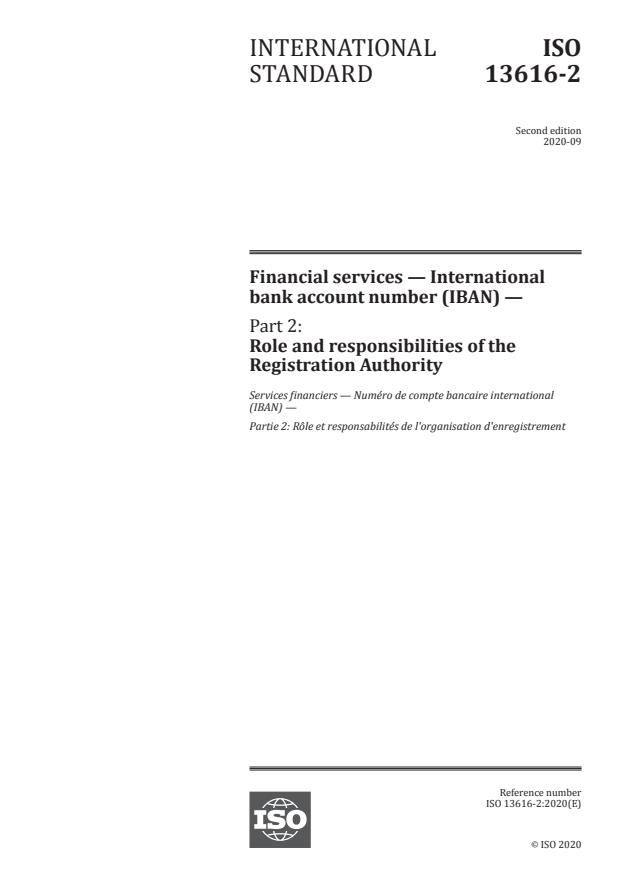
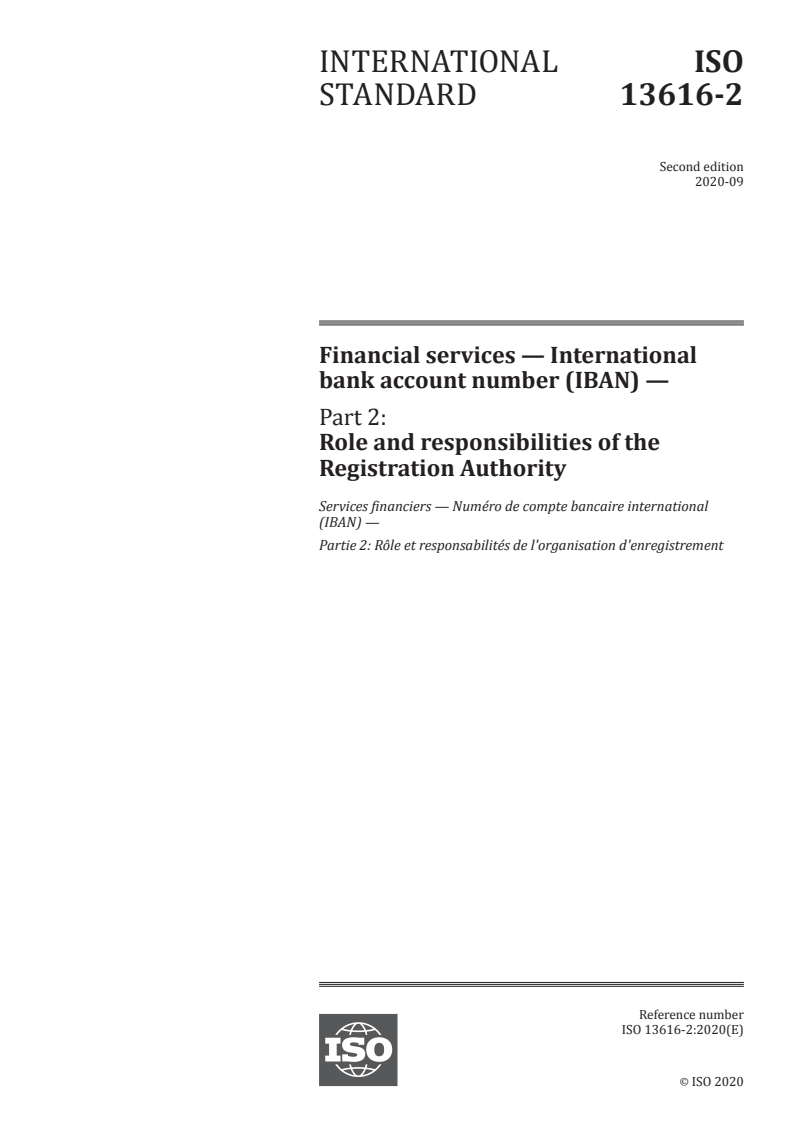
INTERNATIONAL ISO
STANDARD 13616-2
Second edition
2020-09
Financial services — International
bank account number (IBAN) —
Part 2:
Role and responsibilities of the
Registration Authority
Services financiers — Numéro de compte bancaire international
(IBAN) —
Partie 2: Rôle et responsabilités de l'organisation d'enregistrement
Reference number
©
ISO 2020
© ISO 2020
All rights reserved. Unless otherwise specified, or required in the context of its implementation, no part of this publication may
be reproduced or utilized otherwise in any form or by any means, electronic or mechanical, including photocopying, or posting
on the internet or an intranet, without prior written permission. Permission can be requested from either ISO at the address
below or ISO’s member body in the country of the requester.
ISO copyright office
CP 401 • Ch. de Blandonnet 8
CH-1214 Vernier, Geneva
Phone: +41 22 749 01 11
Email: copyright@iso.org
Website: www.iso.org
Published in Switzerland
ii © ISO 2020 – All rights reserved
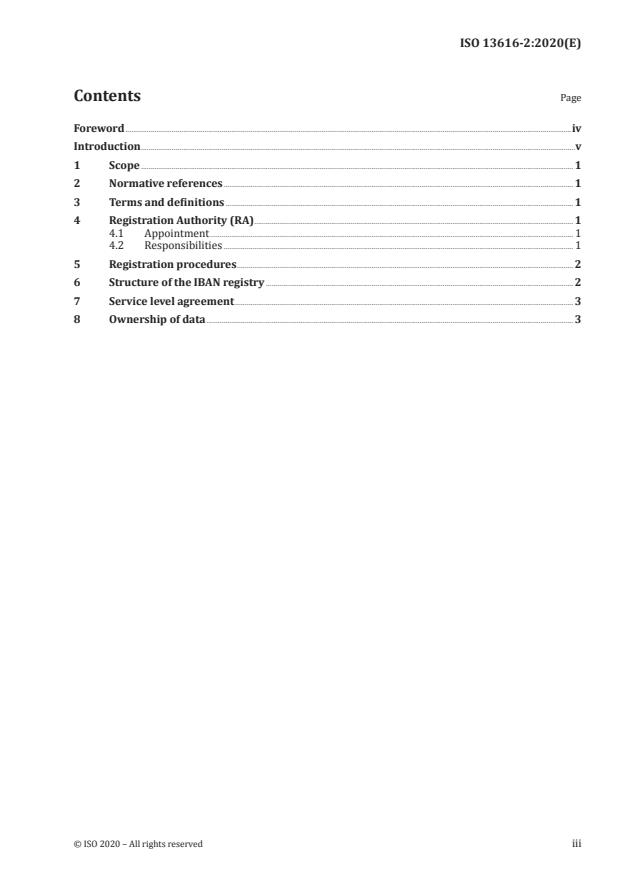
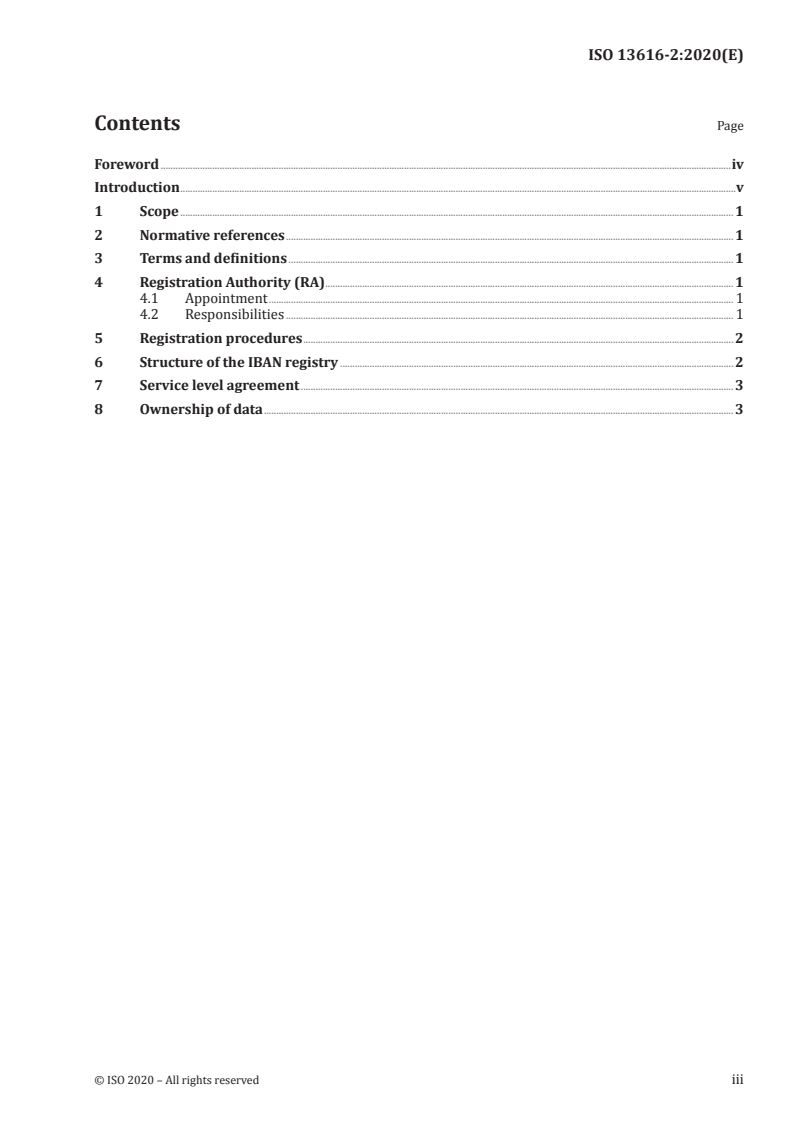
Contents Page
Foreword .iv
Introduction .v
1 Scope . 1
2 Normative references . 1
3 Terms and definitions . 1
4 R egistration Authority (RA) . 1
4.1 Appointment . 1
4.2 Responsibilities . 1
5 Registration procedures . 2
6 Structure of the IBAN registry . 2
7 Service level agreement . 3
8 Ownership of data . 3
Foreword
ISO (the International Organization for Standardization) is a worldwide federation of national standards
bodies (ISO member bodies). The work of preparing International Standards is normally carried out
through ISO technical committees. Each member body interested in a subject for which a technical
committee has been established has the right to be represented on that committee. International
organizations, governmental and non-governmental, in liaison with ISO, also take part in the work.
ISO collaborates closely with the International Electrotechnical Commission (IEC) on all matters of
electrotechnical standardization.
The procedures used to develop this document and those intended for its further maintenance are
described in the ISO/IEC Directives, Part 1. In particular, the different approval criteria needed for the
different types of ISO documents should be noted. This document was drafted in accordance with the
editorial rules of the ISO/IEC Directives, Part 2 (see www .iso .org/ directives).
Attention is drawn to the possibility that some of the elements of this document may be the subject of
patent rights. ISO shall not be held responsible for identifying any or all such patent rights. Details of
any patent rights identified during the development of the document will be in the Introduction and/or
on the ISO list of patent declarations received (see www .iso .org/ patents).
Any trade name used in this document is information given for the convenience of users and does not
constitute an endorsement.
For an explanation of the voluntary nature of standards, the meaning of ISO specific terms and
expressions related to conformity assessment, as well as information about ISO's adherence to the
World Trade Organization (WTO) principles in the Technical Barriers to Trade (TBT), see www .iso .org/
iso/ foreword .html.
This document was prepared by Technical Committee ISO/TC 68, Financial services, Subcommittee SC
8, Reference data for financial services.
This second edition cancels and replaces the first edition (ISO 13616-2:2007), of which it constitutes a
minor revision. The changes to the previous edition are as follows:
— updates of the Foreword and the Introduction;
— minor editorial changes.
A list of all parts in the ISO 13616 series can be found on the ISO website.
Any feedback or questions on this document should be directed to the user’s national standards body. A
complete listing of these bodies can be found at www .iso .org/ members .html.
iv © ISO 2020 – All rights reserved
Introduction
The use of electronic communication media and services internationally for the cross-border
transmission of information and payment-related transactions between financial institutions, as well
as between financial institutions and their customers, continues to increase. In order to facilitate
automated processes in support of straight through processing (STP) in this environment, the ISO 13616
series has been developed as a means by which financial institutions and their customers can exchange,
through inter-industry electronic data interchange (EDI), customer account identification details in a
machine-readable form. It also makes provision for validation of the information provided.
In developing the ISO 13616 series, it was recognized that a single, universal method for identifying the
account and banking relationship for customers of financial institutions was not practical. Accordingly,
the ISO 13616 series recognizes that financial institutions would wish to retain, wherever possible, their
current national identification methods. It therefore provides a method whereby a minimum amount
of change to existing systems is required and, at the same time, proposes a means of structuring the
information in a way that promotes automated proce
...
INTERNATIONAL ISO
STANDARD 13616-2
Second edition
2020-09
Financial services — International
bank account number (IBAN) —
Part 2:
Role and responsibilities of the
Registration Authority
Services financiers — Numéro de compte bancaire international
(IBAN) —
Partie 2: Rôle et responsabilités de l'organisation d'enregistrement
Reference number
©
ISO 2020
© ISO 2020
All rights reserved. Unless otherwise specified, or required in the context of its implementation, no part of this publication may
be reproduced or utilized otherwise in any form or by any means, electronic or mechanical, including photocopying, or posting
on the internet or an intranet, without prior written permission. Permission can be requested from either ISO at the address
below or ISO’s member body in the country of the requester.
ISO copyright office
CP 401 • Ch. de Blandonnet 8
CH-1214 Vernier, Geneva
Phone: +41 22 749 01 11
Email: copyright@iso.org
Website: www.iso.org
Published in Switzerland
ii © ISO 2020 – All rights reserved
Contents Page
Foreword .iv
Introduction .v
1 Scope . 1
2 Normative references . 1
3 Terms and definitions . 1
4 R egistration Authority (RA) . 1
4.1 Appointment . 1
4.2 Responsibilities . 1
5 Registration procedures . 2
6 Structure of the IBAN registry . 2
7 Service level agreement . 3
8 Ownership of data . 3
Foreword
ISO (the International Organization for Standardization) is a worldwide federation of national standards
bodies (ISO member bodies). The work of preparing International Standards is normally carried out
through ISO technical committees. Each member body interested in a subject for which a technical
committee has been established has the right to be represented on that committee. International
organizations, governmental and non-governmental, in liaison with ISO, also take part in the work.
ISO collaborates closely with the International Electrotechnical Commission (IEC) on all matters of
electrotechnical standardization.
The procedures used to develop this document and those intended for its further maintenance are
described in the ISO/IEC Directives, Part 1. In particular, the different approval criteria needed for the
different types of ISO documents should be noted. This document was drafted in accordance with the
editorial rules of the ISO/IEC Directives, Part 2 (see www .iso .org/ directives).
Attention is drawn to the possibility that some of the elements of this document may be the subject of
patent rights. ISO shall not be held responsible for identifying any or all such patent rights. Details of
any patent rights identified during the development of the document will be in the Introduction and/or
on the ISO list of patent declarations received (see www .iso .org/ patents).
Any trade name used in this document is information given for the convenience of users and does not
constitute an endorsement.
For an explanation of the voluntary nature of standards, the meaning of ISO specific terms and
expressions related to conformity assessment, as well as information about ISO's adherence to the
World Trade Organization (WTO) principles in the Technical Barriers to Trade (TBT), see www .iso .org/
iso/ foreword .html.
This document was prepared by Technical Committee ISO/TC 68, Financial services, Subcommittee SC
8, Reference data for financial services.
This second edition cancels and replaces the first edition (ISO 13616-2:2007), of which it constitutes a
minor revision. The changes to the previous edition are as follows:
— updates of the Foreword and the Introduction;
— minor editorial changes.
A list of all parts in the ISO 13616 series can be found on the ISO website.
Any feedback or questions on this document should be directed to the user’s national standards body. A
complete listing of these bodies can be found at www .iso .org/ members .html.
iv © ISO 2020 – All rights reserved
Introduction
The use of electronic communication media and services internationally for the cross-border
transmission of information and payment-related transactions between financial institutions, as well
as between financial institutions and their customers, continues to increase. In order to facilitate
automated processes in support of straight through processing (STP) in this environment, the ISO 13616
series has been developed as a means by which financial institutions and their customers can exchange,
through inter-industry electronic data interchange (EDI), customer account identification details in a
machine-readable form. It also makes provision for validation of the information provided.
In developing the ISO 13616 series, it was recognized that a single, universal method for identifying the
account and banking relationship for customers of financial institutions was not practical. Accordingly,
the ISO 13616 series recognizes that financial institutions would wish to retain, wherever possible, their
current national identification methods. It therefore provides a method whereby a minimum amount
of change to existing systems is required and, at the same time, proposes a means of structuring the
information in a way that promotes automated proce
...