

ISO 24165-2:2025
(Main)Digital token identifier (DTI) — Registration, assignment and structure — Part 2: Data elements for registration
General Information
- Abstract
This document defines the data elements included in the registry record and used to establish the 1:1 relationship between a digital token and the identifier assigned according to the method in ISO 24165-1.
- Status
- Published
- Publication Date
- 09-Jun-2025
- Technical Committee
- ISO/TC 68/SC 8 - Reference data for financial services
- Drafting Committee
- ISO/TC 68/SC 8 - Reference data for financial services
- Current Stage
- 6060 - International Standard published
- Start Date
- 10-Jun-2025
- Due Date
- 26-Aug-2025
- Completion Date
- 10-Jun-2025
Overview
ISO 24165-2:2025, part of the ISO 24165 series, defines the specific data elements required for the registration of digital token identifiers (DTIs) and digital ledger identifiers (DLIs). This standard serves as an authoritative reference for the consistent assignment and documentation of digital tokens and the ledgers on which these tokens reside, ensuring a 1:1 relationship per the method outlined in ISO 24165-1. The standard is essential for organizations and stakeholders across the financial services and digital asset landscape seeking to register digital tokens in a transparent, standardized, and verifiable manner.
Key Topics
Data Element Categories
- Normative Data Elements: Technical facts that uniquely establish the connection between a digital token (or ledger) and its assigned identifier. These are validated by the registration authority.
- Informative Data Elements: Supplementary details provided by applicants that add context to records-such as names, URLs, or issuer details-but may not always be independently verified.
Classes of Information
- Validated: Verified elements accessible for independent verification.
- Privately Managed: Verified but not publicly accessible elements.
- Descriptive: Elements provided but not verified.
- Provisional/Validation Pending: Elements awaiting complete validation or submission.
Expanded Scope in 2025 Edition
- Inclusion of non-fungible tokens (NFTs) in addition to previously covered tokens.
- Distinction between DTI (for tokens) and DLI (for ledgers).
- Addition of anchor block information when genesis blocks are missing.
- Introduction of the equivalent digital token group concept and updated terminology for token types.
- Optional, informative fields for issuer and maintainer.
Mandatory Data Elements for Registration
- Type of Digital Token: Auxiliary, protocol, equivalent group, or non-fungible.
- Distributed Ledger Technology Details: Technical references, ledger identifiers, mechanisms.
- NFT-specific Information: Group indicator, implementation mechanism, and technical reference.
- Equivalent Token Grouping Details: Reasons for groupings and associated DTIs.
Informative Data Elements
- Token and Ledger Names: Including original language variants, short names, and tickers.
- Identifiers and External References: External asset or token identifiers, issuer and maintainer info, URLs.
- Public Ledger Indicator: Noting whether registry data can be independently verified.
Applications
ISO 24165-2:2025 is a vital resource for:
- Regulatory compliance: Supporting transparency for regulators and auditors regarding digital assets.
- Service providers & custodians: Efficiently managing and tracking diverse digital tokens on distributed ledgers.
- Trading platforms & exchanges: Ensuring standardized identification and differentiation of digital assets and ledgers, including NFTs.
- Financial research and reporting: Enhancing data reliability across accounting, tracking, and analytics involving digital assets.
- Developers and standards implementers: Module design for DTI/DLI registry integration, digital asset management systems, and blockchain infrastructure.
Related Standards
To ensure full compliance and seamless integration, consider the following:
- ISO 24165-1: Outlines the method for registration and assignment for DTIs and DLIs.
- ISO/IEC 10646: Universal character set for data encoding and language support.
- ISO 6166: International securities identification standards.
- ISO 4217: Currencies and currency codes, relevant for tokenized traditional instruments.
- ISO 22739: Foundational blockchain and distributed ledger technology terminology.
- ISO 17442: Legal entity identifier (LEI) standards for entity identification.
By adhering to ISO 24165-2:2025, market participants enhance the integrity, interoperability, and reliability of digital token and ledger identification across the rapidly evolving digital asset ecosystem. For further details and ongoing updates, consult the ISO maintenance agencies and your national standards body.
Relations
- Effective Date
- 27-Aug-2022
Get Certified
Connect with accredited certification bodies for this standard

Great Wall Tianjin Quality Assurance Center
Established 1993, first batch to receive national accreditation with IAF recognition.
Hong Kong Quality Assurance Agency (HKQAA)
Hong Kong's leading certification body.

Innovative Quality Certifications Pvt. Ltd. (IQCPL)
Known for integrity, providing ethical & impartial Assessment & Certification. CMMI Institute Partner.
Sponsored listings
Frequently Asked Questions
ISO 24165-2:2025 is a standard published by the International Organization for Standardization (ISO). Its full title is "Digital token identifier (DTI) — Registration, assignment and structure — Part 2: Data elements for registration". This standard covers: This document defines the data elements included in the registry record and used to establish the 1:1 relationship between a digital token and the identifier assigned according to the method in ISO 24165-1.
This document defines the data elements included in the registry record and used to establish the 1:1 relationship between a digital token and the identifier assigned according to the method in ISO 24165-1.
ISO 24165-2:2025 is classified under the following ICS (International Classification for Standards) categories: 03.060 - Finances. Banking. Monetary systems. Insurance. The ICS classification helps identify the subject area and facilitates finding related standards.
ISO 24165-2:2025 has the following relationships with other standards: It is inter standard links to ISO 24165-2:2021. Understanding these relationships helps ensure you are using the most current and applicable version of the standard.
ISO 24165-2:2025 is available in PDF format for immediate download after purchase. The document can be added to your cart and obtained through the secure checkout process. Digital delivery ensures instant access to the complete standard document.
Standards Content (Sample)
International
Standard
ISO 24165-2
Second edition
Digital token identifier (DTI) —
2025-06
Registration, assignment and
structure —
Part 2:
Data elements for registration
Jeton digital — Enregistrement, affectation et structure —
Partie 2: Données d’enregistrement
Reference number
© ISO 2025
All rights reserved. Unless otherwise specified, or required in the context of its implementation, no part of this publication may
be reproduced or utilized otherwise in any form or by any means, electronic or mechanical, including photocopying, or posting on
the internet or an intranet, without prior written permission. Permission can be requested from either ISO at the address below
or ISO’s member body in the country of the requester.
ISO copyright office
CP 401 • Ch. de Blandonnet 8
CH-1214 Vernier, Geneva
Phone: +41 22 749 01 11
Email: copyright@iso.org
Website: www.iso.org
Published in Switzerland
ii
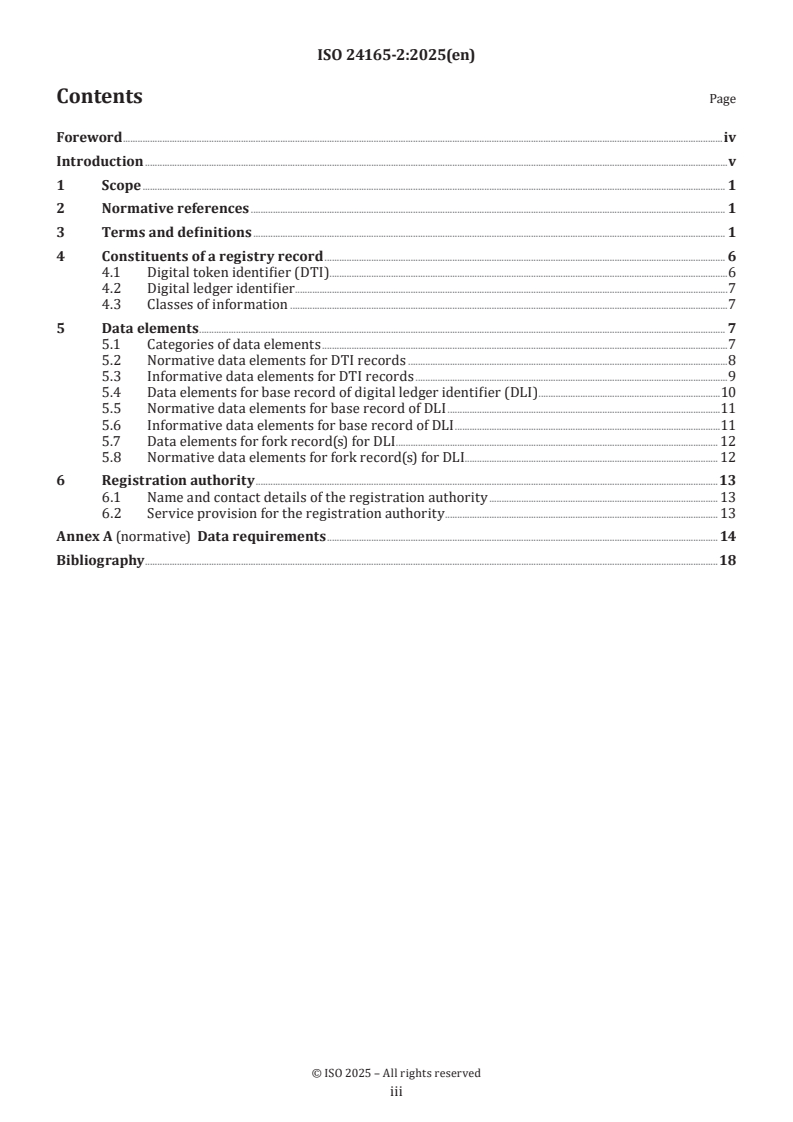
Contents Page
Foreword .iv
Introduction .v
1 Scope . 1
2 Normative references . 1
3 Terms and definitions . 1
4 Constituents of a registry record . 6
4.1 Digital token identifier (DTI).6
4.2 Digital ledger identifier . .7
4.3 Classes of information .7
5 Data elements . 7
5.1 Categories of data elements .7
5.2 Normative data elements for DTI records .8
5.3 Informative data elements for DTI records .9
5.4 Data elements for base record of digital ledger identifier (DLI) .10
5.5 Normative data elements for base record of DLI .11
5.6 Informative data elements for base record of DLI .11
5.7 Data elements for fork record(s) for DLI . 12
5.8 Normative data elements for fork record(s) for DLI . 12
6 Registration authority .13
6.1 Name and contact details of the registration authority . 13
6.2 Service provision for the registration authority . 13
Annex A (normative) Data requirements . 14
Bibliography .18
iii
Foreword
ISO (the International Organization for Standardization) is a worldwide federation of national standards
bodies (ISO member bodies). The work of preparing International Standards is normally carried out through
ISO technical committees. Each member body interested in a subject for which a technical committee
has been established has the right to be represented on that committee. International organizations,
governmental and non-governmental, in liaison with ISO, also take part in the work. ISO collaborates closely
with the International Electrotechnical Commission (IEC) on all matters of electrotechnical standardization.
The procedures used to develop this document and those intended for its further maintenance are described
in the ISO/IEC Directives, Part 1. In particular, the different approval criteria needed for the different types
of ISO documents should be noted. This document was drafted in accordance with the editorial rules of the
ISO/IEC Directives, Part 2 (see www.iso.org/directives).
ISO draws attention to the possibility that the implementation of this document may involve the use of (a)
patent(s). ISO takes no position concerning the evidence, validity or applicability of any claimed patent
rights in respect thereof. As of the date of publication of this document, ISO had not received notice of (a)
patent(s) which may be required to implement this document. However, implementers are cautioned that
this may not represent the latest information, which may be obtained from the patent database available at
www.iso.org/patents. ISO shall not be held responsible for identifying any or all such patent rights.
Any trade name used in this document is information given for the convenience of users and does not
constitute an endorsement.
For an explanation of the voluntary nature of standards, the meaning of ISO specific terms and expressions
related to conformity assessment, as well as information about ISO's adherence to the World Trade
Organization (WTO) principles in the Technical Barriers to Trade (TBT), see www.iso.org/iso/foreword.html.
This document was prepared by Technical Committee ISO/TC 68, Financial services, Subcommittee SC 8,
Reference data for financial services.
This second edition cancels and replaces the first edition (ISO 24165-2:2021), which has been technically
revised.
The main changes are as follows:
— The scope for digital token identifiers (DTIs) has been extended to include non-fungible tokens (NFTs).
— The document now separates DTIs to identify tokens and digital ledger identifiers (DLIs) to identify
ledgers (only ledgers that have one or more DTIs linked to them are in the scope of this document).
— Anchor block information has been added where genesis block is either not known/lost.
— "Functionally fungible group" has been renamed "equivalent digital token group".
— Issuer and maintainer have been added as informative, optional fields.
— "Native token" has been renamed "protocol token".
A list of all parts in the ISO 24165 series can be found on the ISO website.
Any feedback or questions on this document should be directed to the user’s national standards body. A
complete listing of these bodies can be found at www.iso.org/members.html.
iv
Introduction
With the rise in popularity of peer-to-peer payment systems, these systems rely less on centralized
authorities. Instead, they depend on aspects of cryptography, decentralized processing and a distributed
network. This network maintains a shared record of transaction activity.
As a result, the need to identify the digital tokens issued, traded, transacted or stored on these networks
has grown. Stakeholders in the trading community, service providers, custodians and regulatory bodies
have identified numerous use cases where a standard identifier for accounting, research, tracking and
management of these digital tokens would improve efficiency and eliminate confusion in the marketplace.
However, the nature of these new types of digital asset means they do not fit within the structure of existing
ISO identifiers, in part because they can lack clear reference to an issuing authority and will therefore not
be considered the liability of an issuing authority or corporate governing body. These digital assets, in many
cases, extend across various regions and monetary governance jurisdictions.
Though these digital assets are sometimes referred to as cryptocurrencies, virtual currencies or digital
currencies, the term "currency" has a specific meaning as defined by ISO 4217. This definition is in conflict
with the nature of the digital tokens identified in this document due to the reasons described above; namely,
the lack of monetary authority and geographic location.
Where traditional financial instruments or currencies are tokenized for electronic exchange and issued by
a legal entity including the monetary authority responsible for it, other International Standards, such as
ISO 6166 or ISO 4217, can apply. To eliminate confusion for users of this document, care has been taken to
provide a clear definition and eligibility criteria for assignment of a digital token identifier (DTI) and digital
ledger identifier (DLI).
This document is addressed to applicants seeking to identify digital tokens that conform to the definition
provided in ISO 24165-1. The data elements described in this document are used to distinguish one set
of digital tokens and ledgers from another and are, wherever possible, objective and publicly available.
Inclusion in the registry and the issuance of an identifier signifies only the existence of the token and/or
ledger and its 1:1 relationship to its identifier.
The ISO 24165 series is organized into the following parts:
— ISO 24165-1 describes the method of registration and assignment of a DTI and a DLI.
— ISO 24165-2 describes the data elements required for registration and display on the DTI and DLI registry.
v
International Standard ISO 24165-2:2025(en)
Digital token identifier (DTI) — Registration, assignment and
structure —
Part 2:
Data elements for registration
1 Scope
This document defines the data elements included in the registry record and used to establish the 1:1
relationship between a digital token and the identifier assigned according to the method in ISO 24165-1.
2 Normative references
The following documents are referred to in the text in such a way that some or all of their content constitutes
requirements of this document. For dated references, only the edition cited applies. For undated references,
the latest edition of the referenced document (including any amendments) applies.
ISO/IEC 10646, Information technology — Universal coded character set (UCS)
ISO 24165-1, Digital token identifier—Registration, assignment and structure—Part 1: Method for registration
and assignment
3 Terms and definitions
For the purposes of this document, the following terms and definitions apply.
ISO and IEC maintain terminology databases for use in standardization at the following addresses:
— ISO Online browsing platform: available at https:// www .iso .org/ obp
— IEC Electropedia: available at https:// www .electropedia .org/
3.1
anchor block
earliest known and verifiable block in a blockchain
Note 1 to entry: The anchor block is typically the blockchain genesis block (3.33).
3.2
anchor block hash
block hash (3.10) of the anchor block
Note 1 to entry: The anchor block hash is typically recorded in the block immediately following the anchor block.
3.3
anchor block hash algorithm
block hash algorithm (3.11) used to produce the block hash (3.10) of the anchor block (3.1)
3.4
anchor block height
block height (3.13) of the anchor block (3.1)
3.5
anchor block UTC timestamp
timestamp recorded in the anchor block (3.1)
Note 1 to entry: Frequently, the anchor block UTC timestamp is located in the anchor block header (data structure that
includes a cryptographic link to the previous block [ISO 22739:2024, 3.4]) .
Note 2 to entry: The anchor block UTC timestamp is expressed in Coordinated Universal Time.
3.6
auxiliary digital token
non-protocol digital token (3.51) created as an application on an existing blockchain or other distributed
ledger technology for its issuance, storage or transaction record which is explicitly identified within the
distributed ledger technology protocol
Note 1 to entry: A distributed ledger may support zero or more auxiliary digital tokens.
3.7
auxiliary digital token distributed ledger
assigned digital ledger identifier of the distributed ledger used for issuance, storage or transaction record of
an auxiliary digital token (3.6)
EXAMPLE If registering an ERC-20 token operating on the Ethereum blockchain, this data element will contain
the DLI assigned to the Ethereum blockchain.
3.8
auxiliary digital token mechanism
protocol used to create an auxiliary digital token (3.6)
Note 1 to entry: This definition does not take into account the concept of token lifecycle, only its creation. .
EXAMPLE ERC-20 (used for Ethereum) and Omni Layer (used for Bitcoin).
3.9
auxiliary digital token technical reference
element, such as a smart contract address, used to uniquely identify the origin of an auxiliary digital token
(3.6) on a distributed ledger technology platform
Note 1 to entry: For each auxiliary digital token mechanism (3.8), refer to the specifications of the element, including
the syntax for that element, on the registration authority website (https:// www .iso .org/ maintenance _agencies .html).
For example, for an auxiliary token mechanism ERC-20, the auxiliary token technical reference is likely to be a smart
contract address with a designated syntax.
3.10
block hash
cryptographic hash value of the information contained in a block in a blockchain as specified by the
consensus mechanism
3.11
block hash algorithm
cryptographic hash function, specified by the consensus mechanism of a blockchain, used to produce the
block hash (3.10)
EXAMPLE A double SHA-256 hash (a SHA-256 hash of a SHA-256 hash).
3.12
block height
number of blocks preceding a given block in a blockchain
EXAMPLE A genesis block (3.33) has block height = 0.
3.13
block number offset
the difference between the typically displayed block number and the block height (3.12)
3.14
consensus mechanism change response
binary choice denoting, if true, that the consensus mechanism used to validate the block at the fork block
height (3.31) identified in the fork record differs from the consensus mechanism used to validate the block
immediately prior to the block at the fork block height identified in the fork record
Note 1 to entry: See 4.1 and 5.3.
3.15
digital asset external identifiers type
enumerated list expressing the types of digital asset external identifiers (3.25) for the digital token
3.16
digital asset external identifiers value
list of digital asset external identifiers (3.25) for the digital token
3.17
digital token external identifiers type
enumerated list of types of external identifier (3.25) for the digital token
3.18
digital token external identifiers value
list of other external identifiers (3.25) for the digital token
3.19
digital token identifier type
categorization of the digital token identifier within the registry
Note 1 to entry: See 5.2.
3.20
digital token long name
string containing the full name of the digital token, as represented in alphanumeric basic Latin characters
Note 1 to entry: See ISO/IEC 2382 for a definition of "alphanumeric".
3.21
digital token reference implementation URL
uniform resource locator (URL) pointing to the digital token’s reference implementation or software
repository
Note 1 to entry: The supported set of protocols shall be provided in the registration authority website https:// www
.iso .org/ maintenance _agencies .html.
3.22
digital token short name
short name or ticker symbol used to represent this digital token, as represented in alphanumeric basic Latin
characters
Note 1 to entry: See ISO/IEC 2382 for a definition of "alphanumeric".
3.23
digital token unit multiplier
multiplier used to map from the unit of value associated with the digital token long name (3.20) to the unit of
value stored on the distributed ledger
EXAMPLE Bitcoin has a digital token unit multiplier of 100 000 000. 2 Bitcoin multiplied by 100 000 000 equals
200 000 000 units of value (satoshi) stored on the Bitcoin blockchain.
3.24
distributed ledger technology type
category of systems implementing distributed ledger technology based on their consensus mechanisms
3.25
external identifier
identifier, external to this document, that may be used to identify either the digital token or the digital asset
that this digital token represents
EXAMPLE International securities identification number (see ISO 6166).
3.26
equivalent digital token group
set of digital tokens which are not technically compatible, but considered equivalent in one or more specific
use cases
Note 1 to entry: The presence of tokens within an equivalent digital token group does not imply fungibility in a
regulatory or legal sense.
3.27
fork
creation of two or more different versions of a distributed ledger originating from a common starting point
with a single history
Note 1 to entry: A fork can result in the creation of a new digital ledger.
Note 2 to entry: Terms such as hard fork and soft fork are sometimes used to distinguish backwards compatibility
changes to the consensus mechanism of a blockchain. This document uses the term fork to encompass both scenarios.
[SOURCE: ISO 22739:2024, 3.45, modified — Notes to entry added.]
3.28
fork block
block having a block height (3.12) equal to the fork block height (3.31) data element specified in a fork record
3.29
fork block hash
block hash (3.10) of the block with a block height (3.12) equal to the fork block height (3.31)
3.30
fork block hash algorithm
block hash algorithm (3.11) of the fork block (3.28)
Note 1 to entry: The fork block hash algorithm may differ from the anchor block hash algorithm (3.3) when a fork (3.29)
defines a new block hash algorithm as part of a consensus mechanism change.
3.31
fork block height
block height (3.12) of the first block after a fork (3.27)
Note 1 to entry: When a digital token is created as a result of a fork, the original blockchain and the new blockchain
are identical for all blocks with a block height less than the fork block height. Blocks on the original and the new
blockchains at the block height equal to or greater than the fork block height will differ.
3.32
fork block UTC timestamp
timestamp recorded in the fork block (3.28)
Note 1 to entry: Frequently, the fork block UTC timestamp is located in the fork block header (data structure that
includes a cryptographic link to the previous block [ISO 22739:2024 , 3.4]) .
Note 2 to entry: The fork block UTC timestamp is expressed in Coordinated Universal Time.
3.33
genesis block
first block in a blockchain
Note 1 to entry: A genesis block has no previous block and serves to initialize the blockchain.
[SOURCE: ISO 22739:2024, 3.37]
3.34
external entity identifier
identifier, external to this document, that can be used to identify either a natural person or a legal entity
EXAMPLE Legal entity identifier (as defined in ISO 17442-1:2020).
3.35
issuer
entity against which a digital asset represents liability or equity
3.36
issuer identifiers type
enumerated list of external entity identifiers (3.34) types for the issuer
3.37
issuer identifiers value
list of external entity identifiers (3.34) for the issuer
3.38
issuer name
string containing the full name of the issuer (3.35), as represented in alphanumeric basic Latin characters
Note 1 to entry: See ISO/IEC 2382 for a definition of "alphanumeric".
3.39
issuer original language name
string containing the full name of the issuer (3.35)
3.40
maintainer
an entity responsible for the creation, maintenance or operation of the technical implementation of a digital
token or distributed ledger
3.41
maintainer identifiers type
enumerated list of types of external entity identifier (3.34) for the issuer
3.42
maintainer identifiers value
list of external entity identifiers (3.34) for the issuer
3.43
maintainer name
string containing the full name of the maintainer (3.40), as represented in alphanumeric basic Latin
characters
Note 1 to entry: See ISO/IEC 2382 for a definition of "alphanumeric".
3.44
maintainer original language name
string containing the full name of the maintainer (3.40)
3.45
non-fungible token group indicator
binary choice indicating, if true, that the digital token identifier (DTI) is associated with a non-fungible
token group, and if false, that the DTI is associated with a unique, individual non-fungible token
3.46
non-fungible token implementation mechanism
protocol used to create non-fungible tokens
EXAMPLE ERC-721 (used for Ethereum).
3.47
non-fungible token technical reference
element, such as a smart contract address, used to uniquely identify a non-fungible token (NFT)’s origin on a
distributed ledger technology platform
Note 1 to entry: This can identify an individual NFT or an NFT group.
Note 2 to entry: For each NFT implementation mechanism, refer to the specifications of the element, including the
syntax for that element, on the registration authority website. The name and contact information of the registration
authority for this document can be found at https:// www .iso .org/ maintenance _agencies .html.
Note 3 to entry: For example, for an NFT implementation mechanism ERC-721, the NFT technical reference is likely to
be a smart contract address with a designated syntax.
3.48
original language digital token long name
string containing the full name of the digital token
3.49
original language digital token short name
short name or ticker symbol used to represent this digital token
3.50
protocol digital ledger creation response
binary choice indicating whether the base record's distributed ledger identifier references a new ledger
from a fork (true) or the entire ledger history (false).
Note 1 to entry: If no fork records contain this field as true, it defaults to referencing the entire ledger history.
3.51
protocol digital token
single digital token that can be transacted on a distributed ledger with no further protocol-level identification
required
Note 1 to entry: A distributed ledger can have no protocol digital tokens or one default protocol digital token.
3.52
public distributed ledger indicator
binary choice indicating, if true, that access to reading the distributed ledger is unrestricted, and the data
elements specified in this document are accessible for independent verification by the general public
4 Constituents of a registry record
4.1 Digital token identifier (DTI)
A registry record of a digital token shall consist of a record (see 5.2 and 5.3) containing the data elements
specified in Table A.1, Table A.2 and Table A.3 for the applicable digital token identifier (DTI) type.
Each digital token registry record shall be noted according to the registration authority (RA) guidelines.
The name and contact information of the RA for this document can be found at www .iso .org/ maintenance
_agencies.
4.2 Digital ledger identifier
A r
...