

ISO 10962:2021
(Main)Securities and related financial instruments — Classification of financial instruments (CFI) code
General Information
- Abstract
This document defines and describes the structure for the codes for an internationally valid system to classify financial instruments. The classification system applies to financial instruments negotiated internationally as well as to domestic instruments. The term “financial instruments” refers not only to classical securities and derivatives but also covers the innovative financial products that have emerged in different markets (a trend that is expected to continue in the future). This document is intended for use in any application in the trading and administration of financial instruments in the international securities business. Insofar as the trading and administration of securities do not affect other countries, the application of this document remains at the discretion of the responsible national bodies, such as stock exchanges, banks, brokers, regulatory bodies and other institutions active in the securities field. In principle, the CFI code reflects characteristics that are defined when a financial instrument is issued and that remain unchanged during its entire lifetime. However, a few events that can lead to a new CFI code for the same instrument are anticipated, such as the changing of voting rights or ownership restrictions by a stockholders' meeting.
- Status
- Published
- Publication Date
- 17-May-2021
- Technical Committee
- ISO/TC 68/SC 8 - Reference data for financial services
- Drafting Committee
- ISO/TC 68/SC 8 - Reference data for financial services
- Current Stage
- 9060 - Close of review
- Completion Date
- 02-Dec-2031
Buy Documents



ISO 10962:2021 - Securities and related financial instruments -- Classification of financial instruments (CFI) code

ISO 10962:2021REDLINE - Securities and related financial instruments -- Classification of financial instruments (CFI) code

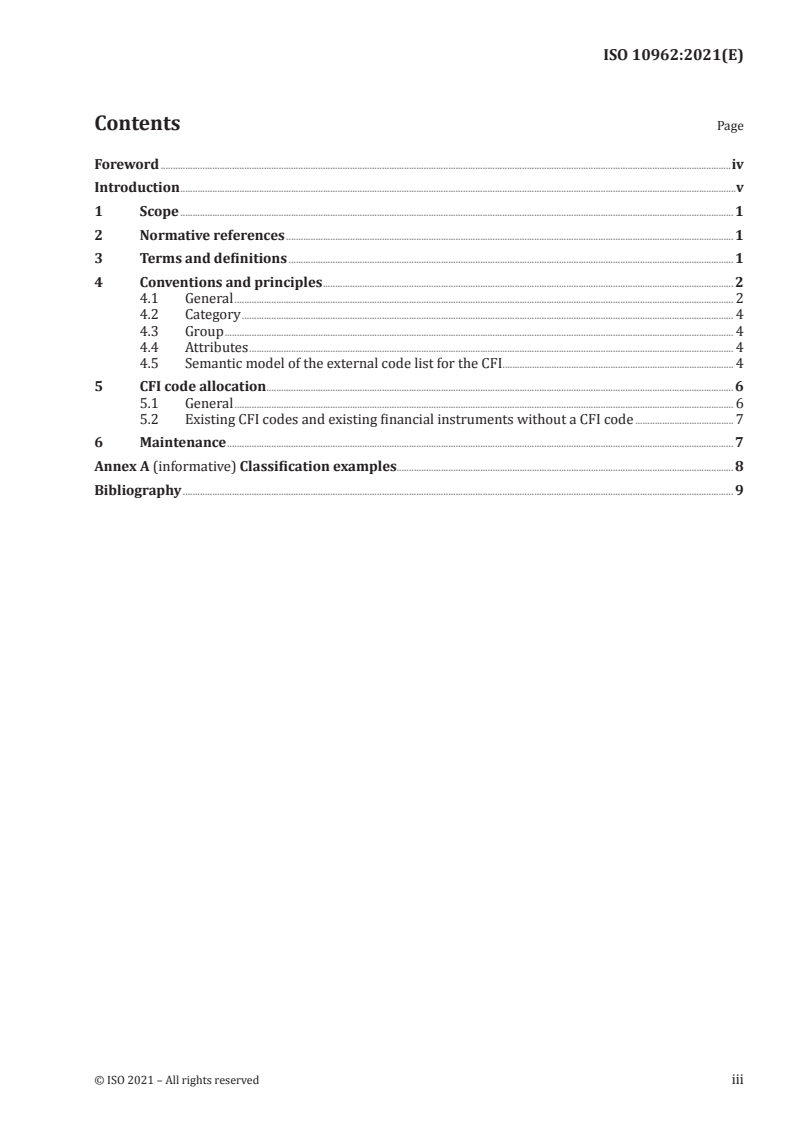
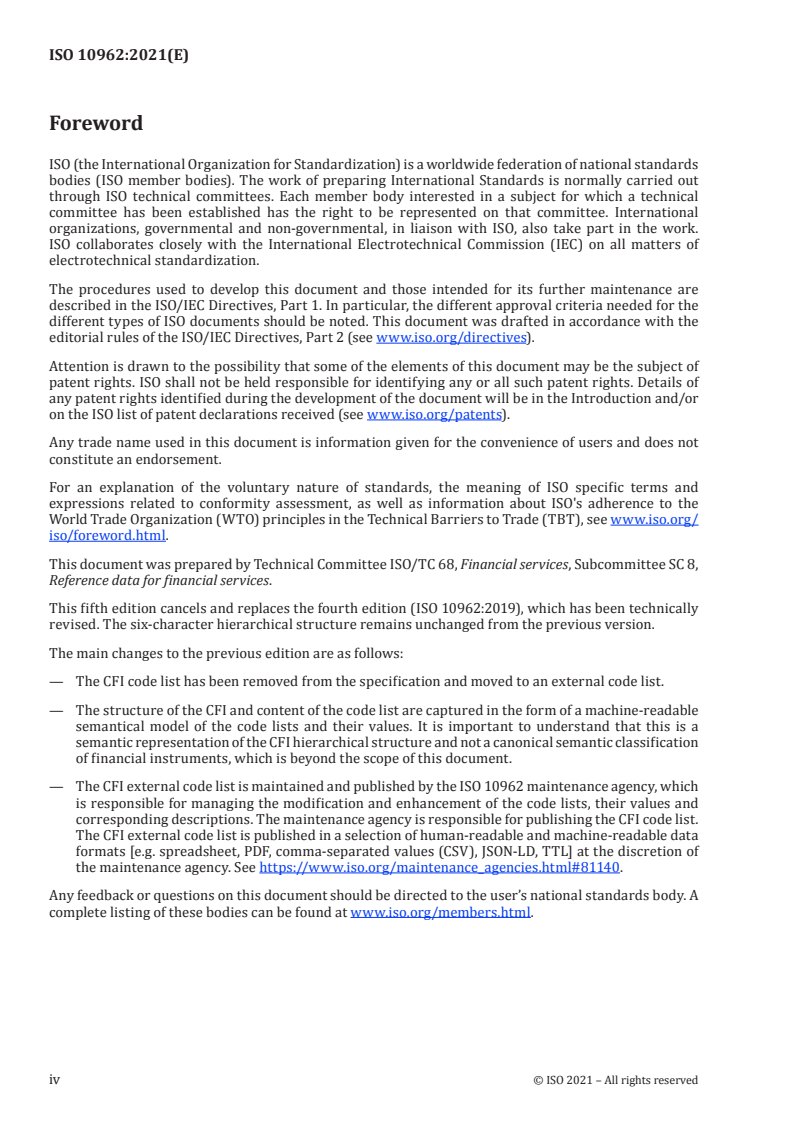
ISO 10962:2021 - Securities and related financial instruments — Classification of financial instruments (CFI) code/18/2021
REDLINE ISO 10962:2021 - Securities and related financial instruments — Classification of financial instruments (CFI) code/18/2021
Overview
ISO 10962:2021, titled "Securities and related financial instruments - Classification of financial instruments (CFI) code," is an international standard published by the International Organization for Standardization (ISO). This standard establishes a globally recognized structure for classifying financial instruments using the CFI code, supporting consistent and transparent identification across international and domestic markets. The CFI code applies to a broad range of financial instruments, including traditional securities, derivatives, and innovative financial products. By doing so, it enhances communication, efficiency, and comparability in the trading and administration of financial instruments worldwide.
Key Topics
- Universal Classification System: The CFI code system provides a hierarchical structure that reflects the intrinsic characteristics of financial instruments, regardless of differing national terminologies or market practices.
- Scope of Instruments: The standard covers not just classical securities (e.g., equities, debt instruments) and derivatives (e.g., options, futures, swaps), but also addresses new and complex financial products emerging in global markets.
- Code Structure: A six-character, hierarchical CFI code is assigned at issuance based on fixed attributes, though changes in certain instrument features (e.g., voting rights) may warrant a new code.
- Governance and Maintenance: The CFI code list is managed by an ISO maintenance agency and supplied in both human-readable and machine-readable formats, ensuring accessibility and ongoing relevance.
- Alignment with International Standards: ISO 10962 complements other important standards, such as ISO 6166 for the International Securities Identification Number (ISIN), facilitating interoperability in the financial industry.
Applications
- Market Data Consistency: Adoption of ISO 10962 supports straight-through processing and data automation, reducing errors in trade processing, settlement, and clearing.
- Regulatory Reporting: Regulatory bodies rely on the CFI code for accurate categorization and aggregation of securities data, essential for compliance and systemic risk management.
- Global Trading and Administration: International and domestic stock exchanges, banks, brokers, and custodians use the CFI for securities processing, portfolio reporting, and instrument comparison across markets.
- Risk Assessment and Portfolio Management: Financial institutions and asset managers benefit from standard classifications enabling comprehensive asset class analysis, risk aggregation, and performance benchmarking.
- Innovation Readiness: The flexible code structure is designed to adapt as financial markets introduce new types of securities and investment vehicles, ensuring longevity and continued relevance.
Related Standards
- ISO 6166: Securities and related financial instruments - International securities identification numbering system (ISIN). Integrates with CFI codes for unique identification of financial instruments.
- ISO/TC 68 Standards: Additional standards for financial services reference data and messaging may complement or interoperate with ISO 10962.
- Market Practices: Many national and regional market frameworks align their security classification practices with ISO 10962 to maintain consistency in global financial reporting.
By adhering to ISO 10962:2021, financial market participants benefit from a common language for instrument classification, enabling efficient trading, settlement, and risk management on a global scale. The CFI code's universal and structured approach plays a critical role in facilitating transparency and comparability in the fast-evolving world of securities and financial instruments. For more information and official publications, visit ISO’s official website on CFI codes.
Relations
- Effective Date
- 12-Oct-2020
Buy Documents
ISO 10962:2021 - Securities and related financial instruments -- Classification of financial instruments (CFI) code
ISO 10962:2021REDLINE - Securities and related financial instruments -- Classification of financial instruments (CFI) code
ISO 10962:2021 - Securities and related financial instruments — Classification of financial instruments (CFI) code/18/2021
REDLINE ISO 10962:2021 - Securities and related financial instruments — Classification of financial instruments (CFI) code/18/2021
Get Certified
Connect with accredited certification bodies for this standard

Great Wall Tianjin Quality Assurance Center
Established 1993, first batch to receive national accreditation with IAF recognition.
Hong Kong Quality Assurance Agency (HKQAA)
Hong Kong's leading certification body.

Innovative Quality Certifications Pvt. Ltd. (IQCPL)
Known for integrity, providing ethical & impartial Assessment & Certification. CMMI Institute Partner.
Sponsored listings
Frequently Asked Questions
ISO 10962:2021 is a standard published by the International Organization for Standardization (ISO). Its full title is "Securities and related financial instruments — Classification of financial instruments (CFI) code". This standard covers: This document defines and describes the structure for the codes for an internationally valid system to classify financial instruments. The classification system applies to financial instruments negotiated internationally as well as to domestic instruments. The term “financial instruments” refers not only to classical securities and derivatives but also covers the innovative financial products that have emerged in different markets (a trend that is expected to continue in the future). This document is intended for use in any application in the trading and administration of financial instruments in the international securities business. Insofar as the trading and administration of securities do not affect other countries, the application of this document remains at the discretion of the responsible national bodies, such as stock exchanges, banks, brokers, regulatory bodies and other institutions active in the securities field. In principle, the CFI code reflects characteristics that are defined when a financial instrument is issued and that remain unchanged during its entire lifetime. However, a few events that can lead to a new CFI code for the same instrument are anticipated, such as the changing of voting rights or ownership restrictions by a stockholders' meeting.
This document defines and describes the structure for the codes for an internationally valid system to classify financial instruments. The classification system applies to financial instruments negotiated internationally as well as to domestic instruments. The term “financial instruments” refers not only to classical securities and derivatives but also covers the innovative financial products that have emerged in different markets (a trend that is expected to continue in the future). This document is intended for use in any application in the trading and administration of financial instruments in the international securities business. Insofar as the trading and administration of securities do not affect other countries, the application of this document remains at the discretion of the responsible national bodies, such as stock exchanges, banks, brokers, regulatory bodies and other institutions active in the securities field. In principle, the CFI code reflects characteristics that are defined when a financial instrument is issued and that remain unchanged during its entire lifetime. However, a few events that can lead to a new CFI code for the same instrument are anticipated, such as the changing of voting rights or ownership restrictions by a stockholders' meeting.
ISO 10962:2021 is classified under the following ICS (International Classification for Standards) categories: 03.060 - Finances. Banking. Monetary systems. Insurance. The ICS classification helps identify the subject area and facilitates finding related standards.
ISO 10962:2021 has the following relationships with other standards: It is inter standard links to ISO 10962:2019. Understanding these relationships helps ensure you are using the most current and applicable version of the standard.
ISO 10962:2021 is available in PDF format for immediate download after purchase. The document can be added to your cart and obtained through the secure checkout process. Digital delivery ensures instant access to the complete standard document.
Standards Content (Sample)
INTERNATIONAL ISO
STANDARD 10962
Fifth edition
2021-05
Securities and related financial
instruments — Classification of
financial instruments (CFI) code
Valeurs mobilières et autres instruments financiers concernés —
Classification des instruments financiers (code CFI)
Reference number
©
ISO 2021
© ISO 2021
All rights reserved. Unless otherwise specified, or required in the context of its implementation, no part of this publication may
be reproduced or utilized otherwise in any form or by any means, electronic or mechanical, including photocopying, or posting
on the internet or an intranet, without prior written permission. Permission can be requested from either ISO at the address
below or ISO’s member body in the country of the requester.
ISO copyright office
CP 401 • Ch. de Blandonnet 8
CH-1214 Vernier, Geneva
Phone: +41 22 749 01 11
Email: copyright@iso.org
Website: www.iso.org
Published in Switzerland
ii © ISO 2021 – All rights reserved
Contents Page
Foreword .iv
Introduction .v
1 Scope . 1
2 Normative references . 1
3 Terms and definitions . 1
4 Conventions and principles . 2
4.1 General . 2
4.2 Category . 4
4.3 Group . 4
4.4 Attributes . 4
4.5 Semantic model of the external code list for the CFI . 4
5 CFI code allocation . 6
5.1 General . 6
5.2 Existing CFI codes and existing financial instruments without a CFI code . 7
6 Maintenance . 7
Annex A (informative) Classification examples. 8
Bibliography . 9
Foreword
ISO (the International Organization for Standardization) is a worldwide federation of national standards
bodies (ISO member bodies). The work of preparing International Standards is normally carried out
through ISO technical committees. Each member body interested in a subject for which a technical
committee has been established has the right to be represented on that committee. International
organizations, governmental and non-governmental, in liaison with ISO, also take part in the work.
ISO collaborates closely with the International Electrotechnical Commission (IEC) on all matters of
electrotechnical standardization.
The procedures used to develop this document and those intended for its further maintenance are
described in the ISO/IEC Directives, Part 1. In particular, the different approval criteria needed for the
different types of ISO documents should be noted. This document was drafted in accordance with the
editorial rules of the ISO/IEC Directives, Part 2 (see www .iso .org/ directives).
Attention is drawn to the possibility that some of the elements of this document may be the subject of
patent rights. ISO shall not be held responsible for identifying any or all such patent rights. Details of
any patent rights identified during the development of the document will be in the Introduction and/or
on the ISO list of patent declarations received (see www .iso .org/ patents).
Any trade name used in this document is information given for the convenience of users and does not
constitute an endorsement.
For an explanation of the voluntary nature of standards, the meaning of ISO specific terms and
expressions related to conformity assessment, as well as information about ISO's adherence to the
World Trade Organization (WTO) principles in the Technical Barriers to Trade (TBT), see www .iso .org/
iso/ foreword .html.
This document was prepared by Technical Committee ISO/TC 68, Financial services, Subcommittee SC 8,
Reference data for financial services.
This fifth edition cancels and replaces the fourth edition (ISO 10962:2019), which has been technically
revised. The six-character hierarchical structure remains unchanged from the previous version.
The main changes to the previous edition are as follows:
— The CFI code list has been removed from the specification and moved to an external code list.
— The structure of the CFI and content of the code list are captured in the form of a machine-readable
semantical model of the code lists and their values. It is important to understand that this is a
semantic representation of the CFI hierarchical structure and not a canonical semantic classification
of financial instruments, which is beyond the scope of this document.
— The CFI external code list is maintained and published by the ISO 10962 maintenance agency, which
is responsible for managing the modification and enhancement of the code lists, their values and
corresponding descriptions. The maintenance agency is responsible for publishing the CFI code list.
The CFI external code list is published in a selection of human-readable and machine-readable data
formats [e.g. spreadsheet, PDF, comma-separated values (CSV), JSON-LD, TTL] at the discretion of
the maintenance agency. See https:// www .iso .org/ maintenance _agencies .html #81140.
Any feedback or questions on this document should be directed to the user’s national standards body. A
complete listing of these bodies can be found at www .iso .org/ members .html.
iv © ISO 2021 – All rights reserved
Introduction
The classification of financial instruments (CFI) code was developed to address several problems
that concerned the financial community. With the growth of cross-border trading, the requirement to
improve communication of information among market participants had become critical.
The business problems centred around an inability to obtain information on financial instruments due
to the lack of a consistent and uniform approach to grouping financial instruments. With the explosive
growth over the previous 20 years in new instruments and features attached to financial instruments,
a serious communication problem had developed.
Many market participants were using similar terminology for instruments having significantly different
features. This problem was compounded when market participants looked beyond their own national
markets where they encountered the same words used to describe instruments with significantly
different features. Where the terminology was in a different language, market participants encountered
additional problems of translation, which can also be misleading.
In addition, the customs and practices of local markets varied considerably in how they structured
financial instruments, often leaving foreign participants perplexed. On careful analysis, it was often
found that the characteristics and features of these instruments were similar to domestic instruments.
However, most market participants did not have the time and resources to do this analysis.
The inability to group financial instruments in a consistent manner was another problem encountered
by market participants. Reports of holdings by different sources for similar financial instruments
often resulted in those instruments being categorized differently. This not only affected comparability
but caused a credibility issue with the reader. When relative performance is measured, the ability to
properly categorize holdings is essential if true comparisons are to be made.
A twofold solution was developed to address these problems. One was to establish a series of codes that
classify financial instruments having similar features. The other was to develop a glossary of terms and
provide common definitions that allow market participants to easily understand the terminology being
used.
The benefits derived are many:
— The CFI code system provides a set of codes for financial instruments that can be used globally
for straight-through processing by all involved participants in an electronic data processing
environment. For example, readers of portfolio holdings see reports from different sources using
the same categories, groups and attributes, making the comparison of instruments more credible.
— The use of these codes increases the efficiency, reliability, data consistency and transparency of
financial services transactions for both market and reference data. Classifying financial instruments
in a consistent, structured and standardized way is also beneficial for regulatory reporting
requirements.
— The broadened scope and coverage of CFI codes encourages market participants to take advantage of
other International Standards, particularly international securities identification numbers (ISINs).
— It is intended that the improved understanding of the characteristics and categorization leads to
a better understanding of financial instruments. This leads to more active markets and improved
market liquidity. In addition, these codes are displayed on websites using internet technology, which
has allowed the growth of e-issuing, e-trading and e-settlements.
— The CFI code system can further serve as a basis for the classification of financial instruments for
industry risk aggregation and regulatory reporting.
The International Organization for Standardization (ISO) draws attention to the fact that it is claimed
that compliance with this document may involve the use of a patent.
ISO takes no position concerning the evidence, validity and scope of this patent right.
The holder of this patent right has assured ISO that he or she is willing to negotiate licences under
reasonable and non-discriminatory terms and conditions with applicants throughout the world. In
this respect, the statement of the holder of this patent right is registered with ISO. Information may be
obtained from the patent database available at www .iso .org/ patents.
Attention is drawn to the possibility that some of the elements of this document may be the subject of
patent rights other than those in the patent database. ISO shall not be held responsible for identifying
...
INTERNATIONAL ISO
STANDARD 10962
Redline version
compares ISO 10962:2021
to ISO 10962:2019
Securities and related financial
instruments — Classification of
financial instruments (CFI) code
Valeurs mobilières et autres instruments financiers concernés —
Classification des instruments financiers (code CFI)
Reference number
ISO 10962:redline:2021(E)
©
ISO 2021
ISO 10962:redline:2021(E)
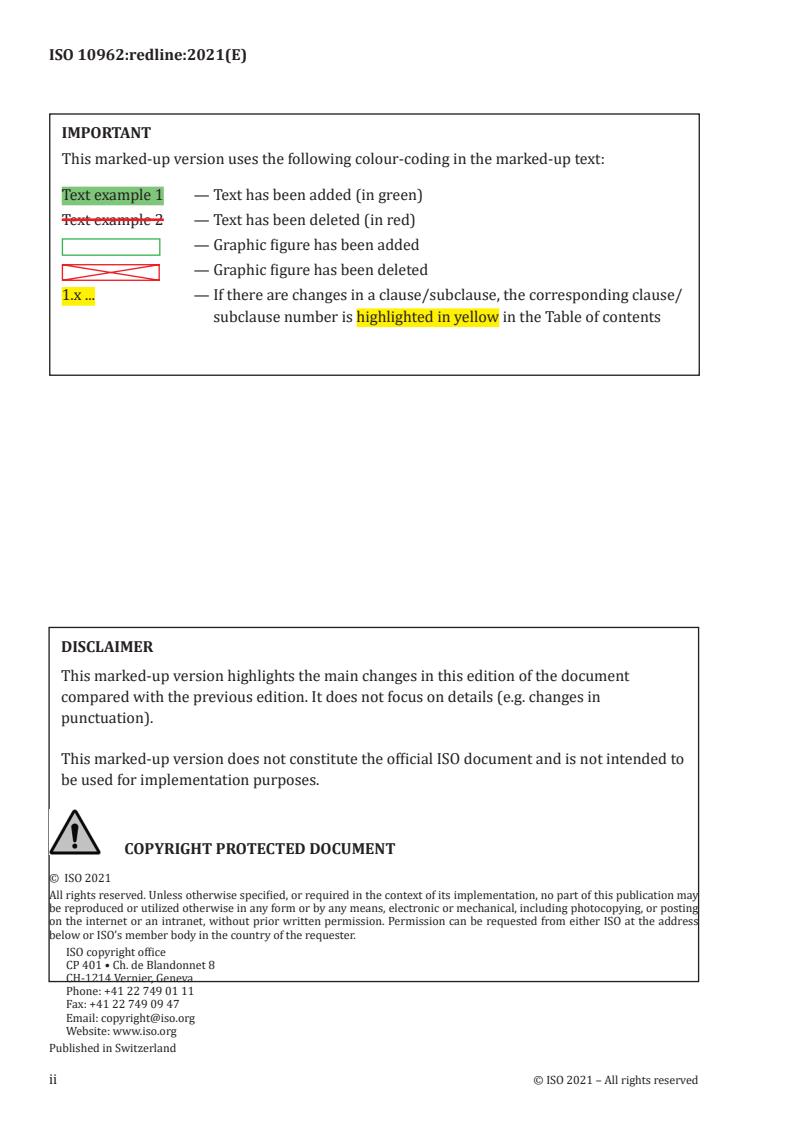
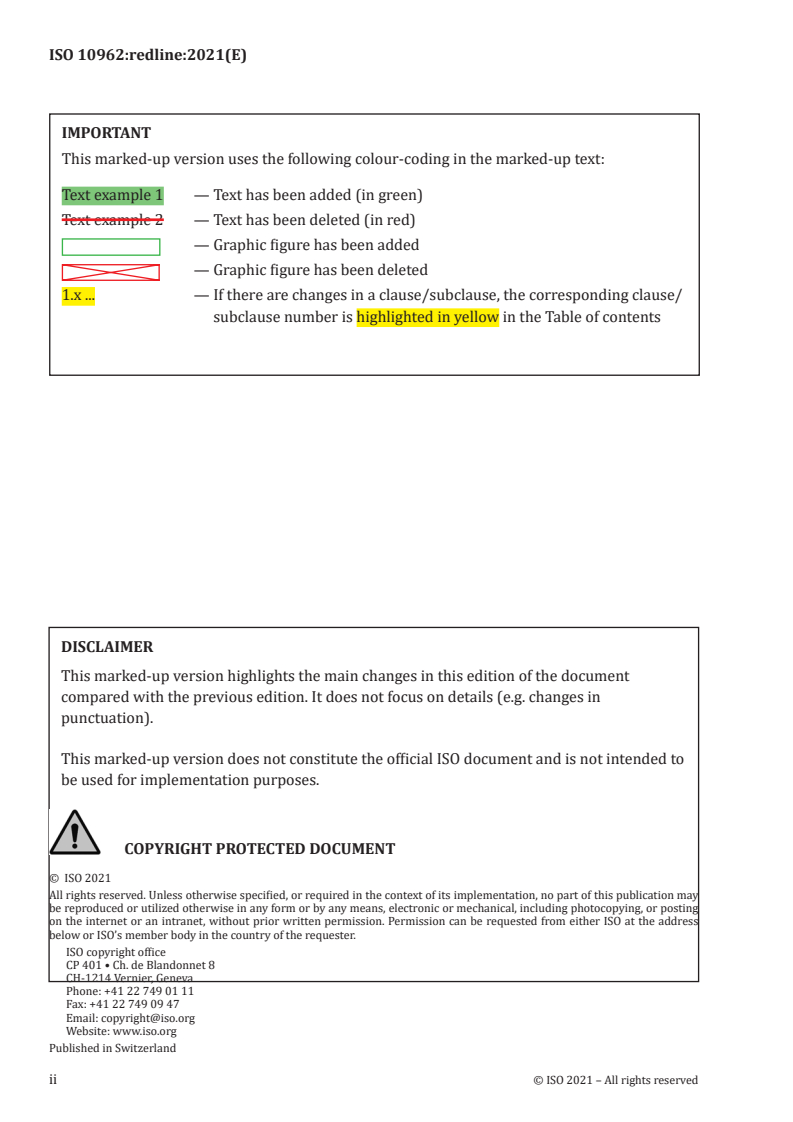
IMPORTANT
This marked-up version uses the following colour-coding in the marked-up text:
Text example 1 — Text has been added (in green)
— Text has been deleted (in red)
Text example 2
— Graphic figure has been added
— Graphic figure has been deleted
1.x . — If there are changes in a clause/subclause, the corresponding clause/
subclause number is highlighted in yellow in the Table of contents
DISCLAIMER
This marked-up version highlights the main changes in this edition of the document
compared with the previous edition. It does not focus on details (e.g. changes in
punctuation).
This marked-up version does not constitute the official ISO document and is not intended to
be used for implementation purposes.
© ISO 2021
All rights reserved. Unless otherwise specified, or required in the context of its implementation, no part of this publication may
be reproduced or utilized otherwise in any form or by any means, electronic or mechanical, including photocopying, or posting
on the internet or an intranet, without prior written permission. Permission can be requested from either ISO at the address
below or ISO’s member body in the country of the requester.
ISO copyright office
CP 401 • Ch. de Blandonnet 8
CH-1214 Vernier, Geneva
Phone: +41 22 749 01 11
Fax: +41 22 749 09 47
Email: copyright@iso.org
Website: www.iso.org
Published in Switzerland
ii © ISO 2021 – All rights reserved
ISO 10962:redline:2021(E)
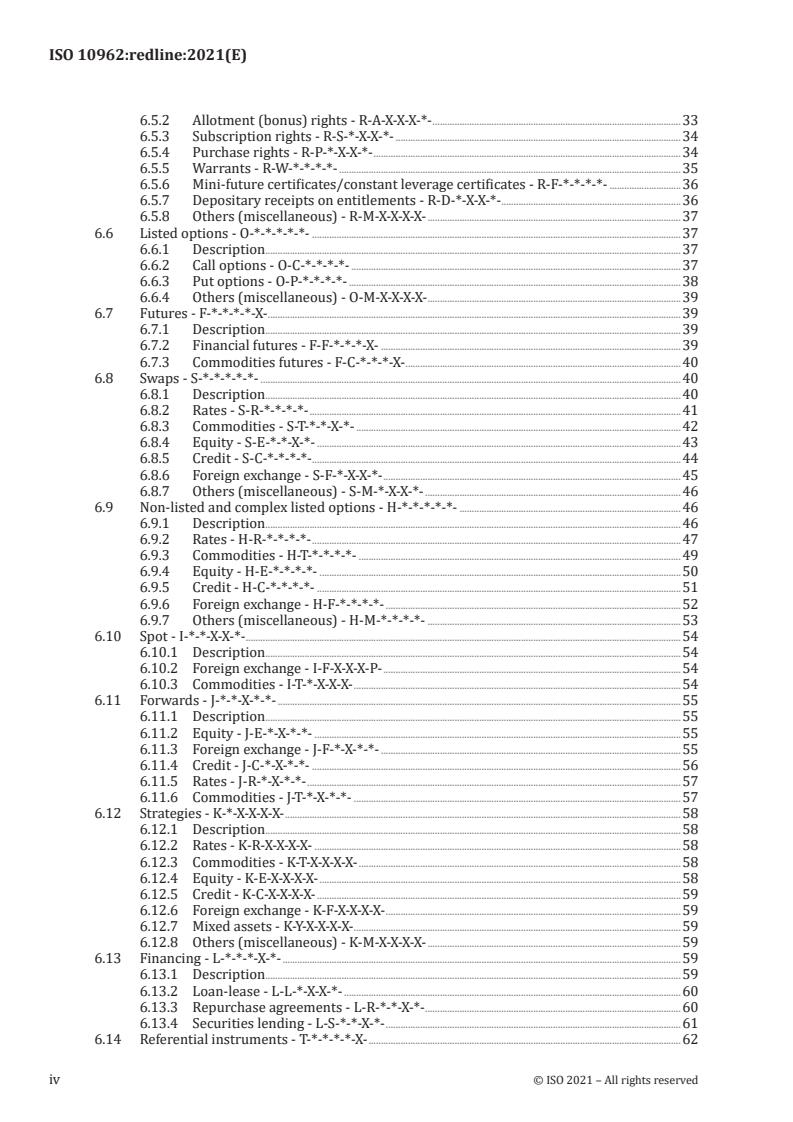
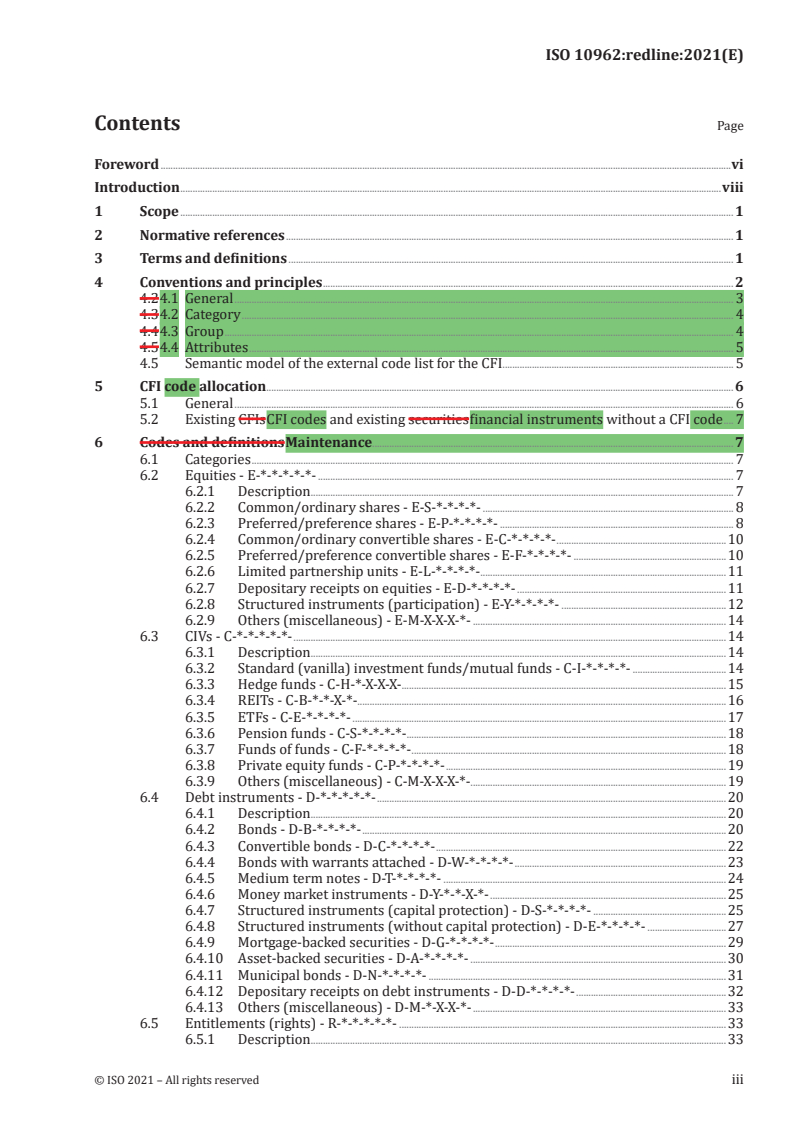
Contents Page
Foreword .vi
Introduction .viii
1 Scope . 1
2 Normative references . 1
3 Terms and definitions . 1
4 Conventions and principles . 2
4.2 4.1 General . 3
4.3 4.2 Category . 4
4.4 4.3 Group . 4
4.5 4.4 Attributes . 5
4.5 Semantic model of the external code list for the CFI . 5
5 CFI code allocation . 6
5.1 General . 6
5.2 Existing CFIs CFI codes and existing securities financial instruments without a CFI code . 7
6 Codes and definitions Maintenance. 7
6.1 Categories . 7
6.2 Equities - E-*-*-*-*-*- . 7
6.2.1 Description . . . 7
6.2.2 Common/ordinary shares - E-S-*-*-*-*- . 8
6.2.3 Preferred/preference shares - E-P-*-*-*-*- . 8
6.2.4 Common/ordinary convertible shares - E-C-*-*-*-*- .10
6.2.5 Preferred/preference convertible shares - E-F-*-*-*-*- .10
6.2.6 Limited partnership units - E-L-*-*-*-*- . .11
6.2.7 Depositary receipts on equities - E-D-*-*-*-*- .11
6.2.8 Structured instruments (participation) - E-Y-*-*-*-*- .12
6.2.9 Others (miscellaneous) - E-M-X-X-X-*- .14
6.3 CIVs - C-*-*-*-*-*- .14
6.3.1 Description . . .14
6.3.2 Standard (vanilla) investment funds/mutual funds - C-I-*-*-*-*- .14
6.3.3 Hedge funds - C-H-*-X-X-X- .15
6.3.4 REITs - C-B-*-*-X-*-.16
6.3.5 ETFs - C-E-*-*-*-*- .17
6.3.6 Pension funds - C-S-*-*-*-*- .18
6.3.7 Funds of funds - C-F-*-*-*-*- .18
6.3.8 Private equity funds - C-P-*-*-*-*- .19
6.3.9 Others (miscellaneous) - C-M-X-X-X-*-.19
6.4 Debt instruments - D-*-*-*-*-*- .20
6.4.1 Description . . .20
6.4.2 Bonds - D-B-*-*-*-*- .20
6.4.3 Convertible bonds - D-C-*-*-*-*- .22
6.4.4 Bonds with warrants attached - D-W-*-*-*-*- .23
6.4.5 Medium term notes - D-T-*-*-*-*- .24
6.4.6 Money market instruments - D-Y-*-*-X-*- .25
6.4.7 Structured instruments (capital protection) - D-S-*-*-*-*- .25
6.4.8 Structured instruments (without capital protection) - D-E-*-*-*-*- .27
6.4.9 Mortgage-backed securities - D-G-*-*-*-*- .29
6.4.10 Asset-backed securities - D-A-*-*-*-*- .30
6.4.11 Municipal bonds - D-N-*-*-*-*- .31
6.4.12 Depositary receipts on debt instruments - D-D-*-*-*-*- .32
6.4.13 Others (miscellaneous) - D-M-*-X-X-*- .33
6.5 Entitlements (rights) - R-*-*-*-*-*- .33
6.5.1 Description . . .33
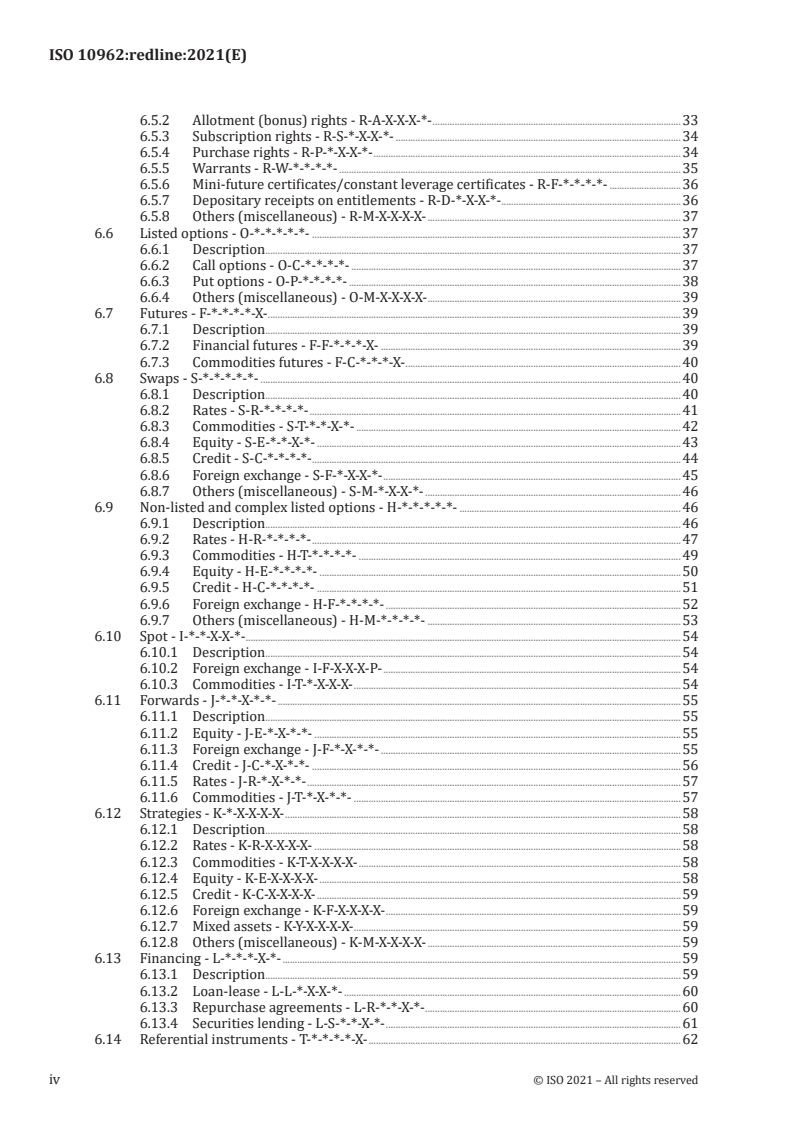
ISO 10962:redline:2021(E)
6.5.2 Allotment (bonus) rights - R-A-X-X-X-*- .33
6.5.3 Subscription rights - R-S-*-X-X-*- .34
6.5.4 Purchase rights - R-P-*-X-X-*- .34
6.5.5 Warrants - R-W-*-*-*-*- .35
6.5.6 Mini-future certificates/constant leverage certificates - R-F-*-*-*-*- .36
6.5.7 Depositary receipts on entitlements - R-D-*-X-X-*- .36
6.5.8 Others (miscellaneous) - R-M-X-X-X-X- .37
6.6 Listed options - O-*-*-*-*-*- .37
6.6.1 Description . . .37
6.6.2 Call options - O-C-*-*-*-*- .37
6.6.3 Put options - O-P-*-*-*-*- .38
6.6.4 Others (miscellaneous) - O-M-X-X-X-X- .39
6.7 Futures - F-*-*-*-*-X- .39
6.7.1 Description . . .39
6.7.2 Financial futures - F-F-*-*-*-X- .39
6.7.3 Commodities futures - F-C-*-*-*-X- .40
6.8 Swaps - S-*-*-*-*-*- .40
6.8.1 Description . . .40
6.8.2 Rates - S-R-*-*-*-*- .41
6.8.3 Commodities - S-T-*-*-X-*- .42
6.8.4 Equity - S-E-*-*-X-*- .43
6.8.5 Credit - S-C-*-*-*-*- . .44
6.8.6 Foreign exchange - S-F-*-X-X-*- .45
6.8.7 Others (miscellaneous) - S-M-*-X-X-*- .46
6.9 Non-listed and complex listed options - H-*-*-*-*-*- .46
6.9.1 Description . . .46
6.9.2 Rates - H-R-*-*-*-*- .47
6.9.3 Commodities - H-T-*-*-*-*- .49
6.9.4 Equity - H-E-*-*-*-*- .50
6.9.5 Credit - H-C-*-*-*-*- .51
6.9.6 Foreign exchange - H-F-*-*-*-*- .52
6.9.7 Others (miscellaneous) - H-M-*-*-*-*- .53
6.10 Spot - I-*-*-X-X-*- .54
6.10.1 Description . . .54
6.10.2 Foreign exchange - I-F-X-X-X-P- .54
6.10.3 Commodities - I-T-*-X-X-X- .54
6.11 Forwards - J-*-*-X-*-*- .55
6.11.1 Description . . .55
6.11.2 Equity - J-E-*-X-*-*- .55
6.11.3 Foreign exchange - J-F-*-X-*-*- .55
6.11.4 Credit - J-C-*-X-*-*- .56
6.11.5 Rates - J-R-*-X-*-*- .57
6.11.6 Commodities - J-T-*-X-*-*- .57
6.12 Strategies - K-*-X-X-X-X- .58
6.12.1 Description . . .58
6.12.2 Rates - K-R-X-X-X-X- .58
6.12.3 Commodities - K-T-X-X-X-X- .58
6.12.4 Equity - K-E-X-X-X-X- .58
6.12.5 Credit - K-C-X-X-X-X- .59
6.12.6 Foreign exchange - K-F-X-X-X-X- .59
6.12.7 Mixed assets - K-Y-X-X-X-X- .59
6.12.8 Others (miscellaneous) - K-M-X-X-X-X- .59
6.13 Financing - L-*-*-*-X-*- .59
6.13.1 Description . . .59
6.13.2 Loan-lease - L-L-*-X-X-*- .60
6.13.3 Repurchase agreements - L-R-*-*-X-*- .60
6.13.4 Securities lending - L-S-*-*-X-*- .61
6.14 Referential instruments - T-*-*-*-*-X- .62
iv © ISO 2021 – All rights reserved
ISO 10962:redline:2021(E)
6.14.1 Description . . .62
6.14.2 Currencies - T-C-*-X-X-X- .62
6.14.3 Commodities - T-T-*-X-X-X- .62
6.14.4 Interest rates - T-R-*-*-X-X- . .63
6.14.5 Indices - T-I-*-*-*-X- .63
6.14.6 Baskets - T-B-*-X-X-X- . .64
6.14.7 Stock dividends - T-D-*-X-X-X- .65
6.14.8 Others (miscellaneous) - T-M-X-X-X-X- .65
6.15 Others (miscellaneous) - M-*-*-*-X-*- .65
6.15.1 Description . . .65
6.15.2 Combined instruments - M-C-*-*-X-*- .65
6.15.3 Other assets - M-M-*-X-X-X- .66
Annex A
(informative)
Classification examples .67
Bibliography .74
ISO 10962:redline:2021(E)
Foreword
ISO (the International Organization for Standardization) is a worldwide federation of national standards
bodies (ISO member bodies). The work of preparing International Standards is normally carried out
through ISO technical committees. Each member body interested in a subject for which a technical
committee has been established has the right to be represented on that committee. International
organizations, governmental and non-governmental, in liaison with ISO, also take part in the work.
ISO collaborates closely with the International Electrotechnical Commission (IEC) on all matters of
electrotechnical standardization.
The procedures used to develop this document and those intended for its further maintenance are
described in the ISO/IEC Directives, Part 1. In particular, the different approval criteria needed for the
different types of ISO documents should be noted. This document was drafted in accordance with the
editorial rules of the ISO/IEC Directives, Part 2 (see www .iso .org/ directives).
Attention is drawn to the possibility that some of the elements of this document may be the subject of
patent rights. ISO shall not be held responsible for identifying any or all such patent rights. Details of
any patent rights identified during the development of the document will be in the Introduction and/or
on the ISO list of patent declarations received (see www .iso .org/ patents).
Any trade name used in this document is information given for the convenience of users and does not
constitute an endorsement.
For an explanation of the voluntary nature of standards, the meaning of ISO specific terms and
expressions related to conformity assessment, as well as information about ISO's adherence to the
World Trade Organization (WTO) principles in the Technical Barriers to Trade (TBT), see www .iso .org/
iso/ foreword .htmlwww .iso .org/ iso/ foreword .html.
This document was prepared by Technical Committee ISO/TC 68, Financial services, Subcommittee SC 8,
Reference data for financial services.
This fourthfifth edition cancels and replaces the thirdfourth edition (ISO 10962:20152019), which
has been technically revised. The main changes to the previous edition are as follows: six -character
hierarchical structure remains unchanged from the previous version.
The main changes to the previous edition are as follows:
— The CFI code list has been removed from the specification and moved to an external code list.
— To address industry requirements for the classification of derivative instruments,The structure of
the CFI and content of 6.8, 6.9 and 6.11 have been amended, where the support for multi-commodity
derivatives, the addition of exercise styles not connected to option type (put or call) and the
ability to classify foreign exchange derivatives for single currencies and a basket of currencies are
includedthe code list are captured in the form of a machine-readable semantical model of the code
lists and their values. It is important to understand that this is a semantic representation of the CFI
hierarchical structure and not a canonical semantic classification of financial instruments, which is
beyond the scope of this document.
— In 6.8The CFI external code list is maintained and published by the ISO 10962, changes have been
introduced for the identification of deliverable/non-deliverable for swap products. maintenance
agency, which is responsible for managing the modification and enhancement of the code lists, their
values and corresponding descriptions. The maintenance agency is responsible for publishing the
CFI code list. The CFI external code list is published in a selection of human-readable and machine-
readable data formats [e.g. spreadsheet, PDF, comma-separated values (CSV), JSON-LD, TTL] at
the discretion of the maintenance agency. See https:// www .iso .org/ maintenance _agencies .html
#81140.
— Rolling foreign exchange spot contracts have been included in 6.11.
vi © ISO 2021 – All rights reserved
ISO 10962:redline:2021(E)
Any feedback or questions on this document should be directed to the user’s national standards body. A
complete listing of these bodies can be found at www .iso .org/ members .html.
ISO 10962:redline:2021(E)
Introduction
The classification of financial instruments (CFI) code was developed to address a number of problems
which haveseveral problems that concerned the financial community. With the growth of cross-border
trading, the requirement to improve communication of information among market participants hashad
become critical.
The business problems centrecentred around an inability to obtain information on securitiesfinancial
instruments due to the lack of a consistent and uniform approach to grouping financial instruments.
With the explosive growth over the pastprevious 20 years in new instruments and features attached to
financial instruments, a serious communication problem hashad developed.
Many market participants arewere using similar terminology for instruments having significantly
different features. The problem isThis problem was compounded when market participants looklooked
beyond their own national markets. They encounter where they encountered the same words used to
describe instruments in another country, which havewith significantly different features. Where the
terminology iswas in a different language, the market participant encounters the problem of the same
words being applied to different instruments along with themarket participants encountered additional
problems of translation, which also can also be misleading.
In addition, the customs and practices of local markets varyvaried considerably in the manner in which
they structurehow they structured financial instruments, often leaving foreign participants confused
and perplexed. On careful analysis, it iswas often found that the characteristics and features of these
instruments arewere similar to a domestic instrumentinstruments. However, most market participants
dodid not have the time and resources to do this analysis.
The inability to group securitiesfinancial instruments in a consistent manner iswas another problem
encountered by market participants. Reports of holdings by different sources for similar financial
instruments often result in financialresulted in those instruments being categorized differently. This
not only affectsaffected comparability but causescaused a credibility issue with the reader. When
relative performances are beingperformance is measured, the ability to properly categorize holdings is
essential if true comparisons are to be made.
The solution envisioned is twofold. One isA twofold solution was developed to address these problems.
One was to establish a series of codes which clearlythat classify financial instruments having similar
features. The other iswas to develop a glossary of terms and provide common definitions whichthat
allow market participants to easily understand the terminology being used.
The benefits derived are many:
— The development of these codes will increase the efficiency, reliability, data consistency and
transparency of financial services transactions for both market and reference data. Classifying
financial instruments in a consistent, structured and standardized way is also beneficial for
regulatory reporting requirements.
— The CFI code system provides a set of codes for financial instruments whichthat can be used
globally for straight-through processing by all involved participants in an electronic data processing
environment. For example, readers of portfolio holdings see reports from different sources using
the same Categories, Groups and Attributes, makingcategories, groups and attributes, making the
comparison of instruments more credible.
— The use of these codes increases the efficiency, reliability, data consistency and transparency of
financial services transactions for both market and reference data. Classifying financial instruments
in a consistent, structured and standardized way is also beneficial for regulatory reporting
requirements.
— The broadened scope and coverage of CFI codes encourages market participants to take advantage of
other International Standards, particularly international securities identification numbers (ISINs).
viii © ISO 2021 – All rights reserved
ISO 10962:redline:2021(E)
— It is intended that the improved understanding of the characteristics and categorization leads to a
better comprehensionunderstanding of financial instruments. This leads to more active markets
and the resulting improvement inimproved market liquidity. In addition, these codes will beare
displayed on websites using internet technology, which has allowed the growth of e-issuing,
e-trading and e-settlements.
— The CFI code system can further serve as a basis for the classification of financial instruments for
industry risk aggregation and regulatory reporting.
The International Organization for Standardization (ISO) draws attention to the fact that it is claimed
that compliance with this document may involve the use of a patent.
ISO takes no position concerning the evidence, validity and scope of this patent right.
The holder of this patent right has assured ISO that he or she is willing to negotiate licences under
reasonable and non-discriminatory terms and conditions with applicants throughout the world. In
this respect, the statement of the holder of this patent right is registered with ISO. Information may be
obtained from the patent database available at www .iso .org/ patents.
Attention is drawn to the possibility that some of the elements of this document may be the subject of
patent rights other than those in the patent database. ISO shall not be held responsible for identifying
any or all such patent rights.
INTERNATIONAL STANDARD ISO 10962:redline:2021(E)
Securities and related financial instruments —
Classification of financial instruments (CFI) code
1 Scope
This document defines and describes the structure for the codes for an internationally valid system
to classify financial instruments. The classification system applies to financial instruments negotiated
internationally as well as to domestic instruments. The term “financial instruments” refers not only to
classical securities, and derivatives but also covers the innovative financial products that have emerged
in different markets (a trend that is expected to continue in the future).
This document is intended for use in any application in the trading and administration of
securitiesfinancial instruments in the international securities business. In so farInsofar as the trading
and the administration of securities do not affect other countries, the application of this document
remains at the discretion of the responsible national bodies, such as stock exchanges, banks, brokers,
regulatory bodies and other institutions active in the securities field.
In principle, the CFI code reflects characteristics that are defined when a financial instrument is issued
and that remain unchanged during its entire lifetime. However, a few events that can lead to a new
CFI code for the same instrument are anticipated, such as the changing of voting rights or ownership
restrictions by a stockholders' meeting.
2 Normative references
The following documents are referred to in the text in such a way that some or all of their content
constitutes requirements ofThere are no normative references in this document. For dated references,
only the edition cited applies. For undated references, the latest edition of the referenced document
(including any amendments) applies.
ISO 6166, Securities and related financial instruments — International securities identification numbering
system (ISIN)
3 Terms and definitions
NoFor the purposes of this document, the following terms and definitions are listed in this
documentapply.
ISO and IEC maintain terminological databases for use in standardization at the following addresses:
— ISO Online browsing platform: available at https:// www .iso .org/ obphttps:// www .iso .org/ obp
— IEC Electropedia: available at http:// www .electropedia .org/
3.1
concept
unit thought, idea or meaning
Note 1 to entry: A concept uses an Internationalized Resource Identifier (3.2) as a unique identifier.
ISO 10962:redline:2021(E)
3.2
Internationalized Resource Identifier
IRI
unique string of characters to identify a concept (3.1)
Note 1 to entry: The IRI supersedes the universal resource identifier (URI) for use in identifying concepts within
a Resource Definition Framework (3.3).
3.3
Resource Definition Framework
RDF
general method used to model concepts (3.1)
3.4
Web Ontology Language
OWL
semantic web language designed to represent rich and complex knowledge about things, groups of
things and relations between things, allowing one to represent hierarchical class relationships and
capture properties and constraints, among other things
Note 1 to entry: Further information is provided at: https:// www .w3 .org/ OWL/ . There are various syntax
conventions by which OWL can be represented [see Terse RDF Triple Language (3.6)].
Note 2 to entry: Any terms that are part of this vocabulary are prefixed with owl:.
3.5
Simple Knowledge Organization System
SKOS
W3C recommendation designed for representing classification schemes and taxonomies
Note 1 to entry: Like OWL, SKOS is an RDF-based vocabulary.
Note 2 to entry: Unlike the class hierarchy one can develop in OWL, SKOS provides the ability to create
hierarchies that utilize different types of relationships, e.g. is-a-part/member-of and as such, and also provides
the opportunity to support classifications and taxonomies across a broad range of information and use cases.
Note 3 to entry: Further information is provided at: https:// www .w3 .org/ SKOS/ .
Note 4 to entry: Any terms that are part of this vocabulary are prefixed with skos:.
3.6
Terse RDF Triple Language
TTL
syntax convention that represents the Web Ontology Language (3.4)
Note 1 to entry: Further information on this OWL syntax and details regarding how it is structured is provided
at: https:// www .w3 .org/ TeamSubmission/ turtle/ .
4 Conventions and principles
4.1 The CFI code provides the most comprehensive information possible, while maintaining the code
manageability. One of the essential rules of this CFI concept is that the classification is determined by
the intrinsic characteristics of the respective financial instruments and not by the instrument names and
terms prevailing in a given country; these terms can possibly be used in a different sense in another
country. This principle avoids confusion arising from different linguistic usage as well as redundancy,
while allowing objective comparison of the instruments across all domestic markets.
Refer to the examples in Annex A.
2 © ISO 2021 – All rights reserved
ISO 10962:redline:2021(E)
4.2 4.1 General
The CFI code provides the most comprehensive information possible while maintaining the
manageability of the code. One of the essential rules of this CFI concept is that the classification is
determined by the intrinsic characteristics of the respective financial instruments and not by the
instrument names and terms prevailing in a given country; these terms can be used in a different sense
in another country. This principle avoids confusion arising from different linguistic usage as well as
redundancy, while allowing objective comparison of the instruments across all domestic markets.
The CFI code should be defined in such a way that there is only one possible unique CFI code per type of
financial instrument. The CFI code should have a one-to-many relationship with financial instruments.
A financial instrument should only be associated with a single CFI code, see Figure 1.
Key
concepts or entities not defined within TC 68/SC 8 standards as of publication of this document
entity defined by an ISO standard
relationship between entities
Cardinality rules
0.* (optional, zero or more)
1.1 (one to one)
Figure 1 — Entity relationship
The CFI code is composed of six alphabetic characters where each character position has special
significance. The structure can be summarized as follows (detailed descriptions are provided in the
following subclauses):
— The first character represents the Category of the instrument.
ISO 10962:redline:2021(E)
— The second character represents the Group within a given Category.
— The third to the sixth characters are attributes which are defined to be significant within the context
of a given Category and Group.
The CFI code consists of six alphabetical characters. The following alphabetic characters,alphabetic
characters A, B, C, D, E, F, G, H, I, J, K, L, M, N, O, P, Q, R, S, T, U, V, W, X, Y and Z are available for assignment.
Two alphabetic characters have special meaningmeanings and cannot be redefined:
X Not applicable/ or undefined: the character 'X' may be used for any respective Attribute if the infor-
mation is unknown, not available or applicable at the time of assignment, regardless of whether it
is stated as an available character for the Attribute and should be updated to reflect the respective
Attribute as soon as it is known or available.
The character 'X' shall not be used as a value in the above describedthis manner for Category or
Group.
M Others (miscellaneous): the character ‘M’ exclusively represents ‘Others (miscellaneous)’ and may
only be used where it is available as a character within the context of its parent category or group.
‘M’ is only to be selected when the Category, Group or Attribute being classified cannot shall not
be attributed to an existing specified Category, Group or Attribute.
The meaning of an alphabetic character is local to, and only valid within, the context of its parent
Category or Groupcategory or its group.
Refer to Annex A for an example.
4.3 4.2 Category
The first character indicates the highest level of classification and differentiates between Categories
such as equities, collective investment vehicles (CIVs), debt instruments and many more, the Category,
which describes the broad asset classes of the instrument, such as debt, equities, listed options,
referential instruments or swaps.
4.4 4.3 Group
The second character indicates specific Groups within each Category; equities, for example,category.
For example, equities are broken down into: groups such as common or ordinary shares, preferred
or preference shares, and common or ordinary convertible shares. Within the category of debt
instruments, groups include bonds and convertible bonds.
— common/ordinary shares,
— preferred/preference shares,
— common/ordinary convertible shares,
— preferred/preference convertible shares,
— limited partnership units,
— depositary receipts on equities,
— structured instruments (participation) and
— others (miscellaneous).
Within the Category of debt instruments, the Groups are bonds, convertible bonds, bonds with warrants
attached, medium-term notes, money market instruments, structured instruments (capital protection),
structured instruments (without capital protection), mortgage-backed securities, asset-backed
securities, municipal bonds, depositary receipts on debt instruments and others (miscellaneous).
4 © ISO 2021 – All rights reserved
ISO 10962:redline:2021(E)
For the complete classification breakdown covering all categories, see Clause 6https://www .iso .org/
maintenance _agencies .html #81140.
4.5 4.4 Attributes
The last four characters indicate the most relevant attributes applicable to each Groupgroup within
a category. Whereas voting rights, ownership/transfer/, transfer or sales restrictions, payment status
and form are useful information in equities, these features do not exist for options, which have other
attributes such as option style, underlying assets, delivery, standardized/ or non-standardized, or
trigger. The position of the four attributes among them do not represent a hierarchical structure within
the instrument group.
4.5 Semantic model of the external code list for the CFI
The metamodel for the CFI consists of a specification of each type of CFI component (e.g. Category,
Group, First Attribute) as well as the metadata that is attached to each of those components. The
anno
...
INTERNATIONAL ISO
STANDARD 10962
Fifth edition
2021-05
Securities and related financial
instruments — Classification of
financial instruments (CFI) code
Valeurs mobilières et autres instruments financiers concernés —
Classification des instruments financiers (code CFI)
Reference number
©
ISO 2021
© ISO 2021
All rights reserved. Unless otherwise specified, or required in the context of its implementation, no part of this publication may
be reproduced or utilized otherwise in any form or by any means, electronic or mechanical, including photocopying, or posting
on the internet or an intranet, without prior written permission. Permission can be requested from either ISO at the address
below or ISO’s member body in the country of the requester.
ISO copyright office
CP 401 • Ch. de Blandonnet 8
CH-1214 Vernier, Geneva
Phone: +41 22 749 01 11
Email: copyright@iso.org
Website: www.iso.org
Published in Switzerland
ii © ISO 2021 – All rights reserved
Contents Page
Foreword .iv
Introduction .v
1 Scope . 1
2 Normative references . 1
3 Terms and definitions . 1
4 Conventions and principles . 2
4.1 General . 2
4.2 Category . 4
4.3 Group . 4
4.4 Attributes . 4
4.5 Semantic model of the external code list for the CFI . 4
5 CFI code allocation . 6
5.1 General . 6
5.2 Existing CFI codes and existing financial instruments without a CFI code . 7
6 Maintenance . 7
Annex A (informative) Classification examples. 8
Bibliography . 9
Foreword
ISO (the International Organization for Standardization) is a worldwide federation of national standards
bodies (ISO member bodies). The work of preparing International Standards is normally carried out
through ISO technical committees. Each member body interested in a subject for which a technical
committee has been established has the right to be represented on that committee. International
organizations, governmental and non-governmental, in liaison with ISO, also take part in the work.
ISO collaborates closely with the International Electrotechnical Commission (IEC) on all matters of
electrotechnical standardization.
The procedures used to develop this document and those intended for its further maintenance are
described in the ISO/IEC Directives, Part 1. In particular, the different approval criteria needed for the
different types of ISO documents should be noted. This document was drafted in accordance with the
editorial rules of the ISO/IEC Directives, Part 2 (see www .iso .org/ directives).
Attention is drawn to the possibility that some of the elements of this document may be the subject of
patent rights. ISO shall not be held responsible for identifying any or all such patent rights. Details of
any patent rights identified during the development of the document will be in the Introduction and/or
on the ISO list of patent declarations received (see www .iso .org/ patents).
Any trade name used in this document is information given for the convenience of users and does not
constitute an endorsement.
For an explanation of the voluntary nature of standards, the meaning of ISO specific terms and
expressions related to conformity assessment, as well as information about ISO's adherence to the
World Trade Organization (WTO) principles in the Technical Barriers to Trade (TBT), see www .iso .org/
iso/ foreword .html.
This document was prepared by Technical Committee ISO/TC 68, Financial services, Subcommittee SC 8,
Reference data for financial services.
This fifth edition cancels and replaces the fourth edition (ISO 10962:2019), which has been technically
revised. The six-character hierarchical structure remains unchanged from the previous version.
The main changes to the previous edition are as follows:
— The CFI code list has been removed from the specification and moved to an external code list.
— The structure of the CFI and content of the code list are captured in the form of a machine-readable
semantical model of the code lists and their values. It is important to understand that this is a
semantic representation of the CFI hierarchical structure and not a canonical semantic classification
of financial instruments, which is beyond the scope of this document.
— The CFI external code list is maintained and published by the ISO 10962 maintenance agency, which
is responsible for managing the modification and enhancement of the code lists, their values and
corresponding descriptions. The maintenance agency is responsible for publishing the CFI code list.
The CFI external code list is published in a selection of human-readable and machine-readable data
formats [e.g. spreadsheet, PDF, comma-separated values (CSV), JSON-LD, TTL] at the discretion of
the maintenance agency. See https:// www .iso .org/ maintenance _agencies .html #81140.
Any feedback or questions on this document should be directed to the user’s national standards body. A
complete listing of these bodies can be found at www .iso .org/ members .html.
iv © ISO 2021 – All rights reserved
Introduction
The classification of financial instruments (CFI) code was developed to address several problems
that concerned the financial community. With the growth of cross-border trading, the requirement to
improve communication of information among market participants had become critical.
The business problems centred around an inability to obtain information on financial instruments due
to the lack of a consistent and uniform approach to grouping financial instruments. With the explosive
growth over the previous 20 years in new instruments and features attached to financial instruments,
a serious communication problem had developed.
Many market participants were using similar terminology for instruments having significantly different
features. This problem was compounded when market participants looked beyond their own national
markets where they encountered the same words used to describe instruments with significantly
different features. Where the terminology was in a different language, market participants encountered
additional problems of translation, which can also be misleading.
In addition, the customs and practices of local markets varied considerably in how they structured
financial instruments, often leaving foreign participants perplexed. On careful analysis, it was often
found that the characteristics and features of these instruments were similar to domestic instruments.
However, most market participants did not have the time and resources to do this analysis.
The inability to group financial instruments in a consistent manner was another problem encountered
by market participants. Reports of holdings by different sources for similar financial instruments
often resulted in those instruments being categorized differently. This not only affected comparability
but caused a credibility issue with the reader. When relative performance is measured, the ability to
properly categorize holdings is essential if true comparisons are to be made.
A twofold solution was developed to address these problems. One was to establish a series of codes that
classify financial instruments having similar features. The other was to develop a glossary of terms and
provide common definitions that allow market participants to easily understand the terminology being
used.
The benefits derived are many:
— The CFI code system provides a set of codes for financial instruments that can be used globally
for straight-through processing by all involved participants in an electronic data processing
environment. For example, readers of portfolio holdings see reports from different sources using
the same categories, groups and attributes, making the comparison of instruments more credible.
— The use of these codes increases the efficiency, reliability, data consistency and transparency of
financial services transactions for both market and reference data. Classifying financial instruments
in a consistent, structured and standardized way is also beneficial for regulatory reporting
requirements.
— The broadened scope and coverage of CFI codes encourages market participants to take advantage of
other International Standards, particularly international securities identification numbers (ISINs).
— It is intended that the improved understanding of the characteristics and categorization leads to
a better understanding of financial instruments. This leads to more active markets and improved
market liquidity. In addition, these codes are displayed on websites using internet technology, which
has allowed the growth of e-issuing, e-trading and e-settlements.
— The CFI code system can further serve as a basis for the classification of financial instruments for
industry risk aggregation and regulatory reporting.
The International Organization for Standardization (ISO) draws attention to the fact that it is claimed
that compliance with this document may involve the use of a patent.
ISO takes no position concerning the evidence, validity and scope of this patent right.
The holder of this patent right has assured ISO that he or she is willing to negotiate licences under
reasonable and non-discriminatory terms and conditions with applicants throughout the world. In
this respect, the statement of the holder of this patent right is registered with ISO. Information may be
obtained from the patent database available at www .iso .org/ patents.
Attention is drawn to the possibility that some of the elements of this document may be the subject of
patent rights other than those in the patent database. ISO shall not be held responsible for identifying
...
INTERNATIONAL ISO
STANDARD 10962
Redline version
compares ISO 10962:2021
to ISO 10962:2019
Securities and related financial
instruments — Classification of
financial instruments (CFI) code
Valeurs mobilières et autres instruments financiers concernés —
Classification des instruments financiers (code CFI)
Reference number
ISO 10962:redline:2021(E)
©
ISO 2021
ISO 10962:redline:2021(E)
IMPORTANT
This marked-up version uses the following colour-coding in the marked-up text:
Text example 1 — Text has been added (in green)
— Text has been deleted (in red)
Text example 2
— Graphic figure has been added
— Graphic figure has been deleted
1.x . — If there are changes in a clause/subclause, the corresponding clause/
subclause number is highlighted in yellow in the Table of contents
DISCLAIMER
This marked-up version highlights the main changes in this edition of the document
compared with the previous edition. It does not focus on details (e.g. changes in
punctuation).
This marked-up version does not constitute the official ISO document and is not intended to
be used for implementation purposes.
© ISO 2021
All rights reserved. Unless otherwise specified, or required in the context of its implementation, no part of this publication may
be reproduced or utilized otherwise in any form or by any means, electronic or mechanical, including photocopying, or posting
on the internet or an intranet, without prior written permission. Permission can be requested from either ISO at the address
below or ISO’s member body in the country of the requester.
ISO copyright office
CP 401 • Ch. de Blandonnet 8
CH-1214 Vernier, Geneva
Phone: +41 22 749 01 11
Fax: +41 22 749 09 47
Email: copyright@iso.org
Website: www.iso.org
Published in Switzerland
ii © ISO 2021 – All rights reserved
ISO 10962:redline:2021(E)
Contents Page
Foreword .vi
Introduction .viii
1 Scope . 1
2 Normative references . 1
3 Terms and definitions . 1
4 Conventions and principles . 2
4.2 4.1 General . 3
4.3 4.2 Category . 4
4.4 4.3 Group . 4
4.5 4.4 Attributes . 5
4.5 Semantic model of the external code list for the CFI . 5
5 CFI code allocation . 6
5.1 General . 6
5.2 Existing CFIs CFI codes and existing securities financial instruments without a CFI code . 7
6 Codes and definitions Maintenance. 7
6.1 Categories . 7
6.2 Equities - E-*-*-*-*-*- . 7
6.2.1 Description . . . 7
6.2.2 Common/ordinary shares - E-S-*-*-*-*- . 8
6.2.3 Preferred/preference shares - E-P-*-*-*-*- . 8
6.2.4 Common/ordinary convertible shares - E-C-*-*-*-*- .10
6.2.5 Preferred/preference convertible shares - E-F-*-*-*-*- .10
6.2.6 Limited partnership units - E-L-*-*-*-*- . .11
6.2.7 Depositary receipts on equities - E-D-*-*-*-*- .11
6.2.8 Structured instruments (participation) - E-Y-*-*-*-*- .12
6.2.9 Others (miscellaneous) - E-M-X-X-X-*- .14
6.3 CIVs - C-*-*-*-*-*- .14
6.3.1 Description . . .14
6.3.2 Standard (vanilla) investment funds/mutual funds - C-I-*-*-*-*- .14
6.3.3 Hedge funds - C-H-*-X-X-X- .15
6.3.4 REITs - C-B-*-*-X-*-.16
6.3.5 ETFs - C-E-*-*-*-*- .17
6.3.6 Pension funds - C-S-*-*-*-*- .18
6.3.7 Funds of funds - C-F-*-*-*-*- .18
6.3.8 Private equity funds - C-P-*-*-*-*- .19
6.3.9 Others (miscellaneous) - C-M-X-X-X-*-.19
6.4 Debt instruments - D-*-*-*-*-*- .20
6.4.1 Description . . .20
6.4.2 Bonds - D-B-*-*-*-*- .20
6.4.3 Convertible bonds - D-C-*-*-*-*- .22
6.4.4 Bonds with warrants attached - D-W-*-*-*-*- .23
6.4.5 Medium term notes - D-T-*-*-*-*- .24
6.4.6 Money market instruments - D-Y-*-*-X-*- .25
6.4.7 Structured instruments (capital protection) - D-S-*-*-*-*- .25
6.4.8 Structured instruments (without capital protection) - D-E-*-*-*-*- .27
6.4.9 Mortgage-backed securities - D-G-*-*-*-*- .29
6.4.10 Asset-backed securities - D-A-*-*-*-*- .30
6.4.11 Municipal bonds - D-N-*-*-*-*- .31
6.4.12 Depositary receipts on debt instruments - D-D-*-*-*-*- .32
6.4.13 Others (miscellaneous) - D-M-*-X-X-*- .33
6.5 Entitlements (rights) - R-*-*-*-*-*- .33
6.5.1 Description . . .33
ISO 10962:redline:2021(E)
6.5.2 Allotment (bonus) rights - R-A-X-X-X-*- .33
6.5.3 Subscription rights - R-S-*-X-X-*- .34
6.5.4 Purchase rights - R-P-*-X-X-*- .34
6.5.5 Warrants - R-W-*-*-*-*- .35
6.5.6 Mini-future certificates/constant leverage certificates - R-F-*-*-*-*- .36
6.5.7 Depositary receipts on entitlements - R-D-*-X-X-*- .36
6.5.8 Others (miscellaneous) - R-M-X-X-X-X- .37
6.6 Listed options - O-*-*-*-*-*- .37
6.6.1 Description . . .37
6.6.2 Call options - O-C-*-*-*-*- .37
6.6.3 Put options - O-P-*-*-*-*- .38
6.6.4 Others (miscellaneous) - O-M-X-X-X-X- .39
6.7 Futures - F-*-*-*-*-X- .39
6.7.1 Description . . .39
6.7.2 Financial futures - F-F-*-*-*-X- .39
6.7.3 Commodities futures - F-C-*-*-*-X- .40
6.8 Swaps - S-*-*-*-*-*- .40
6.8.1 Description . . .40
6.8.2 Rates - S-R-*-*-*-*- .41
6.8.3 Commodities - S-T-*-*-X-*- .42
6.8.4 Equity - S-E-*-*-X-*- .43
6.8.5 Credit - S-C-*-*-*-*- . .44
6.8.6 Foreign exchange - S-F-*-X-X-*- .45
6.8.7 Others (miscellaneous) - S-M-*-X-X-*- .46
6.9 Non-listed and complex listed options - H-*-*-*-*-*- .46
6.9.1 Description . . .46
6.9.2 Rates - H-R-*-*-*-*- .47
6.9.3 Commodities - H-T-*-*-*-*- .49
6.9.4 Equity - H-E-*-*-*-*- .50
6.9.5 Credit - H-C-*-*-*-*- .51
6.9.6 Foreign exchange - H-F-*-*-*-*- .52
6.9.7 Others (miscellaneous) - H-M-*-*-*-*- .53
6.10 Spot - I-*-*-X-X-*- .54
6.10.1 Description . . .54
6.10.2 Foreign exchange - I-F-X-X-X-P- .54
6.10.3 Commodities - I-T-*-X-X-X- .54
6.11 Forwards - J-*-*-X-*-*- .55
6.11.1 Description . . .55
6.11.2 Equity - J-E-*-X-*-*- .55
6.11.3 Foreign exchange - J-F-*-X-*-*- .55
6.11.4 Credit - J-C-*-X-*-*- .56
6.11.5 Rates - J-R-*-X-*-*- .57
6.11.6 Commodities - J-T-*-X-*-*- .57
6.12 Strategies - K-*-X-X-X-X- .58
6.12.1 Description . . .58
6.12.2 Rates - K-R-X-X-X-X- .58
6.12.3 Commodities - K-T-X-X-X-X- .58
6.12.4 Equity - K-E-X-X-X-X- .58
6.12.5 Credit - K-C-X-X-X-X- .59
6.12.6 Foreign exchange - K-F-X-X-X-X- .59
6.12.7 Mixed assets - K-Y-X-X-X-X- .59
6.12.8 Others (miscellaneous) - K-M-X-X-X-X- .59
6.13 Financing - L-*-*-*-X-*- .59
6.13.1 Description . . .59
6.13.2 Loan-lease - L-L-*-X-X-*- .60
6.13.3 Repurchase agreements - L-R-*-*-X-*- .60
6.13.4 Securities lending - L-S-*-*-X-*- .61
6.14 Referential instruments - T-*-*-*-*-X- .62
iv © ISO 2021 – All rights reserved
ISO 10962:redline:2021(E)
6.14.1 Description . . .62
6.14.2 Currencies - T-C-*-X-X-X- .62
6.14.3 Commodities - T-T-*-X-X-X- .62
6.14.4 Interest rates - T-R-*-*-X-X- . .63
6.14.5 Indices - T-I-*-*-*-X- .63
6.14.6 Baskets - T-B-*-X-X-X- . .64
6.14.7 Stock dividends - T-D-*-X-X-X- .65
6.14.8 Others (miscellaneous) - T-M-X-X-X-X- .65
6.15 Others (miscellaneous) - M-*-*-*-X-*- .65
6.15.1 Description . . .65
6.15.2 Combined instruments - M-C-*-*-X-*- .65
6.15.3 Other assets - M-M-*-X-X-X- .66
Annex A
(informative)
Classification examples .67
Bibliography .74
ISO 10962:redline:2021(E)
Foreword
ISO (the International Organization for Standardization) is a worldwide federation of national standards
bodies (ISO member bodies). The work of preparing International Standards is normally carried out
through ISO technical committees. Each member body interested in a subject for which a technical
committee has been established has the right to be represented on that committee. International
organizations, governmental and non-governmental, in liaison with ISO, also take part in the work.
ISO collaborates closely with the International Electrotechnical Commission (IEC) on all matters of
electrotechnical standardization.
The procedures used to develop this document and those intended for its further maintenance are
described in the ISO/IEC Directives, Part 1. In particular, the different approval criteria needed for the
different types of ISO documents should be noted. This document was drafted in accordance with the
editorial rules of the ISO/IEC Directives, Part 2 (see www .iso .org/ directives).
Attention is drawn to the possibility that some of the elements of this document may be the subject of
patent rights. ISO shall not be held responsible for identifying any or all such patent rights. Details of
any patent rights identified during the development of the document will be in the Introduction and/or
on the ISO list of patent declarations received (see www .iso .org/ patents).
Any trade name used in this document is information given for the convenience of users and does not
constitute an endorsement.
For an explanation of the voluntary nature of standards, the meaning of ISO specific terms and
expressions related to conformity assessment, as well as information about ISO's adherence to the
World Trade Organization (WTO) principles in the Technical Barriers to Trade (TBT), see www .iso .org/
iso/ foreword .htmlwww .iso .org/ iso/ foreword .html.
This document was prepared by Technical Committee ISO/TC 68, Financial services, Subcommittee SC 8,
Reference data for financial services.
This fourthfifth edition cancels and replaces the thirdfourth edition (ISO 10962:20152019), which
has been technically revised. The main changes to the previous edition are as follows: six -character
hierarchical structure remains unchanged from the previous version.
The main changes to the previous edition are as follows:
— The CFI code list has been removed from the specification and moved to an external code list.
— To address industry requirements for the classification of derivative instruments,The structure of
the CFI and content of 6.8, 6.9 and 6.11 have been amended, where the support for multi-commodity
derivatives, the addition of exercise styles not connected to option type (put or call) and the
ability to classify foreign exchange derivatives for single currencies and a basket of currencies are
includedthe code list are captured in the form of a machine-readable semantical model of the code
lists and their values. It is important to understand that this is a semantic representation of the CFI
hierarchical structure and not a canonical semantic classification of financial instruments, which is
beyond the scope of this document.
— In 6.8The CFI external code list is maintained and published by the ISO 10962, changes have been
introduced for the identification of deliverable/non-deliverable for swap products. maintenance
agency, which is responsible for managing the modification and enhancement of the code lists, their
values and corresponding descriptions. The maintenance agency is responsible for publishing the
CFI code list. The CFI external code list is published in a selection of human-readable and machine-
readable data formats [e.g. spreadsheet, PDF, comma-separated values (CSV), JSON-LD, TTL] at
the discretion of the maintenance agency. See https:// www .iso .org/ maintenance _agencies .html
#81140.
— Rolling foreign exchange spot contracts have been included in 6.11.
vi © ISO 2021 – All rights reserved
ISO 10962:redline:2021(E)
Any feedback or questions on this document should be directed to the user’s national standards body. A
complete listing of these bodies can be found at www .iso .org/ members .html.
ISO 10962:redline:2021(E)
Introduction
The classification of financial instruments (CFI) code was developed to address a number of problems
which haveseveral problems that concerned the financial community. With the growth of cross-border
trading, the requirement to improve communication of information among market participants hashad
become critical.
The business problems centrecentred around an inability to obtain information on securitiesfinancial
instruments due to the lack of a consistent and uniform approach to grouping financial instruments.
With the explosive growth over the pastprevious 20 years in new instruments and features attached to
financial instruments, a serious communication problem hashad developed.
Many market participants arewere using similar terminology for instruments having significantly
different features. The problem isThis problem was compounded when market participants looklooked
beyond their own national markets. They encounter where they encountered the same words used to
describe instruments in another country, which havewith significantly different features. Where the
terminology iswas in a different language, the market participant encounters the problem of the same
words being applied to different instruments along with themarket participants encountered additional
problems of translation, which also can also be misleading.
In addition, the customs and practices of local markets varyvaried considerably in the manner in which
they structurehow they structured financial instruments, often leaving foreign participants confused
and perplexed. On careful analysis, it iswas often found that the characteristics and features of these
instruments arewere similar to a domestic instrumentinstruments. However, most market participants
dodid not have the time and resources to do this analysis.
The inability to group securitiesfinancial instruments in a consistent manner iswas another problem
encountered by market participants. Reports of holdings by different sources for similar financial
instruments often result in financialresulted in those instruments being categorized differently. This
not only affectsaffected comparability but causescaused a credibility issue with the reader. When
relative performances are beingperformance is measured, the ability to properly categorize holdings is
essential if true comparisons are to be made.
The solution envisioned is twofold. One isA twofold solution was developed to address these problems.
One was to establish a series of codes which clearlythat classify financial instruments having similar
features. The other iswas to develop a glossary of terms and provide common definitions whichthat
allow market participants to easily understand the terminology being used.
The benefits derived are many:
— The development of these codes will increase the efficiency, reliability, data consistency and
transparency of financial services transactions for both market and reference data. Classifying
financial instruments in a consistent, structured and standardized way is also beneficial for
regulatory reporting requirements.
— The CFI code system provides a set of codes for financial instruments whichthat can be used
globally for straight-through processing by all involved participants in an electronic data processing
environment. For example, readers of portfolio holdings see reports from different sources using
the same Categories, Groups and Attributes, makingcategories, groups and attributes, making the
comparison of instruments more credible.
— The use of these codes increases the efficiency, reliability, data consistency and transparency of
financial services transactions for both market and reference data. Classifying financial instruments
in a consistent, structured and standardized way is also beneficial for regulatory reporting
requirements.
— The broadened scope and coverage of CFI codes encourages market participants to take advantage of
other International Standards, particularly international securities identification numbers (ISINs).
viii © ISO 2021 – All rights reserved
ISO 10962:redline:2021(E)
— It is intended that the improved understanding of the characteristics and categorization leads to a
better comprehensionunderstanding of financial instruments. This leads to more active markets
and the resulting improvement inimproved market liquidity. In addition, these codes will beare
displayed on websites using internet technology, which has allowed the growth of e-issuing,
e-trading and e-settlements.
— The CFI code system can further serve as a basis for the classification of financial instruments for
industry risk aggregation and regulatory reporting.
The International Organization for Standardization (ISO) draws attention to the fact that it is claimed
that compliance with this document may involve the use of a patent.
ISO takes no position concerning the evidence, validity and scope of this patent right.
The holder of this patent right has assured ISO that he or she is willing to negotiate licences under
reasonable and non-discriminatory terms and conditions with applicants throughout the world. In
this respect, the statement of the holder of this patent right is registered with ISO. Information may be
obtained from the patent database available at www .iso .org/ patents.
Attention is drawn to the possibility that some of the elements of this document may be the subject of
patent rights other than those in the patent database. ISO shall not be held responsible for identifying
any or all such patent rights.
INTERNATIONAL STANDARD ISO 10962:redline:2021(E)
Securities and related financial instruments —
Classification of financial instruments (CFI) code
1 Scope
This document defines and describes the structure for the codes for an internationally valid system
to classify financial instruments. The classification system applies to financial instruments negotiated
internationally as well as to domestic instruments. The term “financial instruments” refers not only to
classical securities, and derivatives but also covers the innovative financial products that have emerged
in different markets (a trend that is expected to continue in the future).
This document is intended for use in any application in the trading and administration of
securitiesfinancial instruments in the international securities business. In so farInsofar as the trading
and the administration of securities do not affect other countries, the application of this document
remains at the discretion of the responsible national bodies, such as stock exchanges, banks, brokers,
regulatory bodies and other institutions active in the securities field.
In principle, the CFI code reflects characteristics that are defined when a financial instrument is issued
and that remain unchanged during its entire lifetime. However, a few events that can lead to a new
CFI code for the same instrument are anticipated, such as the changing of voting rights or ownership
restrictions by a stockholders' meeting.
2 Normative references
The following documents are referred to in the text in such a way that some or all of their content
constitutes requirements ofThere are no normative references in this document. For dated references,
only the edition cited applies. For undated references, the latest edition of the referenced document
(including any amendments) applies.
ISO 6166, Securities and related financial instruments — International securities identification numbering
system (ISIN)
3 Terms and definitions
NoFor the purposes of this document, the following terms and definitions are listed in this
documentapply.
ISO and IEC maintain terminological databases for use in standardization at the following addresses:
— ISO Online browsing platform: available at https:// www .iso .org/ obphttps:// www .iso .org/ obp
— IEC Electropedia: available at http:// www .electropedia .org/
3.1
concept
unit thought, idea or meaning
Note 1 to entry: A concept uses an Internationalized Resource Identifier (3.2) as a unique identifier.
ISO 10962:redline:2021(E)
3.2
Internationalized Resource Identifier
IRI
unique string of characters to identify a concept (3.1)
Note 1 to entry: The IRI supersedes the universal resource identifier (URI) for use in identifying concepts within
a Resource Definition Framework (3.3).
3.3
Resource Definition Framework
RDF
general method used to model concepts (3.1)
3.4
Web Ontology Language
OWL
semantic web language designed to represent rich and complex knowledge about things, groups of
things and relations between things, allowing one to represent hierarchical class relationships and
capture properties and constraints, among other things
Note 1 to entry: Further information is provided at: https:// www .w3 .org/ OWL/ . There are various syntax
conventions by which OWL can be represented [see Terse RDF Triple Language (3.6)].
Note 2 to entry: Any terms that are part of this vocabulary are prefixed with owl:.
3.5
Simple Knowledge Organization System
SKOS
W3C recommendation designed for representing classification schemes and taxonomies
Note 1 to entry: Like OWL, SKOS is an RDF-based vocabulary.
Note 2 to entry: Unlike the class hierarchy one can develop in OWL, SKOS provides the ability to create
hierarchies that utilize different types of relationships, e.g. is-a-part/member-of and as such, and also provides
the opportunity to support classifications and taxonomies across a broad range of information and use cases.
Note 3 to entry: Further information is provided at: https:// www .w3 .org/ SKOS/ .
Note 4 to entry: Any terms that are part of this vocabulary are prefixed with skos:.
3.6
Terse RDF Triple Language
TTL
syntax convention that represents the Web Ontology Language (3.4)
Note 1 to entry: Further information on this OWL syntax and details regarding how it is structured is provided
at: https:// www .w3 .org/ TeamSubmission/ turtle/ .
4 Conventions and principles
4.1 The CFI code provides the most comprehensive information possible, while maintaining the code
manageability. One of the essential rules of this CFI concept is that the classification is determined by
the intrinsic characteristics of the respective financial instruments and not by the instrument names and
terms prevailing in a given country; these terms can possibly be used in a different sense in another
country. This principle avoids confusion arising from different linguistic usage as well as redundancy,
while allowing objective comparison of the instruments across all domestic markets.
Refer to the examples in Annex A.
2 © ISO 2021 – All rights reserved
ISO 10962:redline:2021(E)
4.2 4.1 General
The CFI code provides the most comprehensive information possible while maintaining the
manageability of the code. One of the essential rules of this CFI concept is that the classification is
determined by the intrinsic characteristics of the respective financial instruments and not by the
instrument names and terms prevailing in a given country; these terms can be used in a different sense
in another country. This principle avoids confusion arising from different linguistic usage as well as
redundancy, while allowing objective comparison of the instruments across all domestic markets.
The CFI code should be defined in such a way that there is only one possible unique CFI code per type of
financial instrument. The CFI code should have a one-to-many relationship with financial instruments.
A financial instrument should only be associated with a single CFI code, see Figure 1.
Key
concepts or entities not defined within TC 68/SC 8 standards as of publication of this document
entity defined by an ISO standard
relationship between entities
Cardinality rules
0.* (optional, zero or more)
1.1 (one to one)
Figure 1 — Entity relationship
The CFI code is composed of six alphabetic characters where each character position has special
significance. The structure can be summarized as follows (detailed descriptions are provided in the
following subclauses):
— The first character represents the Category of the instrument.
ISO 10962:redline:2021(E)
— The second character represents the Group within a given Category.
— The third to the sixth characters are attributes which are defined to be significant within the context
of a given Category and Group.
The CFI code consists of six alphabetical characters. The following alphabetic characters,alphabetic
characters A, B, C, D, E, F, G, H, I, J, K, L, M, N, O, P, Q, R, S, T, U, V, W, X, Y and Z are available for assignment.
Two alphabetic characters have special meaningmeanings and cannot be redefined:
X Not applicable/ or undefined: the character 'X' may be used for any respective Attribute if the infor-
mation is unknown, not available or applicable at the time of assignment, regardless of whether it
is stated as an available character for the Attribute and should be updated to reflect the respective
Attribute as soon as it is known or available.
The character 'X' shall not be used as a value in the above describedthis manner for Category or
Group.
M Others (miscellaneous): the character ‘M’ exclusively represents ‘Others (miscellaneous)’ and may
only be used where it is available as a character within the context of its parent category or group.
‘M’ is only to be selected when the Category, Group or Attribute being classified cannot shall not
be attributed to an existing specified Category, Group or Attribute.
The meaning of an alphabetic character is local to, and only valid within, the context of its parent
Category or Groupcategory or its group.
Refer to Annex A for an example.
4.3 4.2 Category
The first character indicates the highest level of classification and differentiates between Categories
such as equities, collective investment vehicles (CIVs), debt instruments and many more, the Category,
which describes the broad asset classes of the instrument, such as debt, equities, listed options,
referential instruments or swaps.
4.4 4.3 Group
The second character indicates specific Groups within each Category; equities, for example,category.
For example, equities are broken down into: groups such as common or ordinary shares, preferred
or preference shares, and common or ordinary convertible shares. Within the category of debt
instruments, groups include bonds and convertible bonds.
— common/ordinary shares,
— preferred/preference shares,
— common/ordinary convertible shares,
— preferred/preference convertible shares,
— limited partnership units,
— depositary receipts on equities,
— structured instruments (participation) and
— others (miscellaneous).
Within the Category of debt instruments, the Groups are bonds, convertible bonds, bonds with warrants
attached, medium-term notes, money market instruments, structured instruments (capital protection),
structured instruments (without capital protection), mortgage-backed securities, asset-backed
securities, municipal bonds, depositary receipts on debt instruments and others (miscellaneous).
4 © ISO 2021 – All rights reserved
ISO 10962:redline:2021(E)
For the complete classification breakdown covering all categories, see Clause 6https://www .iso .org/
maintenance _agencies .html #81140.
4.5 4.4 Attributes
The last four characters indicate the most relevant attributes applicable to each Groupgroup within
a category. Whereas voting rights, ownership/transfer/, transfer or sales restrictions, payment status
and form are useful information in equities, these features do not exist for options, which have other
attributes such as option style, underlying assets, delivery, standardized/ or non-standardized, or
trigger. The position of the four attributes among them do not represent a hierarchical structure within
the instrument group.
4.5 Semantic model of the external code list for the CFI
The metamodel for the CFI consists of a specification of each type of CFI component (e.g. Category,
Group, First Attribute) as well as the metadata that is attached to each of those components. The
anno
...