

ISO/TS 12812-2:2017
(Main)Core banking — Mobile financial services — Part 2: Security and data protection for mobile financial services
General Information
- Abstract
ISO 12812-2:2017 describes and specifies a framework for the management of the security of MFS. It includes - a generic model for the design of the security policy, - a minimum set of security requirements, - recommended cryptographic protocols and mechanisms for mobile device authentication, financial message secure exchange and external authentication, including the following: point-to-point aspects to consider for MFS; end-to-end aspects to consider; security certification aspects; generation of mobile digital signatures; - interoperability issues for the secure certification of MFS, - recommendations for the protection of sensitive data, - guidelines for the implementation of national laws and regulations (e.g. anti-money laundering and combating the funding of terrorism (AML/CFT), and - security management considerations. In order to avoid the duplication of standardization work already performed by other organizations, this document will reference other International Standards as required. In this respect, users of this document are directed to materials developed and published by ISO/TC 68/SC 2 and ISO/IEC JTC 1/SC 27.
- Status
- Published
- Publication Date
- 27-Mar-2017
- Technical Committee
- ISO/TC 68/SC 9 - Information exchange for financial services
- Drafting Committee
- ISO/TC 68/SC 9 - Information exchange for financial services
- Current Stage
- 9093 - International Standard confirmed
- Start Date
- 29-Jul-2025
- Completion Date
- 29-Aug-2026
Overview
ISO/TS 12812-2:2017 - "Core banking - Mobile financial services - Part 2: Security and data protection for mobile financial services" - is a Technical Specification that defines a security management framework and minimum security requirements for Mobile Financial Services (MFS). It helps MFS providers, banks and system designers select and implement proportional security controls for mobile banking, mobile payments and electronic money systems while addressing data protection and regulatory obligations (e.g., AML/CFT).
Keywords: ISO/TS 12812-2:2017, mobile financial services security, MFS security, mobile banking security, data protection.
Key topics and technical requirements
- Security framework and three-layer model: organizational/process, application and infrastructure layers for managing MFS security.
- Minimum security requirements: remote access, transaction processing, protection of sensitive data, mobile device requirements and customer education.
- Device and platform security: guidance on mobile device hardening, wireless network protections, secure remote management (OTA), Trusted Execution Environments (TEE) and Secure Elements (SE).
- Cryptographic components: recommended cryptographic protocols and mechanisms for device authentication, secure financial message exchange and external authentication; requirements for cryptographic hardware and software modules.
- Payments-specific controls: security for proximate (contactless) and remote mobile payments, authentication, proof of consent and gateway processing.
- Data protection and privacy: legal compliance guidance, privacy assessment, recommendations for handling sensitive personal and financial data.
- Security evaluation and certification: guidance on cryptographic and software module evaluation, interoperability of certifications and TEE assessment.
- Supporting materials: informative annexes on risk analysis, Know-Your-Customer (KYC) implementations, cryptographic mechanisms and common vulnerabilities.
Keywords: cryptographic protocols, secure element, TEE, mobile proximate payments, mobile remote payments, KYC, AML/CFT.
Practical applications and who uses it
- Banks and mobile financial service providers (MFSPs) use this standard to design and document MFS security policies and to select appropriate security mechanisms.
- Security architects and developers apply device hardening, cryptographic and application-level guidance when building mobile banking apps, wallet services and payment gateways.
- Regulators and auditors reference the document for compliance expectations on data protection, AML/CFT and certification interoperability.
- Trusted Service Managers and certification bodies use the certification guidance to align interoperable assurance levels.
Practical benefits: reduces fraud risk, supports secure customer onboarding, enables interoperable certification approaches and helps align technical controls with legal/privacy requirements.
Related standards
- References and alignment with work from ISO/TC 68/SC 2 (financial services) and ISO/IEC JTC 1/SC 27 (IT security techniques).
- Part of the broader ISO 12812 series on Mobile Financial Services (see ISO 12812-1 and other related parts).
Keywords: ISO 12812 series, ISO security standards, mobile payments security.
Get Certified
Connect with accredited certification bodies for this standard

Great Wall Tianjin Quality Assurance Center
Established 1993, first batch to receive national accreditation with IAF recognition.
Hong Kong Quality Assurance Agency (HKQAA)
Hong Kong's leading certification body.

Innovative Quality Certifications Pvt. Ltd. (IQCPL)
Known for integrity, providing ethical & impartial Assessment & Certification. CMMI Institute Partner.
Sponsored listings
Frequently Asked Questions
ISO/TS 12812-2:2017 is a technical specification published by the International Organization for Standardization (ISO). Its full title is "Core banking — Mobile financial services — Part 2: Security and data protection for mobile financial services". This standard covers: ISO 12812-2:2017 describes and specifies a framework for the management of the security of MFS. It includes - a generic model for the design of the security policy, - a minimum set of security requirements, - recommended cryptographic protocols and mechanisms for mobile device authentication, financial message secure exchange and external authentication, including the following: point-to-point aspects to consider for MFS; end-to-end aspects to consider; security certification aspects; generation of mobile digital signatures; - interoperability issues for the secure certification of MFS, - recommendations for the protection of sensitive data, - guidelines for the implementation of national laws and regulations (e.g. anti-money laundering and combating the funding of terrorism (AML/CFT), and - security management considerations. In order to avoid the duplication of standardization work already performed by other organizations, this document will reference other International Standards as required. In this respect, users of this document are directed to materials developed and published by ISO/TC 68/SC 2 and ISO/IEC JTC 1/SC 27.
ISO 12812-2:2017 describes and specifies a framework for the management of the security of MFS. It includes - a generic model for the design of the security policy, - a minimum set of security requirements, - recommended cryptographic protocols and mechanisms for mobile device authentication, financial message secure exchange and external authentication, including the following: point-to-point aspects to consider for MFS; end-to-end aspects to consider; security certification aspects; generation of mobile digital signatures; - interoperability issues for the secure certification of MFS, - recommendations for the protection of sensitive data, - guidelines for the implementation of national laws and regulations (e.g. anti-money laundering and combating the funding of terrorism (AML/CFT), and - security management considerations. In order to avoid the duplication of standardization work already performed by other organizations, this document will reference other International Standards as required. In this respect, users of this document are directed to materials developed and published by ISO/TC 68/SC 2 and ISO/IEC JTC 1/SC 27.
ISO/TS 12812-2:2017 is classified under the following ICS (International Classification for Standards) categories: 03.060 - Finances. Banking. Monetary systems. Insurance. The ICS classification helps identify the subject area and facilitates finding related standards.
ISO/TS 12812-2:2017 is available in PDF format for immediate download after purchase. The document can be added to your cart and obtained through the secure checkout process. Digital delivery ensures instant access to the complete standard document.
Standards Content (Sample)
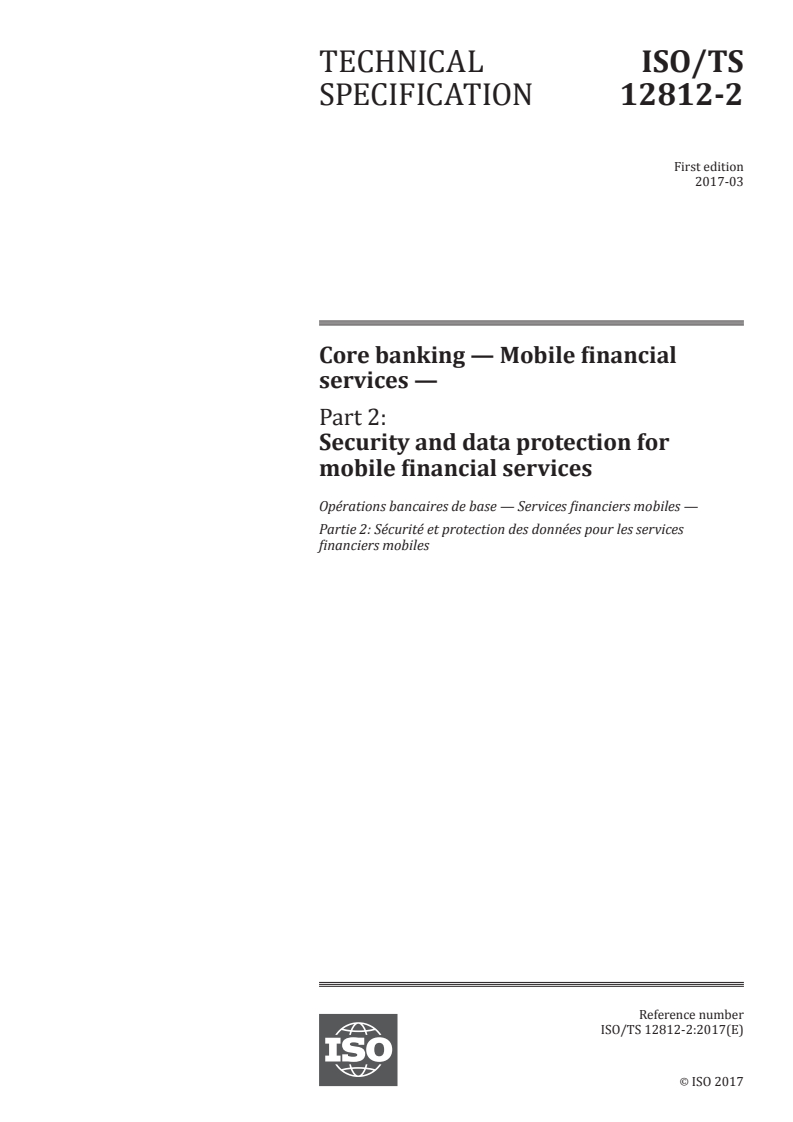
TECHNICAL ISO/TS
SPECIFICATION 12812-2
First edition
2017-03
Core banking — Mobile financial
services —
Part 2:
Security and data protection for
mobile financial services
Opérations bancaires de base — Services financiers mobiles —
Partie 2: Sécurité et protection des données pour les services
financiers mobiles
Reference number
©
ISO 2017
© ISO 2017, Published in Switzerland
All rights reserved. Unless otherwise specified, no part of this publication may be reproduced or utilized otherwise in any form
or by any means, electronic or mechanical, including photocopying, or posting on the internet or an intranet, without prior
written permission. Permission can be requested from either ISO at the address below or ISO’s member body in the country of
the requester.
ISO copyright office
Ch. de Blandonnet 8 • CP 401
CH-1214 Vernier, Geneva, Switzerland
Tel. +41 22 749 01 11
Fax +41 22 749 09 47
copyright@iso.org
www.iso.org
ii © ISO 2017 – All rights reserved
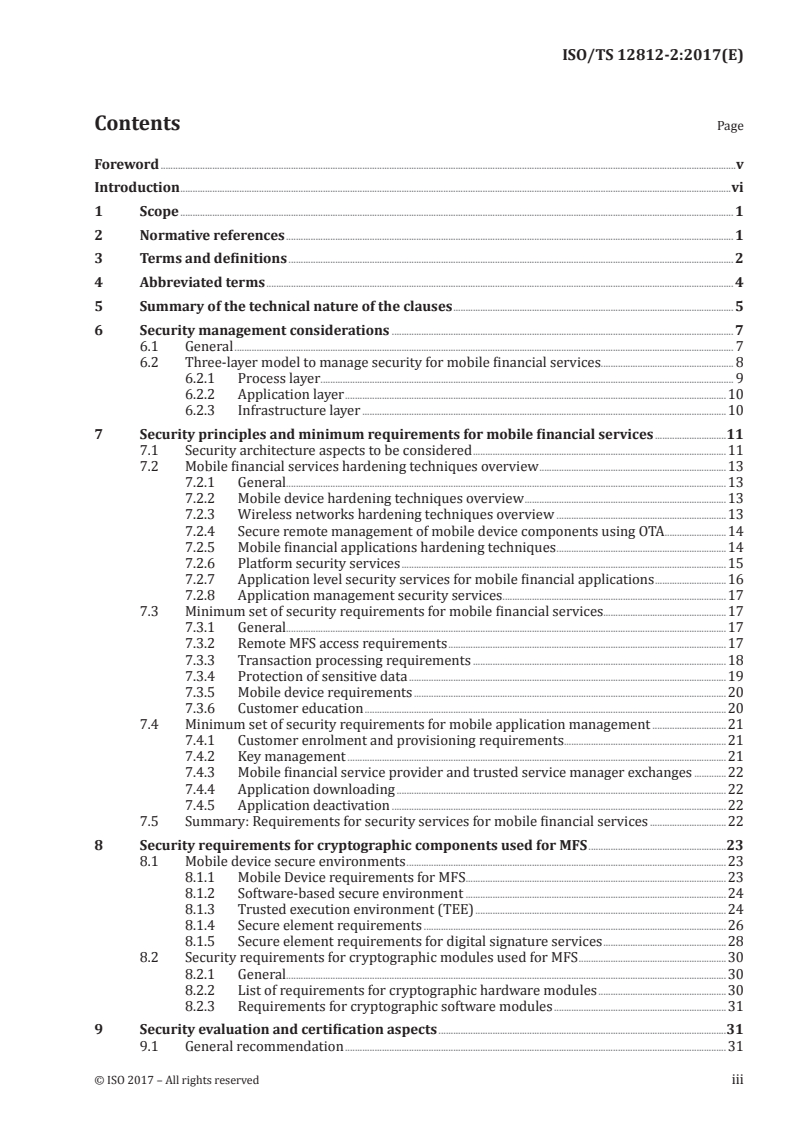
Contents Page
Foreword .v
Introduction .vi
1 Scope . 1
2 Normative references . 1
3 Terms and definitions . 2
4 Abbreviated terms . 4
5 Summary of the technical nature of the clauses . 5
6 Security management considerations . 7
6.1 General . 7
6.2 Three-layer model to manage security for mobile financial services. 8
6.2.1 Process layer . 9
6.2.2 Application layer .10
6.2.3 Infrastructure layer .10
7 Security principles and minimum requirements for mobile financial services .11
7.1 Security architecture aspects to be considered .11
7.2 Mobile financial services hardening techniques overview .13
7.2.1 General.13
7.2.2 Mobile device hardening techniques overview .13
7.2.3 Wireless networks hardening techniques overview .13
7.2.4 Secure remote management of mobile device components using OTA .14
7.2.5 Mobile financial applications hardening techniques .14
7.2.6 Platform security services .15
7.2.7 Application level security services for mobile financial applications .16
7.2.8 Application management security services . .17
7.3 Minimum set of security requirements for mobile financial services.17
7.3.1 General.17
7.3.2 Remote MFS access requirements .17
7.3.3 Transaction processing requirements .18
7.3.4 Protection of sensitive data .19
7.3.5 Mobile device requirements .20
7.3.6 Customer education .20
7.4 Minimum set of security requirements for mobile application management .21
7.4.1 Customer enrolment and provisioning requirements .21
7.4.2 Key management .21
7.4.3 Mobile financial service provider and trusted service manager exchanges .22
7.4.4 Application downloading .22
7.4.5 Application deactivation .22
7.5 Summary: Requirements for security services for mobile financial services .22
8 Security requirements for cryptographic components used for MFS .23
8.1 Mobile device secure environments .23
8.1.1 Mobile Device requirements for MFS .23
8.1.2 Software-based secure environment .24
8.1.3 Trusted execution environment (TEE) .24
8.1.4 Secure element requirements .26
8.1.5 Secure element requirements for digital signature services .28
8.2 Security requirements for cryptographic modules used for MFS .30
8.2.1 General.30
8.2.2 List of requirements for cryptographic hardware modules .30
8.2.3 Requirements for cryptographic software modules .31
9 Security evaluation and certification aspects .31
9.1 General recommendation .31
9.2 Cryptographic modules .31
9.3 Software modules .32
9.4 Interoperability of security certifications .32
9.5 Guidance for TEE security evaluation and certification .33
10 Security requirements for mobile proximate payments .33
10.1 General .33
10.2 Common security requirements .34
10.2.1 Integrity of sensitive data and applications at rest .34
10.2.2 Authentication .34
10.2.3 Data protection in transit .34
11 Security requirements for mobile remote payments .34
11.1 General .34
11.2 Security requirements .35
11.2.1 Authentication .35
11.2.2 Proof of consent .35
11.2.3 Payment gateway processing requirements .35
12 Security requirements for mobile banking .35
12.1 General .35
12.2 Authentication considerations .36
12.3 Security requirements .37
13 Electronic money .37
13.1 General .37
13.2 Anonymity requirements .37
13.3 Security requirements .37
14 Data protection requirements .38
14.1 General considerations and legal framework for compliance .38
14.2 Requirements and recommendations for data protection .39
14.2.1 Requirements .39
14.2.2 Recommendations for data protection .39
14.3 Privacy assessment .39
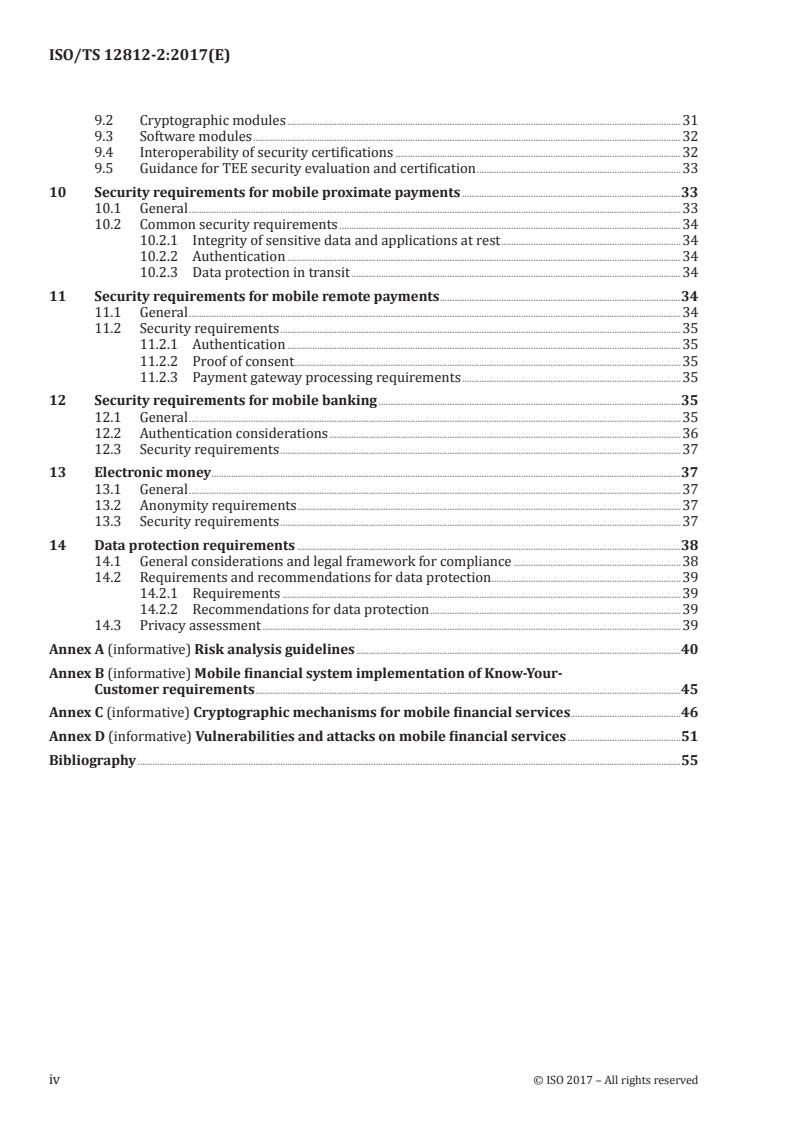
Annex A (informative) Risk analysis guidelines .40
Annex B (informative) Mobile financial system implementation of Know-Your-
Customer requirements .45
Annex C (informative) Cryptographic mechanisms for mobile financial services.46
Annex D (informative) Vulnerabilities and attacks on mobile financial services .51
Bibliography .55
iv © ISO 2017 – All rights reserved
Foreword
ISO (the International Organization for Standardization) is a worldwide federation of national standards
bodies (ISO member bodies). The work of preparing International Standards is normally carried out
through ISO technical committees. Each member body interested in a subject for which a technical
committee has been established has the right to be represented on that committee. International
organizations, governmental and non-governmental, in liaison with ISO, also take part in the work.
ISO collaborates closely with the International Electrotechnical Commission (IEC) on all matters of
electrotechnical standardization.
The procedures used to develop this document and those intended for its further maintenance are
described in the ISO/IEC Directives, Part 1. In particular the different approval criteria needed for the
different types of ISO documents should be noted. This document was drafted in accordance with the
editorial rules of the ISO/IEC Directives, Part 2 (see www .iso .org/ directives).
Attention is drawn to the possibility that some of the elements of this document may be the subject of
patent rights. ISO shall not be held responsible for identifying any or all such patent rights. Details of
any patent rights identified during the development of the document will be in the Introduction and/or
on the ISO list of patent declarations received (see www .iso .org/ patents).
Any trade name used in this document is information given for the convenience of users and does not
constitute an endorsement.
For an explanation on the voluntary nature of standards, the meaning of ISO specific terms and
expressions related to conformity assessment, as well as information about ISO’s adherence to the
World Trade Organization (WTO) principles in the Technical Barriers to Trade (TBT) see the following
URL: w w w . i s o .org/ iso/ foreword .html.
This document was prepared by Technical Committee ISO/TC 68, Financial services, Subcommittee SC 7,
Core banking.
A list of all the parts in the ISO 12812 series can be found on the ISO website.
Introduction
ISO 12812 is made up of ISO 12812-1, an International Standard, and ISO/TS 12812-2 to ISO/TS 12812-
4, published as Technical Specifications addressing interoperable and secure systems for the provision,
operation and management of Mobile Financial Services (MFS).
This document is intended to assist MFS developers and MFS providers (MFSPs) to evaluate and select
security mechanisms for an MFS to be managed according to a pre-established security policy. It is also
important for users of MFS to understand how security requirements and considerations come into
play in the mobile environment.
Security is a central requirement for any MFS. Institutions increasingly seek to mitigate the risk of
fraud in order to protect their customers and hence their own business. Security objectives focus on
risk mitigation of identified threats against the integrity and confidentiality of data. Any sustainable
MFS business model relies on security and fraud prevention. Consequently, the MFSP needs to define
the confidentiality and availability of data prior to implementing any MFS.
Mobile technology has security-specific concerns due to the proliferation and ease of availability of
mobile devices and the observed hacking of mobile applications. The experience with traditional card
payments is different than that with the mobile device and the wireless channel and requires that risks
and controls be reassessed and re-implemented where necessary. Hence, MFSPs require a common
understanding of the risks faced by the ecosystem and the suitability of existing security standards
(architecture, devices and mechanisms) to address them. This document assumes that when the
MFSP is deciding on the security policy to be implemented, the principle of proportionality applies. In
other words, security countermeasures should be proportional to the potential risk of financial and
reputational damage of a particular MFS.
MFS are initiated from a mobile device which is able to support different wireless communication
protocols for different modes of operation. The mobile device can leverage various technologies to
deliver MFS, including but not limited to near-field communications in conjunction with the presence
of an appropriate secure environment (e.g. SE, TEE, software with supplementary security controls)
resident in the mobile device or accessible from a remote/cloud-based back-office. Both types of
technology offer different methods for securing financial data, financial applications, and personal
data. In order to define security requirements for MFS, this document differentiates between:
— a proximate mode of operation, appropriate for various forms of payments where the mobile
device directly communicates with another mobile device (i.e. a payee’s mobile device) or a payment
terminal located at a merchant. Proximate payments are defined as those occurring where the payer
and the payee are physically present in the same location (see ISO 12812-1).
— a mobile remote mode of operation, where the mobile device uses a mobile communication
network which enable MFS to operate where the payer and the payee are not physically located
in the same place (see ISO 12812-1). In remote mode, the wireless communication channel is
established according to a specific set of standard protocols (e.g. GSM, CDMA, WiFi) which includes
authentication procedures to grant access to the network services. A second authentication process
of the mobile financial application enables the connection with the corresponding peer application
in a remote platform.
This document analyses the various security issues that may arise from the choice of platform
and technologies for the operation of MFS. This document also identifies various mobile malware
vulnerabilities (e.g. worms, viruses, trojans) specific to mobile devices.
ISO/TS 12812-2 objectives include
a) defining the minimum security requirements, recommendations and guidelines as appropriate,
b) facilitating a generic security framework for the provision and execution of MFS with sufficient
flexibility to accommodate different security policies,
c) establishing a generic model for managing security of MFS,
vi © ISO 2017 – All rights reserved
d) providing references for implementers to use in evaluating risks of MFS, and
e) identifying security management practices for the operation of MFS, including reference to specific
national legal requirements to combat criminal activities (e.g. anti-money laundering) and to
enhance data security through the use of proven cryptographic methods.
This document is structured as follows.
Clause 5 categorizes the technical content of the clauses of the document as types of materials:
descriptive, recommendations or requirements.
Clause 6 introduces the concept of security management, addressing all different aspects of MFS
security including risk management. Insight into risk analysis is found in Annex A.
Clause 7 describes the minimum set of security requirements for MFS, starting with challenges and
technologies for a secure mobile application system design.
Clause 8 sets out requirements for those components specifically designed to create a secure
environment in the mobile device, as well as cryptographic modules used for MFS transaction
processing.
Clause 9 provides insight and sets out requirements for secure evaluation and certification methods.
Clause 10 through Clause 12 discuss more in depth the concepts outlined in Clause 7, by providing
further requirements for security services needed to balance the vulnerabilities and threats of different
wireless networks both in proximate and remote modes.
Clause 13 is specific to electronic money security requirements.
Clause 14 provides information relevant for selecting countermeasures to mitigate the legal risks of
infringement of data protection laws.
Annex A focus on risk analysis including principles to establish a security management program for MFS.
Annex B provides insight into regulatory constraints that are taken into account when designing and/or
operating an MFS.
Annex C is a list of ISO recommended cryptographic standards and implementations to design the
security services set out in this document.
Annex D elaborates on vulnerabilities and threats for different communication channels used for MFS.
For additional information on the security of mobile payments, please refer to the Bibliography.
TECHNICAL SPECIFICATION ISO/TS 12812-2:2017(E)
Core banking — Mobile financial services —
Part 2:
Security and data protection for mobile financial services
1 Scope
This document describes and specifies a framework for the management of the security of MFS. It
includes
— a generic model for the design of the security policy,
— a minimum set of security requirements,
— recommended cryptographic protocols and mechanisms for mobile device authentication, financial
message secure exchange and external authentication, including the following:
a) point-to-point aspects to consider for MFS;
b) end-to-end aspects to consider;
c) security certification aspects;
d) generation of mobile digital signatures;
— interoperability issues for the secure certification of MFS,
— recommendations for the protection of sensitive data,
— guidelines for the implementation of national laws and regulations (e.g. anti-money laundering and
combating the funding of terrorism (AML/CFT), and
— security management considerations.
In order to avoid the duplication of standardization work already performed by other organizations,
this document will reference other International Standards as required. In this respect, users of this
document are directed to materials developed and published by ISO/TC 68/SC 2 and ISO/IEC JTC 1/SC 27.
2 Normative references
The following documents are referred to in the text in such a way that some or all of their content
constitutes requirements of this document. For dated references, only the edition cited applies. For
undated references, the latest edition of the referenced document (including any amendments) applies.
ISO 9564 (all parts), Financial services — Personal Identification Number (PIN) management and security
ISO 11568, Financial services — Key management (retail)
ISO 12812-1, Core banking — Mobile financial services — Part 1: General framework
ISO/TS 12812-3, Core banking — Mobile financial services — Part 3: Financial application lifecycle
management
ISO 13491 (all parts), Financial services — Secure cryptographic devices (retail)
ISO 19092, Financial services — Biometrics — Security framework
ISO 22307, Financial services — Privacy impact assessment
ISO/IEC 15408 (all parts), Information technology — Security techniques — Evaluation criteria for IT
security
ISO/IEC 19790, Information technology — Security techniques — Security requirements for
cryptographic modules
ISO/IEC 29192 (all parts), Information technology — Security techniques — Lightweight cryptography
3 Terms and definitions
For the purposes of this document, the terms and definitions given in ISO 12812-1 and the following apply.
ISO and IEC maintain terminological databases for use in standardization at the following addresses:
— ISO Online browsing platform: available at http:// www .iso .org/ obp
— IEC Electropedia: available at http:// www .electropedia .org/
3.1
application isolation
security property of the operating system whereby applications are isolated from one another both
during execution and in terms of data they store and/or access
3.2
attack pattern
abstracted approach utilized to attack an MFS asset
3.3
attack potential
measurement of the effort to be expended in attacking an MFS asset, expressed in terms of an attacker’s
expertise, resources and motivation
3.4
attack surface
set of attack points that an attacker can use in order to enter or capture data in an information system
3.5
certificate revocation list
signed data structure containing a time-stamped list of revoked certificates implemented in public key
infrastructures
3.6
common criteria
security evaluation methodology for Information Technology components standardized by
ISO/IEC 15408
3.7
cryptographic module
set of hardware, software and/or firmware that implements approved security functions
3.8
data breach
loss of control, compromise, unauthorized disclosure, unauthorized acquisition or access where
persons other than the legitimate ones have access to personally identifiable information (PII) or any
other sensitive information (e.g. authentication data, keys)
3.9
end-to-end security
data encrypted at the source so that only the final recipient has access to the data
2 © ISO 2017 – All rights reserved
3.10
external authentication
process by which a mobile payment application authenticates an entity
3.11
information security management system
part of the overall management system, based on a business risk approach, used to establish, implement,
operate, monitor, review, maintain and improve information security
3.12
mobile device integrity
absence of unauthorized or unintended changes in the hardware, firmware and software of a
mobile device
3.13
personalization
process of storing on the mobile device the user application data required to execute an MFS
3.14
point-to-point encryption
data encrypted between two nodes, where at least one of the two nodes is neither the source nor the
final recipient of the data
3.15
protection profile
set of security requirements that are specified with the aim of countering identified threats in a
particular environment
3.16
pseudo-anonymity
security traits whereby the true identity of the person (e.g. payer, payee) is masked
3.17
rooting
manipulation by which the user of a mobile device gains access to privileged operating system
administration rights
3.18
secure element provider security domain
confined physical and/or logical unit within the secure element where a security policy under the
control of the secure element provider is applied
3.19
security controls
management, operational and technical controls (i.e. safeguards or countermeasures) prescribed for
an information system to protect the confidentiality, integrity, and availability of the system and its
information
3.20
security encapsulation
layered security where one protocol (e.g. PIN encryption) is embedded inside another (e.g. SSL,TLS)
3.21
sensitive data
data which is required to be protected by security controls for a given MFS
EXAMPLE Authentication credentials, payment and banking credentials, cryptographic keys.
3.22
session key
temporary cryptographic key used to protect data for the current session only
3.23
time stamp
security mechanism providing the digital proof that an electronic document or message was created or
signed before a certain time
3.24
trusted mobile device
mobile device that has been certified to conform to certain industry practices that can support a known
risk profile (e.g. generation of electronic signatures)
3.25
unlinkability
security property of a protocol that protect it against an unauthorized party being able to link two
executions of the protocol to a specific mobile device
4 Abbreviated terms
AES Advanced Encryption Standard
AML Anti-Money Laundering
CBC Cipher Block Chaining
CC Common Criteria
CSP Critical Security Parameters
CVV Card Verification Value
ECC Elliptic Curve Cryptography
GCM Gallois Counter Mode
HCE Host Card Emulation
HMAC Keyed-Hash Message Authentication Code
HSM Hardware Security Module
IMSI International Mobile Subscriber Identity
ISMS Information Security Management system
KEK Key Encryption Key
MAC Message Authentication Code
MFS Mobile Financial Service
MFSP Mobile Financial Service Provider
OEM Original Equipment Manufacturer
OS Operating System
OSI Open System Interconnection
OTA Over the Air
PCD Proximity Coupling Device
4 © ISO 2017 – All rights reserved
PCI-DSS Payment Cared Industry Data Security Standard
PET Privacy Enhancing Technology
PEF Privacy Enhancing Feature
PII Personally Identifiable Information
PIN Personal Identification Number
RSA Rivest Shamir Adleman
RNG Random Number Generator
SE Secure Element
SMS Short Message Service
SMSC Short Message Service Center
SSL Secure Sockets Layer
TEE Trusted Execution Environment
TLS Transport Layer Security
TSM Trusted Service Manager
USSD Unstructured Supplementary Service Data
UVM User Verification Method
5 Summary of the technical nature of the clauses
Table 1 describes the technical nature of the clauses, classified as requirement, recommendation or
descriptive material.
Table 1 — Classification of the technical nature of the clauses
Clause Title Descriptive Requirements Recommendations
Clause 6 Security management considerations
6.2 Three-layer model to manage security for mobile financial services
6.2.1 Process layer X
6.2.2 Application layer X
6.2.3 Infrastructure layer X
Clause 7 Security principles and minimum requirements for mobile financial services
Security architecture aspects to be consid-
7.1 X
ered
7.2 Mobile financial services hardening techniques
Mobile device hardening techniques
7.2.2 X
overview
Wireless networks hardening techniques
7.2.3 X
overview
Secure remote management of mobile de-
7.2.4 X
vice components using OTA
Mobile financial applications hardening
7.2.5 X
techniques
Table 1 (continued)
Clause Title Descriptive Requirements Recommendations
7.2.6 Platform security services X
Application-level security services for mo-
7.2.7 X
bile financial applications
7.2.8 Application management security services X
7.3 Minimum set of security requirements for mobile financial services
Remote mobile financial services access
7.3.2 X
requirements
7.3.3 Transaction processing requirements X
7.3.4 Protection of sensitive data X
7.3.5 Mobile device requirements X
7.3.6 Customer education X
7.4 Minimum set of security requirements for mobile application management
Customer enrolment and provisioning
7.4.1 X
requirements
7.4.2 Key management X
Mobile financial service provider and trust-
7.4.3 X
ed service manager exchanges
7.4.4 Application downloading X
7.4.5 Application deactivation X
Summary: Requirements for security servic-
7.5 X
es for mobile financial applications and data
Clause 8 Security requirements for cryptographic components used for MFS
8.1 Mobile device secure environments
8.1.1 Mobile device requirements for MFS X
8.1.2 Software based secure environment X
8.1.3 Trusted Execution Environment (TEE) X
8.1.4 Secure element requirements X
Secure element requirements for digital
8.1.5 X
signature service
8.2 Security requirements for cryptographic modules used for MFS
List of requirements for cryptographic
8.2.1 X
hardware modules
Requirements for cryptographic software
8.2.2 X
modules
Clause 9 Security evaluation and certification aspects
9.1 General recommendation X
9.2 Common security evaluation requirements
9.3 Security evaluation of the TEE X
9.4 Security evaluation and certification of secure elements
9.5 Security evaluation of cryptographic hardware and software modules
Clause 10 Security requirements for mobile proximate payments
10.2 Common security requirements
10.2.1 Integrity of sensitive data and applica-
X
tions at rest
10.2.2 Authentication X
10.2.3 Data protection at rest X
6 © ISO 2017 – All rights reserved
Table 1 (continued)
Clause Title Descriptive Requirements Recommendations
Clause 11 Security requirements for mobile remote payments
11.2 Security requirements
11.2.1 Authentication X
11.2.2 Proof of consent X
11.2.3 Payment gateway processing requirements X
Clause 12 Security requirements for mobile banking
12.2 Authentication considerations X
12.3 Security requirements X
Clause 13 Electronic money security properties
13.2 Anonymity requirements X
13.3 Security requirements X
Clause 14 Data protection requirements
14.1 General considerations and legal frame-
X
work for compliance
14.2 Requirements and recommendations for data protection
14.2.1 Requirements X
14.2.2 Recommendations for data protection X
14.3 Privacy assessment X
Annex A Risk analysis guidelines X
Annex B Mobile financial system implementation of
X
Know-Your-Customer requirements
Annex C Cryptographic mechanisms for mobile
X
financial services
Annex D Vulnerabilities and attacks on mobile finan-
X
cial services
6 Security management considerations
6.1 General
Clause 6 establishes a framework for the management of the security of MFS. MFSPs are very sensitive
to the possibility of a loss of reputation and therefore strive to ensure that MFS are secure for their
customers. Thus, all MFSPs take care of managing their customer relationships and maintaining the
integrity and security of their MFS lest they suffer reputational, monetary, and legal damages that can
result from data compromise and fraud.
NOTE Refer to Annex A for further details on risk analysis.
It is thus fundamental to establish a security policy for the MFS program in which
— roles and responsibilities are assigned,
— security issues are governed and incentive exists to implement and maintain security best practices,
— transactions are secured and reliable,
— privacy is ensured, and
— security management systems of the involved parties are comparable and credible.
One of the objectives of this document is to provide implementers, with both requirements and
recommendations to establish a security policy for the MFS related operations. According to
ISO 12812-1:2017, Clause 5, the objective of the standard is technical interoperability. This document
provides with references to ISO cryptographic standards, whose implementation facilitates the
interoperability of protocols and applications for MFS.
6.2 Three-layer model to manage security for mobile financial services
This document establishes a generic model for security management to reduce the potential risk
associated with MFS. This model is based on the implementation of security controls on three different
functional layers required to provide MFS, namely the (1) process layer, the (2) application layer and
(3) the infrastructure layer. MFSPs are responsible to identify and mitigate the specific risks associated
with each layer.
— The process layer is made up of the organization and associated policies designed by the MFS
program and implemented by the MFSP in order to minimize the risks during the MFS.
— The application layer refers to the distributed software under the direct control of the MFSP or of
its partners embedded in the different processing computers and communication links required to
initiate and process MFS (e.g. an application stored in the secure environment of the mobile device,
a kernel in a point-of-interaction).
— The infrastructure layer is made up of the computing and networking facilities generating,
storing, processing or transporting MFS data (e.g. a mobile device, a wireless network, databases,
cryptographic modules).
Figure 1 describes the three layers of the generic model and provides examples of security standards
that implementers may find useful for the design of the security architecture for MFS.
and POLICIES
and CONTROLS
Figure 1 — Three-layer approach
Depending on the results of the risk assessment, further risk-driven measurements should be
implemented in addition to the best practices aligned with the security requirements. Similarly, the
attack surface can be effectively analysed and the appropriate countermeasures can be put in place, if
the specific implementation vectors are known.
8 © ISO 2017 – All rights reserved
Implementers may wish to reference available resources in determining how to architect and implement
their security measures. Among such resources are the FFIEC IT Examination Handbook, the NIST
Guidelines (often used by various payment system participants) and the PCI-DSS
The Open System Interconnection seven-layer model (ISO/IEC 7498-1) may be mapped in to the
Application and Infrastructure Layers described in 6.2.3 and 6.2.3.
6.2.1 Process layer
At the process (operational) layer, every party in the MFS program that provides or contributes to the
provision of MFS shall have an information security management system (ISMS) in place consisting of a
defined set of policies, processes, and systems to manage risks to information assets. In some instances,
other than as a consumer, entities that consume MFS information (e.g. cloud providers) also shall have
an information security management system in place. The respective party shall provide information
on its ISMS upon request to anyone for whom that information is relevant (e.g. auditors, contractual
partners), or in appropriate situations, even to customers. Any party who is required to have an ISMS
shall periodically review (e.g. annually) and update it so that it is current.
The ISMS shall contain at least methods and procedures to monitor and manage relevant risks identified
by the party and shall assign the appropriate resources and responsibilities to mitigate these risks.
Every participating party except a consumer shall define their responsibilities and the valuable assets
to protect in their sphere of responsibility.
The minimum set of control objectives that shall be managed and documented by every participating
party, except a consumer, are
— a security policy,
— the organization of information security (e.g. a hierarchical IT structure, a tiered secure management
structure),
— an asset management plan, including access controls, and
— where appropriate, the party has human resource security and related training in place.
Depending on their supplied services, additional control objectives should be part of the information
security management system, including but not limited to the following:
— physical and environmental security;
— communications and operations management;
— access control;
— information systems acquisition, development and maintenance;
— information security incident management;
— business continuity management;
— conformity or compliance mechanism(s).
Although the MFSP has the ultimate responsibility for achieving and maintaining security, if some
services are outsourced or delivered through other contractual partners of the MFSP, some or part of any
area of responsibility may be delegated to those other entities, even though the ultimate responsibility
remains with the MFSP. The MFSP shall monitor its vendors and/or agents with whom it has outsourced
any security requirements, to verify the existence of the security service level periodically to ensure
the security issues are being handled in conformance with the requirements of this document.
Some implementers may find it useful refer to ISO 27001, which defines ISMS. It should be noted,
however, that this document was not developed specifically for use by the financial services industry.
6.2.2 Application layer
At the application layer, software components shall comply with the information requirements outlined
in this document.
The threats and risks related to a particular MFS can be described depending on the devices used,
expected customer behaviour, attack patterns and application environments.
The risk assessment can then be conducted and the security measures can be evaluated following the
use cases. This applies to the roles and responsibilities of each party in an MFS including the MFSP,
customers and third parties. The wireless network, which provides the infrastructure layer (see 6.2.3),
is not usually under the direct control of the MFSP. Different wireless protocols can be used to connect
the mobile device to a processing infrastructure. This connection is performed through a mobile
telecommunication network or an Internet connection, provided by an MNO or a third entity.
As a minimum, MFSPs s
...