

ISO 3531-2:2022
(Main)Financial services — Financial information eXchange session layer — Part 2: FIX session layer
General Information
- Abstract
This document provides the normative specification of the FIX session layer standard and its session profiles.
- Status
- Published
- Publication Date
- 11-Apr-2022
- Technical Committee
- ISO/TC 68/SC 9 - Information exchange for financial services
- Drafting Committee
- ISO/TC 68/SC 9 - Information exchange for financial services
- Current Stage
- 6060 - International Standard published
- Start Date
- 12-Apr-2022
- Due Date
- 24-Jul-2022
- Completion Date
- 12-Apr-2022

Overview
ISO 3531-2:2022 - Financial services - Financial information eXchange session layer - Part 2: FIX session layer - is the normative ISO specification for the FIX session layer. It defines the rules, behaviors and session profiles that govern establishment, operation, synchronization, recovery and termination of FIX sessions used in electronic trading and financial messaging. The standard provides a formalized reference for FIX engines, session profiles (such as FIX.4.2, FIXT, and LFIXT), message formats and session control procedures.
Key topics and technical requirements
ISO 3531-2:2022 covers a comprehensive set of session-level mechanisms and requirements, including:
- Session identification and profiles: specifications for identifying FIX session peers and selecting a FIX session profile (e.g., FIX.4.2, FIXT, LFIXT) and application version behavior.
- Sequence number handling: rules for assigning, validating and synchronizing MsgSeqNum, including ResetSeqNumFlag and NextExpectedMsgSeqNum behaviors.
- Connection establishment: transport-layer requirements, use of Logon/Logout messages, heartbeat interval negotiation and TestMessageIndicator for testing.
- Keep-alive and heartbeat: heartbeat interval determination and keep‑alive behavior to maintain FIX connections.
- Message exchange and validation: requirements for ordered message processing, validation of SendingTime(52), handling garbled or invalid messages, and Reject semantics.
- Message recovery and retransmission: procedures for ResendRequest/Resend handling, gap fill, sequence reset, and distinguishing session-layer retransmission from application-level resend.
- FIX connection termination: graceful and forced logout flows, retransmission during logout and conditions for terminating transport connections.
- Extended features: session state restoration, 24-hour connectivity resets, and interoperability modes (e.g., LFIXT succinct/compatible modes).
- Routing and encoding: point-to-point and third-party routing considerations and transmitting alternatively encoded messages (Attachment groups).
- Components, messages, fields and code sets: normative lists of StandardHeader/StandardTrailer, core messages (Heartbeat, Logon, Logout, ResendRequest, etc.), field definitions and code sets.
Practical applications and users
ISO 3531-2:2022 is directly applicable to organizations that implement or operate FIX session infrastructure:
- FIX engine vendors and software developers implementing session-layer logic
- Buy- and sell-side trading firms integrating order routing and market connectivity
- Exchanges, ATSs and ECNs deploying FIX gateways and routing
- Middleware providers, market data vendors and algorithmic trading platforms
- QA, interoperability testing teams and compliance officers ensuring protocol conformance
Adopting ISO 3531-2:2022 helps ensure reliable message sequencing, robust recovery from gaps, interoperability across counterparties and standardized session behavior for high-availability trading environments.
Related standards
- ISO 3531-2:2022 complements the broader FIX protocol ecosystem and other FIX specification documents (FIXT and application-level FIX versions). Implementers should reference associated FIX application-layer specifications and any additional ISO parts or industry guidance relevant to FIX messaging and transport.
Get Certified
Connect with accredited certification bodies for this standard

Great Wall Tianjin Quality Assurance Center
Established 1993, first batch to receive national accreditation with IAF recognition.
Hong Kong Quality Assurance Agency (HKQAA)
Hong Kong's leading certification body.

Innovative Quality Certifications Pvt. Ltd. (IQCPL)
Known for integrity, providing ethical & impartial Assessment & Certification. CMMI Institute Partner.
Sponsored listings
Frequently Asked Questions
ISO 3531-2:2022 is a standard published by the International Organization for Standardization (ISO). Its full title is "Financial services — Financial information eXchange session layer — Part 2: FIX session layer". This standard covers: This document provides the normative specification of the FIX session layer standard and its session profiles.
This document provides the normative specification of the FIX session layer standard and its session profiles.
ISO 3531-2:2022 is classified under the following ICS (International Classification for Standards) categories: 03.060 - Finances. Banking. Monetary systems. Insurance. The ICS classification helps identify the subject area and facilitates finding related standards.
ISO 3531-2:2022 is available in PDF format for immediate download after purchase. The document can be added to your cart and obtained through the secure checkout process. Digital delivery ensures instant access to the complete standard document.
Standards Content (Sample)
INTERNATIONAL ISO
STANDARD 3531-2
First edition
2022-04
Financial services — Financial
information eXchange session layer —
Part 2:
FIX session layer
Reference number
© ISO 2022
All rights reserved. Unless otherwise specified, or required in the context of its implementation, no part of this publication may
be reproduced or utilized otherwise in any form or by any means, electronic or mechanical, including photocopying, or posting on
the internet or an intranet, without prior written permission. Permission can be requested from either ISO at the address below
or ISO’s member body in the country of the requester.
ISO copyright office
CP 401 • Ch. de Blandonnet 8
CH-1214 Vernier, Geneva
Phone: +41 22 749 01 11
Email: copyright@iso.org
Website: www.iso.org
Published in Switzerland
ii
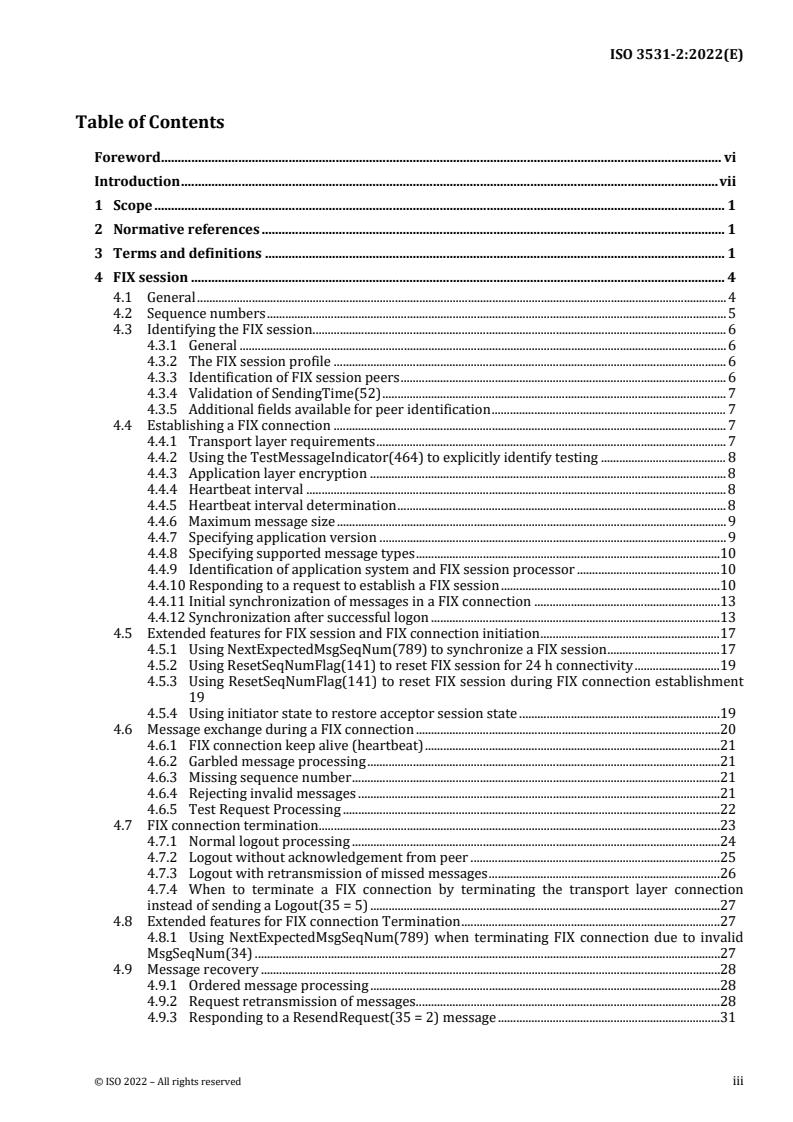
Table of Contents
Foreword . vi
Introduction . vii
1 Scope . 1
2 Normative references . 1
3 Terms and definitions . 1
4 FIX session . 4
4.1 General . 4
4.2 Sequence numbers . 5
4.3 Identifying the FIX session. 6
4.3.1 General . 6
4.3.2 The FIX session profile . 6
4.3.3 Identification of FIX session peers . 6
4.3.4 Validation of SendingTime(52) . 7
4.3.5 Additional fields available for peer identification . 7
4.4 Establishing a FIX connection . 7
4.4.1 Transport layer requirements . 7
4.4.2 Using the TestMessageIndicator(464) to explicitly identify testing . 8
4.4.3 Application layer encryption . 8
4.4.4 Heartbeat interval . 8
4.4.5 Heartbeat interval determination . 8
4.4.6 Maximum message size . 9
4.4.7 Specifying application version . 9
4.4.8 Specifying supported message types .10
4.4.9 Identification of application system and FIX session processor . 10
4.4.10 Responding to a request to establish a FIX session . 10
4.4.11 Initial synchronization of messages in a FIX connection . 13
4.4.12 Synchronization after successful logon .13
4.5 Extended features for FIX session and FIX connection initiation . 17
4.5.1 Using NextExpectedMsgSeqNum(789) to synchronize a FIX session . 17
4.5.2 Using ResetSeqNumFlag(141) to reset FIX session for 24 h connectivity . 19
4.5.3 Using ResetSeqNumFlag(141) to reset FIX session during FIX connection establishment
4.5.4 Using initiator state to restore acceptor session state . 19
4.6 Message exchange during a FIX connection .20
4.6.1 FIX connection keep alive (heartbeat) . 21
4.6.2 Garbled message processing .21
4.6.3 Missing sequence number .21
4.6.4 Rejecting invalid messages .21
4.6.5 Test Request Processing .22
4.7 FIX connection termination .23
4.7.1 Normal logout processing .24
4.7.2 Logout without acknowledgement from peer .25
4.7.3 Logout with retransmission of missed messages . 26
4.7.4 When to terminate a FIX connection by terminating the transport layer connection
instead of sending a Logout(35 = 5) .27
4.8 Extended features for FIX connection Termination .27
4.8.1 Using NextExpectedMsgSeqNum(789) when terminating FIX connection due to invalid
MsgSeqNum(34) .27
4.9 Message recovery .28
4.9.1 Ordered message processing .28
4.9.2 Request retransmission of messages.28
4.9.3 Responding to a ResendRequest(35 = 2) message . 31
4.9.4 Possible duplicates .32
4.9.5 Gap fill process .32
4.9.6 Sequence reset .34
4.9.7 Processing inbound possible duplicate messages (PossDup(43) set to “Y”) . 35
4.9.8 Processing gaps when receiving FIX session layer messages . 35
4.10 Resending an unacknowledged application message . 36
4.10.1 The difference between application layer resend and session layer retransmission . 37
4.11 FIX session state matrix .38
4.11.1 FIX logon process state transition diagram . 40
4.11.2 FIX logout process state transition diagram . 41
5 FIX session profiles . 42
5.1 FIX.4.2 session profile .42
5.1.1 Profile identification .42
5.1.2 Application version identification . 42
5.2 FIX4 session profile .43
5.2.1 Profile identification .43
5.2.2 Application version identification . 43
5.3 FIXT session profile .43
5.3.1 Profile identification .43
5.3.2 Multiple application version support over a single FIXT session . 43
5.3.3 Session default application version identification . 43
5.3.4 Message type default application version . 44
5.3.5 Explicit application version per message . 44
5.3.6 Use of extension packs .44
5.3.7 Use of a custom application version . 45
5.4 Lightweight FIXT (LFIXT session profile) . 45
5.4.1 Profile identification .46
5.4.2 Application version identification . 46
5.4.3 LFIXT transport layer requirements . 46
5.4.4 LFIXT compatible mode .46
5.4.5 LFIXT succinct mode .47
5.4.6 LFIXT and FIXT operating mode interoperability . 47
5.4.7 Validation of message sequence numbers. 48
5.4.8 Application layer recovery .48
5.4.9 LFIXT initiator connects to LFIXT acceptor . 48
5.4.10 FIXT initiator connects to LFIXT acceptor (compatible mode) . 50
5.4.11 Receipt of ResendRequest(35 = 2) message from a FIXT peer . 53
5.4.12 Processing invalid messages .55
6 FIX message routing . 55
6.1 Message routing details – one firm-to-one firm (point-to-point) . 55
6.2 Message routing details – third party message routing . 55
7 Transmitting alternatively encoded messages over a FIX session . 56
7.1 Use of Attachment group .57
8 Components . 57
8.1 AttachmentGrp .57
8.2 AttachmentKeywordGrp .58
8.3 HopGrp .58
8.4 MsgTypeGrp .59
8.5 StandardHeader .59
8.6 StandardTrailer .61
9 Messages . 61
9.1 Heartbeat message .61
9.2 TestRequest message .62
9.3 ResendRequest message .62
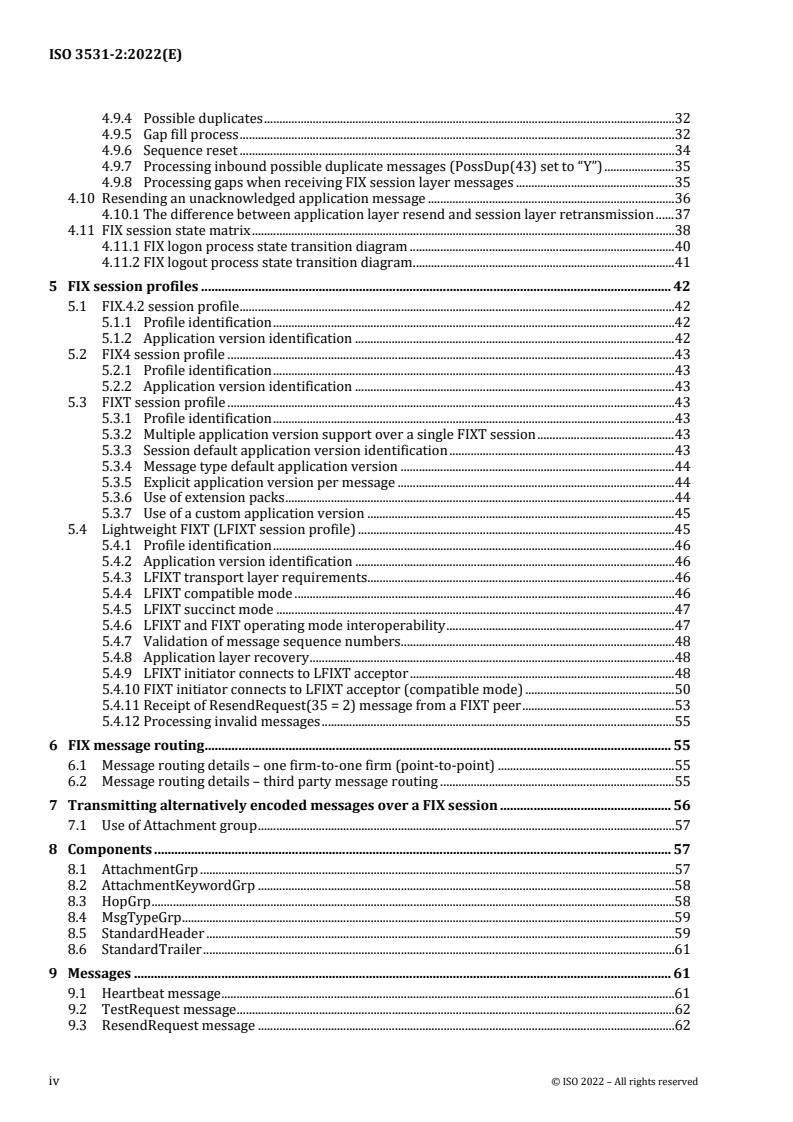
iv © ISO 2022 – All rights reserved
9.4 Reject message .62
9.5 SequenceReset message .63
9.6 Logout message .63
9.7 Logon message .64
9.8 XMLnonFIX message .66
10 Fields . 66
11 Code sets . 72
11.1 ApplLevelRecoveryIndicatorCodeSet .72
11.2 ApplVerIDCodeSet .73
11.3 AttachmentEncodingTypeCodeSet .73
11.4 EncryptMethodCodeSet .74
11.5 GapFillFlagCodeSet .74
11.6 MsgDirectionCodeSet .74
11.7 MsgTypeCodeSet .75
11.8 PossDupFlagCodeSet .75
11.9 PossResendCodeSet .75
11.10 ResetSeqNumFlagCodeSet .76
11.11 SessionRejectReasonCodeSet .76
11.12 SessionStatusCodeSet .77
11.13 TestMessageIndicatorCodeSet .77
Bibliography . 78
Foreword
ISO (the International Organization for Standardization) is a worldwide federation of national
standards bodies (ISO member bodies). The work of preparing International Standards is normally
carried out through ISO technical committees. Each member body interested in a subject for which a
technical committee has been established has the right to be represented on that committee.
International organizations, governmental and non-governmental, in liaison with ISO, also take part in
the work. ISO collaborates closely with the International Electrotechnical Commission (IEC) on all
matters of electrotechnical standardization.
The procedures used to develop this document and those intended for its further maintenance are
described in the ISO/IEC Directives, Part 1. In particular, the different approval criteria needed for the
different types of ISO documents should be noted (see www.iso.org/directives).
Attention is drawn to the possibility that some of the elements of this document may be the subject of
patent rights. ISO shall not be held responsible for identifying any or all such patent rights. Details of
any patent rights identified during the development of the document will be in the Introduction and/or
on the ISO list of patent declarations received (see www.iso.org/patents).
Any trade name used in this document is information given for the convenience of users and does not
constitute an endorsement.
For an explanation of the voluntary nature of standards, the meaning of ISO specific terms and
expressions related to conformity assessment, as well as information about ISO's adherence to the
World Trade Organization (WTO) principles in the Technical Barriers to Trade (TBT), see
www.iso.org/iso/foreword.html.
This document was prepared by FIX Trading Community (as FIX Session Layer Technical Specification)
and drafted in accordance with its editorial rules. It was assigned to Technical Committee ISO/TC 68,
Financial services, Subcommittee SC 9, Information exchange for financial services and adopted under the
“fast-track procedure”.
A list of all parts in the ISO 3531 series can be found on the ISO website.
Any feedback or questions on this document should be directed to the user’s national standards body. A
complete listing of these bodies can be found at www.iso.org/members.html.
vi © ISO 2022 – All rights reserved
Introduction
FIX session protocol was written to be independent of any specific communications protocol (e.g. X.25,
async, TCP/IP) or physical medium (e.g. copper, fibre, satellite) chosen for electronic data delivery. It
offers a reliable stream where a message is delivered once and in order. The FIX session layer is
designed to survive and resume operation in the event of the loss of transport level connections caused
by any type of failure, including network outage, application failure or computer hardware failures.
The session layer is concerned with the ordered delivery of data while the application level defines
business-related data content. This document focuses on the ordered delivery of data using the “FIX
session protocol”.
The FIX session protocol is implemented using the FIX tagvalue encoding syntax for the standard
header, standard trailer and the session level messages which make up the FIX session protocol. It is
possible to send messages using other encodings, such as the other FIX-defined encodings (e.g. FIXML,
SBE, JSON, GPB, ASN.1) or non-FIX-defined encodings (e.g. XML, FpML, ISO 20022 XML, JSON).
The Financial Information eXchange session layer is used to provide reliable and recoverable messaging
for electronic trading. The protocol is intended for use by asset managers, trading firms, brokerages,
trading venues, clearing houses, custodians, depositories, asset servicers and others involved in the
trading life cycle activities of a wide range of financial instruments. The FIX session layer functionality is
a realization of the ISO/IEC 7498-1 Open System Interconnection basic reference model level 5 session
layer.
INTERNATIONAL STANDARD ISO 3531:2022(E)
Financial services — Financial information eXchange
session layer —
Part 2:
FIX session layer
1 Scope
This document provides the normative specification of the FIX session layer standard and its session
profiles.
2 Normative references
There are no normative references in this document.
3 Terms and definitions
3.1
session layer message
message carried over the FIX session that is integral to the operation of the FIX session
3.2
application message
message that is carried over a FIX session to accomplish some business purpose
Note 1 to entry: Examples of a business purpose include an order to buy or sell a financial instrument, reporting
market data or reporting an execution of a trade.
3.3
message type
identifier (code) that defines the type of message being sent
Note 1 to entry: The message type for the FIX session is a case-sensitive string encoded in the MsgType(35) field.
3.4
valid FIX message
session or application message that is a tagvalue encoded string of octets that is properly formed
according to the FIX tagvalue encoding specification
3.5
FIX session processor
combination of computer hardware, firmware and software that implements the FIX session layer
Note 1 to entry: Commonly referred to as a FIX Engine.
3.6
initiator
FIX session processor that establishes the transport layer connection and initiates the session via
transmission of the initial Logon(35=A) message
3.7
acceptor
FIX session processor that is able to establish a transport layer connection and receive Logon(35=A)
requests from FIX session initiators to start or resume a FIX session
3.8
rules of engagement
specification, usually provided in document form, that describes a specific use of FIX
Note 1 to entry: Often referred to as a FIX service offering. FIX Orchestra is a standard that may be used to specify
machine-readable rules of engagement.
3.9
peer
FIX session processor being communicated with over a FIX session
Note 1 to entry: The peer of the initiator is the acceptor. The peer of the acceptor is the initiator. The initiator and
acceptor are peers.
3.10
counterparty
firm, legal entity or individual agreeing to use the FIX session layer to conduct some form of business
endeavour
3.11
NextNumIn
Each FIX session processor must keep track of the next message sequence number it is expecting to
receive from its peer to guarantee ordered delivery of messages over the life of a FIX session that may
span multiple FIX connections. The next expected incoming sequence number (NextNumIn) is
compared to the value in the MsgSeqNum(34) field in each message received from the peer.
3.12
NextNumOut
Each FIX session processor must keep track of the next outbound sequence number (NextNumOut) it
will send to its peer over a FIX connection.
3.13
retransmission
resending of a message that was previously sent in order to resynchronize the FIX session
Note 1 to entry: A retransmitted message uses the original MsgSeqNum(34) value with PossDupFlag(43)=Y.
3.14
resend
application message being resent by an application layer because it has not received an application
layer acknowledgement for the message
Note 1 to entry: A resend may only be initiated by the application layer, not the session layer. The determination
of whether the message was previously received is the responsibility of the application layer, not the session layer.
3.15
gap fill
process to resolve gaps in message sequence numbers within a FIX session
2 © ISO 2022 – All rights reserved
3.16
application version
The FIX session layer provides fields to communicate versions of the application layer messages. The
FIX Trading Community defines standard application versions.
3.17
extension pack
approved addition to the FIX standard
Note 1 to entry: The granularity of an extension pack may vary widely from a single enumeration value addition to
the definition of entire new categories of messages. Extension packs are identified by a sequential integer number
and must be applied in order. An extension pack is considered available for use if it has been approved and
published by the FIX Global Technical Committee. Extension packs are created on an as-needed basis and are
generally driven by community requests. An extension pack is cumulative, in that the artefacts (Orchestra file,
FIXimate) include all previous extension packs. When an extension pack is published, it becomes the FIX Latest
version of FIX.
3.18
session profile
extension or restriction on the use of the standard session layer messages that can be used to represent
context of usage
Note 1 to entry: FIX4, FIXT, and LFIXT are the current FIX session profiles.
3.19
CompID
alphanumeric identifier for the entity associated with a FIX session
Note 1 to entry: As this is likely a financial markets participant company, the name was viewed colloquially as a
company identifier abbreviated as a CompID.
3.20
SubID
subidentifier optionally available to identify a subentity within a CompID
Note 1 to entry: The SubID may be used to identify a specific trader or a subunit of a business entity. The use of
SubIDs is at the discretion of the counterparties. Certain regulatory regimes globally require the use of SubID to
identify specific traders.
3.21
LocationID
location identifier providing additional location information either geographical or within a trading
desk on a trading floor
Note 1 to entry: The use of LocationIDs is at the discretion of the counterparties.
3.22
transport layer connection
A FIX session relies on a transport layer to provide for ordered delivery of messages and message
recovery during the life of the transport layer connection. The FIX session does not require a specific
transport layer, although TCP/IP is widely used and is a de facto standard transport layer for FIX
sessions. TCP/IP provides an ordered reliable delivery of a stream of bytes during the life of the TCP
connection. The FIX session processor reads this stream identifying FIX message boundaries.
3.23
in-band communication
transmission of control information or metadata about the application layer or session layer in
application and session FIX message types over the FIX session
Note 1 to entry: Sending the HeartBtInt(108) field in the Logon(35=A) message is an example of in-band
transmission of control information. Providing version information about a FIX service in the
CstmApplVerID(1129) on the Logon(35=A) message is another example.
3.24
out-of-band communication
exchange of control information or metadata about a FIX session via a separate communication
mechanism than the FIX session
Note 1 to entry: Providing the TestRequestThreshold in a rules of engagement document is an example of
exchanging information out-of-band. Providing version information about a FIX service on a website or in a rules
of engagement document is another example of out-of-band communication. Providing access to a specification
online via a website or web service would be another example of out-of-band communication. Even though this is
electronic communication, it is not being done over the FIX session to which that information applies.
3.25
TestRequestThreshold
amount of time expressed as a multiplier of the heart beat interval before a TestRequest(35=1) message
is sent to the peer when the heartbeat interval has been exceeded without receiving a message from the
peer
Note 1 to entry: This value may be specified out-of-band in a rules of engagement.
3.26
SendingTimeThreshold
amount of time expressed in seconds in which the SendingTime(52) value in an inbound message
differs from the system time available to the receiving FIX session processor
Note 1 to entry: This value may be specified out-of-band in a rules of engagement.
3.27
LogoutAckThreshold
amount of time expressed in seconds that a FIX session processor that has transmitted a Logout(35=5)
request will wait for the Logout(35=5) acknowledgement before terminating the transport layer
connection
Note 1 to entry: This value may be specified out-of-band in a rules of engagement.
4 FIX session
4.1 General
A FIX session is a bidirectional stream of ordered messages between two peers within a continuous
sequence number series beginning with 1. A single FIX session can exist across multiple sequential (not
concurrent) FIX connections, which means that peers may intentionally or unintentionally connect and
disconnect multiple times while maintaining a single FIX session. The FIX session can be thought of as a
bidirectional durable session sharing characteristics of the guaranteed delivery and durable subscriber
enterprise integration architecture patterns.
4 © ISO 2022 – All rights reserved
A FIX connection consists of three parts: logon process, message exchange (inclusive of
resynchronization of state) and possible logout process over a transport layer connection. A FIX
connection may be concluded by the unrecoverable loss of the transport layer, a system failure or an
application failure.
Figure 1 — Conceptual view of FIX session layer
Connecting parties shall bilaterally agree upon the time the FIX session is started and the duration of a
FIX session. A FIX session is often configured to correspond to a certain period of time, such as a
trading day, calendar day or a trading session. A FIX session may extend beyond multiple periods by
counterparty agreement.
The FIX session is based on an optimistic model. Normal delivery of data are assumed (i.e. no session
layer acknowledgement of individual messages) with errors in delivery identified by message sequence
number gaps.
4.2 Sequence numbers
All messages sent over a FIX session shall be identified by a unique sequence number in the
MsgSeqNum(34) field.
A FIX session shall start with a next expected outgoing sequence number (NextNumOut) of 1 and a next
expected incoming sequence number (NextNumIn) of 1.
A FIX session processor must maintain the NextNumOut and NextNumIn for the entire FIX session.
A FIX session processor shall persist the NextNumOut and NextNumIn in order to support FIX session
recovery across multiple FIX connections.
Resetting NextNumOut to 1 and NextNumIn to 1, for whatever reason, shall constitute the beginning of
a new FIX session.
FIX session layer and application layer messages shall share the same sequence number space.
Firms may document the session layer configuration using the FIX Orchestra interface specification.
Each FIX session layer and application layer message sent consumes the next outbound sequence
number, incrementing NextNumOut by 1.
Each FIX session layer and application layer message received consumes the next inbound sequence
number, incrementing NextNumIn by 1.
A FIX session must always have peer1.NextNumIn < = peer2.NextNumOut and
peer2.NextNumIn < = peer1.NextNumOut to be considered in a valid and recoverable state.
4.3 Identifying the FIX session
4.3.1 General
A FIX session is identified by the unique combination of BeginString(8) + initiator CompID + acceptor
CompID.
4.3.2 The FIX session profile
BeginString(8) shall be used to identify the FIX session profile or version of FIX.
These FIX session profiles are defined within this specification.
Table 1 — The FIX session profiles
FIX session
BeginString(8) Description
profile
FIX.4.2 FIX.4.2 The FIX session profile for use with the FIX.4.2 application layer.
FIX4 FIX.4.4 The FIX session profile backward compatible with FIX.4.4 recommended
when counterparties will only be using a single application version during
the FIX session, such as FIX Latest.
FIXT FIXT.1.1 The FIX session profile that must be used when mixing multiple application
versions over the same FIX session. May be used with a single application
version of FIX such as FIX Latest.
LFIXT FIXT.1.1 Lightweight FIXT restricted session layer message recovery to simplify the
protocol while maintaining compatibility with FIXT when using LFIXT
compatible model of operation.
FIX session acceptor may be configured to support multiple FIX session profiles (or FIX versions prior to
FIX.4.4) over the same transport layer with only one FIX session profile (or FIX version prior to FIX.4.4)
being used per FIX session.
The FIX session acceptor should use the incoming Logon(35 = A) request BeginString(8) to identify the
FIX session profile or FIX version being requested by the initiator.
4.3.3 Identification of FIX session peers
FIX relies on alphanumeric strings known as CompIDs to identify the initiator and the acceptor of FIX
messages.
Counterparties must agree to their respective CompID values, which act as an identifier for the peer.
Each message sent over a FIX session layer must contain the sending entity in SenderCompID(49) and
the receiving (destination) entity in TargetCompID(56). This requirement applies to both session layer
and application layer messages.
The LFIXT session profile uses the same BeginString(8) value as the FIXT session profile. The use of LFIXT and its mode of
operation must be agreed upon out-of-band by counterparty agreement.
6 © ISO 2022 – All rights reserved
FIX service processors must validate the SenderCompID(49) and TargetCompID(56) of each message
and ensure that it is identical to the values present in the FIX connection Logon(35 = A) message. A
discrepancy in the SenderCompID(49)+TargetCompID(56) pair should result in the termination of the
FIX connection by sending a Logout(35 = A) message using the Text(58) field to indicate the error,
followed by termination of the transport layer connection.
4.3.4 Validation of SendingTime(52)
SendingTime(52) must be set to the time the message is transmitted by the FIX session processor, not
the time the message was queued for transmission.
SendingTime(52) must be in UTC (Universal Time Coordinated).
SendingTime(52) should be within the reasonable time of a synchronized time source of the receiving
FIX session processor. This SendingTimeThreshold is highly dependent upon the type of application
using the FIX session layer. The SendingTimeThreshold may be as low as seconds for high volume, low
latency applications up to several minutes for certain order routing applications.
The SendingTimeThreshold may be defined and communicated to counterparties out-of-band within the
rules of engagement.
The receiving peer shall transmit a Reject(35 = 3) message with SessionRejectReason(373) set to 10
(SendingTime Accuracy Problem) followed by a Logout(35 = 5) request when the SendingTime(52) is
not within a specified tolerance of a synchronized clock.
4.3.5 Additional fields available for peer identification
The FIX session layer provides additional fields which may be used to further identify recipients within
the respective counterparties.
Each counterparty may provide a subidentifier (SenderSubID(50) and TargetSubID(57)) known as
SubID.
Each counterparty may provide a location identifier (SenderLocationID(142) and
TargetLocationID(143)) known as LocationID.
The SubID and LocationID may vary across messages across the same FIX session.
The counterparties must agree upon the context and semantics of the SubID and LocationID if used.
4.4 Establishing a FIX connection
Establishing a FIX connection involves three distinct operations: creation of a transport layer
connection, acceptance with optional authentication of the initiator by the acceptor and message
synchronization (initialization).
The initiator shall establish a transport layer connection with the acceptor to establish a FIX connection.
4.4.1 Transport layer requirements
FIX session layer requires that the transport layer provides ordered and lossless message delivery and
full duplex operation for the life of the transport layer connection.
FIX implementations that use the TCP/IP protocol as the transport layer must use the FIX-over-TLS
(FIXS) specification which specifies the use of Transport Layer Security (TLS) with the FIX session layer
to provide transport layer encryption.
The initiator shall send a Logon(35 = A) request message to initiate a FIX connection.
The Logon(35 = A) request message must always be the first message transmitted over a FIX
connection. If the acceptor receives anything other than a valid Logon(35 = A) request message, an
error should be logged and the transport layer connection terminated without Logout(35 = 5)
processing.
4.4.2 Using the TestMessageIndicator(464) to explicitly identify testing
Counterparties should populate the TestMessageIndicator(464) field with “Y” in the Logon(35=A)
request and acknowledgement when testing.
FIX counterparties should validate that the TestMessageIndicator(464) field corresponds to the
environment.
If the TestMessageIndicator(464) with value “Y” is present in a Logon(35 = A) message indicating a test
session and the environment is not a test environment, the peer should transmit a Logout(35 = 5)
message with the Text(58) indicating that the TestMessageIndicator(464) was set to “Y” and the
environment is a production environment. Certain venues support sending test messages within the
production environment. Counterparties should communicate how testing is conducted within the
production environment to prevent test messages from being accepted as production messages.
If the TestMessageIndicator(464) with value “N” is present in a Logon(35 = A) message indicating a
production session and the environment is a test environment, the peer should transmit a
Logout(35 = 5) message with the Text(58) indicating that the TestMessageIndicator(464) was set to “N”
and the environment is a test environment.
Failure to validate the TestMessageIndicator(464) against the environment may potentially lead to
financial losses.
4.4.3 Application layer encryption
The use of application layer message encryption has been discouraged since the FIX.4.3 version of the
FIX protocol.
EncyptionMethod(98) must be present in the Logon(35 = A) message and set to “0” when application
layer encryption is not in use.
Firms may implement application layer encryption by counterparty agreement.
4.4.4 Heartbeat interval
The HeartBtInt(108) field must be present and specify the interval in seconds for generating heartbeat
messages during periods of inactivity.
The HeartBtInt(108) field must be present in the Logon(35 = A) message.
The HeartBtInt(108) value must be agreed upon by the initiator and the acceptor.
The initiator and acceptor must use the same HeartBtInt(108) value within a FIX connection.
The HeartBtInt(108) value is the maximum time allowed between receipt of messages from the peer.
Each FIX session processor should implement a heartbeat interval timer. The timer should be reset
upon receipt of each message
...