

ISO 16696-1:2019
(Main)Timber structures — Cross laminated timber — Part 1: Component performance, production requirements and certification scheme
General Information
- Abstract
This document establishes the basic principles for component performance and minimum production requirements for cross laminated timber (CLT). This document also contains scheme requirements for conformance, as provided in Annex D. The document is applicable to CLT products which are manufactured from solid-sawn timber or wood based panels built up of at least three layers in which the grain of adjoining layers are at right angles to each other. This document provides CLT dimension tolerances; component requirements; performance criteria; production, testing and trade marking guidance; and minimum requirements for factory production control. This document is based on known species, species combination and/or wood based panel structural performance and bondability. CLT qualified in accordance with the provisions of this document are intended to resist the effects of moisture on structural performance as can occur due to construction delays or other conditions of similar severity. NOTE This document does not include how CLT is to be used and installed, as it will be detailed in ISO 16696-2.
- Status
- Published
- Publication Date
- 13-Feb-2019
- Technical Committee
- ISO/TC 165 - Timber structures
- Drafting Committee
- ISO/TC 165/WG 2 - Structural glued wood products
- Current Stage
- 9093 - International Standard confirmed
- Start Date
- 11-Apr-2025
- Completion Date
- 29-Aug-2026
Buy Documents
ISO 16696-1:2019 - Timber structures -- Cross laminated timber
ISO 16696-1:2019 - Timber structures — Cross laminated timber — Part 1: Component performance, production requirements and certification scheme/14/2019
Overview
ISO 16696-1:2019 - "Timber structures - Cross laminated timber - Part 1: Component performance, production requirements and certification scheme" - sets the baseline requirements for the manufacture, performance assessment and conformity of cross laminated timber (CLT) products. It applies to CLT built from solid‑sawn timber or wood‑based panels composed of at least three layers with adjacent layer grain at right angles. The standard covers dimensional tolerances, component and adhesive requirements, performance criteria, production control, testing and trade‑marking guidance. Annex D defines the conformance/certification scheme.
Key technical topics and requirements
- Scope of applicability: CLT from known species or combinations and wood‑based panels; intended to resist moisture effects encountered in construction conditions.
- Dimensional tolerances: Requirements for panel thickness, layer thickness, width, length, squareness and straightness at manufacture and corrected sizes related to moisture content.
- Component requirements:
- Solid sawn timber and wood‑based panel specifications (sizes, face‑bonding surfaces, moisture content).
- Ply grading and allowable species/combination considerations.
- Adhesive and bond performance:
- Requirements for adhesives (bond integrity), testing for adhesive changes, finger and edge joint performance and glue‑line integrity.
- Mechanical and durability performance:
- Layup rules, mechanical resistance (strength and stiffness) expectations, durability against biological attack, and formaldehyde emission evaluation referenced to relevant test methods.
- Production and quality control:
- Minimum factory production control (FPC) criteria, sampling and testing procedures, trade marking and production assessment processes (Annex D).
- Normative and informative annexes:
- Layup examples (Annex A), appearance classification (Annex B), ply grading (Annex C), certification scheme and FPC details (Annex D), supplementary properties (Annex E).
Practical applications and who uses it
ISO 16696-1 is used by:
- CLT manufacturers - to design production lines, specify adhesives, and document factory production control and trade marking.
- Structural engineers and designers - to verify component performance, dimensional tolerances and layup requirements for load calculations.
- Architects and specifiers - to select compliant CLT products and confirm durability/appearance classes.
- Testing laboratories and certification bodies - to assess bond performance, mechanical properties and formaldehyde emissions and to implement the conformance scheme in Annex D.
- Building regulators and procurement teams - to reference minimum performance and production requirements for approval and contract specification.
Related standards
- ISO 16696-2 (CLT installation and use guidance)
- EN 16351, ANSI/APA PRG 320 (source standards informing ISO 16696 series)
- Relevant test standards cited: ISO/IEC 12460 (formaldehyde), ISO 20152 (bond performance), ISO/IEC 13910, ISO/IEC 16979 and ISO/IEC 3130 (moisture and sampling)
Keywords: ISO 16696-1, cross laminated timber, CLT, production requirements, component performance, certification scheme, dimensional tolerances, factory production control, adhesive requirements.
Buy Documents
ISO 16696-1:2019 - Timber structures -- Cross laminated timber
ISO 16696-1:2019 - Timber structures — Cross laminated timber — Part 1: Component performance, production requirements and certification scheme/14/2019
Get Certified
Connect with accredited certification bodies for this standard

DIBt (Deutsches Institut für Bautechnik)
German Institute for Building Technology.
DIN CERTCO
DIN Group product certification.

Aboma Certification B.V.
Specialized in construction, metal, and transport sectors.
Sponsored listings
Frequently Asked Questions
ISO 16696-1:2019 is a standard published by the International Organization for Standardization (ISO). Its full title is "Timber structures — Cross laminated timber — Part 1: Component performance, production requirements and certification scheme". This standard covers: This document establishes the basic principles for component performance and minimum production requirements for cross laminated timber (CLT). This document also contains scheme requirements for conformance, as provided in Annex D. The document is applicable to CLT products which are manufactured from solid-sawn timber or wood based panels built up of at least three layers in which the grain of adjoining layers are at right angles to each other. This document provides CLT dimension tolerances; component requirements; performance criteria; production, testing and trade marking guidance; and minimum requirements for factory production control. This document is based on known species, species combination and/or wood based panel structural performance and bondability. CLT qualified in accordance with the provisions of this document are intended to resist the effects of moisture on structural performance as can occur due to construction delays or other conditions of similar severity. NOTE This document does not include how CLT is to be used and installed, as it will be detailed in ISO 16696-2.
This document establishes the basic principles for component performance and minimum production requirements for cross laminated timber (CLT). This document also contains scheme requirements for conformance, as provided in Annex D. The document is applicable to CLT products which are manufactured from solid-sawn timber or wood based panels built up of at least three layers in which the grain of adjoining layers are at right angles to each other. This document provides CLT dimension tolerances; component requirements; performance criteria; production, testing and trade marking guidance; and minimum requirements for factory production control. This document is based on known species, species combination and/or wood based panel structural performance and bondability. CLT qualified in accordance with the provisions of this document are intended to resist the effects of moisture on structural performance as can occur due to construction delays or other conditions of similar severity. NOTE This document does not include how CLT is to be used and installed, as it will be detailed in ISO 16696-2.
ISO 16696-1:2019 is classified under the following ICS (International Classification for Standards) categories: 91.080.20 - Timber structures. The ICS classification helps identify the subject area and facilitates finding related standards.
ISO 16696-1:2019 is available in PDF format for immediate download after purchase. The document can be added to your cart and obtained through the secure checkout process. Digital delivery ensures instant access to the complete standard document.
Standards Content (Sample)
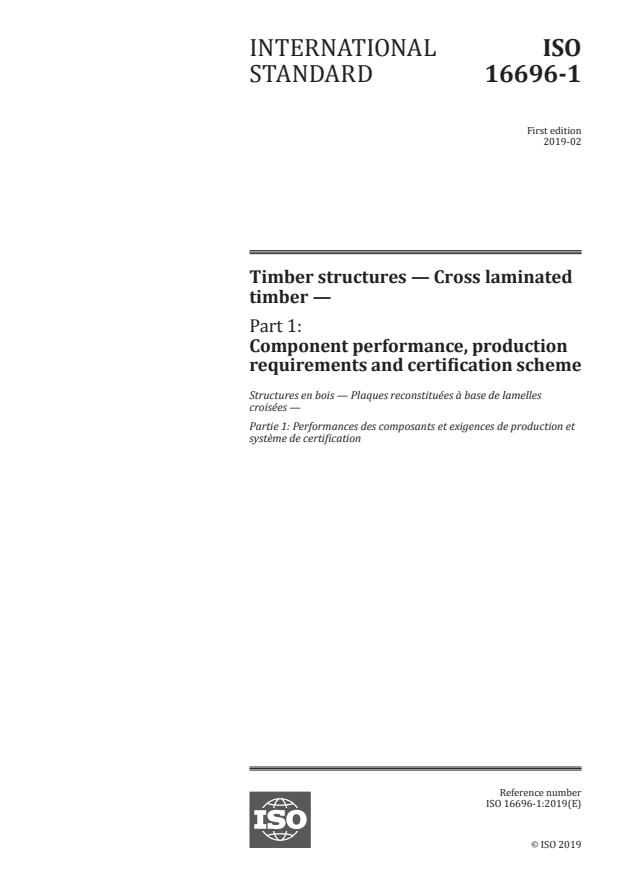
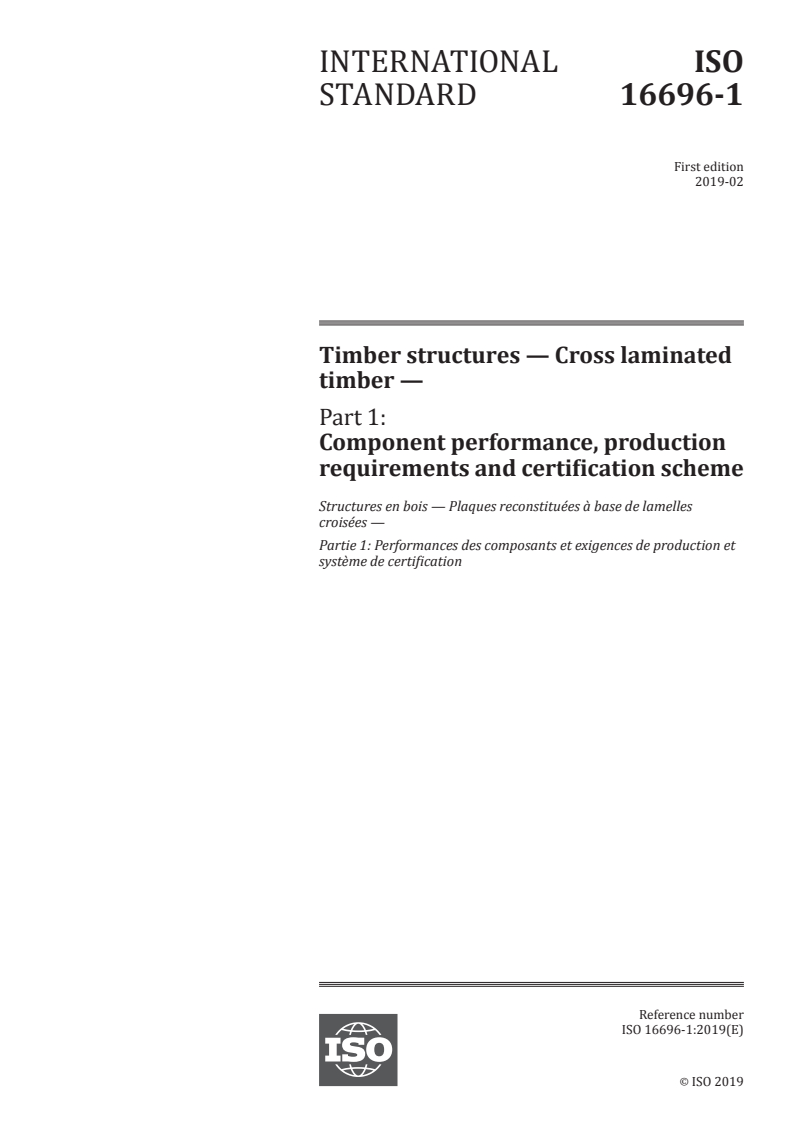
INTERNATIONAL ISO
STANDARD 16696-1
First edition
2019-02
Timber structures — Cross laminated
timber —
Part 1:
Component performance, production
requirements and certification scheme
Structures en bois — Plaques reconstituées à base de lamelles
croisées —
Partie 1: Performances des composants et exigences de production et
système de certification
Reference number
©
ISO 2019
© ISO 2019
All rights reserved. Unless otherwise specified, or required in the context of its implementation, no part of this publication may
be reproduced or utilized otherwise in any form or by any means, electronic or mechanical, including photocopying, or posting
on the internet or an intranet, without prior written permission. Permission can be requested from either ISO at the address
below or ISO’s member body in the country of the requester.
ISO copyright office
CP 401 • Ch. de Blandonnet 8
CH-1214 Vernier, Geneva
Phone: +41 22 749 01 11
Fax: +41 22 749 09 47
Email: copyright@iso.org
Website: www.iso.org
Published in Switzerland
ii © ISO 2019 – All rights reserved
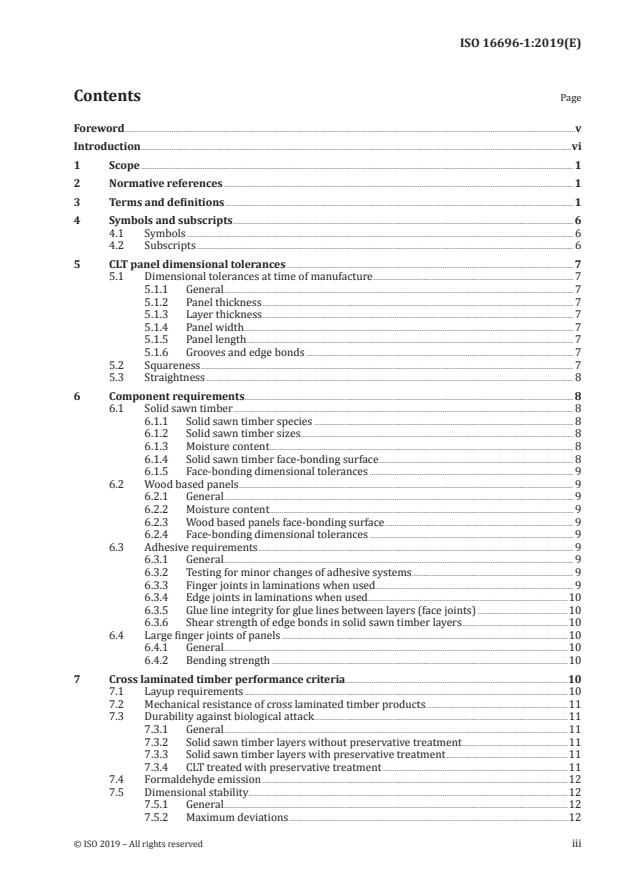
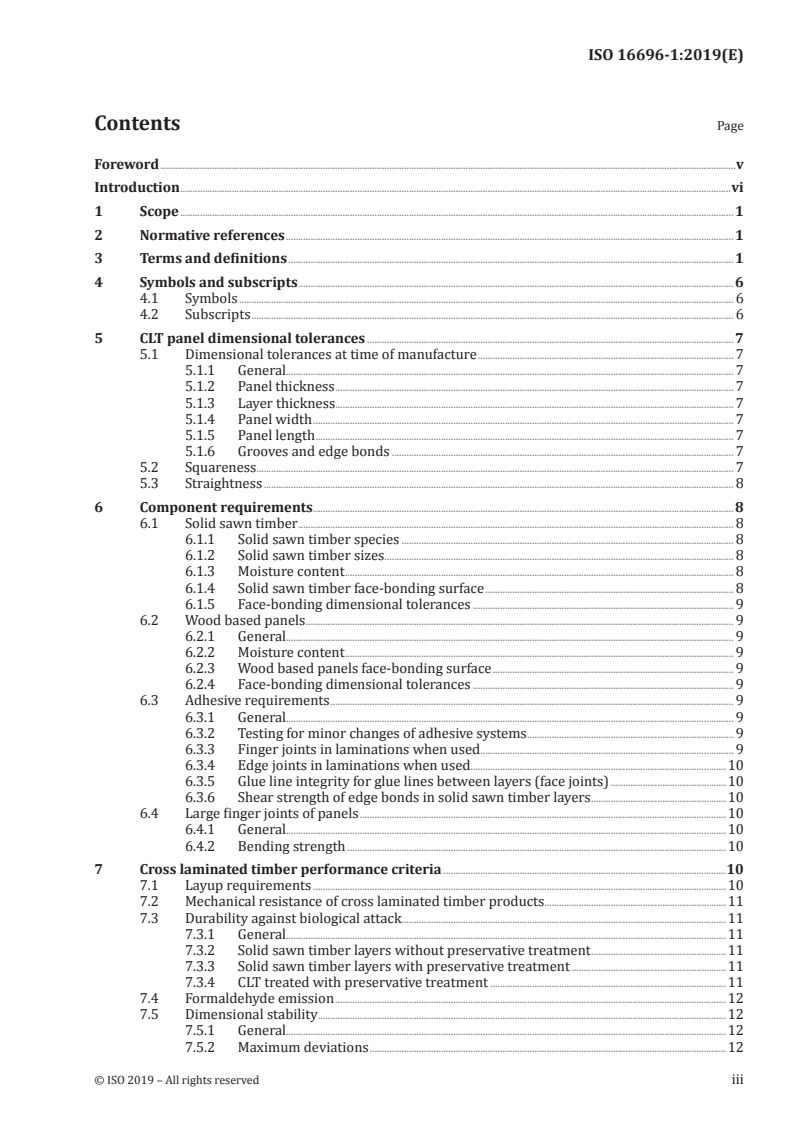
Contents Page
Foreword .v
Introduction .vi
1 Scope . 1
2 Normative references . 1
3 Terms and definitions . 1
4 Symbols and subscripts . 6
4.1 Symbols . 6
4.2 Subscripts . 6
5 CLT panel dimensional tolerances . 7
5.1 Dimensional tolerances at time of manufacture . 7
5.1.1 General. 7
5.1.2 Panel thickness . 7
5.1.3 Layer thickness . . . 7
5.1.4 Panel width . 7
5.1.5 Panel length . 7
5.1.6 Grooves and edge bonds . 7
5.2 Squareness . 7
5.3 Straightness . 8
6 Component requirements . 8
6.1 Solid sawn timber . 8
6.1.1 Solid sawn timber species . 8
6.1.2 Solid sawn timber sizes . . . 8
6.1.3 Moisture content . 8
6.1.4 Solid sawn timber face-bonding surface . 8
6.1.5 Face-bonding dimensional tolerances . 9
6.2 Wood based panels . 9
6.2.1 General. 9
6.2.2 Moisture content . 9
6.2.3 Wood based panels face-bonding surface . 9
6.2.4 Face-bonding dimensional tolerances . 9
6.3 Adhesive requirements . 9
6.3.1 General. 9
6.3.2 Testing for minor changes of adhesive systems . 9
6.3.3 Finger joints in laminations when used . 9
6.3.4 Edge joints in laminations when used.10
6.3.5 Glue line integrity for glue lines between layers (face joints) .10
6.3.6 Shear strength of edge bonds in solid sawn timber layers .10
6.4 Large finger joints of panels .10
6.4.1 General.10
6.4.2 Bending strength .10
7 Cross laminated timber performance criteria .10
7.1 Layup requirements .10
7.2 Mechanical resistance of cross laminated timber products.11
7.3 Durability against biological attack.11
7.3.1 General.11
7.3.2 Solid sawn timber layers without preservative treatment .11
7.3.3 Solid sawn timber layers with preservative treatment .11
7.3.4 CLT treated with preservative treatment .11
7.4 Formaldehyde emission .12
7.5 Dimensional stability .12
7.5.1 General.12
7.5.2 Maximum deviations .12
7.5.3 Corrected sizes and moisture deformation factor .12
7.6 Appearance classification .12
8 Production, testing, and trade marking .13
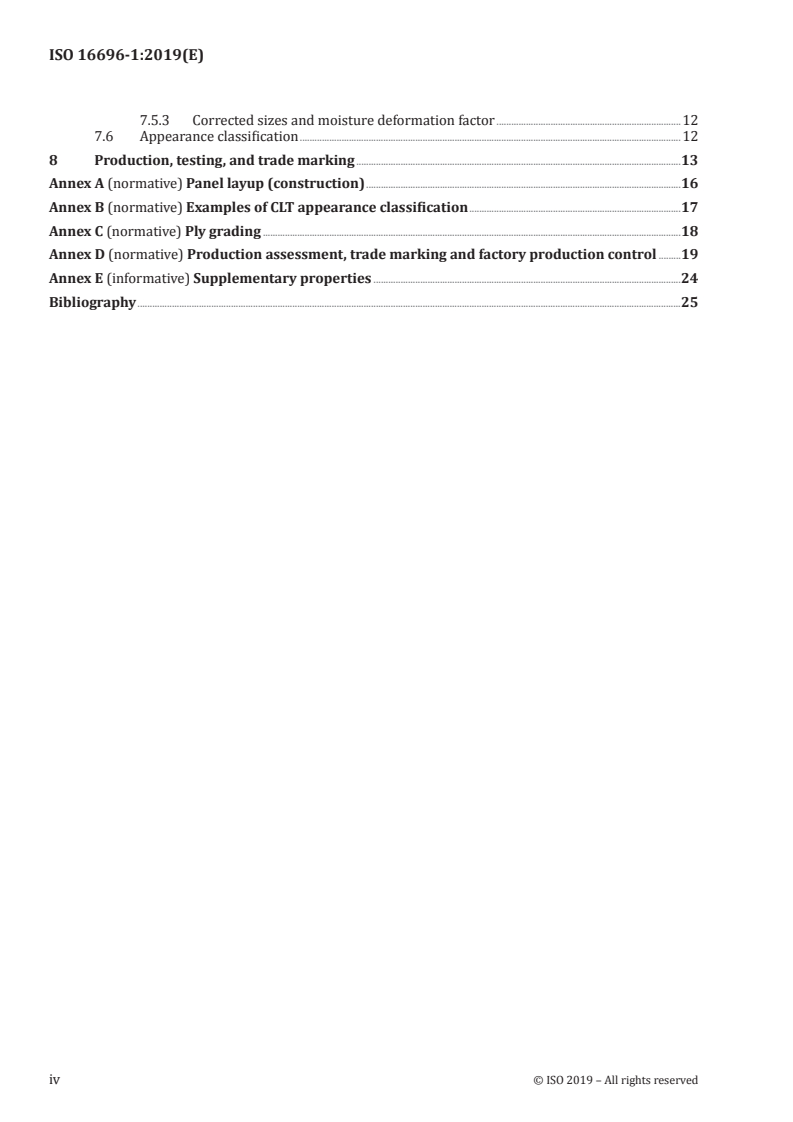
Annex A (normative) Panel layup (construction) .16
Annex B (normative) Examples of CLT appearance classification .17
Annex C (normative) Ply grading .18
Annex D (normative) Production assessment, trade marking and factory production control .19
Annex E (informative) Supplementary properties .24
Bibliography .25
iv © ISO 2019 – All rights reserved
Foreword
ISO (the International Organization for Standardization) is a worldwide federation of national standards
bodies (ISO member bodies). The work of preparing International Standards is normally carried out
through ISO technical committees. Each member body interested in a subject for which a technical
committee has been established has the right to be represented on that committee. International
organizations, governmental and non-governmental, in liaison with ISO, also take part in the work.
ISO collaborates closely with the International Electrotechnical Commission (IEC) on all matters of
electrotechnical standardization.
The procedures used to develop this document and those intended for its further maintenance are
described in the ISO/IEC Directives, Part 1. In particular, the different approval criteria needed for the
different types of ISO documents should be noted. This document was drafted in accordance with the
editorial rules of the ISO/IEC Directives, Part 2 (see www .iso .org/directives).
Attention is drawn to the possibility that some of the elements of this document may be the subject of
patent rights. ISO shall not be held responsible for identifying any or all such patent rights. Details of
any patent rights identified during the development of the document will be in the Introduction and/or
on the ISO list of patent declarations received (see www .iso .org/patents).
Any trade name used in this document is information given for the convenience of users and does not
constitute an endorsement.
For an explanation of the voluntary nature of standards, the meaning of ISO specific terms and
expressions related to conformity assessment, as well as information about ISO's adherence to the
World Trade Organization (WTO) principles in the Technical Barriers to Trade (TBT) see www .iso
.org/iso/foreword .html.
This document was prepared by Technical Committee ISO/TC 165, Timber structures.
A list of all parts in the ISO 16696 series can be found on the ISO website.
Any feedback or questions on this document should be directed to the user’s national standards body. A
complete listing of these bodies can be found at www .iso .org/members .html.
Introduction
The general principle of this document is that a certain level of performance and production techniques
are required in the production of cross laminated timber (CLT) to be acceptable for structural
application of the product. This document specifies the minimum requirements for CLT production and
performance assessment.
This document was based heavily on the draft European Standard EN 16351 prepared by Technical
Committee CEN/TC 124 and the North American Standard ANSI/APA PRG 320. The technical contents
from these standards were merged and modified to bring it into conformance with ISO procedures and
requirements. The ISO 16696 series consists of two parts: this document (Part 1) gives performance
and production requirements for CLT, which also includes conformance requirements, as provided in
Annex D; ISO 16696-2 provides guidance on how CLT is to be installed and used.
The bibliography lists standards referenced during the development of this document.
vi © ISO 2019 – All rights reserved
INTERNATIONAL STANDARD ISO 16696-1:2019(E)
Timber structures — Cross laminated timber —
Part 1:
Component performance, production requirements and
certification scheme
1 Scope
This document establishes the basic principles for component performance and minimum production
requirements for cross laminated timber (CLT). This document also contains scheme requirements for
conformance, as provided in Annex D.
The document is applicable to CLT products which are manufactured from solid-sawn timber or wood
based panels built up of at least three layers in which the grain of adjoining layers are at right angles to
each other.
This document provides CLT dimension tolerances; component requirements; performance criteria;
production, testing and trade marking guidance; and minimum requirements for factory production
control. This document is based on known species, species combination and/or wood based panel
structural performance and bondability.
CLT qualified in accordance with the provisions of this document are intended to resist the effects of
moisture on structural performance as can occur due to construction delays or other conditions of
similar severity.
NOTE This document does not include how CLT is to be used and installed, as it will be detailed in
ISO 16696-2.
2 Normative references
The following documents are referred to in the text in such a way that some or all of their content
constitutes requirements of this document. For dated references, only the edition cited applies. For
undated references, the latest edition of the referenced document (including any amendments) applies.
EN 16351, Timber structures — Cross laminated timber — Requirements
ISO/IEC 3130, Wood — Determination of moisture content for physical and mechanical tests
ISO 10983, Timber — Finger joints — Minimum production requirements and testing methods
ISO/IEC 12460 (all parts), Wood-based panels — Determination of formaldehyde release
ISO/IEC 13910, Structural timber — Sampling, full-size testing, and evaluation of the characteristic values
of strength graded timber
ISO/IEC 16979, Wood based panels — Determination of moisture content
ISO 20152-1, Timber structures — Bond performance of adhesives — Part 1: Basic requirements
ISO 20152-2:2011, Timber structures — Bond performance of adhesives — Part 2: Additional requirements
3 Terms and definitions
For the purposes of this document, the following terms and definitions apply.
ISO and IEC maintain terminological databases for use in standardization at the following addresses:
— IEC Electropedia: available at http: //www .electropedia .org/
— ISO Online browsing platform: available at http: //www .iso .org/obp
3.1
actual size
measured size of a CLT product at a related moisture content
3.2
adhesive
substance capable of bonding materials together
3.3
adherend
material held to another material by an adhesive
3.4
bond
attachment at an interface between adhesive and adherends or the act of attaching adherends together
by adhesive
3.5
bondline
layer of adhesive which attaches two adherends
3.6
characteristic value
structural property estimate, typically a population mean for stiffness properties or a tolerance limit
th
(5 percentile with 75 % confidence) for strength properties
Note 1 to entry: As estimated from the test data that is representative of the population being sampled as
determined in accordance with ISO 12122-1.
3.7
corrected size
actual size of a CLT product corrected by calculation to the reference moisture content
3.8
corrective action
action to eliminate the cause of nonconformities
3.9
cross laminated timber
CLT
a prefabricated engineered wood product made of at least three orthogonal layers of graded sawn
lumber or wood based panels that are laminated by gluing with structural adhesives
3.10
CLT thickness
dimension of the CLT panel measured perpendicular to the plane of the panel
3.11
delamination
separation of layers in a laminate due to failure of the adhesive either in the adhesive itself or at the
interface between the adhesive and the adherend
3.12
edge
panel edge
narrow face of a panel that exposes the ends or narrow faces of the laminations
2 © ISO 2019 – All rights reserved
3.13
edge gluing
edge joints
gluing the edges of adjacent lamination within a CLT layer
3.14
end joint
joint made by gluing of the finger joints of the same laminations within a CLT layer prior to laminating
adjacent layers
3.15
face
one of the four longitudinal surfaces of a piece or panel
3.16
face bondline
bondline joining the wide faces of the laminations in adjacent layers
3.17
factory production control
FPC
procedures, regular inspections and tests which ensure that products placed on the market conform to
the performance requirements stated by the manufacturer
3.18
finger angle
α
inclination of the fingers of a finger joint
Note 1 to entry: see Figure 1.
3.19
finger joint
self-locating end joint formed by machining a number of similar, tapered, symmetrical fingers in the
ends of solid sawn timber components, which are formed by a finger joint cutter and then bonded
together
Note 1 to entry: see Figure 1.
3.20
finger length
l
j
distance between the finger base and the tip of the finger, measured along the centre line of the finger
Note 1 to entry: see Figure 1.
3.21
finished thickness and width
thickness and width after planing
3.22
lamination
solid sawn timber or wood based panels, including stress rated boards and manufactured timber which
has been prepared to be a layer
3.23
large finger joint
finger joint through the full cross sectional area at the end of plane cross laminated components solely
made of solid sawn timber layer, having identical cross sectional layups and bonded together
Note 1 to entry: see Figure 2.
3.24
layer
all laminations on one side of a face bondline and consist of one solid sawn timber grade or one grade of
wood based panel
3.25
layup
cross-sectional arrangement of layers of solid sawn timber or wood based panels, which may have
different species, strength classes, strength profiles, thicknesses or technical classes (3.41), into a
CLT product
3.26
manufacturing standard
procedures established by manufacturer to produce and maintain a product with the stated
performance requirements
3.27
major strength direction
general direction of the grain of the outermost layers of the CLT panel
3.28
maximum delamination length
largest delamination length in any single glue line measured around the circumference of the test piece
3.29
minor strength direction
direction perpendicular to the major strength direction of the CLT panel
3.30
moisture content
u
amount of water present in solid sawn timber or wood based panels, expresses as percentage of oven
dry mass
Note 1 to entry: Determined in accordance with ISO 3130 or ISO 16979.
3.31
panel
single CLT billet formed by bonding lamination with a structural adhesive
3.32
pitch
distance between fingers, measured from centre to centre
Note 1 to entry: see Figure 1.
3.33
ply
all laminations between two adjacent bondline and consist of one solid sawn timber grade or one grade
of wood-based panel
3.34
service class 1
service class characterized by a moisture content in the materials corresponding to a temperature of
20 °C and a relative humidity of the surrounding air exceeding 65 % for a few weeks per year
Note 1 to entry: In Service Class 1, the average equilibrium moisture content of most softwoods does not
exceed 12 %.
[SOURCE: ISO 20152-1:2010, 3.1]
4 © ISO 2019 – All rights reserved
3.35
service class 2
service class characterized by a moisture content in the materials corresponding to a temperature of
20 °C and a relative humidity of the surrounding air exceeding 85 % for a few weeks per year
Note 1 to entry: In Service Class 2, the average equilibrium moisture content of most softwoods does not exceed
20 %. Such conditions include resistance to the effects of moisture on structural performance due to construction
delays or other conditions of similar severity.
[SOURCE: ISO 20152-1:2010, 3.2]
3.36
service class 3
service class characterized by climatic conditions leading to higher moisture content than Service Class
2 such as occurs when a member is fully exposed to the weather
[SOURCE: ISO 20152-1:2010, 3.3]
3.37
solid sawn timber grade
a solid sawn wood product population produced with standardized rules that maintain well-defined
limits on strength-controlling characteristics or properties
3.38
specific gravity
ratio of the oven-dry mass of a specimen to the mass of a volume of water equal to the volume of the
specimen at the specified moisture content
3.39
surveillance of FPC
continual monitoring of the factory production control test plan(s) and production processes
3.40
target size
size specified (at the reference moisture content) to which deviations are related
3.41
technical class
class of product performance included in a standard for the purpose of relating product performance to
its intended use
3.42
tip gap
l
t
distance between fingertip and slot base in a bonded finger joint
Note 1 to entry: see Figure 1.
3.43
tip width
b
t
distance between finger faces, measured at the tip of the finger
Note 1 to entry: see Figure 1.
3.44
total delamination length
sum of delamination lengths of all glue lines around the circumference of a test piece
3.45
wood based panel
engineered wood product that is intended for structural use and bonded with adhesives, such as
oriented strand board (OSB), plywood, laminated veneer lumber (LVL), and plywood and single-layered
solid wood panels
3.46
wood failure
rupture in or between wood fibres
3.47
wood failure percentage
area of wood fibre remaining at the bondline following the rupture of wood fibres from the specified
shear test, expressed as a percentage of total area involved in such failure
4 Symbols and subscripts
4.1 Symbols
b tip width of the cutter, in mm
cut
b finished lamination width, in mm
l
E modulus of elasticity in bending, in MPa
f characteristic bending strength of CLT, in MPa
b
h depth of cross section, in mm
h actual depth, in mm
a
h corrected depth, in mm
cor
k moisture deformation factor perpendicular to the grain for a change in moisture content of 1 %
for moisture contents between 6 % and 25 %
l length, in mm
n number
p pitch, in mm
S section modulus, in mm , of the composite CLT section for calculating the moment capacity of CLT
t thickness, in mm
t finished lamination thickness, in mm
l
u actual moisture content, in %
a
4.2 Subscripts
a actual
cor corrected
ref referenced
6 © ISO 2019 – All rights reserved
0 parallel to grain
th
05 5 percentile
90 perpendicular to grain
5 CLT panel dimensional tolerances
5.1 Dimensional tolerances at time of manufacture
5.1.1 General
The relevant geometrical data (cross sectional sizes, layup, layer thickness and orientations, presence
of grooves, presence of edge bonds and ratio of lamination width to lamination thickness) shall
be determined and declared. The moisture deformation factor for unhindered moisture-induced
deformation shall be taken from the national design code standard governing the production for the
timber species.
NOTE The actual sizes of CLT are influenced by swelling and shrinkage due to changes of moisture content.
5.1.2 Panel thickness
The thickness of CLT panel shall not exceed 500 mm. The moisture corrected thickness of the cross
section shall not deviate from the nominal thickness by more than ±2 mm or 2 % of the nominal
thickness whichever is greater.
5.1.3 Layer thickness
The dimensional tolerance for thickness permitted at time of manufacturing for a single layer shall
be ±1 mm.
5.1.4 Panel width
The dimensional tolerance for CLT panel width permitted at time of manufacturing shall be ±3 mm of
the target CLT panel width.
5.1.5 Panel length
The dimensional tolerance for CLT panel length at time of manufacturing shall be ±6,5 mm of the target
CLT panel length.
Textured or other face or edge finishes may alter the tolerances specified in this clause. The designer
should compensate for any loss of cross-section and/or specified strength of such alterations.
5.1.6 Grooves and edge bonds
In order to reduce cupping and cracking, laminations are permitted to be grooved. Grooves shall have
a maximum depth of 90 % of the thickness of the lamination and a maximum width of 4 mm (Figure 3).
Adjacent laminations shall be permitted to be non-edge bonded. The width of the gaps between adjacent
laminations within a CLT layer shall be less than or equal to 6 mm (Figure 3).
5.2 Squareness
Unless specified otherwise, the length of the two panel face diagonals measured between panel corners
shall not differ by more than ±3 mm.
5.3 Straightness
Unless specified otherwise, deviations of parallel edges from straight line between the adjacent panel
corners shall not exceed ±1,5 mm.
6 Component requirements
6.1 Solid sawn timber
6.1.1 Solid sawn timber species
Any solid sawn timber species or species combinations recognized by national standards and having
a published characteristic density of not less than 300 kg/m shall be permitted for use in CLT
manufacturing provided it meets the performance requirements of Clause 7.
Solid sawn timber shall be graded in conformity with appropriate national standards for graded
material. Proprietary solid sawn timber grades shall be permitted for use provided they meet the
requirements of 6.1.3, 6.1.4, and 6.1.5.
For grades that deviate from national standards, records shall be maintained that document the quality
(grade) and characteristic values of the various layers of solid sawn timber.
6.1.2 Solid sawn timber sizes
The net width of solid sawn timber shall not be less than 1,75 times the solid sawn timber thickness
for the parallel layers. If the laminations in the perpendicular (cross) layers are not edge bonded, the
net width of the solid sawn timber shall be at least 3,5 times the solid sawn timber thickness for the
perpendicular (cross) layers unless the inter-laminar shear strength and stiffness is confirmed by
testing using ISO 8375. The net thickness of solid sawn timber for all layers at the time of gluing shall
not be less than 6 mm or more than 50 mm.
NOTE The width-to-thickness ratio of 3,5 for the solid sawn timber in the perpendicular (cross) layers is
intended for alleviating the CLT creep deflection when the laminations are not edge bonded.
6.1.3 Moisture content
The moisture content of the wood components at the time of CLT manufacturing shall be within
4 moisture content percentage points of the reference moisture content or as recommended by the
adhesive manufacturer.
NOTE 1 The moisture content is the equilibrium moisture content of the product in an environment
maintained at 20 °C/65 % RH unless as specified in the governing national standard.
NOTE 2 For example, if the equilibrium moisture content of the product is expected to be 10 %, the moisture
content of the wood component at the time of CLT manufacturing should be between 6 to 14 %.
6.1.4 Solid sawn timber face-bonding surface
All surfaces to be bonded shall be planed prior to face bonding and except for minor local variations,
shall be free of raised grain, torn grain, skip, burns, glazing or other deviation from the plane of the
surface that migh
...
INTERNATIONAL ISO
STANDARD 16696-1
First edition
2019-02
Timber structures — Cross laminated
timber —
Part 1:
Component performance, production
requirements and certification scheme
Structures en bois — Plaques reconstituées à base de lamelles
croisées —
Partie 1: Performances des composants et exigences de production et
système de certification
Reference number
©
ISO 2019
© ISO 2019
All rights reserved. Unless otherwise specified, or required in the context of its implementation, no part of this publication may
be reproduced or utilized otherwise in any form or by any means, electronic or mechanical, including photocopying, or posting
on the internet or an intranet, without prior written permission. Permission can be requested from either ISO at the address
below or ISO’s member body in the country of the requester.
ISO copyright office
CP 401 • Ch. de Blandonnet 8
CH-1214 Vernier, Geneva
Phone: +41 22 749 01 11
Fax: +41 22 749 09 47
Email: copyright@iso.org
Website: www.iso.org
Published in Switzerland
ii © ISO 2019 – All rights reserved
Contents Page
Foreword .v
Introduction .vi
1 Scope . 1
2 Normative references . 1
3 Terms and definitions . 1
4 Symbols and subscripts . 6
4.1 Symbols . 6
4.2 Subscripts . 6
5 CLT panel dimensional tolerances . 7
5.1 Dimensional tolerances at time of manufacture . 7
5.1.1 General. 7
5.1.2 Panel thickness . 7
5.1.3 Layer thickness . . . 7
5.1.4 Panel width . 7
5.1.5 Panel length . 7
5.1.6 Grooves and edge bonds . 7
5.2 Squareness . 7
5.3 Straightness . 8
6 Component requirements . 8
6.1 Solid sawn timber . 8
6.1.1 Solid sawn timber species . 8
6.1.2 Solid sawn timber sizes . . . 8
6.1.3 Moisture content . 8
6.1.4 Solid sawn timber face-bonding surface . 8
6.1.5 Face-bonding dimensional tolerances . 9
6.2 Wood based panels . 9
6.2.1 General. 9
6.2.2 Moisture content . 9
6.2.3 Wood based panels face-bonding surface . 9
6.2.4 Face-bonding dimensional tolerances . 9
6.3 Adhesive requirements . 9
6.3.1 General. 9
6.3.2 Testing for minor changes of adhesive systems . 9
6.3.3 Finger joints in laminations when used . 9
6.3.4 Edge joints in laminations when used.10
6.3.5 Glue line integrity for glue lines between layers (face joints) .10
6.3.6 Shear strength of edge bonds in solid sawn timber layers .10
6.4 Large finger joints of panels .10
6.4.1 General.10
6.4.2 Bending strength .10
7 Cross laminated timber performance criteria .10
7.1 Layup requirements .10
7.2 Mechanical resistance of cross laminated timber products.11
7.3 Durability against biological attack.11
7.3.1 General.11
7.3.2 Solid sawn timber layers without preservative treatment .11
7.3.3 Solid sawn timber layers with preservative treatment .11
7.3.4 CLT treated with preservative treatment .11
7.4 Formaldehyde emission .12
7.5 Dimensional stability .12
7.5.1 General.12
7.5.2 Maximum deviations .12
7.5.3 Corrected sizes and moisture deformation factor .12
7.6 Appearance classification .12
8 Production, testing, and trade marking .13
Annex A (normative) Panel layup (construction) .16
Annex B (normative) Examples of CLT appearance classification .17
Annex C (normative) Ply grading .18
Annex D (normative) Production assessment, trade marking and factory production control .19
Annex E (informative) Supplementary properties .24
Bibliography .25
iv © ISO 2019 – All rights reserved
Foreword
ISO (the International Organization for Standardization) is a worldwide federation of national standards
bodies (ISO member bodies). The work of preparing International Standards is normally carried out
through ISO technical committees. Each member body interested in a subject for which a technical
committee has been established has the right to be represented on that committee. International
organizations, governmental and non-governmental, in liaison with ISO, also take part in the work.
ISO collaborates closely with the International Electrotechnical Commission (IEC) on all matters of
electrotechnical standardization.
The procedures used to develop this document and those intended for its further maintenance are
described in the ISO/IEC Directives, Part 1. In particular, the different approval criteria needed for the
different types of ISO documents should be noted. This document was drafted in accordance with the
editorial rules of the ISO/IEC Directives, Part 2 (see www .iso .org/directives).
Attention is drawn to the possibility that some of the elements of this document may be the subject of
patent rights. ISO shall not be held responsible for identifying any or all such patent rights. Details of
any patent rights identified during the development of the document will be in the Introduction and/or
on the ISO list of patent declarations received (see www .iso .org/patents).
Any trade name used in this document is information given for the convenience of users and does not
constitute an endorsement.
For an explanation of the voluntary nature of standards, the meaning of ISO specific terms and
expressions related to conformity assessment, as well as information about ISO's adherence to the
World Trade Organization (WTO) principles in the Technical Barriers to Trade (TBT) see www .iso
.org/iso/foreword .html.
This document was prepared by Technical Committee ISO/TC 165, Timber structures.
A list of all parts in the ISO 16696 series can be found on the ISO website.
Any feedback or questions on this document should be directed to the user’s national standards body. A
complete listing of these bodies can be found at www .iso .org/members .html.
Introduction
The general principle of this document is that a certain level of performance and production techniques
are required in the production of cross laminated timber (CLT) to be acceptable for structural
application of the product. This document specifies the minimum requirements for CLT production and
performance assessment.
This document was based heavily on the draft European Standard EN 16351 prepared by Technical
Committee CEN/TC 124 and the North American Standard ANSI/APA PRG 320. The technical contents
from these standards were merged and modified to bring it into conformance with ISO procedures and
requirements. The ISO 16696 series consists of two parts: this document (Part 1) gives performance
and production requirements for CLT, which also includes conformance requirements, as provided in
Annex D; ISO 16696-2 provides guidance on how CLT is to be installed and used.
The bibliography lists standards referenced during the development of this document.
vi © ISO 2019 – All rights reserved
INTERNATIONAL STANDARD ISO 16696-1:2019(E)
Timber structures — Cross laminated timber —
Part 1:
Component performance, production requirements and
certification scheme
1 Scope
This document establishes the basic principles for component performance and minimum production
requirements for cross laminated timber (CLT). This document also contains scheme requirements for
conformance, as provided in Annex D.
The document is applicable to CLT products which are manufactured from solid-sawn timber or wood
based panels built up of at least three layers in which the grain of adjoining layers are at right angles to
each other.
This document provides CLT dimension tolerances; component requirements; performance criteria;
production, testing and trade marking guidance; and minimum requirements for factory production
control. This document is based on known species, species combination and/or wood based panel
structural performance and bondability.
CLT qualified in accordance with the provisions of this document are intended to resist the effects of
moisture on structural performance as can occur due to construction delays or other conditions of
similar severity.
NOTE This document does not include how CLT is to be used and installed, as it will be detailed in
ISO 16696-2.
2 Normative references
The following documents are referred to in the text in such a way that some or all of their content
constitutes requirements of this document. For dated references, only the edition cited applies. For
undated references, the latest edition of the referenced document (including any amendments) applies.
EN 16351, Timber structures — Cross laminated timber — Requirements
ISO/IEC 3130, Wood — Determination of moisture content for physical and mechanical tests
ISO 10983, Timber — Finger joints — Minimum production requirements and testing methods
ISO/IEC 12460 (all parts), Wood-based panels — Determination of formaldehyde release
ISO/IEC 13910, Structural timber — Sampling, full-size testing, and evaluation of the characteristic values
of strength graded timber
ISO/IEC 16979, Wood based panels — Determination of moisture content
ISO 20152-1, Timber structures — Bond performance of adhesives — Part 1: Basic requirements
ISO 20152-2:2011, Timber structures — Bond performance of adhesives — Part 2: Additional requirements
3 Terms and definitions
For the purposes of this document, the following terms and definitions apply.
ISO and IEC maintain terminological databases for use in standardization at the following addresses:
— IEC Electropedia: available at http: //www .electropedia .org/
— ISO Online browsing platform: available at http: //www .iso .org/obp
3.1
actual size
measured size of a CLT product at a related moisture content
3.2
adhesive
substance capable of bonding materials together
3.3
adherend
material held to another material by an adhesive
3.4
bond
attachment at an interface between adhesive and adherends or the act of attaching adherends together
by adhesive
3.5
bondline
layer of adhesive which attaches two adherends
3.6
characteristic value
structural property estimate, typically a population mean for stiffness properties or a tolerance limit
th
(5 percentile with 75 % confidence) for strength properties
Note 1 to entry: As estimated from the test data that is representative of the population being sampled as
determined in accordance with ISO 12122-1.
3.7
corrected size
actual size of a CLT product corrected by calculation to the reference moisture content
3.8
corrective action
action to eliminate the cause of nonconformities
3.9
cross laminated timber
CLT
a prefabricated engineered wood product made of at least three orthogonal layers of graded sawn
lumber or wood based panels that are laminated by gluing with structural adhesives
3.10
CLT thickness
dimension of the CLT panel measured perpendicular to the plane of the panel
3.11
delamination
separation of layers in a laminate due to failure of the adhesive either in the adhesive itself or at the
interface between the adhesive and the adherend
3.12
edge
panel edge
narrow face of a panel that exposes the ends or narrow faces of the laminations
2 © ISO 2019 – All rights reserved
3.13
edge gluing
edge joints
gluing the edges of adjacent lamination within a CLT layer
3.14
end joint
joint made by gluing of the finger joints of the same laminations within a CLT layer prior to laminating
adjacent layers
3.15
face
one of the four longitudinal surfaces of a piece or panel
3.16
face bondline
bondline joining the wide faces of the laminations in adjacent layers
3.17
factory production control
FPC
procedures, regular inspections and tests which ensure that products placed on the market conform to
the performance requirements stated by the manufacturer
3.18
finger angle
α
inclination of the fingers of a finger joint
Note 1 to entry: see Figure 1.
3.19
finger joint
self-locating end joint formed by machining a number of similar, tapered, symmetrical fingers in the
ends of solid sawn timber components, which are formed by a finger joint cutter and then bonded
together
Note 1 to entry: see Figure 1.
3.20
finger length
l
j
distance between the finger base and the tip of the finger, measured along the centre line of the finger
Note 1 to entry: see Figure 1.
3.21
finished thickness and width
thickness and width after planing
3.22
lamination
solid sawn timber or wood based panels, including stress rated boards and manufactured timber which
has been prepared to be a layer
3.23
large finger joint
finger joint through the full cross sectional area at the end of plane cross laminated components solely
made of solid sawn timber layer, having identical cross sectional layups and bonded together
Note 1 to entry: see Figure 2.
3.24
layer
all laminations on one side of a face bondline and consist of one solid sawn timber grade or one grade of
wood based panel
3.25
layup
cross-sectional arrangement of layers of solid sawn timber or wood based panels, which may have
different species, strength classes, strength profiles, thicknesses or technical classes (3.41), into a
CLT product
3.26
manufacturing standard
procedures established by manufacturer to produce and maintain a product with the stated
performance requirements
3.27
major strength direction
general direction of the grain of the outermost layers of the CLT panel
3.28
maximum delamination length
largest delamination length in any single glue line measured around the circumference of the test piece
3.29
minor strength direction
direction perpendicular to the major strength direction of the CLT panel
3.30
moisture content
u
amount of water present in solid sawn timber or wood based panels, expresses as percentage of oven
dry mass
Note 1 to entry: Determined in accordance with ISO 3130 or ISO 16979.
3.31
panel
single CLT billet formed by bonding lamination with a structural adhesive
3.32
pitch
distance between fingers, measured from centre to centre
Note 1 to entry: see Figure 1.
3.33
ply
all laminations between two adjacent bondline and consist of one solid sawn timber grade or one grade
of wood-based panel
3.34
service class 1
service class characterized by a moisture content in the materials corresponding to a temperature of
20 °C and a relative humidity of the surrounding air exceeding 65 % for a few weeks per year
Note 1 to entry: In Service Class 1, the average equilibrium moisture content of most softwoods does not
exceed 12 %.
[SOURCE: ISO 20152-1:2010, 3.1]
4 © ISO 2019 – All rights reserved
3.35
service class 2
service class characterized by a moisture content in the materials corresponding to a temperature of
20 °C and a relative humidity of the surrounding air exceeding 85 % for a few weeks per year
Note 1 to entry: In Service Class 2, the average equilibrium moisture content of most softwoods does not exceed
20 %. Such conditions include resistance to the effects of moisture on structural performance due to construction
delays or other conditions of similar severity.
[SOURCE: ISO 20152-1:2010, 3.2]
3.36
service class 3
service class characterized by climatic conditions leading to higher moisture content than Service Class
2 such as occurs when a member is fully exposed to the weather
[SOURCE: ISO 20152-1:2010, 3.3]
3.37
solid sawn timber grade
a solid sawn wood product population produced with standardized rules that maintain well-defined
limits on strength-controlling characteristics or properties
3.38
specific gravity
ratio of the oven-dry mass of a specimen to the mass of a volume of water equal to the volume of the
specimen at the specified moisture content
3.39
surveillance of FPC
continual monitoring of the factory production control test plan(s) and production processes
3.40
target size
size specified (at the reference moisture content) to which deviations are related
3.41
technical class
class of product performance included in a standard for the purpose of relating product performance to
its intended use
3.42
tip gap
l
t
distance between fingertip and slot base in a bonded finger joint
Note 1 to entry: see Figure 1.
3.43
tip width
b
t
distance between finger faces, measured at the tip of the finger
Note 1 to entry: see Figure 1.
3.44
total delamination length
sum of delamination lengths of all glue lines around the circumference of a test piece
3.45
wood based panel
engineered wood product that is intended for structural use and bonded with adhesives, such as
oriented strand board (OSB), plywood, laminated veneer lumber (LVL), and plywood and single-layered
solid wood panels
3.46
wood failure
rupture in or between wood fibres
3.47
wood failure percentage
area of wood fibre remaining at the bondline following the rupture of wood fibres from the specified
shear test, expressed as a percentage of total area involved in such failure
4 Symbols and subscripts
4.1 Symbols
b tip width of the cutter, in mm
cut
b finished lamination width, in mm
l
E modulus of elasticity in bending, in MPa
f characteristic bending strength of CLT, in MPa
b
h depth of cross section, in mm
h actual depth, in mm
a
h corrected depth, in mm
cor
k moisture deformation factor perpendicular to the grain for a change in moisture content of 1 %
for moisture contents between 6 % and 25 %
l length, in mm
n number
p pitch, in mm
S section modulus, in mm , of the composite CLT section for calculating the moment capacity of CLT
t thickness, in mm
t finished lamination thickness, in mm
l
u actual moisture content, in %
a
4.2 Subscripts
a actual
cor corrected
ref referenced
6 © ISO 2019 – All rights reserved
0 parallel to grain
th
05 5 percentile
90 perpendicular to grain
5 CLT panel dimensional tolerances
5.1 Dimensional tolerances at time of manufacture
5.1.1 General
The relevant geometrical data (cross sectional sizes, layup, layer thickness and orientations, presence
of grooves, presence of edge bonds and ratio of lamination width to lamination thickness) shall
be determined and declared. The moisture deformation factor for unhindered moisture-induced
deformation shall be taken from the national design code standard governing the production for the
timber species.
NOTE The actual sizes of CLT are influenced by swelling and shrinkage due to changes of moisture content.
5.1.2 Panel thickness
The thickness of CLT panel shall not exceed 500 mm. The moisture corrected thickness of the cross
section shall not deviate from the nominal thickness by more than ±2 mm or 2 % of the nominal
thickness whichever is greater.
5.1.3 Layer thickness
The dimensional tolerance for thickness permitted at time of manufacturing for a single layer shall
be ±1 mm.
5.1.4 Panel width
The dimensional tolerance for CLT panel width permitted at time of manufacturing shall be ±3 mm of
the target CLT panel width.
5.1.5 Panel length
The dimensional tolerance for CLT panel length at time of manufacturing shall be ±6,5 mm of the target
CLT panel length.
Textured or other face or edge finishes may alter the tolerances specified in this clause. The designer
should compensate for any loss of cross-section and/or specified strength of such alterations.
5.1.6 Grooves and edge bonds
In order to reduce cupping and cracking, laminations are permitted to be grooved. Grooves shall have
a maximum depth of 90 % of the thickness of the lamination and a maximum width of 4 mm (Figure 3).
Adjacent laminations shall be permitted to be non-edge bonded. The width of the gaps between adjacent
laminations within a CLT layer shall be less than or equal to 6 mm (Figure 3).
5.2 Squareness
Unless specified otherwise, the length of the two panel face diagonals measured between panel corners
shall not differ by more than ±3 mm.
5.3 Straightness
Unless specified otherwise, deviations of parallel edges from straight line between the adjacent panel
corners shall not exceed ±1,5 mm.
6 Component requirements
6.1 Solid sawn timber
6.1.1 Solid sawn timber species
Any solid sawn timber species or species combinations recognized by national standards and having
a published characteristic density of not less than 300 kg/m shall be permitted for use in CLT
manufacturing provided it meets the performance requirements of Clause 7.
Solid sawn timber shall be graded in conformity with appropriate national standards for graded
material. Proprietary solid sawn timber grades shall be permitted for use provided they meet the
requirements of 6.1.3, 6.1.4, and 6.1.5.
For grades that deviate from national standards, records shall be maintained that document the quality
(grade) and characteristic values of the various layers of solid sawn timber.
6.1.2 Solid sawn timber sizes
The net width of solid sawn timber shall not be less than 1,75 times the solid sawn timber thickness
for the parallel layers. If the laminations in the perpendicular (cross) layers are not edge bonded, the
net width of the solid sawn timber shall be at least 3,5 times the solid sawn timber thickness for the
perpendicular (cross) layers unless the inter-laminar shear strength and stiffness is confirmed by
testing using ISO 8375. The net thickness of solid sawn timber for all layers at the time of gluing shall
not be less than 6 mm or more than 50 mm.
NOTE The width-to-thickness ratio of 3,5 for the solid sawn timber in the perpendicular (cross) layers is
intended for alleviating the CLT creep deflection when the laminations are not edge bonded.
6.1.3 Moisture content
The moisture content of the wood components at the time of CLT manufacturing shall be within
4 moisture content percentage points of the reference moisture content or as recommended by the
adhesive manufacturer.
NOTE 1 The moisture content is the equilibrium moisture content of the product in an environment
maintained at 20 °C/65 % RH unless as specified in the governing national standard.
NOTE 2 For example, if the equilibrium moisture content of the product is expected to be 10 %, the moisture
content of the wood component at the time of CLT manufacturing should be between 6 to 14 %.
6.1.4 Solid sawn timber face-bonding surface
All surfaces to be bonded shall be planed prior to face bonding and except for minor local variations,
shall be free of raised grain, torn grain, skip, burns, glazing or other deviation from the plane of the
surface that migh
...